71 Senior Mathematical Challenge questions from every year we have, newest year first. Use Difficulty › Position in the paper to practise the early (easier) or late (harder) questions, or the Year filter for one year.
10. Six friends Pat, Qasim, Roman, Sam, Tara and Uma, stand in a line for a photograph. There are three people standing between Pat and Qasim, two between Qasim and Roman and one between Roman and Sam. Sam is not at either end of the line.
How many people are standing between Tara and Uma?
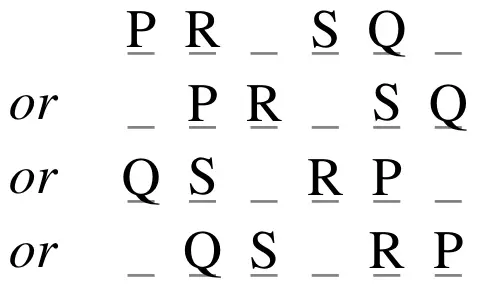
The first piece of information allows us to place \(P\) and \(Q\) in four possible pairings as shown. In each case, the second piece of information tells us that the position of Roman is uniquely determined and in each case this is next to Pat. As Sam is not at the end of the line, the third piece of information shows us that Sam’s position is also uniquely determined and is next to Qasim. The positions which remain for Tara and Uma, in each of the four cases, have two people between them.
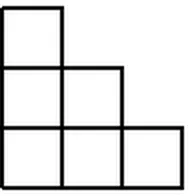
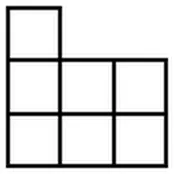
14. Diane has five identical blue disks, two identical red disks and one yellow disk. She wants to place them on the grid opposite so that each cell contains exactly one disk. The two red disks are not to be placed in cells that share a common edge.
How many different-looking completed grids can she produce?
One counting method is to consider first the position of the two red disks working systematically from left to right. If there is a red disk in either of the two positions in the first column, then there are five possible positions for the second red disk.
If there are no red disks in the first column but one in either of the two positions in the second column then there are three possible positions for the second red disk. If there are no red disks in either of the first two columns but there is one in either of the two positions in the third column then there is exactly one position for the second red disk. This gives a total of \(2 \times 5 + 2 \times 3 + 2 \times 1 = 18\) different looking positions for the two red disks. The single yellow disk can then be placed in any of the remaining six squares. The last five positions are filled with the five blue disks. This gives \(18 \times 6 \times 1 = 108\) possibilities.
Combining \(p - q = r\) and \(r - s = t\) gives \(p - q = s + t\) which rearranges to \(t = p - (q + s)\). The maximum value of \(t\) can be found by maximising \(p\) and minimising the sum of \(q\) and \(s\), so \(t_{\text{max}} = 9 - (1 + 2) = 6\). The minimum value of \(t\) is 1, for example \(t_{\text{min}} = 9 - (2 + 6) = 1\). All the values of \(t\) from 1 to 6 are possible in a similar way. Therefore \(t\) can have six different values.
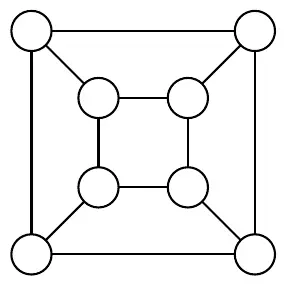
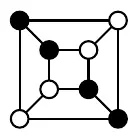
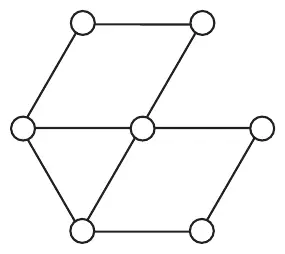
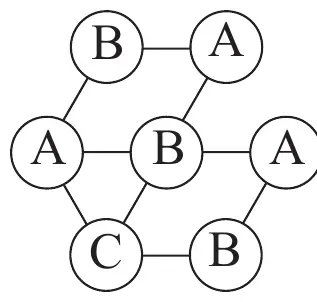
Each circle in the diagram is connected to three others, exactly one of which must be filled with the same colour. So, the number of colours required is greater than 1. One possible colouring with just two colours is shown here.
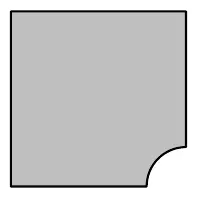
Folding the paper four times gives \(2^4\) layers. Removing a corner, 16 quarter-circles are formed. Of the given options, only D, with four whole circles could then be possible.
3. The five integers 2, 5, 6, 9, 14 are arranged into a different order. In the new arrangement, the sum of the first three integers is equal to the sum of the last three integers. What is the middle number in the new arrangement?
In the new arrangement, the sum of the first two numbers and the sum of the last two numbers must be equal. Considering all ten possible pairings, the only two pairs with the same total are 2, 9 and 5, 6. So 14 must be the middle number.
6. The circles in the diagram are to be coloured so that any two circles connected by a line segment have different colours. What is the smallest number of colours required?
In the bottom left of the diagram there are three circles connected to each other. These three must be coloured using different colours. Once those have been determined, one possible colouring, using just three colours, is as shown.
Since only one person is lying this must be Genotan or Josh; their statements cannot both be true. If Josh were lying (and therefore guilty) then Genotan's statement would mean that Tegan was also guilty, a contradiction. Hence Genotan is lying and we can check that all four statements are consistent with this.
24. There is a set of straight lines in a plane such that each line intersects exactly ten others. Which of the following could not be the number of lines in that set?
When \(n\) non-parallel lines are drawn in a plane, each line intersects every other line exactly once. So each line intersects \((n - 1)\) lines. A line drawn parallel to one of the existing \(n\) lines also intersects \((n - 1)\) lines. In order that every line drawn intersects the same number of other lines, each of the original \(n\) lines must be part of a set of \(k\) parallel lines, for some integer \(k\). Then \(kn\) lines will each have \(k(n - 1)\) points of intersection. Here \(k(n - 1) = 10\) so as \((n - 1)\) is an integer \((n - 1)\) must be 1, 2, 5 or 10 giving \(n = 2, 3, 6\) or 11 and \(k = 10, 5, 2\) and 1 respectively. Of the options given: A is 11 non-parallel lines (\(n = 11\), \(k = 1\)); B is 6 sets of 2 parallel lines (\(n = 6\), \(k = 2\)); C is 3 sets of 5 parallel lines (\(n = 3\), \(k = 5\)); E is 2 different sets of 10 parallel lines (\(n = 2\), \(k = 10\)). These are the only four possible solutions to the problem, so 16 could not be the number of lines.
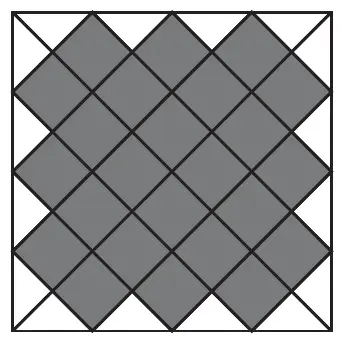
8. Points are drawn on the sides of a square, dividing each side into \(n\) equal parts (so, in the example shown, \(n = 4\)). The points are joined in the manner indicated, to form several small squares (24 in the example, shown shaded) and some triangles. How many small squares are formed when \(n = 7\)?
One way to count the number of small squares formed is to divide the large square into four quarters along its two diagonals. The number of small squares formed is \(4 \times T_{n-1}\), where \(T_{n-1}\) is the \((n - 1)\)th triangular number. When \(n = 7\), this is \(4 \times \tfrac{1}{2}(6 \times 7)\) which is \(4 \times 21\). So 84 squares are formed.
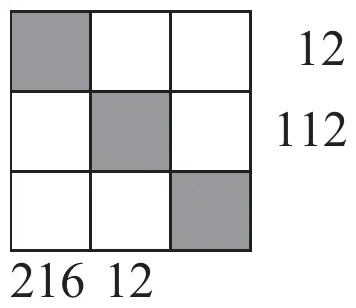
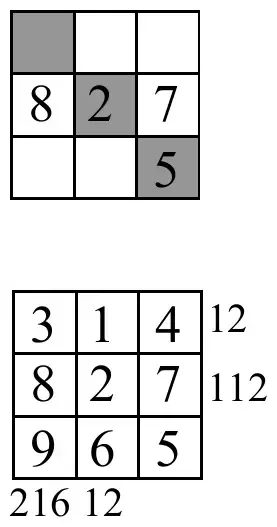
10. The digits from 1 to 9 are to be written in the nine cells of the \(3 \times 3\) grid shown, one digit in each cell. The product of the three digits in the first row is 12. The product of the three digits in the second row is 112. The product of the three digits in the first column is 216. The product of the three digits in the second column is 12. What is the product of the digits in the shaded cells?
None of the products for the first two rows and first two columns contains a factor of 5, so the bottom right cell must contain the 5. The prime factorisation of 112 is \(2^4 \times 7\) and, as 7 is not a factor of 216 or 12, then 7 must be in the right cell of the middle row. The remaining \(2^4\) must be the product of two different numbers, namely 8 and 2. The 2 must be in the centre cell as 8 is not a factor of 12. The grid is now as shown above. The prime factorisation of 216 is \(2^3 \times 3^3\) and the \(3^3\) must be the product of a 3 and a 9. The 3 must be in the top left cell as the product of the top row is 12 which is not a multiple of 9. Thus, the product of the three shaded cells is \(3 \times 2 \times 5\) which is 30. The completed grid is as shown on the right.
17. Aaron has to choose a three-digit code for his bike lock. The digits can be chosen from 1 to 9. To help him remember them, Aaron chooses three different digits in increasing order, for example 278. How many such codes can be chosen?
One way to count the possible codes is in descending numerical order of the three-digit codes. The list begins: 789; 689, 679, 678; 589, 579, 578, 569, 568, 567; ... . Each initial digit \(n\) produces part of the list with the \((8 - n)\)th triangular number of possible codes, where \(n \leqslant 7\). The total number of possible codes is then the sum of these triangular numbers \(1 + 3 + 6 + 10 + 15 + 21 + 28\) including 1 code starting with the digit 7, all the way to 28 codes starting with the digit 1. The total number of codes that Aaron can choose is 84.
19. Let \(S\) be a set of five different positive integers, the largest of which is \(m\). It is impossible to construct a quadrilateral with non-zero area, whose side-lengths are all distinct elements of \(S\). What is the smallest possible value of \(m\)?
Let \(S\) consist of \(h\),\(j\),\(k\),\(l\), \(m\) in ascending order of size. We want \(m\) to be as small as possible. Given three side-lengths, there is a quadrilateral with non-zero area with a specified fourth side-length if and only if the fourth side-length is less than the sum of the other three side-lengths. To ensure that \(j\),\(k\),\(l\), \(m\) are not the side-lengths of such a quadrilateral, we must have \(m \geqslant j + k + l\). Likewise, considering \(h\),\(j\),\(k\),\(l\), we must have \(l \geqslant h + j + k\). Since the smallest possible values of \(h\), \(j\) and \(k\) are 1, 2 and 3 respectively then \(l \geqslant 1 + 2 + 3\) so 6 is the smallest value of \(l\). Also \(m \geqslant 2 + 3 + 6\) so 11 is the smallest value of \(m\).
22. Three friends make the following statements. Ben says, “Exactly one of Dan and Cam is telling the truth.” Dan says, “Exactly one of Ben and Cam is telling the truth.” Cam says, “Neither Ben nor Dan is telling the truth.” Which of the three friends is lying?
Suppose first that Cam is telling the truth, so Ben and Dan are both lying. Then Ben's statement is actually correct, as is Dan's. There is a clear contradiction. So we know that Cam is in fact lying. Therefore at least one of Ben and Dan is telling the truth. If Ben is telling the truth, then we learn that Dan is telling the truth. If Dan is telling the truth then we learn that Ben is telling the truth. So both Ben and Dan are telling the truth. This means that only Cam is lying.
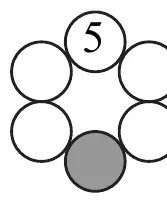
6. The numbers 5, 6, 7, 8, 9, 10 are to be placed, one in each of the circles in the diagram, so that the sum of the numbers in each pair of touching circles is a prime number. The number 5 is placed in the top circle. Which number is placed in the shaded circle?
The prime numbers which are the sums of pairs of numbers in touching circles are all odd as they are greater than 2. This means that any two adjacent circles in the diagram must be filled with one odd number and one even number. The number 10 may not be placed on either side of 5, since \(10 + 5 = 15 = 3 \times 5\). So either side of the 5 must be 6 and 8. Below 6 and 8 must be 7 and 9 respectively leaving 10 to be placed in the shaded circle at the bottom.
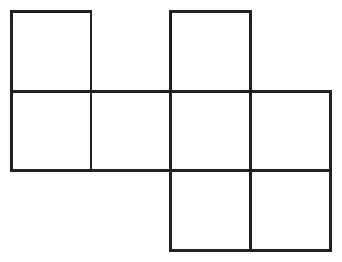
8. The diagram shows eight small squares. Six of these squares are to be shaded so that the shaded squares form the net of a cube. In how many different ways can this be done?
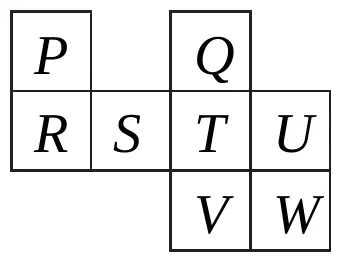
Let the squares in the diagram be labelled as shown. Each of the nets formed from six squares must contain all of \(R\), \(S\) and \(T\). The net must also include one of \(P\) and \(Q\) (but not both as they will fold into the same position), and any two of \(U\), \(V\) and \(W\). This therefore gives \(2 \times 3 = 6\) different ways.
9. Four different straight lines are drawn on a flat piece of paper. The number of points where two or more lines intersect is counted. Which of the following could not be the number of such points?
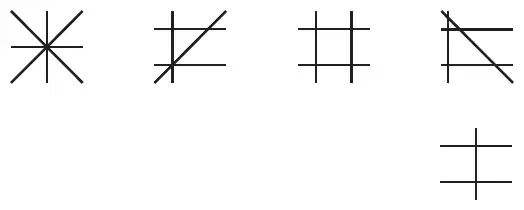
Possible configurations of four different straight lines drawn in a plane are shown here to give 1, 3, 4 and 5 points of intersection respectively. In order to have exactly 2 points of intersection, two of the straight lines would need to lie in the same position and so would not be ‘different’.
11. Rahid has a large number of cubic building blocks. Each block has sides of length 4 cm, 6 cm or 10 cm. Rahid makes little towers built from three blocks stacked on top of each other. How many different heights of tower can he make?
13. The Knave of Hearts tells only the truth on Mondays, Tuesdays, Wednesdays and Thursdays. He tells only lies on all the other days. The Knave of Diamonds tells only the truth on Fridays, Saturdays, Sundays and Mondays. He tells only lies on all the other days. On one day last week, they both said, “Yesterday I told lies.” On which day of the week was that?
When a knave says “Yesterday I told lies” it could be that today he is telling the truth and he did indeed tell lies yesterday. In the table, this is a T preceded by an L. It could also be that today he is lying, in which case he was in fact telling the truth yesterday. In the table, this is an L preceded by a T. The only day when one or the other of these options applies to each knave is Friday.
16. Fnargs are either red or blue and have 2, 3 or 4 heads. A group of six Fnargs consisting of one of each possible form is made to line up such that no immediate neighbours are the same colour nor have the same number of heads. How many ways are there of lining them up from left to right?
Let the six Fnargs in their final positions be denoted by \(F_1F_2F_3F_4F_5F_6\). There are six choices for \(F_1\). Once this Fnarg is chosen, the colours of the Fnargs must alternate all along the line and so we need only consider the number of heads. There are \(3 - 1 = 2\) choices for \(F_2\) as the number of heads for \(F_2\) \(\neq\) the number of heads for \(F_1\). There is only one choice for \(F_3\) as \(F_3\) cannot have the same number of heads as \(F_2\) or \(F_1\) (\(F_3\) and \(F_1\) are the same colour and so have different numbers of heads). There is only one choice for \(F_4\) as it is completely determined by \(F_3\) and \(F_2\), just as \(F_3\) was completely determined by \(F_2\) and \(F_1\). There is only one choice for each of \(F_5\) and \(F_6\) as they are the last of each colour of Fnargs. The total number of ways of lining up the Fnargs is \(6 \times 2 \times 1 \times 1 \times 1 \times 1\) which is 12.
24. Peter has 25 cards, each printed with a different integer from 1 to 25. He wishes to place \(N\) cards in a single row so that the numbers on every adjacent pair of cards have a prime factor in common. What is the largest value of \(N\) for which this is possible?
There are five cards in Peter's set that are printed with an integer that has no prime factors in common with any other number from 1 to 25. The five numbers are 1 (which has no prime factors) and the primes 13, 17, 19 and 23. These cards cannot be placed anywhere in the row of \(N\) cards. One possible row is: 11, 22, 18, 16, 12, 10, 8, 6, 4, 2, 24, 3, 9, 21, 7, 14, 20, 25, 15, 5. So the longest row is of 20 cards.
2. The diagram shows 6 regions. Each of the regions is to be painted a single colour, so that no two regions sharing an edge have the same colour. What is the smallest number of colours required?
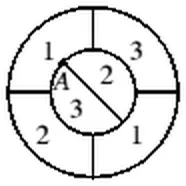
There are points on the diagram, such as \(A\), where the edges of three regions meet, so three or more different colours are required. A colouring with three colours is possible as shown, so the smallest number of colours required is three.
The year 1997 was not a leap year so had \(365 = 52 \times 7 + 1\) days. Hence, starting from 1st January, 1997 had 52 complete weeks, each starting with the same day as 1st January, followed by 31st December. As 31st December was a Wednesday, so too were all the first days of the 52 complete weeks. So there were 53 Wednesdays in 1997.
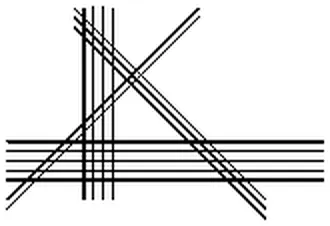
The intersections occur in six groups and the total number of points is \(2 \times 3 + 2 \times 4 + 2 \times 5 + 3 \times 4 + 3 \times 5 + 4 \times 5\) which is \(6 + 8 + 10 + 12 + 15 + 20 = 71\).
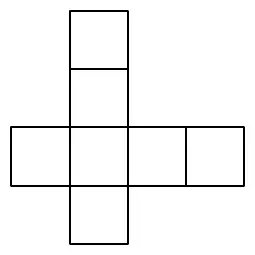
Each of P, Q, R, S and T when folded to form a cube consists of a shape of three black faces and an interlocking shape of three white faces, so they are all nets of the same cube.
Label the squares as shown. Possible pairs to be shaded which include A are AD, AE, AF and AG. Pairs excluding A are BD, BG, DE, EG. Triples must include A and there are two possibilities, ADE and AEG. This gives 10 ways of shading the grid,
22. A bag contains \(m\) blue and \(n\) yellow marbles. One marble is selected at random from the bag and its colour is noted. It is then returned to the bag along with \(k\) other marbles of the same colour. A second marble is now selected at random from the bag. What is the probability that the second marble is blue?
The probability that the second marble is blue equals P(2nd marble is blue given that the 1st marble is blue) + P(2nd marble is blue given that the 1st marble is yellow), which is
\(\dfrac{m}{m + n} \times \dfrac{m + k}{m + n + k} + \dfrac{n}{m + n} \times \dfrac{m}{m + n + k} = \dfrac{m^2 + mk + mn}{(m + n)(m + n + k)} = \dfrac{m(m + k + n)}{(m + n)(m + n + k)} = \dfrac{m}{m + n}.\)
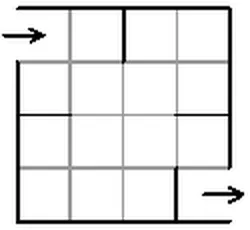
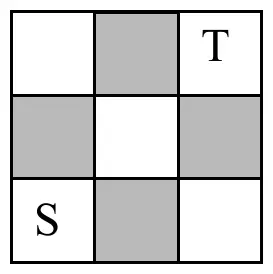
4. A route on the \(3 \times 3\) board shown consists of a number of steps. Each step is from one square to an adjacent square of a different colour. How many different routes are there from square S to square T which pass through every other square exactly once?
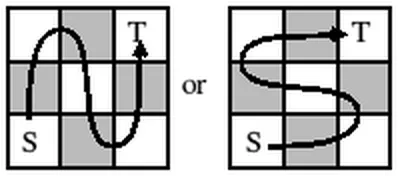
In order to pass through each square exactly once, a route must pass in and out of both unlabelled corner squares and also pass through the middle. Passing in and out of a corner involves three squares, coloured grey, white and grey in that order. Passing in and out of the two unlabelled corners therefore accounts for six unlabelled squares, leaving only the middle square which must be in the middle of any possible route. So, there are two possible routes as shown.
12. As a special treat, Sammy is allowed to eat five sweets from his very large jar which contains many sweets of each of three flavours − Lemon, Orange and Strawberry. He wants to eat his five sweets in such a way that no two consecutive sweets have the same flavour. In how many ways can he do this?
There are three options for Sammy's first choice and then two options for each subsequent choice. Therefore the number of possible ways is \(3 \times 2 \times 2 \times 2 \times 2 = 48\).
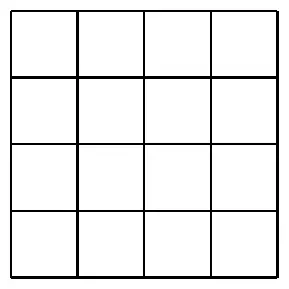
19. The 16 small squares shown in the diagram each have a side length of 1 unit. How many pairs of vertices are there in the diagram whose distance apart is an integer number of units?
There are 25 vertices in the diagram. Each vertex is part of a row of 5 vertices and a column of 5 vertices. Each vertex is therefore an integer number of units away from the 4 other vertices in its row and from the other 4 vertices in its column. This appears to give \(25 \times (4 + 4) = 200\) pairs. However, counting in this manner includes each pair twice so there are only 100 different pairs. By using the Pythagorean triple 3, 4, 5, each corner vertex is five units away from two other non-corner vertices, giving another 8 pairs. No other Pythagorean triples include small enough numbers to yield pairs of vertices on this grid. Thus the total number of pairs is 108.
22. Consider numbers of the form \(10n + 1\), where \(n\) is a positive integer. We shall call such a number ‘grime’ if it cannot be expressed as the product of two smaller numbers, possibly equal, both of which are of the form \(10k + 1\), where \(k\) is a positive integer. How many ‘grime numbers’ are there in the sequence 11, 21, 31, 41, ..., 981, 991?
The numbers in the sequence 11, 21, 31, 41, …. , 981, 991 are of the form \(10n + 1\) for \(n = 1\) to 99. There are therefore 99 numbers in this sequence. Twelve terms of this sequence can be expressed using factors of the form \(10k + 1\). In this form, these terms are \(11 \times 11\),\(11 \times 21\),\(11 \times 31\), …, \(11 \times 81\) and \(21 \times 21\),\(21 \times 31\), \(21 \times 41\) and \(31 \times 31\). All other pairings give products that are too large. Hence, there are \(99 - 12 = 87\) ‘grime’ numbers.
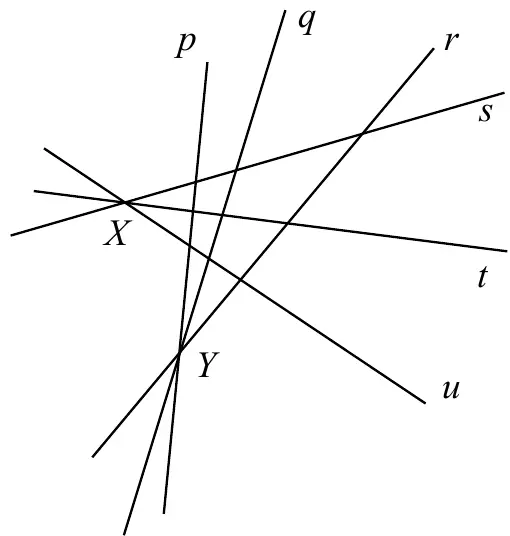
Challengeborough's underground train network consists of six lines, \(p\),\(q\),\(r\),\(s\),\(t\),\(u\), as shown. Wherever two lines meet there is a station which enables passengers to change lines. On each line, each train stops at every station. Jessica wants to travel from station \(X\) to station \(Y\). She does not want to use any line more than once, nor return to station \(X\) after leaving it, nor leave station \(Y\) having reached it. How many different routes, satisfying these conditions, can she choose?
Jessica must travel alternately on lines which are connected to station \(X\) (i.e. \(s\), \(t\) or \(u\)), and connected to station \(Y\) (i.e. \(p\), \(q\) or \(r\)). In order to depart from \(X\) and end her journey at \(Y\), she must travel along an even number of lines. This can be 2, 4 or 6 lines, making 1, 3 or 5 changes respectively. Case A, 2 lines: Jessica leaves station \(X\) along one of the lines \(s\), \(t\) or \(u\), makes one change onto one of lines \(p\), \(q\) or \(r\) and reaches station \(Y\). Here there are \(3 \times 3\) possibilities. Case B, 4 lines: Jessica leaves station \(X\) along one of the lines \(s\), \(t\) or \(u\) and makes her first change onto one of lines \(p\), \(q\) or \(r\). She then makes her second change onto either of the two lines \(s\), \(t\) or \(u\) on which she has not previously travelled and her third change onto either of the two lines \(p\), \(q\) or \(r\) on which she has not previously travelled and reaches station \(Y\). Here there are \(3 \times 3 \times 2 \times 2\) possibilities. Case C, 6 lines: Her journey is as described in Case B but her fourth change is onto the last of the lines \(s\), \(t\) or \(u\) on which she has not previously travelled and her fifth change is onto the last of the lines \(p\), \(q\) or \(r\) on which she has not previously travelled. Here there are \(3 \times 3 \times 2 \times 2 \times 1 \times 1\) possibilities. So in total Jessica can choose \(9 + 36 + 36 = 81\) different routes.
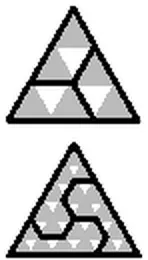
8. The diagrams below show four types of tile, each of which is made up of one or more equilateral triangles. For how many of these types of tile can we place three identical copies of the tile together, without gaps or overlaps, to make an equilateral triangle?
If an equilateral triangle is split into a number of smaller identical equilateral triangles then there must be one small triangle in the top row, three small triangles in the row below, five small triangles in the row below that and so on. So the total number of small triangles is 4 or 9 or 16 etc. These are all squares and it is left to the reader to prove that the sum of the first \(n\) odd numbers is \(n^2\). So, for three copies of a given tile to form an equilateral triangle, the number of triangles which comprise the tile must be one third of a square number. Only the tiles made up of three equilateral triangles and twelve equilateral triangles satisfy this condition. However, it is still necessary to show that three copies of these tiles can indeed make equilateral triangles. The diagrams above show how they can do this.
9. Pierre said, “Just one of us is telling the truth”. Qadr said, “What Pierre says is not true”. Ratna said, “What Qadr says is not true”. Sven said, “What Ratna says is not true”. Tanya said, “What Sven says is not true”. How many of them were telling the truth?
If Pierre is telling the truth then Qadr is not telling the truth. However, this means that Ratna is telling the truth, so this leads to a contradiction as Pierre stated that just one person is telling the truth. So Pierre is not telling the truth, which means that Qadr is telling the truth, but Ratna is not telling the truth. This in turn means that Sven is telling the truth, but Tanya is not. So only Qadr and Sven are telling the truth.
Two different ways of expressing 5 are 1 + 4 and 4 + 1. In the following list these are denoted as {1, 4: two ways}. The list of all possible ways is {5: one way}, {2, 3: two ways}, {1, 4: two ways}, {1, 2, 2: three ways}, {1, 1, 3: three ways}, {1, 1, 1, 2: four ways}, {1, 1, 1, 1, 1: one way}. So in total there are 16 ways. {Different expressions of a positive integer in the above form are known as ‘partitions’. It may be shown that the number of distinct compositions of a positive integer n is\(2^{n-1}\).}
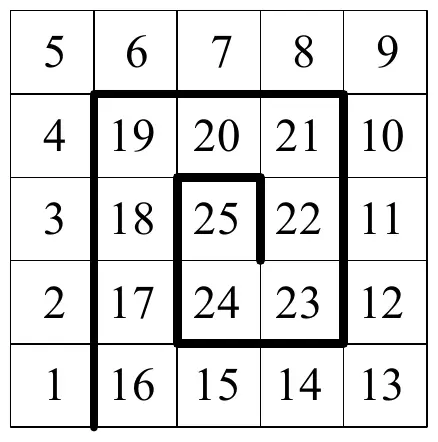
13. A cube is placed with one face on square 1 in the maze shown, so that it completely covers the square with no overlap. The upper face of the cube is covered in wet paint. The cube is then ‘rolled’ around the maze, rotating about an edge each time, until it reaches square 25. It leaves paint on all of the squares on which the painted face lands, but on no others. The cube is removed on reaching the square 25. What is the sum of the numbers on the squares which are now marked with paint?
The table below shows the position of the face marked with paint when the base of the cube is on the 25 squares. Code: T - top, B - base; F - front; H - hidden (rear); L - left; R - right.
1
2
3
4
5
6
7
8
9
10
11
12
13
14
15
16
17
18
19
20
21
22
23
24
25
T
H
B
F
T
R
B
L
T
F
B
H
T
L
B
R
R
R
R
B
L
L
L
B
F
So the required sum is \(3 + 7 + 11 + 15 + 20 + 24 = 80\).
14. Six students who share a house all speak exactly two languages. Helga speaks only English and German; Ina speaks only German and Spanish; Jean-Pierre speaks only French and Spanish; Karim speaks only German and French; Lionel speaks only French and English whilst Mary speaks only Spanish and English. If two of the students are chosen at random, what is the probability that they speak a common language?
Note that each student has a language in common with exactly four of the other five students. For instance, Jean-Pierre has a language in common with each of Ina, Karim, Lionel and Mary. Only Helga does not have a language in common with Jean-Pierre. So whichever two students are chosen, the probability that they have a language in common is 4/5.
19. The numbers 2, 3, 4, 5, 6, 7, 8 are to be placed, one per square, in the diagram shown so that the sum of the four numbers in the horizontal row equals 21 and the sum of the four numbers in the vertical column also equals 21. In how many different ways can this be done?
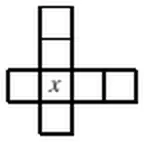
Note that the number represented by \(x\) appears in both the horizontal row and the vertical column. Note also that \(2 + 3 + 4 + 5 + 6 + 7 + 8 = 35\). Since the numbers in the row and those in the column have sum 21, we deduce that \(x = 2 \times 21 - 35 = 7\). We now need two disjoint sets of three numbers chosen from 2, 3, 4, 5, 6, 8 so that the numbers in both sets total 14. The only possibilities are {2, 4, 8} and {3, 5, 6}. We have six choices of which number to put in the top space in the vertical line, then two for the next space down and one for the bottom space. That leaves three choices for the first space in the horizontal line, two for the next space and one for the final space. So the total number of ways is \(6 \times 2 \times 1 \times 3 \times 2 \times 1 = 72\).
23. Tom and Geri have a competition. Initially, each player has one attempt at hitting a target. If one player hits the target and the other does not then the successful player wins. If both players hit the target, or if both players miss the target, then each has another attempt, with the same rules applying. If the probability of Tom hitting the target is always \(\tfrac{4}{5}\) and the probability of Geri hitting the target is always \(\tfrac{2}{3}\), what is the probability that Tom wins the competition?
Tom wins after one attempt each if he hits the target and Geri misses. The probability of this happening is \(\tfrac{4}{5} \times \tfrac{1}{3} = \tfrac{4}{15}\). Similarly the probability that Geri wins after one attempt is \(\tfrac{2}{3} \times \tfrac{1}{5} = \tfrac{2}{15}\). So the probability that both competitors will have at least one more attempt is \(1 - \tfrac{4}{15} - \tfrac{2}{15} = \tfrac{3}{5}\). Therefore the probability that Tom wins after two attempts each is \(\tfrac{3}{5} \times \tfrac{4}{15}\). The probability that neither Tom nor Geri wins after two attempts each is \(\tfrac{3}{5} \times \tfrac{3}{5}\). So the probability that Tom wins after three attempts each is \(\left(\tfrac{3}{5}\right)^2 \times \tfrac{4}{15}\) and, more generally, the probability that he wins after \(n\) attempts each is \(\left(\tfrac{3}{5}\right)^{n-1} \times \tfrac{4}{15}\). Therefore the probability that Tom wins is \(\tfrac{4}{15} + \left(\tfrac{3}{5}\right) \times \tfrac{4}{15} + \left(\tfrac{3}{5}\right)^2 \times \tfrac{4}{15} + \left(\tfrac{3}{5}\right)^3 \times \tfrac{4}{15} + \ldots\). This is the sum to infinity of a geometric series with first term \(\tfrac{4}{15}\) and common ratio \(\tfrac{3}{5}\). Its value is \(\tfrac{4}{15} \div \left(1 - \tfrac{3}{5}\right) = \tfrac{2}{3}\).
7. Two sides of a triangle have lengths 4 cm and 5 cm. The third side has length \(x\) cm, where \(x\) is a positive integer. How many different values can \(x\) have?
In order to form a triangle, \(x\) must exceed the difference between 4 and 5 and \(x\) must be less than the sum of 4 and 5, i.e. \(1 < x < 9\). Hence \(x = 2, 3, 4, 5, 6, 7\) or 8. So \(x\) can have 7 different values.
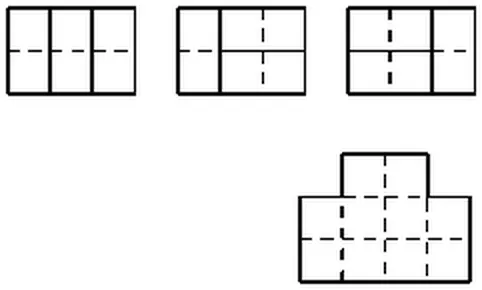
The \(1 \times 2\) rectangles can appear in two different ways: A or B . If, in the given shape, A forms the top \(1 \times 2\) rectangle then the possible different ways to fill the remaining \(2 \times 4\) rectangle are, from left to right:
A, A, A, A; A, A, B, B; B, A, A, B; B, B, A, A; B, B, B, B.
If A does not form the top \(1 \times 2\) rectangle, then the only possible way is to use 4B and an A. Hence there are 6 ways of dividing the given shape into \(1 \times 2\) rectangles.
9. Sam has a large collection of \(1 \times 1 \times 1\) cubes, each of which is either red or yellow. Sam makes a \(3 \times 3 \times 3\) block from twenty-seven cubes, so that no cubes of the same colour meet face-to-face. What is the difference between the largest number of red cubes that Sam can use and the smallest number?
Let the centre cube in the \(3 \times 3 \times 3\) block be red. As no cubes of the same colour meet face-to-face then the 6 centre cubes on the outer faces must be yellow. All six outer faces are as shown alongside. Thus 14 faces are yellow and 13 faces are red. If the centre cube is yellow then the situation is reversed. Hence the difference between the largest number of red cubes that Sam can use and the smallest number is 1.
13. The diagram represents a maze. Given that you can only move horizontally and vertically and are not allowed to revisit a square, how many different routes are there through the maze?
Let the centres of the starting and finishing squares in the maze have coordinates (1,4) and (4,1) respectively. Each path must pass through (2,3) and (3,2). There are two different routes from (1,4) to (2,3). The next visit is to (3,3) or (2,2). When visiting (3,3) the next visit has to be (3,2) as (3,4), (4,3) and (4,4) cannot be visited without subsequently revisiting a square. From (2,2) the next valid visit is to (1,2), (2,1) or (3,2). From each of these points there is only one route to (3,2). Thus there are four ways of visiting (3,2). Upon visiting (3,2), the only valid route through the maze is (4,2) then (4,1). Hence the number of different routes through the maze is \(2 \times 4 = 8\).
14. An equilateral triangle of side length 4 cm is divided into smaller equilateral triangles, all of which have side length equal to a whole number of centimetres. Which of the following cannot be the number of smaller triangles obtained?
Let us define \(T_n\) to represent an equilateral triangle with side length \(n\) cm. Then an equilateral triangle of side length 4 cm can be divided into smaller equilateral triangles as follows:
\(1 \times T_3\) and \(7 \times T_1\)
\(4 \times T_2\)
\(3 \times T_2\) and \(4 \times T_1\)
\(2 \times T_2\) and \(8 \times T_1\)
\(1 \times T_2\) and \(12 \times T_1\)
\(16 \times T_1\).
The number of triangles used are: 8, 4, 7, 10, 13 and 16. So it is not possible to dissect the original triangle into 12 triangles.
17. Jamie conducted a survey on the food preferences of pupils at a school and discovered that 70% of the pupils like pears, 75% like oranges, 80% like bananas and 85% like apples. What is the smallest possible percentage of pupils who like all four of these fruits?
Let \(a\),\(b\), \(o\) and \(p\) represent the percentage of pupils liking apples, bananas, oranges and pears respectively. As \(a = 85\), there are 15% of pupils who do not like apples. As \(b = 80\), \(a \cap b\) is greater than or equal to \(80 - (100 - 85) = 65\). As \(o = 75\), \(a \cap b \cap o\) is greater than or equal to \(75 - (100 - 65) = 40\). Finally, as \(p = 70\), \(a \cap b \cap o \cap p\) is greater than or equal to \(70 - (100 - 40) = 10\). Hence the percentage of pupils who like all four fruits is at least 10%.
21. Each of the Four Musketeers made a statement about the four of them, as follows.
d'Artagnan: “Exactly one is lying.” Athos: “Exactly two of us are lying.” Porthos: “An odd number of us is lying.” Aramis: “An even number of us is lying.”
How many of them were lying (with the others telling the truth)?
At least one of d'Artagnan and Athos is lying. One of Porthos or Aramis is telling the truth and the other is lying. So the number of liars is either two (d'Artagnan and Porthos) or three (all except Porthos).
7. There are 120 different arrangements of the five letters in the word ANGLE. If all 120 are listed in alphabetical order starting with AEGLN and finishing with NLGEA, which position in the list does ANGLE occupy?
There are 24 arrangements of the letters in the word ANGLE with A as the first letter. In alphabetical order AEGLN is first and ANLGE is last ie 24th. ANLEG is the 23rd and hence ANGLE is the 22nd.
The lowest common multiple of 3 and 4 is 12. Hence both of the required conditions are satisfied only by numbers that are 2 less than multiples of 12 and also less than 100, ie: 10, 22, 34, 46, 58, 70, 82 and 94. Therefore 8 two-digit numbers satisfy the conditions.
20. There are 10 girls in a mixed class. If two pupils from the class are selected at random to represent the class on the School Council, then the probability that both are girls is 0.15. How many boys are in the class?
Let the number of boys in the class be \(x\). Hence \(\dfrac{10}{10 + x} \times \dfrac{9}{9 + x} = \dfrac{3}{20}\). Simplifying gives \(1800 = 3(10 + x)(9 + x)\) and then \(x^2 + 19x - 510 = 0\). Factorising gives \((x + 34)(x - 15) = 0\) and, since \(x \neq -34\),\(x = 15\).
25. All the digits of a number are different, the first digit is not zero, and the sum of the digits is 36. There are \(N \times 7!\) such numbers. What is the value of \(N\)?
The sum of 10 different digits is 45. As the sum of the digits in the question is 36 then digits adding to 9 are omitted. The combinations of digits satisfying this are:
6. A bag contains hundreds of glass marbles, each one coloured either red, orange, green or blue. There are more than 2 marbles of each colour. Marbles are drawn randomly from the bag, one at a time, and not replaced. How many marbles must be drawn from the bag in order to ensure at least three marbles of the same colour are drawn?
If at most two marbles of each colour are chosen, the maximum number we can choose is 8, corresponding to 2 of each. Therefore, if 9 are chosen, we must have at least 3 of one colour, but this statement is not true if 9 is replaced by any number less than 9.
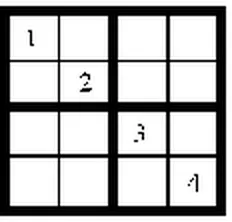
7. A mini-sudoku is a 4 by 4 grid, where each row, column and 2 by 2 outlined block contains the digits 1, 2, 3 and 4 once and once only. How many different ways are there of completing the mini-sudoku shown?
The top left 2 by 2 outlined block must contain a 3 and a 4 and this can be done in two ways. For each choice there is only one way to complete the entire mini-sudoku.
A number is a multiple of 6 precisely when it is both a multiple of 2 and of 3. To be a multiple of 2, it will need to end with an even digit; i.e. 0 or 2. If it ends with 0, the sum of the other two digits must be a multiple of 3; and only 3 = 1 + 2 or 6 = 1 + 5 are possible. That gives the numbers 120, 210, 150, 510. If it ends with 2, the sum of the others must be 1 = 0 + 1 or 4 = 1 + 3. That gives 102, 132 and 312.
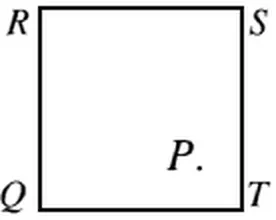
If \(\angle RPQ = 90°\) then \(P\) lies on a semicircle of diameter \(RQ\). Let \(x\) be the side-length of the square \(QRST\). Hence the area of the semicircle \(RPQ = \tfrac{1}{2}\pi\left(\tfrac{1}{2}x\right)^2 = \tfrac{1}{8}\pi x^2\) and the area of square \(QRST\) is \(x^2\). \(\angle RPQ\) is acute when \(P\) is outside the semicircle \(RPQ\). Hence the probability that \(\angle RPQ\) is acute is \(\dfrac{x^2 - \frac{1}{8}\pi x^2}{x^2} = 1 - \dfrac{\pi}{8}\).
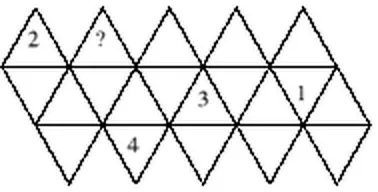
23. The net shown is folded into an icosahedron and the remaining faces are numbered such that at each vertex the numbers 1 to 5 all appear. What number must go on the face with a question mark?
Label the rows of the triangles from left to right as follows: \(a_1, \ldots, a_5\); \(b_1, \ldots, b_{10}\) and \(c_1, \ldots, c_5\). Now 1 cannot be at \(a_4\),\(a_5\),\(b_7\), \(b_8\) or \(c_4\) hence 1 must be at \(c_3\). Hence \(b_4\) and \(b_5\) are 2 and 5 in either order. Hence \(a_3\) is 1 or 4. But 1 cannot be at \(a_4\) or \(b_7\) hence 1 must be at \(a_3\). 4 cannot be at \(b_3\) thus 4 is at \(a_2\). Hence the number on the face with the question mark must be 4.
6. It is required to shade at least one of the six small squares in the diagram on the right so that the resulting figure has exactly one axis of symmetry. In how many different ways can this be done?
We number the squares to identify them. The only line of symmetry possible is the diagonal through 1 and 5. For a symmetric shading, if 4 is shaded, then so too must be 2; so either both are shaded or neither. Likewise 3 and 6 go together and provide 2 more choices. Whether 1 is shaded or not will not affect a symmetry, and this gives a further 2 choices; and the same applies to 5. Overall, therefore, there are \(2^4 = 16\) choices. However, one of these is the choice to shade no squares, which is excluded by the question.
There are 365 days in a normal year and 366 in a leap year. Apart from certain exceptions (none of which occurs in this period) a leap year occurs every 4 years. Now 365 = 7 × 52 + 1 and 366 = 7 × 52 + 2. Hence each date moves on by 5 days every 4 years. So in 60 years, it moves on 75 days. Since 75 = 7 × 10 + 5, that means it moves on to a Thursday.
If Sam's birthday falls before 9 November, then the fact that she is aged 30 on 8 November means that she was born in 1977. However, if her birthday falls on 9 November or later then her 31st birthday will fall in 2007, which means that she was born in 1976.
There are 1003 whole numbers between 1 and 2007 which are divisible by 2. Those which are also divisible by 7 are the multiples of 14, namely 14, 28, 42, …, 2002. There are 143 of these, so the required number is 1003 − 143 = 860.
15. How many hexagons can be found in the diagram on the right if each side of a hexagon must consist of all or part of one of the straight lines in the diagram?
In the given diagram, there are four hexagons congruent to the hexagon in Figure (i), four hexagons congruent to the hexagon in Figure (ii) and eight hexagons congruent to the hexagon in Figure (iii).
18. The year 1789 (when the French Revolution started) has three and no more than three adjacent digits (7, 8 and 9) which are consecutive integers in increasing order. How many years between 1000 and 9999 have this property?
There are 9 years of the form 123\(n\) as \(n\) may be any digit other than 4. Similarly, there are 9 years each of the forms 234\(n\), 345\(n\), 456\(n\), 567\(n\) and 678\(n\), but 10 years of the form 789\(n\) as, in this case, \(n\) may be any digit. There are also 9 years of the form \(n\)012 and 9 of the form \(n\)123, as in both cases \(n\) may be any digit other than 0. However, there are 8 years of the form \(n\)234 as in this case \(n\) cannot be 0 or 1. Similarly, there are 8 years each of the forms \(n\)345, \(n\)456, \(n\)567, \(n\)678 and \(n\)789. So the total numbers of years is 1 × 10 + 8 × 9 + 6 × 8 = 130.
21. A bracelet is to be made by threading four identical red beads and four identical yellow beads onto a hoop. How many different bracelets can be made?
In this solution, the notation \(p\,/\,q\,/\,r\,/\,s\,/\,\ldots\) represents \(p\) beads of one colour, followed by \(q\) beads of the other colour, followed by \(r\) beads of the first colour, followed by \(s\) beads of the second colour etc. Since the colours alternate, there must be an even number of these sections of beads. If there are just two sections, then the necklace is 4/4 and there is only one such necklace. If there are four, then each colour is split either 2, 2 or 3, 1. So the possibilities are 2/3/2/1 (which can occur in two ways, with the 3 being one colour or the other) or 2/2/2/2 (which can occur in one way) or 3/3/1/1(also one way). Note that 3/2/1/2 appears to be another possibility, but is the same as 2/3/2/1 rotated. If there are six sections, then each colour must be split into 2, 1, 1 and the possibilities are 2/2/1/1/1/1 (one way)or 2/1/1/2/1/1 (one way). Finally, if there are eight, then the only possible necklace is 1/1/1/1/1/1/1/1. In total that gives 8 necklaces.
As 2006 is not a leap year, January 1st, 2007 will fall one day later in the week than January 1st, 2006, that is on a Monday. So there will be 53 Mondays in 2007 and 52 of each of the other days of the week.
10. The digits 1, 2, 3, 4, 5, 6, 7, 8, and 9 are to be written in the squares so that every row and every column of three squares has a total of 13. Two numbers have already been entered. What is the value of \(n\)?
Let \(a\),\(b\),\(c\),\(d\),\(e\), \(f\) be the numbers in the squares shown. Then the sum of the numbers in the four lines is \(1 + 2 + 3 + \;\ldots\; + 9 + b + n + e\) since each of the numbers in the corner squares appears in exactly one row and one column. So \(45 + b + n + e = 4 \times 13 = 52\), that is \(b + n + e = 7\). Hence \(b\),\(n\), \(e\) are 1, 2, 4 in some order. If \(b = 2\) then \(a = 2\); if \(b = 4\) then \(a = 0\). Both cases are impossible, so \(b = 1\) and \(a = 3\). This means that \(n = 2\) or \(n = 4\). However, if \(n = 2\) then \(c = 10\), so \(n = 4\) and \(c = 8\). (The values of the other letters are \(e = 2\),\(d = 7\),\(f = 6\).)
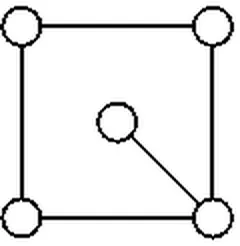
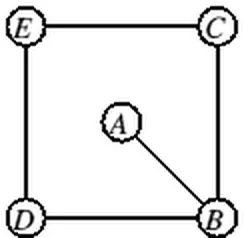
13. The diagram shows five discs connected by five line segments. Three colours are available to colour these discs. In how many different ways is it possible to colour all five discs if discs which are connected by a line segment are to have different colours?
Disc \(A\) may have any one of three colours and, for each of these, disc \(B\) may have two colours. So these two discs may be coloured in six different ways. If discs \(C\) and \(D\) have the same colour, then they may be coloured in two different ways and, for each of these, disc \(E\) may have two colours. So the discs may be coloured in 24 different ways if \(C\) and \(D\) are the same colour. However, if discs C and D are different colours, then \(C\) may have one of two colours, but the colours of discs \(D\) and \(E\) are then determined. So the discs may be coloured in 12 different ways if \(C\) and \(D\) are different colours. In total, therefore, the discs may be coloured in 36 different ways.
18. What is the greatest number of the following five statements about numbers \(a\), \(b\) which can be true at the same time? \[\tfrac{1}{a} < \tfrac{1}{b} \qquad\qquad a^2 > b^2 \qquad\qquad a < b \qquad\qquad a < 0 \qquad\qquad b < 0\]
It is not possible for all five statements to be true at the same time since if \(a < b\),\(a < 0\), \(b < 0\) are all true then \(\tfrac{1}{a} < \tfrac{1}{b}\) is not true since \(\tfrac{1}{b} - \tfrac{1}{a} = \tfrac{a - b}{ab}\) which is negative. However, when these three statements are true, \(a^2 > b^2\) is also true, so it is possible for four of the statements to be true at the same time.
6. How many differently shaped triangles exist in which no two sides are the same length, each side is of integral unit length and the perimeter of the triangle is less than 13 units?
The longest side of any triangle is shorter than the sum of the lengths of the other two sides. This condition means that the only possible triangles having different sides of integral unit length, and having perimeters less than 13 units, have sides of length 2, 3, 4 or 2, 4, 5 or 3, 4, 5.
8. An examination paper is made by taking 5 large sheets of paper, folding the pile in half and stapling it. The pages are then numbered in order from 1 to 20. What is the sum of the three page numbers that are on the same sheet of paper as page number 5?
15. The four statements in the box on the right refer to a mother and her four daughters. One statement is true, three statements are false. Who is the mother?
A Alice
B Beth
C Carol
D Diane
E Ella
Alice is the mother. Carol and Ella are both daughters. Beth is the mother. One of Alice, Diane or Ella is the mother.
Number the four statements in order from the top. If Alice is the mother, then statements 1 and 4 are both true. If Beth is the mother, then statements 2 and 3 are both true. If Carol is the mother, then all four statements are false. If Diane is the mother, then statements 2 and 4 are both true. However, if Ella is the mother then statements 1, 2 and 3 are false and statement 4 is true, as required.
16. A hockey team consists of 1 goalkeeper, 4 defenders, 4 midfielders and 2 forwards. There are 4 substitutes: 1 goalkeeper, 1 defender, 1 midfielder and 1 forward. A substitute may only replace a player of the same category eg: midfielder for midfielder. Given that a maximum of 3 substitutes may be used and that there are still 11 players on the pitch at the end, how many different teams could finish the game?
Firstly, we note that of the players on the pitch at the end of the game, the goalkeeper is one of two players; the four defenders form one of five different possible combinations, as do the four midfielders, and the two forwards form one of three different possible combinations. So, if up to four substitutes were allowed, the number of different teams which could finish the game would be 2 × 5 × 5 × 3, that is 150. From this number we must subtract the number of these teams which require four substitutions to be made. This is 1 × 4 × 4 × 2, that is 32, so the required number of teams is 118.
24. The factorial of \(n\), written \(n!\), is defined by \(n! = 1 \times 2 \times 3 \times \ldots \times (n - 2) \times (n - 1) \times n\). For how many positive integer values of \(k\) less than 50 is it impossible to find a value of \(n\) such that \(n!\) ends in exactly \(k\) zeros?
When \(n!\) is written in full, the number of zeros at the end of the number is equal to the power of 5 when \(n!\) is written as the product of prime factors, because there is at least that high a power of 2 available. For example, \(12! = 1 \times 2 \times 3 \times \;\ldots\; \times 12\) \(= 2^{10} \times 3^5 \times 5^2 \times 7 \times 11\). This may be written as \(2^8 \times 3^5 \times 7 \times 11 \times 10^2\), so \(12!\) ends in 2 zeros, as \(2^8 \times 3^5 \times 7 \times 11\) is not a multiple of 10. We see that \(24!\) ends in 4 zeros as 5, 10, 15 and 20 all contribute one 5 when \(24!\) is written as the product of prime factors, but \(25!\) ends in 6 zeros because \(25 = 5 \times 5\) and hence contributes two 5s. So there is no value of \(n\) for which \(n!\) ends in 5 zeros. Similarly, there is no value of \(n\) for which \(n!\) ends in 11 zeros since \(49!\) ends in 10 zeros and \(50!\) ends in 12 zeros. The full set of values of \(k\) less than 50 for which it is impossible to find a value of \(n\) such that \(n!\) ends in \(k\) zeros is 5, 11, 17, 23, 29, 30 (since \(124!\) ends in 28 zeros and \(125!\) ends in 31 zeros), 36, 42, 48.
We'd like to use Google Analytics cookies to count visits and see which pages help most. They're optional, and the site works exactly the same either way. Privacy policy


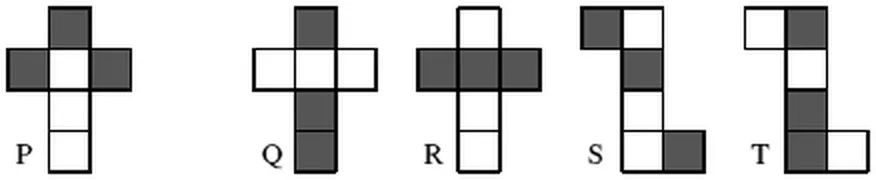
 shape of three black faces and an interlocking
 shape of three white faces, so they are all nets of the same cube.

 or B
 .