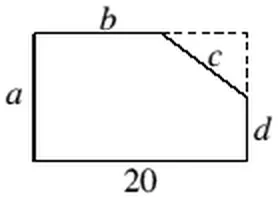
The diagram shows the original rectangle with the corner cut from it to form a pentagon. It may be deduced that the length of the original rectangle is 20 and that \(a\), \(b\), \(c\), \(d\) are 8, 10, 13, 15 in some order.
By Pythagoras' Theorem \(c^2 = (20 - b)^2 + (a - d)^2\). So \(c\) cannot be 8 as there is no right-angled triangle having integer sides and hypotenuse 8. If \(c = 10\), then \((20 - b)\) and \((a - d)\) are 6 and 8 in some order, but this is not possible using values of 8, 13 and 15. Similarly, if \(c = 15\), then \((20 - b)\) and \((a - d)\) are 9 and 12 in some order, but this is not possible using values of 8, 10 and 13. However, if \(c = 13\), then \((20 - b)\) and \((a - d)\) are 5 and 12 in some order, which is true if and only if \(a = 15\), \(b = 8\), \(d = 10\).
So the area of the pentagon is \(20 \times 15 - \tfrac{1}{2} \times 5 \times 12 = 270\).