The whole Senior Mathematical Challenge 2009 paper, one question at a time in order (25 questions). Press Mark as done after each one: your marks add up below.
\(\dfrac{785}{15} = 52\tfrac{1}{3}\) hence 785 is not a multiple of 15. But \(\dfrac{135}{15} = 9\),\(\dfrac{315}{15} = 21\),\(\dfrac{555}{15} = 37\),\(\dfrac{915}{15} = 61\).
4. Steve travelled 150 miles on a motorbike and used 10 litres of petrol. Given that 1 gallon ≈ 4.5 litres, roughly how many miles per gallon did Steve achieve on his journey?
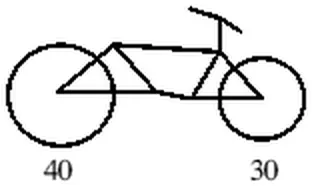
5. Boris Biker entered the Tour de Transylvania with an unusual bicycle whose back wheel is larger than the front. The radius of the back wheel is 40 cm, and the radius of the front wheel is 30 cm. On the first stage of the race the smaller wheel made 120000 revolutions. How many revolutions did the larger wheel make?
6. A bag contains hundreds of glass marbles, each one coloured either red, orange, green or blue. There are more than 2 marbles of each colour. Marbles are drawn randomly from the bag, one at a time, and not replaced. How many marbles must be drawn from the bag in order to ensure at least three marbles of the same colour are drawn?
If at most two marbles of each colour are chosen, the maximum number we can choose is 8, corresponding to 2 of each. Therefore, if 9 are chosen, we must have at least 3 of one colour, but this statement is not true if 9 is replaced by any number less than 9.
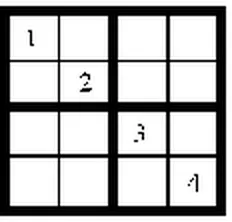
7. A mini-sudoku is a 4 by 4 grid, where each row, column and 2 by 2 outlined block contains the digits 1, 2, 3 and 4 once and once only. How many different ways are there of completing the mini-sudoku shown?
The top left 2 by 2 outlined block must contain a 3 and a 4 and this can be done in two ways. For each choice there is only one way to complete the entire mini-sudoku.
8. The entries to the Senior Mathematical Challenge grew from 87400 in 2007 to 92690 in 2008. Approximately what percentage increase does this represent?
The increase in entries from 2007 to 2008 is 92 690 − 87 400 = 5290. Hence the percentage increase is \(\dfrac{5290}{87400} \times 100\% = \dfrac{5290}{874}\% \approx \dfrac{5400}{900}\% = 6\%\). (The exact value is \(6\tfrac{1}{19}\).)
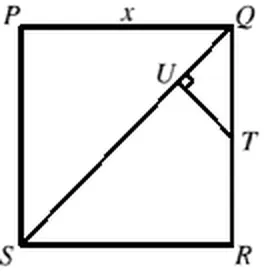
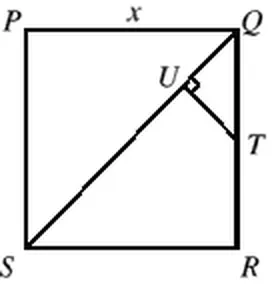
9. A square \(PQRS\) has sides of length \(x\). \(T\) is the midpoint of \(QR\) and \(U\) is the foot of the perpendicular from \(T\) to \(QS\). What is the length of \(TU\)?
As \(T\) is the midpoint of \(QR\) then \(QT = \tfrac{1}{2}x\). Since \(\angle UQT = \angle SQR = 45°\) and \(\angle QUT = 90°\),\(\angle UTQ = 45°\). Thus triangle \(QTU\) is isosceles with \(UQ = UT\). In triangle \(QTU\), by Pythagoras' Theorem, \(QT^2 = QU^2 + TU^2\). Hence \(\left(\tfrac{1}{2}x\right)^2 = 2TU^2\) so \(TU^2 = \tfrac{1}{8}x^2\) giving \(TU = \dfrac{x}{2\sqrt{2}}\).
A number is a multiple of 6 precisely when it is both a multiple of 2 and of 3. To be a multiple of 2, it will need to end with an even digit; i.e. 0 or 2. If it ends with 0, the sum of the other two digits must be a multiple of 3; and only 3 = 1 + 2 or 6 = 1 + 5 are possible. That gives the numbers 120, 210, 150, 510. If it ends with 2, the sum of the others must be 1 = 0 + 1 or 4 = 1 + 3. That gives 102, 132 and 312.
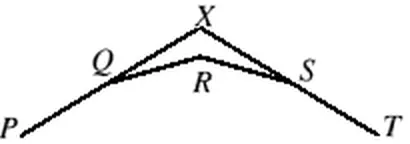
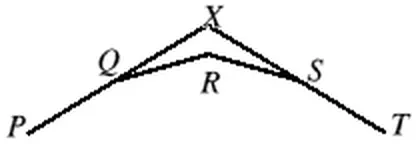
14.\(P\),\(Q\),\(R\),\(S\), \(T\) are vertices of a regular polygon. The sides \(PQ\) and \(TS\) are produced to meet at \(X\), as shown in the diagram, and \(\angle QXS = 140°\). How many sides does the polygon have?
Let the external angle of the regular polygon be \(x\)°. Hence \(\angle XQR = \angle XSR = x\)° and reflex angle \(\angle QRS = (180 + x)\)°. As the sum of the angles in the quadrilateral \(QRSX\) is 360° then \(140 + x + x + 180 + x = 360\). Hence \(3x = 40\) and the polygon has \(\dfrac{360}{40 \div 3} = 27\) sides.
Let \(\dfrac{n}{100 - n} = x\) where \(x\) is an integer. Hence \(n = 100x - nx\). Hence \(n\,(1 + x) = 100x\) giving \(n = \dfrac{100x}{1 + x}\). Now \(x\) and \(1 + x\) can have no common factors. Therefore \(1 + x\) must be a factor of 100 and can be any of them. Hence \(1 + x \in \{\pm 1, \pm 2, \pm 4, \pm 5, \pm 10, \pm 20, \pm 25, \pm 50, \pm 100\}\) thus the number of possible integers \(n\) is 18.
17. A solid cube is divided into two pieces by a single rectangular cut. As a result, the total surface area increases by a fraction \(f\) of the surface area of the original cube. What is the greatest possible value of \(f\)?
The greatest possible value of \(f\) is achieved by a rectangular cut through an edge of a cube and the furthest edge from it. If we take \(x\) as the side of the cube, by Pythagoras' Theorem the extra surface area formed by the cut is \(2\sqrt{2}x^2\). Hence \(f = \dfrac{2\sqrt{2}x^2}{6x^2} = \dfrac{\sqrt{2}}{3}\).
We have \(y^2 = x\,(2 - x)\). Now \(y^2 \geqslant 0\) for all real \(y\) hence \(x\,(2 - x) \geqslant 0\). Hence \(0 \leqslant x \leqslant 2\). In fact we can rewrite the equation as \((x - 1)^2 + y^2 = 1\); so this is a circle of radius 1 with centre (1,0).
19. Hamish and his friend Ben live in villages which are 51 miles apart. During the summer holidays, they agreed to cycle towards each other along the same main road. Starting at noon, Hamish cycled at \(x\) mph. Starting at 2 pm, Ben cycled at \(y\) mph. They met at 4 pm. If they had both started at noon, they would have met at 2.50 pm. What is the value of \(y\)?
The distance cycled by Hamish between noon and 4 pm is \(4x\). The distance cycled by Ben between 2 pm and 4 pm is \(2y\). They meet at 4 pm hence \(4x + 2y = 51\) or \(2x + 2\,(x + y) = 51\) (*). If they had both started at noon then they would have met at 2:50 pm and so \(2\tfrac{5}{6}(x + y) = 51\). Hence \(x + y = 51 \times \dfrac{6}{17} = 18\). Hence from (*) \(2x + 2 \times 18 = 51\). Hence \(2x = 15\) giving \(x = 7\tfrac{1}{2}\). Thus \(y = 10\tfrac{1}{2}\).
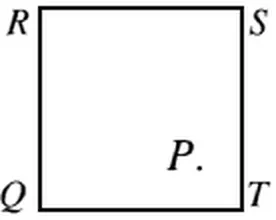
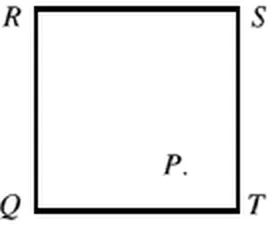
If \(\angle RPQ = 90°\) then \(P\) lies on a semicircle of diameter \(RQ\). Let \(x\) be the side-length of the square \(QRST\). Hence the area of the semicircle \(RPQ = \tfrac{1}{2}\pi\left(\tfrac{1}{2}x\right)^2 = \tfrac{1}{8}\pi x^2\) and the area of square \(QRST\) is \(x^2\). \(\angle RPQ\) is acute when \(P\) is outside the semicircle \(RPQ\). Hence the probability that \(\angle RPQ\) is acute is \(\dfrac{x^2 - \frac{1}{8}\pi x^2}{x^2} = 1 - \dfrac{\pi}{8}\).
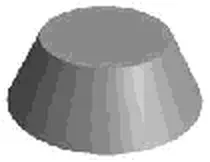
21. A frustum is the solid obtained by slicing a right-circular cone perpendicular to its axis and removing the small cone above the slice. This leaves a shape with two circular faces and a curved surface. The original cone has base radius 6 cm and height 8 cm, and the curved surface area of the frustum is equal to the area of the two circles. What is the height of the frustum?
Let \(r\) be the radius of the small cone and \(h\) the height. Let \(l_1\) and \(l_2\) be the slant heights of the small and large cones respectively. By Pythagoras' Theorem \(l_2 = \sqrt{6^2 + 8^2} = 10\). Using similar triangles, \(\dfrac{l_1}{r} = \dfrac{10}{6}\) so \(l_1 = \dfrac{5}{3}r\) and \(\dfrac{h}{8} = \dfrac{r}{6}\) giving \(h = \dfrac{4}{3}r\). Thus the area of the curved surface of the frustum is \[\pi \times 6 \times 10 - \pi \times r \times \frac{5}{3} \times r = \pi\left(60 - \frac{5r^2}{3}\right).\] The sum of the areas of the two circles is \(\pi \times 6^2 + \pi \times r^2 = \pi\,(36 + r^2)\). Hence \(\pi\left(60 - \dfrac{5r^2}{3}\right) = \pi\,(36 + r^2)\) and so \(24 = \dfrac{8r^2}{3}\) giving \(r = 3\), so \(h = \dfrac{4}{3} \times 3 = 4\). Therefore, in cms, the height of the frustum is 8 − 4 = 4.
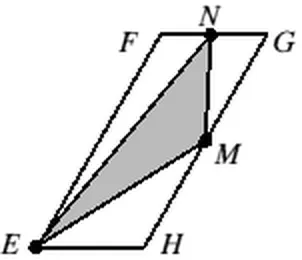
22. \(M\) and \(N\) are the midpoints of sides \(GH\) and \(FG\), respectively, of parallelogram \(EFGH\). The area of triangle \(ENM\) is 12 cm2. What is the area of the parallelogram \(EFGH\)?
Let the perpendicular distance between \(EH\) and \(FG\) be \(x\) cm and the area of the parallelogram \(EFGH\) be \(y\) cm2. Thus \(y = FG \times x\). The area of triangle \(EFN\) is \(\tfrac{1}{2}FN \times x = \tfrac{1}{2} \times \tfrac{1}{2} \times FG \times x = \tfrac{1}{4}y\) cm2. Likewise the areas of triangles \(EHM\) and \(NGM\) are \(\tfrac{1}{4}y\) cm2 and \(\tfrac{1}{8}y\) cm2 respectively. The area of triangle \(ENM\) is 12 cm2, hence \(y = 12 + \tfrac{5}{8}y\) and so \(y = 32\). Hence the area of the parallelogram \(EFGH\) is 32 cm2.
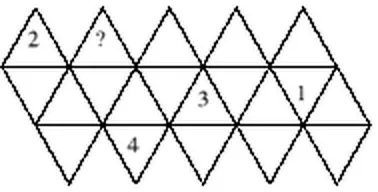
23. The net shown is folded into an icosahedron and the remaining faces are numbered such that at each vertex the numbers 1 to 5 all appear. What number must go on the face with a question mark?
Label the rows of the triangles from left to right as follows: \(a_1, \ldots, a_5\); \(b_1, \ldots, b_{10}\) and \(c_1, \ldots, c_5\). Now 1 cannot be at \(a_4\),\(a_5\),\(b_7\), \(b_8\) or \(c_4\) hence 1 must be at \(c_3\). Hence \(b_4\) and \(b_5\) are 2 and 5 in either order. Hence \(a_3\) is 1 or 4. But 1 cannot be at \(a_4\) or \(b_7\) hence 1 must be at \(a_3\). 4 cannot be at \(b_3\) thus 4 is at \(a_2\). Hence the number on the face with the question mark must be 4.
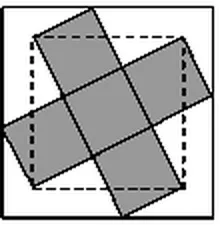
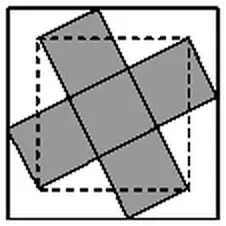
24. A figure in the shape of a cross is made from five 1 × 1 squares, as shown. The cross is inscribed in a large square whose sides are parallel to the dashed square, formed by four of the vertices of the cross. What is the area of the large outer square?
A shaded triangle is congruent to an unshaded triangle (ASA). Hence the area of the dashed square is equal to the area of the cross and both are 5. Thus the side-length of the dashed square is \(\sqrt{5}\). Hence the sides of a shaded triangle are: \(\tfrac{1}{2}\), 1 and \(\tfrac{1}{2}\sqrt{5}\). Now the perpendicular distance between the squares is equal to the altitude, \(h\), of the shaded triangle. The area of such a triangle is \(\tfrac{1}{2} \times \left(\tfrac{1}{2} \times 1\right) = \tfrac{1}{4}\) so that \(\tfrac{1}{2} \times \left(\tfrac{1}{2}\sqrt{5} \times h\right) = \tfrac{1}{4}\) which gives \(h = \dfrac{1}{\sqrt{5}}\). Hence the length of the sides of the outer square are \(\sqrt{5} + 2 \times \dfrac{1}{\sqrt{5}} = \dfrac{5}{\sqrt{5}} + \dfrac{2}{\sqrt{5}} = \dfrac{7}{\sqrt{5}}\). Thus the area of the large square is \(\left(\dfrac{7}{\sqrt{5}}\right)^2 = \dfrac{49}{5}\).
25. Four positive integers \(a\),\(b\), \(c\) and \(d\) are such that \[abcd + abc + bcd + cda + dab + ab + bc + cd + da + ac + bd + a + b + c + d = 2009.\] What is the value of \(a + b + c + d\)?
The left-hand side of the equation can be written as \[(a + 1)(b + 1)(c + 1)(d + 1) - 1.\] Hence \[(a + 1)(b + 1)(c + 1)(d + 1) = 2010.\] Now expressing 2010 as a product of primes gives 2010 = 2 × 3 × 5 × 67 hence \(a + b + c + d = 1 + 2 + 4 + 66 = 73\).
We'd like to use Google Analytics cookies to count visits and see which pages help most. They're optional, and the site works exactly the same either way. Privacy policy