The whole Senior Mathematical Challenge 2018 paper, one question at a time in order (25 questions). Press Mark as done after each one: your marks add up below.
The values of the expressions are 1, 8, 81, 1024 and 15 625 respectively, so there are three odd numbers. Alternatively, note also that positive integer powers of odd and even numbers are themselves odd and even respectively.
Option A can be expressed using the difference of two squares as \(2019^2 - 2014^2 = (2019 + 2014)(2019 - 2014) = 4033 \times 5\), so this answer is a multiple of 5.
Option B is \(2019^2 \times 10^2\) which is \(2019^2 \times 10 \times 2 \times 5\), which again is a multiple of 5.
Option C is \(\frac{2020^2}{101^2}\) which equals \(\left(\frac{2020}{101}\right)^2\) and this simplifies to \(20^2\) which is \(80 \times 5\), so the answer is a multiple of 5.
Option D is \(2010^2 - 2005^2\) which equals \((2010 + 2005)(2010 - 2005)\), so \(4015 \times 5\) which again is a multiple of 5.
However, option E is \(\frac{2015^2}{5^2}\) which equals \(\left(\frac{2015}{5}\right)^2\) and this is \(403^2\). As the final digit of \(403^2\) is 9, this is not a multiple of 5.
The expression \(25 \times 15 \times 9 \times 5.4 \times 3.24 = 5^2 \times 3 \times 5 \times 3^2 \times \frac{54}{10} \times \frac{324}{100}\) which factorises further to \(5^2 \times 3 \times 5 \times 3^2 \times \frac{2 \times 3^3}{2 \times 5} \times \frac{2^2 \times 3^4}{2^2 \times 5^2}\). All the factors of 2 and 5 in the numerator and denominator cancel to leave only the product of powers of 3. This is \(3^1 \times 3^2 \times 3^3 \times 3^4\), so the expression is equal to \(3^{10}\).
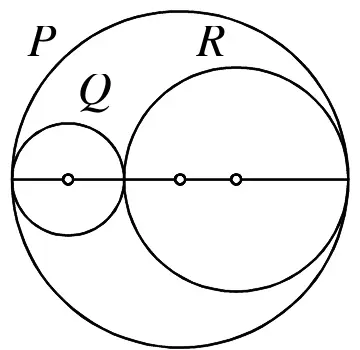
Let the radius of the circle \(Q\) be \(q\) and the radius of the circle \(R\) be \(r\). The radius of the largest circle, \(P\), can therefore be written as \((q + r)\). Using ‘circumference = \(2\pi \times\) radius’, the required expression becomes \(\dfrac{2\pi q + 2\pi r}{2\pi(q + r)}\) which equals \(\dfrac{2\pi(q + r)}{2\pi(q + r)}\) and so has value 1.
The first four terms of the geometric sequence \(7^n\) are 7, 49, 343 and 2401. Evaluating \(7^5\) by considering \(2401 \times 7\) shows that the tens and units digits are ‘07’ as in the first term. Hence a cyclical pattern for the tens and units digits is formed using ‘07’, ‘49’, ‘43’ and ‘01’. As \(2018 = 504 \times 4 + 2\), then \(7^{2018}\) must end in the second value of the cycle, so ‘49’.
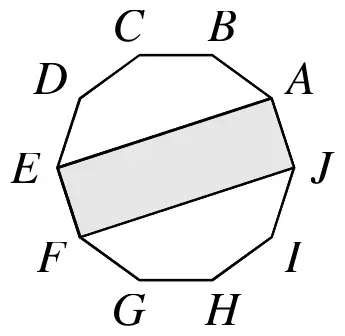
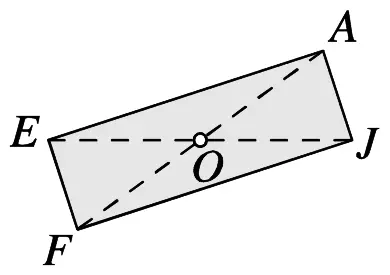
Let \(O\) be the centre of the regular decagon. The decagon can be split into ten congruent isosceles triangles each with a vertex at \(O\). Triangles \(AOJ\) and \(EOF\) are two of these ten isosceles triangles. As \(O\) is also the centre of the rectangle and the diagonals of a rectangle split its interior into four equal areas, the triangles \(EOA\) and \(FOJ\) each have the same area as triangle \(AOJ\). The required ratio is then 4 : 10 which simplifies to 2 : 5.
In order to calculate Laura’s average speed over the whole journey we can first calculate the total distance travelled and the total time taken. Using “distance in km = speed in km/h × time in h’, the total distance travelled, in km, is \(12 \times \frac{5}{60} + 15 \times \frac{10}{60} + 18 \times \frac{15}{60}\) which is \(1 + 2.5 + 4.5\), so 8. The total time taken is 5 + 10 + 15 minutes, so \(\frac{1}{2}\) hour. Laura’s average speed is then \(\frac{8}{1/2} = 16\) km/h.
For each equation, consider \(x = 0\). Then, \(y = x^4 + 1\) becomes \(y = 0^4 + 1 = 1\) and so the graph with this equation passes through \((0, 1)\) rather than \((0, 0)\). For the other three equations, using \(x = 0\) shows that \(y = 0\) too and so their graphs all pass through the origin. Hence only one graph does not pass through the origin.
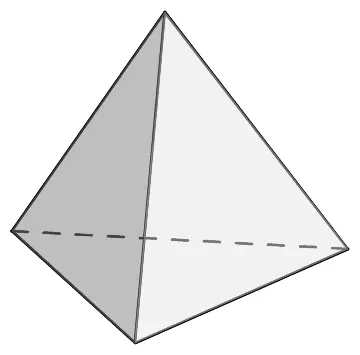
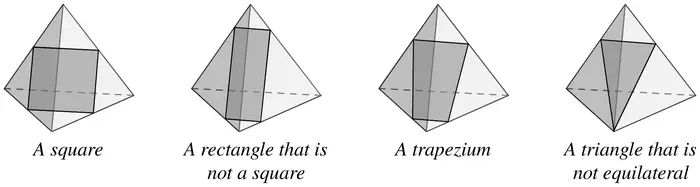
12. A regular tetrahedron is a polyhedron with four faces, each of which is an equilateral triangle, as shown. A solid regular tetrahedron is cut into two pieces by a single plane cut.
Which of the following could not be the shape of the section formed by the cut?
When the regular tetrahedron is cut by a single plane cut, each of its four faces is cut at most once. The line along which each face is cut becomes an edge of the newly formed section. Therefore the pentagon, with five edges, cannot be formed. Each of the other four options is possible as the following examples show.
Since \(y = x\) and \(y = mx - 4\), it follows that \(x = mx - 4\) and so \(4 = mx - x = (m - 1)x\); therefore \(x = \frac{4}{m - 1}\). In order for \(x\) to be a positive integer, \(m - 1\) must be a positive factor of 4 therefore \(m - 1\) can equal 1, 2 or 4 and so \(m\) can equal 2, 3 or 5. The sum of these values of \(m\) is then 10.
The mean of the twelve integers is given to be 7. Therefore \(1 + 3x + 5y + 8 + 9 + 11 = 12 \times 7\) so \(3x + 5y = 55\). As the twelve integers are written in ascending order, the median value is half way between the 6th and 7th values, each of which is \(y\), so the median is \(y\). Rearranging our equation gives \(y = \dfrac{55 - 3x}{5}\) and hence \(3x\) must be a multiple of 5 so that the numerator can be divided exactly by 5. To ensure that the twelve integers are in ascending order the minimum value of \(x\) is 1 and the maximum value of \(x\) is 8. The only value in this interval which makes \(3x\) a multiple of 5 is \(x = 5\), in which case \(y = \dfrac{55 - 15}{5} = 8\).
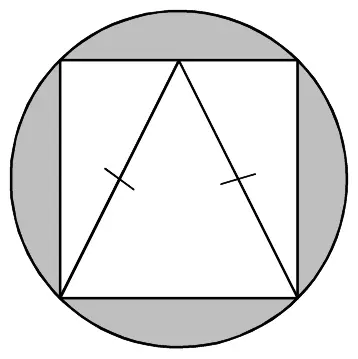
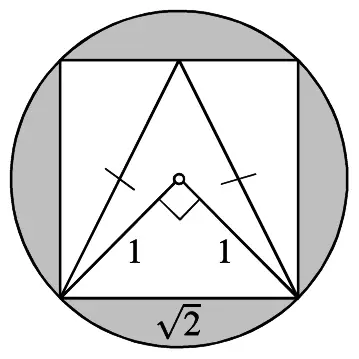
The circle has radius 1, so, using Pythagoras’ Theorem, the length of the side of the square is \(\sqrt{2}\). The area of the shaded region is then \(\pi \times 1^2 - \sqrt{2}^2\) which equals \(\pi - 2\). The base of the original isosceles triangle is also one of the sides of the square and so has length \(\sqrt{2}\). Its perpendicular height is also \(\sqrt{2}\) as it is parallel to two of the other sides of the square. The area of the triangle is then \(\frac{1}{2} \times \sqrt{2} \times \sqrt{2}\) which is 1. The required ratio is then \(1 : \pi - 2\).
Considering the first set of equations \(4p = 3q = 2r = s\), we can see that \(p < q < r < s\). Also, \(s\) must be a multiple of 2, 3 and 4. The smallest such multiple is 12 which gives \(p = 3\),\(q = 4\), \(r = 6\) and \(s = 12\). In the equation \(p + 2q + 3r + 4s = k\) we then have \(3 + 2 \times 4 + 3 \times 6 + 4 \times 12 = k\), so \(k = 77\).
Let the number of 20p coins and 50p coins Bethany has be \(x\) and \(y\) respectively. Her total number of coins is then \(11 + x + y\). As the mean value of her coins is 52p, the total value of her coins is both \(52 \times (11 + x + y)\) and \(100 \times 11 + 20x + 50y\). The equation formed is \(52(11 + x + y) = 1100 + 20x + 50y\) which becomes \(572 + 52x + 52y = 1100 + 20x + 50y\) and this simplifies to \(32x + 2y = 528\) or \(16x + y = 264\). By rearranging we can see that \(11 + x + y = 275 - 15x\). So Bethany’s total number of coins is of the form \(275 - 15x\), or \(5 + 15(18 - x)\) which gives values that are 5 more than multiples of 15. Of the given options the only one which is not 5 more than a multiple of 15 is 40. We can also see that Bethany must have a large purse!
Let the three angles \(P\), \(Q\) and \(R\) be written in the form ‘\(p.a\)’, ‘\(q.b\)’ and ‘\(r.c\)’ respectively, where \(p\),\(q\), and \(r\) are positive integers and \(a\), \(b\) and \(c\) each represent the full decimal part of the angle. The sum of the decimal parts of the angles falls into one of three cases: (i) \(a + b + c = 0\), so \(p + q + r = 180\); (ii) \(a + b + c = 1\), so \(p + q + r = 179\); (iii) \(a + b + c = 2\), so \(p + q + r = 178\).
In case (i) no rounding is necessary as all three angles are integers so \(P + Q + R = 180\). In case (ii), none (e.g. ‘\(p.4\)’, ‘\(q.4\)’, ‘\(r.2\)’), one (e.g. ‘\(p.5\)’, ‘\(q.4\)’, ‘\(r.1\)’) or two (e.g. ‘\(p.5\)’, ‘\(q.5\)’, ‘\(r.0\)’) could be large enough for the respective integer parts to ‘round up’. So \(P + Q + R\) could be 179 + 0, 179 + 1 or 179 + 2. In case (iii) either two (e.g. ‘\(p.9\)’, ‘\(q.9\)’, ‘\(r.2\)’) or three (e.g. ‘\(p.7\)’, ‘\(q.7\)’, ‘\(r.6\)’) of \(a\), \(b\) and \(c\) could be large enough for the respective integer parts to ‘round up’. So the total of \(P + Q + R\) could be 178 + 2 or 178 + 3. The complete list of possible values of \(P + Q + R\) is then 179, 180, 181.
If the exterior angle of an \(m\)-sided polygon is \(n°\) then its number of sides, \(m\), is \(\frac{360}{n}\). Similarly if the exterior angle of an \(n\)-sided polygon is \(m°\), then its number of sides, \(n\), is \(\frac{360}{m}\). Both \(n\) and \(m\) must be positive integers greater than two (or no polygon can be formed) and \(n \times m\) must be 360. The value of \(m\) can therefore be any of the twenty numbers 3, 4, 5, 6, 8, 9, 10, 12, 15, 18, 20, 24, 30, 36, 40, 45, 60, 72, 90 or 120 and the corresponding value of \(n\) will be \(\frac{360}{m}\).
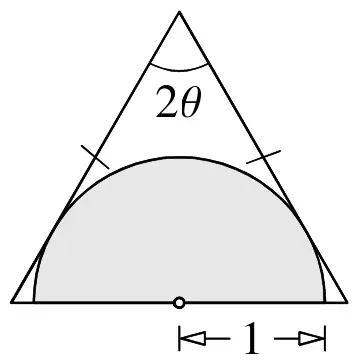
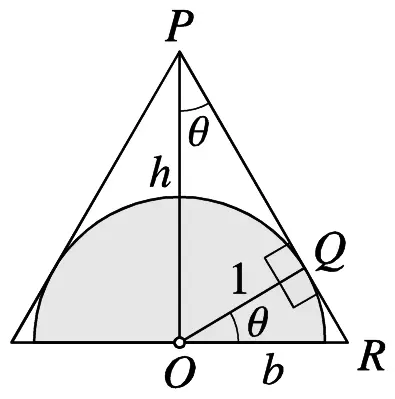
20. The diagram shows a semicircle of radius 1 inside an isosceles triangle. The diameter of the semicircle lies along the ‘base’ of the triangle, and the angle of the triangle opposite the ‘base’ is equal to \(2\theta\). Each of the two equal sides of the triangle is tangent to the semicircle.
Let \(O\) be the centre of the circle, \(P\) be the vertex at the top of the triangle, \(R\) the vertex at one end of the ‘base’ and \(Q\) be the point where \(PR\) is tangent to the semicircle, as shown. Let \(OP\) have length \(h\) and \(OR\) have length \(b\). The line \(OQ\) is a radius of the semicircle so has length 1 and is perpendicular to \(PR\).
As \(OP\) and \(OR\) are perpendicular, triangles \(ROQ\) and \(OPQ\) are similar and so angle \(ROQ\) and angle \(OPQ\) are equal. Triangles \(ROQ\) and \(OPQ\) can be used to find expressions for the lengths of the base and height of the original isosceles triangle. Considering triangle \(ROQ\) gives \(\cos\theta = \frac{1}{b}\) so \(b = \frac{1}{\cos\theta}\). Considering the triangle \(OPQ\) gives \(\sin\theta = \frac{1}{h}\) so \(h = \frac{1}{\sin\theta}\). Then the area of the isosceles triangle is \(\frac{1}{2} \times 2b \times h = \frac{1}{\cos\theta} \times \frac{1}{\sin\theta} = \frac{1}{\sin\theta\cos\theta}\).
After reflecting the graph of \(y = \frac{1}{x}\) in the line \(y = 1\) we have a graph whose equation is \(y = 1 + (1 - \frac{1}{x})\), so \(y = -\frac{1}{x} + 2\). The second reflection is in the line \(y = -x\). Here, \(y\) is replaced by \(-x\) and \(-x\) is replaced by \(y\). Hence the equation \(y = -\frac{1}{x} + 2\) becomes \(-x = -\frac{1}{-y} + 2\) which rearranges to \(-(x + 2) = \frac{1}{y}\) and then to \(y = \dfrac{-1}{(x + 2)}\).
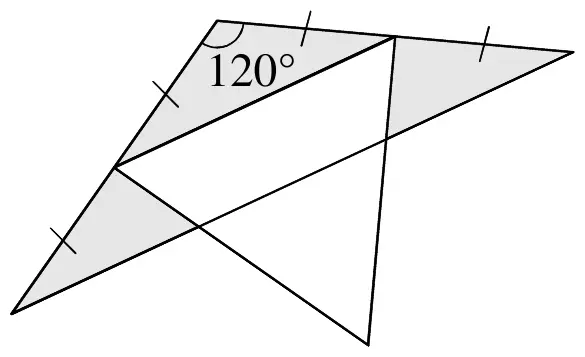
22. The diagram shows two overlapping triangles; an isosceles triangle with an angle of 120° and an equilateral triangle with area 36. Two of the vertices of the equilateral triangle are midpoints of the equal sides of the isosceles triangle.
What is the total area of the shaded regions (inside the isosceles triangle but outside the equilateral triangle)?
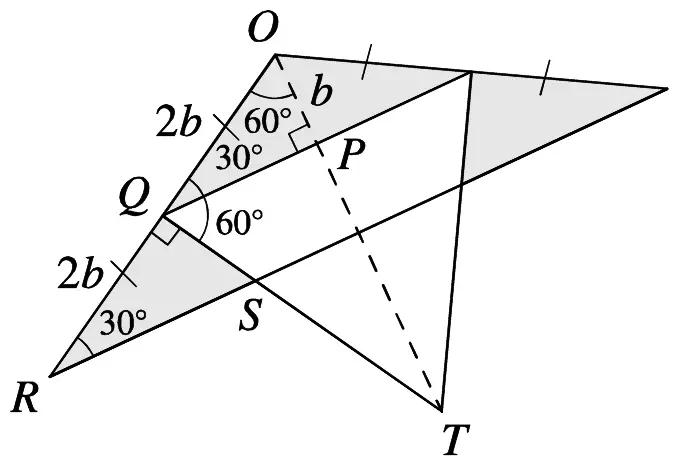
As two vertices of the equilateral triangle are given to be midpoints of the equal sides of the isosceles triangle, \(OT\) is a line of symmetry. Let \(P\) be the point where \(OT\) intersects an edge of the equilateral triangle, as shown. By using the line of symmetry through \(O\), \(P\) and \(T\), we can see the shaded region as four grey triangles. As we are given an angle of 120° at \(O\), and angles of an equilateral triangle are each 60°, the four grey triangles each have angles 30°, 60°, 90° and sides whose lengths are in the ratios \(1 : \sqrt{3} : 2\). Let \(OP = b\). Then \(OQ = QR = 2b\). Also \(QP = \sqrt{3}b\) and \(QS = \frac{2b}{\sqrt{3}}\) using similar triangles. The total shaded area is then \(2(\frac{1}{2} \times b \times \sqrt{3}b + \frac{1}{2} \times \frac{2b}{\sqrt{3}} \times 2b) = \sqrt{3}b^2 + \frac{4b^2}{\sqrt{3}} = \frac{7b^2}{\sqrt{3}}\). Triangle \(QPT\) also has sides in the ratios \(1 : \sqrt{3} : 2\) and as \(QP = \sqrt{3}b\),\(PT = 3b\). The area of the equilateral triangle is then \(\frac{1}{2} \times 2\sqrt{3}b \times 3b = 3\sqrt{3}b^2\) which we are told is 36. So \(3\sqrt{3}b^2 = 36\) and therefore \(\frac{b^2}{\sqrt{3}} = 4\). Hence the area of the shaded region is \(\frac{7b^2}{\sqrt{3}} = 7 \times 4 = 28\).
23. For particular real numbers \(a\) and \(b\), the function \(f\) is defined by \(f(x) = ax + b\), and is such that \(f\big(f\big(f(x)\big)\big) = 27x - 52\).
Which of the following formulas defines the function \(g\) such that, for all values of \(x\),\(g\big(f(x)\big) = x\)?
As \(f(x) = ax + b\), \(f(f(f(x))) = a(a(ax + b) + b) + b\) which expands to give \(a^3x + a^2b + ab + b\) and this can be written as \(a^3x + b(a^2 + a + 1)\). We therefore have \(a^3x + b(a^2 + a + 1) = 27x - 52\). Equating coefficients of \(x\) gives \(a^3 = 27\), so \(a = 3\). Equating the constants gives \(b(3^2 + 3 + 1) = -52\), so \(b = -4\). So the function \(f\) is given by \(f(x) = 3x - 4\). As we are given that \(g(f(x)) = x\), the function \(g\) uses inverse operations to undo the two steps in the function \(f\), in order to return to \(x\). As the operations in \(f\) are ‘multiply by 3’ then ‘subtract 4’, the operations in \(g\) are ‘add 4’ then ‘divide by 3’. Therefore the function \(g\) is given by \(g(x) = \frac{x + 4}{3} = \frac{1}{3}x + \frac{4}{3}\).
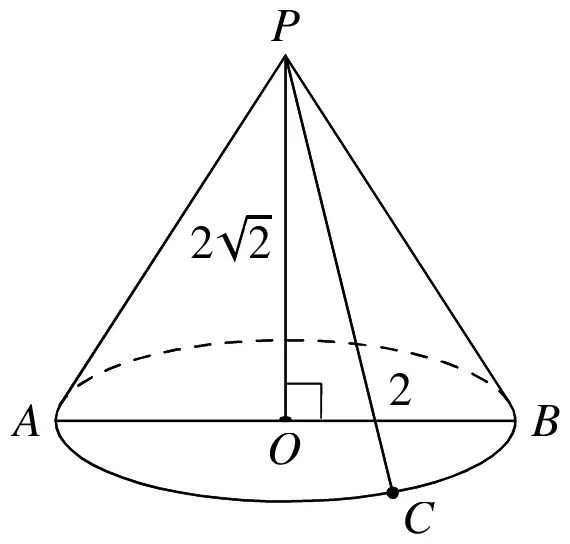
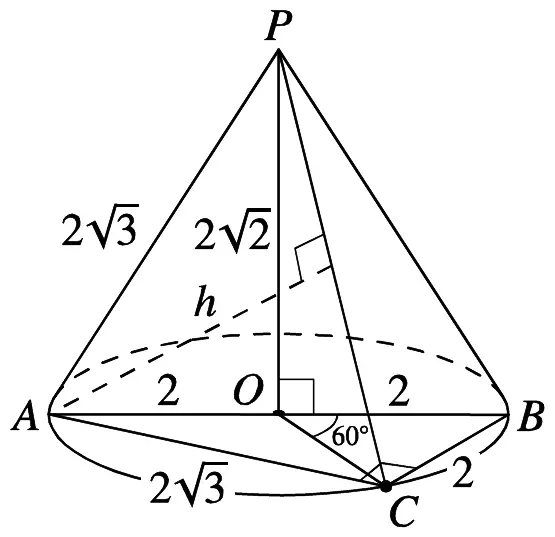
24. The diagram shows a circle with centre \(O\) which lies in a horizontal plane. The diameter \(AB\) has length 4. Point \(P\) lies vertically above \(O\) and \(PO = 2\sqrt{2}\). Point \(C\) lies on the semicircular arc \(AB\) such that the ratio of the lengths of the arcs \(AC\) and \(CB\) is 2 : 1.
What is the shortest distance from \(A\) to \(PC\)?
As points \(A\) and \(C\) are both on the circular base with centre \(O\), and \(P\) is directly above \(O\), we have \(PA = PC\). Applying Pythagoras’ Theorem to triangle \(OPA\) gives \(PA^2 = 2^2 + (2\sqrt{2})^2 = 12\), so \(PA = 2\sqrt{3} = PC\). Now we consider the circular base. Since the arcs \(AC\) and \(CB\) are in the ratio 2 : 1, then \(\angle AOC : \angle COB\) is also 2 : 1, giving \(\angle COB = 60°\). Triangle \(BOC\) is therefore equilateral, as \(OB = OC\), giving us that \(BC = 2\). Triangle \(ACB\) is right-angled, as angles in a semicircle are 90°. Applying Pythagoras’ Theorem to triangle \(ACB\) gives \(AC^2 + 2^2 = 4^2\), so \(AC = 2\sqrt{3}\).
As \(PA = PC = AC = 2\sqrt{3}\), triangle \(PAC\) is now shown to be equilateral. The shortest distance \(h\) from \(A\) to line \(PC\) is therefore the line of symmetry of that equilateral triangle. So \(h^2 + \sqrt{3}^2 = (2\sqrt{3})^2\) giving \(h^2 = 9\) and therefore \(h = 3\).
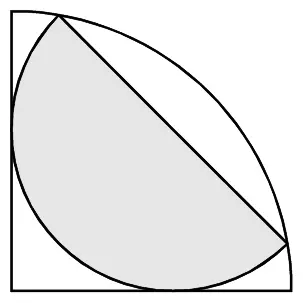
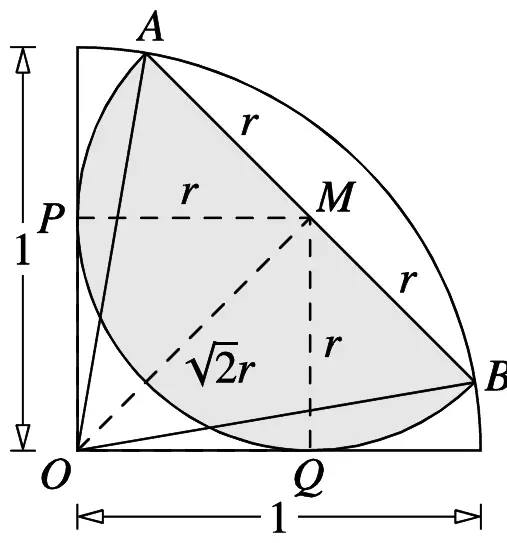
Let \(O\) be the centre of the quarter circle, \(A\) and \(B\) be the ends of the diameter of the semicircle and \(M\) be the midpoint of \(AB\). Let \(P\) and \(Q\) be the points on the straight edges of the quarter circle where the quarter circle is tangent to the semicircle. Let the radius of the quarter circle be 1, so \(OA = 1\). Let the radius of the semicircle be \(r\), so \(MA = r\). As a tangent to a circle is perpendicular to its radius, \(PM = r = QM\), and \(OPMQ\) is a square. Using Pythagoras’ Theorem on triangle \(OPM\) gives \(OM = \sqrt{2}r\). Considering triangle \(OAM\) gives \((\sqrt{2}r)^2 + r^2 = 1^2\) so \(3r^2 = 1\) and \(r^2 = \frac{1}{3}\).
The area of the quarter circle is \(\frac{1}{4} \times \pi \times 1^2 = \frac{\pi}{4}\). The area of the shaded semicircle is \(\frac{1}{2} \times \pi r^2\) which is \(\frac{1}{2} \times \pi \times \frac{1}{3}\), so \(\frac{\pi}{6}\). The fraction of the quarter circle which is shaded is then \(\dfrac{\pi/6}{\pi/4} = \frac{2}{3}\).
We'd like to use Google Analytics cookies to count visits and see which pages help most. They're optional, and the site works exactly the same either way. Privacy policy

 after it has been rotated clockwise through 135°?