38 Senior Mathematical Challenge questions from every year we have, newest year first. Use Difficulty › Position in the paper to practise the early (easier) or late (harder) questions, or the Year filter for one year.
9. In 2018, a racing driver was allowed to use the Drag Reduction System provided that the car was within 1 second of the car ahead. Suppose that two cars were 1 second apart, each travelling at 180 km/h (in the same direction!).
Using distance = speed × time, distance = 180 km/h × 1 second, which written in metres and seconds is \(\dfrac{180 \times 1000\,\text{m}}{60 \times 60 \text{ seconds}} \times 1 \text{ second} = 50\,\text{m}\).
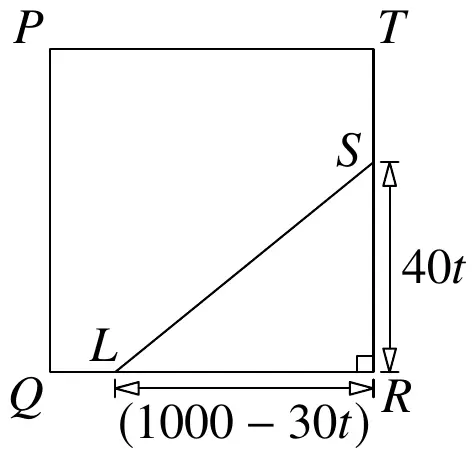
21. In a square garden \(PQRT\) of side 10 m, a ladybird sets off from \(Q\) and moves along edge \(QR\) at 30 cm per minute. At the same time, a spider sets off from \(R\) and moves along edge \(RT\) at 40 cm per minute.
What will be the shortest distance between them, in metres?
Let \(L\) be the position of the ladybird on \(QR\) and let \(S\) be the position of the spider on \(RT\) each after \(t\) minutes. The shortest distance between \(L\) and \(S\) is along the straight line which is the hypotenuse of the right-angled triangle \(LRS\). The distance \(QL\) is \(30t\) cm, so the distance \(LR\) is \((1000 - 30t)\) cm. Also, the distance \(RS\) is \(40t\) cm. So, \(LS^2 = (1000 - 30t)^2 + (40t)^2\) which expands and simplifies to \(2500(t^2 - 24t + 400) = 2500((t - 12)^2 + 256)\). The distance from \(L\) to \(S\) is shortest when \(t = 12\) and is \(\sqrt{2500 \times 256}\) cm = 800 cm = 8 m.
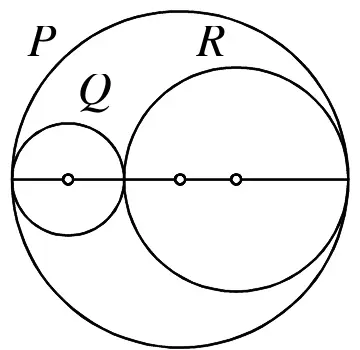
Let the radius of the circle \(Q\) be \(q\) and the radius of the circle \(R\) be \(r\). The radius of the largest circle, \(P\), can therefore be written as \((q + r)\). Using ‘circumference = \(2\pi \times\) radius’, the required expression becomes \(\dfrac{2\pi q + 2\pi r}{2\pi(q + r)}\) which equals \(\dfrac{2\pi(q + r)}{2\pi(q + r)}\) and so has value 1.
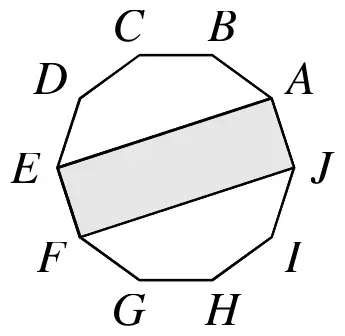
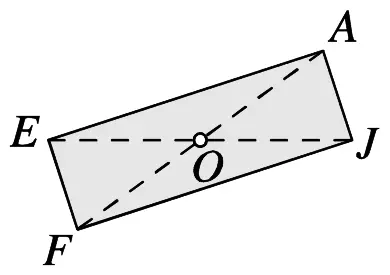
Let \(O\) be the centre of the regular decagon. The decagon can be split into ten congruent isosceles triangles each with a vertex at \(O\). Triangles \(AOJ\) and \(EOF\) are two of these ten isosceles triangles. As \(O\) is also the centre of the rectangle and the diagonals of a rectangle split its interior into four equal areas, the triangles \(EOA\) and \(FOJ\) each have the same area as triangle \(AOJ\). The required ratio is then 4 : 10 which simplifies to 2 : 5.
In order to calculate Laura’s average speed over the whole journey we can first calculate the total distance travelled and the total time taken. Using “distance in km = speed in km/h × time in h’, the total distance travelled, in km, is \(12 \times \frac{5}{60} + 15 \times \frac{10}{60} + 18 \times \frac{15}{60}\) which is \(1 + 2.5 + 4.5\), so 8. The total time taken is 5 + 10 + 15 minutes, so \(\frac{1}{2}\) hour. Laura’s average speed is then \(\frac{8}{1/2} = 16\) km/h.
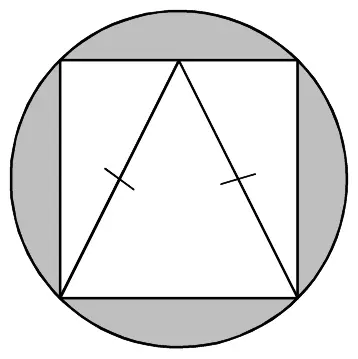
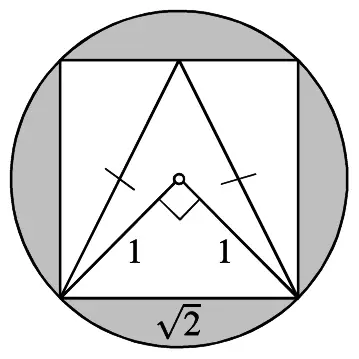
The circle has radius 1, so, using Pythagoras’ Theorem, the length of the side of the square is \(\sqrt{2}\). The area of the shaded region is then \(\pi \times 1^2 - \sqrt{2}^2\) which equals \(\pi - 2\). The base of the original isosceles triangle is also one of the sides of the square and so has length \(\sqrt{2}\). Its perpendicular height is also \(\sqrt{2}\) as it is parallel to two of the other sides of the square. The area of the triangle is then \(\frac{1}{2} \times \sqrt{2} \times \sqrt{2}\) which is 1. The required ratio is then \(1 : \pi - 2\).
2. Last year, an earthworm from Wigan named Dave wriggled into the record books as the largest found in the UK. Dave was 40 cm long and had a mass of 26 g. What was Dave's mass per unit length?
10. A rectangle is divided into three smaller congruent rectangles as shown. Each smaller rectangle is similar to the large rectangle. In each of these four rectangles, what is the ratio of the length of a longer side to that of a shorter side?
Let the sides of each of the smaller rectangles be 1 and \(a\) with \(a > 1\). Then the sides of the larger rectangle are \(a\) and 3 with \(3 > a\). As the rectangles are similar, \(\frac{a}{1} = \frac{3}{a}\). So \(a^2 = 3\) and \(a = \sqrt{3}\). The ratio of the sides is therefore \(\sqrt{3} : 1\).
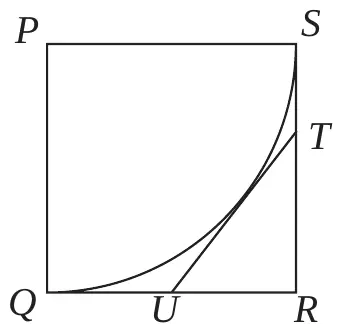
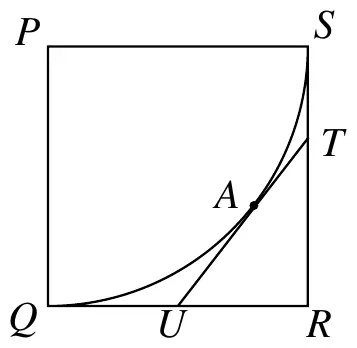
24. The diagram shows a square \(PQRS\). The arc \(QS\) is a quarter circle. The point \(U\) is the midpoint of \(QR\) and the point \(T\) lies on \(SR\). The line \(TU\) is a tangent to the arc \(QS\). What is the ratio of the length of \(TR\) to the length of \(UR\)?
Let the square have side-length 2, \(RT = h\) and let \(A\) be the point of contact between \(TU\) and the circle. Two tangents to a circle which meet at a point are of equal length. So as \(QU = 1\) so does \(AU\). Similarly \(TA = TS = 2 - h\). Applying Pythagoras' Theorem to triangle \(URT\) gives \(1^2 + h^2 = (1 + 2 - h)^2\) so \(1 + h^2 = 9 - 6h + h^2\) and therefore \(8 - 6h = 0\) which gives \(h = \tfrac{4}{3}\). The required ratio is then \(4 : 3\).
3. When Louise had her first car, 50 litres of petrol cost £40. When she filled up the other day, she noticed that 40 litres of petrol cost £50. By approximately what percentage has the cost of petrol increased over this time?
When 50 litres of petrol cost £40, 1 litre cost \(\dfrac{\text{£}40}{50}\) which is 80 pence. More recently, 1 litre cost \(\dfrac{\text{£}50}{40} = 125\) pence. The percentage increase is then \(\dfrac{\text{actual increase}}{\text{original price}} \times 100\) which is \(\dfrac{45}{80} \times 100 = \dfrac{450}{8} = 56.25\). So the approximate increase is 56%.
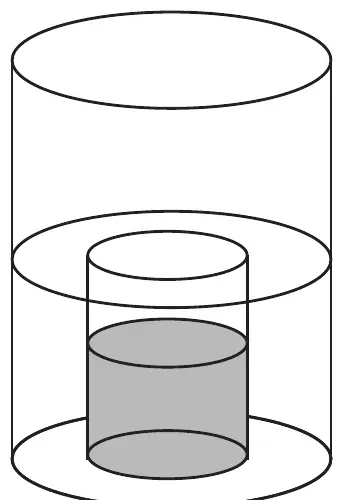
15. Two vases are cylindrical in shape. The larger vase has diameter 20 cm. The smaller vase has diameter 10 cm and height 16 cm. The larger vase is partially filled with water. Then the empty smaller vase, with the open end at the top, is slowly pushed down into the water, which flows over its rim. When the smaller vase is pushed right down, it is half full of water. What was the original depth of the water in the larger vase?
Let the original water level in the larger vase be \(h\) cm. The volume of water at the start is then \(\pi \times 10^2 \times h\) cm3. The volume of water completely within the vase is constant, but when the smaller vase is pushed down, some of the water moves into it. In the end the depth of the water in the larger vase is the same as the height of the smaller vase itself, which is 16 cm. We are given that the final depth of water in the smaller vase is 8 cm. So the total volume of water is then \(\pi \times 10^2 \times 16\) cm3 less the gap in the top half of the smaller vase. So \(\pi \times 10^2 \times h = \pi \times 10^2 \times 16 - \pi \times 5^2 \times 8\), giving \(100\pi h = 1600\pi - 200\pi\) and therefore \(h = 14\).
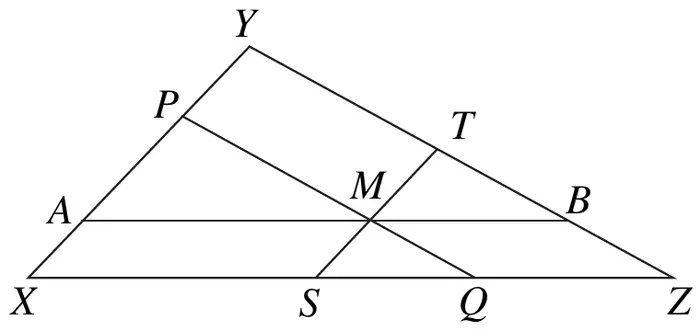
21. The diagram shows a triangle \(XYZ\). The sides \(XY\), \(YZ\) and \(XZ\) have lengths 2, 3 and 4 respectively. The lines \(AMB\), \(PMQ\) and \(SMT\) are drawn parallel to the sides of triangle \(XYZ\) so that \(AP\), \(QS\) and \(BT\) are of equal length. What is the length of \(AP\)?
All of the triangles in the diagram are similar as they contain the same angles. The sides of each triangle are therefore in the ratio \(2 : 3 : 4\). First consider triangle \(APM\). Let \(AP = x\), so that \(AM = 2x\). Now considering triangle \(TBM\), as \(BT = x\),\(BM = \tfrac{4x}{3}\). The quadrilateral \(AMSX\) is a parallelogram as \(AM\) is parallel to \(XS\) and \(MS\) is parallel to \(AX\). So \(AM = XS = 2x\). Similarly \(QZ = BM = \tfrac{4x}{3}\). Considering the base of triangle \(XYZ\),\(XS + SQ + QZ = 4\). So \(2x + x + \tfrac{4x}{3} = 4\) and therefore \(x = \tfrac{12}{13}\).
7. According to recent research, global sea levels could rise 36.8 cm by the year 2100 as a result of melting ice. Roughly how many millimetres is that per year?
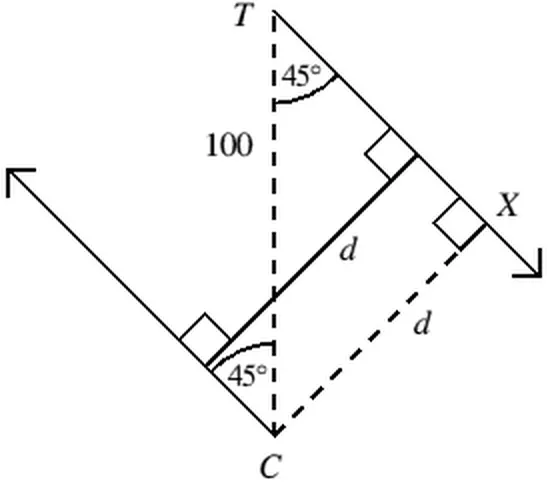
17. An oil tanker is 100 km due north of a cruise liner. The tanker sails SE at a speed of 20 kilometres per hour and the liner sails NW at a speed of 10 kilometres per hour. What is the shortest distance between the two boats during the subsequent motion?
The tanker and the cruise liner are travelling in parallel and opposite directions, each making an angle of 45° with the line joining their starting positions. The shortest distance between the ships is \(d\), the perpendicular distance between the parallel lines. This is independent of the speeds of the ships. Considering triangle \(TCX\) gives \(\sin 45° = \dfrac{d}{100}\) so \(d = \dfrac{1}{\sqrt{2}} \times 100 = 50\sqrt{2}\).
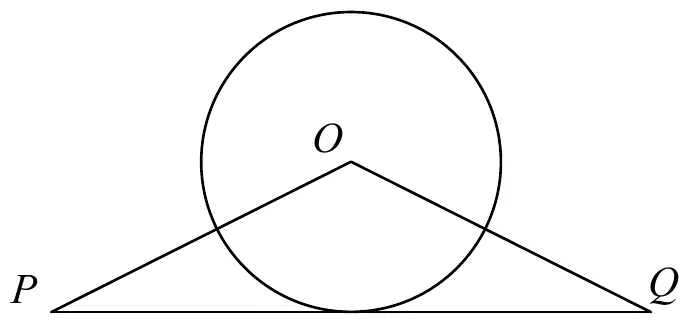
11. The diagram shows a circle with centre \(O\) and a triangle \(OPQ\). Side \(PQ\) is a tangent to the circle. The area of the circle is equal to the area of the triangle. What is the ratio of the length of \(PQ\) to the circumference of the circle?
Let the radius of the circle be \(r\). Then its area is \(\pi r^2\). The height of the triangle is \(r\) and its area is \(\tfrac{1}{2} \times PQ \times r\). So \(\tfrac{1}{2} \times PQ \times r = \pi r^2\) and therefore \(PQ = 2\pi r\), which is also the circumference of the circle. Therefore the ratio of the length of \(PQ\) to the circumference of the circle is \(1 : 1\).
13. Two entrants in a school's sponsored run adopt different tactics. Angus walks for half the time and runs for the other half, whilst Bruce walks for half the distance and runs for the other half. Both competitors walk at 3mph and run at 6mph. Angus takes 40 minutes to complete the course. How many minutes does Bruce take?
Angus completes the course in 40 minutes, so he spends 20 minutes (which is \(\tfrac{1}{3}\) of an hour) walking and the same time running. By using distance = speed × time, the length of the course is \(3 \times \tfrac{1}{3} + 6 \times \tfrac{1}{3} = 1 + 2 = 3\) miles. Bruce completes the course by walking for \(1\tfrac{1}{2}\) miles and running for \(1\tfrac{1}{2}\) miles. So, by using time \(= \dfrac{\text{distance}}{\text{speed}}\), Bruce's total time in hours is \(\dfrac{1\frac{1}{2}}{3} + \dfrac{1\frac{1}{2}}{6} = \dfrac{1}{2} + \dfrac{1}{4} = \dfrac{3}{4}\) of an hour. So Bruce takes 45 minutes to complete the course.
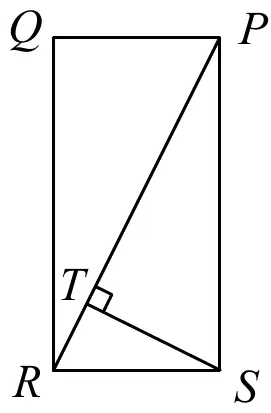
14. The diagram shows a rectangle \(PQRS\) in which \(PQ : QR = 1 : 2\). The point \(T\) on \(PR\) is such that \(ST\) is perpendicular to \(PR\). What is the ratio of the area of the triangle \(RST\) to the area of the rectangle \(PQRS\)?
Triangle \(RST\) is similar to triangle \(RPS\) as their corresponding angles are equal. Using Pythagoras' Theorem, the ratio of \(RS\) to \(RP\) is \(1 : \sqrt{5}\). So the ratio of \(RT\) to \(RS\) is also \(1 : \sqrt{5}\). Therefore the ratio of the area of the triangle \(RST\) to the area of triangle \(RPS\) is \(1 : 5\). Triangle \(RPS\) is half the rectangle \(PQRS\), so the ratio of the area of triangle \(RST\) to the area of rectangle \(PQRS\) is \(1 : 10\).
Let the two positive numbers be \(x\) and \(y\) with \(x > y\). The sum of the numbers is greater than their difference, so the two ratios which are equal are \(x : y\) and \(x + y : x - y\). Therefore \(\dfrac{x}{y} = \dfrac{x + y}{x - y}\). By dividing the top and bottom of the right-hand side by \(y\) we obtain \(\dfrac{x}{y} = \dfrac{\frac{x}{y} + 1}{\frac{x}{y} - 1}\). Letting \(k = \tfrac{x}{y}\) gives \(k = \tfrac{k + 1}{k - 1}\) which gives the quadratic \(k^2 - 2k - 1 = 0\). Completing the square gives \((k - 1)^2 = 2\) whence \(k = 1 \pm \sqrt{2}\). However, as \(x\) and \(y\) are both positive, \(k \neq 1 - \sqrt{2}\). As the ratio \(\tfrac{x}{y} = 1 + \sqrt{2}\), the ratio \(x : y\) is \(1 + \sqrt{2} : 1\).
15. Professor Rosseforp runs to work every day. On Thursday he ran 10% faster than his usual average speed. As a result, his journey time was reduced by \(x\) minutes. How many minutes did the journey take on Wednesday?
Let Professor Rosseforp's usual journey take \(t\) minutes at an average speed of \(v\) metres/minute. Then the distance to work is \(vt\) metres. On Thursday his speed increased by 10%, i.e. it was \(11v/10\) metres/minute. The time taken was \((t - x)\) minutes. Therefore \(11v/10 \times (t - x) = vt\). So \(11(t - x) = 10t\), i.e. \(t = 11x\).
5. A notice on Morecambe promenade reads: ‘It would take 20 million years to fill Morecambe Bay from a bath tap.’ Assuming that the flow from the bath tap is 6 litres a minute, what does the notice imply is the approximate capacity of Morecambe Bay in litres?
6. Dean runs up a mountain road at 8 km per hour. It takes him one hour to get to the top. He runs down the same road at 12 km per hour. How many minutes does it take him to run down the mountain?
The length of the road is 8km. Hence the time taken to run down the mountain is \(\tfrac{8}{12}\) hours \(= \tfrac{8}{12} \times 60\) min \(= 40\) min.
4. Steve travelled 150 miles on a motorbike and used 10 litres of petrol. Given that 1 gallon ≈ 4.5 litres, roughly how many miles per gallon did Steve achieve on his journey?
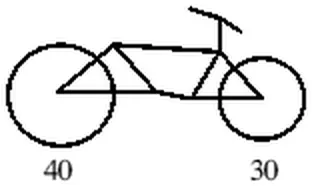
5. Boris Biker entered the Tour de Transylvania with an unusual bicycle whose back wheel is larger than the front. The radius of the back wheel is 40 cm, and the radius of the front wheel is 30 cm. On the first stage of the race the smaller wheel made 120000 revolutions. How many revolutions did the larger wheel make?
19. Hamish and his friend Ben live in villages which are 51 miles apart. During the summer holidays, they agreed to cycle towards each other along the same main road. Starting at noon, Hamish cycled at \(x\) mph. Starting at 2 pm, Ben cycled at \(y\) mph. They met at 4 pm. If they had both started at noon, they would have met at 2.50 pm. What is the value of \(y\)?
The distance cycled by Hamish between noon and 4 pm is \(4x\). The distance cycled by Ben between 2 pm and 4 pm is \(2y\). They meet at 4 pm hence \(4x + 2y = 51\) or \(2x + 2\,(x + y) = 51\) (*). If they had both started at noon then they would have met at 2:50 pm and so \(2\tfrac{5}{6}(x + y) = 51\). Hence \(x + y = 51 \times \dfrac{6}{17} = 18\). Hence from (*) \(2x + 2 \times 18 = 51\). Hence \(2x = 15\) giving \(x = 7\tfrac{1}{2}\). Thus \(y = 10\tfrac{1}{2}\).
2. A giant thresher shark weighing 1250 pounds, believed to be the heaviest ever caught, was landed by fisherman Roger Nowell off the Cornish coast in November 2007. The fish was sold by auction at Newlyn Fish Market for £255. Roughly, what was the cost per pound?
7. A newspaper headline read ‘Welsh tortoise recaptured 1.8 miles from home after 8 months on the run’. Assuming the tortoise travelled in a straight line, roughly how many minutes did the tortoise take on average to ‘run’ one foot? [1 mile = 5280 feet]
In 1.8 miles there are 1.8 × 5280 feet = 18 × 528 feet, while in 8 months there are roughly 8 × 30 × 24 × 60 minutes. Hence the time to ‘run’ one foot in minutes is roughly \(\dfrac{10 \times 30 \times 20 \times 60}{20 \times 500} = 36\) minutes.
22. A pentagon is made by attaching an equilateral triangle to a square with the same edge length. Four such pentagons are placed inside a rectangle, as shown. What is the ratio of the length of the rectangle to its width?
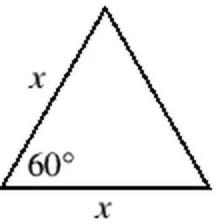
Let \(r\) be the length of a side of the equilateral triangle. Hence the width of the rectangle is \(r\sin 60° + r + r\sin 60° =\) \(r(1 + 2\sin 60°) = r(1 + \sqrt{3})\) and its length is \(3r + 2r\sin 60° = r(3 + \sqrt{3})\). So the ratio of the length to the width is \[(3 + \sqrt{3}) : (1 + \sqrt{3}) = \sqrt{3}(1 + \sqrt{3}) : (1 + \sqrt{3}) = \sqrt{3} : 1.\]
8. Travelling at an average speed of 100 km/hr, a train took 3 hours to travel to Birmingham. Unfortunately the train then waited just outside the station, which reduced the average speed for the whole journey to 90 km/hr. For how many minutes was the train waiting?
The distance travelled to Birmingham by the train was 300 km. The time taken to travel this distance at an average speed of 90 km/hr is \(\tfrac{300}{90}\) hr \(= 3\tfrac{1}{3}\) hr = 3 hr 20 min. So the train was waiting for 20 minutes.
10. In 1954, a total of 6 527 mm of rain fell at Sprinkling Tarn and this set a UK record for annual rainfall. The tarn has a surface area of 23 450 m2. Roughly how many million litres of water fell on Sprinkling Tarn in 1954?
The volume of water which fell at Sprinkling Tarn in 1954 is approximately equal to (25 000 × 6) m3, that is 150 000 m3. Now 1 m3 = 106 cm3 = 106 ml = 1000 litres. So approximately 150 million litres of water fell on Sprinkling Tarn in 1954.
1. The promotion ‘AMAZING! 20% OFF ALL OUR BEDFRAMES’ appears on the cover of the 2006 brochure of a well-known furniture company. If 20% were to be taken off the length of a bedframe originally 2.10 m long, what would be the resulting length of the bedframe?
Each spoke of the London Eye is about \(\tfrac{1}{20}\) mile long. As 1 mile is approximately 1600 m, this means that the radius of the giant wheel is roughly 80 m. So the circumference is approximately 500 m.
19. An engineer is directed to a faulty signal, one quarter of the way into a tunnel. Whilst there, he is warned of a train heading towards the tunnel entrance. The engineer can run at 12 mph and can either run back to the tunnel entrance or forward to the exit. In either case, the engineer and the front of the train would reach the entrance or exit together. What is the speed in mph of the train?
Let the length of the tunnel and the distance from the front of the train to the entrance of the tunnel when the engineer receives the warning be \(l\) and \(x\) respectively. If the engineer runs to the exit of the tunnel, he will take three times as long as he would if he ran to the entrance. So the train takes three times as long to travel a distance \(x + l\) as it does to travel a distance \(x\). Hence \(l = 2x\). The train, therefore, travels a distance \(x\) in the same time that the engineer would take to travel \(\tfrac{1}{2}l\), that is to travel \(\tfrac{1}{2}x\). So the speed of the train is twice that of the engineer.
5. Last year Rachel took part in a swimathon. Every day for 9 weeks she swam the same number of lengths, either in a 25 m indoor pool or a 20 m outdoor pool. Later she discovered that she had swum the same total distance in each pool. On how many days did Rachel swim in the indoor pool?
Four lengths of the indoor pool are equivalent to five lengths of the outdoor pool. So Rachel swam four ninths of the 63 days, that is 28 days, in the indoor pool.
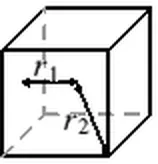
18. A cube exactly fits inside a sphere and another sphere exactly fits inside this cube. What is the ratio of the volume of the smaller sphere to the volume of the larger sphere?
Let the radii of the two spheres be \(r_1\) and \(r_2\), as shown. Applying Pythagoras' Theorem: \(r_2^2 = r_1^2 + r_1^2 + r_1^2\), so \(r_2 = \sqrt{3}r_1\). The ratio of the volumes of the spheres \(= r_1^3 : r_2^3 = 1 : (\sqrt{3})^3\), that is \(1 : 3\sqrt{3}\).
20. It takes two weeks to clean the 3312 panes of glass in the 6000 m2 glass roof of the British Museum, a task performed once every two years. Assuming that all the panes are equilateral triangles of the same size, roughly how long is the side of each pane?
Let the length in metres of the side of a pane be \(x\). Then the area of one pane \(= \tfrac{1}{2} \times x \times x \times \sin 60° = \tfrac{\sqrt{3}}{4}x^2\). So \[\frac{\sqrt{3}}{4}x^2 \approx \frac{6000}{3300},\ \text{that is}\ x^2 \approx \frac{4 \times 6000}{\sqrt{3} \times 3300}.\] We conclude that \(x^2 \approx \tfrac{7}{\sqrt{3}} \approx 4\).
We'd like to use Google Analytics cookies to count visits and see which pages help most. They're optional, and the site works exactly the same either way. Privacy policy