The whole Senior Mathematical Challenge 2006 paper, one question at a time in order (25 questions). Press Mark as done after each one: your marks add up below.
1. The promotion ‘AMAZING! 20% OFF ALL OUR BEDFRAMES’ appears on the cover of the 2006 brochure of a well-known furniture company. If 20% were to be taken off the length of a bedframe originally 2.10 m long, what would be the resulting length of the bedframe?
Subtracting the second equation from the first: \(6x - y - (6y - x) = 21 - 14\). So \(7x - 7y = 7\), that is \(x - y = 1\). (The equations may be solved to give \(x = 4\),\(y = 3\), but it is not necessary to do this in order to find the value of \(x - y\).)
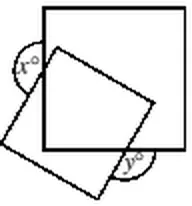
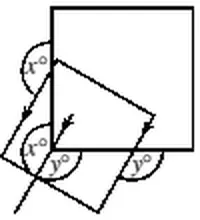
The overlapping region of the two squares is bounded by a pentagon. Two of the interior angles of this pentagon are vertically opposite the given angles of size \(x\)° and \(y\)°, whilst the other three interior angles are all right angles. So \(x + y + 3 \times 90 = 540\), that is \(x + y = 270\). (The diagram on the right also demonstrates that \(x + y = 270\).)
As 2006 is not a leap year, January 1st, 2007 will fall one day later in the week than January 1st, 2006, that is on a Monday. So there will be 53 Mondays in 2007 and 52 of each of the other days of the week.
6. Which symbol should replace \(\oplus\) to make the following equation true? \[1 \times 2 \times (3 \oplus 4 + 5) \times (6 \times 7 + 8 + 9) = 2006.\]
8. Matt black paint absorbs 97% of light, the remainder being reflected. Scientists have developed a new superblack coating, “10 times blacker” than matt black paint, meaning that it reflects \(\tfrac{1}{10}\) of the light reflected by matt black paint. What percentage of light does the new coating absorb?
Each spoke of the London Eye is about \(\tfrac{1}{20}\) mile long. As 1 mile is approximately 1600 m, this means that the radius of the giant wheel is roughly 80 m. So the circumference is approximately 500 m.
10. The digits 1, 2, 3, 4, 5, 6, 7, 8, and 9 are to be written in the squares so that every row and every column of three squares has a total of 13. Two numbers have already been entered. What is the value of \(n\)?
Let \(a\),\(b\),\(c\),\(d\),\(e\), \(f\) be the numbers in the squares shown. Then the sum of the numbers in the four lines is \(1 + 2 + 3 + \;\ldots\; + 9 + b + n + e\) since each of the numbers in the corner squares appears in exactly one row and one column. So \(45 + b + n + e = 4 \times 13 = 52\), that is \(b + n + e = 7\). Hence \(b\),\(n\), \(e\) are 1, 2, 4 in some order. If \(b = 2\) then \(a = 2\); if \(b = 4\) then \(a = 0\). Both cases are impossible, so \(b = 1\) and \(a = 3\). This means that \(n = 2\) or \(n = 4\). However, if \(n = 2\) then \(c = 10\), so \(n = 4\) and \(c = 8\). (The values of the other letters are \(e = 2\),\(d = 7\),\(f = 6\).)
11. Three consecutive even numbers are such that the sum of four times the smallest and twice the largest exceeds three times the second by 2006. What is the sum of the digits of the smallest number?
Let the smallest of the three even numbers be \(n\). Then the other two numbers are \(n + 2\) and \(n + 4\). So \(4n + 2(n + 4) = 3(n + 2) + 2006\), that is \(6n + 8 = 3n + 2012\), that is \(n = 668\).
12. The factorial of \(n\), written \(n!\), is defined by \(n! = 1 \times 2 \times 3 \times \;\ldots\; \times (n - 2) \times (n - 1) \times n\). Which of the following values of \(n\) provides a counterexample to the statement:
“If \(n\) is a prime number, then \(n! + 1\) is also a prime number”?
It is necessary to test only \(n = 2\),\(n = 3\), \(n = 5\) since the other two possible values are not prime. \(2! + 1 = 3\), which is prime; \(3! + 1 = 7\), which is prime; but \(5! + 1 = 121\), which is not prime. So \(n = 5\) provides the counterexample.
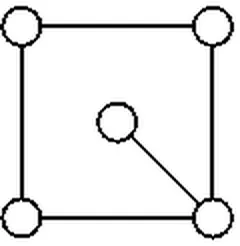
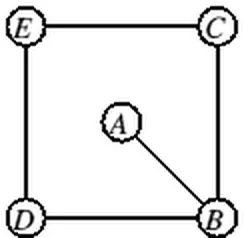
13. The diagram shows five discs connected by five line segments. Three colours are available to colour these discs. In how many different ways is it possible to colour all five discs if discs which are connected by a line segment are to have different colours?
Disc \(A\) may have any one of three colours and, for each of these, disc \(B\) may have two colours. So these two discs may be coloured in six different ways. If discs \(C\) and \(D\) have the same colour, then they may be coloured in two different ways and, for each of these, disc \(E\) may have two colours. So the discs may be coloured in 24 different ways if \(C\) and \(D\) are the same colour. However, if discs C and D are different colours, then \(C\) may have one of two colours, but the colours of discs \(D\) and \(E\) are then determined. So the discs may be coloured in 12 different ways if \(C\) and \(D\) are different colours. In total, therefore, the discs may be coloured in 36 different ways.
14. Heather and Rachel each has some pennies. Heather has more than Rachel. In fact, the number of pennies that Heather has is the square of the number that Rachel has. The total number of pennies they have between them makes a whole number of pounds. What is the smallest this total could be?
Let Rachel and Heather have \(x\) and \(x^2\) pennies respectively. So \(x + x^2 = 100n\), where \(x\) and \(n\) are positive integers. We require, therefore, that \(x(x + 1) = 100n = 2^2 \times 5^2 \times n\). Now \(x\) and \(x + 1\) cannot both be multiples of 5, so their product will be a multiple of 25 if and only if \(x\) or \(x + 1\) is a multiple of 25. The smallest value of \(x\) which satisfies this condition is 24 which is a multiple of 4 so 24 × 25 is a multiple of 100. Therefore Rachel has 24 pennies, Heather has 576 pennies and, in total, they have £6.
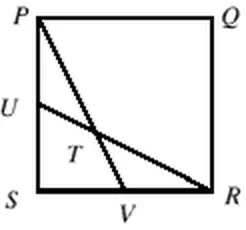
15. \(PQRS\) is a square with \(U\) and \(V\) the mid-points of the sides \(PS\) and \(SR\) respectively. Line segments \(PV\) and \(UR\) meet at \(T\). What fraction of the area of the square \(PQRS\) is the area of the quadrilateral \(PQRT\)?
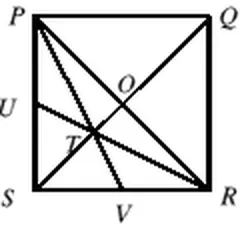
Let \(O\) be the centre of square \(PQRS\). The medians of triangle \(PSR\) intersect at \(T\) so \(OT = \tfrac{1}{3}OS\). Hence the area of triangle \(PTR\) is one third of the area of triangle \(PSR\), that is one sixth of the area of square \(PQRS\). So the required fraction \(= \tfrac{1}{6} + \tfrac{1}{2} = \tfrac{2}{3}\).
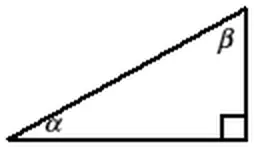
16. If \(\alpha < \beta\), how many different values are there among the following expressions? \[\sin\alpha\,\sin\beta \qquad\quad \sin\alpha\,\cos\beta \qquad\quad \cos\alpha\,\sin\beta \qquad\quad \cos\alpha\,\cos\beta\]
As \(\alpha + \beta = 90°\),\(\sin\alpha = \cos\beta\);\(\cos\alpha = \sin\beta\). So \(\sin\alpha\,\sin\beta = \sin\alpha\,\cos\alpha\);\(\sin\alpha\,\cos\beta = \sin^2\alpha\);\(\cos\alpha\,\sin\beta = \cos^2\alpha\);\(\cos\alpha\,\cos\beta = \cos\alpha\,\sin\alpha\). As \(\alpha < \beta\),\(\alpha \neq 45°\). So \(\sin\alpha \neq \cos\alpha\). Thus three of the four expressions have different values.
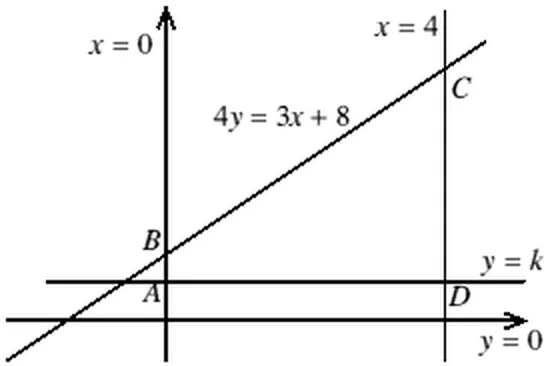
17. A trapezium is bounded by four lines, the equations of which are \(x = 0\),\(x = 4\), \(4y = 3x + 8\) and \(y = k\), where \(k < 2\). For which value of \(k\) is the numerical value of the perimeter of the trapezium equal to the numerical value of the area of the trapezium?
The trapezium in question is shown as \(ABCD\) in the diagram. The coordinates of its vertices are \(A(0,\ k)\),\(B(0,\ 2)\),\(C(4,\ 5)\),\(D(4,\ k)\). Using Pythagoras' Theorem: \(BC = \sqrt{4^2 + 3^2} = 5\). The perimeter of \(ABCD = (2 - k) + 5 + (5 - k) + 4\) \(= 16 - 2k\). The area of \(ABCD = 4(2 - k) + \tfrac{1}{2} \times 4 \times 3\) \(= 14 - 4k\). So \(16 - 2k = 14 - 4k\), that is \(k = -1\). (In the diagram it was assumed that \(k > 0\), although it transpires that \(k < 0\). However, this does not affect the validity of the solution.)
18. What is the greatest number of the following five statements about numbers \(a\), \(b\) which can be true at the same time? \[\tfrac{1}{a} < \tfrac{1}{b} \qquad\qquad a^2 > b^2 \qquad\qquad a < b \qquad\qquad a < 0 \qquad\qquad b < 0\]
It is not possible for all five statements to be true at the same time since if \(a < b\),\(a < 0\), \(b < 0\) are all true then \(\tfrac{1}{a} < \tfrac{1}{b}\) is not true since \(\tfrac{1}{b} - \tfrac{1}{a} = \tfrac{a - b}{ab}\) which is negative. However, when these three statements are true, \(a^2 > b^2\) is also true, so it is possible for four of the statements to be true at the same time.
19. An engineer is directed to a faulty signal, one quarter of the way into a tunnel. Whilst there, he is warned of a train heading towards the tunnel entrance. The engineer can run at 12 mph and can either run back to the tunnel entrance or forward to the exit. In either case, the engineer and the front of the train would reach the entrance or exit together. What is the speed in mph of the train?
Let the length of the tunnel and the distance from the front of the train to the entrance of the tunnel when the engineer receives the warning be \(l\) and \(x\) respectively. If the engineer runs to the exit of the tunnel, he will take three times as long as he would if he ran to the entrance. So the train takes three times as long to travel a distance \(x + l\) as it does to travel a distance \(x\). Hence \(l = 2x\). The train, therefore, travels a distance \(x\) in the same time that the engineer would take to travel \(\tfrac{1}{2}l\), that is to travel \(\tfrac{1}{2}x\). So the speed of the train is twice that of the engineer.
20. A positive number \(a = [a] + \{a\}\) where \([a]\) is the integer part of \(a\) and \(\{a\}\) is the fractional part of \(a\). Given that \(x + [y] + \{z\} = 4.2\),\(y + [z] + \{x\} = 3.6\),\(z + [x] + \{y\} = 2.0\), and \(x\),\(y\),\(z > 0\), what is the value of \(\{y\}\) ?
Adding all three equations: \(x + [y] + \{z\} + y + [z] + \{x\} + z + [x] + \{y\} = 4.2 + 3.6 + 2.0 = 9.8\). Now \([x] + \{x\} = x\),\([y] + \{y\} = y\),\([z] + \{z\} = z\), so \(2x + 2y + 2z = 9.8\), that is \(x + y + z = 4.9\). Therefore: \(x + y + z - (x + [y] + \{z\}) = 4.9 - 4.2\), that is \(\{y\} + [z] = 0.7\). So \([z] = 0\),\(\{y\} = 0.7\). (It is not necessary to find the values of \(x\),\(y\), \(z\) to solve this problem, but their values may be shown to be 1.9, 2.7, 0.3 respectively.)
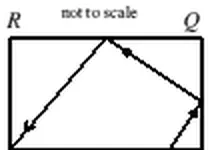
21. A toy pool table is 6 feet long and 3 feet wide. It has pockets at each of the four corners \(P\),\(Q\), \(R\) and \(S\). When a ball hits a side of the table, it bounces off the side at the same angle as it hit that side. A ball, initially 1 foot to the left of pocket \(P\), is hit from the side \(SP\) towards the side \(PQ\) as shown.
How many feet from \(P\) does the ball hit side \(PQ\) if it lands in pocket \(S\) after two bounces?
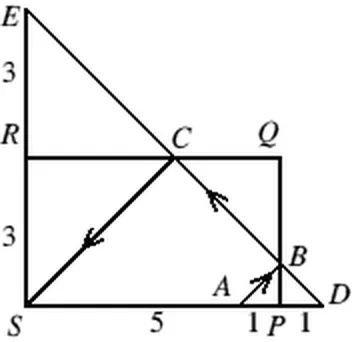
The route of the ball is \(A \rightarrow B \rightarrow C \rightarrow S\). The diagram also shows point \(D\), the reflection of point \(A\) in \(PQ\), and point \(E\), the reflection of point \(S\) in \(QR\). As the ball bounces off a side at the same angle at which it hits that side, points \(D\),\(B\),\(C\), \(E\) lie in a straight line. Triangles \(DPB\) and \(DSE\) are similar since both are right-angled and they have a common angle at \(D\). So \(\tfrac{BP}{PD} = \tfrac{ES}{SD} = \tfrac{6}{7}\). Hence \(BP = \tfrac{6}{7}\).
The terms on the left-hand side of the equation form an arithmetic progression which has \(n^3 - 5\) terms. So the sum of these terms is \(\dfrac{n^3 - 5}{2}\left(\dfrac{3}{n^3} + \dfrac{n^3 - 3}{n^3}\right) = \dfrac{n^3 - 5}{2}\). Hence \(n^3 - 5 = 120\), so \(n = 5\).
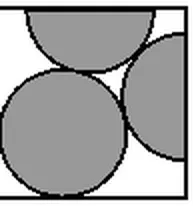
Let the vertices of the square be \(A\),\(B\),\(C\), \(D\) and the centres of the circle and the two semicircles be \(P\),\(Q\),\(R\), as shown. The midpoint of \(QR\) is \(S\). By symmetry, \(P\) and \(S\) both lie on diagonal \(BD\) of square \(ABCD\) and the whole figure is symmetrical about \(BD\). As \(P\) is distance 1 from both \(AD\) and \(DC\), the length of \(DP\) is \(\sqrt{2}\). As the circles and semicircles are mutually tangent, \(PQR\) is an equilateral triangle of side 2, so the length of \(PS\) is \(\sqrt{3}\). As angles \(QBS\) and \(BSQ\) are 45° and 90° respectively, triangle \(SBQ\) is isosceles, so \(SB = SQ = 1\). Hence the length of \(BD\) is \(\sqrt{2} + \sqrt{3} + 1\). Now the length of the side of the square is \(BD \div \sqrt{2}\) so the perimeter of the square is \(4 \times (BD \div \sqrt{2})\), that is \(2\sqrt{2} \times BD\). So the perimeter is \(2\sqrt{2}\,(\sqrt{2} + \sqrt{3} + 1)\), that is \(4 + 2\sqrt{6} + 2\sqrt{2}\).
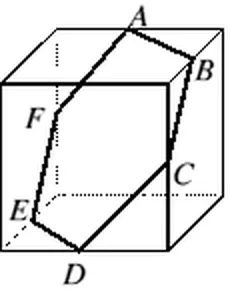
24. A solid red plastic cube, volume 1 cm3, is painted white on its outside. The cube is cut by a plane passing through the mid-points of various edges, as shown. What, in cm2, is the total red area exposed by the cut?
Let \(O\) be the centre of the cube. Consider triangle \(ABO\): from Pythagoras' Theorem, \(OA = AB = BO = \sqrt{\left(\tfrac{1}{2}\right)^2 + \left(\tfrac{1}{2}\right)^2}\) cm \(= \tfrac{1}{\sqrt{2}}\) cm. So triangle \(OAB\) is equilateral. A similar argument may be applied to triangles \(OBC\), \(OCD\) etc. The area of each of these equilateral triangles is \(\tfrac{1}{2} \times \tfrac{1}{\sqrt{2}} \times \tfrac{1}{\sqrt{2}} \times \sin 60°\) cm2, that is \(\tfrac{1}{8}\sqrt{3}\) cm2. So the area of hexagon \(ABCDEF\) is \(6 \times \tfrac{\sqrt{3}}{8}\) cm2. However, the total red area exposed by the cut is twice the area of this hexagon, that is \(\tfrac{3\sqrt{3}}{2}\) cm2.
25. \(X\) is a positive integer in which each digit is 1; that is, \(X\) is of the form 11111… . Given that every digit of the integer \(pX^2 + qX + r\) (where \(p\), \(q\) and \(r\) are fixed integer coefficients and \(p > 0\)) is also 1, irrespective of the number of digits \(X\), which of the following is a possible value of \(q\)?
Let \(X\) consist of \(x\) digits, each of which is 1. So \(X = \tfrac{10^x - 1}{9}\). Let \(pX^2 + qX + r\) consist of \(y\) digits, each of which is 1. So \(pX^2 + qX + r = \tfrac{10^y - 1}{9}\). Then \(p\left(\tfrac{10^x - 1}{9}\right)^2 + q\left(\tfrac{10^x - 1}{9}\right) + r = \tfrac{10^y - 1}{9}\), that is \(p(10^{2x} - 2 \times 10^x + 1) + 9q(10^x - 1) + 81r = 9(10^y - 1)\), that is (on dividing throughout by \(10^{2x}\)) \(p + (9q - 2p)10^{-x} + (p - 9q + 81r)10^{-2x} = 9 \times 10^{y - 2x} - 9 \times 10^{-2x}\). We now let \(x\) tend to infinity (through integer values). The LHS of the above equation tends to \(p\), and the second term on the right goes to 0. By continuity of the function \(f(u) = 10^u = e^{u \log 10}\), we can deduce that \(y - 2x\) must tend to a limit. Let this limit be \(L\). Since \(y - 2x\) is always an integer, it must actually equal \(L\) for all \(x\) sufficiently large. Passing to the limit, therefore, we obtain \(p = 9 \times 10^L\). Since \(p\) is to be an integer, we must have that \(L\) (also an integer) is a non-negative integer. Substituting for \(p\) in the previous equation and simplifying leads to \[9q - 18 \times 10^L + (9 \times 10^L - 9q + 81r)10^{-x} = -9 \times 10^{-x}.\] Passing to the limit again leads to \(q = 2 \times 10^L\) and the previous line then also gives \(9 \times 10^L - 18 \times 10^L + 81r = -9\). So \(r = \tfrac{10^L - 1}{9}\). Possible values of \((p,\ q,\ r)\) therefore are (9, 2, 0), (90, 20, 1), (900, 200, 11), etc. So of the values given in the question for \(q\), only \(q = 2\) is possible. (Observe that the three triples above correspond to \(L = 0\),\(L = 1\), \(L = 2\) respectively and we note that increasing L by 1 corresponds to multiplying \(pX^2 + qX + r\) by 10 and adding 1. As \(pX^2 + qX + r\) consists only of 1s, \(10\,(pX^2 + qX + r) + 1\) will also consist only of 1s, explaining why there is an infinite family of quadratics which satisfy the required condition.)
We'd like to use Google Analytics cookies to count visits and see which pages help most. They're optional, and the site works exactly the same either way. Privacy policy