The whole Senior Mathematical Challenge 2011 paper, one question at a time in order (25 questions). Press Mark as done after each one: your marks add up below.
Every integer is divisible by 1; 2012 is divisible by 2 since it is even; 2013 is divisible by 3 since its digits total to a multiple of 3; and 2015 is divisible by 5 since its last digit is 5. However, 2014 is not divisible by 4 because 14 is not.
2. Jack and Jill went up the hill to fetch a pail of water. Having filled the pail to the full, Jack fell down, spilling \(\tfrac{2}{3}\) of the water, before Jill caught the pail. She then tumbled down the hill, spilling \(\tfrac{2}{5}\) of the remainder. What fraction of the pail does the remaining water fill?
After the first spill, \(\tfrac{1}{3}\) of the water remains. After the second spill, \(\tfrac{3}{5} \times \tfrac{1}{3}\) of the water remains, hence \(\tfrac{1}{5}\) of the pail had water left in it.
3. The robot Lumber9 moves along the number line. Lumber9 starts at 0, takes 1 step forward (to 1), then 2 steps backward (to −1), then 3 steps forward, 4 steps backward, and so on, moving alternately forwards and backwards, one more step each time. At what number is Lumber9 after 2011 steps?
After the \(n\) th step, Lumber9 is at number: \(\begin{cases} \frac{n+1}{2} & \text{for } n \text{ odd,} \\ \frac{-n}{2} & \text{for } n \text{ even.} \end{cases}\) Hence when \(n = 2011\),Lumber9 is at number \(\tfrac{2011 + 1}{2} = 1006\).
Since \(3^1 = 3\),\(3^2 = 9\),\(3^3 = 27\),\(3^4 = 81\), \(3^5 = 243, \ldots\) we see that the final digits cycle through the four numbers 3, 9, 7, 1. As \(2011 = 502 \times 4 + 3\), the last digit of \(3^{2011}\) is 7.
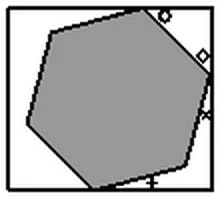
As the sum of the angles in a triangle is 180° and all four angles in a rectangle are 90°, the sum of the two marked angles in the triangle is \(180° - 90° = 90°\). Each interior angle of a regular hexagon is 120° and the sum of the angles in a quadrilateral is 360°; hence the sum of the two marked angles in the quadrilateral is \(360° - 90° - (360° - 120°) = 30°\). Hence the sum of the four marked angles is \(90° + 30° = 120°\).
6. Granny and her granddaughter Gill both had their birthday yesterday. Today, Granny's age in years is an even number and 15 times that of Gill. In 4 years' time Granny's age in years will be the square of Gill's age in years. How many years older than Gill is Granny today?
7. Two sides of a triangle have lengths 4 cm and 5 cm. The third side has length \(x\) cm, where \(x\) is a positive integer. How many different values can \(x\) have?
In order to form a triangle, \(x\) must exceed the difference between 4 and 5 and \(x\) must be less than the sum of 4 and 5, i.e. \(1 < x < 9\). Hence \(x = 2, 3, 4, 5, 6, 7\) or 8. So \(x\) can have 7 different values.
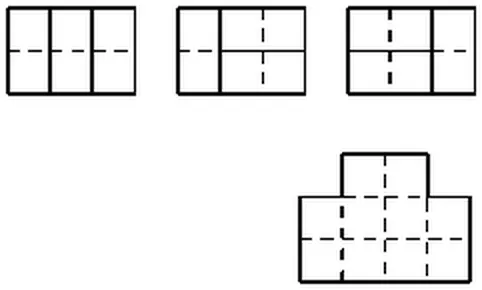
The \(1 \times 2\) rectangles can appear in two different ways: A or B . If, in the given shape, A forms the top \(1 \times 2\) rectangle then the possible different ways to fill the remaining \(2 \times 4\) rectangle are, from left to right:
A, A, A, A; A, A, B, B; B, A, A, B; B, B, A, A; B, B, B, B.
If A does not form the top \(1 \times 2\) rectangle, then the only possible way is to use 4B and an A. Hence there are 6 ways of dividing the given shape into \(1 \times 2\) rectangles.
9. Sam has a large collection of \(1 \times 1 \times 1\) cubes, each of which is either red or yellow. Sam makes a \(3 \times 3 \times 3\) block from twenty-seven cubes, so that no cubes of the same colour meet face-to-face. What is the difference between the largest number of red cubes that Sam can use and the smallest number?
Let the centre cube in the \(3 \times 3 \times 3\) block be red. As no cubes of the same colour meet face-to-face then the 6 centre cubes on the outer faces must be yellow. All six outer faces are as shown alongside. Thus 14 faces are yellow and 13 faces are red. If the centre cube is yellow then the situation is reversed. Hence the difference between the largest number of red cubes that Sam can use and the smallest number is 1.
10. A triangle has two edges of length 5. What length should be chosen for the third side of the triangle so as to maximise the area within the triangle?
The area of a triangle is \(\tfrac{1}{2}ab\sin C\). The maximum area is attained when \(\angle C = 90°\). Hence, in order to maximise the area, the triangle must be right-angled with common side lengths equal to 5. Let \(x\) be the side length of the hypotenuse, so, by Pythagoras' Theorem, \(x^2 = 5^2 + 5^2 = 50\). Thus \(x = 5\sqrt{2}\) is the length that should be chosen.
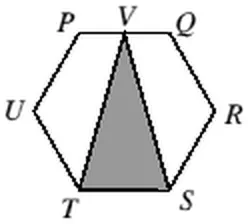
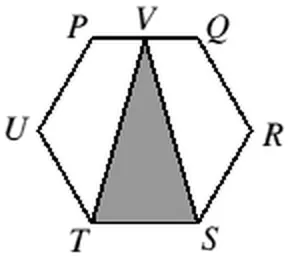
Let \(x\) be the side length of the regular hexagon \(PQRSTU\) and let \(h = PT = QS\), the perpendicular height of triangle \(STV\). Thus the area of triangle \(STV\) is \(\tfrac{1}{2}xh\) and the areas of triangles \(PTV\) and \(QSV\) are both \(\tfrac{1}{2}\left(\tfrac{1}{2}xh\right) = \tfrac{1}{4}xh\). The perpendicular heights of triangles \(PTU\) and \(QRS\) are
Hence the area of each of triangles \(PTU\) and \(QRS\) is \(\tfrac{1}{2}h \times \tfrac{1}{2}x = \tfrac{1}{4}hx\). Therefore the area of triangle \(STV\) is one third of the area of \(PQRSTU\).
12. The primorial of a number is the product of all of the prime numbers less than or equal to that number. For example, the primorial of 6 is \(2 \times 3 \times 5 = 30\). How many different whole numbers have a primorial of 210?
The primorial of 7 is \(2 \times 3 \times 5 \times 7 = 210\). As 8, 9 and 10 are not prime numbers, they also have a primorial of 210. The primorial of 11 is \(2 \times 3 \times 5 \times 7 \times 11 = 2310\). Hence there are exactly four different whole numbers which have a primorial of 210.
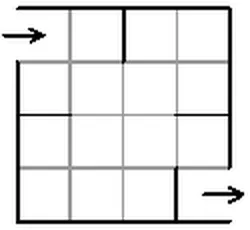
13. The diagram represents a maze. Given that you can only move horizontally and vertically and are not allowed to revisit a square, how many different routes are there through the maze?
Let the centres of the starting and finishing squares in the maze have coordinates (1,4) and (4,1) respectively. Each path must pass through (2,3) and (3,2). There are two different routes from (1,4) to (2,3). The next visit is to (3,3) or (2,2). When visiting (3,3) the next visit has to be (3,2) as (3,4), (4,3) and (4,4) cannot be visited without subsequently revisiting a square. From (2,2) the next valid visit is to (1,2), (2,1) or (3,2). From each of these points there is only one route to (3,2). Thus there are four ways of visiting (3,2). Upon visiting (3,2), the only valid route through the maze is (4,2) then (4,1). Hence the number of different routes through the maze is \(2 \times 4 = 8\).
14. An equilateral triangle of side length 4 cm is divided into smaller equilateral triangles, all of which have side length equal to a whole number of centimetres. Which of the following cannot be the number of smaller triangles obtained?
Let us define \(T_n\) to represent an equilateral triangle with side length \(n\) cm. Then an equilateral triangle of side length 4 cm can be divided into smaller equilateral triangles as follows:
\(1 \times T_3\) and \(7 \times T_1\)
\(4 \times T_2\)
\(3 \times T_2\) and \(4 \times T_1\)
\(2 \times T_2\) and \(8 \times T_1\)
\(1 \times T_2\) and \(12 \times T_1\)
\(16 \times T_1\).
The number of triangles used are: 8, 4, 7, 10, 13 and 16. So it is not possible to dissect the original triangle into 12 triangles.
If \(a\), \(b\) are roots of \(x^2 + ax + b = 0\) then \(x^2 + ax + b = 0\) must be \((x - a)(x - b) = 0\). As \((x - a)(x - b) = x^2 + (-a - b)x + ab\) then \(a = -a - b\) and \(b = ab\). If \(b = 0\) we see immediately that \(a = 0\). But this is not possible as \(a\) and \(b\) are different. If \(b \neq 0\) then \(a = 1\) and \(b = -2\). So there is just one solution pair.
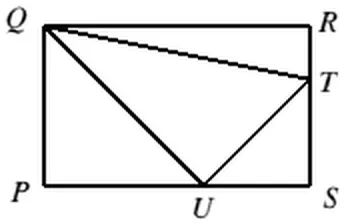
16.PQRS is a rectangle. The area of triangle QRT is \(\tfrac{1}{5}\) of the area of PQRS, and the area of triangle TSU is \(\tfrac{1}{8}\) of the area of PQRS. What fraction of the area of rectangle PQRS is the area of triangle QTU?
Let \(QR = x\) and \(RS = y\) in the rectangle \(PQRS\). Hence the area of \(PQRS\) is \(xy\). The area of triangle \(QRT\) is \(\tfrac{1}{2}RT \times x = \tfrac{1}{5}xy\), hence \(RT = \tfrac{2}{5}y\). Thus \(TS = RS - RT = \tfrac{3}{5}y\). The area of triangle \(TSU\) is \(\tfrac{1}{2}SU \times \tfrac{3}{5}y = \tfrac{1}{8}xy\), hence \(SU = \tfrac{5}{12}x\). Therefore the area of triangle \(PUQ\) is \(\tfrac{1}{2} \times \tfrac{7}{12}xy = \tfrac{7}{24}xy\). Hence, as a fraction of the area of rectangle \(PQRS\), the area of triangle \(QTU\) is
17. Jamie conducted a survey on the food preferences of pupils at a school and discovered that 70% of the pupils like pears, 75% like oranges, 80% like bananas and 85% like apples. What is the smallest possible percentage of pupils who like all four of these fruits?
Let \(a\),\(b\), \(o\) and \(p\) represent the percentage of pupils liking apples, bananas, oranges and pears respectively. As \(a = 85\), there are 15% of pupils who do not like apples. As \(b = 80\), \(a \cap b\) is greater than or equal to \(80 - (100 - 85) = 65\). As \(o = 75\), \(a \cap b \cap o\) is greater than or equal to \(75 - (100 - 65) = 40\). Finally, as \(p = 70\), \(a \cap b \cap o \cap p\) is greater than or equal to \(70 - (100 - 40) = 10\). Hence the percentage of pupils who like all four fruits is at least 10%.
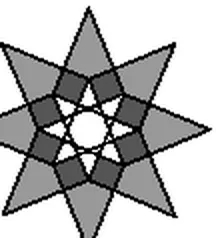
19. The diagram shows a small regular octagram (an eight-sided star) surrounded by eight squares (dark grey) and eight kites (light grey) to make a large regular octagram. Each square has area 1. What is the area of one of the light grey kites?
As each square has area 1 its side length must be 1. The external angle of the small regular octagon is \(\tfrac{1}{8} \times 360° = 45°\). Hence, as the sum of the angles on a straight line is 180° and the sum of the angles in a kite is 360°, the four angles in each of the eight kites (white) are: 90°, 90°, 135° and 45°. As the light grey kites and the white kites are similar, the interior angles are the same. Two of the sides of the grey kite have length 1. Let the other sides have length \(a\). Using the Cosine Rule twice within a light grey kite, the square of the short diagonal is \(1^2 + 1^2 - 2 \times 1 \times 1\cos 135° = a^2 + a^2 - 2a \times a\cos 45°\). Hence \(2 + 2 \times 1/\sqrt{2} = 2a^2 - 2a^2 \times 1/\sqrt{2}\). Thus \(a^2 = \dfrac{1 + \frac{1}{\sqrt{2}}}{1 - \frac{1}{\sqrt{2}}} = \dfrac{\sqrt{2} + 1}{\sqrt{2} - 1}\) and so \(a = \sqrt{2} + 1\). But the area of one of the light grey kites is \(2 \times \tfrac{1}{2}a \times 1 = a\). Hence the area of one of the light grey kites is \(\sqrt{2} + 1\).
20. Positive integers \(x\) and \(y\) satisfy the equation \(\sqrt{x} - \sqrt{11} = \sqrt{y}\). What is the maximum possible value of \(\dfrac{x}{y}\) ?
Squaring the equation \(\sqrt{x} - \sqrt{11} = \sqrt{y}\) gives \(x - 2\sqrt{11x} + 11 = y \ldots (1)\). You see here that \(2\sqrt{11x}\) is an integer. Thus \(x = 11a^2\) for some integer \(a\). Hence in (1), \(y = 11a^2 - 22a + 11 = 11(a^2 - 2a + 1)\). Thus \(\dfrac{x}{y} = \left(\dfrac{a}{a - 1}\right)^2\) whose maximum value, for integer \(a\), is easily seen to be \(\left(\tfrac{2}{1}\right)^2 = 4\).
21. Each of the Four Musketeers made a statement about the four of them, as follows.
d'Artagnan: “Exactly one is lying.” Athos: “Exactly two of us are lying.” Porthos: “An odd number of us is lying.” Aramis: “An even number of us is lying.”
How many of them were lying (with the others telling the truth)?
At least one of d'Artagnan and Athos is lying. One of Porthos or Aramis is telling the truth and the other is lying. So the number of liars is either two (d'Artagnan and Porthos) or three (all except Porthos).
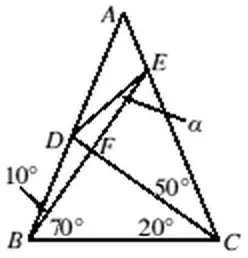
22. In the diagram, \(\angle ABE = 10°\);\(\angle EBC = 70°\);\(\angle ACD = 50°\);\(\angle DCB = 20°\);\(\angle DEF = \alpha\). Which of the following is equal to \(\tan\alpha\)?
As the sum of the angles in a triangle is 180°, in triangle \(CBF\),\(\angle BFC = 90°\). As vertically opposite angles are equal \(\angle DFE = \angle BFC = 90°\). As the sum of the angles on a straight line is 180°, \(\angle DFB = \angle EFC = 90°\). Hence in triangle \(EFD\),\(\tan\alpha = \tfrac{DF}{EF}\): in triangle \(DFB\),\(\tan 10° = \tfrac{DF}{FB}\): in triangle \(BFC\), \(\tan 20° = \tfrac{FB}{FC}\) and in triangle \(CEF\),\(\tan 50° = \tfrac{EF}{FC}\). Thus \(\tan\alpha = \tfrac{DF}{EF} = \tfrac{\tan 10° FB}{EF} = \tfrac{\tan 10°\ \tan 20° FC}{EF} = \tfrac{\tan 10°\ \tan 20°}{\tan 50°}\).
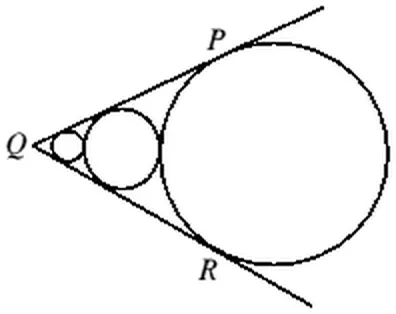
24. Three circles and the lines PQ and QR touch as shown. The distance between the centres of the smallest and the biggest circles is 16 times the radius of the smallest circle. What is the size of \(\angle PQR\)?
Let the radii of the circles from smallest to largest be \(r_1\), \(r_2\) and \(r_3\) respectively. Hence \(16r_1 = r_3 + 2r_2 + r_1\), thus \(r_3 = 15r_1 - 2r_2 \ldots (1)\). Let \(r_1 + x\) be the distance from \(Q\) to the centre of the smallest circle. By similar triangles,
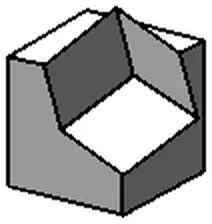
25. A solid sculpture consists of a \(4 \times 4 \times 4\) cube with a \(3 \times 3 \times 3\) cube sticking out, as shown. Three vertices of the smaller cube lie on edges of the larger cube, the same distance along each. What is the total volume of the sculpture?
Three vertices of the smaller cube lie on edges of the larger cube, the same distance along each. Let this distance be \(x\) and let the distance between any two of these vertices be \(y\). Hence, by Pythagoras' Theorem, \(y^2 = x^2 + x^2\) and, as the side length of the smaller cube is 3, \(y^2 = 3^2 + 3^2\). Thus \(x = 3\) and \(y = 3\sqrt{2}\). The intersection of the cubes forms two congruent tetrahedra of base area equal to \(\tfrac{1}{2}y^2\sin 60° = \tfrac{1}{2}(3\sqrt{2})^2 \times \tfrac{\sqrt{3}}{2} = \tfrac{9\sqrt{3}}{2}\). Let \(h\) be the perpendicular height of the tetrahedra. Hence, using Pythagoras' Theorem twice gives \(9 = h^2 + 6\), thus \(h = \sqrt{3}\). Thus the total volume of the sculpture is \(4^3 + 3^3 - 2 \times \tfrac{1}{3} \times \tfrac{9\sqrt{3}}{2} \times \sqrt{3} = 91 - 9 = 82\).
We'd like to use Google Analytics cookies to count visits and see which pages help most. They're optional, and the site works exactly the same either way. Privacy policy

 or B
 .