The whole Senior Mathematical Challenge 2012 paper, one question at a time in order (25 questions). Press Mark as done after each one: your marks add up below.
If an odd number is written as the sum of two prime numbers then one of those primes is 2, since 2 is the only even prime. However, 9 is not prime so 11 cannot be written as the sum of two primes. Note that \(5 = 2 + 3\);\(7 = 2 + 5\);\(9 = 2 + 7\);\(10 = 3 + 7\), so 11 is the only alternative which is not the sum of two primes.
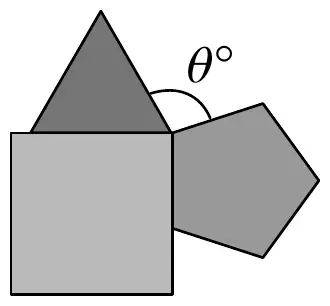
The interior angles of an equilateral triangle, square, regular pentagon are 60°, 90°, 108° respectively. The sum of the angles at a point is 360°. So \(\theta = 360 - (60 + 90 + 108) = 102\).
3. The price of my favourite soft drink has gone up by leaps and bounds over the past ten years. In four of those years it has leapt up by 5p each year, whilst in the other six years it has bounded up by 2p each year. The drink cost 70p in 2002. How much does it cost now?
4. According to one astronomer, there are one hundred thousand million galaxies in the universe, each containing one hundred thousand million stars. How many stars is that altogether?
Let the required addition be ‘\(ab\)’ + ‘\(cd\)’ + ‘\(ef\)’, where \(a\),\(b\),\(c\),\(d\),\(e\), \(f\) are single, distinct digits. To make this sum as large as possible, we need \(a\),\(c\), \(e\) (the tens digits) as large as possible; so they must be 7, 8, 9 in some order. Then we need \(b\),\(d\), \(f\) as large as possible, so 4, 5, 6 in some order. Hence the largest sum is \(10(7 + 8 + 9) + (4 + 5 + 6) = 10 \times 24 + 15 = 255\).
6. What is the sum of the digits of the largest 4-digit palindromic number which is divisible by 15? [Palindromic numbers read the same backwards and forwards, e.g. 7227.]
In order to be a multiple of 15, a number must be a multiple both of 3 and of 5. So its units digit must be 0 or 5. However, the units digit must also equal the thousands digit and this cannot be 0, so the required number is of the form ‘5\(aa\)5’. The largest such four-digit numbers are 5995, 5885, 5775. Their digit sums are 28, 26, 24 respectively. In order to be a multiple of 3, the digit sum of a number must also be a multiple of 3, so 5775 is the required number. The sum of its digits is 24.
Add the first and third equations: \(2x = 4\), so \(x = 2\). Add the first two equations: \(2x + 2y = 3\), so \(y = -\tfrac{1}{2}\). Substitute for \(x\) and \(y\) in the first equation: \(2 + \left(-\tfrac{1}{2}\right) + z = 1\) so \(z = -\tfrac{1}{2}\). Therefore \(xyz = 2 \times \left(-\tfrac{1}{2}\right) \times \left(-\tfrac{1}{2}\right) = \tfrac{1}{2}\).
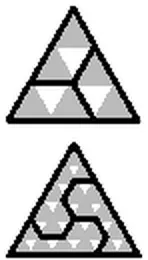
8. The diagrams below show four types of tile, each of which is made up of one or more equilateral triangles. For how many of these types of tile can we place three identical copies of the tile together, without gaps or overlaps, to make an equilateral triangle?
If an equilateral triangle is split into a number of smaller identical equilateral triangles then there must be one small triangle in the top row, three small triangles in the row below, five small triangles in the row below that and so on. So the total number of small triangles is 4 or 9 or 16 etc. These are all squares and it is left to the reader to prove that the sum of the first \(n\) odd numbers is \(n^2\). So, for three copies of a given tile to form an equilateral triangle, the number of triangles which comprise the tile must be one third of a square number. Only the tiles made up of three equilateral triangles and twelve equilateral triangles satisfy this condition. However, it is still necessary to show that three copies of these tiles can indeed make equilateral triangles. The diagrams above show how they can do this.
9. Pierre said, “Just one of us is telling the truth”. Qadr said, “What Pierre says is not true”. Ratna said, “What Qadr says is not true”. Sven said, “What Ratna says is not true”. Tanya said, “What Sven says is not true”. How many of them were telling the truth?
If Pierre is telling the truth then Qadr is not telling the truth. However, this means that Ratna is telling the truth, so this leads to a contradiction as Pierre stated that just one person is telling the truth. So Pierre is not telling the truth, which means that Qadr is telling the truth, but Ratna is not telling the truth. This in turn means that Sven is telling the truth, but Tanya is not. So only Qadr and Sven are telling the truth.
It can be deduced that \(N\) must consist of at least 224 digits since the largest 223-digit positive integer consists of 223 nines and has a digit sum of 2007. It is possible to find 224-digit positive integers which have a digit sum of 2012. The largest of these is 99 999 ...999 995 and the smallest is 59 999 ...999 999. So \(N = 59\,999\ldots\ 999\,999\) and \(N + 1 = 60\,000\ldots\ 000\,000\) (223 zeros).
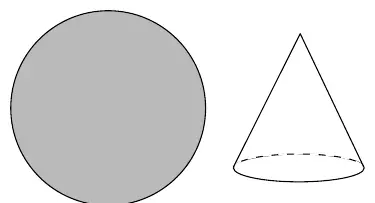
11. Coco is making clown hats from a circular piece of cardboard. The circumference of the base of each hat equals its slant height, which in turn is equal to the radius of the piece of cardboard. What is the maximum number of hats that Coco can make from the piece of cardboard?
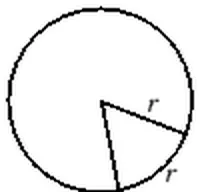
Let the radius of the circular piece of cardboard be \(r\). The diagram shows a sector of the circle which would make one hat, with the minor arc shown becoming the circumference of the base of the hat. The circumference of the circle is \(2\pi r\). Now \(6r < 2\pi r < 7r\). This shows that we can cut out 6 hats in this fashion and also shows that the area of cardboard unused in cutting out any 6 hats is less than the area of a single hat. Hence there is no possibility that more than 6 hats could be cut out.
Two different ways of expressing 5 are 1 + 4 and 4 + 1. In the following list these are denoted as {1, 4: two ways}. The list of all possible ways is {5: one way}, {2, 3: two ways}, {1, 4: two ways}, {1, 2, 2: three ways}, {1, 1, 3: three ways}, {1, 1, 1, 2: four ways}, {1, 1, 1, 1, 1: one way}. So in total there are 16 ways. {Different expressions of a positive integer in the above form are known as ‘partitions’. It may be shown that the number of distinct compositions of a positive integer n is\(2^{n-1}\).}
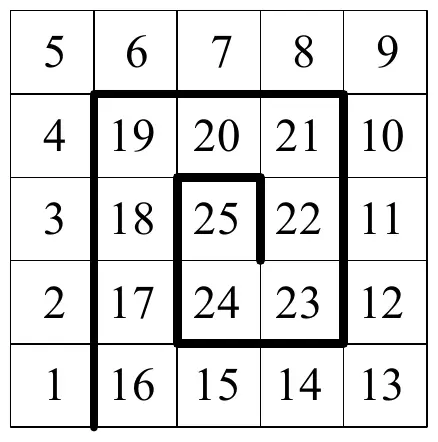
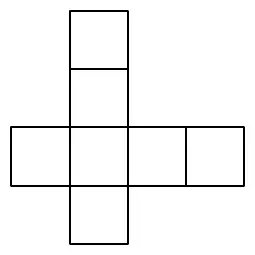
13. A cube is placed with one face on square 1 in the maze shown, so that it completely covers the square with no overlap. The upper face of the cube is covered in wet paint. The cube is then ‘rolled’ around the maze, rotating about an edge each time, until it reaches square 25. It leaves paint on all of the squares on which the painted face lands, but on no others. The cube is removed on reaching the square 25. What is the sum of the numbers on the squares which are now marked with paint?
The table below shows the position of the face marked with paint when the base of the cube is on the 25 squares. Code: T - top, B - base; F - front; H - hidden (rear); L - left; R - right.
1
2
3
4
5
6
7
8
9
10
11
12
13
14
15
16
17
18
19
20
21
22
23
24
25
T
H
B
F
T
R
B
L
T
F
B
H
T
L
B
R
R
R
R
B
L
L
L
B
F
So the required sum is \(3 + 7 + 11 + 15 + 20 + 24 = 80\).
14. Six students who share a house all speak exactly two languages. Helga speaks only English and German; Ina speaks only German and Spanish; Jean-Pierre speaks only French and Spanish; Karim speaks only German and French; Lionel speaks only French and English whilst Mary speaks only Spanish and English. If two of the students are chosen at random, what is the probability that they speak a common language?
Note that each student has a language in common with exactly four of the other five students. For instance, Jean-Pierre has a language in common with each of Ina, Karim, Lionel and Mary. Only Helga does not have a language in common with Jean-Pierre. So whichever two students are chosen, the probability that they have a language in common is 4/5.
15. Professor Rosseforp runs to work every day. On Thursday he ran 10% faster than his usual average speed. As a result, his journey time was reduced by \(x\) minutes. How many minutes did the journey take on Wednesday?
Let Professor Rosseforp's usual journey take \(t\) minutes at an average speed of \(v\) metres/minute. Then the distance to work is \(vt\) metres. On Thursday his speed increased by 10%, i.e. it was \(11v/10\) metres/minute. The time taken was \((t - x)\) minutes. Therefore \(11v/10 \times (t - x) = vt\). So \(11(t - x) = 10t\), i.e. \(t = 11x\).
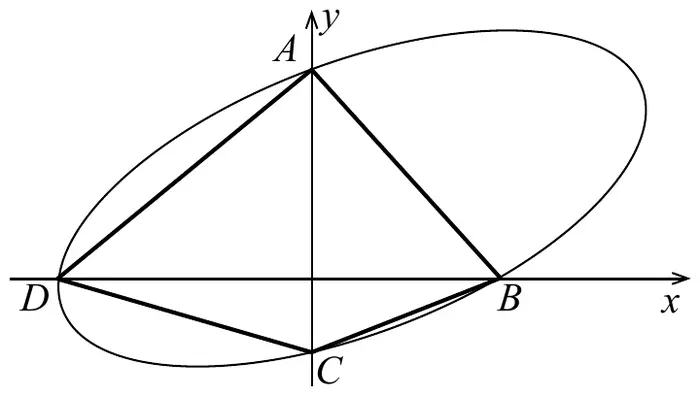
16. The diagram shows the ellipse whose equation is \(x^2 + y^2 - xy + x - 4y = 12\). The curve cuts the \(y\)-axis at points \(A\) and \(C\) and cuts the \(x\)-axis at points \(B\) and \(D\). What is the area of the inscribed quadrilateral \(ABCD\)?
At points \(A\) and \(C\),\(x = 0\). So \(y^2 - 4y = 12\), i.e. \((y - 6)(y + 2) = 0\), i.e. \(y = 6\) or \(y = -2\). So \(C\) is \((0, -2)\) and \(A\) is \((0, 6)\). At points \(B\) and \(D\),\(y = 0\). So \(x^2 + x = 12\), i.e. \((x - 3)(x + 4) = 0\), i.e. \(x = 3\) or \(x = -4\). So \(D\) is \((-4, 0)\) and \(B\) is \((3, 0)\). Therefore the areas of triangles \(DAB\) and \(DBC\) are \(\tfrac{1}{2} \times 7 \times 6 = 21\) and \(\tfrac{1}{2} \times 7 \times 2 = 7\). So \(ABCD\) has area 28. {It is left to the reader to prove that area\(ABCD = \tfrac{1}{2}BD \times AC\).}
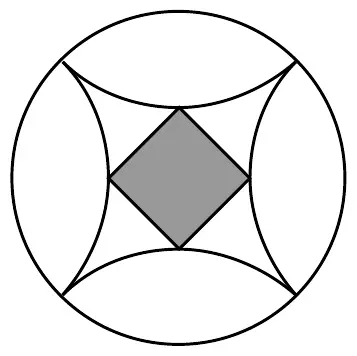
17. The diagram shows a pattern found on a floor tile in the cathedral in Spoleto, Umbria. A circle of radius 1 surrounds four quarter circles, also of radius 1, which enclose a square. The pattern has four axes of symmetry. What is the side length of the square?
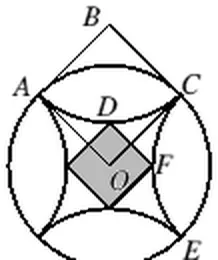
In the diagram, \(B\) is the centre of the quarter-circle arc \(AC\); \(D\) is the point where the central square touches arc \(AC\); \(F\) is the point where the central square touches arc \(CE\); \(O\) is the centre of the circle. As both the circle and arc \(AC\) have radius 1, \(OABC\) is a square of side 1. By Pythagoras' Theorem: \(OB^2 = 1^2 + 1^2\). So \(OB = \sqrt{2}\). Therefore \(OD = OB - DB = \sqrt{2} - 1\). By a similar argument, \(OF = \sqrt{2} - 1\). Now \(DF^2 = OD^2 + OF^2 = 2 \times OD^2\) since \(OD = OF\). So the side of the square is \(\sqrt{2} \times OD = \sqrt{2}(\sqrt{2} - 1) = 2 - \sqrt{2}\).
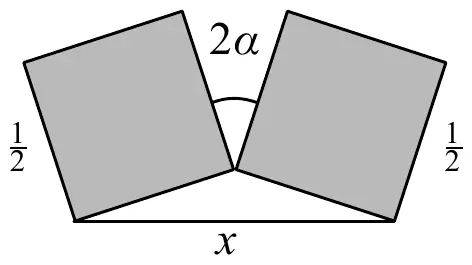
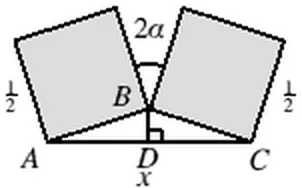
In the diagram, \(D\) is the midpoint of \(AC\). Triangle \(ABC\) is isosceles since \(AB = BC = \tfrac{1}{2}\). Therefore, \(BD\) bisects \(\angle ABC\) and \(BD\) is perpendicular to \(AC\). The angles at a point total 360°, so \(\angle ABC = 360° - 2 \times 90° - 2\alpha = 180° - 2\alpha\). Therefore \(\angle ABD = \angle CBD = 90° - \alpha\). So \(\angle BAD = \angle BCD = \alpha\). Therefore \(x = AC = 2 \times AD = 2 \times AB\cos\alpha = 2 \times \tfrac{1}{2}\cos\alpha = \cos\alpha\).
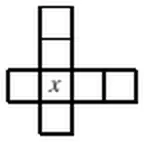
19. The numbers 2, 3, 4, 5, 6, 7, 8 are to be placed, one per square, in the diagram shown so that the sum of the four numbers in the horizontal row equals 21 and the sum of the four numbers in the vertical column also equals 21. In how many different ways can this be done?
Note that the number represented by \(x\) appears in both the horizontal row and the vertical column. Note also that \(2 + 3 + 4 + 5 + 6 + 7 + 8 = 35\). Since the numbers in the row and those in the column have sum 21, we deduce that \(x = 2 \times 21 - 35 = 7\). We now need two disjoint sets of three numbers chosen from 2, 3, 4, 5, 6, 8 so that the numbers in both sets total 14. The only possibilities are {2, 4, 8} and {3, 5, 6}. We have six choices of which number to put in the top space in the vertical line, then two for the next space down and one for the bottom space. That leaves three choices for the first space in the horizontal line, two for the next space and one for the final space. So the total number of ways is \(6 \times 2 \times 1 \times 3 \times 2 \times 1 = 72\).
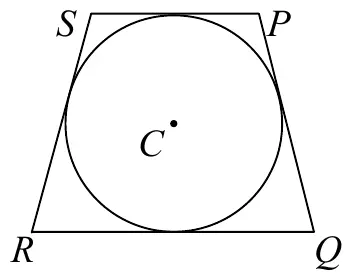
20. In trapezium PQRS, SR = PQ = 25cm and SP is parallel to RQ. All four sides of PQRS are tangent to a circle with centre C. The area of the trapezium is 600cm2. What is the radius of the circle?
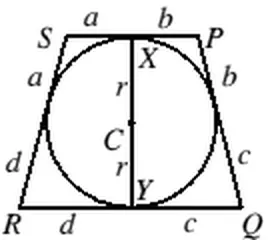
The two tangents drawn from a point outside a circle to that circle are equal in length. This theorem has been used to mark four pairs of equal line segments on the diagram. In the circle the diameter, \(XY\), has been marked. It is also a perpendicular height of the trapezium. We are given that \(SR = PQ = 25\) cm so we can deduce that \((a + d) + (b + c) = 25 + 25 = 50\). The area of trapezium \(PQRS = \tfrac{1}{2}(SP + QR) \times XY = 600\) cm2. Therefore \(\tfrac{1}{2}(a + b + c + d) \times 2r = 600\). So \(\tfrac{1}{2} \times 50 \times 2r = 600\), i.e. \(r = 12\).
\((x + y\sqrt{2})^2 = x^2 + 2xy\sqrt{2} + 2y^2\). Note that all of the alternatives given are of the form \(a + 12\sqrt{2}\) so we need \(xy = 6\). The only ordered pairs \((x, y)\) of positive integers which satisfy this are (1, 6), (2, 3), (3, 2), (6, 1). For these, the values of \(x^2 + 2y^2\) are 73, 22, 17, 38 respectively. So the required number is \(54 + 12\sqrt{2}\).
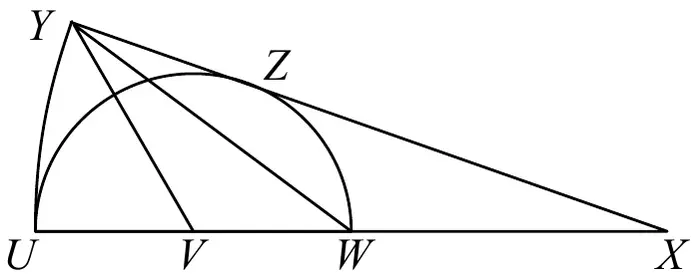
22. A semicircle of radius \(r\) is drawn with centre \(V\) and diameter \(UW\). The line \(UW\) is then extended to the point \(X\), such that \(UW\) and \(WX\) are of equal length. An arc of the circle with centre \(X\) and radius \(4r\) is then drawn so that the line \(XY\) is a tangent to the semicircle at \(Z\), as shown. What, in terms of \(r\), is the area of triangle \(YVW\)?
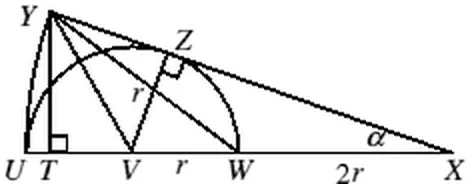
Let the perpendicular from \(Y\) meet \(UV\) at \(T\) and let \(\angle ZXV = \alpha\). Note that \(\angle VZX = 90°\) as a tangent to a circle is perpendicular to the radius at the point of contact. Therefore \(\sin\alpha = \tfrac{r}{3r} = \tfrac{1}{3}\). Consider triangle \(YTX\):\(\sin\alpha = \tfrac{YT}{YX}\). So \(YT = YX\sin\alpha = \tfrac{4r}{3}\). So the area of triangle \(YVW = \tfrac{1}{2} \times VW \times YT = \tfrac{1}{2} \times r \times \tfrac{4r}{3} = \tfrac{2r^2}{3}\).
23. Tom and Geri have a competition. Initially, each player has one attempt at hitting a target. If one player hits the target and the other does not then the successful player wins. If both players hit the target, or if both players miss the target, then each has another attempt, with the same rules applying. If the probability of Tom hitting the target is always \(\tfrac{4}{5}\) and the probability of Geri hitting the target is always \(\tfrac{2}{3}\), what is the probability that Tom wins the competition?
Tom wins after one attempt each if he hits the target and Geri misses. The probability of this happening is \(\tfrac{4}{5} \times \tfrac{1}{3} = \tfrac{4}{15}\). Similarly the probability that Geri wins after one attempt is \(\tfrac{2}{3} \times \tfrac{1}{5} = \tfrac{2}{15}\). So the probability that both competitors will have at least one more attempt is \(1 - \tfrac{4}{15} - \tfrac{2}{15} = \tfrac{3}{5}\). Therefore the probability that Tom wins after two attempts each is \(\tfrac{3}{5} \times \tfrac{4}{15}\). The probability that neither Tom nor Geri wins after two attempts each is \(\tfrac{3}{5} \times \tfrac{3}{5}\). So the probability that Tom wins after three attempts each is \(\left(\tfrac{3}{5}\right)^2 \times \tfrac{4}{15}\) and, more generally, the probability that he wins after \(n\) attempts each is \(\left(\tfrac{3}{5}\right)^{n-1} \times \tfrac{4}{15}\). Therefore the probability that Tom wins is \(\tfrac{4}{15} + \left(\tfrac{3}{5}\right) \times \tfrac{4}{15} + \left(\tfrac{3}{5}\right)^2 \times \tfrac{4}{15} + \left(\tfrac{3}{5}\right)^3 \times \tfrac{4}{15} + \ldots\). This is the sum to infinity of a geometric series with first term \(\tfrac{4}{15}\) and common ratio \(\tfrac{3}{5}\). Its value is \(\tfrac{4}{15} \div \left(1 - \tfrac{3}{5}\right) = \tfrac{2}{3}\).
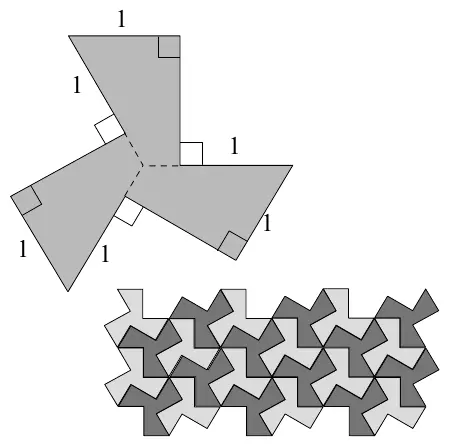
24. The top diagram on the right shows a shape that tiles the plane, as shown in the lower diagram. The tile has nine sides, six of which have length 1. It may be divided into three congruent quadrilaterals as shown. What is the area of the tile?
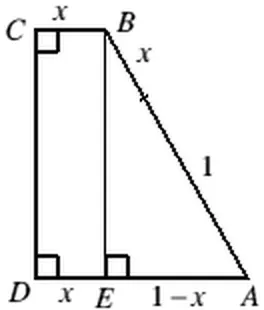
The diagram shows one of the three quadrilaterals making up the tile, labelled and with a line \(BE\) inserted. Note that it is a trapezium. As three quadrilaterals fit together, it may be deduced that \(\angle ABC = 360° \div 3 = 120°\), so \(\angle BAD = 60°\). It may also be deduced that the length of \(AB\) is \(1 + x\), where \(x\) is the length of \(BC\). Now \(\cos\angle BAD = \cos 60° = \tfrac{1}{2} = \tfrac{1 - x}{1 + x}\). So \(1 + x = 2 - 2x\), i.e. \(x = \tfrac{1}{3}\). The area of \(ABCD\) is \(\tfrac{1}{2}(AD + BC) \times CD = \tfrac{1}{2}\left(1 + \tfrac{1}{3}\right) \times \tfrac{4}{3}\sin 60° = \tfrac{2}{3} \times \tfrac{4}{3} \times \tfrac{\sqrt{3}}{2} = \tfrac{4\sqrt{3}}{9}\). So the area of the tile is \(3 \times \tfrac{4\sqrt{3}}{9} = \tfrac{4\sqrt{3}}{3}\).
We'd like to use Google Analytics cookies to count visits and see which pages help most. They're optional, and the site works exactly the same either way. Privacy policy