The whole Senior Mathematical Challenge 2010 paper, one question at a time in order (25 questions). Press Mark as done after each one: your marks add up below.
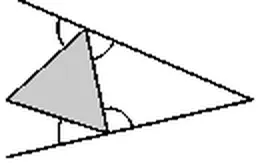
The three internal angles of an equilateral triangle are all 60°. As the sum of the angles on a straight line is 180° then the sum of the four marked angles is \(2 \times (180 - 60)° = 2 \times 120° = 240°\).
\(2 + 0 + 1 + 1 = 4\). Multiples of 4 are even, hence 2011 is not valid and the same argument applies to 2013, 2015, 2017 and 2019. \(2 + 0 + 1 + 2 = 5\). The units digit for multiples of 5 is 0 or 5, hence 2012 is not valid. \(2 + 0 + 1 + 4 = 7\). But \(\dfrac{2014}{7} = 287\tfrac{5}{7}\), hence 2014 is not valid. \(2 + 0 + 1 + 6 = 9\). Since \(2016 = 9 \times 224\), 2016 is valid. Hence we have to wait \(2016 - 2010 \,(= 6)\) more years.
5. A notice on Morecambe promenade reads: ‘It would take 20 million years to fill Morecambe Bay from a bath tap.’ Assuming that the flow from the bath tap is 6 litres a minute, what does the notice imply is the approximate capacity of Morecambe Bay in litres?
6. Dean runs up a mountain road at 8 km per hour. It takes him one hour to get to the top. He runs down the same road at 12 km per hour. How many minutes does it take him to run down the mountain?
The length of the road is 8km. Hence the time taken to run down the mountain is \(\tfrac{8}{12}\) hours \(= \tfrac{8}{12} \times 60\) min \(= 40\) min.
7. There are 120 different arrangements of the five letters in the word ANGLE. If all 120 are listed in alphabetical order starting with AEGLN and finishing with NLGEA, which position in the list does ANGLE occupy?
There are 24 arrangements of the letters in the word ANGLE with A as the first letter. In alphabetical order AEGLN is first and ANLGE is last ie 24th. ANLEG is the 23rd and hence ANGLE is the 22nd.
9. The symbol \(\Diamond\) is defined by \(x \mathbin{\Diamond} y = x^y - y^x\). What is the value of \((2 \mathbin{\Diamond} 3) \mathbin{\Diamond} 4\)?
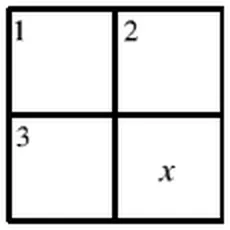
Let the original square have sides of length \(y\) cm and the single square which is not \(1 \times 1\) have sides of length \(x\) cm. Then \(y^2 = 36 + x^2\), and so \(y^2 - x^2 = 36\) and hence \((y + x)(y - x) = 36\). As \(36 = 2^2 \times 3^2\) and \(y + x > y - x\) the possible factors of 36 are:
\(y + x\)
\(y - x\)
\(y\)
\(x\)
9
4
\(6\tfrac{1}{2}\)
\(2\tfrac{1}{2}\)
impossible
12
3
\(7\tfrac{1}{2}\)
\(4\tfrac{1}{2}\)
impossible
18
2
10
8
possible
36
1
\(18\tfrac{1}{2}\)
\(17\tfrac{1}{2}\)
impossible
We can check that \(10^2 = 36 + 8^2 = 100\) and hence the length of the side of the original square is 10 cm.
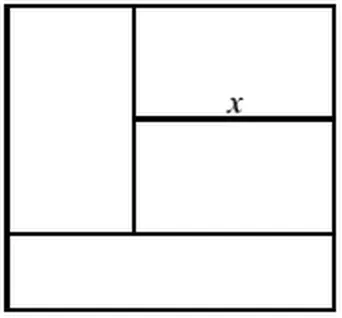
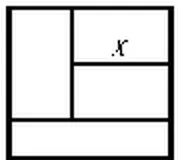
12. The diagram, which is not to scale, shows a square with side length 1, divided into four rectangles whose areas are equal. What is the length labelled \(x\)?
As the square has side length 1 its area is \(1 \times 1 = 1\). Thus the area of each of the four rectangles is \(\tfrac{1}{4}\). The length of the bottom rectangle is 1 hence its width is \(\tfrac{1}{4}\). Thus the width of each of the two congruent rectangles is \(\tfrac{1}{2}\left(1 - \tfrac{1}{4}\right) = \tfrac{3}{8}\). Hence the area of one of these congruent rectangles is \(\tfrac{3}{8}x\). But we know this area is \(\tfrac{1}{4}\), therefore \(\tfrac{3}{8}x = \tfrac{1}{4}\) and hence \(x = \tfrac{2}{3}\).
The lowest common multiple of 3 and 4 is 12. Hence both of the required conditions are satisfied only by numbers that are 2 less than multiples of 12 and also less than 100, ie: 10, 22, 34, 46, 58, 70, 82 and 94. Therefore 8 two-digit numbers satisfy the conditions.
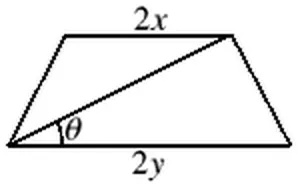
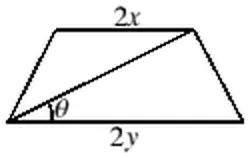
14. The parallel sides of a trapezium have lengths \(2x\) and \(2y\) respectively. The diagonals are equal in length, and a diagonal makes an angle \(\theta\) with the parallel sides, as shown. What is the length of each diagonal?
Drop perpendiculars from the top vertices to the bottom line. The distance from the foot to the nearer base vertex is \(\tfrac{1}{2}(2y - 2x) = y - x\). So the distance to the further base vertex is \(2y - (y - x) = y + x\). Hence \(\cos\theta = \dfrac{x + y}{d}\) where \(d\) is the length of the diagonal.
The first eight prime numbers are: 2, 3, 5, 7, 11, 13, 17, 19. If the sum of two prime numbers is prime, one of them must be 2. If the sum of three different prime numbers is prime they must all be odd. The answer is therefore 19 as: \(2 + 17 = 19\) and \(3 + 5 + 11 = 19\).
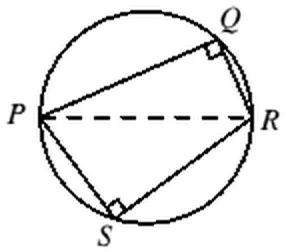
16.PQRS is a quadrilateral inscribed in a circle of which PR is a diameter. The lengths of PQ, QR and RS are 60, 25 and 52 respectively. What is the length of SP?
As \(PR\) is a diameter, \(\angle PQR = \angle PSR = 90°\) (angles in a semicircle are 90°). Since \(PQ = 12 \times 5\) and \(QR = 5 \times 5\), triangle \(PQR\) is an enlarged 5, 12, 13 triangle and so \(PR = 13 \times 5 = 65\). Since \(PR = 5 \times 13\) and \(SR = 4 \times 13\), triangle \(PRS\) is an enlarged 3, 4, 5 triangle and so \(SP = 3 \times 13 = 39\).
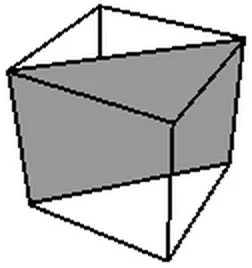
18. A solid cube of side 2 cm is cut into two triangular prisms by a plane passing through four vertices, as shown. What is the total surface area of these two prisms?
Let \(x\) be the length of the shaded rectangle. By Pythagoras' Theorem, \(x^2 = 2^2 + 2^2\), hence \(x = 2\sqrt{2}\). The total surface area of the two prisms equals the surface area of the solid cube plus twice the surface area of that shaded rectangle, that is \(6 \times 2 \times 2 + 2 \times 2 \times 2\sqrt{2} = 24 + 8\sqrt{2} = 8(3 + \sqrt{2})\).
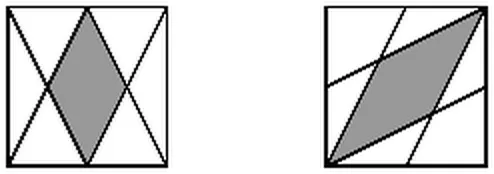
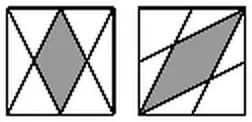
19. The diagrams show two different shaded rhombuses, each inside a square with sides of length 6. Each rhombus is formed by joining vertices of the square to midpoints of the sides of the square. What is the difference between the shaded areas?
In the rhombus on the left, drawing vertical straight lines at distances of \(1\tfrac{1}{2}\), 3 and \(4\tfrac{1}{2}\) from the left edge of the square, and a horizontal straight line bisecting the square, creates 16 equivalent triangles. Of these, four are shaded giving a total shaded area of \(\tfrac{1}{4} \times 6 \times 6 = 9\). Draw in the diagonal from NW to SE in the rhombus on the right. The four unshaded triangles now above the shaded area are all equal in area (\(a\) say); and one can see that 3 of these together make up \(\tfrac{1}{4}\) of the square. Hence \(a = 3\). Thus the shaded area equals \(36 - 3 \times 8 = 12\). Therefore the difference between the shaded areas is \(12 - 9 = 3\).
20. There are 10 girls in a mixed class. If two pupils from the class are selected at random to represent the class on the School Council, then the probability that both are girls is 0.15. How many boys are in the class?
Let the number of boys in the class be \(x\). Hence \(\dfrac{10}{10 + x} \times \dfrac{9}{9 + x} = \dfrac{3}{20}\). Simplifying gives \(1800 = 3(10 + x)(9 + x)\) and then \(x^2 + 19x - 510 = 0\). Factorising gives \((x + 34)(x - 15) = 0\) and, since \(x \neq -34\),\(x = 15\).
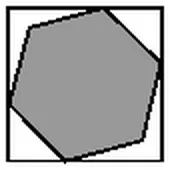
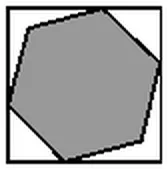
21. The diagram shows a regular hexagon, with sides of length 1, inside a square. Two vertices of the hexagon lie on a diagonal of the square and the other four lie on the edges.
The hypotenuse of one of the small right-angled triangles is parallel to the diagonal and hence makes angles of 45°. Since the hypotenuse has length 1, the other two sides have length \(\tfrac{1}{\sqrt{2}}\), by Pythagoras' Theorem. As the internal angle of a regular hexagon is 120°, drawing a diagonal from NW to SE forms two triangles, bottom right, each with angles 45°, 120° and 15°. (The sum of the angles in a triangle is 180°). Let the square have length \(y\) units. Using the Sine Rule gives \(\dfrac{y - \frac{1}{\sqrt{2}}}{\sin 120°} = \dfrac{1}{\sin 45°}\). Hence \(y - \dfrac{1}{\sqrt{2}} = \dfrac{\sqrt{3}}{2} \div \dfrac{1}{\sqrt{2}} = \dfrac{\sqrt{3}}{\sqrt{2}}\) and therefore \(y = \dfrac{\sqrt{3} + 1}{\sqrt{2}}\). Hence the area of the square is \(y^2 = \left(\dfrac{\sqrt{3} + 1}{\sqrt{2}}\right)^2 = \dfrac{4 + 2\sqrt{3}}{2} = 2 + \sqrt{3}\).
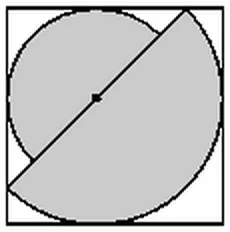
23. The diagram shows two different semicircles inside a square with sides of length 2. The common centre of the semicircles lies on a diagonal of the square. What is the total shaded area?
Let \(r_1\) and \(r_2\) represent the radii of the smaller and larger semicircles respectively. A vertical line through the common centre of the semicircles gives \(r_1 + r_2 = 2 \ldots (1)\). Also, together with the diameter of the larger semicircle, this line forms a right-angled, isosceles triangle giving \(\sin 45° = \dfrac{r_1}{r_2}\). Hence \(r_2 = \sqrt{2}r_1 \ldots (2)\). Substituting (2) into (1) gives \((1 + \sqrt{2})r_1 = 2\) so that \(r_1 = 2(\sqrt{2} - 1)\). Therefore \(r_2 = 2\sqrt{2}(\sqrt{2} - 1)\). Hence the total shaded area is \(\tfrac{1}{2}\pi(r_1^2 + r_2^2) = \tfrac{1}{2}\pi\left[4(\sqrt{2} - 1)^2 + 8(\sqrt{2} - 1)^2\right] = 6\pi(3 - 2\sqrt{2})\).
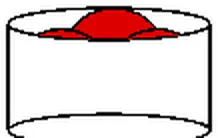
24. Three spheres of radius 1 are placed on a horizontal table and inside a vertical hollow cylinder of height 2 units which is just large enough to surround them. What fraction of the internal volume of the cylinder is occupied by the spheres?
The volume of the three spheres is \(3 \times \tfrac{4}{3}\pi \times 1^3 = 4\pi\). Let \(r\) be the radius of the cross-sectional area of the cylinder. Hence the volume of the cylinder is \(2\pi r^2\). Thus the required fraction is \(\tfrac{2}{r^2}\). The straight lines joining the centres of the three spheres form an equilateral triangle of side length 2. Let \(x\) be the distance from the centre of a sphere to the midpoint of the triangle. Using the Sine Rule, \(\dfrac{2}{\sin 120°} = \dfrac{x}{\sin 30°}\) hence \(x = \dfrac{2}{\sqrt{3}}\). As the sphere has radius 1, \(r = x + 1\) and \(r = 1 + \tfrac{2}{\sqrt{3}}\). Thus \(r^2 = \tfrac{1}{3}(2 + \sqrt{3})^2 = \tfrac{1}{3}(7 + 4\sqrt{3})\). Hence the required fraction is \(\dfrac{6}{7 + 4\sqrt{3}}\).
25. All the digits of a number are different, the first digit is not zero, and the sum of the digits is 36. There are \(N \times 7!\) such numbers. What is the value of \(N\)?
The sum of 10 different digits is 45. As the sum of the digits in the question is 36 then digits adding to 9 are omitted. The combinations of digits satisfying this are:
We'd like to use Google Analytics cookies to count visits and see which pages help most. They're optional, and the site works exactly the same either way. Privacy policy