The whole Senior Mathematical Challenge 2016 paper, one question at a time in order (25 questions). Press Mark as done after each one: your marks add up below.
2. On a Monday, all prices in Isla's shop are 10% more than normal. On Friday all prices in Isla's shop are 10% less than normal. James bought a book on Monday for £5.50. What would be the price of another copy of this book on Friday?
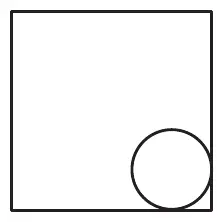
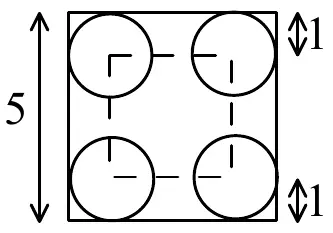
3. The diagram shows a circle with radius 1 that rolls without slipping around the inside of a square with sides of length 5. The circle rolls once around the square, returning to its starting point. What distance does the centre of the circle travel?
As the circle rolls, the centre of the circle moves along four straight lines shown as dashed lines. Each dashed line has length \(5 - (1 + 1)\) so the total distance travelled is \(4 \times 3\) which is 12.
4. Alex draws a scalene triangle. One of the angles is 80°. Which of the following could be the difference between the other two angles in Alex's triangle?
One angle in Alex's triangle is 80°. Let \(\alpha°\) be the smaller of the other two angles so \((100 - \alpha)°\) is the third angle. The difference between these angles is then \((100 - 2\alpha)°\). Considering each option: A: \(100 - 2\alpha = 0\) gives both \(\alpha\) and \(100 - \alpha\) to be 50. This triangle is therefore isosceles and not scalene. B: \(100 - 2\alpha = 60\) gives \(\alpha\) to be 20 and \(100 - \alpha\) to be 80. This is again isosceles. Option D gives angles of 80, 0 and 100. Option E gives angles of 80, −10 and 110. Neither of these cases forms a triangle. C: \(100 - 2\alpha = 80\) gives \(\alpha\) to be 10 and \(100 - \alpha\) to be 90. All three angles are different so this is the correct option.
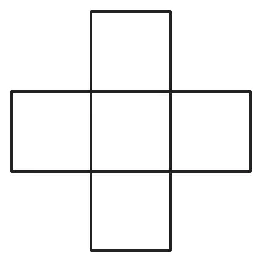
5. All the digits 2, 3, 4, 5 and 6 are placed in the grid, one in each cell, to form two three-digit numbers that are squares. Which digit is placed in the centre of the grid?
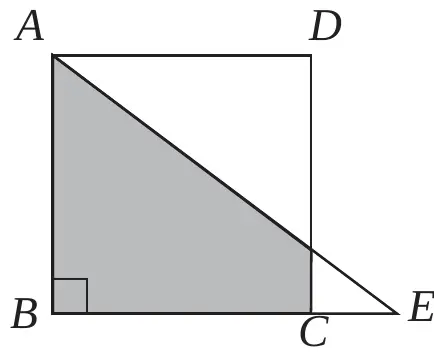
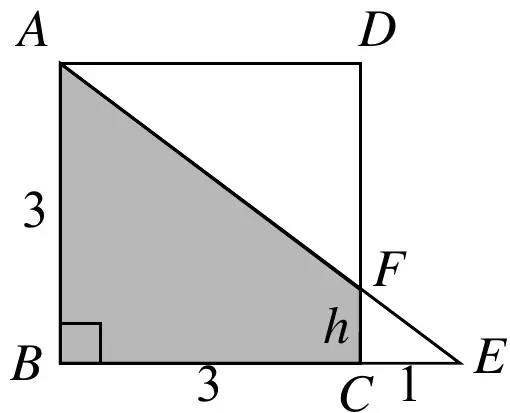
6. The diagram shows a square \(ABCD\) and a right-angled triangle \(ABE\). The length of \(BC\) is 3. The length of \(BE\) is 4. What is the area of the shaded region?
Let \(F\) be the point of intersection of the lines \(AE\) and \(CD\). Let the length of \(CF\) be \(h\). Then, using similar triangles, \(\dfrac{CF}{CE} = \dfrac{BA}{BE}\), so \(\dfrac{h}{1} = \dfrac{3}{4}\) giving \(h = \dfrac{3}{4}\). The shaded region \(ABCF\) is a trapezium, so has area \(\dfrac{1}{2}\left(3 + \dfrac{3}{4}\right) \times 3 = \dfrac{45}{8}\) which is \(5\frac{5}{8}\).
The number \(2016^0\) has value 1. As \(2016 > 1\),\(2016^{1/2} < 2016^1\). The values of their reciprocals, \(2016^{-1/2}\) and \(2016^{-1}\) are then in the opposite order. So the five options given are in numerical order, with \(2016^{-1}\), or \(\frac{1}{2016}\), being the smallest.
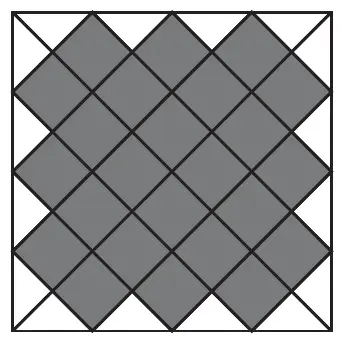
8. Points are drawn on the sides of a square, dividing each side into \(n\) equal parts (so, in the example shown, \(n = 4\)). The points are joined in the manner indicated, to form several small squares (24 in the example, shown shaded) and some triangles. How many small squares are formed when \(n = 7\)?
One way to count the number of small squares formed is to divide the large square into four quarters along its two diagonals. The number of small squares formed is \(4 \times T_{n-1}\), where \(T_{n-1}\) is the \((n - 1)\)th triangular number. When \(n = 7\), this is \(4 \times \tfrac{1}{2}(6 \times 7)\) which is \(4 \times 21\). So 84 squares are formed.
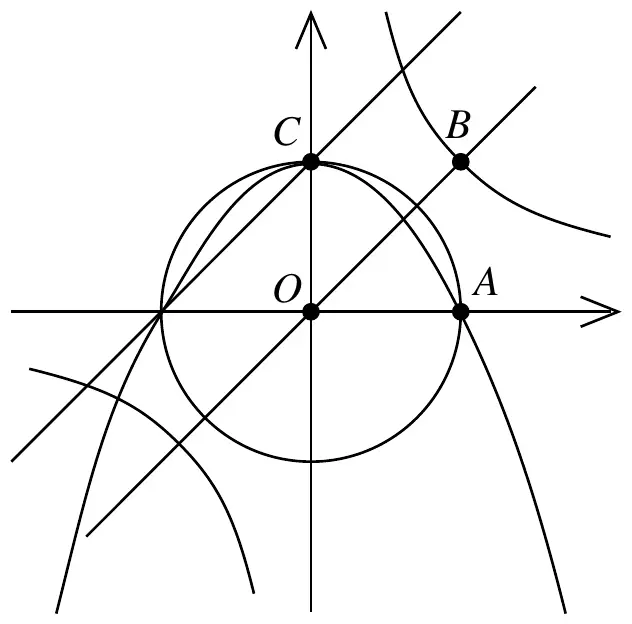
Let \(O = (0,0)\),\(A = (1,0)\),\(B = (1,1)\), \(C = (0,1)\) be the vertices of the square. The equation \(x^2 + y^2 = 1\) gives a circle passing through \(A\) and \(C\). The equation \(y = x + 1\) gives a straight line passing only through \(C\). The equation \(y = -x^2 + 1\) gives a parabola passing through \(A\) and \(C\). The equation \(y = x\) gives a straight line passing through \(O\) and \(B\). The equation \(y = \frac{1}{x}\) gives a rectangular hyperbola which has two branches and passes only through \(B\). So, only \(x^2 + y^2 = 1\), \(y = x\) and \(y = -x^2 + 1\) have graphs passing through exactly two of the vertices of the square.
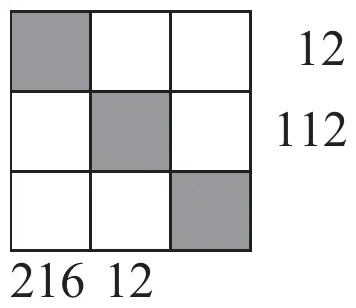
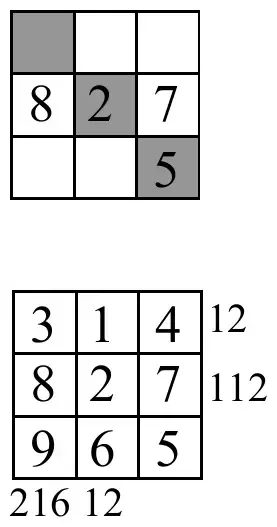
10. The digits from 1 to 9 are to be written in the nine cells of the \(3 \times 3\) grid shown, one digit in each cell. The product of the three digits in the first row is 12. The product of the three digits in the second row is 112. The product of the three digits in the first column is 216. The product of the three digits in the second column is 12. What is the product of the digits in the shaded cells?
None of the products for the first two rows and first two columns contains a factor of 5, so the bottom right cell must contain the 5. The prime factorisation of 112 is \(2^4 \times 7\) and, as 7 is not a factor of 216 or 12, then 7 must be in the right cell of the middle row. The remaining \(2^4\) must be the product of two different numbers, namely 8 and 2. The 2 must be in the centre cell as 8 is not a factor of 12. The grid is now as shown above. The prime factorisation of 216 is \(2^3 \times 3^3\) and the \(3^3\) must be the product of a 3 and a 9. The 3 must be in the top left cell as the product of the top row is 12 which is not a multiple of 9. Thus, the product of the three shaded cells is \(3 \times 2 \times 5\) which is 30. The completed grid is as shown on the right.
11. In the grid below each of the blank squares and the square marked \(X\) are to be filled by the mean of the two numbers in its adjacent squares. Which number should go in the square marked \(X\)?
For each square to be filled with the mean of the numbers in the adjacent squares, the differences between all five pairs of adjacent numbers must be equal. This common difference is \(\left(\dfrac{25 - 10}{5}\right)\) which is 3. The grid is then
The prime factorisation of 2016 is \(2^5 \times 3^2 \times 7\). To create the smallest square which is a multiple of 2016, the powers of each prime must be as small as possible and even, whilst also being at least as big as those in the prime factorisation of 2016. This gives \(2^6 \times 3^2 \times 7^2\) which is \(\left(2^3 \times 3 \times 7\right)^2\) or \(168^2\).
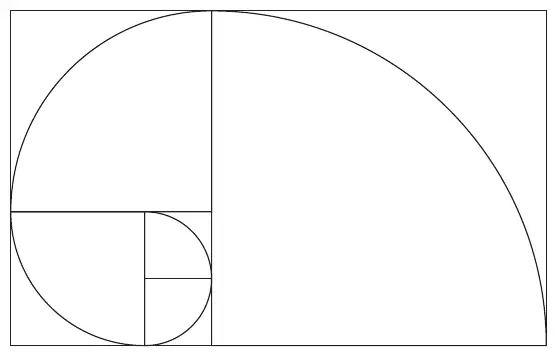
13. Five square tiles are put together side by side. A quarter circle is drawn on each tile to make a continuous curve as shown. Each of the smallest squares has side-length 1. What is the total length of the curve?
A quarter circle of radius \(r\) has length \(\frac{2\pi r}{4}\) which is \(\frac{\pi r}{2}\). The total length of the curve shown is then \(\frac{\pi}{2}(1 + 1 + 2 + 3 + 5)\) which is \(6\pi\).
14. Which of the following values of the positive integer \(n\) is a counterexample to the statement: “If \(n\) is not prime then \(n - 2\) is not prime”?
The five options give the values of \(n\) to be considered. In option B, 11 is prime so that can be discounted. The options A, C and E are 6, 27 and 51 which are not prime and subtracting 2 from each of these gives 4, 25 and 49 which are also not prime. However in D, \(n = 33\) which is not prime but \(n - 2 = 31\) is prime.
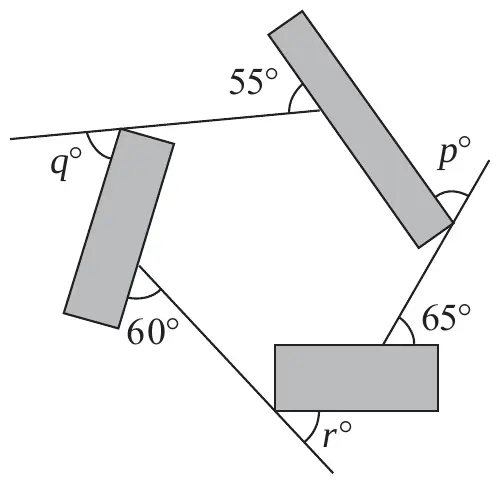
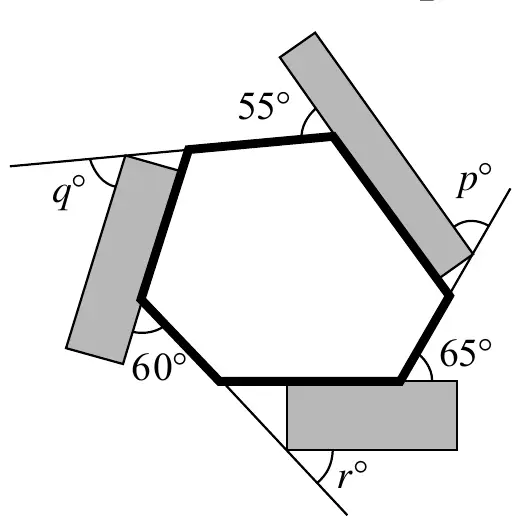
A non-regular hexagon can be drawn on the diagram as shown. Three of the exterior angles of the hexagon are then 55°, 60° and 65°. Since corresponding angles on parallel lines are equal, the other three exterior angles are \(p°\), \(q°\) and \(r°\). The total of the exterior angles of any polygon is 360°. Hence \(p + q + r + 55 + 60 + 65 = 360\) and so \(p + q + r = 180\).
The expression \(\sqrt{2016} + \sqrt{56}\) can be written as \(\sqrt{2^5 \times 3^2 \times 7} + \sqrt{2^3 \times 7}\) which is \(\sqrt{4^2 \times 3^2 \times 2 \times 7} + \sqrt{2^2 \times 2 \times 7}\). This simplifies to \(12\sqrt{14} + 2\sqrt{14}\) which is \(14\sqrt{14}\) and, using index notation, this can be written as \(14^{3/2}\). Hence \(k = \tfrac{3}{2}\).
17. Aaron has to choose a three-digit code for his bike lock. The digits can be chosen from 1 to 9. To help him remember them, Aaron chooses three different digits in increasing order, for example 278. How many such codes can be chosen?
One way to count the possible codes is in descending numerical order of the three-digit codes. The list begins: 789; 689, 679, 678; 589, 579, 578, 569, 568, 567; ... . Each initial digit \(n\) produces part of the list with the \((8 - n)\)th triangular number of possible codes, where \(n \leqslant 7\). The total number of possible codes is then the sum of these triangular numbers \(1 + 3 + 6 + 10 + 15 + 21 + 28\) including 1 code starting with the digit 7, all the way to 28 codes starting with the digit 1. The total number of codes that Aaron can choose is 84.
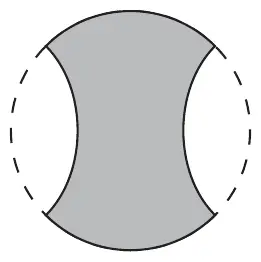
18. The circumference of a circle with radius 1 is divided into four equal arcs. Two of the arcs are ‘turned over’ as shown. What is the area of the shaded region?
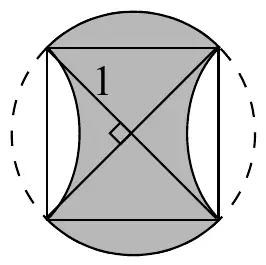
The four arcs are of equal length and their end-points lie on a circle, so the four end-points can be joined to make a square. As two of the arcs are ‘turned over’, the two unshaded regions inside the square have areas equal to the two shaded regions outside the square. The total shaded area is therefore equal to the area of the square. The radius of the circle is given as 1 so, by Pythagoras' Theorem, the side-length of the square is \(\sqrt{1^2 + 1^2} = \sqrt{2}\). So the area of the shaded region is \(\sqrt{2} \times \sqrt{2} = 2\).
19. Let \(S\) be a set of five different positive integers, the largest of which is \(m\). It is impossible to construct a quadrilateral with non-zero area, whose side-lengths are all distinct elements of \(S\). What is the smallest possible value of \(m\)?
Let \(S\) consist of \(h\),\(j\),\(k\),\(l\), \(m\) in ascending order of size. We want \(m\) to be as small as possible. Given three side-lengths, there is a quadrilateral with non-zero area with a specified fourth side-length if and only if the fourth side-length is less than the sum of the other three side-lengths. To ensure that \(j\),\(k\),\(l\), \(m\) are not the side-lengths of such a quadrilateral, we must have \(m \geqslant j + k + l\). Likewise, considering \(h\),\(j\),\(k\),\(l\), we must have \(l \geqslant h + j + k\). Since the smallest possible values of \(h\), \(j\) and \(k\) are 1, 2 and 3 respectively then \(l \geqslant 1 + 2 + 3\) so 6 is the smallest value of \(l\). Also \(m \geqslant 2 + 3 + 6\) so 11 is the smallest value of \(m\).
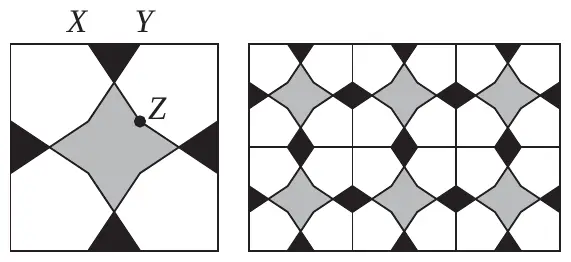
20. Michael was walking in Marrakesh when he saw a tiling formed by tessellating the square tile as shown. The tile has four lines of symmetry and the length of each side is 8 cm. The length of \(XY\) is 2 cm. The point \(Z\) is such that \(XZ\) is a straight line and \(YZ\) is parallel to sides of the square. What is the area of the central grey octagon?
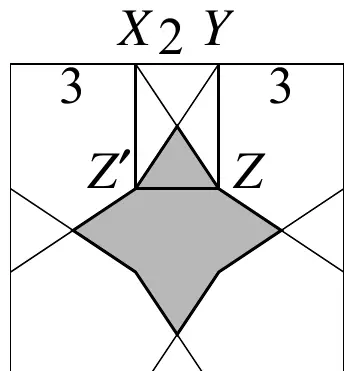
Let the point \(Z'\) be directly below \(X\), so that \(XYZZ'\) is a rectangle. As the length of \(XY\) is 2 cm, the distance from \(Y\) to the nearest corner of the square is 3 cm. The area of \(XYZZ'\)is 2 cm × 3 cm which is 6 cm2. The diagonals \(XZ\) and \(YZ'\) split \(XYZZ'\) into quarters and each has area \(1\frac{1}{2}\) cm2. The central grey octagon is formed from a square with side \(Z'Z\) of length 2 cm together with four triangles, each of area \(1\frac{1}{2}\) cm2. The total area of the shaded octagon is \(2 \times 2 + 4 \times 1\frac{1}{2}\) which is 10 cm2.
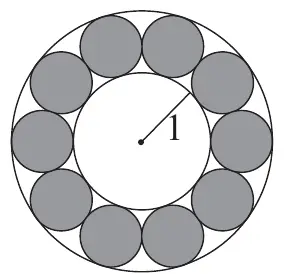
21. The diagram shows ten equal discs that lie between two concentric circles − an inner circle and an outer circle. Each disc touches two neighbouring discs and both circles. The inner circle has radius 1. What is the radius of the outer circle?
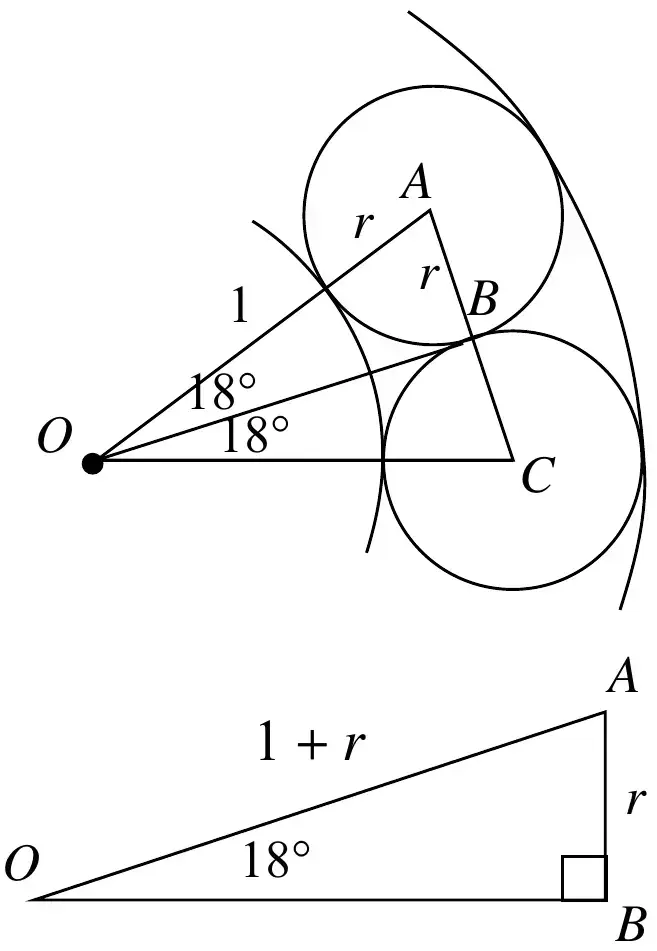
As there are 10 discs, the adjacent lines drawn from the centre of the inner circle to the centre of each disc are separated by an angle of 36°. The line \(OB\) is a tangent to both the disc with centre \(A\) and the disc with centre \(C\). So the points \(A\), \(B\) and \(C\) lie on a straight line as angles \(OBA\) and \(OBC\) are both 90°. In the second diagram, from triangle \(OAB\) we have \(\sin 18° = \dfrac{r}{1 + r}\) which rearranges to \[\frac{\sin 18°}{1 - \sin 18°} = r.\] The radius of the outer circle is \[1 + 2r = 1 + \frac{2\sin 18°}{1 - \sin 18°} = \frac{1 + \sin 18°}{1 - \sin 18°}.\]
22. Three friends make the following statements. Ben says, “Exactly one of Dan and Cam is telling the truth.” Dan says, “Exactly one of Ben and Cam is telling the truth.” Cam says, “Neither Ben nor Dan is telling the truth.” Which of the three friends is lying?
Suppose first that Cam is telling the truth, so Ben and Dan are both lying. Then Ben's statement is actually correct, as is Dan's. There is a clear contradiction. So we know that Cam is in fact lying. Therefore at least one of Ben and Dan is telling the truth. If Ben is telling the truth, then we learn that Dan is telling the truth. If Dan is telling the truth then we learn that Ben is telling the truth. So both Ben and Dan are telling the truth. This means that only Cam is lying.
23. A cuboid has sides of lengths 22, 2 and 10. It is contained within a sphere of the smallest possible radius. What is the side-length of the largest cube that will fit inside the same sphere?
For the cuboid to be contained within a sphere of smallest possible radius, all eight vertices of the cuboid must lie on the sphere. The radius \(r\) of the smallest sphere is then half of the length of the body diagonal of the cuboid, so \(r = \sqrt{1^2 + 5^2 + 11^2} = \sqrt{147}\). If the largest cube which will fit inside this sphere has side-length \(2x\), then \(r = \sqrt{x^2 + x^2 + x^2}\). Thus \(3x^2 = 147\), so \(x^2 = 49\) and so \(x = 7\). The side-length of the largest cube is 14.
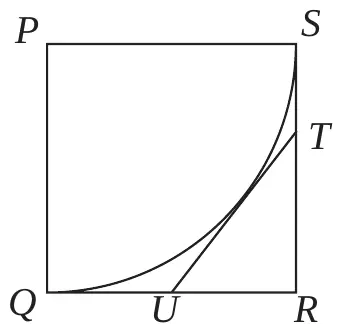
24. The diagram shows a square \(PQRS\). The arc \(QS\) is a quarter circle. The point \(U\) is the midpoint of \(QR\) and the point \(T\) lies on \(SR\). The line \(TU\) is a tangent to the arc \(QS\). What is the ratio of the length of \(TR\) to the length of \(UR\)?
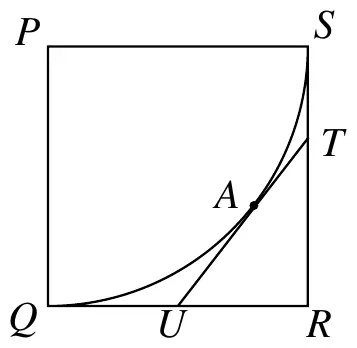
Let the square have side-length 2, \(RT = h\) and let \(A\) be the point of contact between \(TU\) and the circle. Two tangents to a circle which meet at a point are of equal length. So as \(QU = 1\) so does \(AU\). Similarly \(TA = TS = 2 - h\). Applying Pythagoras' Theorem to triangle \(URT\) gives \(1^2 + h^2 = (1 + 2 - h)^2\) so \(1 + h^2 = 9 - 6h + h^2\) and therefore \(8 - 6h = 0\) which gives \(h = \tfrac{4}{3}\). The required ratio is then \(4 : 3\).
For \(n\) to be the smallest integer for which \(7n\) has 2016 digits, \(7n\) must start with 1, be followed by 2014 zeros and end with a digit \(a\). When this number is divided by 7, the answer is formed from the repeating sequence of 6 digits 142857. The remainders also form a repeating sequence 3, 2, 6, 4, 5, 1. These sequences are repeated 335 times as \(6 \times 335\) is 2010. The last 4 zeros (to make 2014 zeros in total) and the final \(a\) create the last section of the division as shown:
We'd like to use Google Analytics cookies to count visits and see which pages help most. They're optional, and the site works exactly the same either way. Privacy policy