The whole Senior Mathematical Challenge 2015 paper, one question at a time in order (25 questions). Press Mark as done after each one: your marks add up below.
The expression \(2015^2 - 2016 \times 2014\) can be written as \(2015^2 - (2015 + 1)(2015 - 1)\) which simplifies, using the difference of two squares, to \(2015^2 - \left(2015^2 - 1\right) = 1\).
Rearranging \(6x = \dfrac{150}{x}\) gives \(x^2 = \dfrac{150}{6}\), so \(x^2 = 25\). This has two solutions, \(x = 5\) and \(x = -5\). Therefore the sum of the solutions is \(5 + (-5) = 0\).
3. When Louise had her first car, 50 litres of petrol cost £40. When she filled up the other day, she noticed that 40 litres of petrol cost £50. By approximately what percentage has the cost of petrol increased over this time?
When 50 litres of petrol cost £40, 1 litre cost \(\dfrac{\text{£}40}{50}\) which is 80 pence. More recently, 1 litre cost \(\dfrac{\text{£}50}{40} = 125\) pence. The percentage increase is then \(\dfrac{\text{actual increase}}{\text{original price}} \times 100\) which is \(\dfrac{45}{80} \times 100 = \dfrac{450}{8} = 56.25\). So the approximate increase is 56%.
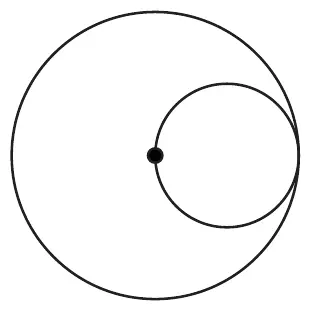
4. In the diagram, the smaller circle touches the larger circle and also passes through its centre. What fraction of the area of the larger circle is outside the smaller circle?
Let the radius of the smaller circle be \(r\) and so the radius of the larger circle is \(2r\). The area of the smaller circle is then \(\pi r^2\) and the area of the larger circle is \(\pi \times (2r)^2\) which is \(4\pi r^2\). The fraction of the larger circle which is outside the smaller circle is then \(\dfrac{4\pi r^2 - \pi r^2}{4\pi r^2} = \dfrac{3\pi r^2}{4\pi r^2} = \dfrac{3}{4}\).
The mean of 17, 23 and \(2n\) is given to be \(n\), so \(\dfrac{17 + 23 + 2n}{3} = n\) which gives \(40 + 2n = 3n\). As \(n\) is then 40, the sum of the digits of \(n\) is 4.
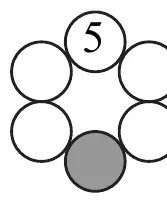
6. The numbers 5, 6, 7, 8, 9, 10 are to be placed, one in each of the circles in the diagram, so that the sum of the numbers in each pair of touching circles is a prime number. The number 5 is placed in the top circle. Which number is placed in the shaded circle?
The prime numbers which are the sums of pairs of numbers in touching circles are all odd as they are greater than 2. This means that any two adjacent circles in the diagram must be filled with one odd number and one even number. The number 10 may not be placed on either side of 5, since \(10 + 5 = 15 = 3 \times 5\). So either side of the 5 must be 6 and 8. Below 6 and 8 must be 7 and 9 respectively leaving 10 to be placed in the shaded circle at the bottom.
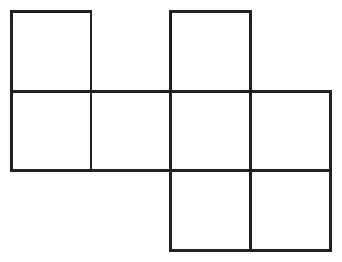
8. The diagram shows eight small squares. Six of these squares are to be shaded so that the shaded squares form the net of a cube. In how many different ways can this be done?
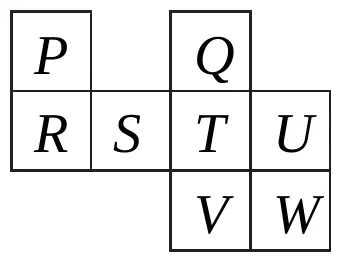
Let the squares in the diagram be labelled as shown. Each of the nets formed from six squares must contain all of \(R\), \(S\) and \(T\). The net must also include one of \(P\) and \(Q\) (but not both as they will fold into the same position), and any two of \(U\), \(V\) and \(W\). This therefore gives \(2 \times 3 = 6\) different ways.
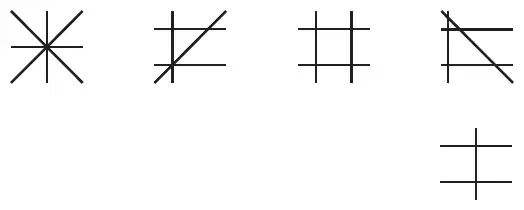
9. Four different straight lines are drawn on a flat piece of paper. The number of points where two or more lines intersect is counted. Which of the following could not be the number of such points?
Possible configurations of four different straight lines drawn in a plane are shown here to give 1, 3, 4 and 5 points of intersection respectively. In order to have exactly 2 points of intersection, two of the straight lines would need to lie in the same position and so would not be ‘different’.
10. The positive integer \(n\) is between 1 and 20. Milly adds up all the integers from 1 to \(n\) inclusive. Billy adds up all the integers from \(n + 1\) to 20 inclusive. Their totals are the same. What is the value of \(n\)?
The total of the numbers from 1 to 20 is \(\tfrac{1}{2} \times 20 \times (20 + 1) = 210\). If Milly and Billy have totals which are equal, their totals must each be 105. Milly's total, of the numbers from 1 to \(n\), is \(\tfrac{1}{2}n(n + 1)\) so \(\tfrac{1}{2}n(n + 1) = 105\) which gives \(n^2 + n = 210\). Therefore \(n^2 + n - 210 = 0\) which factorises to give \((n + 15)(n - 14) = 0\). As \(n\) is a positive integer, \(n = 14\).
11. Rahid has a large number of cubic building blocks. Each block has sides of length 4 cm, 6 cm or 10 cm. Rahid makes little towers built from three blocks stacked on top of each other. How many different heights of tower can he make?
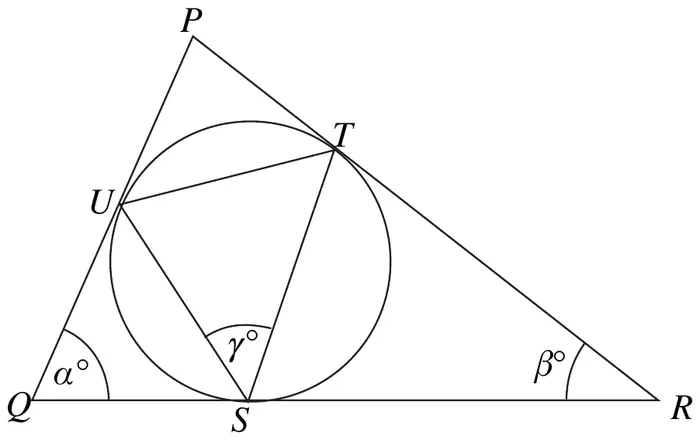
12. A circle touches the sides of triangle \(PQR\) at the points \(S\), \(T\) and \(U\) as shown. Also \(\angle PQR = \alpha°\), \(\angle PRQ = \beta°\) and \(\angle TSU = \gamma°\). Which of the following gives \(\gamma\) in terms of \(\alpha\) and \(\beta\)?
Each of the three sides of triangle \(PQR\) is a tangent to the circle. Two tangents to a circle which meet at a point are of equal length. So \(QU\) and \(QS\) are of equal length. Similarly \(RT = RS\). This means that \(\angle QUS = \angle QSU = \tfrac{1}{2}(180 - \alpha)\) and also \(\angle RTS = \angle RST = \tfrac{1}{2}(180 - \beta)\). At \(S\) we can consider the sum of the three angles, so \(\tfrac{1}{2}(180 - \alpha) + \gamma + \tfrac{1}{2}(180 - \beta) = 180\). Simplifying gives \(90 - \tfrac{1}{2}\alpha + \gamma + 90 - \tfrac{1}{2}\beta = 180\) and so \(\gamma = \tfrac{1}{2}(\alpha + \beta)\).
13. The Knave of Hearts tells only the truth on Mondays, Tuesdays, Wednesdays and Thursdays. He tells only lies on all the other days. The Knave of Diamonds tells only the truth on Fridays, Saturdays, Sundays and Mondays. He tells only lies on all the other days. On one day last week, they both said, “Yesterday I told lies.” On which day of the week was that?
When a knave says “Yesterday I told lies” it could be that today he is telling the truth and he did indeed tell lies yesterday. In the table, this is a T preceded by an L. It could also be that today he is lying, in which case he was in fact telling the truth yesterday. In the table, this is an L preceded by a T. The only day when one or the other of these options applies to each knave is Friday.
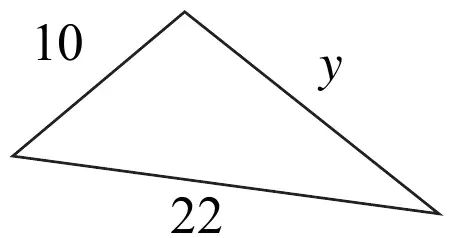
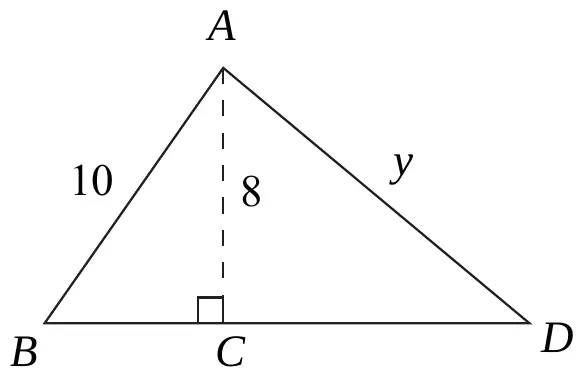
Let the vertices of the triangle be labelled \(A\), \(B\) and \(D\) as shown. Let the point where the perpendicular from \(A\) meets \(BD\) be labelled \(C\). The area of triangle \(ABD\) is given as 88. As \(BD\) is 22, \(AC\) must be 8. Considering triangle \(ABC\) and using Pythagoras' Theorem gives \(BC = 6\). The remainder of the base \(CD\) is then \(22 - 6 = 16\). Considering triangle \(ACD\) and using Pythagoras' Theorem again gives \(y^2 = 8^2 + 16^2 = 8^2\left(1^2 + 2^2\right) = 8^2 \times 5\). So \(y = 8\sqrt{5}\).
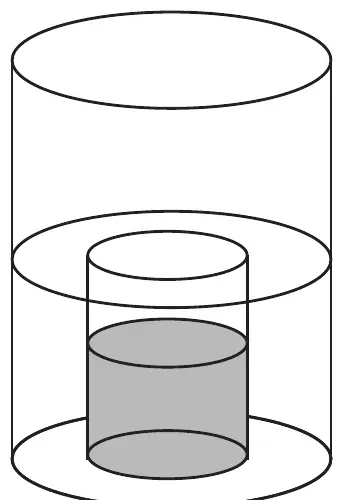
15. Two vases are cylindrical in shape. The larger vase has diameter 20 cm. The smaller vase has diameter 10 cm and height 16 cm. The larger vase is partially filled with water. Then the empty smaller vase, with the open end at the top, is slowly pushed down into the water, which flows over its rim. When the smaller vase is pushed right down, it is half full of water. What was the original depth of the water in the larger vase?
Let the original water level in the larger vase be \(h\) cm. The volume of water at the start is then \(\pi \times 10^2 \times h\) cm3. The volume of water completely within the vase is constant, but when the smaller vase is pushed down, some of the water moves into it. In the end the depth of the water in the larger vase is the same as the height of the smaller vase itself, which is 16 cm. We are given that the final depth of water in the smaller vase is 8 cm. So the total volume of water is then \(\pi \times 10^2 \times 16\) cm3 less the gap in the top half of the smaller vase. So \(\pi \times 10^2 \times h = \pi \times 10^2 \times 16 - \pi \times 5^2 \times 8\), giving \(100\pi h = 1600\pi - 200\pi\) and therefore \(h = 14\).
16. Fnargs are either red or blue and have 2, 3 or 4 heads. A group of six Fnargs consisting of one of each possible form is made to line up such that no immediate neighbours are the same colour nor have the same number of heads. How many ways are there of lining them up from left to right?
Let the six Fnargs in their final positions be denoted by \(F_1F_2F_3F_4F_5F_6\). There are six choices for \(F_1\). Once this Fnarg is chosen, the colours of the Fnargs must alternate all along the line and so we need only consider the number of heads. There are \(3 - 1 = 2\) choices for \(F_2\) as the number of heads for \(F_2\) \(\neq\) the number of heads for \(F_1\). There is only one choice for \(F_3\) as \(F_3\) cannot have the same number of heads as \(F_2\) or \(F_1\) (\(F_3\) and \(F_1\) are the same colour and so have different numbers of heads). There is only one choice for \(F_4\) as it is completely determined by \(F_3\) and \(F_2\), just as \(F_3\) was completely determined by \(F_2\) and \(F_1\). There is only one choice for each of \(F_5\) and \(F_6\) as they are the last of each colour of Fnargs. The total number of ways of lining up the Fnargs is \(6 \times 2 \times 1 \times 1 \times 1 \times 1\) which is 12.
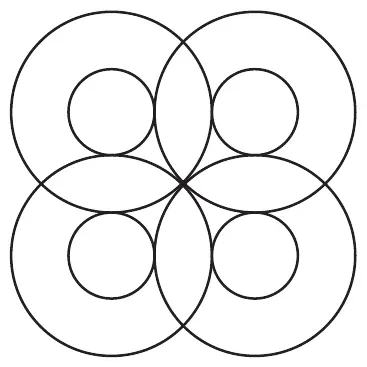
17. The diagram shows eight circles of two different sizes. The circles are arranged in concentric pairs so that the centres form a square. Each larger circle touches one other larger circle and two smaller circles. The larger circles have radius 1. What is the radius of each smaller circle?
Let the radius of each of the smaller circles be \(r\) and let the centres of the circles be \(A\),\(B\), \(C\) and \(D\) in order. We are given that \(ABCD\) is a square. When two circles touch externally, the distance between their centres equals the sum of their radii. Hence \(AB\) and \(BC\) have length \(r + 1\) and \(AC\) has length \(1 + 1 = 2\). By Pythagoras' Theorem \((r + 1)^2 + (r + 1)^2 = 2^2\), so \(2(r + 1)^2 = 2^2 = 4\) and therefore \((r + 1)^2 = 2\). Square rooting both sides gives \(r + 1 = \sqrt{2}\), as we must take the positive root, and so \(r = \sqrt{2} - 1\).
Expressed as a product of its prime factors, \(10!\) is \(2 \times 5 \times 3 \times 3 \times 2 \times 2 \times 2 \times 7 \times 2 \times 3 \times 5 \times 2 \times 2 \times 3 \times 2\) which is \(2^8 \times 3^4 \times 5^2 \times 7\). This can be written as \(\left(2^4 \times 3^2 \times 5\right)^2 \times 7\) so the largest integer \(k\) such that \(k^2\) is a factor of \(10!\) is \(2^4 \times 3^2 \times 5\) which is 720.
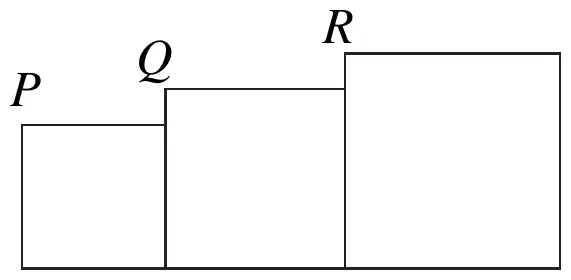
19. Three squares are arranged as shown so that their bases lie on a straight line. Also, the corners \(P\), \(Q\) and \(R\) lie on a straight line. The middle square has sides that are 8 cm longer than the sides of the smallest square. The largest square has sides of length 50 cm. There are two possible values for the length (in cm) of the sides of the smallest square. Which of the following are they?
Let the length of the side of the smallest square be \(x\) cm. So the three squares have sides of lengths \(x\) cm, \((x + 8)\) cm and 50 cm respectively. The gradient of \(PQ\) is then \(\tfrac{8}{x}\) and the gradient of \(PR\) is \(\dfrac{50 - x}{x + x + 8}\). As \(P\), \(Q\) and \(R\) lie on a straight line, \(\dfrac{8}{x} = \dfrac{50 - x}{2x + 8}\) so \(8(2x + 8) = x(50 - x)\). Expanding gives \(16x + 64 = 50x - x^2\) and therefore \(x^2 - 34x + 64 = 0\), giving \(x = 2\) or 32.
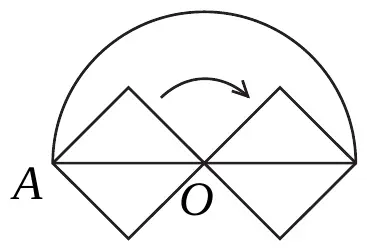
20. A square ink pad has sides of length 1 cm. It is covered in black ink and carefully placed in the middle of a piece of white paper. The square pad is then rotated 180° about one of its corners so that all of the pad remains in contact with the paper throughout the turn. The pad is then removed from the paper. What area of paper, in cm2, is coloured black?
Let the corner of the square about which it is rotated be \(O\) and the opposite vertex of the square be \(A\). As the circle is rotated through 180° about \(O\), the vertex \(A\) travels along a semicircle whose centre is \(O\). The area coloured black by the ink is then formed from two half squares and a semicircle. The square has side-length 1, so \(OA = \sqrt{2}\). The total area of the two half squares and the semicircle is \(2 \times \left(\tfrac{1}{2} \times 1 \times 1\right) + \tfrac{1}{2} \times \pi \times \left(\sqrt{2}\right)^2\) which is \(1 + \pi\).
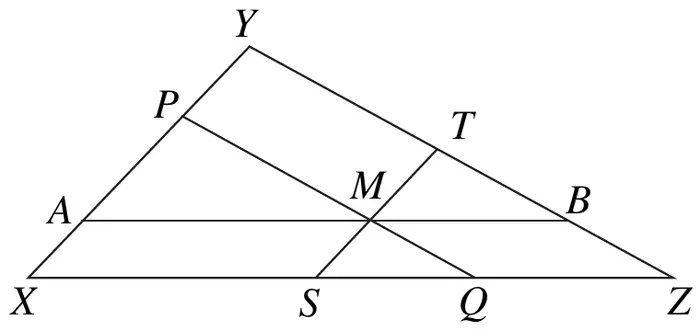
21. The diagram shows a triangle \(XYZ\). The sides \(XY\), \(YZ\) and \(XZ\) have lengths 2, 3 and 4 respectively. The lines \(AMB\), \(PMQ\) and \(SMT\) are drawn parallel to the sides of triangle \(XYZ\) so that \(AP\), \(QS\) and \(BT\) are of equal length. What is the length of \(AP\)?
All of the triangles in the diagram are similar as they contain the same angles. The sides of each triangle are therefore in the ratio \(2 : 3 : 4\). First consider triangle \(APM\). Let \(AP = x\), so that \(AM = 2x\). Now considering triangle \(TBM\), as \(BT = x\),\(BM = \tfrac{4x}{3}\). The quadrilateral \(AMSX\) is a parallelogram as \(AM\) is parallel to \(XS\) and \(MS\) is parallel to \(AX\). So \(AM = XS = 2x\). Similarly \(QZ = BM = \tfrac{4x}{3}\). Considering the base of triangle \(XYZ\),\(XS + SQ + QZ = 4\). So \(2x + x + \tfrac{4x}{3} = 4\) and therefore \(x = \tfrac{12}{13}\).
23. Given four different non-zero digits, it is possible to form 24 different four-digit numbers containing each of these four digits. What is the largest prime factor of the sum of the 24 numbers?
Let a four-digit positive integer be expressed as \(1000a + 100b + 10c + d\) where \(a\),\(b\), \(c\) and \(d\) are all different. In the 24 possible permutations of \(a\),\(b\), \(c\) and \(d\), each of the four letters appears in each position six times. Adding all 24 numbers together gives \(1000(6a + 6b + 6c + 6d) + 100(6a + 6b + 6c + 6d)\) \(+\, 10(6a + 6b + 6c + 6d) + 6a + 6b + 6c + 6d\). The total is therefore \(1111 \times 6(a + b + c + d)\) which factorises to \(2 \times 3 \times 11 \times 101(a + b + c + d)\). As \(a + b + c + d < 101\), the largest prime factor of the sum is 101.
24. Peter has 25 cards, each printed with a different integer from 1 to 25. He wishes to place \(N\) cards in a single row so that the numbers on every adjacent pair of cards have a prime factor in common. What is the largest value of \(N\) for which this is possible?
There are five cards in Peter's set that are printed with an integer that has no prime factors in common with any other number from 1 to 25. The five numbers are 1 (which has no prime factors) and the primes 13, 17, 19 and 23. These cards cannot be placed anywhere in the row of \(N\) cards. One possible row is: 11, 22, 18, 16, 12, 10, 8, 6, 4, 2, 24, 3, 9, 21, 7, 14, 20, 25, 15, 5. So the longest row is of 20 cards.
25. A function, defined on the set of positive integers, is such that \(f(xy) = f(x) + f(y)\) for all \(x\) and \(y\). It is known that \(f(10) = 14\) and \(f(40) = 20\). What is the value of \(f(500)\)?
Repeatedly using the rule that \(f(xy) = f(x) + f(y)\) allows us to write \(f(500)\) as \(f(2 \times 2 \times 5 \times 5 \times 5) = f(2) + f(2) + f(5) + f(5) + f(5) = 2f(2) + 3f(5)\). We are given values for \(f(40)\) and \(f(10)\) and from them we need to calculate the values of \(f(2)\) and \(f(5)\). Now \(f(40)\) can be written as \(f(2) + f(2) + f(10)\) so \(20 = 2f(2) + 14\) and therefore \(f(2) = 3\). Similarly \(f(10) = f(2) + f(5)\) so \(14 = 3 + f(5)\) giving \(f(5) = 11\). So \(f(500) = 2f(2) + 3f(5) = 2 \times 3 + 3 \times 11 = 39\).
We'd like to use Google Analytics cookies to count visits and see which pages help most. They're optional, and the site works exactly the same either way. Privacy policy