
SMC 2015 Q15
15. Two vases are cylindrical in shape. The larger vase has diameter 20 cm. The smaller vase has diameter 10 cm and height 16 cm. The larger vase is partially filled with water. Then the empty smaller vase, with the open end at the top, is slowly pushed down into the water, which flows over its rim. When the smaller vase is pushed right down, it is half full of water.
What was the original depth of the water in the larger vase?
- A 10 cm
- B 12 cm
- C 14 cm
- D 16 cm
- E 18 cm
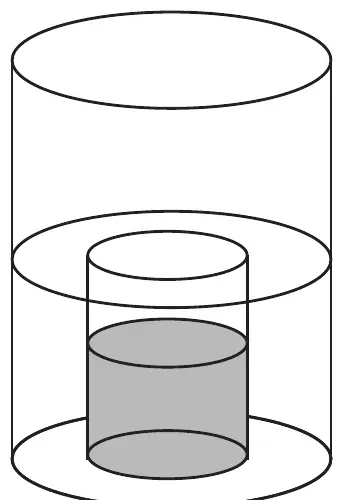
Senior Mathematical Challenge 2015, Question 15. © UK Mathematics Trust. Original paper on ukmt.org.uk
Answer: C 14 cm
Let the original water level in the larger vase be \(h\) cm. The volume of water at the start is then \(\pi \times 10^2 \times h\) cm3. The volume of water completely within the vase is constant, but when the smaller vase is pushed down, some of the water moves into it. In the end the depth of the water in the larger vase is the same as the height of the smaller vase itself, which is 16 cm. We are given that the final depth of water in the smaller vase is 8 cm. So the total volume of water is then \(\pi \times 10^2 \times 16\) cm3 less the gap in the top half of the smaller vase. So \(\pi \times 10^2 \times h = \pi \times 10^2 \times 16 - \pi \times 5^2 \times 8\), giving \(100\pi h = 1600\pi - 200\pi\) and therefore \(h = 14\).
Solution © UK Mathematics Trust, from the SMC 2015 solutions. Longer versions with investigations: Solutions and investigations (PDF).