73 Senior Mathematical Challenge questions from every year we have, newest year first. Use Difficulty › Position in the paper to practise the early (easier) or late (harder) questions, or the Year filter for one year.
When the product \(1234 \times 5678\) is calculated, its units digit is the units digit of \(4 \times 8\), so 2. This is the remainder when the product is divided by 5.
6. There are fewer than 30 students in the A-level mathematics class. One half of them play the piano, one quarter play hockey and one seventh are in the school play.
The number of students in the maths class must be a multiple of 2, 4 and 7. As there are known to be fewer than 30 students, there must be 28 students in the class, which is the only common multiple of 2, 4 and 7 less than 30. Therefore the number of students who play hockey is \(\frac{28}{4} = 7\).
Using the difference of two squares, \(106^2 - 15^2 = (106 + 15)(106 - 15) = 121 \times 91\), which when expressed as the product of primes is \(11 \times 11 \times 7 \times 13\). The largest of these primes is 13.
When \(16!\) is written out as the product of its primes, \(16! = (2^4) \times (3 \times 5) \times (2 \times 7) \times (13) \times\) \((2^2 \times 3) \times (11) \times (2 \times 5) \times (3^2) \times\) \((2^3) \times (7) \times (2 \times 3) \times (5) \times (2^2) \times (3) \times (2)\) in which the power of 2 is \(2^{4+1+2+1+3+1+2+1} = 2^{15}\). In order for \(16! \div 2^k\) to be an odd integer, \(2^k\) must exactly equal \(2^{15}\), so \(k = 15\).
As \(m\) is a positive integer, in this equation \(3m\) could equal 3, 6, 9, 12 or 15 leaving \(\dfrac{3}{n + \frac{1}{p}} = 14\), 11, 8, 5 or 2. However \(n, p > 1 \implies n + \frac{1}{p} > 1 \implies \dfrac{3}{n + \frac{1}{p}} < 3\). Therefore the only possibility here is that \(\dfrac{3}{n + \frac{1}{p}} = 2\). So \(\frac{3}{2} = n + \frac{1}{p}\) which is possible only when \(n = 1\) and \(p = 2\).
The expression \((10^{2020} + 2020)^2\) can be written as \((10^{2020} + 2020)(10^{2020} + 2020)\) and expanded to give \(10^{4040} + 4040 \times 10^{2020} + 4080400\). The sum of the digits of the 4041-digit number is the sum of the non-zero digits. Since there is no overlap of the positions of the non-zero digits of the three parts of the expanded expression, this sum is \(1 + 4 + 4 + 4 + 8 + 4 = 25\).
The expression \(n^2 + 2n\) factorises to \(n(n + 2)\). For \(n(n + 2)\) to be prime, one factor must equal 1 whilst the other must be equal to a prime. This happens when \(n = 1\), as \(n + 2 = 3\), but not when \(n + 2 = 1\) as \(n\) would be negative. There is therefore exactly one positive integer value of \(n\) which makes \(n^2 + 2n\) prime.
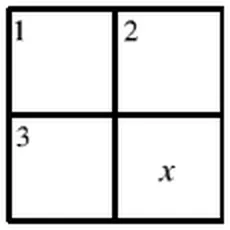
6. Each of the factors of 100 is to be placed in a 3 by 3 grid, one per cell, in such a way that the products of the three numbers in each row, column and diagonal are all equal. The positions of the numbers 1, 2, 50 and \(x\) are shown in the diagram.
The product of all the factors of 100 is \(1 \times 100 \times 2 \times 50 \times 4 \times 25 \times 5 \times 20 \times 10 =\) 1 000 000 000. As there are three rows, each of which has the same ’row product’, that row product is 1000. So, considering the top row, \(x \times 1 \times 50 = 1000\) and therefore \(x = 20\). The completed grid is as shown.
To provide a counterexample, we are looking for both the values of \(6n - 1\) and \(6n + 1\) to be composite for a particular \(n\) . When \(n = 20\), \(6n - 1 = 119 = 7 \times 17\) and \(6n + 1 = 121 = 11 \times 11\), which is our counter-example. In each of the other cases, at least one value is prime.
In order for \(\sqrt{200 - \sqrt{k}}\) to be an integer, \(200 - \sqrt{k}\) must be a square. As \(\sqrt{k} \geq 0\) , the smallest possible value of \(200 - \sqrt{k}\) which is square is 0, (when \(k = 200^2\)) and the largest is \(14^2 = 196\), (when \(k = 4^2\)). Counting the squares from \(0^2\) to \(14^2\) gives 15 values.
For a square to be a factor of \(10!\), the prime factors of the square must be present in \(10!\) an even number of times. Writing \(10!\) first as \(10 \times 9 \times 8 \times 7 \times 6 \times 5 \times 4 \times 3 \times 2 \times 1\) and then as \(2 \times 5 \times 3 \times 3 \times 2 \times 2 \times 2 \times 7 \times 2 \times 3 \times 5 \times 2 \times 2 \times 3 \times 2\) \(= 2^8 \times 3^4 \times 5^2 \times 7\) \(= (2^4 \times 3^2 \times 5)^2 \times 7\) we can see that the largest square is \(2^4 \times 3^2 \times 5\). Expanding \(2^4 \times 3^2 \times 5\) as \((2 \times 3) \times 5 \times (2 \times 2) \times 3 \times 2 \times 1\) shows that it is exactly \(6!\). So \((6!)^2\) is the largest square which is a factor of \(10!\).
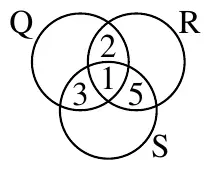
For \(Q + R + S\) to be as small as possible, we want the highest common factors of the pairs to be as small as possible, and prime. Therefore the highest common factors are 2, 3 and 5 in some order and then \(Q\), \(R\) and \(S\) are \(2 \times 3\), \(2 \times 5\) and \(3 \times 5\), i.e. 6, 10 and 15, in some order. This gives \(Q + R + S = 6 + 15 + 10 = 31\).
The values of the expressions are 1, 8, 81, 1024 and 15 625 respectively, so there are three odd numbers. Alternatively, note also that positive integer powers of odd and even numbers are themselves odd and even respectively.
Option A can be expressed using the difference of two squares as \(2019^2 - 2014^2 = (2019 + 2014)(2019 - 2014) = 4033 \times 5\), so this answer is a multiple of 5.
Option B is \(2019^2 \times 10^2\) which is \(2019^2 \times 10 \times 2 \times 5\), which again is a multiple of 5.
Option C is \(\frac{2020^2}{101^2}\) which equals \(\left(\frac{2020}{101}\right)^2\) and this simplifies to \(20^2\) which is \(80 \times 5\), so the answer is a multiple of 5.
Option D is \(2010^2 - 2005^2\) which equals \((2010 + 2005)(2010 - 2005)\), so \(4015 \times 5\) which again is a multiple of 5.
However, option E is \(\frac{2015^2}{5^2}\) which equals \(\left(\frac{2015}{5}\right)^2\) and this is \(403^2\). As the final digit of \(403^2\) is 9, this is not a multiple of 5.
The expression \(25 \times 15 \times 9 \times 5.4 \times 3.24 = 5^2 \times 3 \times 5 \times 3^2 \times \frac{54}{10} \times \frac{324}{100}\) which factorises further to \(5^2 \times 3 \times 5 \times 3^2 \times \frac{2 \times 3^3}{2 \times 5} \times \frac{2^2 \times 3^4}{2^2 \times 5^2}\). All the factors of 2 and 5 in the numerator and denominator cancel to leave only the product of powers of 3. This is \(3^1 \times 3^2 \times 3^3 \times 3^4\), so the expression is equal to \(3^{10}\).
The first four terms of the geometric sequence \(7^n\) are 7, 49, 343 and 2401. Evaluating \(7^5\) by considering \(2401 \times 7\) shows that the tens and units digits are ‘07’ as in the first term. Hence a cyclical pattern for the tens and units digits is formed using ‘07’, ‘49’, ‘43’ and ‘01’. As \(2018 = 504 \times 4 + 2\), then \(7^{2018}\) must end in the second value of the cycle, so ‘49’.
Since \(y = x\) and \(y = mx - 4\), it follows that \(x = mx - 4\) and so \(4 = mx - x = (m - 1)x\); therefore \(x = \frac{4}{m - 1}\). In order for \(x\) to be a positive integer, \(m - 1\) must be a positive factor of 4 therefore \(m - 1\) can equal 1, 2 or 4 and so \(m\) can equal 2, 3 or 5. The sum of these values of \(m\) is then 10.
If the exterior angle of an \(m\)-sided polygon is \(n°\) then its number of sides, \(m\), is \(\frac{360}{n}\). Similarly if the exterior angle of an \(n\)-sided polygon is \(m°\), then its number of sides, \(n\), is \(\frac{360}{m}\). Both \(n\) and \(m\) must be positive integers greater than two (or no polygon can be formed) and \(n \times m\) must be 360. The value of \(m\) can therefore be any of the twenty numbers 3, 4, 5, 6, 8, 9, 10, 12, 15, 18, 20, 24, 30, 36, 40, 45, 60, 72, 90 or 120 and the corresponding value of \(n\) will be \(\frac{360}{m}\).
The equation \(4^x = y^2 + 15\) can be rearranged to give \(\left(2^x\right)^2 - y^2 = 15\) which, using the difference of two squares, is \(\left(2^x + y\right)\left(2^x - y\right) = 15\). As we are looking for positive integer values then either \(2^x + y = 5\) and \(2^x - y = 3\) or \(2^x + y = 15\) and \(2^x - y = 1\). Solving each pair gives either \((x, y) = (2, 1)\) or \((x, y) = (3, 7)\) so there are just two possible pairs.
24. There is a set of straight lines in a plane such that each line intersects exactly ten others. Which of the following could not be the number of lines in that set?
When \(n\) non-parallel lines are drawn in a plane, each line intersects every other line exactly once. So each line intersects \((n - 1)\) lines. A line drawn parallel to one of the existing \(n\) lines also intersects \((n - 1)\) lines. In order that every line drawn intersects the same number of other lines, each of the original \(n\) lines must be part of a set of \(k\) parallel lines, for some integer \(k\). Then \(kn\) lines will each have \(k(n - 1)\) points of intersection. Here \(k(n - 1) = 10\) so as \((n - 1)\) is an integer \((n - 1)\) must be 1, 2, 5 or 10 giving \(n = 2, 3, 6\) or 11 and \(k = 10, 5, 2\) and 1 respectively. Of the options given: A is 11 non-parallel lines (\(n = 11\), \(k = 1\)); B is 6 sets of 2 parallel lines (\(n = 6\), \(k = 2\)); C is 3 sets of 5 parallel lines (\(n = 3\), \(k = 5\)); E is 2 different sets of 10 parallel lines (\(n = 2\), \(k = 10\)). These are the only four possible solutions to the problem, so 16 could not be the number of lines.
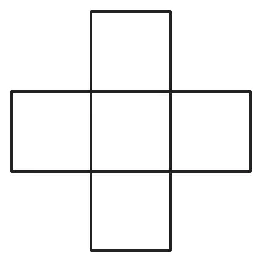
5. All the digits 2, 3, 4, 5 and 6 are placed in the grid, one in each cell, to form two three-digit numbers that are squares. Which digit is placed in the centre of the grid?
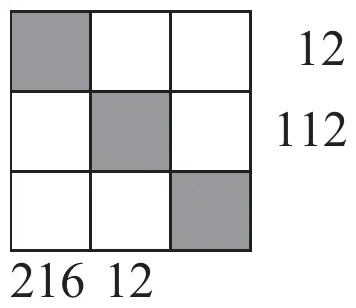
10. The digits from 1 to 9 are to be written in the nine cells of the \(3 \times 3\) grid shown, one digit in each cell. The product of the three digits in the first row is 12. The product of the three digits in the second row is 112. The product of the three digits in the first column is 216. The product of the three digits in the second column is 12. What is the product of the digits in the shaded cells?
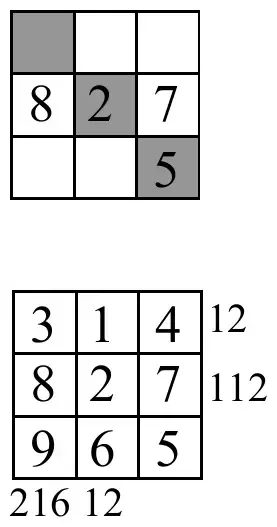
None of the products for the first two rows and first two columns contains a factor of 5, so the bottom right cell must contain the 5. The prime factorisation of 112 is \(2^4 \times 7\) and, as 7 is not a factor of 216 or 12, then 7 must be in the right cell of the middle row. The remaining \(2^4\) must be the product of two different numbers, namely 8 and 2. The 2 must be in the centre cell as 8 is not a factor of 12. The grid is now as shown above. The prime factorisation of 216 is \(2^3 \times 3^3\) and the \(3^3\) must be the product of a 3 and a 9. The 3 must be in the top left cell as the product of the top row is 12 which is not a multiple of 9. Thus, the product of the three shaded cells is \(3 \times 2 \times 5\) which is 30. The completed grid is as shown on the right.
The prime factorisation of 2016 is \(2^5 \times 3^2 \times 7\). To create the smallest square which is a multiple of 2016, the powers of each prime must be as small as possible and even, whilst also being at least as big as those in the prime factorisation of 2016. This gives \(2^6 \times 3^2 \times 7^2\) which is \(\left(2^3 \times 3 \times 7\right)^2\) or \(168^2\).
14. Which of the following values of the positive integer \(n\) is a counterexample to the statement: “If \(n\) is not prime then \(n - 2\) is not prime”?
The five options give the values of \(n\) to be considered. In option B, 11 is prime so that can be discounted. The options A, C and E are 6, 27 and 51 which are not prime and subtracting 2 from each of these gives 4, 25 and 49 which are also not prime. However in D, \(n = 33\) which is not prime but \(n - 2 = 31\) is prime.
For \(n\) to be the smallest integer for which \(7n\) has 2016 digits, \(7n\) must start with 1, be followed by 2014 zeros and end with a digit \(a\). When this number is divided by 7, the answer is formed from the repeating sequence of 6 digits 142857. The remainders also form a repeating sequence 3, 2, 6, 4, 5, 1. These sequences are repeated 335 times as \(6 \times 335\) is 2010. The last 4 zeros (to make 2014 zeros in total) and the final \(a\) create the last section of the division as shown:
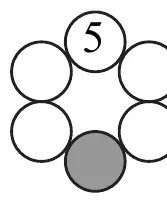
6. The numbers 5, 6, 7, 8, 9, 10 are to be placed, one in each of the circles in the diagram, so that the sum of the numbers in each pair of touching circles is a prime number. The number 5 is placed in the top circle. Which number is placed in the shaded circle?
The prime numbers which are the sums of pairs of numbers in touching circles are all odd as they are greater than 2. This means that any two adjacent circles in the diagram must be filled with one odd number and one even number. The number 10 may not be placed on either side of 5, since \(10 + 5 = 15 = 3 \times 5\). So either side of the 5 must be 6 and 8. Below 6 and 8 must be 7 and 9 respectively leaving 10 to be placed in the shaded circle at the bottom.
Expressed as a product of its prime factors, \(10!\) is \(2 \times 5 \times 3 \times 3 \times 2 \times 2 \times 2 \times 7 \times 2 \times 3 \times 5 \times 2 \times 2 \times 3 \times 2\) which is \(2^8 \times 3^4 \times 5^2 \times 7\). This can be written as \(\left(2^4 \times 3^2 \times 5\right)^2 \times 7\) so the largest integer \(k\) such that \(k^2\) is a factor of \(10!\) is \(2^4 \times 3^2 \times 5\) which is 720.
23. Given four different non-zero digits, it is possible to form 24 different four-digit numbers containing each of these four digits. What is the largest prime factor of the sum of the 24 numbers?
Let a four-digit positive integer be expressed as \(1000a + 100b + 10c + d\) where \(a\),\(b\), \(c\) and \(d\) are all different. In the 24 possible permutations of \(a\),\(b\), \(c\) and \(d\), each of the four letters appears in each position six times. Adding all 24 numbers together gives \(1000(6a + 6b + 6c + 6d) + 100(6a + 6b + 6c + 6d)\) \(+\, 10(6a + 6b + 6c + 6d) + 6a + 6b + 6c + 6d\). The total is therefore \(1111 \times 6(a + b + c + d)\) which factorises to \(2 \times 3 \times 11 \times 101(a + b + c + d)\). As \(a + b + c + d < 101\), the largest prime factor of the sum is 101.
24. Peter has 25 cards, each printed with a different integer from 1 to 25. He wishes to place \(N\) cards in a single row so that the numbers on every adjacent pair of cards have a prime factor in common. What is the largest value of \(N\) for which this is possible?
There are five cards in Peter's set that are printed with an integer that has no prime factors in common with any other number from 1 to 25. The five numbers are 1 (which has no prime factors) and the primes 13, 17, 19 and 23. These cards cannot be placed anywhere in the row of \(N\) cards. One possible row is: 11, 22, 18, 16, 12, 10, 8, 6, 4, 2, 24, 3, 9, 21, 7, 14, 20, 25, 15, 5. So the longest row is of 20 cards.
The prime factorisations of 20 and 14 are \(20 = 2 \times 2 \times 5\) and \(14 = 2 \times 7\). The lowest common multiple of 20 and 14 is 140 as \(140 = 2 \times 2 \times 5 \times 7\). For a number to be a multiple of 20 and 14 it must be a multiple of 140. As \(2014 \div 140 = 14\) remainder 54, there are 14 integers in the required range. Note: The integer 0, which is also a multiple of 20 and of 14 is excluded as we are considering numbers between 1 and 2014.
A number is divisible by 9 if and only if its digit sum is divisible by 9. The number \(10^{2014}\) can be written as a 1 followed by 2014 zeros, so this part has a digit sum of 1. Of all the options given, only adding on 8 to this will make a digit sum of 9, so \(10^{2014} + 8\) is the required answer.
First note that the exponent in each of the five options is prime, so we need to see which of the five numbers is not prime. By direct calculation the numbers are 3, 7, 31, 127 and 2047. Only the last number is not prime, as \(2047 = 23 \times 89\).
Factorising \(2013^2 - 2013\) gives \(2013(2013 - 1)\) which equals \(2013 \times 2012\). So the tens digit is 5 as \(13 \times 12 = 156\) and only this part of the product contributes to the tens digit of the answer.
A prime number has exactly two factors, one of which is 1. The expression \(4^n - 1\) can be factorised as \(4^n - 1 = (2^n + 1)(2^n - 1)\). For \(4^n - 1\) to be prime, the smaller of the factors, \(2^n - 1\), must equal 1. If \(2^n - 1 = 1\) then \(2^n = 2\) giving \(n = 1\). So there is exactly one value of \(n\) for which \(4^n - 1\) is prime and this value is 1.
16. Andrew states that every composite number of the form \(8n + 3\), where \(n\) is an integer, has a prime factor of the same form. Which of these numbers is an example showing that Andrew's statement is false?
By the Fundamental Theorem of Arithmetic, every positive integer greater than 1 is either prime or a product of two or more primes. A number that is the product of two or more primes is called a composite number. We are looking to choose, from the options provided, a composite number which is of the form \(8n + 3\) but does not have a prime factor of the form \(8n + 3\). Option A is prime, so is not possible. Options B and C are not of the form \(8n + 3\). Option E is \(8 \times 12 + 3 = 99\). The number 99, when expressed as a product of its prime factors, is \(3 \times 3 \times 11\) and the factor 11 is of the required form as \(11 = 8 \times 1 + 3\). However, option D is of the form \(8n + 3\) as \(8 \times 11 + 3 = 91\) but neither of the prime factors of 91, which are 7 and 13, are of the form \(8n + 3\).
18. The numbers 2, 3, 12, 14, 15, 20, 21 may be divided into two sets so that the product of the numbers in each set is the same. What is this product?
The product of all the numbers in the list is \(2 \times 3 \times 12 \times 14 \times 15 \times 20 \times 21\) which, when expressed in terms of prime factors is \(2 \times 3 \times 2 \times 2 \times 3 \times 2 \times 7 \times 3 \times 5 \times 2 \times 2 \times 5 \times 3 \times 7\) which is equal to \(2^6 \times 3^4 \times 5^2 \times 7^2 = (2^3 \times 3^2 \times 5 \times 7)^2 = 2520^2\). The answer 2520 is expressible as both \(2 \times 3 \times 20 \times 21\) and \(12 \times 14 \times 15\).
22. Consider numbers of the form \(10n + 1\), where \(n\) is a positive integer. We shall call such a number ‘grime’ if it cannot be expressed as the product of two smaller numbers, possibly equal, both of which are of the form \(10k + 1\), where \(k\) is a positive integer. How many ‘grime numbers’ are there in the sequence 11, 21, 31, 41, ..., 981, 991?
The numbers in the sequence 11, 21, 31, 41, …. , 981, 991 are of the form \(10n + 1\) for \(n = 1\) to 99. There are therefore 99 numbers in this sequence. Twelve terms of this sequence can be expressed using factors of the form \(10k + 1\). In this form, these terms are \(11 \times 11\),\(11 \times 21\),\(11 \times 31\), …, \(11 \times 81\) and \(21 \times 21\),\(21 \times 31\), \(21 \times 41\) and \(31 \times 31\). All other pairings give products that are too large. Hence, there are \(99 - 12 = 87\) ‘grime’ numbers.
If an odd number is written as the sum of two prime numbers then one of those primes is 2, since 2 is the only even prime. However, 9 is not prime so 11 cannot be written as the sum of two primes. Note that \(5 = 2 + 3\);\(7 = 2 + 5\);\(9 = 2 + 7\);\(10 = 3 + 7\), so 11 is the only alternative which is not the sum of two primes.
Let the required addition be ‘\(ab\)’ + ‘\(cd\)’ + ‘\(ef\)’, where \(a\),\(b\),\(c\),\(d\),\(e\), \(f\) are single, distinct digits. To make this sum as large as possible, we need \(a\),\(c\), \(e\) (the tens digits) as large as possible; so they must be 7, 8, 9 in some order. Then we need \(b\),\(d\), \(f\) as large as possible, so 4, 5, 6 in some order. Hence the largest sum is \(10(7 + 8 + 9) + (4 + 5 + 6) = 10 \times 24 + 15 = 255\).
6. What is the sum of the digits of the largest 4-digit palindromic number which is divisible by 15? [Palindromic numbers read the same backwards and forwards, e.g. 7227.]
In order to be a multiple of 15, a number must be a multiple both of 3 and of 5. So its units digit must be 0 or 5. However, the units digit must also equal the thousands digit and this cannot be 0, so the required number is of the form ‘5\(aa\)5’. The largest such four-digit numbers are 5995, 5885, 5775. Their digit sums are 28, 26, 24 respectively. In order to be a multiple of 3, the digit sum of a number must also be a multiple of 3, so 5775 is the required number. The sum of its digits is 24.
It can be deduced that \(N\) must consist of at least 224 digits since the largest 223-digit positive integer consists of 223 nines and has a digit sum of 2007. It is possible to find 224-digit positive integers which have a digit sum of 2012. The largest of these is 99 999 ...999 995 and the smallest is 59 999 ...999 999. So \(N = 59\,999\ldots\ 999\,999\) and \(N + 1 = 60\,000\ldots\ 000\,000\) (223 zeros).
Every integer is divisible by 1; 2012 is divisible by 2 since it is even; 2013 is divisible by 3 since its digits total to a multiple of 3; and 2015 is divisible by 5 since its last digit is 5. However, 2014 is not divisible by 4 because 14 is not.
Since \(3^1 = 3\),\(3^2 = 9\),\(3^3 = 27\),\(3^4 = 81\), \(3^5 = 243, \ldots\) we see that the final digits cycle through the four numbers 3, 9, 7, 1. As \(2011 = 502 \times 4 + 3\), the last digit of \(3^{2011}\) is 7.
12. The primorial of a number is the product of all of the prime numbers less than or equal to that number. For example, the primorial of 6 is \(2 \times 3 \times 5 = 30\). How many different whole numbers have a primorial of 210?
The primorial of 7 is \(2 \times 3 \times 5 \times 7 = 210\). As 8, 9 and 10 are not prime numbers, they also have a primorial of 210. The primorial of 11 is \(2 \times 3 \times 5 \times 7 \times 11 = 2310\). Hence there are exactly four different whole numbers which have a primorial of 210.
\(2 + 0 + 1 + 1 = 4\). Multiples of 4 are even, hence 2011 is not valid and the same argument applies to 2013, 2015, 2017 and 2019. \(2 + 0 + 1 + 2 = 5\). The units digit for multiples of 5 is 0 or 5, hence 2012 is not valid. \(2 + 0 + 1 + 4 = 7\). But \(\dfrac{2014}{7} = 287\tfrac{5}{7}\), hence 2014 is not valid. \(2 + 0 + 1 + 6 = 9\). Since \(2016 = 9 \times 224\), 2016 is valid. Hence we have to wait \(2016 - 2010 \,(= 6)\) more years.
The lowest common multiple of 3 and 4 is 12. Hence both of the required conditions are satisfied only by numbers that are 2 less than multiples of 12 and also less than 100, ie: 10, 22, 34, 46, 58, 70, 82 and 94. Therefore 8 two-digit numbers satisfy the conditions.
The first eight prime numbers are: 2, 3, 5, 7, 11, 13, 17, 19. If the sum of two prime numbers is prime, one of them must be 2. If the sum of three different prime numbers is prime they must all be odd. The answer is therefore 19 as: \(2 + 17 = 19\) and \(3 + 5 + 11 = 19\).
25. All the digits of a number are different, the first digit is not zero, and the sum of the digits is 36. There are \(N \times 7!\) such numbers. What is the value of \(N\)?
The sum of 10 different digits is 45. As the sum of the digits in the question is 36 then digits adding to 9 are omitted. The combinations of digits satisfying this are:
\(\dfrac{785}{15} = 52\tfrac{1}{3}\) hence 785 is not a multiple of 15. But \(\dfrac{135}{15} = 9\),\(\dfrac{315}{15} = 21\),\(\dfrac{555}{15} = 37\),\(\dfrac{915}{15} = 61\).
A number is a multiple of 6 precisely when it is both a multiple of 2 and of 3. To be a multiple of 2, it will need to end with an even digit; i.e. 0 or 2. If it ends with 0, the sum of the other two digits must be a multiple of 3; and only 3 = 1 + 2 or 6 = 1 + 5 are possible. That gives the numbers 120, 210, 150, 510. If it ends with 2, the sum of the others must be 1 = 0 + 1 or 4 = 1 + 3. That gives 102, 132 and 312.
Let \(\dfrac{n}{100 - n} = x\) where \(x\) is an integer. Hence \(n = 100x - nx\). Hence \(n\,(1 + x) = 100x\) giving \(n = \dfrac{100x}{1 + x}\). Now \(x\) and \(1 + x\) can have no common factors. Therefore \(1 + x\) must be a factor of 100 and can be any of them. Hence \(1 + x \in \{\pm 1, \pm 2, \pm 4, \pm 5, \pm 10, \pm 20, \pm 25, \pm 50, \pm 100\}\) thus the number of possible integers \(n\) is 18.
25. Four positive integers \(a\),\(b\), \(c\) and \(d\) are such that \[abcd + abc + bcd + cda + dab + ab + bc + cd + da + ac + bd + a + b + c + d = 2009.\] What is the value of \(a + b + c + d\)?
The left-hand side of the equation can be written as \[(a + 1)(b + 1)(c + 1)(d + 1) - 1.\] Hence \[(a + 1)(b + 1)(c + 1)(d + 1) = 2010.\] Now expressing 2010 as a product of primes gives 2010 = 2 × 3 × 5 × 67 hence \(a + b + c + d = 1 + 2 + 4 + 66 = 73\).
A number is divisible by 9 if, and only if, the sum of its digits is divisible by 9. The given number is \(N + 2\), where \(N = 222\ldots220\) has 2007 2s. Since 2007 = 223 × 9, \(N\) is divisible by 9 and the required remainder is therefore 2.
Since \(1280 = 2^8 \times 5 = 2^8(2^0 + 2^2) = 2^8 + 2^{10}\), we may take \(m\)=8 and \(n\) = 10 (or vice versa) to get \(m + n = 8 + 10 = 18\). It is easy to check that there are no other possibilities.
Let \(199p + 1 = X^2\). Then \(199p = X^2 - 1 = (X + 1)(X - 1)\). Note that 197 is prime. If \(p\) is also to be prime then either\(X + 1 = 199\), in which case \(X - 1 = 197\),or\(X - 1 = 199\), in which case \(X + 1 = 201\) (and 201 = 3 × 67 is not prime). Note that \(X - 1 = 1\), \(X + 1 = 199p\) is impossible. Hence \(p = 197\) is the only possibility.
There are 1003 whole numbers between 1 and 2007 which are divisible by 2. Those which are also divisible by 7 are the multiples of 14, namely 14, 28, 42, …, 2002. There are 143 of these, so the required number is 1003 − 143 = 860.
Let \(N\) be the two-digit number ‘\(ab\)’, that is \(N = 10a + b\). So the sum of \(N\) and its ‘reverse’ is \(10a + b + 10b + a = 11a + 11b = 11\,(a + b)\). As 11 is prime and \(a\) and \(b\) are both single digits, \(11\,(a + b)\) is a square if, and only if, \(a + b = 11\). So the possible values of \(N\) are 29, 38, 47, 56, 65, 74, 83, 92.
16. Damien wishes to find out if 457 is a prime number. In order to do this he needs to check whether it is exactly divisible by some prime numbers. What is the smallest number of possible prime number divisors that Damien needs to check before he can be sure that 457 is a prime number?
The smallest number of possible prime divisors of 457 that Damien needs to check is the number of prime numbers less than or equal to the square root of 457. Since \(21^2 < 457 < 22^2\), he needs to check only primes less than 22. These primes are 2, 3, 5, 7, 11, 13, 17 and 19.
11. Three consecutive even numbers are such that the sum of four times the smallest and twice the largest exceeds three times the second by 2006. What is the sum of the digits of the smallest number?
Let the smallest of the three even numbers be \(n\). Then the other two numbers are \(n + 2\) and \(n + 4\). So \(4n + 2(n + 4) = 3(n + 2) + 2006\), that is \(6n + 8 = 3n + 2012\), that is \(n = 668\).
12. The factorial of \(n\), written \(n!\), is defined by \(n! = 1 \times 2 \times 3 \times \;\ldots\; \times (n - 2) \times (n - 1) \times n\). Which of the following values of \(n\) provides a counterexample to the statement:
“If \(n\) is a prime number, then \(n! + 1\) is also a prime number”?
It is necessary to test only \(n = 2\),\(n = 3\), \(n = 5\) since the other two possible values are not prime. \(2! + 1 = 3\), which is prime; \(3! + 1 = 7\), which is prime; but \(5! + 1 = 121\), which is not prime. So \(n = 5\) provides the counterexample.
14. Heather and Rachel each has some pennies. Heather has more than Rachel. In fact, the number of pennies that Heather has is the square of the number that Rachel has. The total number of pennies they have between them makes a whole number of pounds. What is the smallest this total could be?
Let Rachel and Heather have \(x\) and \(x^2\) pennies respectively. So \(x + x^2 = 100n\), where \(x\) and \(n\) are positive integers. We require, therefore, that \(x(x + 1) = 100n = 2^2 \times 5^2 \times n\). Now \(x\) and \(x + 1\) cannot both be multiples of 5, so their product will be a multiple of 25 if and only if \(x\) or \(x + 1\) is a multiple of 25. The smallest value of \(x\) which satisfies this condition is 24 which is a multiple of 4 so 24 × 25 is a multiple of 100. Therefore Rachel has 24 pennies, Heather has 576 pennies and, in total, they have £6.
25. \(X\) is a positive integer in which each digit is 1; that is, \(X\) is of the form 11111… . Given that every digit of the integer \(pX^2 + qX + r\) (where \(p\), \(q\) and \(r\) are fixed integer coefficients and \(p > 0\)) is also 1, irrespective of the number of digits \(X\), which of the following is a possible value of \(q\)?
Let \(X\) consist of \(x\) digits, each of which is 1. So \(X = \tfrac{10^x - 1}{9}\). Let \(pX^2 + qX + r\) consist of \(y\) digits, each of which is 1. So \(pX^2 + qX + r = \tfrac{10^y - 1}{9}\). Then \(p\left(\tfrac{10^x - 1}{9}\right)^2 + q\left(\tfrac{10^x - 1}{9}\right) + r = \tfrac{10^y - 1}{9}\), that is \(p(10^{2x} - 2 \times 10^x + 1) + 9q(10^x - 1) + 81r = 9(10^y - 1)\), that is (on dividing throughout by \(10^{2x}\)) \(p + (9q - 2p)10^{-x} + (p - 9q + 81r)10^{-2x} = 9 \times 10^{y - 2x} - 9 \times 10^{-2x}\). We now let \(x\) tend to infinity (through integer values). The LHS of the above equation tends to \(p\), and the second term on the right goes to 0. By continuity of the function \(f(u) = 10^u = e^{u \log 10}\), we can deduce that \(y - 2x\) must tend to a limit. Let this limit be \(L\). Since \(y - 2x\) is always an integer, it must actually equal \(L\) for all \(x\) sufficiently large. Passing to the limit, therefore, we obtain \(p = 9 \times 10^L\). Since \(p\) is to be an integer, we must have that \(L\) (also an integer) is a non-negative integer. Substituting for \(p\) in the previous equation and simplifying leads to \[9q - 18 \times 10^L + (9 \times 10^L - 9q + 81r)10^{-x} = -9 \times 10^{-x}.\] Passing to the limit again leads to \(q = 2 \times 10^L\) and the previous line then also gives \(9 \times 10^L - 18 \times 10^L + 81r = -9\). So \(r = \tfrac{10^L - 1}{9}\). Possible values of \((p,\ q,\ r)\) therefore are (9, 2, 0), (90, 20, 1), (900, 200, 11), etc. So of the values given in the question for \(q\), only \(q = 2\) is possible. (Observe that the three triples above correspond to \(L = 0\),\(L = 1\), \(L = 2\) respectively and we note that increasing L by 1 corresponds to multiplying \(pX^2 + qX + r\) by 10 and adding 1. As \(pX^2 + qX + r\) consists only of 1s, \(10\,(pX^2 + qX + r) + 1\) will also consist only of 1s, explaining why there is an infinite family of quadratics which satisfy the required condition.)
The sequences have common differences of 7 and 9 respectively. The lowest common multiple of 7 and 9 is 63, so the next term after 2005 to appear in both sequences is 2005 + 63, that is 2068.
When divided by 6, a whole number leaves remainder 0, 1, 2, 3, 4 or 5. So the possible remainders when a square number is divided by 6 are the remainders when 0, 1, 4, 9, 16 and 25 are divided by 6. These are 0, 1, 4, 3, 4 and 1 respectively, so a square number cannot leave remainder 2 (or remainder 5) when divided by 6.
Note that \(n^2 - 1\) is divisible by \(n - 1\). Thus: \[\frac{n^2 - 9}{n - 1} = \frac{n^2 - 1}{n - 1} - \frac{8}{n - 1} = n + 1 - \frac{8}{n - 1} \qquad (n \neq 1).\] So, if \(n\) is an integer, then \(\dfrac{n^2 - 9}{n - 1}\) is an integer if and only if \(n - 1\) divides exactly into 8. The possible values of \(n - 1\) are −8, −4, −2, −1, 1, 2, 4, 8, so \(n\) is −7, −3, −1, 0, 2, 3, 5, 9. The sum of these values is 8. (Note that the sum of the 8 values of \(n - 1\) is clearly 0, so the sum of the 8 values of \(n\) is 8.)
22. Given that \(S = (x + 20) + (x + 21) + (x + 22) + \ldots + (x + 100)\), where \(x\) is a positive integer, what is the smallest value of \(x\) such that \(S\) is a perfect square?
There are 81 terms in the series, so, using the formula \(S = \tfrac{1}{2}n(a + l)\) for an arithmetic series: \[S = \frac{81}{2}(x + 20 + x + 100) = 81\,(x + 60)\,.\] Now 81 is a perfect square, so \(S\) is a perfect square if and only if \(x + 60\) is a perfect square. As \(x\) is a positive integer, the smallest possible value of \(x\) is 4.
24. The factorial of \(n\), written \(n!\), is defined by \(n! = 1 \times 2 \times 3 \times \ldots \times (n - 2) \times (n - 1) \times n\). For how many positive integer values of \(k\) less than 50 is it impossible to find a value of \(n\) such that \(n!\) ends in exactly \(k\) zeros?
When \(n!\) is written in full, the number of zeros at the end of the number is equal to the power of 5 when \(n!\) is written as the product of prime factors, because there is at least that high a power of 2 available. For example, \(12! = 1 \times 2 \times 3 \times \;\ldots\; \times 12\) \(= 2^{10} \times 3^5 \times 5^2 \times 7 \times 11\). This may be written as \(2^8 \times 3^5 \times 7 \times 11 \times 10^2\), so \(12!\) ends in 2 zeros, as \(2^8 \times 3^5 \times 7 \times 11\) is not a multiple of 10. We see that \(24!\) ends in 4 zeros as 5, 10, 15 and 20 all contribute one 5 when \(24!\) is written as the product of prime factors, but \(25!\) ends in 6 zeros because \(25 = 5 \times 5\) and hence contributes two 5s. So there is no value of \(n\) for which \(n!\) ends in 5 zeros. Similarly, there is no value of \(n\) for which \(n!\) ends in 11 zeros since \(49!\) ends in 10 zeros and \(50!\) ends in 12 zeros. The full set of values of \(k\) less than 50 for which it is impossible to find a value of \(n\) such that \(n!\) ends in \(k\) zeros is 5, 11, 17, 23, 29, 30 (since \(124!\) ends in 28 zeros and \(125!\) ends in 31 zeros), 36, 42, 48.
We'd like to use Google Analytics cookies to count visits and see which pages help most. They're optional, and the site works exactly the same either way. Privacy policy