The whole Senior Mathematical Challenge 2013 paper, one question at a time in order (25 questions). Press Mark as done after each one: your marks add up below.
Factorising \(2013^2 - 2013\) gives \(2013(2013 - 1)\) which equals \(2013 \times 2012\). So the tens digit is 5 as \(13 \times 12 = 156\) and only this part of the product contributes to the tens digit of the answer.
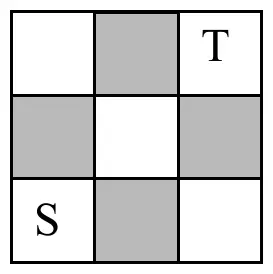
4. A route on the \(3 \times 3\) board shown consists of a number of steps. Each step is from one square to an adjacent square of a different colour. How many different routes are there from square S to square T which pass through every other square exactly once?
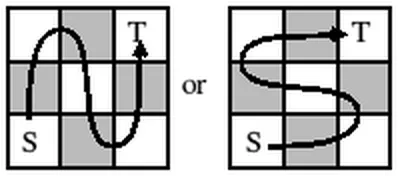
In order to pass through each square exactly once, a route must pass in and out of both unlabelled corner squares and also pass through the middle. Passing in and out of a corner involves three squares, coloured grey, white and grey in that order. Passing in and out of the two unlabelled corners therefore accounts for six unlabelled squares, leaving only the middle square which must be in the middle of any possible route. So, there are two possible routes as shown.
6. Rebecca went swimming yesterday. After a while she had covered one fifth of her intended distance. After swimming six more lengths of the pool, she had covered one quarter of her intended distance. How many lengths of the pool did she intend to complete?
Let \(d\) be the number of lengths that Rebecca intended to swim. Then \(6 = \dfrac{d}{4} - \dfrac{d}{5} = \dfrac{d}{20}\) and therefore \(d = 6 \times 20 = 120\).
The first item that Susanna buys makes her bill a number of pounds and 99 pence. Each extra item she buys after that decreases by one the number of pence in her total bill. Let \(n\) be the number of items bought. To be charged £65.76, \(1 + 99 - n = 76\) so \(n = 100 - 76 = 24\). Alternatives of 124 items or more are infeasible as they would each give a total greater than £65.76.
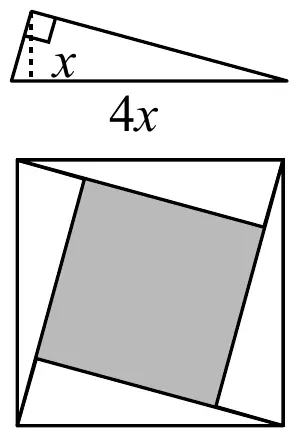
8. The right-angled triangle shown has a base which is 4 times its height. Four such triangles are placed so that their hypotenuses form the boundary of a large square as shown. What is the side-length of the shaded square in the diagram?
The area of the shaded square is equal to the area of the large square minus the area of the four triangles. Thus the area of the shaded square is \((4x)^2 - 4 \times \tfrac{1}{2} \times 4x \times x = 16x^2 - 8x^2 = 8x^2\). So the side-length is \(\sqrt{8x^2} = 2\sqrt{2}x\).
9. According to a headline, ‘Glaciers in the French Alps have lost a quarter of their area in the past 40 years’. What is the approximate percentage reduction in the length of the side of a square when it loses one quarter of its area, thereby becoming a smaller square?
When a square loses a quarter of its area, thereby becoming a smaller square, three quarters of its area remains. Therefore the lengths of the sides of the original square have been multiplied by \(\sqrt{\tfrac{3}{4}} = \tfrac{1}{2}\sqrt{3} \approx 0.866\). This means a reduction of \((100 - 86.6)\)% which is approximately 13%.
10. Frank's teacher asks him to write down five integers such that the median is one more than the mean, and the mode is one greater than the median. Frank is also told that the median is 10. What is the smallest possible integer that he could include in his list?
The median is 10. Therefore the mode must be 11 and there must be two 11s in Frank's list. The mean is 9, so the total of the five numbers is 45. This means that the total of the two smallest integers is \(45 - (10 + 2 \times 11) = 13\). The maximum size of the second largest integer is 9 so the smallest integer that Frank could include in his list is \(13 - 9 = 4\).
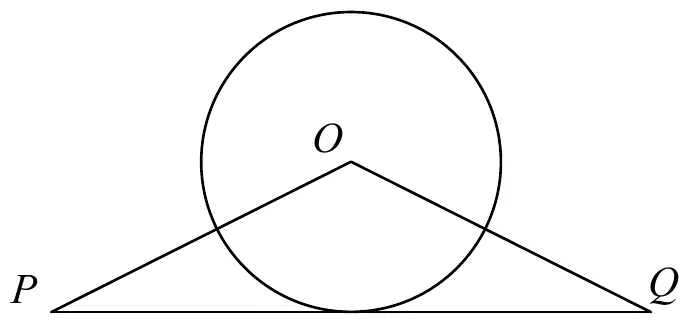
11. The diagram shows a circle with centre \(O\) and a triangle \(OPQ\). Side \(PQ\) is a tangent to the circle. The area of the circle is equal to the area of the triangle. What is the ratio of the length of \(PQ\) to the circumference of the circle?
Let the radius of the circle be \(r\). Then its area is \(\pi r^2\). The height of the triangle is \(r\) and its area is \(\tfrac{1}{2} \times PQ \times r\). So \(\tfrac{1}{2} \times PQ \times r = \pi r^2\) and therefore \(PQ = 2\pi r\), which is also the circumference of the circle. Therefore the ratio of the length of \(PQ\) to the circumference of the circle is \(1 : 1\).
12. As a special treat, Sammy is allowed to eat five sweets from his very large jar which contains many sweets of each of three flavours − Lemon, Orange and Strawberry. He wants to eat his five sweets in such a way that no two consecutive sweets have the same flavour. In how many ways can he do this?
There are three options for Sammy's first choice and then two options for each subsequent choice. Therefore the number of possible ways is \(3 \times 2 \times 2 \times 2 \times 2 = 48\).
13. Two entrants in a school's sponsored run adopt different tactics. Angus walks for half the time and runs for the other half, whilst Bruce walks for half the distance and runs for the other half. Both competitors walk at 3mph and run at 6mph. Angus takes 40 minutes to complete the course. How many minutes does Bruce take?
Angus completes the course in 40 minutes, so he spends 20 minutes (which is \(\tfrac{1}{3}\) of an hour) walking and the same time running. By using distance = speed × time, the length of the course is \(3 \times \tfrac{1}{3} + 6 \times \tfrac{1}{3} = 1 + 2 = 3\) miles. Bruce completes the course by walking for \(1\tfrac{1}{2}\) miles and running for \(1\tfrac{1}{2}\) miles. So, by using time \(= \dfrac{\text{distance}}{\text{speed}}\), Bruce's total time in hours is \(\dfrac{1\frac{1}{2}}{3} + \dfrac{1\frac{1}{2}}{6} = \dfrac{1}{2} + \dfrac{1}{4} = \dfrac{3}{4}\) of an hour. So Bruce takes 45 minutes to complete the course.
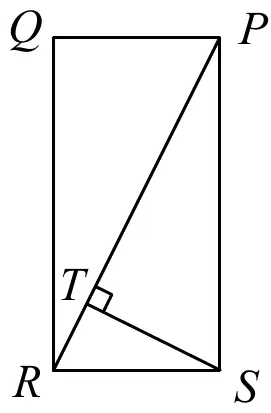
14. The diagram shows a rectangle \(PQRS\) in which \(PQ : QR = 1 : 2\). The point \(T\) on \(PR\) is such that \(ST\) is perpendicular to \(PR\). What is the ratio of the area of the triangle \(RST\) to the area of the rectangle \(PQRS\)?
Triangle \(RST\) is similar to triangle \(RPS\) as their corresponding angles are equal. Using Pythagoras' Theorem, the ratio of \(RS\) to \(RP\) is \(1 : \sqrt{5}\). So the ratio of \(RT\) to \(RS\) is also \(1 : \sqrt{5}\). Therefore the ratio of the area of the triangle \(RST\) to the area of triangle \(RPS\) is \(1 : 5\). Triangle \(RPS\) is half the rectangle \(PQRS\), so the ratio of the area of triangle \(RST\) to the area of rectangle \(PQRS\) is \(1 : 10\).
A prime number has exactly two factors, one of which is 1. The expression \(4^n - 1\) can be factorised as \(4^n - 1 = (2^n + 1)(2^n - 1)\). For \(4^n - 1\) to be prime, the smaller of the factors, \(2^n - 1\), must equal 1. If \(2^n - 1 = 1\) then \(2^n = 2\) giving \(n = 1\). So there is exactly one value of \(n\) for which \(4^n - 1\) is prime and this value is 1.
16. Andrew states that every composite number of the form \(8n + 3\), where \(n\) is an integer, has a prime factor of the same form. Which of these numbers is an example showing that Andrew's statement is false?
By the Fundamental Theorem of Arithmetic, every positive integer greater than 1 is either prime or a product of two or more primes. A number that is the product of two or more primes is called a composite number. We are looking to choose, from the options provided, a composite number which is of the form \(8n + 3\) but does not have a prime factor of the form \(8n + 3\). Option A is prime, so is not possible. Options B and C are not of the form \(8n + 3\). Option E is \(8 \times 12 + 3 = 99\). The number 99, when expressed as a product of its prime factors, is \(3 \times 3 \times 11\) and the factor 11 is of the required form as \(11 = 8 \times 1 + 3\). However, option D is of the form \(8n + 3\) as \(8 \times 11 + 3 = 91\) but neither of the prime factors of 91, which are 7 and 13, are of the form \(8n + 3\).
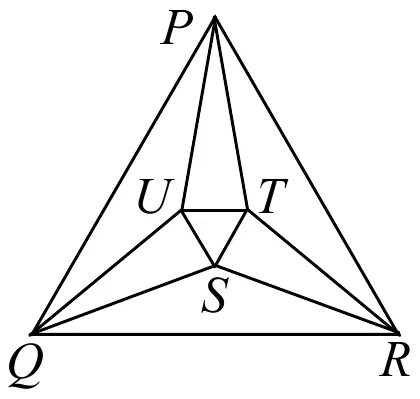
17. The equilateral triangle \(PQR\) has side-length 1. The lines \(PT\) and \(PU\) trisect the angle \(RPQ\), the lines \(RS\) and \(RT\) trisect the angle \(QRP\) and the lines \(QS\) and \(QU\) trisect the angle \(PQR\). What is the side-length of the equilateral triangle \(STU\)?
Triangle \(PQR\) is equilateral so \(\angle QPU = \angle UPT = \angle TPR = 20°\). Triangle \(PUT\) is isosceles, so \(\angle PUT = 80°\). Let \(X\) be the midpoint of \(PQ\) and \(Y\) be the midpoint of \(UT\). Considering the right-angled triangle \(PXU\) gives \(\cos 20° = \dfrac{PX}{PU} = \dfrac{\frac{1}{2}}{PU}\), so \(PU = \dfrac{1}{2\cos 20°}\). Considering the right-angled triangle \(PUY\) gives \(\cos 80° = \dfrac{UY}{PU}\), so \(UY = PU\cos 80° = \dfrac{\cos 80°}{2\cos 20°}\). Therefore \(UT = 2UY = \dfrac{2\cos 80°}{2\cos 20°} = \dfrac{\cos 80°}{\cos 20°}\). {Note that triangle UTS is a Morley triangle, named after the mathematician Frank Morley. His 1899 trisector theorem states that in any triangle, the three points of intersection of the adjacent angle trisectors form an equilateral triangle, in this case, triangle UTS.}
18. The numbers 2, 3, 12, 14, 15, 20, 21 may be divided into two sets so that the product of the numbers in each set is the same. What is this product?
The product of all the numbers in the list is \(2 \times 3 \times 12 \times 14 \times 15 \times 20 \times 21\) which, when expressed in terms of prime factors is \(2 \times 3 \times 2 \times 2 \times 3 \times 2 \times 7 \times 3 \times 5 \times 2 \times 2 \times 5 \times 3 \times 7\) which is equal to \(2^6 \times 3^4 \times 5^2 \times 7^2 = (2^3 \times 3^2 \times 5 \times 7)^2 = 2520^2\). The answer 2520 is expressible as both \(2 \times 3 \times 20 \times 21\) and \(12 \times 14 \times 15\).
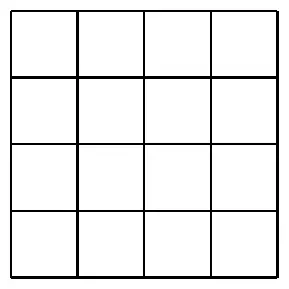
19. The 16 small squares shown in the diagram each have a side length of 1 unit. How many pairs of vertices are there in the diagram whose distance apart is an integer number of units?
There are 25 vertices in the diagram. Each vertex is part of a row of 5 vertices and a column of 5 vertices. Each vertex is therefore an integer number of units away from the 4 other vertices in its row and from the other 4 vertices in its column. This appears to give \(25 \times (4 + 4) = 200\) pairs. However, counting in this manner includes each pair twice so there are only 100 different pairs. By using the Pythagorean triple 3, 4, 5, each corner vertex is five units away from two other non-corner vertices, giving another 8 pairs. No other Pythagorean triples include small enough numbers to yield pairs of vertices on this grid. Thus the total number of pairs is 108.
Let the two positive numbers be \(x\) and \(y\) with \(x > y\). The sum of the numbers is greater than their difference, so the two ratios which are equal are \(x : y\) and \(x + y : x - y\). Therefore \(\dfrac{x}{y} = \dfrac{x + y}{x - y}\). By dividing the top and bottom of the right-hand side by \(y\) we obtain \(\dfrac{x}{y} = \dfrac{\frac{x}{y} + 1}{\frac{x}{y} - 1}\). Letting \(k = \tfrac{x}{y}\) gives \(k = \tfrac{k + 1}{k - 1}\) which gives the quadratic \(k^2 - 2k - 1 = 0\). Completing the square gives \((k - 1)^2 = 2\) whence \(k = 1 \pm \sqrt{2}\). However, as \(x\) and \(y\) are both positive, \(k \neq 1 - \sqrt{2}\). As the ratio \(\tfrac{x}{y} = 1 + \sqrt{2}\), the ratio \(x : y\) is \(1 + \sqrt{2} : 1\).
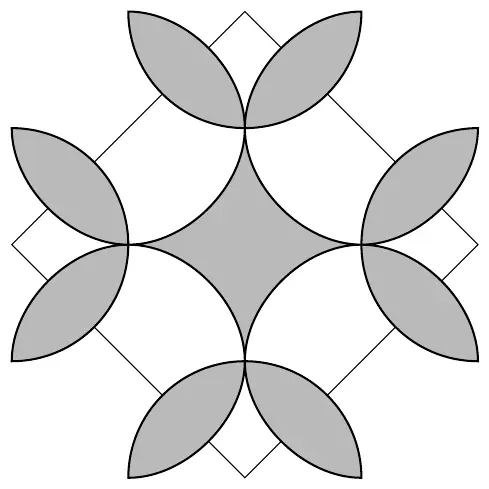
The shaded design shown in the diagram is made by drawing eight circular arcs, all with the same radius. The centres of four arcs are the vertices of the square; the centres of the four touching arcs are the midpoints of the sides of the square. The diagonals of the square have length 1. What is the total length of the border of the shaded design?
Let the top vertex of the square be \(A\) and the midpoints of the two lines that meet at \(A\) be \(B\) and \(C\). The line \(BC\) is of length \(\tfrac{1}{2}\) and is perpendicular to the diagonal of the square through \(A\). Let the point of intersection of these two lines be \(D\). Let the end of the uppermost arc, above \(B\), be \(E\). Then \(ADBE\) is a rhombus, made from four radii of the arcs, \(AD\),\(DB\), \(BE\) and \(EA\), each of length \(\tfrac{1}{4}\). As \(\angle ADB = 90°\), this rhombus is a square. It then follows that the four arcs whose centres are the vertices of the original square are all semi-circles. The remaining four touching arcs are each \(\tfrac{3}{4}\) of a circle. In total, the length of the border is \(4 \times \tfrac{1}{2} + 4 \times \tfrac{3}{4}\) times the circumference of a circle with the same radius, so is \(5 \times 2\pi \times \tfrac{1}{4} = \tfrac{5}{2}\pi\).
22. Consider numbers of the form \(10n + 1\), where \(n\) is a positive integer. We shall call such a number ‘grime’ if it cannot be expressed as the product of two smaller numbers, possibly equal, both of which are of the form \(10k + 1\), where \(k\) is a positive integer. How many ‘grime numbers’ are there in the sequence 11, 21, 31, 41, ..., 981, 991?
The numbers in the sequence 11, 21, 31, 41, …. , 981, 991 are of the form \(10n + 1\) for \(n = 1\) to 99. There are therefore 99 numbers in this sequence. Twelve terms of this sequence can be expressed using factors of the form \(10k + 1\). In this form, these terms are \(11 \times 11\),\(11 \times 21\),\(11 \times 31\), …, \(11 \times 81\) and \(21 \times 21\),\(21 \times 31\), \(21 \times 41\) and \(31 \times 31\). All other pairings give products that are too large. Hence, there are \(99 - 12 = 87\) ‘grime’ numbers.
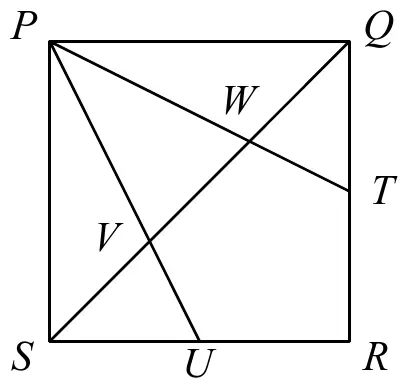
23.PQRS is a square. The points T and U are the midpoints of QR and RS respectively. The line QS cuts PT and PU at W and V respectively. What fraction of the area of the square PQRS is the area of the pentagon RTWVU?
The pentagon \(RTWVU\) is the remainder when triangles \(SUV\) and \(WTQ\) are removed from the bottom right half of the square. Draw in the diagonal \(PR\) and consider the triangle \(PRS\). The medians of triangle \(PRS\) join each vertex \(P\), \(R\) and \(S\) to the midpoint of its opposite side, i.e. \(P\) to \(U\) and \(S\) to the middle of the square. The medians intersect at \(V\) and therefore the height of \(V\) above \(SR\) is \(\tfrac{1}{3}\) of \(PS\). The area of triangle \(SUV\) is therefore \(\tfrac{1}{2} \times \tfrac{1}{2}SR \times \tfrac{1}{3}PS = \tfrac{1}{12}\) of the area of the square. By symmetry, this is also the area of triangle \(WTQ\). The area of the pentagon \(RTWVU\) is then \(\tfrac{1}{2} - \left(\tfrac{1}{12} + \tfrac{1}{12}\right) = \tfrac{1}{3}\) of the area of the square \(PQRS\).
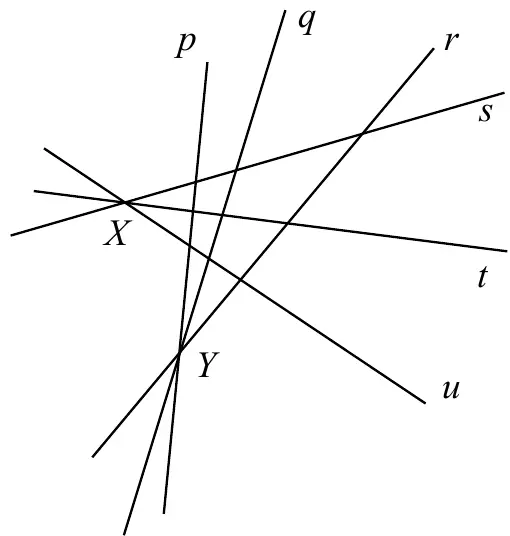
Challengeborough's underground train network consists of six lines, \(p\),\(q\),\(r\),\(s\),\(t\),\(u\), as shown. Wherever two lines meet there is a station which enables passengers to change lines. On each line, each train stops at every station. Jessica wants to travel from station \(X\) to station \(Y\). She does not want to use any line more than once, nor return to station \(X\) after leaving it, nor leave station \(Y\) having reached it. How many different routes, satisfying these conditions, can she choose?
Jessica must travel alternately on lines which are connected to station \(X\) (i.e. \(s\), \(t\) or \(u\)), and connected to station \(Y\) (i.e. \(p\), \(q\) or \(r\)). In order to depart from \(X\) and end her journey at \(Y\), she must travel along an even number of lines. This can be 2, 4 or 6 lines, making 1, 3 or 5 changes respectively. Case A, 2 lines: Jessica leaves station \(X\) along one of the lines \(s\), \(t\) or \(u\), makes one change onto one of lines \(p\), \(q\) or \(r\) and reaches station \(Y\). Here there are \(3 \times 3\) possibilities. Case B, 4 lines: Jessica leaves station \(X\) along one of the lines \(s\), \(t\) or \(u\) and makes her first change onto one of lines \(p\), \(q\) or \(r\). She then makes her second change onto either of the two lines \(s\), \(t\) or \(u\) on which she has not previously travelled and her third change onto either of the two lines \(p\), \(q\) or \(r\) on which she has not previously travelled and reaches station \(Y\). Here there are \(3 \times 3 \times 2 \times 2\) possibilities. Case C, 6 lines: Her journey is as described in Case B but her fourth change is onto the last of the lines \(s\), \(t\) or \(u\) on which she has not previously travelled and her fifth change is onto the last of the lines \(p\), \(q\) or \(r\) on which she has not previously travelled. Here there are \(3 \times 3 \times 2 \times 2 \times 1 \times 1\) possibilities. So in total Jessica can choose \(9 + 36 + 36 = 81\) different routes.
We'd like to use Google Analytics cookies to count visits and see which pages help most. They're optional, and the site works exactly the same either way. Privacy policy