The whole Senior Mathematical Challenge 2014 paper, one question at a time in order (25 questions). Press Mark as done after each one: your marks add up below.
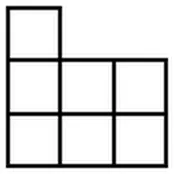
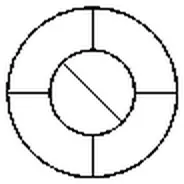
2. The diagram shows 6 regions. Each of the regions is to be painted a single colour, so that no two regions sharing an edge have the same colour. What is the smallest number of colours required?
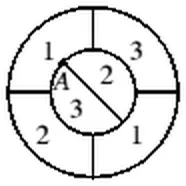
There are points on the diagram, such as \(A\), where the edges of three regions meet, so three or more different colours are required. A colouring with three colours is possible as shown, so the smallest number of colours required is three.
The year 1997 was not a leap year so had \(365 = 52 \times 7 + 1\) days. Hence, starting from 1st January, 1997 had 52 complete weeks, each starting with the same day as 1st January, followed by 31st December. As 31st December was a Wednesday, so too were all the first days of the 52 complete weeks. So there were 53 Wednesdays in 1997.
Let the original amount of money be \(x\) (in pounds). If I spend \(\tfrac{x}{5}\) then \(\tfrac{4x}{5}\) remains. When I spend \(\tfrac{1}{4}\) of that, \(\tfrac{3}{4}\) of it remains. So \(\tfrac{4x}{5} \times \tfrac{3}{4}\) is what is left and that is £15. As \(\tfrac{4x}{5} \times \tfrac{3}{4} = 15\), we have \(x = \tfrac{5}{3} \times 15 = 25\). So the original amount of money is £25.
The prime factorisations of 20 and 14 are \(20 = 2 \times 2 \times 5\) and \(14 = 2 \times 7\). The lowest common multiple of 20 and 14 is 140 as \(140 = 2 \times 2 \times 5 \times 7\). For a number to be a multiple of 20 and 14 it must be a multiple of 140. As \(2014 \div 140 = 14\) remainder 54, there are 14 integers in the required range. Note: The integer 0, which is also a multiple of 20 and of 14 is excluded as we are considering numbers between 1 and 2014.
Working from right to left, the units column shows that \(S = 2\) or 7. If \(S = 2\), then \(I + I = 1\) or 11, neither of which is possible. Hence \(S = 7\) and it follows that \(I + I = 0\) or 10. However, as the digits are non-zero, \(I = 5\). The hundreds column then shows that \(H = 9\) and so \(T = 1\). This gives \(T + H + I + S = 1 + 9 + 5 + 7 = 22\).
7. According to recent research, global sea levels could rise 36.8 cm by the year 2100 as a result of melting ice. Roughly how many millimetres is that per year?
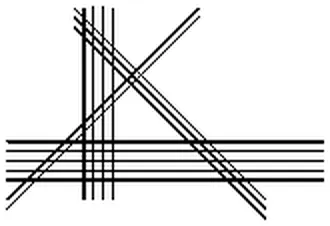
The intersections occur in six groups and the total number of points is \(2 \times 3 + 2 \times 4 + 2 \times 5 + 3 \times 4 + 3 \times 5 + 4 \times 5\) which is \(6 + 8 + 10 + 12 + 15 + 20 = 71\).
A number is divisible by 9 if and only if its digit sum is divisible by 9. The number \(10^{2014}\) can be written as a 1 followed by 2014 zeros, so this part has a digit sum of 1. Of all the options given, only adding on 8 to this will make a digit sum of 9, so \(10^{2014} + 8\) is the required answer.
Let the length of the rectangle be \(x\) cm and its width be \(y\) cm. The area is given as 120 cm2 so \(xy = 120\). The perimeter is 46 cm, so \(46 = 2x + 2y\) and therefore \(23 = x + y\). Using Pythagoras' Theorem, the length of the diagonal is \(\sqrt{x^2 + y^2}\). As \(x^2 + y^2 = (x + y)^2 - 2xy\),\(\sqrt{x^2 + y^2} = \sqrt{23^2 - 2 \times 120} = \sqrt{529 - 240} = \sqrt{289} = 17\). So the diagonal has length 17 cm.
First note that the exponent in each of the five options is prime, so we need to see which of the five numbers is not prime. By direct calculation the numbers are 3, 7, 31, 127 and 2047. Only the last number is not prime, as \(2047 = 23 \times 89\).
12. Karen has three times the number of cherries that Lionel has, and twice the number of cherries that Michael has. Michael has seven more cherries than Lionel. How many cherries do Karen, Lionel and Michael have altogether?
Let Lionel have \(x\) cherries. Michael then has \((x + 7)\) cherries. Karen's number of cherries is described in two ways. She has \(3x\) cherries and also \(2(x + 7)\) cherries. So \(3x = 2x + 14\) and therefore \(x = 14\). Lionel has 14 cherries, Michael 21 cherries and Karen 42 cherries giving a total of \(14 + 21 + 42 = 77\) cherries.
Each of P, Q, R, S and T when folded to form a cube consists of a shape of three black faces and an interlocking shape of three white faces, so they are all nets of the same cube.
Label the squares as shown. Possible pairs to be shaded which include A are AD, AE, AF and AG. Pairs excluding A are BD, BG, DE, EG. Triples must include A and there are two possibilities, ADE and AEG. This gives 10 ways of shading the grid,
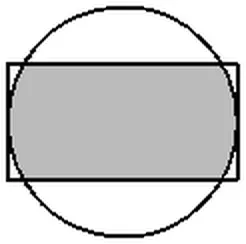
16. The diagram shows a rectangle measuring \(6 \times 12\) and a circle. The two shorter sides of the rectangle are tangents to the circle. The circle and rectangle have the same centre. The region that lies inside both the rectangle and the circle is shaded. What is its area?
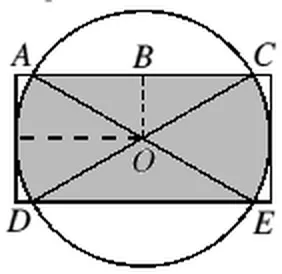
The diameter of the circle is the same length as the longest sides of the rectangle, so the radius of the circle is 6. The perpendicular distance from the centre of the circle to the longest sides of the rectangle is half of the length of the shortest sides which is 3.
Drawing two diameters \(AE\) and \(DC\) as shown splits the shaded area into two sectors and two isosceles triangles. As \(OA\) is 6 and \(OB\) is 3, \(\angle AOB = 60°\) and, by Pythagoras' Theorem, \(AB = 3\sqrt{3}\). Thus \(\angle AOD = 180° - 2 \times 60° = 60°\). So the shaded area is \(2 \times \dfrac{60}{360} \times \pi \times 6^2 + 2 \times \dfrac{1}{2} \times 2 \times 3\sqrt{3} \times 3 = 12\pi + 18\sqrt{3}\).
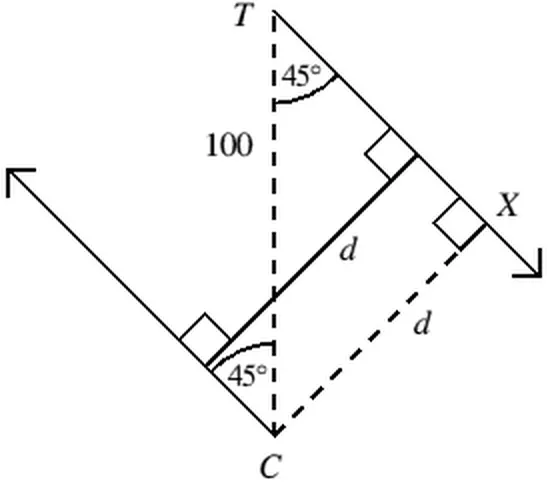
17. An oil tanker is 100 km due north of a cruise liner. The tanker sails SE at a speed of 20 kilometres per hour and the liner sails NW at a speed of 10 kilometres per hour. What is the shortest distance between the two boats during the subsequent motion?
The tanker and the cruise liner are travelling in parallel and opposite directions, each making an angle of 45° with the line joining their starting positions. The shortest distance between the ships is \(d\), the perpendicular distance between the parallel lines. This is independent of the speeds of the ships. Considering triangle \(TCX\) gives \(\sin 45° = \dfrac{d}{100}\) so \(d = \dfrac{1}{\sqrt{2}} \times 100 = 50\sqrt{2}\).
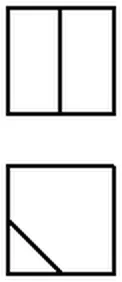
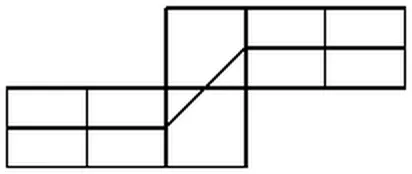
18. Beatrix decorates the faces of a cube, whose edges have length 2. For each face, she either leaves it blank, or draws a single straight line on it. Every line drawn joins the midpoints of two edges, either opposite or adjacent, as shown. What is the length of the longest unbroken line that Beatrix can draw on the cube?
To draw the longest unbroken line Beatrix must be able to draw her design on the net of a cube without taking her pen off the paper. She must minimise the number of lines of length \(\sqrt{2}\) and maximise the number of lines of length 2. If no lines of length \(\sqrt{2}\) are used, the maximum number of lines of length 2 is four, forming a loop and leaving two faces blank. Thus the longest possible unbroken line would have four lines of length 2 and two lines of length \(\sqrt{2}\). A possible configuration to achieve this is shown in the diagram. The length of Beatrix's line is then \(8 + 2\sqrt{2}\). Note: This path is not a loop but it is not required to be.
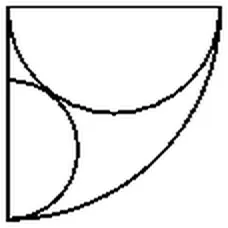
19. The diagram shows a quadrant of radius 2, and two touching semicircles. The larger semicircle has radius 1. What is the radius of the smaller semicircle?
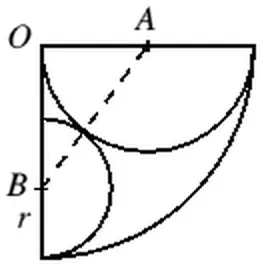
Let the centre of the quadrant be \(O\), the centre of the larger semicircle be \(A\) and the centre of the smaller semicircle be \(B\). Let the radius of the smaller semicircle be \(r\). It is given that \(OA = 1\). The common tangent to the two semicircles at the point of contact makes an angle of 90° with the radius of each semicircle. Therefore the line \(AB\) passes through the point of contact, as \(2 \times 90° = 180°\) and angles on a straight line sum to 180°. So the line \(AB\) has length \(r + 1\). This is the hypotenuse of the right-angled triangle \(OAB\) in which \(OA = 1\) and \(OB = 2 - r\). By Pythagoras' Theorem \((2 - r)^2 + 1^2 = (r + 1)^2\), so \(4 - 4r + r^2 + 1 = r^2 + 2r + 1\) and therefore \(4 = 6r\) and so \(r = \tfrac{2}{3}\).
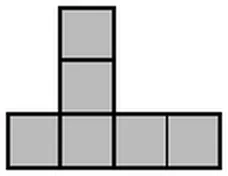
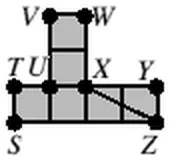
It is always possible to draw a circle through three points which are not on a straight line. The smallest circle containing all six squares must pass through (at least) three of the eight vertices of the diagram. Of all such circles, the smallest passes through \(S\), \(V\) and \(Z\) and has its centre at \(X\). The radius is then \(\sqrt{4^2 + 2^2} = \sqrt{16 + 4} = \sqrt{20} = 2\sqrt{5}\).
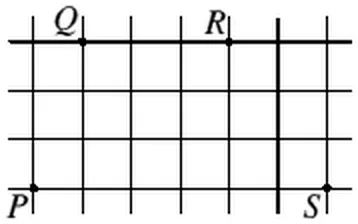
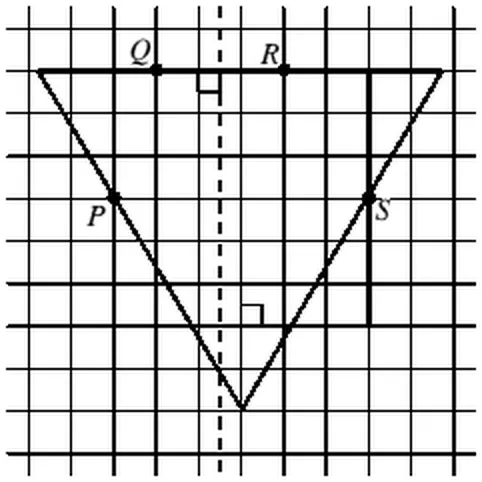
21. Fiona wants to draw a 2-dimensional shape whose perimeter passes through all of the points \(P\),\(Q\), \(R\) and \(S\) on the grid of squares shown. Which of the following can she draw?
The diagram shows that it is possible to draw a square whose edges go through \(P\),\(Q\), \(R\) and \(S\). By drawing lines through \(P\) and \(S\) each making an angle of 60° with \(QR\), we can construct an equilateral triangle, as shown, whose edges pass through \(P\),\(Q\), \(R\) and \(S\). However there is no circle through these four points. The centre of such a circle would be equidistant from \(Q\) and \(R\), and hence would lie on the perpendicular bisector of \(QR\). Similarly it would lie on the perpendicular bisector of \(PS\), but these perpendicular bisectors are parallel lines which don't meet.
22. A bag contains \(m\) blue and \(n\) yellow marbles. One marble is selected at random from the bag and its colour is noted. It is then returned to the bag along with \(k\) other marbles of the same colour. A second marble is now selected at random from the bag. What is the probability that the second marble is blue?
The probability that the second marble is blue equals P(2nd marble is blue given that the 1st marble is blue) + P(2nd marble is blue given that the 1st marble is yellow), which is
\(\dfrac{m}{m + n} \times \dfrac{m + k}{m + n + k} + \dfrac{n}{m + n} \times \dfrac{m}{m + n + k} = \dfrac{m^2 + mk + mn}{(m + n)(m + n + k)} = \dfrac{m(m + k + n)}{(m + n)(m + n + k)} = \dfrac{m}{m + n}.\)
If the graphs of \(y = 2x\), \(y = 2^x\) and \(y = x^2\) are sketched on the same axes it can be seen that case (i) holds for \(2 < x < 4\), case (ii) holds for \(0 < x < 1\), case (iv) holds for \(1 < x < 2\) and case (vi) holds for \(x > 4\). There are no real solutions for case (iii). Consider \(x^2 < 2x\), which is true for \(0 < x < 2\). However for \(0 < x < 2\) it can be seen that \(2^x > x^2\) rather than \(2^x < x^2\) as stated. There are no real solutions for case (v). Consider \(2x < x^2\), which is true for \(x < 0\) or \(x > 2\). However, when \(x < 0\) we have \(2^x > 2x\) as \(2^x\) is positive and \(2x\) is negative, rather than \(2^x < 2x\) as stated. Also, when \(x = 2\) we have \(2^x = 2x\), but for \(x > 2\), \(2^x > 2x\) rather than \(2^x < 2x\) as stated.
Each of the five expressions can be written in the form \(\sqrt{x} - \sqrt{x - 1}\), where \(x\) is in turn 100, 64, 25, 81 and 49. As \((\sqrt{x} - \sqrt{x - 1})(\sqrt{x} + \sqrt{x - 1}) = x - (x - 1) = 1\), we can write \(\left(\sqrt{x} - \sqrt{x - 1}\right) = \dfrac{1}{\left(\sqrt{x} + \sqrt{x - 1}\right)}\). Since \(\left(\sqrt{x} + \sqrt{x - 1}\right)\) increases with \(x\), then \(\left(\sqrt{x} - \sqrt{x - 1}\right)\) must decrease with \(x\). Therefore, of the given expressions, the one corresponding to the largest value of \(x\) is the smallest. This is \(\sqrt{100} - \sqrt{99}\) which is \(10 - 3\sqrt{11}\).
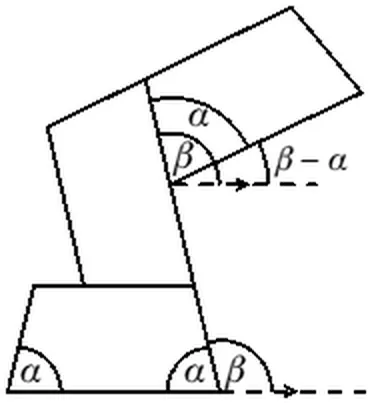
25. Figure 1 shows a tile in the form of a trapezium, where \(\alpha = 83\tfrac{1}{3}°\). Several copies of the tile are placed together to form a symmetrical pattern, part of which is shown in Figure 2. The outer border of the complete pattern is a regular ‘star polygon’. Figure 3 shows an example of a regular ‘star polygon’.
Let the supplementary angle to \(\alpha\) be \(\beta\). Let tile 1 on the outside of the star polygon be horizontal. Counting anti-clockwise around the star polygon, tile 3 has an angle of elevation from the horizontal of \(\beta - \alpha = 96\tfrac{2}{3}° - 83\tfrac{1}{3}° = 13\tfrac{1}{3}°\). As \(360° \div 13\tfrac{1}{3}° = 27\), we need 27 pairs of tiles to complete one revolution. So there are 54 tiles in the complete pattern.
We'd like to use Google Analytics cookies to count visits and see which pages help most. They're optional, and the site works exactly the same either way. Privacy policy

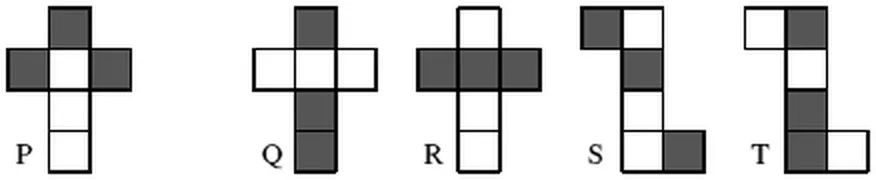
 shape of three black faces and an interlocking
 shape of three white faces, so they are all nets of the same cube.