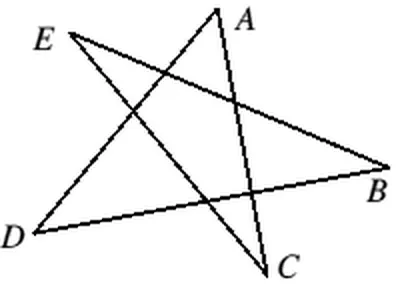
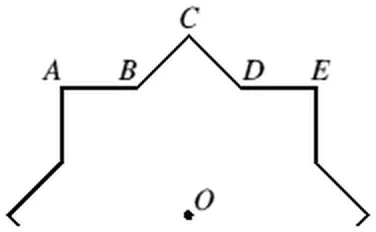
Let \(A\), \(B\), \(C\), \(D\), \(E\) be five vertices of the star, as shown.
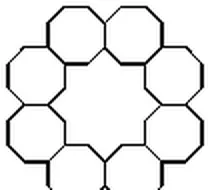
Then \(AB = BC = CD = DE = 1\). Each exterior angle of a regular octagon is 360° ÷ 8, that is 45°, so
\(\angle CBD = \angle CDB = 45°\).
Hence \(\angle BCD\) is a right angle and we deduce from the symmetry of the figure that each interior angle of the star is either 90° or 225°. The length of \(BD\) is \(\sqrt{2}\), so the area of the star is the area of a square of side \(2 + \sqrt{2}\) plus the area of four congruent triangles with sides 1, 1, \(\sqrt{2}\).
The required area, therefore, is \((2 + \sqrt{2})^2 + 4\left(\tfrac{1}{2} \times 1 \times 1\right)\), that is \(6 + 4\sqrt{2} + 2\), that is \(8 + 4\sqrt{2}\).
Possible alternative ending: Dissect the star into 8 congruent kites such as \(OBCD\). As for a rhombus, the area of a kite is half the product of its diagonals. In this case that is \(\tfrac{1}{2}OC \times BD = \tfrac{1}{2}(1 + \sqrt{2}) \times \sqrt{2} = \tfrac{1}{2}(\sqrt{2} + 2)\). Required area is \(4\,(\sqrt{2} + 2)\).