The whole Senior Mathematical Challenge 2017 paper, one question at a time in order (25 questions). Press Mark as done after each one: your marks add up below.
2. Last year, an earthworm from Wigan named Dave wriggled into the record books as the largest found in the UK. Dave was 40 cm long and had a mass of 26 g. What was Dave's mass per unit length?
3. The five integers 2, 5, 6, 9, 14 are arranged into a different order. In the new arrangement, the sum of the first three integers is equal to the sum of the last three integers. What is the middle number in the new arrangement?
In the new arrangement, the sum of the first two numbers and the sum of the last two numbers must be equal. Considering all ten possible pairings, the only two pairs with the same total are 2, 9 and 5, 6. So 14 must be the middle number.
By making a common denominator, \(2017 - \dfrac{1}{2017} = \dfrac{2017^2 - 1}{2017}\). Then, using the difference of two squares on the numerator, this can be written as \(\dfrac{2018 \times 2016}{2017}\).
5. One light-year is nearly \(6 \times 10^{12}\) miles. In 2016, the Hubble Space Telescope set a new cosmic record, observing a galaxy 13.4 thousand million light-years away. Roughly how many miles is that?
The calculation 13.4 thousand million multiplied by \(6 \times 10^{12}\) gives \(13.4 \times 10^9 \times 6 \times 10^{12}\) which is roughly \(80 \times 10^{21}\). So the distance is roughly \(8 \times 10^{22}\) miles.
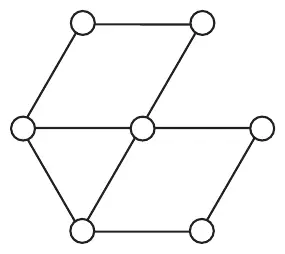
6. The circles in the diagram are to be coloured so that any two circles connected by a line segment have different colours. What is the smallest number of colours required?
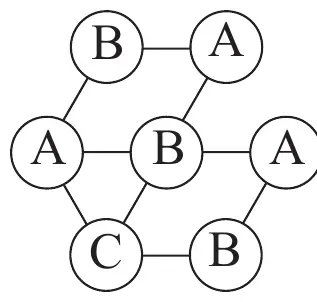
In the bottom left of the diagram there are three circles connected to each other. These three must be coloured using different colours. Once those have been determined, one possible colouring, using just three colours, is as shown.
Simplifying \(\sqrt{2} + \sqrt{8} + \sqrt{18}\) gives \(\sqrt{2} + 2\sqrt{2} + 3\sqrt{2} = 6\sqrt{2}\). This is the same as \(\sqrt{36 \times 2}\) so \(\sqrt{72} = \sqrt{k}\) and therefore \(k = 72\).
Evaluating each option in turn gives \(1^{-1} = 1\);\(4^{-\frac{1}{2}} = \left(\frac{1}{4}\right)^{\frac{1}{2}} = \frac{1}{2}\);\(6^0 = 1\);\(8^{\frac{2}{3}} = \left(8^{\frac{1}{3}}\right)^2 = 2^2 = 4\);\(16^{\frac{3}{4}} = \left(16^{\frac{1}{4}}\right)^3 = 2^3 = 8\). Only option B is not an integer.
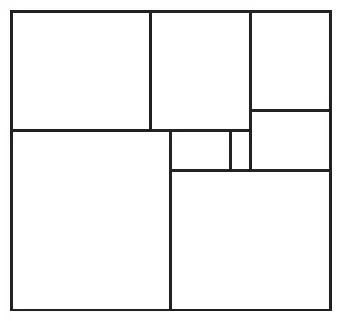
9. The diagram shows an \(n \times (n + 1)\) rectangle tiled with \(k \times (k + 1)\) rectangles, where \(n\) and \(k\) are integers and \(k\) takes each value from 1 to 8 inclusive. What is the value of \(n\)?
The sum of the areas of the tiles is \((1 \times 2) + (2 \times 3) + (3 \times 4) + \ldots + (8 \times 9)\) \(= 2 + 6 + 12 + 20 + 30 + 42 + 56 + 72 = 240 = 15 \times 16\). So the value of \(n\) is 15.
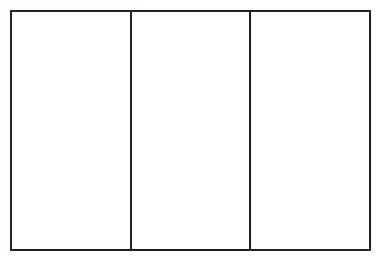
10. A rectangle is divided into three smaller congruent rectangles as shown. Each smaller rectangle is similar to the large rectangle. In each of these four rectangles, what is the ratio of the length of a longer side to that of a shorter side?
Let the sides of each of the smaller rectangles be 1 and \(a\) with \(a > 1\). Then the sides of the larger rectangle are \(a\) and 3 with \(3 > a\). As the rectangles are similar, \(\frac{a}{1} = \frac{3}{a}\). So \(a^2 = 3\) and \(a = \sqrt{3}\). The ratio of the sides is therefore \(\sqrt{3} : 1\).
11. The teenagers Sam and Jo notice the following facts about their ages: The difference between the squares of their ages is four times the sum of their ages. The sum of their ages is eight times the difference between their ages. What is the age of the older of the two?
Let the ages of the teenagers be \(a\) and \(b\) with \(a > b\). Then \(4(a + b) = a^2 - b^2\) \(= (a + b)(a - b)\) and so \(4 = a - b\) as \(a + b \neq 0\). Also, \(a + b = 8(a - b) = 8 \times 4 = 32\). We now have \(a - b = 4\) and \(a + b = 32\) so \(a = 18\) and \(b = 14\). Thus the older of the two is 18.
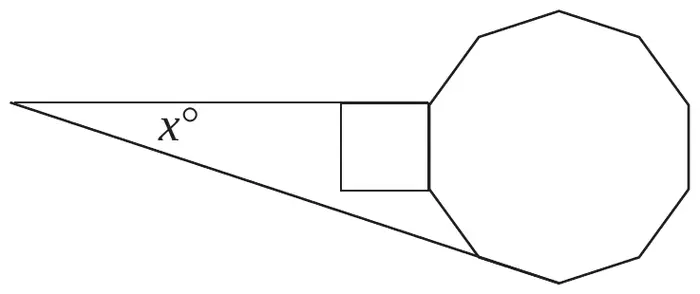
12. The diagram shows a square and a regular decagon that share an edge. One side of the square is extended to meet an extended side of the decagon. What is the value of \(x\)?
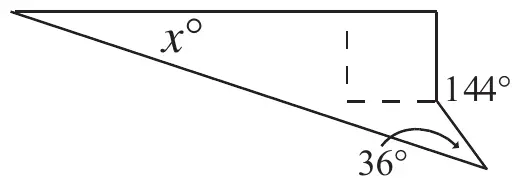
Each of the exterior angles of a regular decagon is \(360° \div 10 = 36°\) so each interior angle is \(180° - 36° = 144°\). The quadrilateral containing \(x\) has an angle sum of 360°. So \(x + 90 + (360 - 144) + 36 = 360\) and \(x = 18\).
Since only one person is lying this must be Genotan or Josh; their statements cannot both be true. If Josh were lying (and therefore guilty) then Genotan's statement would mean that Tegan was also guilty, a contradiction. Hence Genotan is lying and we can check that all four statements are consistent with this.
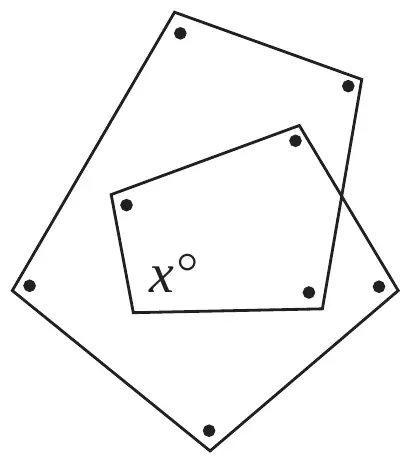
Viewing the diagram as a pentagon inside a hexagon and labelling the unmarked angle in the pentagon as \(y°\) gives \(4x + y = 540\ldots\) (1). For the hexagon, the exterior reflex angle is \(y°\) as opposite angles are equal. So the unmarked interior angle is \((360 - y)°\). This gives \(5x + 360 - y = 720\), so \(5x - y = 360\ldots\) (2). Adding equations (1) and (2) gives \(9x = 900\) and therefore \(x = 100\).
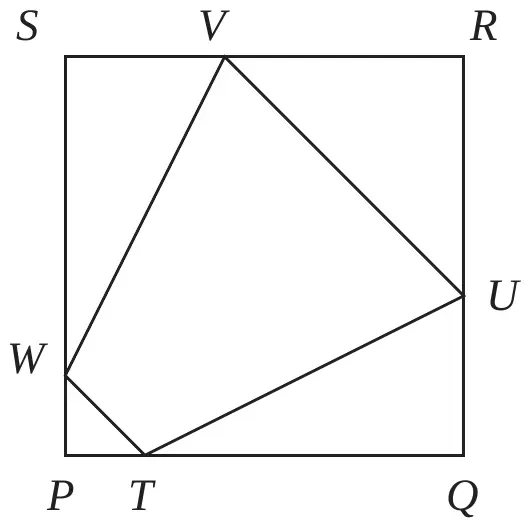
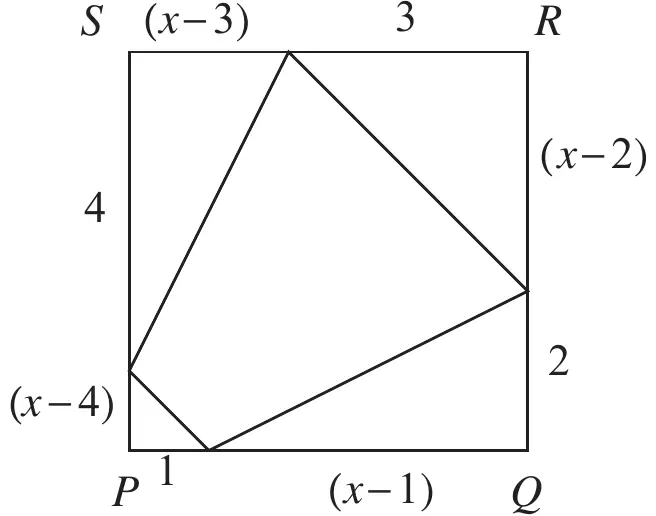
15. The diagram shows a square \(PQRS\). Points \(T\),\(U\), \(V\) and \(W\) lie on the edges of the square as shown, such that \(PT = 1\),\(QU = 2\), \(RV = 3\) and \(SW = 4\). The area of \(TUVW\) is half that of \(PQRS\). What is the length of \(PQ\)?
Let the length of \(PQ\) be \(x\). The sum of the areas of the four right-angled triangles is half the area of the square so \(\tfrac{1}{2}[1 \times (x - 4)] + \tfrac{1}{2}[4 \times (x - 3)] + \tfrac{1}{2}[3 \times (x - 2)] + \tfrac{1}{2}[2 \times (x - 1)] = \tfrac{1}{2}x^2\). This gives \((x - 4) + 4(x - 3) + 3(x - 2) + 2(x - 1) = x^2\) which simplifies to \(10x - 24 = x^2\). Factorising \(x^2 - 10x + 24 = 0\) gives \((x - 6)(x - 4) = 0\) so \(x = 4\) or 6. For there to be four triangles as shown, \((x - 4) > 0\), so \(x\), the length of \(PQ\), is 6.
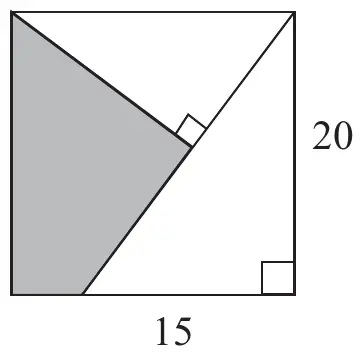
16. The diagram shows two right-angled triangles inside a square. The perpendicular edges of the larger triangle have lengths 15 and 20. What is the area of the shaded quadrilateral?
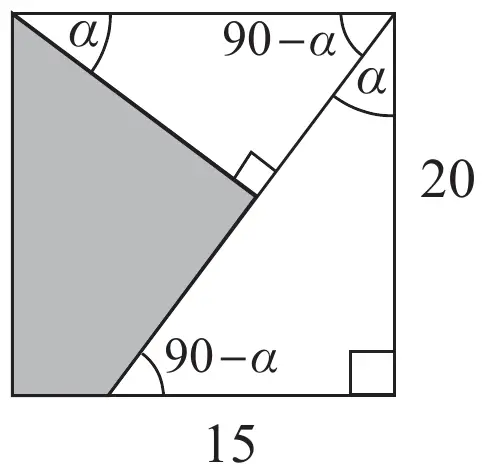
The area of the shaded quadrilateral is the area of the square less the combined areas of the two right-angled triangles. Using both ‘the angle sum of a triangle is 180°’ and ‘the sum of the angles in the corner of a square is 90°’, those two triangles have the same sized angles so they are similar. By Pythagoras' Theorem, the hypotenuse of the larger triangle has length 25. The lengths of the sides of the smaller triangle are then \(\frac{20}{25}\) of the lengths of the sides of the larger triangle. So the shaded area is \(20^2 - \tfrac{1}{2} \times 15 \times 20 - \tfrac{1}{2} \times 12 \times 16\) which is \(400 - 150 - 96 = 154\).
17. Amy, Beth and Claire each has some sweets. Amy gives one third of her sweets to Beth. Beth gives one third of all the sweets she now has to Claire. Then Claire gives one third of all the sweets she now has to Amy. All the girls end up having the same number of sweets. Claire begins with 40 sweets. How many sweets does Beth have originally?
Amy's number of sweets is a multiple of 3, so let her start with \(3a\) sweets. Once Amy has passed on \(a\) of them, Beth's number of sweets must be a multiple of 3. Likewise, after Beth passes on sweets to Claire, Claire's number of sweets must become a multiple of 3. Since \(40 = 3 \times 13 + 1\), Beth must pass on \(3b - 1\) sweets for some \(b\). So Beth must have had \(9b - 3\) sweets after receiving the \(a\) sweets from Amy and hence \(9b - 3 - a\) to start with. This allows us to fill in the table:
Amy
Beth
Claire
originally
\(3a\)
\(9b - 3 - a\)
40
after Amy's gift to Beth
\(2a\)
\(9b - 3\)
40
after Beth's gift to Claire
\(2a\)
\(6b - 2\)
\(3b + 39\)
after Claire's gift to Amy
\(2a + b + 13\)
\(6b - 2\)
\(2b + 26\)
As the girls end up with the same number of sweets, \(6b - 2 = 2b + 26\) and so \(b = 7\). As \(6 \times 7 - 2\) and \(2 \times 7 + 26\) both equal 40, the girls each have 40 sweets at the end. Hence Amy's finishing number \(2a + 7 + 13 = 40\) so \(a = 10\). Then Beth's original number is \(9 \times 7 - 10 - 3 = 50\).
18. The arithmetic mean, \(A\), of any two positive numbers \(x\) and \(y\) is defined to be \(A = \tfrac{1}{2}(x + y)\) and their geometric mean, \(G\), is defined to be \(G = \sqrt{xy}\). For two particular values \(x\) and \(y\), with \(x > y\), the ratio \(A : G = 5 : 4\). For these values of \(x\) and \(y\), what is the ratio \(x : y\)?
Given the ratio \(A : G\) is \(5 : 4\), we have \(4A = 5G\), so \(4 \times \tfrac{1}{2}(x + y) = 5\sqrt{xy}\). Squaring gives \(4(x + y)^2 = 25xy\) and hence \(4x^2 + 8xy + 4y^2 = 25xy\). So \(4x^2 - 17xy + 4y^2 = 0\) which factorises to give \((4x - y)(x - 4y) = 0\) so that either \(4x = y\) or \(x = 4y\). However the first case is impossible as we are given \(x > y > 0\). Hence \(x = 4y\) and \(x : y\) is \(4 : 1\).
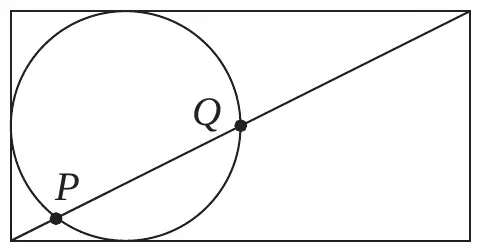
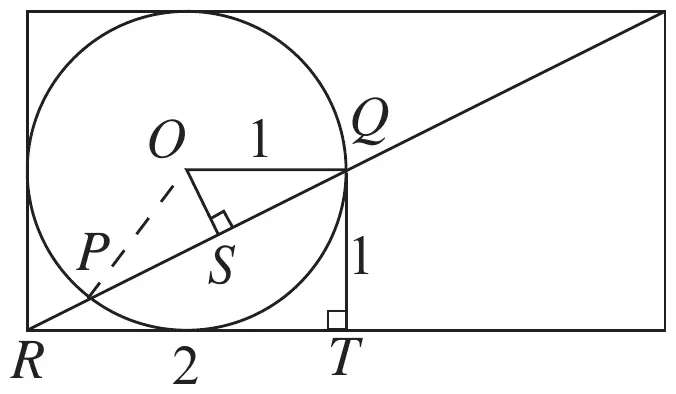
19. The diagram shows a circle of radius 1 touching three sides of a \(2 \times 4\) rectangle. A diagonal of the rectangle intersects the circle at \(P\) and \(Q\), as shown. What is the length of the chord \(PQ\)?
Let \(O\) be the centre of the circle, \(R\) be a corner of the rectangle, \(T\) be the point on the rectangle directly below \(Q\) and \(S\) be the midpoint of \(PQ\). In triangle \(QRT\) we have \(QT = 1\) and \(RT = 2\) and therefore \(RQ = \sqrt{5}\), by Pythagoras' Theorem. As \(RT\) and \(OQ\) are parallel, the right-angled triangles \(OQS\) and \(QRT\) are similar, so \(QS = \frac{2}{\sqrt{5}}\). Therefore the length of chord \(PQ\) is \(2 \times \frac{2}{\sqrt{5}} = \frac{4}{\sqrt{5}}\).
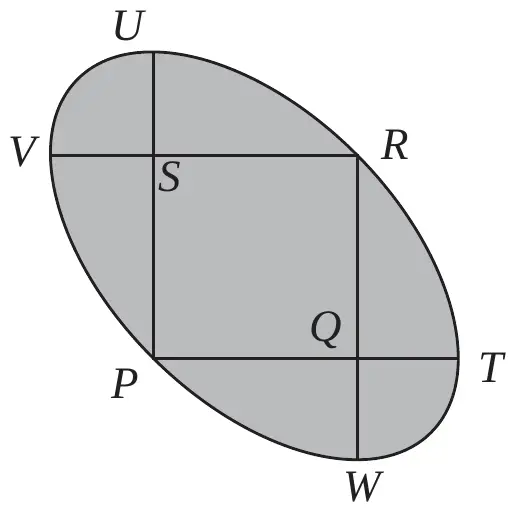
20. The diagram shows a square \(PQRS\) with edges of length 1, and four arcs, each of which is a quarter of a circle. Arc \(TRU\) has centre \(P\); arc \(VPW\) has centre \(R\); arc \(UV\) has centre \(S\); and arc \(WT\) has centre \(Q\). What is the length of the perimeter of the shaded region?
The length of the radius of the quarter circle \(TRU\) is the length of \(PR\), which by Pythagoras' Theorem is \(\sqrt{2}\). The lengths \(PU\) and \(PR\) are equal as they are radii of the same circle. So \(SU = PU - PS = \sqrt{2} - 1\). Hence the total length of the four quarter circles making up the perimeter of the shaded region is \(2 \times \tfrac{1}{4} \times 2\pi\sqrt{2} + 2 \times \tfrac{1}{4} \times 2\pi\left(\sqrt{2} - 1\right) = \left(2\sqrt{2} - 1\right)\pi\).
The equation \(4^x = y^2 + 15\) can be rearranged to give \(\left(2^x\right)^2 - y^2 = 15\) which, using the difference of two squares, is \(\left(2^x + y\right)\left(2^x - y\right) = 15\). As we are looking for positive integer values then either \(2^x + y = 5\) and \(2^x - y = 3\) or \(2^x + y = 15\) and \(2^x - y = 1\). Solving each pair gives either \((x, y) = (2, 1)\) or \((x, y) = (3, 7)\) so there are just two possible pairs.
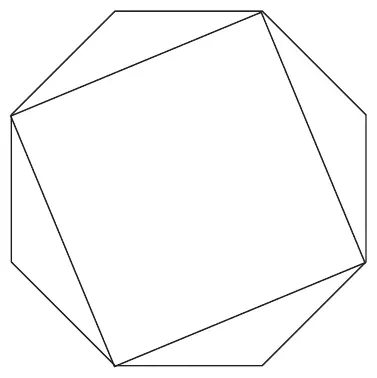
22. The diagram shows a regular octagon and a square formed by drawing four diagonals of the octagon. The edges of the square have length 1. What is the area of the octagon?
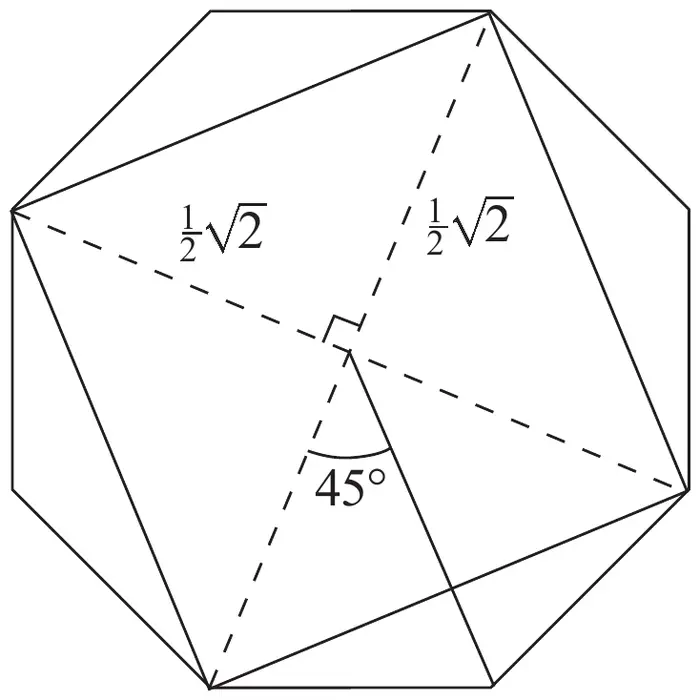
The square can be split into four congruent right-angled triangles by joining each of its vertices to the centre. Each edge of the square has length 1, so the shorter sides of each triangle have length \(\tfrac{1}{2}\sqrt{2}\). The regular octagon can be split into eight congruent isosceles triangles whose longer sides have length \(\tfrac{1}{2}\sqrt{2}\), by joining all eight vertices to the centre. These sides are separated by an angle of \(\tfrac{1}{8} \times 360° = 45°\). Using the formula ‘area \(= \tfrac{1}{2}ab\sin C\)’, the total area of the octagon is \(8 \times \tfrac{1}{2} \times \tfrac{1}{2}\sqrt{2} \times \tfrac{1}{2}\sqrt{2}\sin 45° = 2\sin 45° = 2 \times \frac{1}{\sqrt{2}} = \sqrt{2}\).
23. The parabola with equation \(y = x^2\) is reflected in the line with equation \(y = x + 2\). Which of the following is the equation of the reflected parabola?
Reflecting a graph in the line \(y = x + 2\) is algebraically equivalent to replacing \(y\) by \(x + 2\) and \(x + 2\) by \(y\) in the equation of the graph. So \(y = x^2\) becomes \((x + 2) = (y - 2)^2\). That is \(x + 2 = y^2 - 4y + 4\) which simplifies to \(x = y^2 - 4y + 2\).
24. There is a set of straight lines in a plane such that each line intersects exactly ten others. Which of the following could not be the number of lines in that set?
When \(n\) non-parallel lines are drawn in a plane, each line intersects every other line exactly once. So each line intersects \((n - 1)\) lines. A line drawn parallel to one of the existing \(n\) lines also intersects \((n - 1)\) lines. In order that every line drawn intersects the same number of other lines, each of the original \(n\) lines must be part of a set of \(k\) parallel lines, for some integer \(k\). Then \(kn\) lines will each have \(k(n - 1)\) points of intersection. Here \(k(n - 1) = 10\) so as \((n - 1)\) is an integer \((n - 1)\) must be 1, 2, 5 or 10 giving \(n = 2, 3, 6\) or 11 and \(k = 10, 5, 2\) and 1 respectively. Of the options given: A is 11 non-parallel lines (\(n = 11\), \(k = 1\)); B is 6 sets of 2 parallel lines (\(n = 6\), \(k = 2\)); C is 3 sets of 5 parallel lines (\(n = 3\), \(k = 5\)); E is 2 different sets of 10 parallel lines (\(n = 2\), \(k = 10\)). These are the only four possible solutions to the problem, so 16 could not be the number of lines.
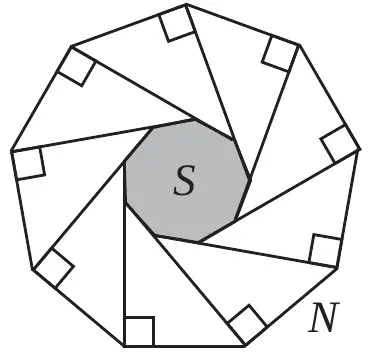
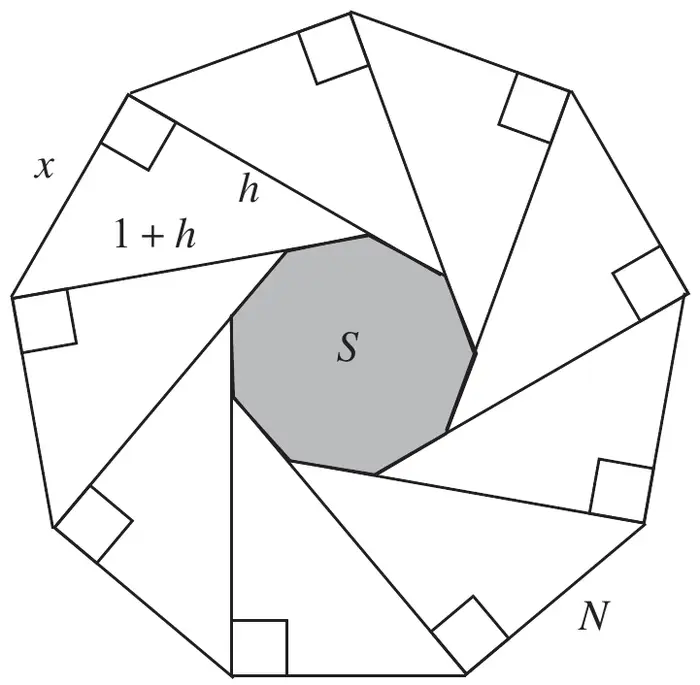
25. The diagram shows a regular nonagon \(N\). Moving clockwise around \(N\), at each vertex a line segment is drawn perpendicular to the preceding edge. This produces a smaller nonagon \(S\), shown shaded. What fraction of the area of \(N\) is the area of \(S\)?
Let the side-length of \(S\) be 1 and the side-length of \(N\) be \(x\). The fraction of the area of \(N\) that is the area of \(S\) is then \(\left(\dfrac{1}{x}\right)^2 = \dfrac{1}{x^2}\). Let the length of the hypotenuse of each of the nine triangles be \(1 + h\), then the third side of each triangle is \(h\). Using Pythagoras' Theorem, \(h^2 + x^2 = (1 + h)^2\) so \(h^2 + x^2 = 1 + 2h + h^2\) and the fraction we want, \(\frac{1}{x^2}\), is then \(\frac{1}{1 + 2h}\). The angle in each triangle which is adjacent to \(S\) is also an exterior angle of \(S\), so is \(\tfrac{1}{9} \times 360° = 40°\). We have \(\cos 40° = \dfrac{h}{1 + h}\) which rearranges to give \(h = \dfrac{\cos 40°}{1 - \cos 40°}\). Therefore \(1 + 2h = \left(\dfrac{1 - \cos 40°}{1 - \cos 40°}\right) + \dfrac{2\cos 40°}{1 - \cos 40°} = \dfrac{1 + \cos 40°}{1 - \cos 40°}\). So the fraction of the area \(N\) which is the area of \(S\) is \(\dfrac{1}{1 + 2h} = \dfrac{1 - \cos 40°}{1 + \cos 40°}\).
We'd like to use Google Analytics cookies to count visits and see which pages help most. They're optional, and the site works exactly the same either way. Privacy policy