Mathematical Olympiad for Girls (MOG)

30 Mathematical Olympiad for Girls questions from every year we have, newest year first. Use Difficulty › Position in the paper to practise the early (easier) or late (harder) questions, or the Year filter for one year.

Whole paper 2020 2019 2018 2017 2016 2015

Questions and solutions © UK Mathematics Trust, shown with permission. Papers and more at ukmt.org.uk.

MOG 2020

MOG 2019

MOG 2018

MOG 2017

MOG 2016

MOG 2015

MOG 2020 Q1

1.
(a)

Let \(p\) and \(q\) be different prime numbers, and let \(a = p^2\), \(b = pq\) and \(c = p^3q\).
Which of \(ab\), \(bc\) and \(ca\) is a square number?(1 mark)

Halle would like to place nine of the ten integers \(1, 2, \ldots, 9, 10\) into the cells of a \(3 \times 3\) grid in such a way that the three numbers within each row are written in increasing order from left to right and the product of the three numbers within each row is equal to a square number.

(b)

Give an example showing that Halle’s task is possible.(4 marks)

(c)

How many different grids can Halle produce?(5 marks)

Mathematical Olympiad for Girls 2020, Question 1. © UK Mathematics Trust. Original paper on ukmt.org.uk

MOG 2020 Q2

2.

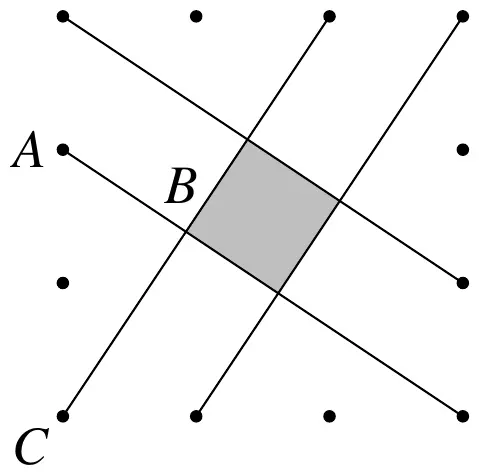
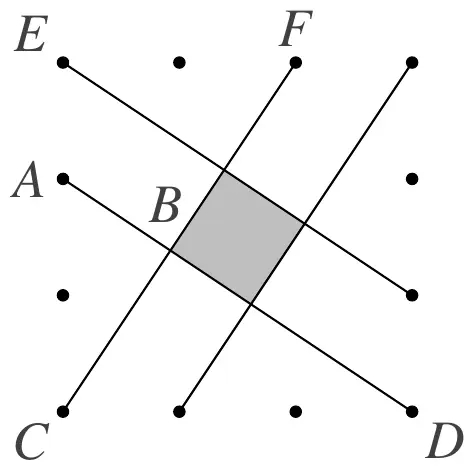
Twelve points, four of which are vertices, lie on the perimeter of a square. The distance between adjacent points is one unit. Some of the points have been connected by straight lines. \(B\) is the intersection of two of those lines, as shown in the diagram.

A 3 by 3 square with twelve equally spaced points on its perimeter. Four lines join points on opposite sides, crossing to enclose a shaded quadrilateral in the middle; A is a point on the left side, C is the bottom left corner, and B is the corner of the shaded region nearest A
(a)

Find the ratio \(AB : BC\). Give your answer in its simplest form.(3 marks)

(b)

Find the area of the shaded region.(7 marks)

Mathematical Olympiad for Girls 2020, Question 2. © UK Mathematics Trust. Original paper on ukmt.org.uk

MOG 2020 Q3

MOGCurrent spec10 marksAlgebraFactors, Primes & Digits
3.
(a)

The expression \(10xy - 2x + 5y - 1\) factorises as \((ax + b)(cy + d)\) where \(a, b, c, d\) are integers and \(a > 0\). Find the values of \(a, b, c, d\).(1 mark)

(b)

Using the factorisation above and considering factor pairs of 99, find all integer pairs \((x, y)\) such that \(10xy - 2x + 5y = 100\).
Enter \(y\) values only on the answer sheet.(4 marks)

(c)

Find all integer pairs \((x, y)\) such that \(10xy - 2x + 5y = 100000001\).
Enter \(y\) values only on the answer sheet.(5 marks)

Mathematical Olympiad for Girls 2020, Question 3. © UK Mathematics Trust. Original paper on ukmt.org.uk

MOG 2020 Q4

4.

Daniel and Alessia each have eight boxes labelled 1 to 8. To start, each of them has \(n\) balloons, all in their box 1.

(a)

Alessia is playing a game with her balloons. She may make the following move:

  • Choose a box \(k\) containing at least two balloons. Pop a single balloon in box \(k\) and then move another balloon from box \(k\) to box \(k + 1\).

Find the value of \(n\) such that, after a finite number of moves, all that remains is a single balloon in box 8.(2 marks)

(b)

Daniel is playing a different game with his balloons. He may use any combination of the following two moves:

  • Pop two balloons in box \(k\) and move a third balloon from box \(k\) to box \(k + 1\).
  • Pop a single balloon in each of boxes \(k\) and \(k + 1\) and then move another balloon from box \(k + 1\) to box \(k + 2\).

What is the smallest value of \(n\) such that after a finite number of moves, all that remains

(i)

is a single balloon in box 4?

(ii)

is a single balloon in box 8?(8 marks)

Mathematical Olympiad for Girls 2020, Question 4. © UK Mathematics Trust. Original paper on ukmt.org.uk

MOG 2020 Q5

MOGCurrent spec10 marksAlgebraNumber & Arithmetic
5.

Freya creates a sequence with first term 1 and each subsequent term 5 more than the previous term. Hilary creates a different sequence with first term \(a\) and each subsequent term 3 less than the previous term. Both sequences are continued forever.

(a)

There is at least one number that appears in both sequences. Let \(c\) be the smallest of those numbers. Find the possible values of \(c\).(3 marks)

(b)

Given that there are exactly 100 numbers which appear in both sequences, find the possible values of \(a\).

Enter the following on the answer sheet:

(i)

How many possible values of \(a\) are there?

(ii)

The smallest possible value of \(a\).

(iii)

The largest possible value of \(a\).

(7 marks)

Mathematical Olympiad for Girls 2020, Question 5. © UK Mathematics Trust. Original paper on ukmt.org.uk

MOG 2019 Q1

1.

At Mathsland Animal Shelter there are only cats and dogs. Unfortunately, one day 60 of the animals managed to escape. Once a volunteer had realised, they counted the remaining animals. They noted that half of the cats and a third of the dogs had escaped.

(a)
(i)

If the number of cats before the escape was \(C\) and the number of dogs before the escape was \(D\), write down an equation linking \(C\) and \(D\).

(ii)

If the total number of animals before the escape was \(T\), write down an equation linking \(C\), \(D\) and \(T\).

(4 marks)

(b)

Given that more cats than dogs escaped, find the largest possible value of \(T\). You must justify why the value you have found is the largest.(6 marks)

Mathematical Olympiad for Girls 2019, Question 1. © UK Mathematics Trust. Original paper on ukmt.org.uk

MOG 2019 Q2

MOGCurrent spec10 marksCounting, Probability & Logic
2.

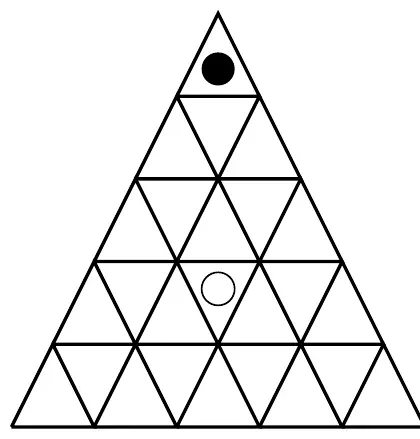
Beth has a black counter and Wendy has a white counter. Beth and Wendy move their counters on the two boards below according to the starting positions and rules given. They always move their counters at the same time.

(a)
A row of eight squares, alternately black and white; the white counter is on the third square and the black counter on the eighth
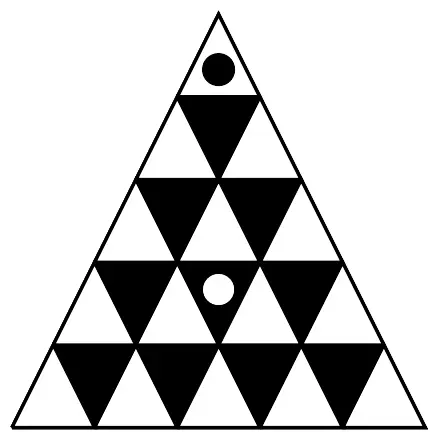
At each turn, each player moves their counter either one square to the left or one square to the right. Prove that the black and white counters can never be in the same square at the same time.

Hint You may find it helpful to refer to the colours of the squares on the board in your explanation.(3 marks)

(b)

At each turn, each player moves their counter to a triangular cell which shares one edge with the cell that their counter is currently in. Can their counters ever be in the same cell at the same time?(7 marks)

A large triangle divided into 25 small triangular cells in five rows; the black counter is in the top cell and the white counter is in the middle of the fourth row

Hint If you think the two counters can never be in the same cell at the same time, you should give an argument that they cannot be in the same cell at the same time which works no matter which sequence of moves Beth and Wendy do. If you think the two counters can be in the same cell at the same time, you should give an example of a sequence of moves after which they are in the same cell at the same time.

Mathematical Olympiad for Girls 2019, Question 2. © UK Mathematics Trust. Original paper on ukmt.org.uk

MOG 2019 Q3

3.
(a)

Seth wants to know how many positive whole numbers from one to one hundred are divisible by two or five. He thinks that the answer is 70 because there are fifty multiples of two and twenty multiples of five from one to one hundred. Explain why his answer is too large.(2 marks)

(b)

Consider the list of 1800 fractions\[\frac{1}{1800}, \frac{2}{1800}, \dots, \frac{1799}{1800}, \frac{1800}{1800}.\]How many are not in simplest form? Explain your reasoning.(8 marks)

[Note: The fraction \(\frac{900}{1800}\) is not in simplest form because it can be simplified to \(\frac{1}{2}\).]

Mathematical Olympiad for Girls 2019, Question 3. © UK Mathematics Trust. Original paper on ukmt.org.uk

MOG 2019 Q4

MOGCurrent spec10 marksAlgebraGeometry & Angles
4.

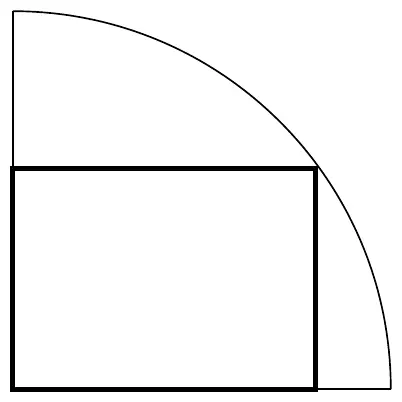
The diagram shows a rectangle placed inside a quarter circle of radius 1, such that its vertices all lie on the perimeter of the quarter circle and one vertex coincides with the centre of the (whole) circle.
Let the perimeter of such a rectangle be \(P\).

(a)

Show that \(P = 3\) is impossible.(4 marks)

(b)

Find the largest possible value of \(P\). You must fully justify why the value that you find is the largest.

(4 marks)

Instead a rectangle is placed inside a whole circle of radius 1, such that its vertices all lie on the circumference of the circle.

(c)

If the perimeter of the rectangle is as large as possible, show that the rectangle must be a square and calculate its perimeter.(2 marks)

A quarter circle with a rectangle drawn inside it, one vertex at the centre and the opposite vertex on the arc

Mathematical Olympiad for Girls 2019, Question 4. © UK Mathematics Trust. Original paper on ukmt.org.uk

MOG 2019 Q5

MOGCurrent spec10 marksCounting, Probability & Logic
5.

Let \(n\) be a positive integer. Tracy writes a list of 10 whole numbers between 1 and \(n\) (inclusive). Each number in the list is either equal to, one less than, or one more than the number before it.

For example, when \(n = 7\):

Her list could be 5, 5, 6, 7, 6, 6, 5, 5, 6, 6 or 4, 4, 3, 2, 1, 1, 1, 1, 1, 1.

Her list could not be 1, 3, 3, 4, 5, 5, 6, 7, 7, 7 or 5, 6, 7, 8, 7, 6, 5, 5, 5, 5.

(a)

Suppose that \(n = 3\). Stacey forms a list by copying Tracy’s list, except that whenever Tracy writes a 1, Stacey writes a 3, and whenever Tracy writes a 3, Stacey writes a 1.

(i)

Which lists could Tracy write that would cause her list to be the same as Stacey’s?

(ii)

Explain why Tracy can write as many lists that start 2, 2, 1 as start 2, 2, 3.

(3 marks)

(b)

For which \(n\) between 1 and 10 (inclusive) is the number of lists that Tracy could write odd?(7 marks)

Mathematical Olympiad for Girls 2019, Question 5. © UK Mathematics Trust. Original paper on ukmt.org.uk

MOG 2018 Q1

MOGCurrent spec10 marksAlgebraFactors, Primes & Digits
1.
(a)

Write down the full factorisation of the expression \(a^2 - b^2\).

(i)

Show that 359999 is not prime.

(ii)

Show that 249919 is not prime.

Hint You can use your factorisation of \(a^2 - b^2\) if you like.(5 marks)

(b)

Write down the full factorisation of \(a^2 + 2ab + b^2\).

(i)

Show that 9006001 is not prime.

(ii)

Show that 11449 is not prime.

(5 marks)

Mathematical Olympiad for Girls 2018, Question 1. © UK Mathematics Trust. Original paper on ukmt.org.uk

MOG 2018 Q2

MOGCurrent spec10 marksGeometry & Angles
2.

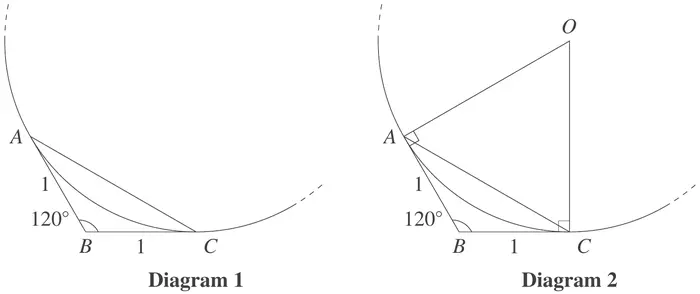
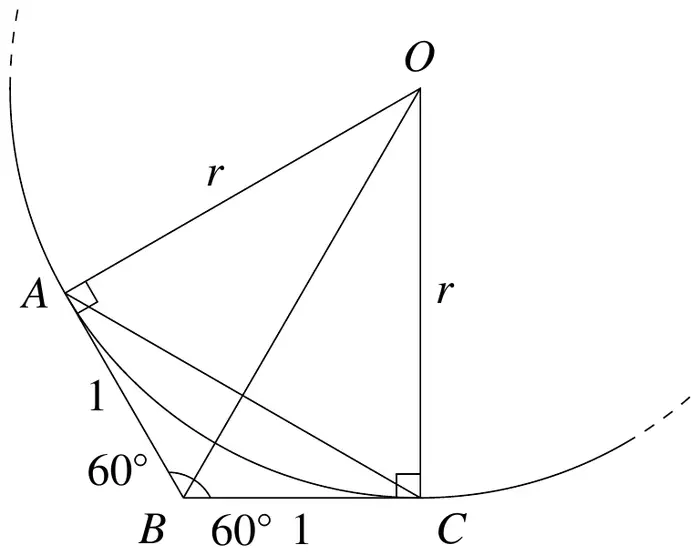
Triangle \(ABC\) is isosceles, with \(AB = BC = 1\) and angle \(ABC\) equal to \(120^\circ\). A circle is tangent to the line \(AB\) at \(A\) and to the line \(BC\) at \(C\).

What is the radius of the circle?(10 marks)

[You should state clearly any geometrical facts or theorems you use in each step of your calculation. For example, if one of your steps calculates the size of an angle in a triangle you might justify that particular step with “because angles in a triangle add up to 180 degrees.”]

Mathematical Olympiad for Girls 2018, Question 2. © UK Mathematics Trust. Original paper on ukmt.org.uk

MOG 2018 Q3

MOGCurrent spec10 marksCounting, Probability & Logic
3.
(a)

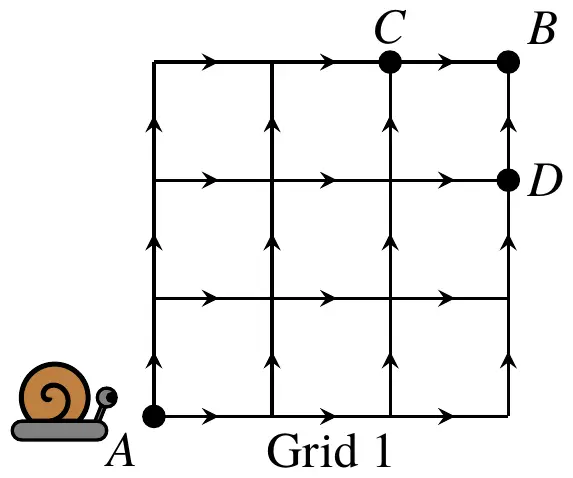
Sheila the snail leaves a trail behind her as she moves along gridlines in Grid 1. She may only move in one direction along a gridline, indicated by arrows. Let \(b\), \(c\), \(d\) be the number of different trails Sheila could make while moving from \(A\) to \(B\), \(C\), \(D\) respectively.

Explain why \(b = c + d\).(2 marks)

Grid 1: a 3 by 3 square grid of lines with arrows pointing right and up; a snail at A in the bottom left corner, C and B at the top right with B in the corner, and D on the right edge just below B
(b)

Ghastly the ghost lives in a haunted mansion with 27 rooms arranged in a \(3 \times 3 \times 3\) cube. He may pass unhindered between adjacent rooms, moving through the walls or ceilings. He wants to move from the room in the bottom left corner of the building to the room farthest away in the top right corner, passing through as few rooms as possible. Unfortunately, a trap has been placed in the room at the centre of the house and he must avoid it at all costs.

How many distinct paths through the house can he take?(8 marks)

Mathematical Olympiad for Girls 2018, Question 3. © UK Mathematics Trust. Original paper on ukmt.org.uk

MOG 2018 Q4

MOGCurrent spec10 marksCounting, Probability & Logic
4.

Each of 100 houses in a row are to be painted white or yellow. The residents are quite particular and request that no three neighbouring houses are all the same colour.

(a)

Explain why no more than 67 houses can be painted yellow.(4 marks)

(b)

In how many different ways may the houses be painted if exactly 67 are painted yellow?

(6 marks)

Mathematical Olympiad for Girls 2018, Question 4. © UK Mathematics Trust. Original paper on ukmt.org.uk

MOG 2018 Q5

MOGCurrent spec10 marksCounting, Probability & Logic
5.

Sophie lays out 9 coins in a \(3 \times 3\) square grid, one in each cell, so that each coin is tail side up. A move consists of choosing a coin and turning over all coins which are adjacent to the chosen coin. For example if the centre coin is chosen then the four coins in cells above, below, left and right of it would be turned over.

(a)

Sophie records the number of times she has chosen each coin in a \(3 \times 3\) table. Explain how she can use this table to determine which way up every coin in the grid is at the end of a sequence of moves.(2 marks)

(b)

Is it possible that after a sequence of moves all coins are tail side down?(4 marks)

(c)

If instead Sophie lays out 16 coins in the cells of a \(4 \times 4\) grid, so that each coin is tail side up, is it possible that after a sequence of moves all coins are tail side down?(4 marks)

[In parts (b) and (c), if you think that it is possible, you should specify a sequence of moves, after which all coins are tail side down. If you think it is not possible, you should give a proof to show that it can’t be done, no matter which sequence of moves Sophie chooses to do.]

Mathematical Olympiad for Girls 2018, Question 5. © UK Mathematics Trust. Original paper on ukmt.org.uk

MOG 2017 Q1

1.

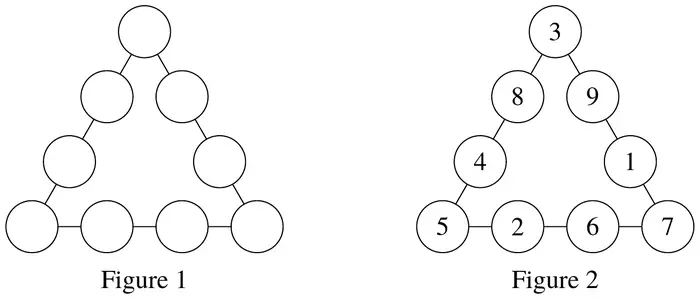
All the digits 1 to 9 are to be placed in the circles in Figure 1, one in each, so that the total of the numbers in any line of four circles is the same. In the example shown in Figure 2, the total is equal to 20.

Figure 1: nine empty circles arranged in a triangle with four circles on each side. Figure 2: the same triangle filled with 3 at the top, 8 and 9 below it, 4 and 1 below those, and 5, 2, 6, 7 along the bottom

Prove that if the total \(T\) is possible then the total \(40 - T\) is possible.

Mathematical Olympiad for Girls 2017, Question 1. © UK Mathematics Trust. Original paper on ukmt.org.uk

MOG 2017 Q2

2.

A positive integer is said to be jiggly if it has four digits, all non-zero, and no matter how you arrange those digits you always obtain a multiple of 12.

How many jiggly positive integers are there?

Mathematical Olympiad for Girls 2017, Question 2. © UK Mathematics Trust. Original paper on ukmt.org.uk

MOG 2017 Q3

MOGCurrent spec10 marksAlgebraGeometry & Angles
3.

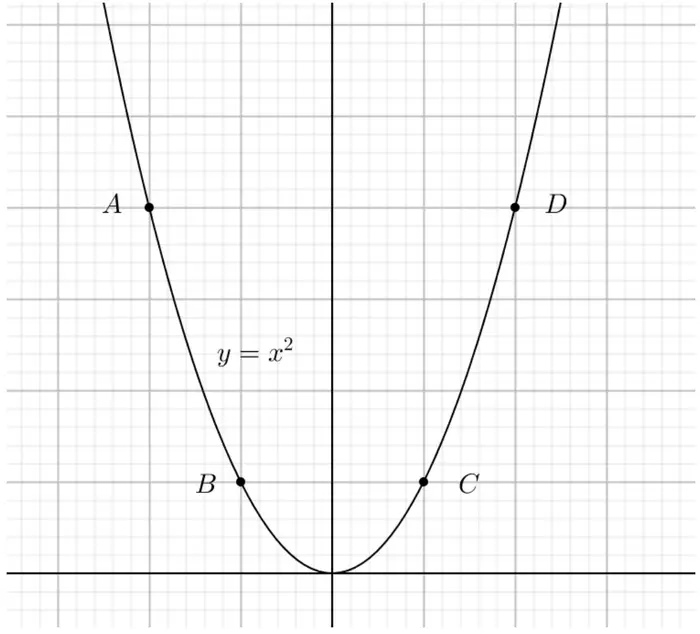
Four different points \(A\), \(B\), \(C\) and \(D\) lie on the curve with equation \(y = x^2\).

Prove that \(ABCD\) is never a parallelogram.

Mathematical Olympiad for Girls 2017, Question 3. © UK Mathematics Trust. Original paper on ukmt.org.uk

MOG 2017 Q4

MOGCurrent spec10 marksAlgebraFactors, Primes & Digits
4.

Let \(n\) be an odd integer greater than 3 and let \(M = n^2 + 2n - 7\).

Prove that, for all such \(n\), at least four different positive integers (excluding 1 and \(M\)) divide \(M\) exactly.

Mathematical Olympiad for Girls 2017, Question 4. © UK Mathematics Trust. Original paper on ukmt.org.uk

MOG 2017 Q5

5.

Claire and Stuart play a game called Nifty Nines:

(i)

they take turns to choose one number at a time, with Claire choosing first;

(ii)

numbers can only be chosen from the integers 1 to 5 inclusive;

(iii)

the game ends when \(n\) numbers have been chosen (repetitions are permitted).

Stuart wins the game if the sum of the chosen numbers is a multiple of 9, otherwise Claire wins.

Find all values of \(n\) for which Claire can ensure a win, whatever Stuart’s choices were. You must prove that you have found them all.

Mathematical Olympiad for Girls 2017, Question 5. © UK Mathematics Trust. Original paper on ukmt.org.uk

MOG 2016 Q1

MOGCurrent spec10 marksAlgebra
1.

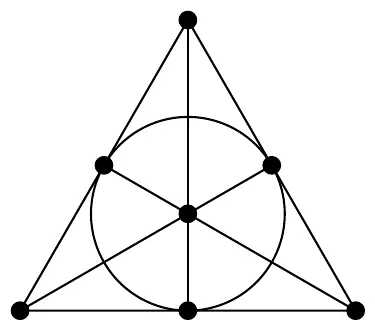
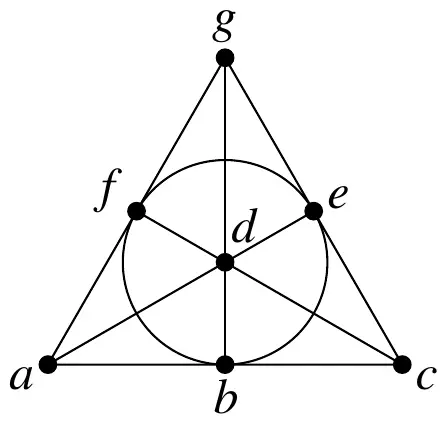
The diagram shows a figure consisting of six line segments and a circle, each containing three points.

Each point is labelled with a real number. The sum of the three numbers on each line segment or circle is \(T\).

Prove that each number is equal to \(\tfrac{1}{3}T\).

An equilateral triangle with its three medians and its inscribed circle, with seven marked points: the three vertices, the three midpoints of the sides and the centre

Mathematical Olympiad for Girls 2016, Question 1. © UK Mathematics Trust. Original paper on ukmt.org.uk

MOG 2016 Q2

MOGCurrent spec10 marksGeometry & Angles
2.

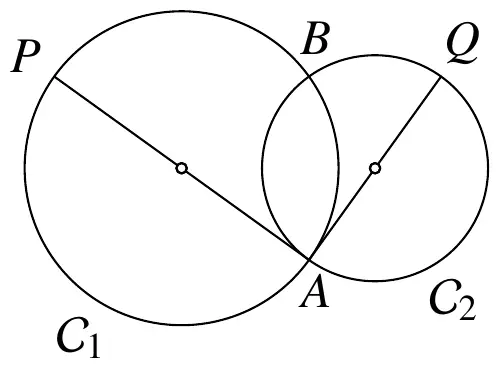
The diagram shows two circles \(C_1\) and \(C_2\) with diameters \(PA\) and \(AQ\). The circles meet at the points \(A\) and \(B\), and the line \(PA\) is a tangent to \(C_2\) at \(A\).

Prove that\[\frac{PB}{BQ} = \frac{\text{area}\,C_1}{\text{area}\,C_2}.\]

Two circles C1 and C2 meeting at A and B, with diameters PA of C1 and AQ of C2

Mathematical Olympiad for Girls 2016, Question 2. © UK Mathematics Trust. Original paper on ukmt.org.uk

MOG 2016 Q3

MOGCurrent spec10 marksCounting, Probability & Logic
3.

Punam puts counters onto some of the cells of a \(5 \times 5\) board. She can put more than one counter on each cell, and she can leave some cells empty. She tells Quinn how many counters there are in each row and column. These ten numbers are all different.

Can Quinn always work out which cells, if any, are empty?

Mathematical Olympiad for Girls 2016, Question 3. © UK Mathematics Trust. Original paper on ukmt.org.uk

MOG 2016 Q4

4.
(a)

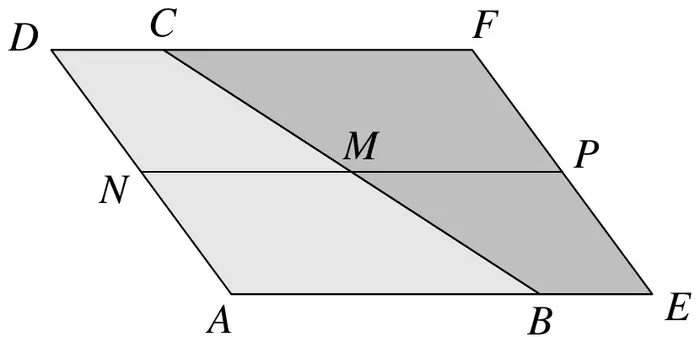
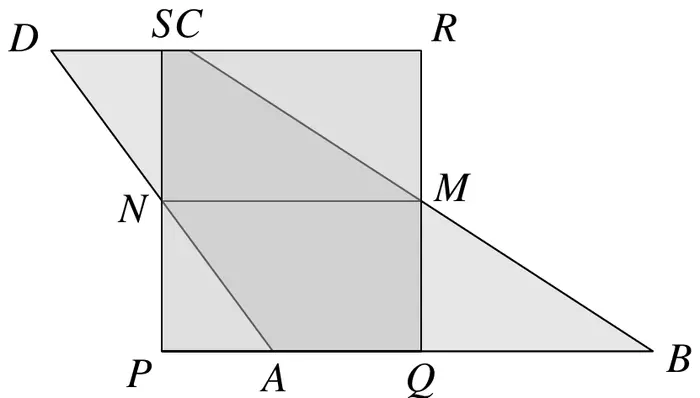
In the trapezium \(ABCD\), the edges \(AB\) and \(DC\) are parallel. The point \(M\) is the midpoint of \(BC\), and \(N\) is the midpoint of \(DA\).

Prove that \(2MN = AB + CD\).

(b)

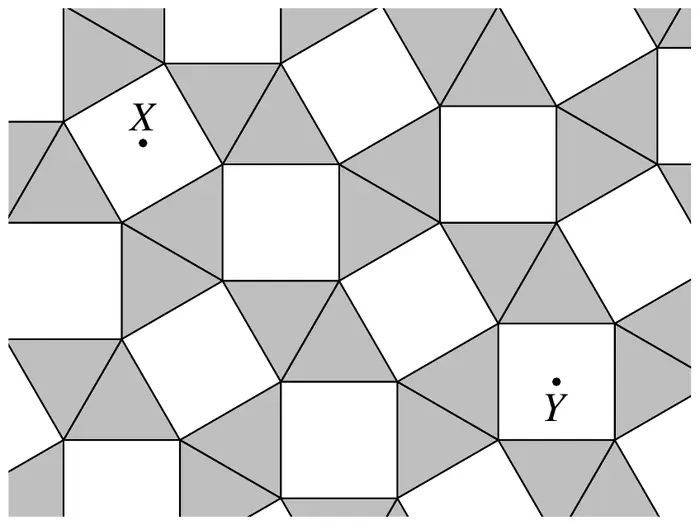
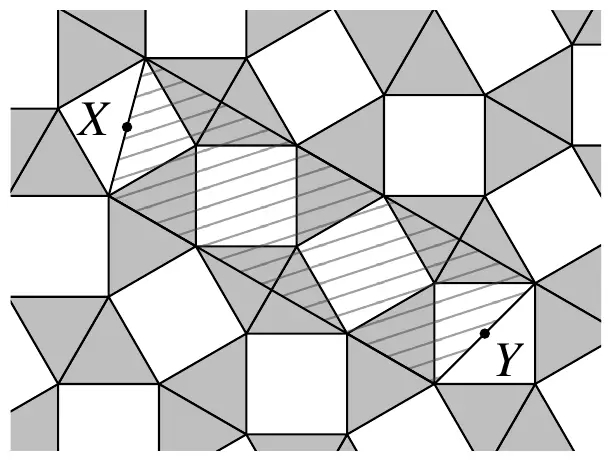
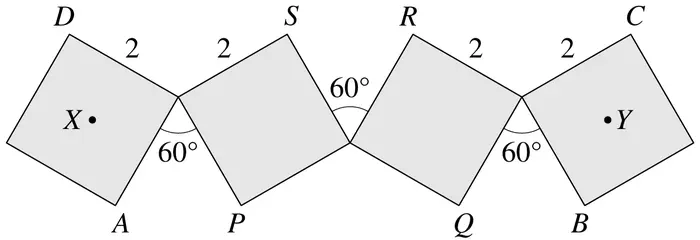
The diagram shows part of a tiling of the plane by squares and equilateral triangles.

Each tile has edges of length 2. The points \(X\) and \(Y\) are at the centres of square tiles.

What is the distance \(XY\)?

Part of a tiling of the plane by squares and equilateral triangles, some tiles shaded grey, with points X and Y at the centres of two square tiles

Mathematical Olympiad for Girls 2016, Question 4. © UK Mathematics Trust. Original paper on ukmt.org.uk

MOG 2016 Q5

5.

Alia, Bella and Catherine are multiplying fractions, aiming to obtain integers. Each of them can multiply as many fractions as she likes (including just one), and can use the same fraction more than once.

Alia’s fractions are of the form \(\dfrac{n + 1}{n}\), where \(n\) is a positive integer.

Bella’s fractions are of the form \(\dfrac{6p - 5}{3p + 6}\), where \(p\) is a positive integer.

Catherine’s fractions are of the form \(\dfrac{4q - 1}{2q + 1}\), where \(q\) is a positive integer.

Which integers can each of them obtain?

Mathematical Olympiad for Girls 2016, Question 5. © UK Mathematics Trust. Original paper on ukmt.org.uk

MOG 2015 Q1

MOGCurrent spec10 marksAlgebra
1.
(a)

Expand and simplify \((a - b)(a^2 + ab + b^2)\).

(b)

Find the value of\[\frac{2016^3 + 2015^3}{2016^2 - 2015^2}.\]

Mathematical Olympiad for Girls 2015, Question 1. © UK Mathematics Trust. Original paper on ukmt.org.uk

MOG 2015 Q2

MOGCurrent spec10 marksGeometry & Angles
2.

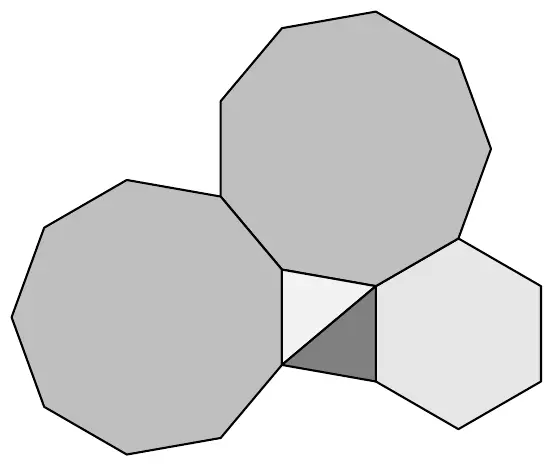
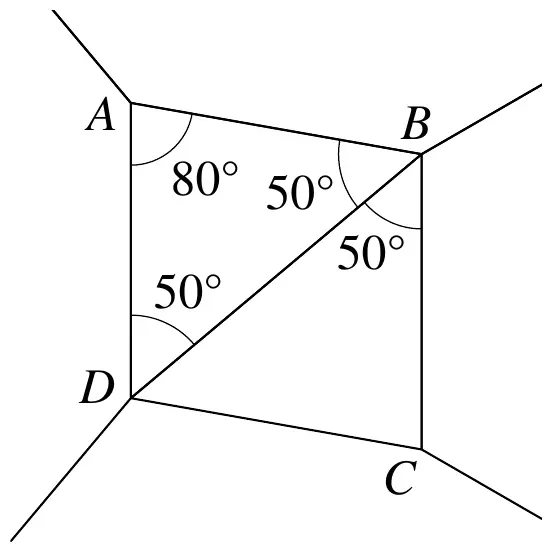
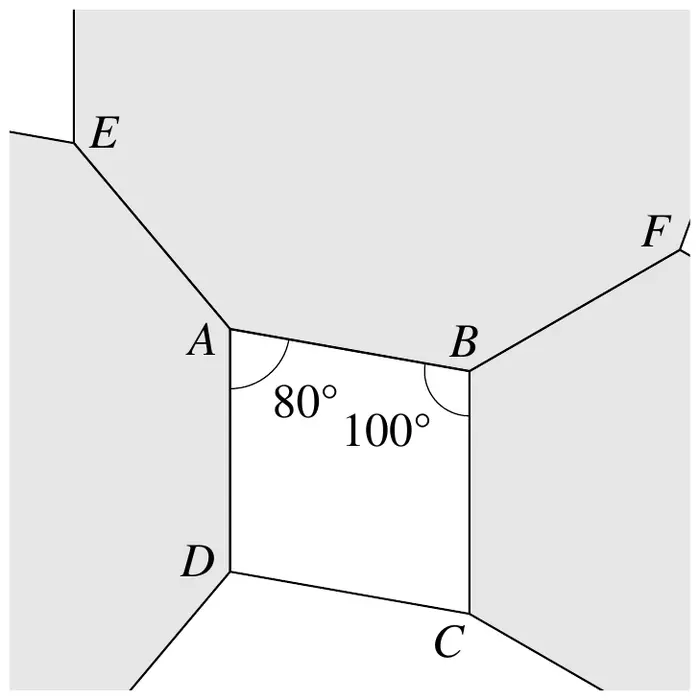
The diagram shows five polygons placed together edge-to-edge: two triangles, a regular hexagon and two regular nonagons.

Prove that each of the triangles is isosceles.

Two grey regular nonagons and a light grey regular hexagon placed edge-to-edge around two triangles, one white and one dark grey

Mathematical Olympiad for Girls 2015, Question 2. © UK Mathematics Trust. Original paper on ukmt.org.uk

MOG 2015 Q3

MOGCurrent spec10 marksCounting, Probability & Logic
3.

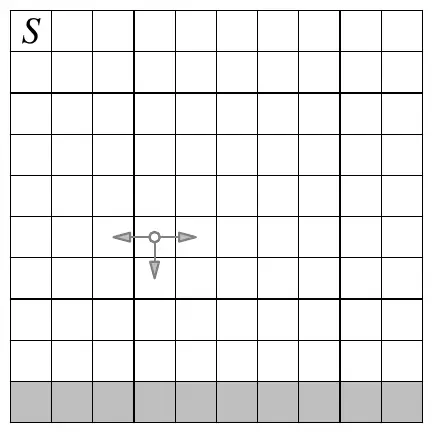
A ladybird is going for a wander around a \(10 \times 10\) board, subject to the following three rules (see the diagram).

(i)

She starts in the top left cell, labelled \(S\).

(ii)

She only moves left, right or down, as indicated.

(iii)

She never goes back to a cell that she has already visited.

In how many different ways can she reach the bottom row of cells, shaded grey?

A 10 by 10 grid with S in the top left cell, arrows showing moves left, right and down, and the bottom row shaded grey

Mathematical Olympiad for Girls 2015, Question 3. © UK Mathematics Trust. Original paper on ukmt.org.uk

MOG 2015 Q4

4.
(a)

A tournament has \(n\) contestants. Each contestant plays exactly one game against every other contestant. Explain why the total number of games is \(\tfrac{1}{2}n(n - 1)\).

(b)

In a particular chess tournament, every contestant is supposed to play exactly one game against every other contestant. However, contestant \(A\) withdrew from the tournament after playing only ten games, and contestant \(B\) withdrew after just one game.

A total of 55 games were played.

Did \(A\) and \(B\) play each other?

Mathematical Olympiad for Girls 2015, Question 4. © UK Mathematics Trust. Original paper on ukmt.org.uk

MOG 2015 Q5

5.
(a)

The integer \(N\) is a square. Find, with proof, all possible remainders when \(N\) is divided by 16.

(b)

Find all positive integers \(m\) and \(n\) such that\[m! + 76 = n^2.\]

[The notation \(m!\) stands for the factorial of \(m\), that is, \(m! = m \times (m - 1) \times \dots \times 2 \times 1\).
For example, \(4! = 4 \times 3 \times 2 \times 1\).]

Mathematical Olympiad for Girls 2015, Question 5. © UK Mathematics Trust. Original paper on ukmt.org.uk