
MOG 2020 Q2
Twelve points, four of which are vertices, lie on the perimeter of a square. The distance between adjacent points is one unit. Some of the points have been connected by straight lines. \(B\) is the intersection of two of those lines, as shown in the diagram.
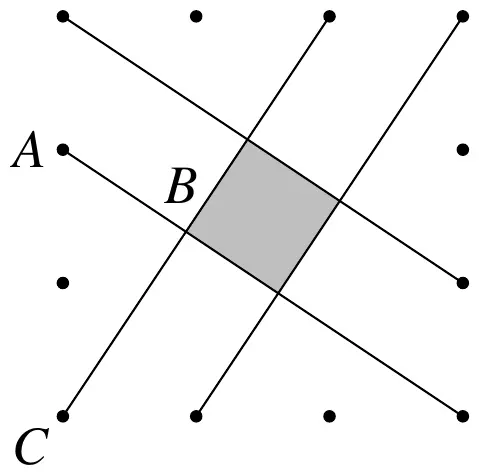
Find the ratio \(AB : BC\). Give your answer in its simplest form.(3 marks)
Find the area of the shaded region.(7 marks)
Mathematical Olympiad for Girls 2020, Question 2. © UK Mathematics Trust. Original paper on ukmt.org.uk
Answer: (a) \(2 : 3\) (b) \(\dfrac{9}{13}\)
Commentary
There are various ways to approach this problem; we will give two solutions using similar triangles and another using coordinate geometry.
You are first asked to find the ratio of two lengths, suggesting that you might want to use similar triangles. Consider the angles of triangle \(ABC\). After labelling some additional points as shown in the diagram, you can see that angle \(CAB\) is shared with triangle \(DAC\) and angle \(ACB\) is shared with triangle \(FCE\). Using this observation, what similar triangles can you find?
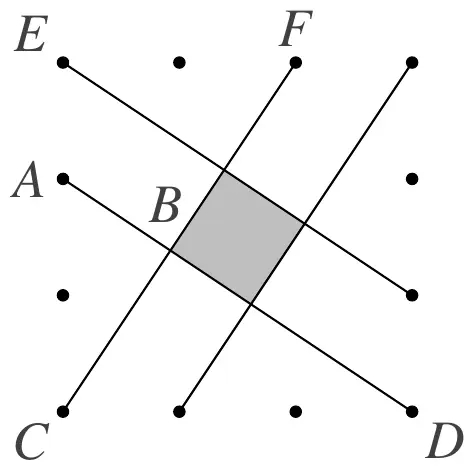
It seems “obvious, by symmetry” that the shaded region is a square, but such assertions should normally be proved. In particular, the symmetry of the diagram suggests that the shaded region has four equal sides, but it is less clear that it also has right angles. Our solution will include a proof of this fact.
If we call the length of the side of the shaded square \(x\), then \(AB + x + BC = \sqrt{3^2 + 2^2} = \sqrt{13}\).You know the ratio \(AB : BC\) from part (a), and triangle \(ABC\) gives you another piece of information about the two lengths: \(AB^2 + BC^2 = 2^2 = 4\). (Note that the analysis in part (a) implies that \(ABC\) is a right angle.) Can you see how you can use this?
It is also possible to find the area of the shaded region without calculating any lengths. To do this, note that the large square (which has area 9) is made up of four copies of triangle \(ABC\) and four copies of the quadrilateral region. Can you use the fact that triangles \(ABC\) and \(ACD\) are similar to find the area of triangle \(ABC\)?
Using the diagram above, \(\angle CAB = \angle CAD\) and \(\angle ACB = \angle ECF\). But triangles \(ACD\) and \(FEC\) are congruent, so \(\angle ACB = \angle CDA\). It follows that triangle \(ABC\) is similar to triangle \(ACD\), so the ratio of its sides is \(AB : BC = 2 : 3\).
From the similarity of triangles \(ABC\) and \(ACD\) it follows that \(ABC\) is a right angle. By symmetry, the shaded region is a square. It is therefore sufficient to find the length of one of its sides.
Triangle \(ABC\) is right angled and its hypotenuse has length 2 units. Hence \(AB^2 + BC^2 = 4\). But \(AB\) and \(BC\) are in the ratio \(2 : 3\), so their squares are in the ratio \(4 : 9\). Since they add up to 4, it follows that \(AB^2 = \frac{4}{13} \times 4 = \frac{16}{13}\) and \(BC^2 = \frac{9}{13} \times 4 = \frac{36}{13}\). Hence \(AB = \frac{4}{\sqrt{13}}\) and \(BC = \frac{6}{\sqrt{13}}\).
Let \(x\) be the length of the side of the shaded square; then \(AB + x + BC = \sqrt{2^2 + 3^2} = \sqrt{13}\). Therefore,\[x = \sqrt{13} - \frac{4}{\sqrt{13}} - \frac{6}{\sqrt{13}} = \frac{13 - 4 - 6}{\sqrt{13}} = \frac{3}{\sqrt{13}},\]and so the area of the shaded square is \(\frac{9}{13}\).
Alternative
We know from part (a) that triangle \(ABC\) is similar to triangle \(ACD\). The smaller triangle has hypotenuse of length 2 and the larger one has hypotenuse of length \(\sqrt{13}\), so the scale factor of the similarity is \(\frac{2}{\sqrt{13}}\).This means that the area scale factor is \(\frac{4}{13}\). Since triangle \(ACD\) has area 3, it follows that triangle \(ABC\) has area \(3 \times \frac{4}{13} = \frac{12}{13}\).
Triangle \(ACD\) is made up of two copies of triangle \(ABC\) and a quadrilateral region. Hence the area of the quadrilateral region is \(3 - 2 \times \frac{12}{13} = \frac{15}{13}\). Finally, the large square, which has area 9, is made up of the required shaded region, four copies of triangle \(ABC\), and four copies of the quadrilateral region. The area of the shaded region is therefore\[9 - 4 \times \frac{12}{13} - 4 \times \frac{15}{13} = \frac{9}{13}.\]
Alternative
We use coordinate geometry to answer both parts. Let the origin be at \(C\) so that \(A\) has coordinates \((0, 2)\) and \(D\) has coordinates \((3, 0)\). Then the equation of the line \(CB\) is \(y = \frac{3}{2}x\) and the equation of the line \(AB\) is \(-\frac{2}{3}x + 2\). This shows that the two lines are perpendicular and so, by symmetry, the shaded region is a square. \(B\) is the intersection of the two lines, so its coordinates are \((\frac{12}{13}, \frac{18}{13})\).
We can now calculate the lengths \(AB = \sqrt{(\frac{12}{13})^2 + (\frac{8}{13})^2} = \sqrt{\frac{208}{169}}\) and \(BC = \sqrt{(\frac{12}{13})^2 + (\frac{18}{13})^2} = \sqrt{\frac{468}{169}}\). Their ratio is \(AB : BC = \sqrt{208} : \sqrt{468} = \sqrt{4} : \sqrt{9} = 2 : 3\).
We only need to find one more vertex of the shaded square. The line through \(E\) parallel to \(AB\) has equation \(y = -\frac{2}{3}x + 3\), and intersecting this with the line \(BC\) gives another vertex with coordinates \((\frac{18}{13}, \frac{27}{13})\). If we write \(x\) for the length of the side of the shaded square, we then have:\[x^2 = \left(\frac{18}{13} - \frac{12}{13}\right)^2 + \left(\frac{27}{13} - \frac{18}{13}\right)^2 = \frac{36}{169} + \frac{81}{169} = \frac{117}{169} = \frac{9}{13}.\]This is the area of the shaded square.
Solution © UK Mathematics Trust, from the MOG 2020 solutions.