112 Senior Mathematical Challenge questions from every year we have, newest year first. Use Difficulty › Position in the paper to practise the early (easier) or late (harder) questions, or the Year filter for one year.
4. The numbers \(p\),\(q\), \(r\) and \(s\) satisfy the equations \(p = 2\),\(p \times q = 20\), \(p \times q \times r = 202\) and \(p \times q \times r \times s = 2020\).
As \(p = 2\),\(q = \frac{20}{2} = 10\). Then \(20 \times r = 202\) so \(r = \frac{202}{20} = 10.1\). Finally, \(202 \times s = 2020\) so \(s = \frac{2020}{202} = 10\). The value of \(p + q + r + s = 2 + 10 + 10.1 + 10 = 32.1\).
12. A three-piece suit consists of a jacket, a pair of trousers and a waistcoat. Two jackets and three pairs of trousers cost £380. A pair of trousers costs the same as two waistcoats.
In pounds, let the price of a jacket = \(j\), the price of a pair of trousers = \(t\) and the price of a waistcoat = \(w\). We are given that \(2j + 3t = 380\) and that \(t = 2w\). We want to know the value of \(j + t + w\). Rewriting the first equation as \(2j + 2t + t = 380\) and substituting \(2w\) instead of the final \(t\) gives \(2j + 2t + 2w = 380\). Dividing by 2 then gives us \(j + t + w = 190\) and so the cost of the three-piece suit is £190.
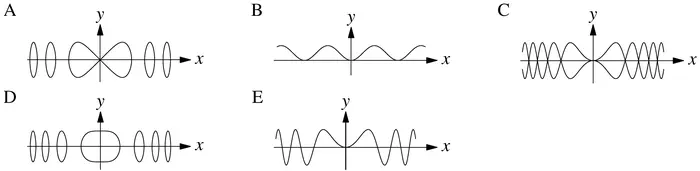
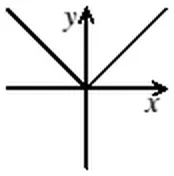
Rearranging \(y^2 - 2y = x^2 + 2x\) gives \(y^2 - x^2 = 2x + 2y\) then factorising on each side gives \((y + x)(y - x) = 2(x + y)\) and so \((y - x - 2)(y + x) = 0\). Therefore either \(y = x + 2\) or \(y = -x\). A sketch of those two straight lines is shown in option E.
As \(m\) is a positive integer, in this equation \(3m\) could equal 3, 6, 9, 12 or 15 leaving \(\dfrac{3}{n + \frac{1}{p}} = 14\), 11, 8, 5 or 2. However \(n, p > 1 \implies n + \frac{1}{p} > 1 \implies \dfrac{3}{n + \frac{1}{p}} < 3\). Therefore the only possibility here is that \(\dfrac{3}{n + \frac{1}{p}} = 2\). So \(\frac{3}{2} = n + \frac{1}{p}\) which is possible only when \(n = 1\) and \(p = 2\).
Combining \(p - q = r\) and \(r - s = t\) gives \(p - q = s + t\) which rearranges to \(t = p - (q + s)\). The maximum value of \(t\) can be found by maximising \(p\) and minimising the sum of \(q\) and \(s\), so \(t_{\text{max}} = 9 - (1 + 2) = 6\). The minimum value of \(t\) is 1, for example \(t_{\text{min}} = 9 - (2 + 6) = 1\). All the values of \(t\) from 1 to 6 are possible in a similar way. Therefore \(t\) can have six different values.
Rewriting both sides of the first equation using a base of \(\sqrt{2}\) gives \(\left(\sqrt{2}^4\right)^y = \frac{1}{\sqrt{2}^6\sqrt{2}^{x+2}}\) so \(\sqrt{2}^{4y} = \sqrt{2}^{-(x+8)}\) and therefore \(4y = -(x + 8)\). Rewriting the second equation with a base of \(\sqrt{3}\) gives \(\left(\sqrt{3}^4\right)^x \times \left(\sqrt{3}^2\right)^y = \sqrt{3}^3\). Again, employing rules of indices leads to \(4x + 2y = 3\). Solving simultaneously the pair of linear equations shows that \(x = 2\) and \(y = -\frac{5}{2}\) and therefore \(x + y = -\frac{1}{2}\). The value of \(5^{x+y} = 5^{-\frac{1}{2}} = \frac{1}{\sqrt{5}}\).
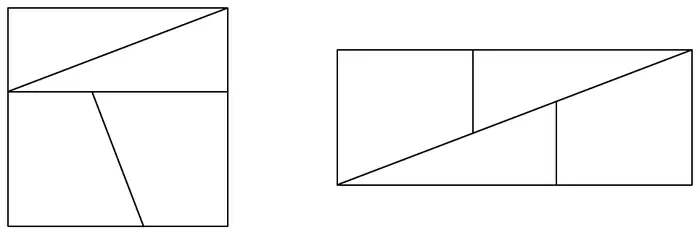
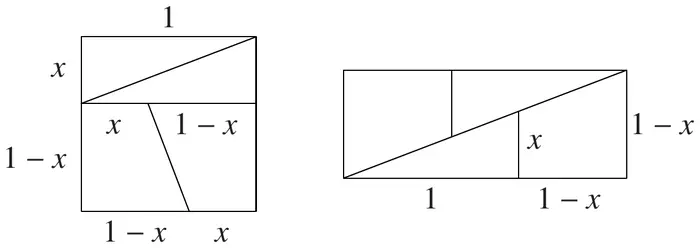
22. A square with perimeter 4 cm can be cut into two congruent right-angled triangles and two congruent trapezia as shown in the first diagram in such a way that the four pieces can be rearranged to form the rectangle shown in the second diagram.
What is the perimeter, in centimetres, of this rectangle?
The perimeter of the square is 4 therefore each side is of length 1 and the area of the square is 1. The square must be cut so that the shortest side of each triangle matches the shorter of the two parallel sides of the trapezium when the pieces are rearranged.
Let each of these sides be of length \(x\) and then the remaining perpendicular sides of each trapezium have length \(1 - x\) as indicated on the first diagram. The perimeter of the rectangle has length \(2 \times 1 + 4(1 - x) = 6 - 4x\).
In order to find the value of \(x\), we can consider the area of the rectangle so \((1 + 1 - x)(1 - x) = 1\). This rearranges to give \(x^2 - 3x + 1 = 0\) and therefore, of the two possible solutions, \(x = \frac{3-\sqrt{5}}{2}\) as \(x < 1\). The perimeter is \(6 - 4(\frac{3-\sqrt{5}}{2}) = 2\sqrt{5}\).
The expression \(n^2 + 2n\) factorises to \(n(n + 2)\). For \(n(n + 2)\) to be prime, one factor must equal 1 whilst the other must be equal to a prime. This happens when \(n = 1\), as \(n + 2 = 3\), but not when \(n + 2 = 1\) as \(n\) would be negative. There is therefore exactly one positive integer value of \(n\) which makes \(n^2 + 2n\) prime.
Considering some integer powers of 3, we have \(3^5 = 243\) and \(3^6 = 729\). As \(243 < 333 < 729\), \(3^5 < 3^{\left(3^x\right)} < 3^6\) implies that \(5 < 3^x < 6\). Rewriting once again to include powers of 3, gives \(3^1 < 5 < 3^x < 6 < 3^2\), so \(3^1 < 3^x < 3^2\) and finally, \(1 < x < 2\).
13. Anish has a number of small congruent square tiles to use in a mosaic. When he forms the tiles into a square of side \(n\), he has 64 tiles left over. When he tries to form the tiles into a square of side \(n + 1\), he has 25 too few.
As \(9x + 3y - 5z = -4\) and \(5x + 2y - 2z = 13\), subtracting the first equation from twice the second gives \((10x + 4y - 4z) - (9x + 3y - 5z) = 2 \times 13 - (-4)\). The mean of \(x\), \(y\) and \(z\) which is \(\frac{(x+y+z)}{3}\) is therefore \(\frac{30}{3} = 10\).
The sum of the first 2019 positive integers is \(\frac{2019 \times 2020}{2}\) which is considerably larger than the required sum of 2019. In order for the sum of Jeroen’s 2019 integers to be only 2019, some of the integers must be positive and some must be negative. One of the integers will then be 0, so the product will also be 0. Jeroen’s list is \(-1008, \ldots - 2, -1, 0, 1, 2, \ldots, 1008, 1009, 1010\).
As \(\sin(0^2) = 0^2\) our graph must pass through the origin, so eliminating option D. As \(y^2 = \sin(x^2)\), \(y = \pm\sqrt{\sin(x^2)}\) and so the \(x\)-axis must be a line of symmetry, so eliminating options B and E. For some \(x\)-values, \(\sin(x^2)\) will be negative and so there will be no corresponding \(y\)-value, so eliminating option C, which has \(y\)-values for every \(x\)-value. The only possible remaining option is then A and it can be checked that the graph is indeed of this form.
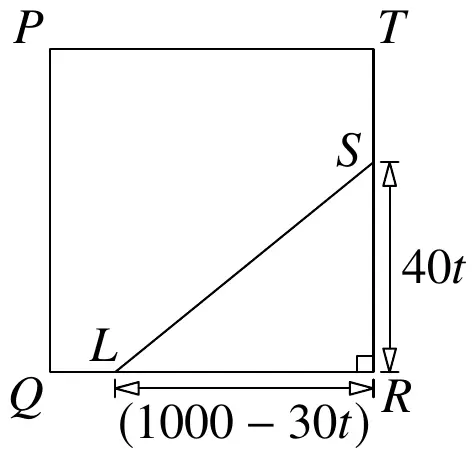
21. In a square garden \(PQRT\) of side 10 m, a ladybird sets off from \(Q\) and moves along edge \(QR\) at 30 cm per minute. At the same time, a spider sets off from \(R\) and moves along edge \(RT\) at 40 cm per minute.
What will be the shortest distance between them, in metres?
Let \(L\) be the position of the ladybird on \(QR\) and let \(S\) be the position of the spider on \(RT\) each after \(t\) minutes. The shortest distance between \(L\) and \(S\) is along the straight line which is the hypotenuse of the right-angled triangle \(LRS\). The distance \(QL\) is \(30t\) cm, so the distance \(LR\) is \((1000 - 30t)\) cm. Also, the distance \(RS\) is \(40t\) cm. So, \(LS^2 = (1000 - 30t)^2 + (40t)^2\) which expands and simplifies to \(2500(t^2 - 24t + 400) = 2500((t - 12)^2 + 256)\). The distance from \(L\) to \(S\) is shortest when \(t = 12\) and is \(\sqrt{2500 \times 256}\) cm = 800 cm = 8 m.
Each of \(x\), \(y\) and \(z\) has the same form which is \(\sqrt{a - b} - \sqrt{a + b}\) for some \(a\) and \(b\). Squaring this expression gives \((a - b) - 2\sqrt{a + b} \times \sqrt{a - b} + (a + b) = 2a - 2\sqrt{(a^2 - b^2)}\). Applying this to \(x\) with \(a = 12\) and \(b = 3\sqrt{7}\) gives \(x^2 = 24 - 2\sqrt{81} = 6\). Similarly we can calculate that \(y^2 = 12\) and \(z^2 = 2\) . This gives us that \(x^2y^2z^2 = 6 \times 12 \times 2 = 144\). From the initial expressions \(x < 0\), \(y < 0\) and \(z > 0\), so \(xyz > 0\) and therefore \(xyz = 12\).
For each equation, consider \(x = 0\). Then, \(y = x^4 + 1\) becomes \(y = 0^4 + 1 = 1\) and so the graph with this equation passes through \((0, 1)\) rather than \((0, 0)\). For the other three equations, using \(x = 0\) shows that \(y = 0\) too and so their graphs all pass through the origin. Hence only one graph does not pass through the origin.
Since \(y = x\) and \(y = mx - 4\), it follows that \(x = mx - 4\) and so \(4 = mx - x = (m - 1)x\); therefore \(x = \frac{4}{m - 1}\). In order for \(x\) to be a positive integer, \(m - 1\) must be a positive factor of 4 therefore \(m - 1\) can equal 1, 2 or 4 and so \(m\) can equal 2, 3 or 5. The sum of these values of \(m\) is then 10.
The mean of the twelve integers is given to be 7. Therefore \(1 + 3x + 5y + 8 + 9 + 11 = 12 \times 7\) so \(3x + 5y = 55\). As the twelve integers are written in ascending order, the median value is half way between the 6th and 7th values, each of which is \(y\), so the median is \(y\). Rearranging our equation gives \(y = \dfrac{55 - 3x}{5}\) and hence \(3x\) must be a multiple of 5 so that the numerator can be divided exactly by 5. To ensure that the twelve integers are in ascending order the minimum value of \(x\) is 1 and the maximum value of \(x\) is 8. The only value in this interval which makes \(3x\) a multiple of 5 is \(x = 5\), in which case \(y = \dfrac{55 - 15}{5} = 8\).
Considering the first set of equations \(4p = 3q = 2r = s\), we can see that \(p < q < r < s\). Also, \(s\) must be a multiple of 2, 3 and 4. The smallest such multiple is 12 which gives \(p = 3\),\(q = 4\), \(r = 6\) and \(s = 12\). In the equation \(p + 2q + 3r + 4s = k\) we then have \(3 + 2 \times 4 + 3 \times 6 + 4 \times 12 = k\), so \(k = 77\).
Let the number of 20p coins and 50p coins Bethany has be \(x\) and \(y\) respectively. Her total number of coins is then \(11 + x + y\). As the mean value of her coins is 52p, the total value of her coins is both \(52 \times (11 + x + y)\) and \(100 \times 11 + 20x + 50y\). The equation formed is \(52(11 + x + y) = 1100 + 20x + 50y\) which becomes \(572 + 52x + 52y = 1100 + 20x + 50y\) and this simplifies to \(32x + 2y = 528\) or \(16x + y = 264\). By rearranging we can see that \(11 + x + y = 275 - 15x\). So Bethany’s total number of coins is of the form \(275 - 15x\), or \(5 + 15(18 - x)\) which gives values that are 5 more than multiples of 15. Of the given options the only one which is not 5 more than a multiple of 15 is 40. We can also see that Bethany must have a large purse!
After reflecting the graph of \(y = \frac{1}{x}\) in the line \(y = 1\) we have a graph whose equation is \(y = 1 + (1 - \frac{1}{x})\), so \(y = -\frac{1}{x} + 2\). The second reflection is in the line \(y = -x\). Here, \(y\) is replaced by \(-x\) and \(-x\) is replaced by \(y\). Hence the equation \(y = -\frac{1}{x} + 2\) becomes \(-x = -\frac{1}{-y} + 2\) which rearranges to \(-(x + 2) = \frac{1}{y}\) and then to \(y = \dfrac{-1}{(x + 2)}\).
23. For particular real numbers \(a\) and \(b\), the function \(f\) is defined by \(f(x) = ax + b\), and is such that \(f\big(f\big(f(x)\big)\big) = 27x - 52\).
Which of the following formulas defines the function \(g\) such that, for all values of \(x\),\(g\big(f(x)\big) = x\)?
As \(f(x) = ax + b\), \(f(f(f(x))) = a(a(ax + b) + b) + b\) which expands to give \(a^3x + a^2b + ab + b\) and this can be written as \(a^3x + b(a^2 + a + 1)\). We therefore have \(a^3x + b(a^2 + a + 1) = 27x - 52\). Equating coefficients of \(x\) gives \(a^3 = 27\), so \(a = 3\). Equating the constants gives \(b(3^2 + 3 + 1) = -52\), so \(b = -4\). So the function \(f\) is given by \(f(x) = 3x - 4\). As we are given that \(g(f(x)) = x\), the function \(g\) uses inverse operations to undo the two steps in the function \(f\), in order to return to \(x\). As the operations in \(f\) are ‘multiply by 3’ then ‘subtract 4’, the operations in \(g\) are ‘add 4’ then ‘divide by 3’. Therefore the function \(g\) is given by \(g(x) = \frac{x + 4}{3} = \frac{1}{3}x + \frac{4}{3}\).
By making a common denominator, \(2017 - \dfrac{1}{2017} = \dfrac{2017^2 - 1}{2017}\). Then, using the difference of two squares on the numerator, this can be written as \(\dfrac{2018 \times 2016}{2017}\).
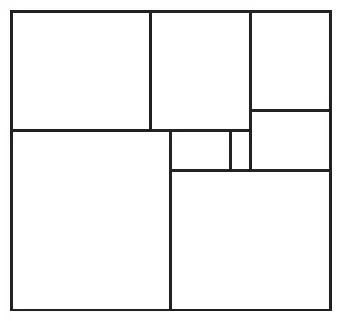
9. The diagram shows an \(n \times (n + 1)\) rectangle tiled with \(k \times (k + 1)\) rectangles, where \(n\) and \(k\) are integers and \(k\) takes each value from 1 to 8 inclusive. What is the value of \(n\)?
The sum of the areas of the tiles is \((1 \times 2) + (2 \times 3) + (3 \times 4) + \ldots + (8 \times 9)\) \(= 2 + 6 + 12 + 20 + 30 + 42 + 56 + 72 = 240 = 15 \times 16\). So the value of \(n\) is 15.
11. The teenagers Sam and Jo notice the following facts about their ages: The difference between the squares of their ages is four times the sum of their ages. The sum of their ages is eight times the difference between their ages. What is the age of the older of the two?
Let the ages of the teenagers be \(a\) and \(b\) with \(a > b\). Then \(4(a + b) = a^2 - b^2\) \(= (a + b)(a - b)\) and so \(4 = a - b\) as \(a + b \neq 0\). Also, \(a + b = 8(a - b) = 8 \times 4 = 32\). We now have \(a - b = 4\) and \(a + b = 32\) so \(a = 18\) and \(b = 14\). Thus the older of the two is 18.
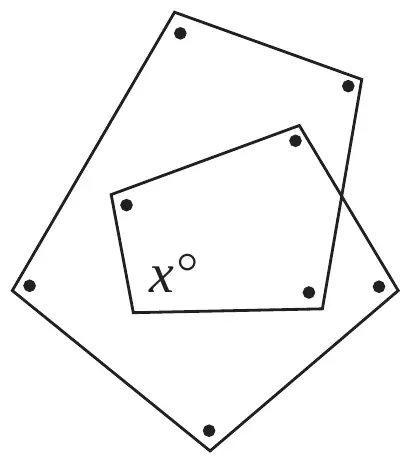
Viewing the diagram as a pentagon inside a hexagon and labelling the unmarked angle in the pentagon as \(y°\) gives \(4x + y = 540\ldots\) (1). For the hexagon, the exterior reflex angle is \(y°\) as opposite angles are equal. So the unmarked interior angle is \((360 - y)°\). This gives \(5x + 360 - y = 720\), so \(5x - y = 360\ldots\) (2). Adding equations (1) and (2) gives \(9x = 900\) and therefore \(x = 100\).
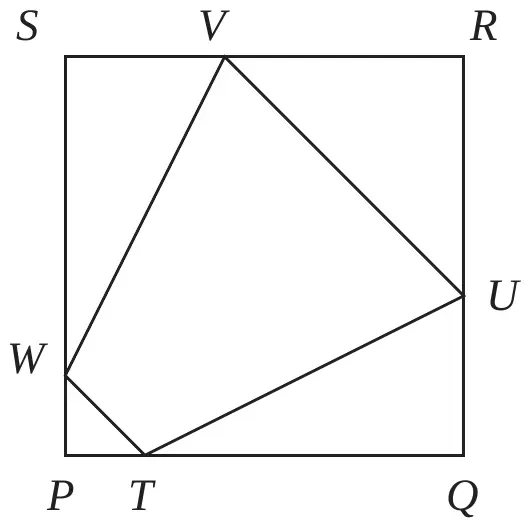
15. The diagram shows a square \(PQRS\). Points \(T\),\(U\), \(V\) and \(W\) lie on the edges of the square as shown, such that \(PT = 1\),\(QU = 2\), \(RV = 3\) and \(SW = 4\). The area of \(TUVW\) is half that of \(PQRS\). What is the length of \(PQ\)?
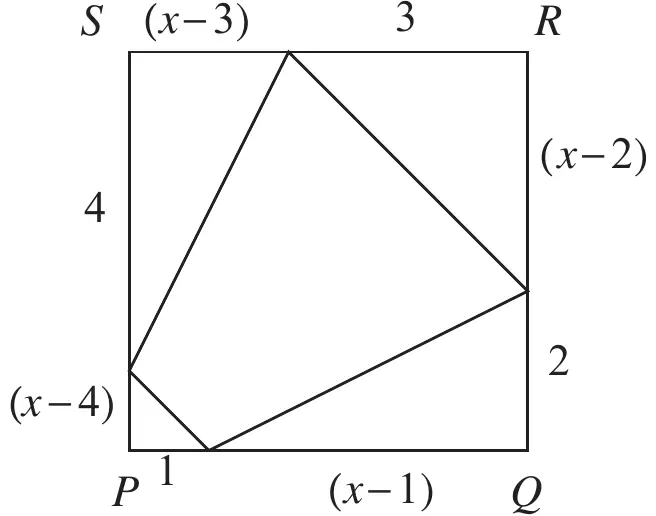
Let the length of \(PQ\) be \(x\). The sum of the areas of the four right-angled triangles is half the area of the square so \(\tfrac{1}{2}[1 \times (x - 4)] + \tfrac{1}{2}[4 \times (x - 3)] + \tfrac{1}{2}[3 \times (x - 2)] + \tfrac{1}{2}[2 \times (x - 1)] = \tfrac{1}{2}x^2\). This gives \((x - 4) + 4(x - 3) + 3(x - 2) + 2(x - 1) = x^2\) which simplifies to \(10x - 24 = x^2\). Factorising \(x^2 - 10x + 24 = 0\) gives \((x - 6)(x - 4) = 0\) so \(x = 4\) or 6. For there to be four triangles as shown, \((x - 4) > 0\), so \(x\), the length of \(PQ\), is 6.
17. Amy, Beth and Claire each has some sweets. Amy gives one third of her sweets to Beth. Beth gives one third of all the sweets she now has to Claire. Then Claire gives one third of all the sweets she now has to Amy. All the girls end up having the same number of sweets. Claire begins with 40 sweets. How many sweets does Beth have originally?
Amy's number of sweets is a multiple of 3, so let her start with \(3a\) sweets. Once Amy has passed on \(a\) of them, Beth's number of sweets must be a multiple of 3. Likewise, after Beth passes on sweets to Claire, Claire's number of sweets must become a multiple of 3. Since \(40 = 3 \times 13 + 1\), Beth must pass on \(3b - 1\) sweets for some \(b\). So Beth must have had \(9b - 3\) sweets after receiving the \(a\) sweets from Amy and hence \(9b - 3 - a\) to start with. This allows us to fill in the table:
Amy
Beth
Claire
originally
\(3a\)
\(9b - 3 - a\)
40
after Amy's gift to Beth
\(2a\)
\(9b - 3\)
40
after Beth's gift to Claire
\(2a\)
\(6b - 2\)
\(3b + 39\)
after Claire's gift to Amy
\(2a + b + 13\)
\(6b - 2\)
\(2b + 26\)
As the girls end up with the same number of sweets, \(6b - 2 = 2b + 26\) and so \(b = 7\). As \(6 \times 7 - 2\) and \(2 \times 7 + 26\) both equal 40, the girls each have 40 sweets at the end. Hence Amy's finishing number \(2a + 7 + 13 = 40\) so \(a = 10\). Then Beth's original number is \(9 \times 7 - 10 - 3 = 50\).
18. The arithmetic mean, \(A\), of any two positive numbers \(x\) and \(y\) is defined to be \(A = \tfrac{1}{2}(x + y)\) and their geometric mean, \(G\), is defined to be \(G = \sqrt{xy}\). For two particular values \(x\) and \(y\), with \(x > y\), the ratio \(A : G = 5 : 4\). For these values of \(x\) and \(y\), what is the ratio \(x : y\)?
Given the ratio \(A : G\) is \(5 : 4\), we have \(4A = 5G\), so \(4 \times \tfrac{1}{2}(x + y) = 5\sqrt{xy}\). Squaring gives \(4(x + y)^2 = 25xy\) and hence \(4x^2 + 8xy + 4y^2 = 25xy\). So \(4x^2 - 17xy + 4y^2 = 0\) which factorises to give \((4x - y)(x - 4y) = 0\) so that either \(4x = y\) or \(x = 4y\). However the first case is impossible as we are given \(x > y > 0\). Hence \(x = 4y\) and \(x : y\) is \(4 : 1\).
The equation \(4^x = y^2 + 15\) can be rearranged to give \(\left(2^x\right)^2 - y^2 = 15\) which, using the difference of two squares, is \(\left(2^x + y\right)\left(2^x - y\right) = 15\). As we are looking for positive integer values then either \(2^x + y = 5\) and \(2^x - y = 3\) or \(2^x + y = 15\) and \(2^x - y = 1\). Solving each pair gives either \((x, y) = (2, 1)\) or \((x, y) = (3, 7)\) so there are just two possible pairs.
23. The parabola with equation \(y = x^2\) is reflected in the line with equation \(y = x + 2\). Which of the following is the equation of the reflected parabola?
Reflecting a graph in the line \(y = x + 2\) is algebraically equivalent to replacing \(y\) by \(x + 2\) and \(x + 2\) by \(y\) in the equation of the graph. So \(y = x^2\) becomes \((x + 2) = (y - 2)^2\). That is \(x + 2 = y^2 - 4y + 4\) which simplifies to \(x = y^2 - 4y + 2\).
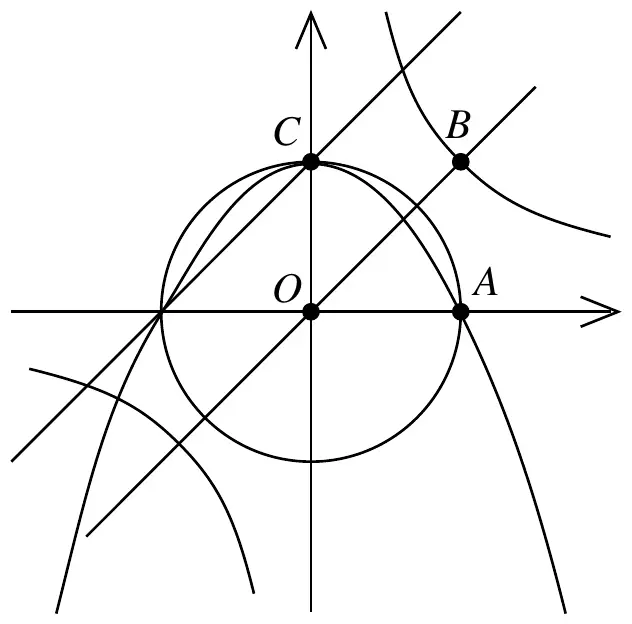
Let \(O = (0,0)\),\(A = (1,0)\),\(B = (1,1)\), \(C = (0,1)\) be the vertices of the square. The equation \(x^2 + y^2 = 1\) gives a circle passing through \(A\) and \(C\). The equation \(y = x + 1\) gives a straight line passing only through \(C\). The equation \(y = -x^2 + 1\) gives a parabola passing through \(A\) and \(C\). The equation \(y = x\) gives a straight line passing through \(O\) and \(B\). The equation \(y = \frac{1}{x}\) gives a rectangular hyperbola which has two branches and passes only through \(B\). So, only \(x^2 + y^2 = 1\), \(y = x\) and \(y = -x^2 + 1\) have graphs passing through exactly two of the vertices of the square.
11. In the grid below each of the blank squares and the square marked \(X\) are to be filled by the mean of the two numbers in its adjacent squares. Which number should go in the square marked \(X\)?
For each square to be filled with the mean of the numbers in the adjacent squares, the differences between all five pairs of adjacent numbers must be equal. This common difference is \(\left(\dfrac{25 - 10}{5}\right)\) which is 3. The grid is then
The expression \(\sqrt{2016} + \sqrt{56}\) can be written as \(\sqrt{2^5 \times 3^2 \times 7} + \sqrt{2^3 \times 7}\) which is \(\sqrt{4^2 \times 3^2 \times 2 \times 7} + \sqrt{2^2 \times 2 \times 7}\). This simplifies to \(12\sqrt{14} + 2\sqrt{14}\) which is \(14\sqrt{14}\) and, using index notation, this can be written as \(14^{3/2}\). Hence \(k = \tfrac{3}{2}\).
The expression \(2015^2 - 2016 \times 2014\) can be written as \(2015^2 - (2015 + 1)(2015 - 1)\) which simplifies, using the difference of two squares, to \(2015^2 - \left(2015^2 - 1\right) = 1\).
Rearranging \(6x = \dfrac{150}{x}\) gives \(x^2 = \dfrac{150}{6}\), so \(x^2 = 25\). This has two solutions, \(x = 5\) and \(x = -5\). Therefore the sum of the solutions is \(5 + (-5) = 0\).
The mean of 17, 23 and \(2n\) is given to be \(n\), so \(\dfrac{17 + 23 + 2n}{3} = n\) which gives \(40 + 2n = 3n\). As \(n\) is then 40, the sum of the digits of \(n\) is 4.
10. The positive integer \(n\) is between 1 and 20. Milly adds up all the integers from 1 to \(n\) inclusive. Billy adds up all the integers from \(n + 1\) to 20 inclusive. Their totals are the same. What is the value of \(n\)?
The total of the numbers from 1 to 20 is \(\tfrac{1}{2} \times 20 \times (20 + 1) = 210\). If Milly and Billy have totals which are equal, their totals must each be 105. Milly's total, of the numbers from 1 to \(n\), is \(\tfrac{1}{2}n(n + 1)\) so \(\tfrac{1}{2}n(n + 1) = 105\) which gives \(n^2 + n = 210\). Therefore \(n^2 + n - 210 = 0\) which factorises to give \((n + 15)(n - 14) = 0\). As \(n\) is a positive integer, \(n = 14\).
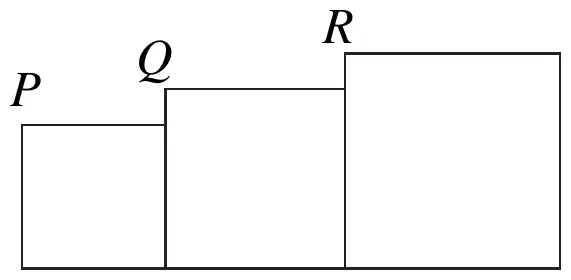
19. Three squares are arranged as shown so that their bases lie on a straight line. Also, the corners \(P\), \(Q\) and \(R\) lie on a straight line. The middle square has sides that are 8 cm longer than the sides of the smallest square. The largest square has sides of length 50 cm. There are two possible values for the length (in cm) of the sides of the smallest square. Which of the following are they?
Let the length of the side of the smallest square be \(x\) cm. So the three squares have sides of lengths \(x\) cm, \((x + 8)\) cm and 50 cm respectively. The gradient of \(PQ\) is then \(\tfrac{8}{x}\) and the gradient of \(PR\) is \(\dfrac{50 - x}{x + x + 8}\). As \(P\), \(Q\) and \(R\) lie on a straight line, \(\dfrac{8}{x} = \dfrac{50 - x}{2x + 8}\) so \(8(2x + 8) = x(50 - x)\). Expanding gives \(16x + 64 = 50x - x^2\) and therefore \(x^2 - 34x + 64 = 0\), giving \(x = 2\) or 32.
23. Given four different non-zero digits, it is possible to form 24 different four-digit numbers containing each of these four digits. What is the largest prime factor of the sum of the 24 numbers?
Let a four-digit positive integer be expressed as \(1000a + 100b + 10c + d\) where \(a\),\(b\), \(c\) and \(d\) are all different. In the 24 possible permutations of \(a\),\(b\), \(c\) and \(d\), each of the four letters appears in each position six times. Adding all 24 numbers together gives \(1000(6a + 6b + 6c + 6d) + 100(6a + 6b + 6c + 6d)\) \(+\, 10(6a + 6b + 6c + 6d) + 6a + 6b + 6c + 6d\). The total is therefore \(1111 \times 6(a + b + c + d)\) which factorises to \(2 \times 3 \times 11 \times 101(a + b + c + d)\). As \(a + b + c + d < 101\), the largest prime factor of the sum is 101.
25. A function, defined on the set of positive integers, is such that \(f(xy) = f(x) + f(y)\) for all \(x\) and \(y\). It is known that \(f(10) = 14\) and \(f(40) = 20\). What is the value of \(f(500)\)?
Repeatedly using the rule that \(f(xy) = f(x) + f(y)\) allows us to write \(f(500)\) as \(f(2 \times 2 \times 5 \times 5 \times 5) = f(2) + f(2) + f(5) + f(5) + f(5) = 2f(2) + 3f(5)\). We are given values for \(f(40)\) and \(f(10)\) and from them we need to calculate the values of \(f(2)\) and \(f(5)\). Now \(f(40)\) can be written as \(f(2) + f(2) + f(10)\) so \(20 = 2f(2) + 14\) and therefore \(f(2) = 3\). Similarly \(f(10) = f(2) + f(5)\) so \(14 = 3 + f(5)\) giving \(f(5) = 11\). So \(f(500) = 2f(2) + 3f(5) = 2 \times 3 + 3 \times 11 = 39\).
Working from right to left, the units column shows that \(S = 2\) or 7. If \(S = 2\), then \(I + I = 1\) or 11, neither of which is possible. Hence \(S = 7\) and it follows that \(I + I = 0\) or 10. However, as the digits are non-zero, \(I = 5\). The hundreds column then shows that \(H = 9\) and so \(T = 1\). This gives \(T + H + I + S = 1 + 9 + 5 + 7 = 22\).
Let the length of the rectangle be \(x\) cm and its width be \(y\) cm. The area is given as 120 cm2 so \(xy = 120\). The perimeter is 46 cm, so \(46 = 2x + 2y\) and therefore \(23 = x + y\). Using Pythagoras' Theorem, the length of the diagonal is \(\sqrt{x^2 + y^2}\). As \(x^2 + y^2 = (x + y)^2 - 2xy\),\(\sqrt{x^2 + y^2} = \sqrt{23^2 - 2 \times 120} = \sqrt{529 - 240} = \sqrt{289} = 17\). So the diagonal has length 17 cm.
12. Karen has three times the number of cherries that Lionel has, and twice the number of cherries that Michael has. Michael has seven more cherries than Lionel. How many cherries do Karen, Lionel and Michael have altogether?
Let Lionel have \(x\) cherries. Michael then has \((x + 7)\) cherries. Karen's number of cherries is described in two ways. She has \(3x\) cherries and also \(2(x + 7)\) cherries. So \(3x = 2x + 14\) and therefore \(x = 14\). Lionel has 14 cherries, Michael 21 cherries and Karen 42 cherries giving a total of \(14 + 21 + 42 = 77\) cherries.
22. A bag contains \(m\) blue and \(n\) yellow marbles. One marble is selected at random from the bag and its colour is noted. It is then returned to the bag along with \(k\) other marbles of the same colour. A second marble is now selected at random from the bag. What is the probability that the second marble is blue?
The probability that the second marble is blue equals P(2nd marble is blue given that the 1st marble is blue) + P(2nd marble is blue given that the 1st marble is yellow), which is
\(\dfrac{m}{m + n} \times \dfrac{m + k}{m + n + k} + \dfrac{n}{m + n} \times \dfrac{m}{m + n + k} = \dfrac{m^2 + mk + mn}{(m + n)(m + n + k)} = \dfrac{m(m + k + n)}{(m + n)(m + n + k)} = \dfrac{m}{m + n}.\)
If the graphs of \(y = 2x\), \(y = 2^x\) and \(y = x^2\) are sketched on the same axes it can be seen that case (i) holds for \(2 < x < 4\), case (ii) holds for \(0 < x < 1\), case (iv) holds for \(1 < x < 2\) and case (vi) holds for \(x > 4\). There are no real solutions for case (iii). Consider \(x^2 < 2x\), which is true for \(0 < x < 2\). However for \(0 < x < 2\) it can be seen that \(2^x > x^2\) rather than \(2^x < x^2\) as stated. There are no real solutions for case (v). Consider \(2x < x^2\), which is true for \(x < 0\) or \(x > 2\). However, when \(x < 0\) we have \(2^x > 2x\) as \(2^x\) is positive and \(2x\) is negative, rather than \(2^x < 2x\) as stated. Also, when \(x = 2\) we have \(2^x = 2x\), but for \(x > 2\), \(2^x > 2x\) rather than \(2^x < 2x\) as stated.
6. Rebecca went swimming yesterday. After a while she had covered one fifth of her intended distance. After swimming six more lengths of the pool, she had covered one quarter of her intended distance. How many lengths of the pool did she intend to complete?
Let \(d\) be the number of lengths that Rebecca intended to swim. Then \(6 = \dfrac{d}{4} - \dfrac{d}{5} = \dfrac{d}{20}\) and therefore \(d = 6 \times 20 = 120\).
A prime number has exactly two factors, one of which is 1. The expression \(4^n - 1\) can be factorised as \(4^n - 1 = (2^n + 1)(2^n - 1)\). For \(4^n - 1\) to be prime, the smaller of the factors, \(2^n - 1\), must equal 1. If \(2^n - 1 = 1\) then \(2^n = 2\) giving \(n = 1\). So there is exactly one value of \(n\) for which \(4^n - 1\) is prime and this value is 1.
Let the two positive numbers be \(x\) and \(y\) with \(x > y\). The sum of the numbers is greater than their difference, so the two ratios which are equal are \(x : y\) and \(x + y : x - y\). Therefore \(\dfrac{x}{y} = \dfrac{x + y}{x - y}\). By dividing the top and bottom of the right-hand side by \(y\) we obtain \(\dfrac{x}{y} = \dfrac{\frac{x}{y} + 1}{\frac{x}{y} - 1}\). Letting \(k = \tfrac{x}{y}\) gives \(k = \tfrac{k + 1}{k - 1}\) which gives the quadratic \(k^2 - 2k - 1 = 0\). Completing the square gives \((k - 1)^2 = 2\) whence \(k = 1 \pm \sqrt{2}\). However, as \(x\) and \(y\) are both positive, \(k \neq 1 - \sqrt{2}\). As the ratio \(\tfrac{x}{y} = 1 + \sqrt{2}\), the ratio \(x : y\) is \(1 + \sqrt{2} : 1\).
Add the first and third equations: \(2x = 4\), so \(x = 2\). Add the first two equations: \(2x + 2y = 3\), so \(y = -\tfrac{1}{2}\). Substitute for \(x\) and \(y\) in the first equation: \(2 + \left(-\tfrac{1}{2}\right) + z = 1\) so \(z = -\tfrac{1}{2}\). Therefore \(xyz = 2 \times \left(-\tfrac{1}{2}\right) \times \left(-\tfrac{1}{2}\right) = \tfrac{1}{2}\).
15. Professor Rosseforp runs to work every day. On Thursday he ran 10% faster than his usual average speed. As a result, his journey time was reduced by \(x\) minutes. How many minutes did the journey take on Wednesday?
Let Professor Rosseforp's usual journey take \(t\) minutes at an average speed of \(v\) metres/minute. Then the distance to work is \(vt\) metres. On Thursday his speed increased by 10%, i.e. it was \(11v/10\) metres/minute. The time taken was \((t - x)\) minutes. Therefore \(11v/10 \times (t - x) = vt\). So \(11(t - x) = 10t\), i.e. \(t = 11x\).
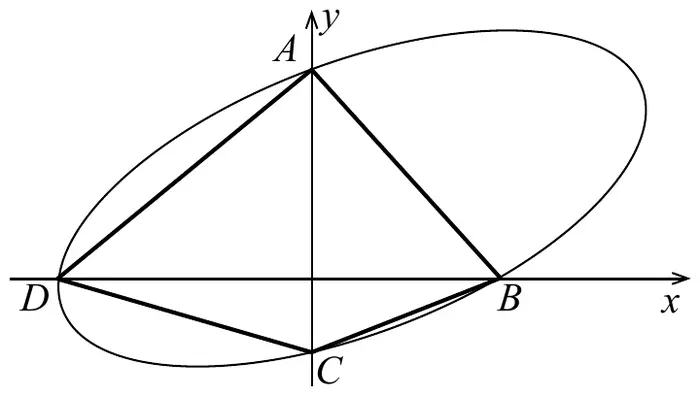
16. The diagram shows the ellipse whose equation is \(x^2 + y^2 - xy + x - 4y = 12\). The curve cuts the \(y\)-axis at points \(A\) and \(C\) and cuts the \(x\)-axis at points \(B\) and \(D\). What is the area of the inscribed quadrilateral \(ABCD\)?
At points \(A\) and \(C\),\(x = 0\). So \(y^2 - 4y = 12\), i.e. \((y - 6)(y + 2) = 0\), i.e. \(y = 6\) or \(y = -2\). So \(C\) is \((0, -2)\) and \(A\) is \((0, 6)\). At points \(B\) and \(D\),\(y = 0\). So \(x^2 + x = 12\), i.e. \((x - 3)(x + 4) = 0\), i.e. \(x = 3\) or \(x = -4\). So \(D\) is \((-4, 0)\) and \(B\) is \((3, 0)\). Therefore the areas of triangles \(DAB\) and \(DBC\) are \(\tfrac{1}{2} \times 7 \times 6 = 21\) and \(\tfrac{1}{2} \times 7 \times 2 = 7\). So \(ABCD\) has area 28. {It is left to the reader to prove that area\(ABCD = \tfrac{1}{2}BD \times AC\).}
\((x + y\sqrt{2})^2 = x^2 + 2xy\sqrt{2} + 2y^2\). Note that all of the alternatives given are of the form \(a + 12\sqrt{2}\) so we need \(xy = 6\). The only ordered pairs \((x, y)\) of positive integers which satisfy this are (1, 6), (2, 3), (3, 2), (6, 1). For these, the values of \(x^2 + 2y^2\) are 73, 22, 17, 38 respectively. So the required number is \(54 + 12\sqrt{2}\).
3. The robot Lumber9 moves along the number line. Lumber9 starts at 0, takes 1 step forward (to 1), then 2 steps backward (to −1), then 3 steps forward, 4 steps backward, and so on, moving alternately forwards and backwards, one more step each time. At what number is Lumber9 after 2011 steps?
After the \(n\) th step, Lumber9 is at number: \(\begin{cases} \frac{n+1}{2} & \text{for } n \text{ odd,} \\ \frac{-n}{2} & \text{for } n \text{ even.} \end{cases}\) Hence when \(n = 2011\),Lumber9 is at number \(\tfrac{2011 + 1}{2} = 1006\).
6. Granny and her granddaughter Gill both had their birthday yesterday. Today, Granny's age in years is an even number and 15 times that of Gill. In 4 years' time Granny's age in years will be the square of Gill's age in years. How many years older than Gill is Granny today?
If \(a\), \(b\) are roots of \(x^2 + ax + b = 0\) then \(x^2 + ax + b = 0\) must be \((x - a)(x - b) = 0\). As \((x - a)(x - b) = x^2 + (-a - b)x + ab\) then \(a = -a - b\) and \(b = ab\). If \(b = 0\) we see immediately that \(a = 0\). But this is not possible as \(a\) and \(b\) are different. If \(b \neq 0\) then \(a = 1\) and \(b = -2\). So there is just one solution pair.
20. Positive integers \(x\) and \(y\) satisfy the equation \(\sqrt{x} - \sqrt{11} = \sqrt{y}\). What is the maximum possible value of \(\dfrac{x}{y}\) ?
Squaring the equation \(\sqrt{x} - \sqrt{11} = \sqrt{y}\) gives \(x - 2\sqrt{11x} + 11 = y \ldots (1)\). You see here that \(2\sqrt{11x}\) is an integer. Thus \(x = 11a^2\) for some integer \(a\). Hence in (1), \(y = 11a^2 - 22a + 11 = 11(a^2 - 2a + 1)\). Thus \(\dfrac{x}{y} = \left(\dfrac{a}{a - 1}\right)^2\) whose maximum value, for integer \(a\), is easily seen to be \(\left(\tfrac{2}{1}\right)^2 = 4\).
9. The symbol \(\Diamond\) is defined by \(x \mathbin{\Diamond} y = x^y - y^x\). What is the value of \((2 \mathbin{\Diamond} 3) \mathbin{\Diamond} 4\)?
Let the original square have sides of length \(y\) cm and the single square which is not \(1 \times 1\) have sides of length \(x\) cm. Then \(y^2 = 36 + x^2\), and so \(y^2 - x^2 = 36\) and hence \((y + x)(y - x) = 36\). As \(36 = 2^2 \times 3^2\) and \(y + x > y - x\) the possible factors of 36 are:
\(y + x\)
\(y - x\)
\(y\)
\(x\)
9
4
\(6\tfrac{1}{2}\)
\(2\tfrac{1}{2}\)
impossible
12
3
\(7\tfrac{1}{2}\)
\(4\tfrac{1}{2}\)
impossible
18
2
10
8
possible
36
1
\(18\tfrac{1}{2}\)
\(17\tfrac{1}{2}\)
impossible
We can check that \(10^2 = 36 + 8^2 = 100\) and hence the length of the side of the original square is 10 cm.
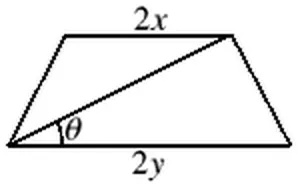
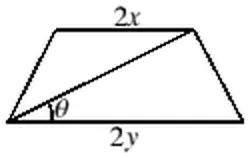
14. The parallel sides of a trapezium have lengths \(2x\) and \(2y\) respectively. The diagonals are equal in length, and a diagonal makes an angle \(\theta\) with the parallel sides, as shown. What is the length of each diagonal?
Drop perpendiculars from the top vertices to the bottom line. The distance from the foot to the nearer base vertex is \(\tfrac{1}{2}(2y - 2x) = y - x\). So the distance to the further base vertex is \(2y - (y - x) = y + x\). Hence \(\cos\theta = \dfrac{x + y}{d}\) where \(d\) is the length of the diagonal.
20. There are 10 girls in a mixed class. If two pupils from the class are selected at random to represent the class on the School Council, then the probability that both are girls is 0.15. How many boys are in the class?
Let the number of boys in the class be \(x\). Hence \(\dfrac{10}{10 + x} \times \dfrac{9}{9 + x} = \dfrac{3}{20}\). Simplifying gives \(1800 = 3(10 + x)(9 + x)\) and then \(x^2 + 19x - 510 = 0\). Factorising gives \((x + 34)(x - 15) = 0\) and, since \(x \neq -34\),\(x = 15\).
Let \(\dfrac{n}{100 - n} = x\) where \(x\) is an integer. Hence \(n = 100x - nx\). Hence \(n\,(1 + x) = 100x\) giving \(n = \dfrac{100x}{1 + x}\). Now \(x\) and \(1 + x\) can have no common factors. Therefore \(1 + x\) must be a factor of 100 and can be any of them. Hence \(1 + x \in \{\pm 1, \pm 2, \pm 4, \pm 5, \pm 10, \pm 20, \pm 25, \pm 50, \pm 100\}\) thus the number of possible integers \(n\) is 18.
We have \(y^2 = x\,(2 - x)\). Now \(y^2 \geqslant 0\) for all real \(y\) hence \(x\,(2 - x) \geqslant 0\). Hence \(0 \leqslant x \leqslant 2\). In fact we can rewrite the equation as \((x - 1)^2 + y^2 = 1\); so this is a circle of radius 1 with centre (1,0).
19. Hamish and his friend Ben live in villages which are 51 miles apart. During the summer holidays, they agreed to cycle towards each other along the same main road. Starting at noon, Hamish cycled at \(x\) mph. Starting at 2 pm, Ben cycled at \(y\) mph. They met at 4 pm. If they had both started at noon, they would have met at 2.50 pm. What is the value of \(y\)?
The distance cycled by Hamish between noon and 4 pm is \(4x\). The distance cycled by Ben between 2 pm and 4 pm is \(2y\). They meet at 4 pm hence \(4x + 2y = 51\) or \(2x + 2\,(x + y) = 51\) (*). If they had both started at noon then they would have met at 2:50 pm and so \(2\tfrac{5}{6}(x + y) = 51\). Hence \(x + y = 51 \times \dfrac{6}{17} = 18\). Hence from (*) \(2x + 2 \times 18 = 51\). Hence \(2x = 15\) giving \(x = 7\tfrac{1}{2}\). Thus \(y = 10\tfrac{1}{2}\).
25. Four positive integers \(a\),\(b\), \(c\) and \(d\) are such that \[abcd + abc + bcd + cda + dab + ab + bc + cd + da + ac + bd + a + b + c + d = 2009.\] What is the value of \(a + b + c + d\)?
The left-hand side of the equation can be written as \[(a + 1)(b + 1)(c + 1)(d + 1) - 1.\] Hence \[(a + 1)(b + 1)(c + 1)(d + 1) = 2010.\] Now expressing 2010 as a product of primes gives 2010 = 2 × 3 × 5 × 67 hence \(a + b + c + d = 1 + 2 + 4 + 66 = 73\).
From the units column we see that \(S = 0\). Then the tens column shows that \(R = 9\), the hundreds column that \(Q = 1\), and the thousands that \(P = 6\). So \(P + Q + R + S = 16\).
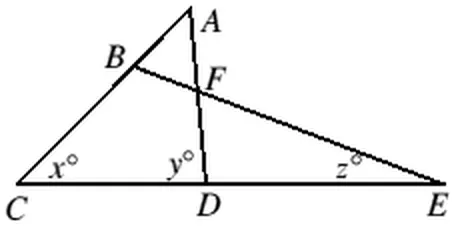
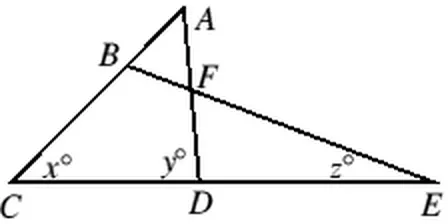
8. In the figure shown, \(AB = AF\) and \(ABC\),\(AFD\), \(BFE\) and \(CDE\) are all straight lines. Which of the following expressions gives \(z\) in terms of \(x\) and \(y\)?
15. A sequence of positive integers \(t_1, t_2, t_3, t_4, \ldots\) is defined by: \(t_1 = 13\); \(t_{n+1} = \tfrac{1}{2}t_n\) if \(t_n\) is even; \(t_{n+1} = 3t_n + 1\) if \(t_n\) is odd. What is the value of \(t_{2008}\)?
The sequence proceeds as follows: 13, 40, 20, 10, 5, 16, 8, 4, 2, 1, 4, 2, 1 … . The block 4, 2, 1 repeats ad infinitum starting after \(t_7\). But 2008 − 7 = 2001 and 2001 = 3 × 667. Hence \(t_{2008}\) is the third term in the 667th such block and is therefore 1.
16. The numbers \(x\), \(y\) and \(z\) satisfy the equations \[x + y + 2z = 850, \qquad x + 2y + z = 950, \qquad 2x + y + z = 1200.\] What is their mean?
17. Andy and his younger cousin Alice both have their birthdays today. Remarkably, Andy is now the same age as the sum of the digits of the year of his birth and the same is true of Alice. How many years older than Alice is Andy?
Let ‘\(X\)’ be a single digit. If \(2008 - 200X = 2 + 0 + 0 + X\) then \(8 - X = 2 + X\) so \(X = 3\). So Alice (being the younger) could have been born in 2003. Next if \(2008 - 199X = 1 + 9 + 9 + X\) then \(18 - X = 19 + X\), which is impossible. Similarly if \(2008 - 198X = 1 + 9 + 8 + X\) then \(28 - X = 18 + X\), so \(X = 5\). Thus Alice or Andy could have been born in 1985. Finally if \(2008 - 19YX = 1 + 9 + X + Y\) for some digit \(Y \leqslant 7\), then \(108 - YX = 10 + Y + X\). Hence \(98 = YX + Y + X\) which is impossible, since \(YX + Y + X\) is at most \(79 + 7 + 9 = 95\). Hence there are no more possible dates and so Andy was born in 1985 and Alice in 2003.
21. The fraction \(\dfrac{2008}{1998}\) may be written in the form \(a + \cfrac{1}{b + \cfrac{1}{c + \cfrac{1}{d}}}\) where \(a\),\(b\), \(c\) and \(d\) are positive integers. What is the value of \(d\)?
Since 2008/1998 lies between 1 and 2, \(a = 1\). Subtracting 1 and inverting gives \(b + 1/(c + 1/d) = 1998/10 = 199 + 4/5\) so that \(b = 199\). Then \(1/(c + 1/d) = 4/5\) so that \(c + 1\,/\,d = 5/4\) and this gives \(c = 1\) and \(d = 4\). {Note : This is an example of a continued fraction.}
Let \(X = x + 3\) and \(Y = y - 3\). Then the given equation becomes \((X + Y)^2 = XY\). So \(X^2 + XY + Y^2 = 0\). However \(X^2\), \(Y^2\) and \(XY\) (\(= (X + Y)^2\)) are non-negative. Hence \(X = Y = 0\); so \(x = -3\) and \(y = 3\) is the only solution.
24. The length of the hypotenuse of a particular right-angled triangle is given by \(\sqrt{1 + 3 + 5 + 7 + \;\ldots\; + 25}\). The lengths of the other two sides are given by \(\sqrt{1 + 3 + 5 + \;\ldots\; + x}\) and \(\sqrt{1 + 3 + 5 + \;\ldots\; + y}\) where \(x\) and \(y\) are positive integers. What is the value of \(x + y\)?
\(1 + 3 + 5 + 7 + \;\ldots\; + (2n + 1) = (n + 1)^2\). The \(n\) in the three cases given is 12, \(\tfrac{1}{2}(x - 1)\) and \(\tfrac{1}{2}(y - 1)\). So, the triangle has sides of length 12 + 1, \(\tfrac{1}{2}(x - 1) + 1\) and \(\tfrac{1}{2}(y - 1) + 1\). However the only right-angled triangle having sides of whole number length with hypotenuse 13 is the (5, 12, 13) triangle. So \(x = 9\) and \(y = 23\) (or vice versa). Hence \(x + y = 32\).
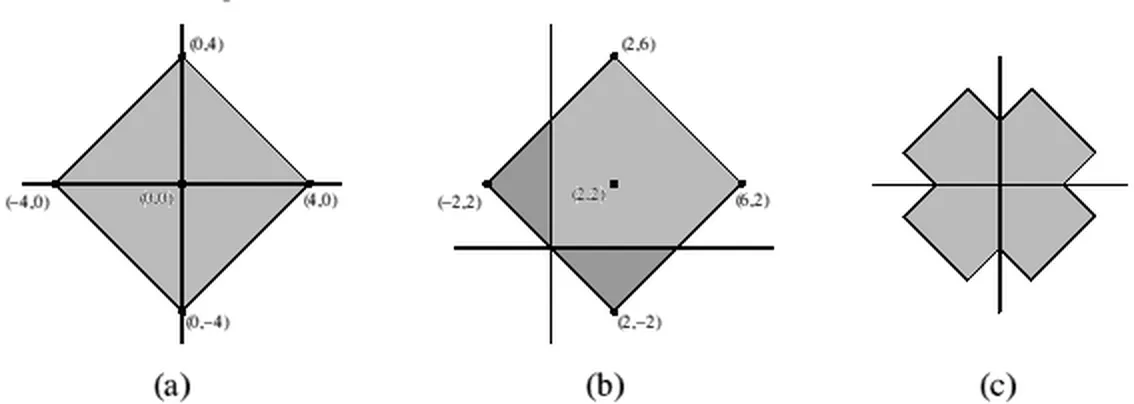
25. What is the area of the polygon formed by all points \((x,\ y)\) in the plane satisfying the inequality \(\big|\,|x| - 2\big| + \big|\,|y| - 2\big| \leqslant 4\) ?
To work out the area of \(\big||x| - 2\big| + \big||y| - 2\big| \leqslant 4\), we first consider the region \(|x| + |y| \leqslant 4\) which is shown in (a). This region is then translated to give \(|x - 2| + |y - 2| \leqslant 4\) as shown in (b). By properties of the modulus, if the point \((x,\ y)\) lies in the polygon, then so do \((x,\ -y)\), \((-x,\ y)\) and \((-x,\ -y)\). Thus \(\big||x| - 2\big| + \big||y| - 2\big| \leqslant 4\) can be obtained from (b) by reflecting in the axes and the origin, as shown in (c).
Hence the required area is 4 times the area in the first quadrant. From (b), the required area in the first quadrant is the area of a square of side \(4\sqrt{2}\) minus two triangles (cut off by the axes) which, combined, make up a square of side \(2\sqrt{2}\). So the area in the first quadrant is \((4\sqrt{2})^2 - (2\sqrt{2})^2 = 32 - 8 = 24\). Hence the area of the polygon is 4 × 24 = 96 square units.
6. Cheryl finds a bag of coins. There are 50 coins inside and the value of the contents is £1.81. Given that it contains only two-pence and five-pence coins, how many more five-pence coins are there inside the bag than two-pence coins?
Let the number of five-pence coins be \(x\). Then \(5x + 2(50 - x) = 181\), that is \(3x = 81\), that is \(x = 27\). So there are 27 five-pence coins and 23 two-pence coins.
Let \(N\) be the two-digit number ‘\(ab\)’, that is \(N = 10a + b\). So the sum of \(N\) and its ‘reverse’ is \(10a + b + 10b + a = 11a + 11b = 11\,(a + b)\). As 11 is prime and \(a\) and \(b\) are both single digits, \(11\,(a + b)\) is a square if, and only if, \(a + b = 11\). So the possible values of \(N\) are 29, 38, 47, 56, 65, 74, 83, 92.
23. The sum of the lengths of the 12 edges of a cuboid is \(x\) cm. The distance from one corner of the cuboid to the furthest corner is \(y\) cm. What, in cm2, is the total surface area of the cuboid?
Let the lengths of the sides of the cuboid, in cm, be \(a\), \(b\) and \(c\). So \(4\,(a + b + c) = x\). Also, by Pythagoras' Theorem \(a^2 + b^2 + c^2 = y^2\). Now the total surface area of the cuboid is \[2ab + 2bc + 2ca = (a + b + c)^2 - (a^2 + b^2 + c^2) = \left(\frac{x}{4}\right)^2 - y^2 = \frac{x^2 - 16y^2}{16}.\]
25. The line with equation \(y = x\) is an axis of symmetry of the curve with equation \(y = \dfrac{px + q}{rx + s}\), where \(p\),\(q\),\(r\), \(s\) are all non-zero. Which of the following is necessarily true?
As the line \(y = x\) is an axis of symmetry of the curve, if the point \((a,\ b)\) lies on the curve, so too does the point \((b,\ a)\). Hence the equation of the curve may also be written as \(x = \dfrac{py + q}{ry + s}\). Therefore, substituting for \(x\) in the original equation: \[y = \frac{p\left(\dfrac{py + q}{ry + s}\right) + q}{r\left(\dfrac{py + q}{ry + s}\right) + s} = \frac{p\,(py + q) + q\,(ry + s)}{r\,(py + q) + s\,(ry + s)}.\] Therefore \(\qquad y\,(r\,(py + q) + s\,(ry + s)) = p\,(py + q) + q\,(ry + s)\), that is \(y^2r\,(p + s) + y\left(qr + s^2 - p^2 - qr\right) - pq - qs = 0\), that is \(\qquad (p + s)\left(y^2r + y\,(s - p) - q\right) = 0\). Since \(r\) is non-zero, the expression in the second bracket is non-zero for all but at most two values of \(y\). Hence \(p + s = 0\).
Subtracting the second equation from the first: \(6x - y - (6y - x) = 21 - 14\). So \(7x - 7y = 7\), that is \(x - y = 1\). (The equations may be solved to give \(x = 4\),\(y = 3\), but it is not necessary to do this in order to find the value of \(x - y\).)
11. Three consecutive even numbers are such that the sum of four times the smallest and twice the largest exceeds three times the second by 2006. What is the sum of the digits of the smallest number?
Let the smallest of the three even numbers be \(n\). Then the other two numbers are \(n + 2\) and \(n + 4\). So \(4n + 2(n + 4) = 3(n + 2) + 2006\), that is \(6n + 8 = 3n + 2012\), that is \(n = 668\).
14. Heather and Rachel each has some pennies. Heather has more than Rachel. In fact, the number of pennies that Heather has is the square of the number that Rachel has. The total number of pennies they have between them makes a whole number of pounds. What is the smallest this total could be?
Let Rachel and Heather have \(x\) and \(x^2\) pennies respectively. So \(x + x^2 = 100n\), where \(x\) and \(n\) are positive integers. We require, therefore, that \(x(x + 1) = 100n = 2^2 \times 5^2 \times n\). Now \(x\) and \(x + 1\) cannot both be multiples of 5, so their product will be a multiple of 25 if and only if \(x\) or \(x + 1\) is a multiple of 25. The smallest value of \(x\) which satisfies this condition is 24 which is a multiple of 4 so 24 × 25 is a multiple of 100. Therefore Rachel has 24 pennies, Heather has 576 pennies and, in total, they have £6.
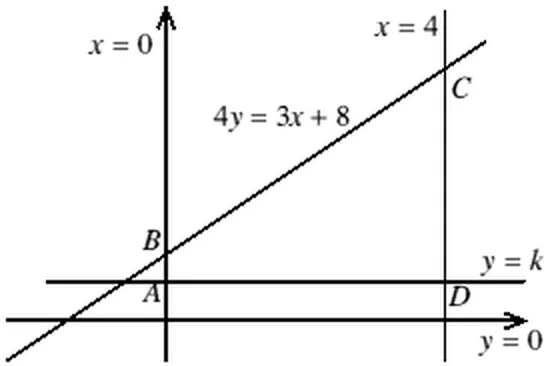
17. A trapezium is bounded by four lines, the equations of which are \(x = 0\),\(x = 4\), \(4y = 3x + 8\) and \(y = k\), where \(k < 2\). For which value of \(k\) is the numerical value of the perimeter of the trapezium equal to the numerical value of the area of the trapezium?
The trapezium in question is shown as \(ABCD\) in the diagram. The coordinates of its vertices are \(A(0,\ k)\),\(B(0,\ 2)\),\(C(4,\ 5)\),\(D(4,\ k)\). Using Pythagoras' Theorem: \(BC = \sqrt{4^2 + 3^2} = 5\). The perimeter of \(ABCD = (2 - k) + 5 + (5 - k) + 4\) \(= 16 - 2k\). The area of \(ABCD = 4(2 - k) + \tfrac{1}{2} \times 4 \times 3\) \(= 14 - 4k\). So \(16 - 2k = 14 - 4k\), that is \(k = -1\). (In the diagram it was assumed that \(k > 0\), although it transpires that \(k < 0\). However, this does not affect the validity of the solution.)
18. What is the greatest number of the following five statements about numbers \(a\), \(b\) which can be true at the same time? \[\tfrac{1}{a} < \tfrac{1}{b} \qquad\qquad a^2 > b^2 \qquad\qquad a < b \qquad\qquad a < 0 \qquad\qquad b < 0\]
It is not possible for all five statements to be true at the same time since if \(a < b\),\(a < 0\), \(b < 0\) are all true then \(\tfrac{1}{a} < \tfrac{1}{b}\) is not true since \(\tfrac{1}{b} - \tfrac{1}{a} = \tfrac{a - b}{ab}\) which is negative. However, when these three statements are true, \(a^2 > b^2\) is also true, so it is possible for four of the statements to be true at the same time.
19. An engineer is directed to a faulty signal, one quarter of the way into a tunnel. Whilst there, he is warned of a train heading towards the tunnel entrance. The engineer can run at 12 mph and can either run back to the tunnel entrance or forward to the exit. In either case, the engineer and the front of the train would reach the entrance or exit together. What is the speed in mph of the train?
Let the length of the tunnel and the distance from the front of the train to the entrance of the tunnel when the engineer receives the warning be \(l\) and \(x\) respectively. If the engineer runs to the exit of the tunnel, he will take three times as long as he would if he ran to the entrance. So the train takes three times as long to travel a distance \(x + l\) as it does to travel a distance \(x\). Hence \(l = 2x\). The train, therefore, travels a distance \(x\) in the same time that the engineer would take to travel \(\tfrac{1}{2}l\), that is to travel \(\tfrac{1}{2}x\). So the speed of the train is twice that of the engineer.
20. A positive number \(a = [a] + \{a\}\) where \([a]\) is the integer part of \(a\) and \(\{a\}\) is the fractional part of \(a\). Given that \(x + [y] + \{z\} = 4.2\),\(y + [z] + \{x\} = 3.6\),\(z + [x] + \{y\} = 2.0\), and \(x\),\(y\),\(z > 0\), what is the value of \(\{y\}\) ?
Adding all three equations: \(x + [y] + \{z\} + y + [z] + \{x\} + z + [x] + \{y\} = 4.2 + 3.6 + 2.0 = 9.8\). Now \([x] + \{x\} = x\),\([y] + \{y\} = y\),\([z] + \{z\} = z\), so \(2x + 2y + 2z = 9.8\), that is \(x + y + z = 4.9\). Therefore: \(x + y + z - (x + [y] + \{z\}) = 4.9 - 4.2\), that is \(\{y\} + [z] = 0.7\). So \([z] = 0\),\(\{y\} = 0.7\). (It is not necessary to find the values of \(x\),\(y\), \(z\) to solve this problem, but their values may be shown to be 1.9, 2.7, 0.3 respectively.)
The terms on the left-hand side of the equation form an arithmetic progression which has \(n^3 - 5\) terms. So the sum of these terms is \(\dfrac{n^3 - 5}{2}\left(\dfrac{3}{n^3} + \dfrac{n^3 - 3}{n^3}\right) = \dfrac{n^3 - 5}{2}\). Hence \(n^3 - 5 = 120\), so \(n = 5\).
25. \(X\) is a positive integer in which each digit is 1; that is, \(X\) is of the form 11111… . Given that every digit of the integer \(pX^2 + qX + r\) (where \(p\), \(q\) and \(r\) are fixed integer coefficients and \(p > 0\)) is also 1, irrespective of the number of digits \(X\), which of the following is a possible value of \(q\)?
Let \(X\) consist of \(x\) digits, each of which is 1. So \(X = \tfrac{10^x - 1}{9}\). Let \(pX^2 + qX + r\) consist of \(y\) digits, each of which is 1. So \(pX^2 + qX + r = \tfrac{10^y - 1}{9}\). Then \(p\left(\tfrac{10^x - 1}{9}\right)^2 + q\left(\tfrac{10^x - 1}{9}\right) + r = \tfrac{10^y - 1}{9}\), that is \(p(10^{2x} - 2 \times 10^x + 1) + 9q(10^x - 1) + 81r = 9(10^y - 1)\), that is (on dividing throughout by \(10^{2x}\)) \(p + (9q - 2p)10^{-x} + (p - 9q + 81r)10^{-2x} = 9 \times 10^{y - 2x} - 9 \times 10^{-2x}\). We now let \(x\) tend to infinity (through integer values). The LHS of the above equation tends to \(p\), and the second term on the right goes to 0. By continuity of the function \(f(u) = 10^u = e^{u \log 10}\), we can deduce that \(y - 2x\) must tend to a limit. Let this limit be \(L\). Since \(y - 2x\) is always an integer, it must actually equal \(L\) for all \(x\) sufficiently large. Passing to the limit, therefore, we obtain \(p = 9 \times 10^L\). Since \(p\) is to be an integer, we must have that \(L\) (also an integer) is a non-negative integer. Substituting for \(p\) in the previous equation and simplifying leads to \[9q - 18 \times 10^L + (9 \times 10^L - 9q + 81r)10^{-x} = -9 \times 10^{-x}.\] Passing to the limit again leads to \(q = 2 \times 10^L\) and the previous line then also gives \(9 \times 10^L - 18 \times 10^L + 81r = -9\). So \(r = \tfrac{10^L - 1}{9}\). Possible values of \((p,\ q,\ r)\) therefore are (9, 2, 0), (90, 20, 1), (900, 200, 11), etc. So of the values given in the question for \(q\), only \(q = 2\) is possible. (Observe that the three triples above correspond to \(L = 0\),\(L = 1\), \(L = 2\) respectively and we note that increasing L by 1 corresponds to multiplying \(pX^2 + qX + r\) by 10 and adding 1. As \(pX^2 + qX + r\) consists only of 1s, \(10\,(pX^2 + qX + r) + 1\) will also consist only of 1s, explaining why there is an infinite family of quadratics which satisfy the required condition.)
Let the five consecutive positive integers be \(x - 2, x - 1, x, x + 1, x + 2\). Their sum is \(5x\), so \(5x = 2005\), that is \(x = 401\). The five numbers are 399, 400, 401, 402, 403.
The sequences have common differences of 7 and 9 respectively. The lowest common multiple of 7 and 9 is 63, so the next term after 2005 to appear in both sequences is 2005 + 63, that is 2068.
9. What is the value of the expression: \(\left(1 + \tfrac{1}{2}\right)\left(1 + \tfrac{1}{3}\right)\left(1 + \tfrac{1}{4}\right)\ldots\left(1 + \tfrac{1}{2004}\right)\left(1 + \tfrac{1}{2005}\right)\) ?
10. Sam and Pat were counting their money. They discovered that if Sam gave Pat £5, then Pat would have 5 times as much as Sam, but if Pat gave Sam £5, then Sam would have 5 times as much as Pat. How much did they have altogether?
Let Sam and Pat have £\(x\) and £\(y\) respectively. Then \(y + 5 = 5(x - 5)\), that is \(y = 5x - 30\). Also, \(x + 5 = 5(y - 5)\), that is \(x = 5y - 30\). Solving these simultaneous equations gives \(x = 7.5\) and \(y = 7.5\) so the friends have £15 altogether. (Note: from the information given, we may deduce that Sam and Pat have the same amount of money and this leads to a shorter method: \(x + 5 = 5(x - 5)\), that is \(x = 5x - 30\), that is \(x = 7.5\).)
When \(x \geqslant 0\),\(|x| = x\), so \(x|x| = x^2\); when \(x < 0\),\(|x| = -x\), so \(x|x| = -x^2\). Only graph A has the same shape as the graph of \(y = x^2\) for \(x \geqslant 0\) and the same shape as the graph of \(y = -x^2\) for \(x < 0\).
Note that \(n^2 - 1\) is divisible by \(n - 1\). Thus: \[\frac{n^2 - 9}{n - 1} = \frac{n^2 - 1}{n - 1} - \frac{8}{n - 1} = n + 1 - \frac{8}{n - 1} \qquad (n \neq 1).\] So, if \(n\) is an integer, then \(\dfrac{n^2 - 9}{n - 1}\) is an integer if and only if \(n - 1\) divides exactly into 8. The possible values of \(n - 1\) are −8, −4, −2, −1, 1, 2, 4, 8, so \(n\) is −7, −3, −1, 0, 2, 3, 5, 9. The sum of these values is 8. (Note that the sum of the 8 values of \(n - 1\) is clearly 0, so the sum of the 8 values of \(n\) is 8.)
22. Given that \(S = (x + 20) + (x + 21) + (x + 22) + \ldots + (x + 100)\), where \(x\) is a positive integer, what is the smallest value of \(x\) such that \(S\) is a perfect square?
There are 81 terms in the series, so, using the formula \(S = \tfrac{1}{2}n(a + l)\) for an arithmetic series: \[S = \frac{81}{2}(x + 20 + x + 100) = 81\,(x + 60)\,.\] Now 81 is a perfect square, so \(S\) is a perfect square if and only if \(x + 60\) is a perfect square. As \(x\) is a positive integer, the smallest possible value of \(x\) is 4.
We'd like to use Google Analytics cookies to count visits and see which pages help most. They're optional, and the site works exactly the same either way. Privacy policy