
SMC 2010 Q18
18. A solid cube of side 2 cm is cut into two triangular prisms by a plane passing through four vertices, as shown. What is the total surface area of these two prisms?
- A \(8(3 + \sqrt{2})\)
- B \(2(8 + \sqrt{2})\)
- C \(8(3 + 2\sqrt{2})\)
- D \(16(3 + \sqrt{2})\)
- E \(8\sqrt{2}\)
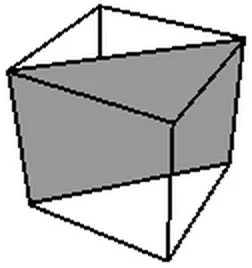
Senior Mathematical Challenge 2010, Question 18. © UK Mathematics Trust. Original paper on ukmt.org.uk
Answer: A \(8(3 + \sqrt{2})\)
Let \(x\) be the length of the shaded rectangle.
By Pythagoras' Theorem, \(x^2 = 2^2 + 2^2\), hence \(x = 2\sqrt{2}\).
The total surface area of the two prisms equals the surface area of the solid cube plus twice the surface area of that shaded rectangle, that is \(6 \times 2 \times 2 + 2 \times 2 \times 2\sqrt{2} = 24 + 8\sqrt{2} = 8(3 + \sqrt{2})\).
Solution © UK Mathematics Trust, from the SMC 2010 solutions. Longer versions with investigations: Solutions and investigations (PDF).