
SMC 2008 Q11
11. The distance between two neighbouring dots in the dot lattice is 1 unit. What, in square units, is the area of the region where the two rectangles overlap?
- A 6
- B \(6\tfrac{1}{4}\)
- C \(6\tfrac{1}{2}\)
- D 7
- E \(7\tfrac{1}{2}\)
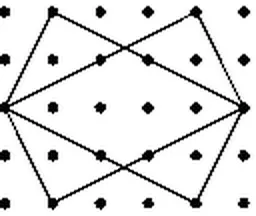
Senior Mathematical Challenge 2008, Question 11. © UK Mathematics Trust. Original paper on ukmt.org.uk
Answer: B \(6\tfrac{1}{4}\)
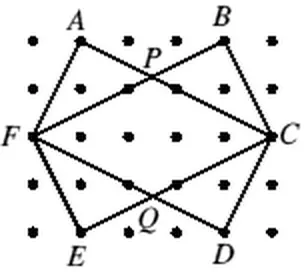
Let the six points where lines meet on the dot lattice be \(A\), \(B\), \(C\), \(D\), \(E\), \(F\) as shown and let the other two points of intersection be \(P\) ( where \(AC\) and \(BF\) meet ) and \(Q\) ( where \(CE\) and \(DF\) meet ).
Triangles \(APB\) and \(CPF\) are similar with base lengths in the ratio 3:5. Hence triangle \(CPF\) has height \(\tfrac{5}{8} \times 2 = \tfrac{5}{4}\) units and base length 5 units so that its area is \(\tfrac{1}{2} \times \tfrac{5}{4} \times 5\) square units. Since the same is true of triangle \(CQF\), the required area is \(\tfrac{5}{4} \times 5 = 6\tfrac{1}{4}\) square units.
Solution © UK Mathematics Trust, from the SMC 2008 solutions.