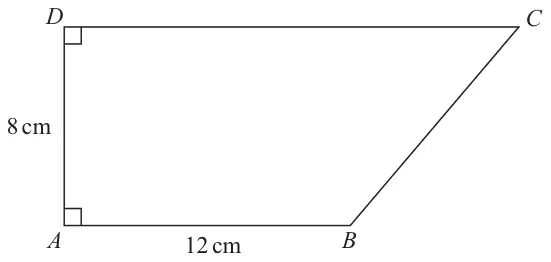
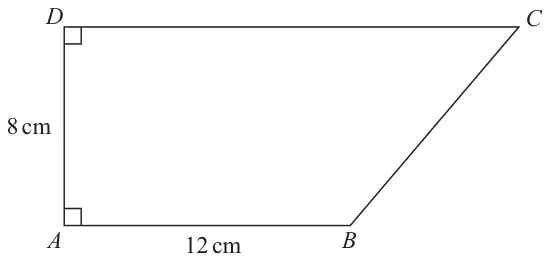
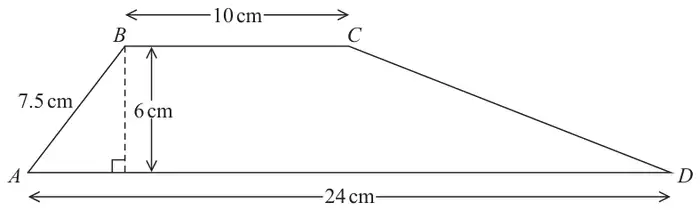
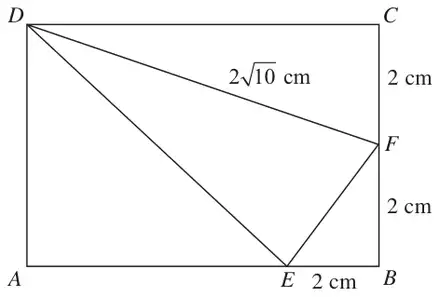
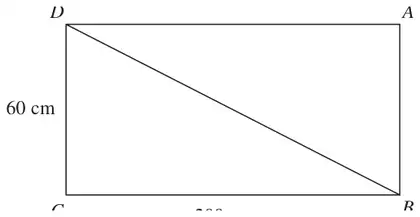
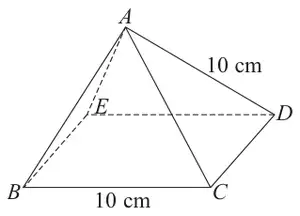
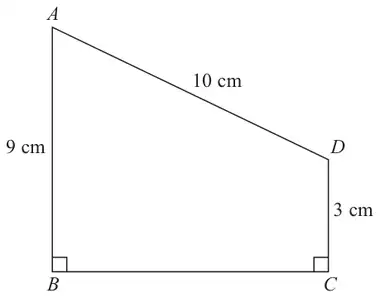
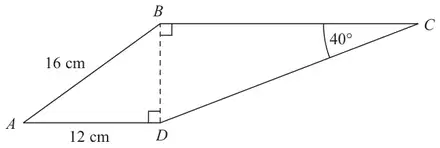
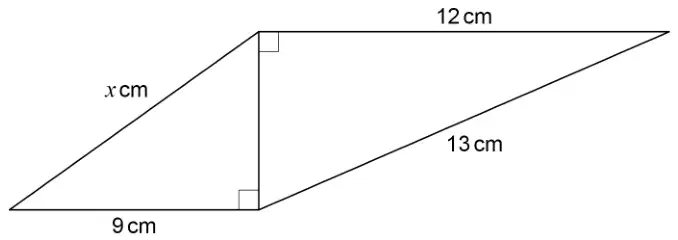
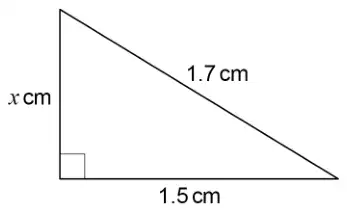
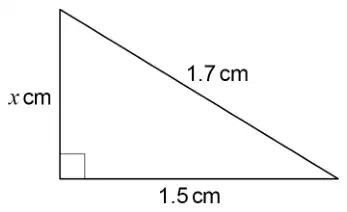
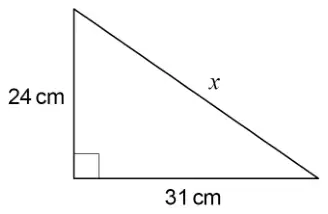
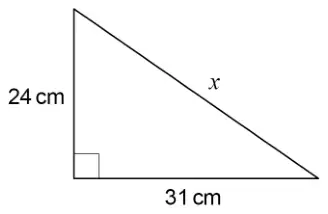
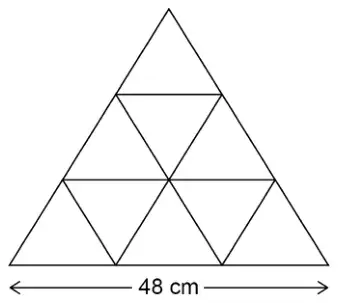
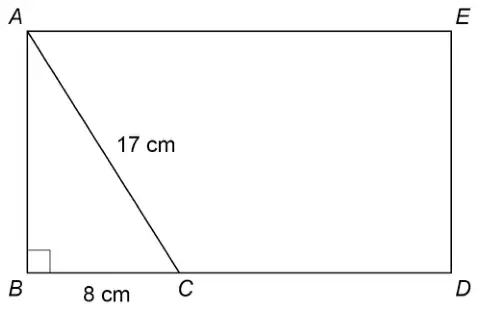
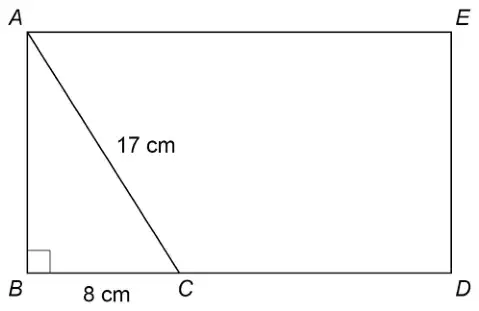
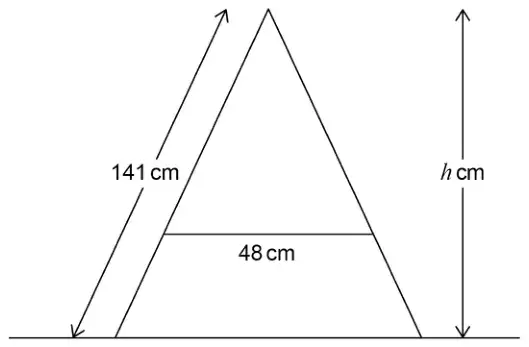
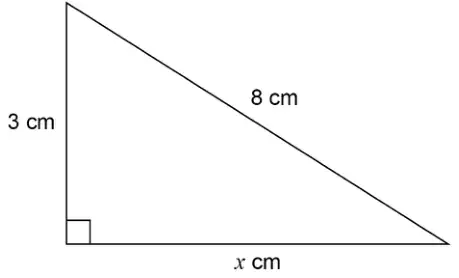
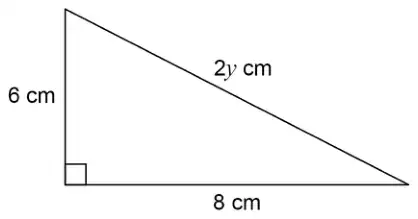
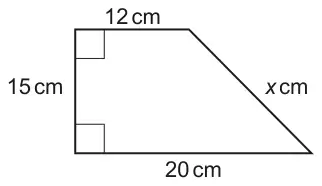
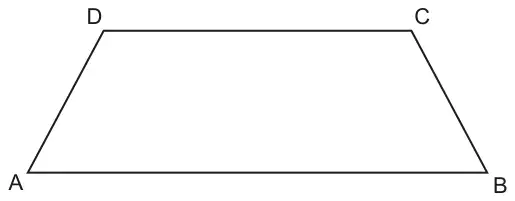
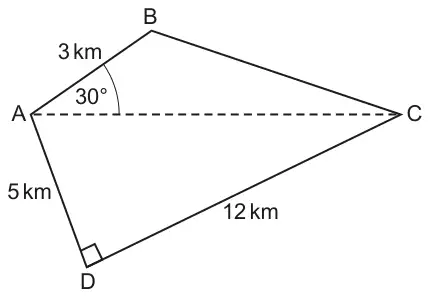
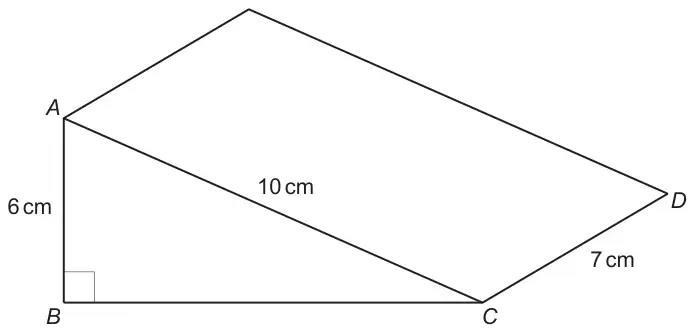
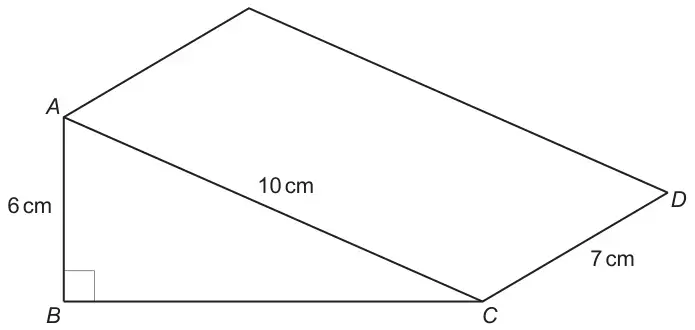
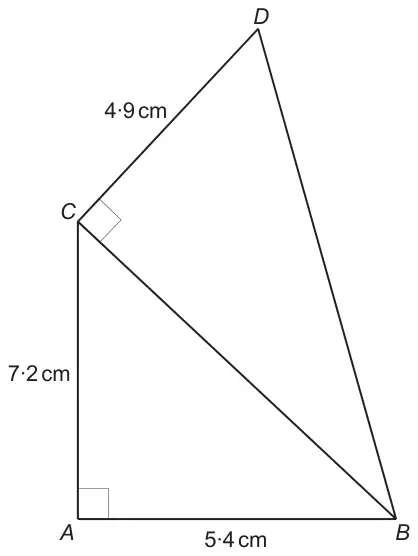
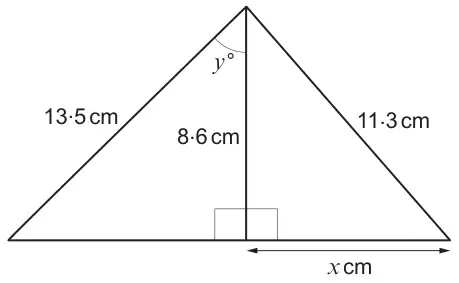
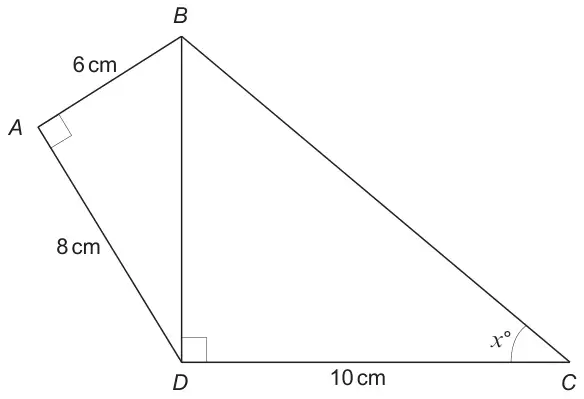
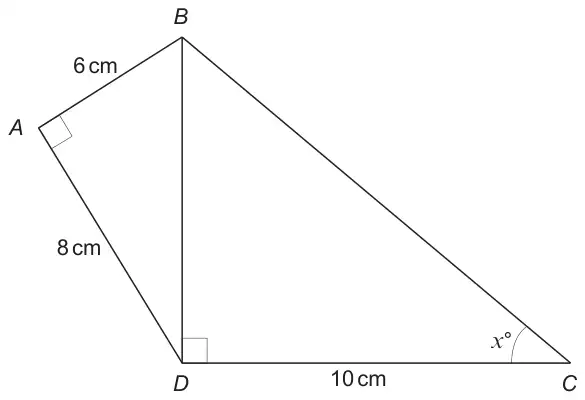
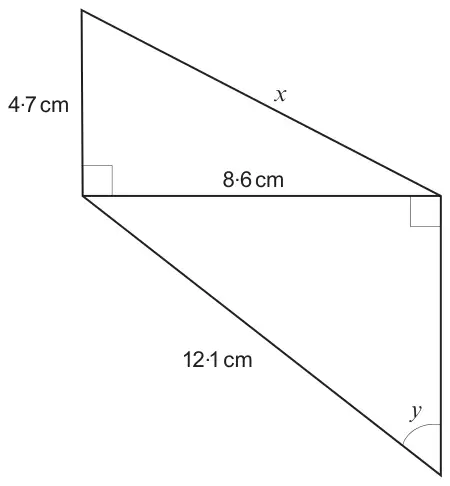
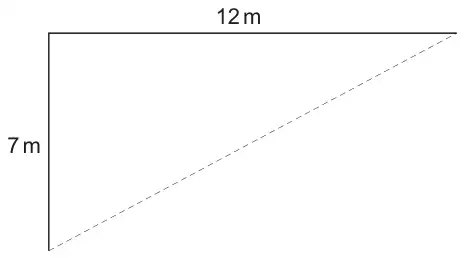
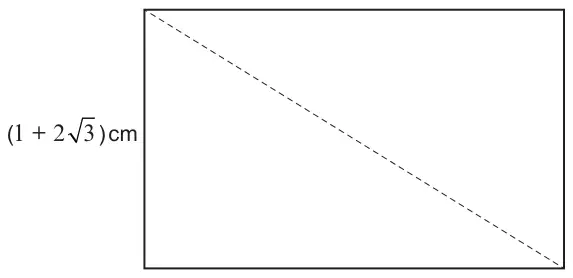
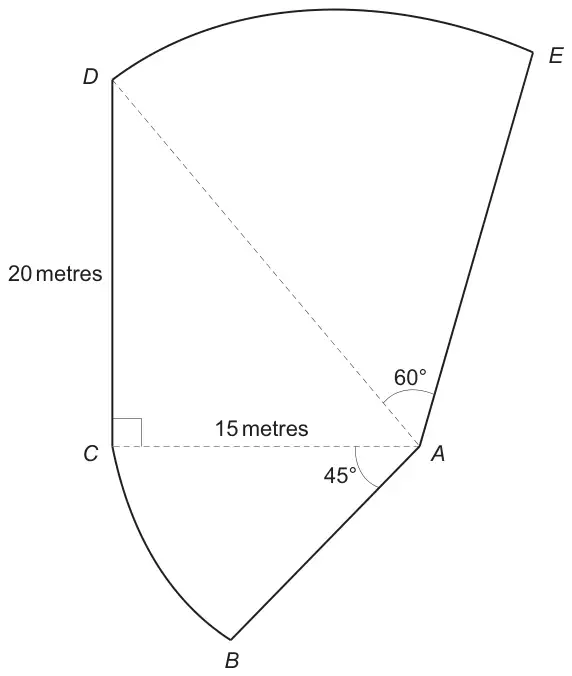
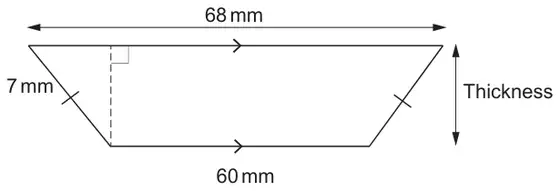
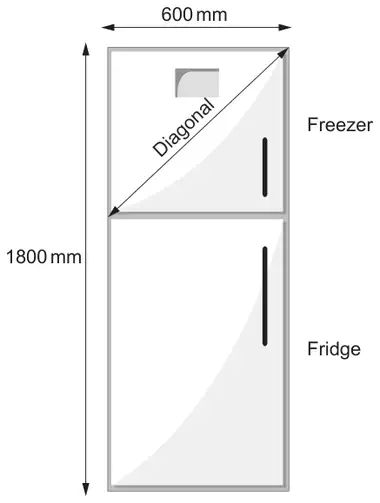
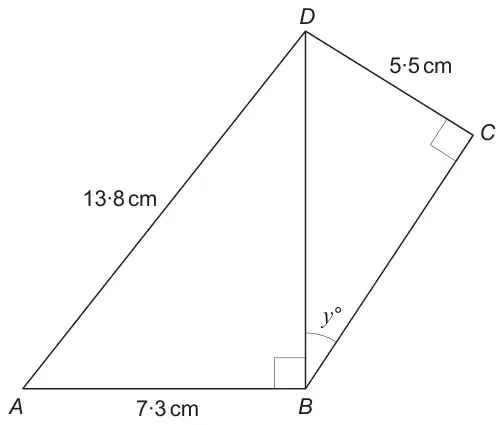
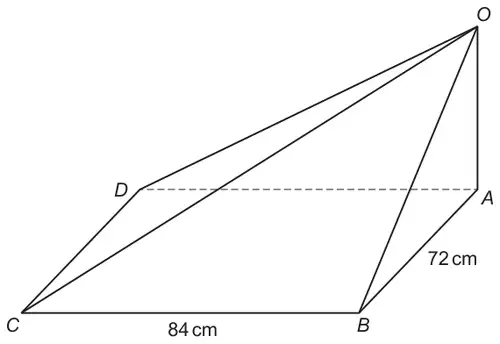
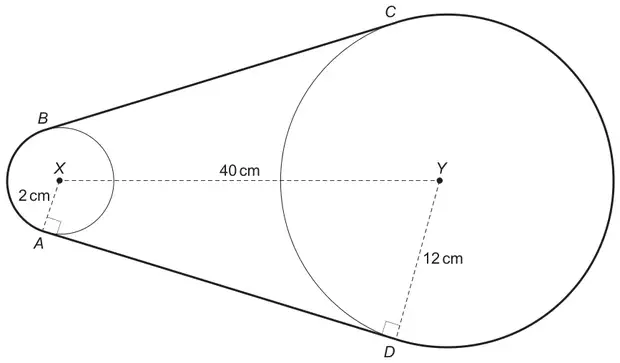
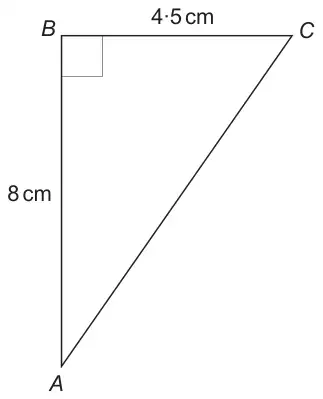
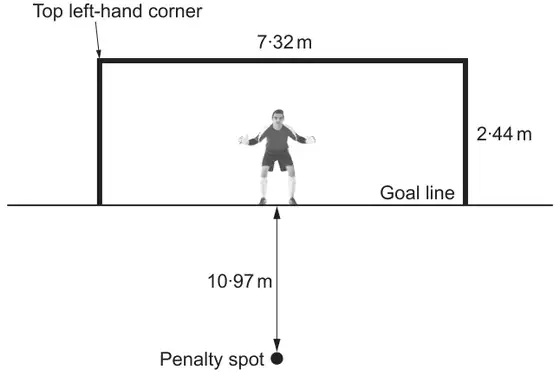
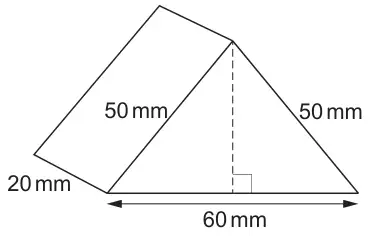
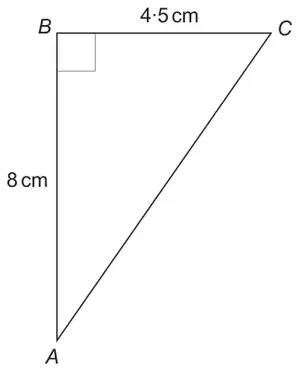
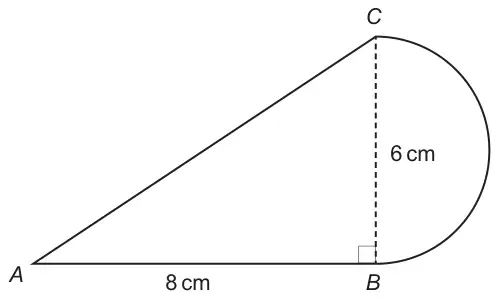
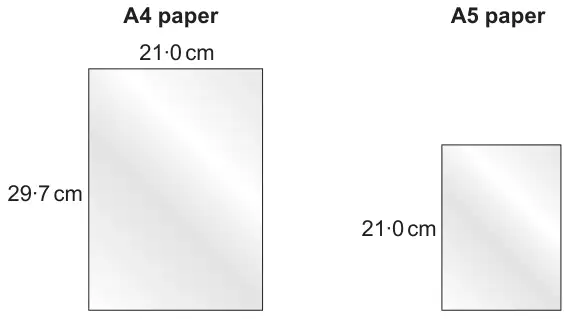
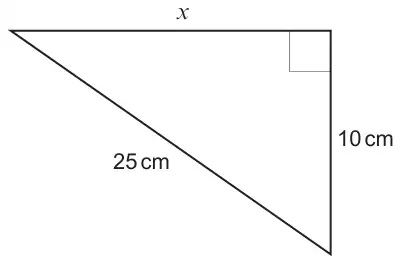
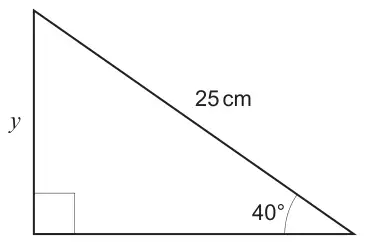
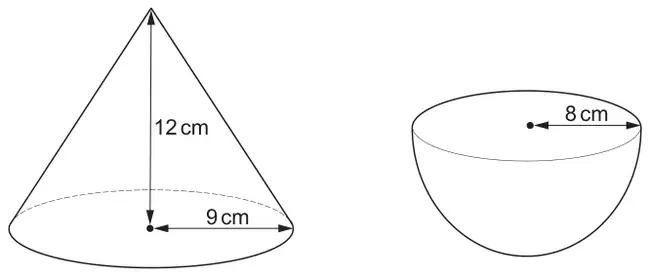
Work out the perimeter of the trapezium. Give your answer correct to 3 significant figures. (5)
Mark scheme
Answer
Mark
Mark scheme
44.9
P1
for process to find an expression for the area of the trapezium, eg \(\tfrac{1}{2}(12 + CD)8\) or \(8 \times 12 + \tfrac{1}{2} \times 8 \times x\)
or for process to find the area of the triangle, eg \(112 - 8 \times 12\ (= 16)\)
P1
for forming an equation and isolating terms in the unknown length, eg \(4CD = 112 - 48\) or \(\tfrac{1}{2} \times 8 \times x = 112 - 8 \times 12\) or \(\tfrac{1}{2} \times 8 \times x = \text{``}16\text{''}\) or \(CD = 16\) or \(x = 4\)
P1
for start of process to find length of \(BC\), eg \(8^2 + \text{``}4\text{''}^2\ (= 80)\) or \(8^2 + [\text{their } x]^2\) or \(\tan^{-1}\left(\dfrac{\text{``}4\text{''}}{8}\right)\ (= 26.5\ldots)\) oe or \(\tan^{-1}\left(\dfrac{8}{\text{``}4\text{''}}\right)\ (= 63.4\ldots)\) where “4” can be [their \(x\)]
P1
for \(\sqrt{8^2 + \text{``}4\text{''}^2}\) or \(\sqrt{64 + \text{``}16\text{''}}\) or \(\sqrt{80}\) or \(4\sqrt{5}\ (= 8.9\ldots)\) oe or \(\sqrt{8^2 + [\text{their } x]^2}\) or \(\dfrac{\text{``}4\text{''}}{\sin \text{``}26.5\ldots\text{''}}\) or \(\dfrac{8}{\cos \text{``}26.5\ldots\text{''}}\) or \(\dfrac{8}{\sin \text{``}63.4\ldots\text{''}}\) or \(\dfrac{\text{``}4\text{''}}{\cos \text{``}63.4\ldots\text{''}}\) where “4” can be [their \(x\)]
A1
for answer in the range 44.9 to 44.95
Additional guidance
\(x\) is the length of the line from \(C\) to where perpendicular from \(B\) meets \(CD\) Allow use of other letters in place of \(CD\) and \(x\) (do not have to be defined unless otherwise stated) Award P1 for \(112 - 8 \times 12\ (= 16)\) even if not used
Award P2 for \(CD = 16\) or \(x = 4\) even if not used unless clearly from incorrect working eg \(12 - 8\ (= 4)\) Only award P2 for 16 if it is clearly identified as \(CD\)
[their \(x\)] can be any value less than 12 or clearly identified as the length of the line from \(C\) to where perpendicular from \(B\) meets \(CD\) (may be seen on the diagram)
Award P4 for (\(BC =\)) \(\sqrt{80}\) or \(4\sqrt{5}\) or 8.9… unless \(x = 4\) is clearly from incorrect working
If an answer is shown in the range in working and then incorrectly rounded award full marks
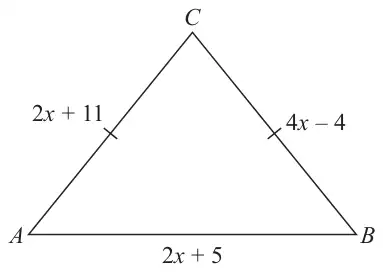
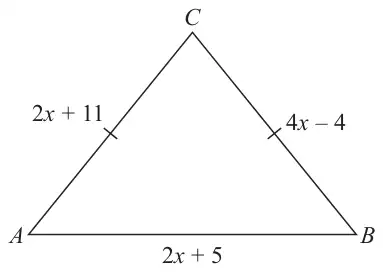
In the diagram, all measurements are in centimetres.
\(AC = BC\)
The perimeter of the triangle is 72 cm.
Work out the area of the triangle. (5)
Mark scheme
Answer
Mark
Mark scheme
240
P1
for forming an appropriate equation, eg \(2x + 11 = 4x - 4\) or \(2x + 11 + 4x - 4 + 2x + 5 = 72\) or \(8x + 12 = 72\)
P1
(dep P1) for process to correctly isolate terms in \(x\), eg \(4x - 2x = 11 + 4\) or \(2x + 4x + 2x = 72 - 11 + 4 - 5\) or \(x = 7.5\) oe
P1
for correct application of Pythagoras, eg \((\text{``}26\text{''})^2 - \left(\dfrac{\text{``}20\text{''}}{2}\right)^2\) or \([AC]^2 - \left(\dfrac{[AB]}{2}\right)^2\) or height = 24 or a complete method to find the height
or for a correct trig statement to find \(CAB\) or \(CBA\) or \(ACB\), eg \(\cos CAB = \cos CBA = \dfrac{\text{``}20\text{''} \div 2}{\text{``}26\text{''}}\) or \(\cos CAB = \cos CBA = \dfrac{20^2 + 26^2 - 26^2}{2 \times 20 \times 26}\) or \(\cos ACB = \dfrac{26^2 + 26^2 - 20^2}{2 \times 26 \times 26}\) or \(CAB = 67.3\ldots\) or \(CBA = 67.3\ldots\) or \(ACB = 45.2\ldots\)
P1
for process to find area of triangle, eg \(\text{``}20\text{''} \times \text{``}24\text{''} \div 2\) or \([AB] \times [\text{height}] \div 2\)
or for process to find area of triangle, eg \(\dfrac{1}{2} \times \text{``}26\text{''} \times \text{``}20\text{''} \times \sin \text{``}67.3\ldots\text{''}\) or \(\dfrac{1}{2} \times \text{``}26\text{''} \times \text{``}26\text{''} \times \sin \text{``}45.2\ldots\text{''}\) or \(\dfrac{1}{2} \times [AB] \times [AC] \times \sin [BAC]\) or \(\dfrac{1}{2} \times [BC] \times [AC] \times \sin [ACB]\)
A1
cao
Additional guidance
\(8x = 60\) or \(2x = 15\) implies P2 A correct length stated or shown on diagram implies P2, eg \(AB = 20\), \(AC = 26\), \(CB = 26\) \([AC]\) \([BC]\) \([AB]\) \([ACB]\) \([CAB]\) and \([BAC]\) must be clearly identified if incorrect. May be on diagram. \(AB = 2 \times \text{``}7.5\text{''} + 5\ (= 20)\) \(AC = 2 \times \text{``}7.5\text{''} + 11\ (= 26)\) \(CB = 4 \times \text{``}7.5\text{''} - 4\ (= 26)\) Alternative scheme not expected on Foundation tier but may be seen.
ft incorrect figures providing at least one previous P1 awarded. [height] is what they clearly think is the height of the triangle but not 26 or 20 or 10
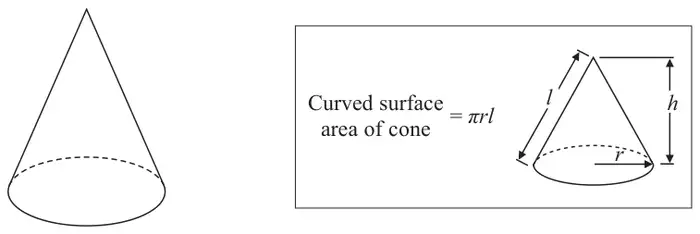
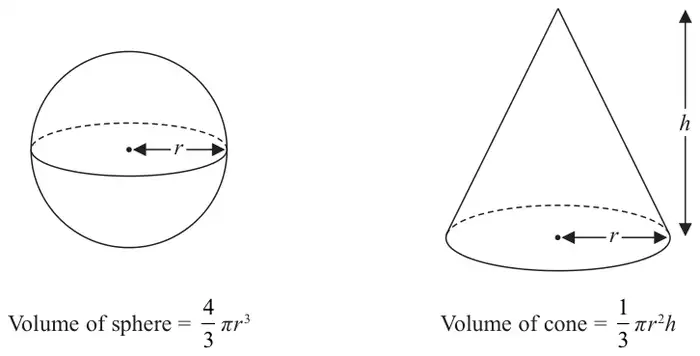
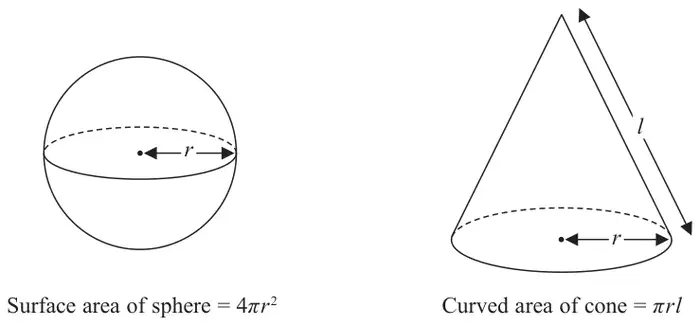
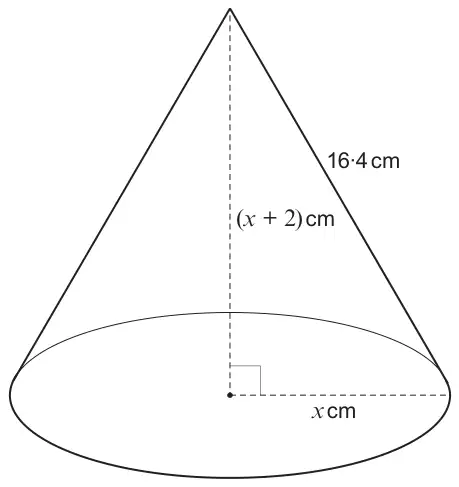
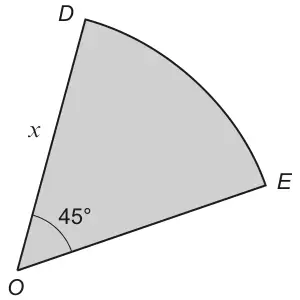
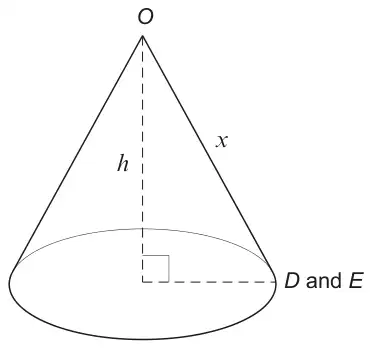
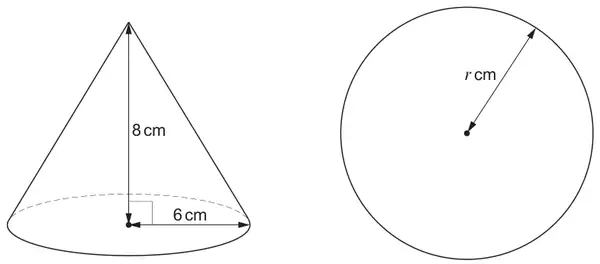
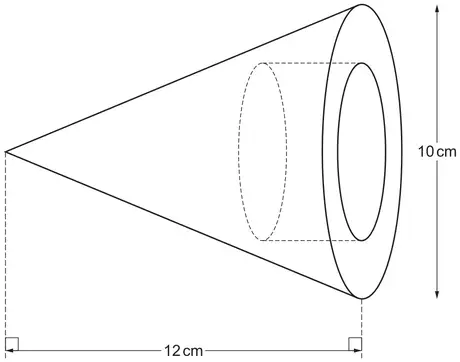
The radius of the base of the cone is \(\dfrac{3}{4}\) of the height of the cone. The total surface area of the cone is \(54\pi\) cm2
Work out the height of the cone. (4)
Mark scheme
Answer
Mark
Mark scheme
6
P1
for starting process, by defining height, radius and using Pythagoras to form an equation for the slant height \(l\) eg height \(= h\), radius \(= \frac{3}{4}h\) and \(l^2 = h^2 + \left(\dfrac{3h}{4}\right)^2 \left(= \dfrac{25}{16}h^2\right)\) or \((l =) \sqrt{h^2 + \left(\dfrac{3h}{4}\right)^2} \left(= \dfrac{5}{4}h\right)\) oe eg \(r = 3x\) and \(h = 4x\) and \(l^2 = (3x)^2 + (4x)^2\)
P1
(dep P1) for process to form a correct expression for the curved surface area in terms of a single variable, eg \(\pi \times \dfrac{3}{4}h \times \text{``}\dfrac{5}{4}h\text{''} \left(= \dfrac{15}{16}\pi h^2\right)\) or \(\pi \times 3x \times \text{``}5x\text{''}\) where \(h = 4x\)
P1
for forming and simplifying a correct equation to find height, eg \(\dfrac{24\pi}{16}h^2 = 54\pi\)
A1
cao
Additional guidance
Can use any other letter than \(h\) provided it is defined eg height \(= x\)
May include area of circle eg \(\pi \times \left(\dfrac{3}{4}h\right)^2 + \pi \times \dfrac{3}{4}h \times \text{``}\dfrac{5}{4}h\text{''} \left(= \dfrac{24}{16}\pi h^2\right)\)
In the diagram, all measurements are in centimetres.
\(AC = BC\)
The perimeter of the triangle is 72 cm.
Work out the area of the triangle. (5)
Mark scheme
Answer
Mark
Mark scheme
240
P1
for forming an appropriate equation, eg \(2x + 11 = 4x - 4\) or \(2x + 11 + 4x - 4 + 2x + 5 = 72\) or \(8x + 12 = 72\)
P1
(dep P1) for process to isolate terms in \(x\) for their equation, eg \(4x - 2x = 11 + 4\) or \(2x + 4x + 2x = 72 - 11 + 4 - 5\) or \(x = 7.5\) oe
P1
for correct application of Pythagoras, eg \((\text{``}26\text{''})^2 - \left(\dfrac{\text{``}20\text{''}}{2}\right)^2\) or \([AC]^2 - \left(\dfrac{[AB]}{2}\right)^2\) or height = 24 or a complete method to find the height
or for a correct trig statement to find \(CAB\) or \(CBA\) or \(ACB\), eg \(\cos CAB = \cos CBA = \dfrac{\text{``}20\text{''} \div 2}{\text{``}26\text{''}}\) or \(\cos CAB = \cos CBA = \dfrac{20^2 + 26^2 - 26^2}{2 \times 20 \times 26}\) or \(\cos ACB = \dfrac{26^2 + 26^2 - 20^2}{2 \times 26 \times 26}\) or \(CAB = 67.3\ldots\) or \(CBA = 67.3\ldots\) or \(ACB = 45.2\ldots\)
P1
for process to find area of triangle, eg \(\text{``}20\text{''} \times \text{``}24\text{''} \div 2\) or \([AB] \times [\text{height}] \div 2\)
or for process to find area of triangle, eg \(\dfrac{1}{2} \times \text{``}26\text{''} \times \text{``}20\text{''} \times \sin \text{``}67.3\ldots\text{''}\) or \(\dfrac{1}{2} \times \text{``}26\text{''} \times \text{``}26\text{''} \times \sin \text{``}45.2\ldots\text{''}\) or \(\dfrac{1}{2} \times [AB] \times [AC] \times \sin [BAC]\) or \(\dfrac{1}{2} \times [BC] \times [AC] \times \sin [ACB]\)
A1
cao
Additional guidance
\(8x = 60\) or \(2x = 15\) implies P2 A correct length stated or shown on diagram implies P2 Eg \(AB = 20\), \(AC = 26\), \(CB = 26\) \([AC]\) \([BC]\) \([AB]\) \([ACB]\) \([CAB]\) and \([BAC]\) must be clearly identified if incorrect. May be on diagram. \(AB = 2 \times \text{``}7.5\text{''} + 5\ (= 20)\) \(AC = 2 \times \text{``}7.5\text{''} + 11\ (= 26)\) \(CB = 4 \times \text{``}7.5\text{''} - 4\ (= 26)\) Alternative scheme not expected on Foundation tier but may be seen.
ft incorrect figures providing at least one previous P1 awarded. [height] is what they clearly think is the height of the triangle but not 26 or 20 or 10
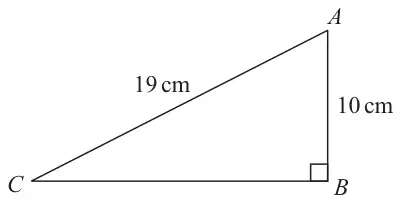
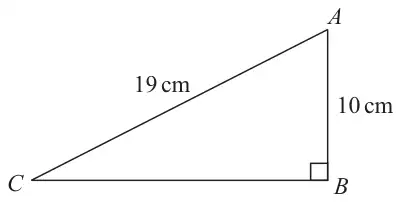
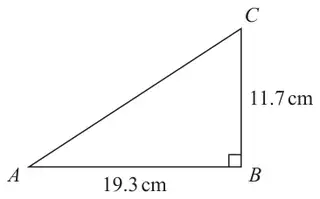
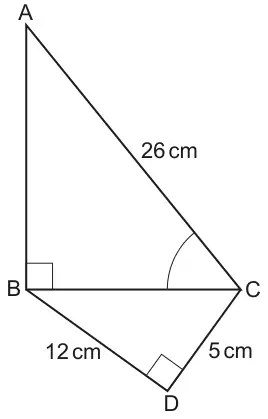
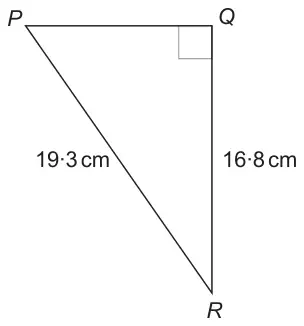
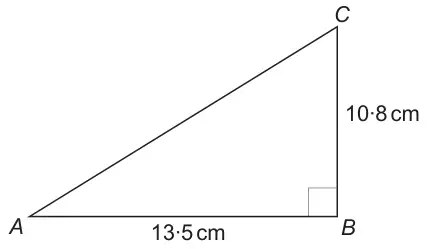
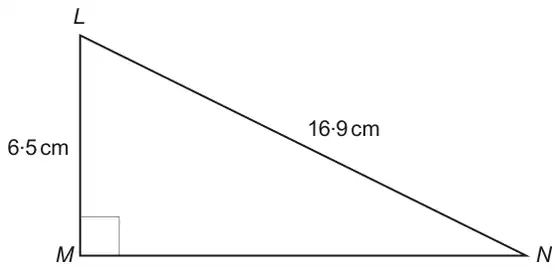
Work out the length of \(CB\). Give your answer correct to 3 significant figures. (2)
Mark scheme
Answer
Mark
Mark scheme
16.2
M1
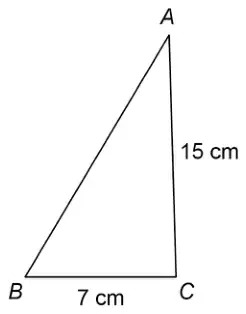
for a correct first step to find \(BC\), eg \(19^2 = 10^2 + BC^2\) or \(19^2 - 10^2\ (= 261)\) or \(\sqrt{19^2 - 10^2}\) or \(\sqrt{261}\) or \(3\sqrt{29}\)
A1
for answer in the range 16.1 to 16.2
Additional guidance
Can use alternative letter for \(BC\) provided intention is clear If using an alternative method using trigonometry must have \(BC\) as the only unknown
29 \(A\), \(B\), \(C\) and \(D\) are points on a circle such that \(ABCD\) is a square.
The square \(ABCD\) has sides of length 3.5 cm.
Calculate the circumference of the circle. Give your answer correct to 1 decimal place. You must show all your working.(4)
Mark scheme
Answer
Mark
Mark scheme
15.6
P1
for beginning process to use Pythagoras to find diameter or radius, eg \(3.5^2 + 3.5^2\ (= 24.5)\) or \(1.75^2 + 1.75^2\ (= 6.125)\)
P1
for complete process to find diameter or radius, eg \(\sqrt{3.5^2 + 3.5^2}\) or \(\sqrt{24.5}\ (= 4.94..)\) or \(\sqrt{1.75^2 + 1.75^2}\) or \(\sqrt{6.125}\ (= 2.47\ldots)\)
P1
for process to find circumference of circle, eg \(\pi \times \text{``}4.94\ldots\text{''}\ (= 15.55\ldots)\) or \(2 \times \pi \times \text{``}2.47\ldots\text{''}\ (= 15.55\ldots)\)
A1
for answer in range 15 to 16
Additional guidance
Award P1 for a correct Pythagorean statement eg \(3.5^2 + 3.5^2 = \text{diameter}^2\)
4.94.. or 2.47.. truncated or rounded can imply P2
Accept use of 3.14 or better for \(\pi\) Accept use of truncated values for 4.94.. or 2.47..
If an answer is shown in the range in working and then incorrectly rounded award full marks. Award 0 marks for a correct answer without correct supportive working.
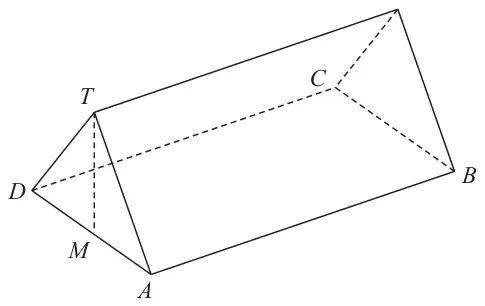
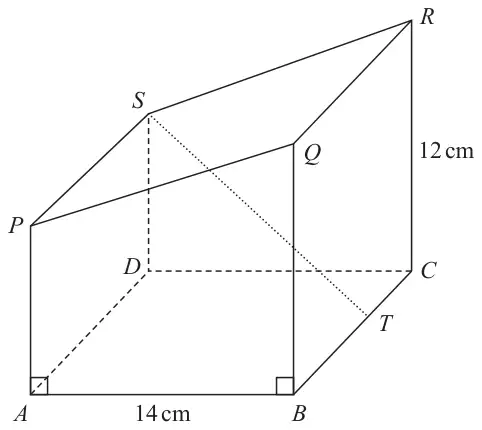
\(P\) is the point on \(AB\) such that \(AP : PB = 5 : 2\)
Calculate the size of the angle between \(TP\) and the base \(ABCD\) of the prism. Give your answer correct to 1 decimal place. (4)
Mark scheme
Answer
Mark
Mark scheme
12.2
P1
for process to find \(AP\), eg \(\tfrac{5}{7} \times 14.7\ (= 10.5)\) or for showing the required angle on a diagram eg with an arc
P1
for process to find \(MP\), eg \(\sqrt{\text{``}10.5\text{''}^2 + 1.9^2}\) oe \((= 10.6\ldots)\) or for a process to find \(TP\), eg \(\sqrt{\text{``}10.5\text{''}^2 + 1.9^2 + 2.3^2}\) oe \((= 10.9\ldots)\)
P1
for using appropriate trigonometry ratio to find angle \(TPM\), eg \(\tan TPM = \dfrac{2.3}{\text{``}10.6\ldots\text{''}}\) or \(\sin TPM = \dfrac{2.3}{\text{``}10.9\ldots\text{''}}\) or \(\cos TPM = \dfrac{\text{``}10.6\ldots\text{''}}{\text{``}10.9\ldots\text{''}}\)
A1
for answer in the range 12.1 to 12.2
Additional guidance
Check diagram for working
If an answer is shown in the range in working and then incorrectly rounded award full marks.
12 \(A\) is the point with coordinates \((7, 13)\) \(B\) is the point with coordinates \((-3, 21)\) \(C\) is the point with coordinates \((15, 23)\)
\(M\) is the midpoint of \(AB\). \(N\) is the midpoint of \(BC\).
Work out the distance between \(M\) and \(N\). Give your answer correct to 1 decimal place. (3)
Mark scheme
Answer
Mark
Mark scheme
6.4
P1
for a suitable start to the process, eg, \(M = \left(\dfrac{7 - 3}{2}, \dfrac{13 + 21}{2}\right)\ (= (2, 17))\) or \(N = \left(\dfrac{15 - 3}{2}, \dfrac{23 + 21}{2}\right)\ (= (6, 22))\)
P1
(dep on P1) for a correct first step using of Pythagoras, eg \((x_N - x_M)^2 + (y_N - y_M)^2\) eg \((\text{``}6\text{''} - \text{``}2\text{''})^2 + (\text{``}22\text{''} - \text{``}17\text{''})^2\ (= 41)\)
A1
for answer in the range 6.4 to 6.41
Additional guidance
Condone missing brackets on coordinates Ignore units throughout
If an answer is given in the range in working and then rounded incorrectly award full marks.
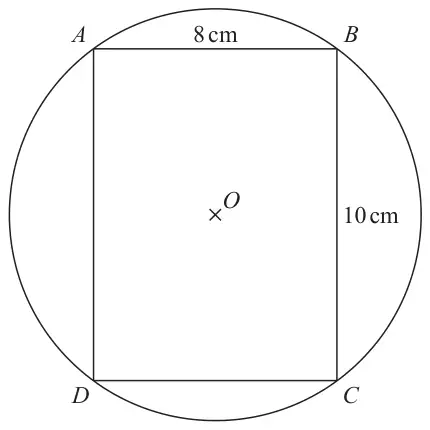
12 The points \(A\), \(B\), \(C\) and \(D\) lie on a circle, centre \(O\). \(ABCD\) is a rectangle.
\(AB = 8\) cm \(BC = 10\) cm
Work out the circumference of the circle. Give your answer correct to 3 significant figures. (4)
Mark scheme
Answer
Mark
Mark scheme
40.2
P1
for start of process to find the diameter or the radius of the circle, eg \(8^2 + 10^2\ (= d^2)\) oe or \(4^2 + 5^2\ (= r^2)\) oe
P1
for complete process to find diameter, eg \(\sqrt{8^2 + 10^2}\ (= 12.8\ldots)\) or complete process to find radius, eg \(\sqrt{4^2 + 5^2}\ (= 6.40\ldots)\)
P1
for process to find circumference, eg \(\pi \times \text{``}12.8\ldots\text{''}\) or \(2 \times \pi \times \text{``}6.40\ldots\text{''}\)
A1
answer in the range 40.2 to 40.24
Additional guidance
Accept \(\sqrt{164}\) or \(2\sqrt{41}\) or \(\sqrt{41}\)
If an answer is given in the range in working and then rounded incorrectly award full marks.
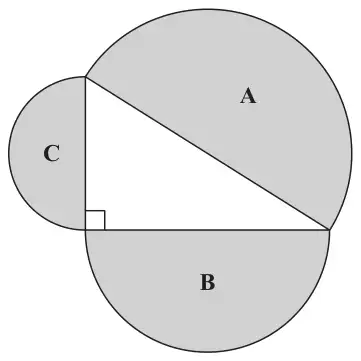
13 A right-angled triangle is formed by the diameters of three semicircular regions, A, B and C as shown in the diagram.
Show that
area of region A = area of region B + area of region C(3)
Mark scheme
Answer
Mark
Mark scheme
Relationship shown
M1
for use of Pythagoras’ theorem, eg \(d_A^{\,2} = d_B^{\,2} + d_C^{\,2}\) or \(a^2 = b^2 + c^2\) or \((2x)^2 = (2y)^2 + (2z)^2\) or \(a = \sqrt{b^2 + c^2}\) or uses a 3, 4, 5 triangle
M1
for forming correct expressions for the areas of at least 2 of the 3 semicircles, eg at least two of \(\dfrac{1}{2}\pi\left(\dfrac{a}{2}\right)^2,\ \dfrac{1}{2}\pi\left(\dfrac{b}{2}\right)^2,\ \dfrac{1}{2}\pi\left(\dfrac{c}{2}\right)^2\) or at least two of \(\dfrac{1}{2}\pi x^2,\ \dfrac{1}{2}\pi y^2,\ \dfrac{1}{2}\pi z^2\) or at least two of \(\dfrac{1}{2}\pi\left(\dfrac{5}{2}\right)^2,\ \dfrac{1}{2}\pi\left(\dfrac{3}{2}\right)^2,\ \dfrac{1}{2}\pi\left(\dfrac{4}{2}\right)^2\)
C1
for a fully correct and convincing chain of reasoning, eg showing that eg \(\dfrac{1}{2}\pi\left(\dfrac{a}{2}\right)^2 = \dfrac{1}{2}\pi\left(\dfrac{b}{2}\right)^2 + \dfrac{1}{2}\pi\left(\dfrac{c}{2}\right)^2\) can be reduced to \(a^2 = b^2 + c^2\) or that \((2x)^2 = (2y)^2 + (2z)^2\) is the same as \(\dfrac{1}{2}\pi x^2 = \dfrac{1}{2}\pi y^2 + \dfrac{1}{2}\pi z^2\)
Additional guidance
May be seen at any stage Where \(d_A\), \(a\), \(2x\), etc are their diameters
Could be any Pythagorean triple
Where \(a\), \(b\), \(c\) are their diameters Where \(2x\), \(2y\), \(2z\) are their diameters Where 3, 4, 5 are their diameters
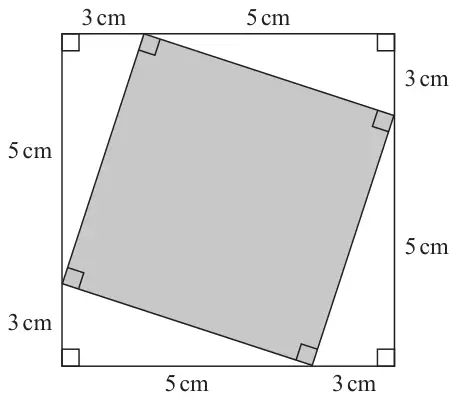
Work out the area of the square shown shaded in the diagram. (4)
Mark scheme
Answer
Mark
Mark scheme
34 cm²
P1
for finding one area eg \(8 \times 8\ (= 64)\) or \(0.5 \times 3 \times 5\ (= 7.5)\) or for first stage in working with Pythagoras eg sight of \(3^2 + 5^2\) or \(9 + 25\)
P1
for a complete process to find the area eg \(\text{``}64\text{''} - 4 \times \text{``}7.5\text{''}\ (= 34)\) or for full use of Pythagoras eg \(\sqrt{3^2 + 5^2}\) or \(\sqrt{34}\) or 5.83…
A1
for an answer in the range 33.6 to 34
B1
(indep) for cm²
Additional guidance
Any figure used must come from a correct process
Can be awarded with incorrect units stated
Can be awarded with an incorrect or absent numerical answer
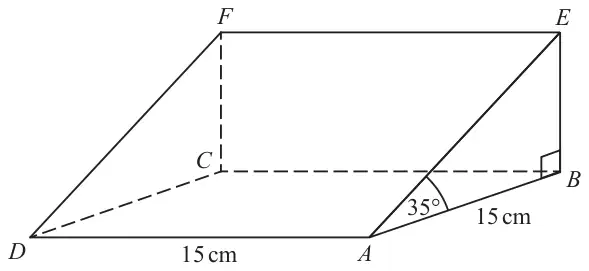
The base, \(ABCD\), of the prism is a square of side length 15 cm. Angle \(ABE\) and angle \(CBE\) are right angles. Angle \(EAB = 35^\circ\)
\(M\) is the point on \(DA\) such that
\(DM : MA = 2 : 3\)
Calculate the size of the angle between \(EM\) and the base of the prism. Give your answer correct to 1 decimal place. (4)
Mark scheme
Answer
Mark
Mark scheme
31.0
P1
for \(\tan 35 = BE \div 15\) or \(BE = 10.5(0\ldots)\) OR finding the length \(DM = \dfrac{2}{5} \times 15\ (= 6)\) or \(MA = \dfrac{3}{5} \times 15\ (= 9)\) or 6 : 9 OR showing the required angle on a diagram, eg with an arc
P1
for \(MB = \sqrt{15^2 + \text{``}9\text{''}^2}\) or \(\sqrt{306}\) or 17.4(9…) OR \(ME = \sqrt{\text{``}9\text{''}^2 + \text{``}18.3(1\ldots)\text{''}^2}\) or \(\sqrt{416.(3\ldots)}\) or 20.4(0…)
P1
for using an appropriate trigonometric ratio to set up an equation in angle \(EMB\) eg \(\tan\theta = \text{``}10.5(0\ldots)\text{''} \div \text{``}17.4(9\ldots)\text{''}\) or \(\cos\theta = \text{``}17.4(9\ldots)\text{''} \div \text{``}20.4(0\ldots)\text{''}\) or \(\sin\theta = \text{``}10.5(0\ldots)\text{''} \div \text{``}20.4(0\ldots)\text{''}\)
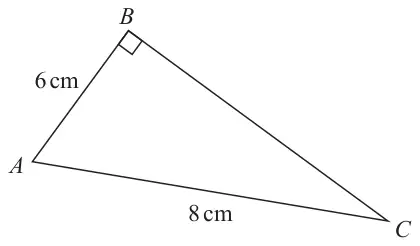
(a) What mistake has Sarah made in her method? (1)
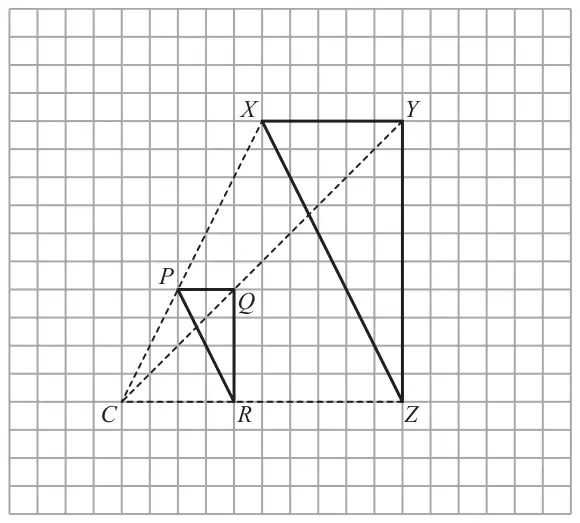
Roy is going to enlarge triangle \(PQR\) with centre \(C\) and scale factor \(1\frac{1}{2}\) He draws triangle \(XYZ\).
(b) Explain why Roy’s diagram is not correct. (1)
Mark scheme (a)
Answer
Mark
Mark scheme
Mistake described
C1
for statement describing a mistake Acceptable eg should be \(AC^2 - AB^2\) she should do \(8^2 - 6^2\) she should be subtracting not adding the numbers she thought that \(BC\) was the hypoteneuse when it was actually \(AC\) should be \(BC^2 + AB^2 = AC^2\) should be \(8^2 = 6^2 + BC^2\) Not acceptable eg she has not used Pythagoras correctly \(6^2 + 8^2\) is 120 the answer should be \(\sqrt{28}\) or 5 or 5.3 or 5.2915 \(BC + AB = AC\)
Mark scheme (b)
Answer
Mark
Mark scheme
Explanation
C1
for explanation Acceptable examples the scale factor used is 2.5 \(5 \div 2\) is not 1.5 \(10 \div 4\) is more than 1.5 the scale factor is not 1.5 he has not used the correct scale factor has enlarged it by too much \(ZY\) should be 6 Not acceptable examples the grid is not large enough he has used the wrong centre
\(AB = 5\) m The vertex \(T\) is 12 m vertically above the midpoint of \(AC\).
Calculate the size of angle \(TAC\). (4)
Mark scheme
Answer
Mark
Mark scheme
73.6
P1
for correct initial use of Pythagoras eg \(5^2 + 5^2\) (=50) or a trigonometric ratio in the form \(\dfrac{5 \div 2}{0.5AC} = \sin 45\) oe
P1
for finding the length of half of the diagonal eg \(\sqrt{\text{``}50\text{''}} \div 2\) ( = 3.5...) or \(0.5AC = \dfrac{5 \div 2}{\sin 45}\) (=3.5...) oe
P1
for process to use tan eg \(\tan TAC = (12 \div \text{``}3.5..\text{''})\) (=3.3..) or complete alternative method arriving at an equation with the subject as \(\sin TAC\) or \(\cos TAC\)
A1
for an answer in the range 73.58 to 74.1
Additional guidance
P1 (half of the diagonal): do not accept \(\sqrt{20} \div 2\)
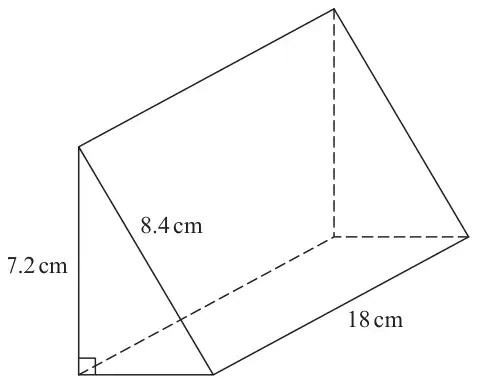
Work out the volume of the prism. Give your answer correct to 3 significant figures. (5)
Mark scheme
Answer
Mark
Mark scheme
280
P1
for starting to use Pythagoras to find the missing side eg \(8.4^2 - 7.2^2\ (= 18.72)\)
P1
for a complete process to find the missing side eg \(\sqrt{70.56 - 51.84}\) or \(\sqrt{18.72}\) (=4.32....)
P1
(dep P1) for a process to find the area of the triangular face eg ([length of base] \(\times\ 7.2) \div 2\) (=15.57..) OR the volume of the cuboid eg [length of base] \(\times\ 7.2 \times 18\) (=560.7..)
P1
for a complete process to find the volume of the prism eg \(\text{``}15.5..\text{''} \times 18\) or \(\text{``}560.7..\text{''} \div 2\)
A1
answer in the range 278 – 281
Additional guidance
Award P1 for a correct Pythagorean statement eg \(x^2 + 7.2^2 = 8.4^2\)
4.3 truncated or rounded can imply P2
Uses a figure they show as the length of the base of the right angled triangle but dep on P1 Allow 15.57.. truncated or rounded if unsupported
If an answer is given in the range 278 to 281 but then incorrectly given to 3 sig fig this mark can still be awarded.
Work out the size of angle \(CDA\). Give your answer correct to 1 decimal place. (5)
Mark scheme
Answer
Mark
Notes
32.3
P1
for using Pythagoras to find length of third side of triangle, eg \(7.5^2 - 6^2\) or \(6^2 + x^2 = 7.5^2\) or uses trigonometry to find angle in triangle eg \(\sin A = \dfrac{6}{7.5}\) or \(\cos B = \dfrac{6}{7.5}\)
P1
(dep P1) for complete process to find length of third side of triangle eg \(\sqrt{7.5^2 - 6^2}\) or \(\sqrt{56.25 - 36}\) or \(\sqrt{20.25}\ (= 4.5)\) or uses trigonometry to find base length of triangle eg \(7.5 \times \cos \text{``}A\text{''}\) or \(7.5 \times \sin \text{``}B\text{''}\) or \(\dfrac{6}{\tan \text{``}A\text{''}}\)
P1
(dep P2) for \(24 - 10 - \text{``}4.5\text{''}\ (= 9.5)\)
P1
(indep) for process to find angle \(CDA\), eg \(\tan CDA = \dfrac{6}{\textit{base}}\) from right-angled triangle
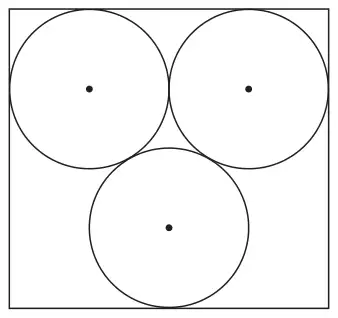
21 The diagram shows 3 identical circles inside a rectangle. Each circle touches the other two circles and the sides of the rectangle, as shown in the diagram.
The radius of each circle is 24 mm.
Work out the area of the rectangle. Give your answer correct to 3 significant figures. (4)
Mark scheme
Answer
Mark
Notes
8600
P1
for process to find the length of the rectangle, e.g. \(24 \times 4\ (= 96)\)
P1
for process to find the perpendicular height of an equilateral triangle of side \((24 \times 2)\) cm, e.g. \(48 \sin 60\ (= 41.5(69\ldots))\) or \(\sqrt{48^2 - 24^2}\ (= 24\sqrt{3}\) oe\()\)
P1
for complete process to find the width of rectangle, e.g. \(\text{``}41.5(69\ldots)\text{''} + 24 + 24\ (= 89.5(69\ldots))\)
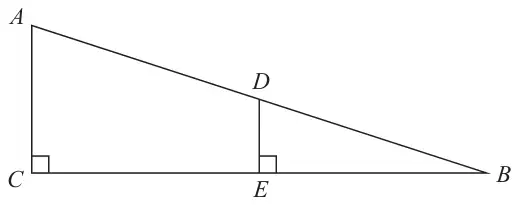
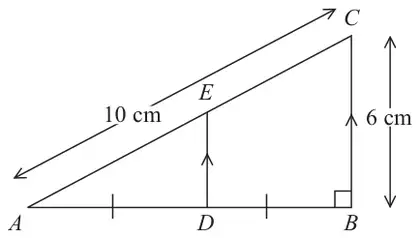
\(ADB\) and \(AEC\) are straight lines. \(DE\) is parallel to \(BC\).
Angle \(ABC = 90^\circ\) \(AC = 10\) cm. \(BC = 6\) cm. \(D\) is the midpoint of \(AB\).
Work out the area of trapezium \(BCED\). (4)
Mark scheme
Answer
Mark
Notes
18
4
M1 for correct initial use of Pythagoras eg (\(AB^2\) =) \(10^2 - 6^2\) (= 64) or \(AB = 8\) M1 (dep M1) for \(\text{``}\sqrt{64}\text{''} \div 2\) (= 4) M1 for method to find area of trapezium eg \(\dfrac{1}{2} \times \text{``}4\text{''} \times (6 \div 2 + 6)\) A1 cao
OR M1 for correct initial use of Pythagoras eg (\(AB^2\) =) \(10^2 - 6^2\) (= 64) or \(AB = 8\) M1 (dep M1) for method to find area of \(\Delta ABC\) eg \(\tfrac{1}{2} \times \text{``}\sqrt{64}\text{''} \times 6\) (= 24) or area of \(\Delta AED\) \(\tfrac{1}{2} \times 6 \div 2 \times \text{``}4\text{''}\) (= 6) or \(24 \times \left(\tfrac{1}{2}\right)^2\) (= 6) M1 for a complete method to find area of \(EDBC\) e.g \(\tfrac{3}{4} \times \text{``}24\text{''}\) eg \(\text{``}24\text{''} - \text{``}6\text{''}\) A1 cao
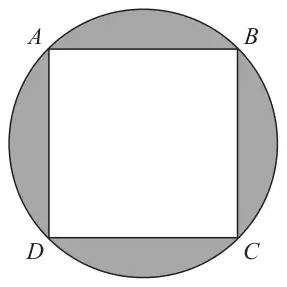
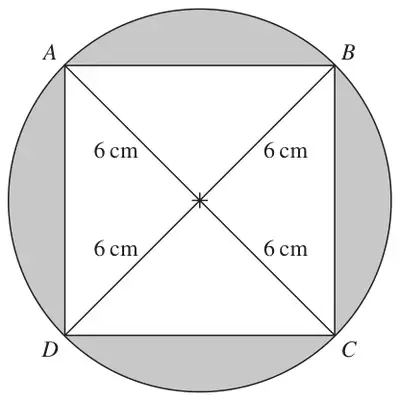
28 The diagram shows a square ABCD inside a circle.
Diagram NOT accurately drawn
The points A, B, C and D lie on the circle. The radius of the circle is 6 cm.
Work out the total area of the shaded regions. Give your answer correct to 3 significant figures. (4)
Mark scheme
Answer
Mark
Notes
41.1
4
M1 for method to work out the area of the circle or quarter circle or semi-circle eg \(\pi \times 6^2\) (= 113.(09..)) or \(\pi \times 6^2 \div 2\) (= 56.5(48..)) or \(\pi \times 6^2 \div 4\) (= 28.2(7…)) M1 for method to work out the area of the square eg (= 72) oe or a triangle eg \(\frac{1}{2} \times 6 \times 6\) (= 18) M1 for complete method to find shaded area. A1 for value in the range 41.04 - 41.112
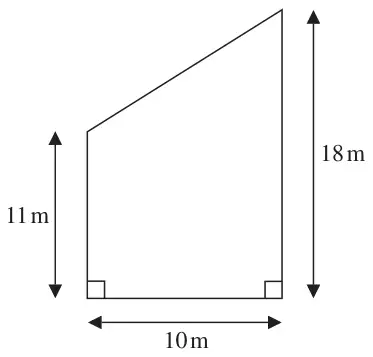
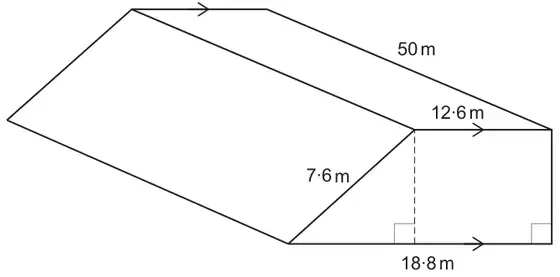
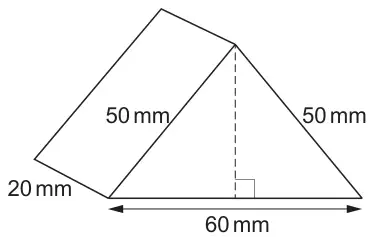
This part of the field is in the shape of a trapezium. A farmer wants to put a fence all the way around the edge of this part of the field.
The farmer has 50 m of fence.
Does he have enough fence? You must show all your working. (5)
Mark scheme
Answer
Mark
Notes
No not enough
5
M1 for substituting into Pythagoras’ theorem M1 for complete correct use of Pythagoras’ theorem M1 for a complete method to find the perimeter of the trapezium A1 51.(20655..) C1 (dep on first two Ms) for correct conclusion dependent upon supporting calculations
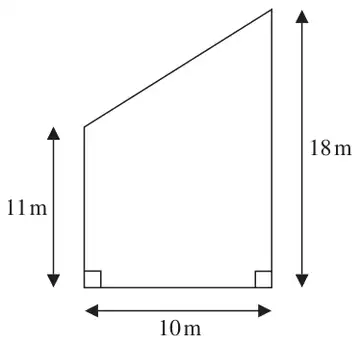
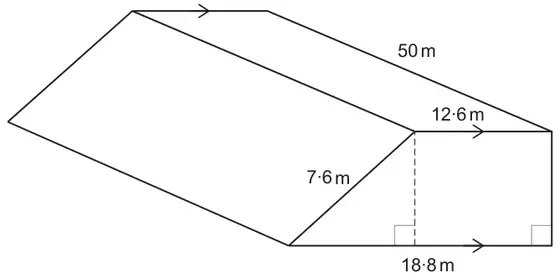
*7 Here is part of a field. This part of the field is in the shape of a trapezium.
Diagram NOT accurately drawn
A farmer wants to put a fence all the way around the edge of this part of the field. The farmer has 50 m of fence.
Does he have enough fence?
You must show all your working.(5)
Mark scheme
Answer
Mark
Notes
No not enough
5
M1 for substituting into Pythagoras’ theorem M1 for complete correct use of Pythagoras’ theorem M1 for a complete method to find the perimeter of their trapezium A1 51.(20655..) C1 (dep on correct first 2 M marks) for correct conclusion dependent upon supporting calculations
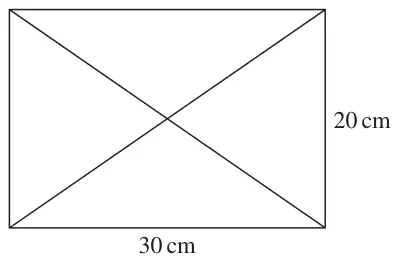
26 A frame is made from wire. The frame is in the shape of a rectangle, 30 cm by 20 cm. The two diagonals of the rectangle are also made from wire.
Diagram NOT accurately drawn
Calculate the total length of wire needed to make the frame and the diagonals. Give your answer correct to 1 decimal place. (4)
Mark scheme
Answer
Mark
Notes
172.1
4
M1 for \(30^2 + 20^2\) or \(900 + 400\) or 1300 M1 for \(\sqrt{30^2 + 20^2}\) or \(\sqrt{1300}\) (= 36(.0555)) M1 for a complete method to find the length of wire required e.g. \(2 \times \text{‘}36.1\text{’} + 2 \times 30 + 2 \times 20\) A1 172 – 172.2
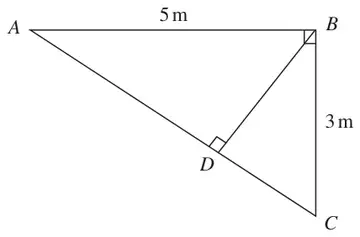
M1 for \((AC^2) = 5^2 + 3^2\) (=34) M1 for \(\sqrt{25 + 9}\) or \(\sqrt{34}\) (=5.83) M1 for \(\dfrac{5}{\text{'}5.83'} = \dfrac{DB}{3}\) or \(DB \times AC = 5 \times 3\) M1 for \((DB =)\ \dfrac{5}{\text{'}5.83'} \times 3\) A1 for 16.4 to 16.41
OR M1 for \((AC^2) = 5^2 + 3^2\) (=34) M1 for \(\sqrt{25 + 9}\) or \(\sqrt{34}\) (=5.83) M1 for using a correct trig ratio in an attempt to find angle \(A\) or angle \(C\), e.g. \(\tan A = \dfrac{3}{5}\), \(\sin A = \dfrac{3}{\text{'}5.83'}\), \(\cos C = \dfrac{3}{\text{'}5.83'}\) M1 for using \(DB\) in a a correct trig ratio, e.g. \(\sin \text{'}30.96\text{'} = \dfrac{DB}{5}\) A1 for 16.4 to 16.41
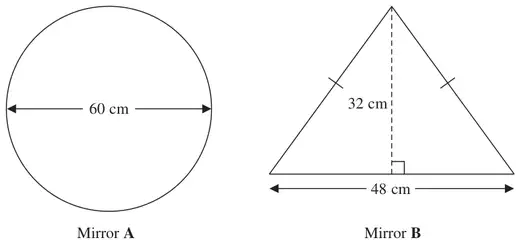
Mirror A is in the shape of a circle. This mirror has a diameter of 60 cm.
Mirror B is in the shape of an isosceles triangle. This mirror has base 48 cm and height 32 cm.
Inderpal buys metal strips to put around the edge of each mirror. The metal strip is sold in lengths of one metre. Each one metre length of metal strip costs £5.68
(b) Work out the total amount Inderpal pays. You must show all your working. (4)
Mark scheme (a)
Answer
Mark
Notes
40
3
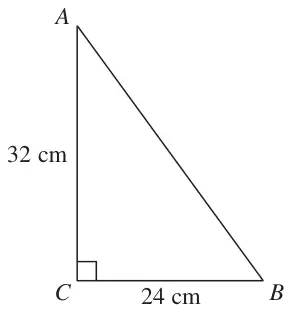
M1 for 32² + 24² M1 for \(\sqrt{1600}\) or \(\sqrt{32^2 + 24^2}\) A1 cao
Mark scheme (b)
Answer
Mark
Notes
22.72
4
M1 for use of \(\pi \times 60\) oe M1 for method to calculate perimeter of triangle, eg 2 × ‘40’ + 48 (=128) M1(dep M2) for complete method to find total length of strip for both mirrors or to find the cost of strip for one mirror, eg 2 × £5.68 A1 for £22.72 from correct working
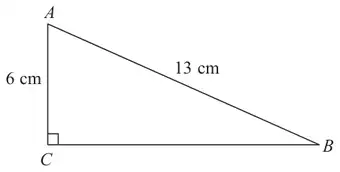
\(ABC\) is a right-angled triangle. \(AC = 6\) cm \(AB = 13\) cm
(a) Work out the length of \(BC\). Give your answer correct to 3 significant figures. (3)
Diagram NOT accurately drawn
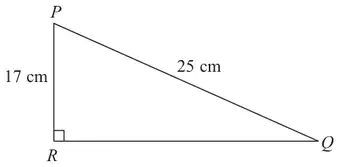
\(PQR\) is a right-angled triangle. \(PR = 17\) cm \(PQ = 25\) cm
(b) Work out the size of angle \(RPQ\). Give your answer correct to 1 decimal place. (3)
Mark scheme (a)
Answer
Mark
Notes
11.5
3
M1 for \(13^2 - 6^2\) or \(169 - 36\) or 133 M1 (dep on M1) for \(\sqrt{13^2 - 6^2}\) or \(\sqrt{133}\) A1 for answer in the range 11.5 − 11.6
Mark scheme (b)
Answer
Mark
Notes
47.2
3
M1 for \(\cos(RPQ) = \frac{17}{25}\) oe OR \(\sin PQR = \frac{17}{25}\) with \(PQR\) clearly identified M1 for (\(RPQ =\)) \(\cos^{-1}\frac{17}{25}\) oe OR \(PQR = \sin^{-1}\frac{17}{25}\) with \(PQR\) clearly identified A1 for answer in the range 47.1 − 47.2 SC : B2 for an answer of 0.823(033...) or 52.3(95...) or 52.4
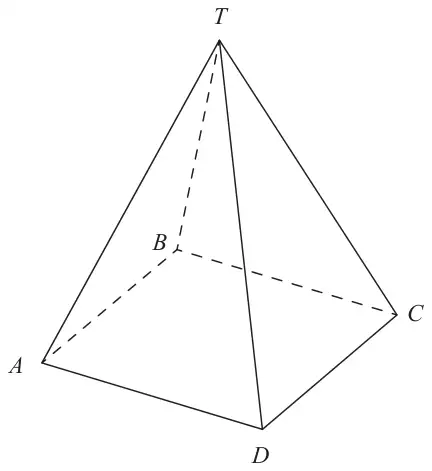
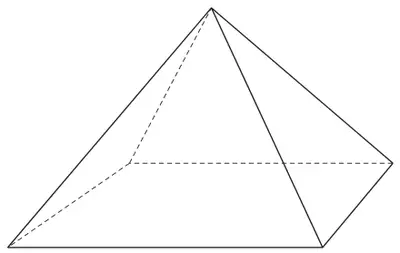
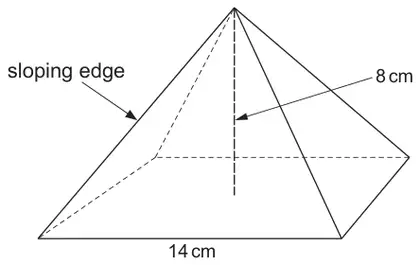
The other faces of the pyramid are equilateral triangles with sides of length 10 cm.
(a) Calculate the volume of the pyramid. Give your answer correct to 3 significant figures. (4)
(b) Find the size of angle \(DAB\). (2)
Mark scheme (a)
Working
Answer
Mark
Notes
Let \(O\) be the centre of the base. \(OB^2 + OC^2 = 10^2\) ; \(OB^2 = 50\) \(AO^2 = AB^2 - OB^2 = 50\) Vol \(= \frac{1}{3} \times 10^2 \times \sqrt{50}\) OR Let \(M\) be the midpt of side \(BC\) and let \(O\) be the centre of the base. \(AM^2 + MC^2 = 10^2\) ; \(AM^2 = 75\) \(AO^2 = AM^2 - MO^2 = 50\) Vol \(= \frac{1}{3} \times 10^2 \times \sqrt{50}\)
236
4
M1 correct method to start to find \(BD\) or \(BO\) using triangle \(OBC\) or triangle \(BCD\) (oe) Eg. \(OB^2 + OC^2 = 10^2\) or \(BO^2 = 50\) or \(BO = \sqrt{50}\) (=7.07..) or \(BO = \dfrac{\sqrt{200}}{2}\) or \(10^2 + 10^2 = BD^2\) or \(BD^2 = 200\) or \(BD = \sqrt{200}\) (=14.1..) M1 (dep) correct method to find height of pyramid using triangle \(AOB\) Eg. \(AO^2 = 10^2 -\) ‘\(\sqrt{50}\)’\(^2\) or \(AO^2 = 50\) or \(AO = \sqrt{50}\) (=7.07..) M1 (indep) \(\frac{1}{3} \times 10^2 \times\) ‘\(\sqrt{50}\)’ (but not \(\frac{1}{3} \times 10^2 \times 10\)) A1 235 – 236 OR M1 correct method to start to find height of a face using triangle \(AMC\) (oe) Eg. \(AM^2 + 5^2 = 10^2\) or \(AM^2 = 75\) or \(AM = \sqrt{75}\) (=8.66...) M1 (dep) correct method to find height of pyramid using triangle \(AOM\) Eg. \(AO^2 =\) ‘\(\sqrt{75}\)’\(^2 - 5^2\) or \(AO^2 = 50\) or \(AO = \sqrt{50}\) (=7.07..) M1 (indep) \(\frac{1}{3} \times 10^2 \times\) ‘\(\sqrt{50}\)’ (but not \(\frac{1}{3} \times 10^2 \times 10\)) A1 235 – 236 OR M1 for \(\sin 45 = \dfrac{x}{10}\) or \(\cos 45 = \dfrac{x}{10}\) M1 for \(h = 10 \times \sin 45\) or \(h = 10 \times \cos 45\) (=7.07..) M1 (indep) \(\frac{1}{3} \times 10^2 \times\) ‘7.07...’ (but not \(\frac{1}{3} \times 10^2 \times 10\)) A1 235 – 236
Mark scheme (b)
Working
Answer
Mark
Notes
Angle \(ABO = 45^\circ\) Angle \(DAB = 180 - 45 - 45\) OR In \(\Delta BAD\), \(\cos A = \dfrac{10^2 + 10^2 - \text{‘}\sqrt{200}\text{’}^2}{2 \times 10 \times 10} = 0\) OR In \(\Delta BOA\), \(\cos B = \dfrac{\text{‘}\sqrt{50}\text{’}}{10}\) Angle \(BAD = 180 -\) ‘45’ – ‘45’ OR \(\sin A = \dfrac{\text{‘}\sqrt{50}\text{’}}{10}\) \(A = 45\) Angle \(BAD = 2 \times\) ‘45’
M2 \(10^2 - (9 - 3)^2\) (=64) or \(BC = 8\) (M1 \(9 - 3\) (= 6) may be seen on diagram) M1 (indep) \(9^2 + \)‘\(BC\)’\(^2\) where \(BC\) is a numerical value M1 (dep on previous M1) \(\sqrt{81 + \text{‘64’}}\) A1 12.0 – 12.042
M1 for \(BD^2 + 12^2 = 16^2\) oe or \(16^2 - 12^2\) or 112 seen M1 for \(\sqrt{256 - 144}\) or \(\sqrt{112}\) (=10.58...) M1 for \(\sin 40 = \dfrac{\text{‘}10.58\text{’}}{CD}\) or \(\cos 50 = \dfrac{\text{‘}10.58\text{’}}{CD}\) M1 for (\(CD =\)) \(\dfrac{\text{‘}10.58\text{’}}{\sin 40}\) or \(\dfrac{\text{‘}10.58\text{’}}{\cos 50}\) A1 for 16.4 – 16.5 OR M1 for \(BD^2 + 12^2 = 16^2\) oe or \(16^2 - 12^2\) or 112 seen M1 for \(\sqrt{256 - 144}\) or \(\sqrt{112}\) (=10.58...) M1 for (\(BC =\)) ‘10.58’ × tan 50 or \(\dfrac{\text{‘}10.58\text{’}}{\tan 40}\) (=12.6…) M1 for \(\sqrt{\text{‘}12.6\text{’}^2 + \text{‘}10.58...\text{’}^2}\) A1 for 16.4 – 16.5
Use Pythagoras’ theorem to show that the value of \(x\) is between 10 and 11 [4 marks]
Mark scheme
Answer
Mark
Comments
\(12^2\) or \(13^2\)
M1
oe 144 or 169 implied by 313 or \(\sqrt{313}\) or [17.6, 17.7]
\(13^2 - 12^2\) or \(169 - 144\) or 25 or \(\sqrt{13^2 - 12^2}\) or \(\sqrt{169 - 144}\) or \(\sqrt{25}\) or 5
M1dep
oe 5 may be in correct position on the diagram
\(9^2 + (\text{their } 5)^2\) or \(81 +\) their 25 or 106 or \(\sqrt{9^2 + (\text{their } 5)^2}\) or \(\sqrt{81 + \text{their } 25}\) or \(\sqrt{106}\) or [10.2, 10.3]
M1dep
oe their 5 or their 25 must be from correct working
\(9^2 + 5^2 = 106\) and \(\sqrt{106}\) and [10.2, 10.3] or \(\sqrt{9^2 + 5^2}\) and [10.2, 10.3] or \(\sqrt{81 + 25}\) and [10.2, 10.3] or \(9^2 + 5^2 = 106\) and \(10^2 = 100\) and \(11^2 = 121\)
A1
oe
Additional guidance
Up to M2 may be awarded for correct work with no answer or incorrect answer, even if this is seen amongst multiple attempts
\(d^2 + d^2 = 10^2\) or \(2d^2 = 100\) or \((2r)^2 + (2r)^2 = 10^2\) or \(8r^2 = 100\)
M1
oe must use same letter for \(PQ\) and \(QR\)
\((d =)\ \sqrt{\dfrac{100}{2}}\) or \((d =)\ 5\sqrt{2}\) or \((d =)\ 7.07(1…)\) or \((d =)\ 7.1\) or \((r^2 =)\ \dfrac{100}{8}\) or \((r =)\ \dfrac{5}{2}\sqrt{2}\)
M1dep
oe eg \((d =)\ \sqrt{50}\)
3.5(3…) or 3.54 or 3.55
A1
Alternative method 2
\(\sin 45 = \dfrac{d}{10}\) or \(\cos 45 = \dfrac{d}{10}\)
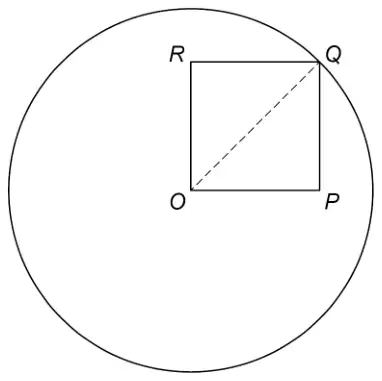
26 A circle, centre \(O\), has circumference \(20\pi\) cm
\(Q\) is a point on the circle.
\(OPQR\) is a square.
Not drawn accurately
perimeter of the square : circumference of the circle \(= \sqrt{a} : \pi \quad\) where \(a\) is an integer.
Work out the value of \(a\).
You must show your working. [4 marks]
Mark scheme
Answer
Mark
Comments
Alternative method 1
\(20\pi \div 2\pi\) or 10
M1
oe may be seen on diagram implied by diameter = 20
\(x^2 + x^2 = (\text{their } 10)^2\) or \(2x^2 = 100\) or \(x^2 = 50\) or their \(10 \times \sin 45\) or their \(10 \times \cos 45\) or their \(10 \times \dfrac{1}{\sqrt{2}}\)
M1
oe any letter (condone \(a\)) their 10 is their length \(OQ\) (the radius of the circle)
\(\sqrt{\text{their } 10^2 \div 2}\) or \(\sqrt{50}\) or \(5\sqrt{2}\) or \(4 \times \sqrt{50}\) or \(4 \times\) their \(10 \times \sin 45\) or \(4 \times\) their \(10 \times \cos 45\) or \(40 \times \dfrac{1}{\sqrt{2}}\) or \(\dfrac{40\sqrt{2}}{2}\) or \(20\sqrt{2}\)
M1dep
oe value for the length of one side of the square or the perimeter of the square eg \(\dfrac{10}{\sqrt{2}}\) dep on previous mark
2 with full working seen for M3
A1
Alternative method 2
\(20\pi \div 2\pi\) or 10 or side length of square \(= 5\sqrt{a}\)
M1
oe may be seen on diagram implied by diameter = 20
(Perimeter of square \(= 20\sqrt{a}\) and) side length of square \(= 5\sqrt{a}\) and \(\left(5\sqrt{a}\right)^2 + \left(5\sqrt{a}\right)^2 = (\text{their } 10)^2\)
M1
oe their 10 is their length \(OQ\) (the radius of the circle)
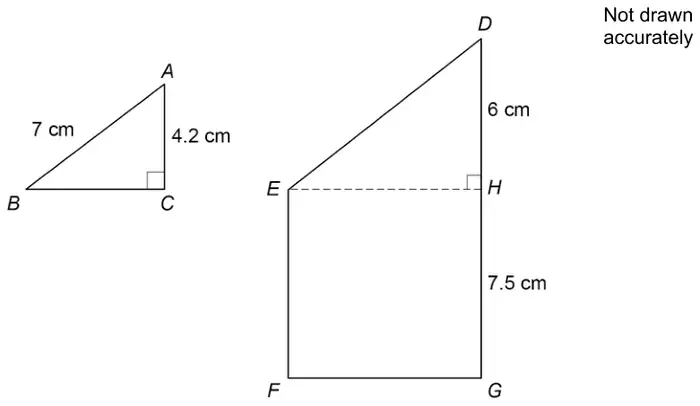
Alternative method 1 – Works out \(BC\) using Pythagoras then works out \(EH\)
\(7^2\) or 49 and \(4.2^2\) or 17.64
M1
oe
\(\sqrt{7^2 - 4.2^2}\) or \(\sqrt{49 - 17.64}\) or \(\sqrt{31.36}\) or 5.6
M1dep
oe implied by 11.76 as the area of the smaller triangle may be on diagram
\(6 \div 4.2 \times\) their 5.6 or 8
M1dep
oe full method to work out \(EH\) may be on diagram as \(EH\) or \(FG\) implied by 24 as the area of the larger triangle or 60 as the area of the rectangle
\(0.5 \times\) their \(8 \times 6\) or 24 and their \(8 \times 7.5\) or 60
M1dep
oe eg \(0.5 \times\) their \(5.6 \times 4.2 \times (6 \div 4.2)^2\) and their \(8 \times 7.5\) or \(0.5 \times\) their \(8 \times (7.5 + 13.5)\)
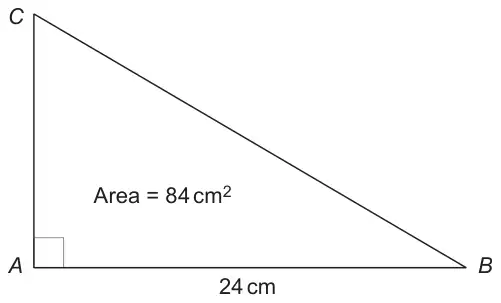
84
A1
Alternative method 2 – Works out \(ED\) using similar triangles then works out \(EH\)
\(6 \div 4.2 \times 7\) or 10
M1
oe may be on diagram
(their \(10)^2\) or 100 and \(6^2\) or 36
M1dep
oe
\(\sqrt{(\text{their } 10)^2 - 6^2}\) or \(\sqrt{100 - 36}\) or \(\sqrt{64}\) or 8
M1dep
oe full method to work out \(EH\) may be on diagram as \(EH\) or \(FG\) implied by 24 as the area of the larger triangle or 60 as the area of the rectangle
\(0.5 \times\) their \(8 \times 6\) or 24 and their \(8 \times 7.5\) or 60
M1dep
oe eg \(0.5 \times\) their \(5.6 \times 4.2 \times (6 \div 4.2)^2\) and their \(8 \times 7.5\) or \(0.5 \times\) their \(8 \times (7.5 + 13.5)\)
84
A1
Alternative method 3 – Uses trigonometry to work out \(BC\) then works out \(EH\) or uses trigonometry to work out \(EH\)
(angle \(ABC =\)) \(\sin^{-1}\left(\dfrac{4.2}{7}\right)\) or (angle \(ABC =\)) [36.8, 36.9] or (angle \(BAC =\)) \(\cos^{-1}\left(\dfrac{4.2}{7}\right)\) or (angle \(BAC =\)) [53.1, 53.2]
M1
oe full method to work out \(ABC\) or \(BAC\)
\(7 \times \cos\) (their [36.8, 36.9]) or \(7 \times \sin\) (their [53.1, 53.2]) or 5.6 or \(\tan\) (their [36.8, 36.9]) \(= \dfrac{6}{EH}\) or \(\tan\) (their [53.1, 53.2]) \(= \dfrac{EH}{6}\)
M1dep
oe full method to work out \(BC\) or partial method to work out \(EH\)
\(6 \div 4.2 \times\) their 5.6 or 8 or \(6 \div \tan\) (their [36.8, 36.9]) or \(6 \times \tan\) (their [53.1, 53.2])
M1dep
oe full method to work out \(EH\) may be on diagram as \(EH\) or \(FG\) implied by 24 as the area of the larger triangle or 60 as the area of the rectangle
\(0.5 \times\) their \(8 \times 6\) or 24 and their \(8 \times 7.5\) or 60
M1dep
oe eg \(0.5 \times\) their \(5.6 \times 4.2 \times (6 \div 4.2)^2\) and their \(8 \times 7.5\) or \(0.5 \times\) their \(8 \times (7.5 + 13.5)\)
84
A1
Additional guidance
Up to M3 may be awarded for correct work with no answer, or incorrect answer, even if this is seen amongst multiple attempts
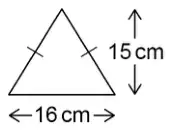
12 An isosceles triangle has base 16 cm and perpendicular height 15 cm
Not drawn accurately
Some of these triangles are used to make a large triangle.
Not drawn accurately
Work out the perimeter of the large triangle. [4 marks]
Mark scheme
Answer
Mark
Comments
Alternative method 1
\(15^2\) or 225 and \((16 \div 2)^2\) or \(8^2\) or 64
M1
oe
\(\sqrt{15^2 + (16 \div 2)^2}\) or \(\sqrt{\text{their } 225 + \text{their } 64}\) or \(\sqrt{289}\) or 17
M1dep
oe full trigonometric method leading to 17 scores M2 eg \(\dfrac{15}{\sin\left(\tan^{-1}\dfrac{15}{8}\right)}\)
\(6 \times\) their \(17 + 3 \times 16\) or \(102 + 48\)
M1dep
oe
150
A1
SC2 \(48 + 6\sqrt{161}\) or [124.08, 124.2]
Alternative method 2
\((48 \div 2)^2\) or \(24^2\) or 576 and \((15 \times 3)^2\) or \(45^2\) or 2025
M1
oe eg \((16 \times 1.5)^2\) and \((3 \times 15)^2\)
\(\sqrt{(48 \div 2)^2 + (3 \times 15)^2}\) or \(\sqrt{\text{their } 576 + \text{their } 2025}\) or \(\sqrt{2601}\) or 51
M1dep
oe full trigonometric method leading to 51 scores M2 eg \(\dfrac{45}{\sin\left(\tan^{-1}\dfrac{15}{8}\right)}\) or \(\dfrac{45}{\sin\left(\tan^{-1}\dfrac{45}{24}\right)}\)
\(2 \times\) their \(51 + 3 \times 16\) or \(102 + 48\)
M1dep
oe
150
A1
SC2 \(48 + 6\sqrt{161}\) or [124.08, 124.2]
Additional guidance
\(15^2 - 8^2\) or \(45^2 - 24^2\)
M1M0M0A0 (unless SC2 scored)
Allow 61.9(2…) or 61.93 or 62 for \(\tan^{-1}\dfrac{15}{8}\) but do not award A1 if premature approximation seen
Correct use of Pythagoras’ theorem using a square root
Alternative method 2
\(\sin E = \dfrac{8}{17}\;\) or \(\;\cos A = \dfrac{8}{17}\) or \(E = 28.(\ldots)\) or \(A = 61.9(\ldots)\) or 62 and \(\cos 28.(\ldots) = \dfrac{EM}{17}\) or \(\tan 28.(\ldots) = \dfrac{8}{EM}\) or \(\sin 61.9(\ldots) = \dfrac{EM}{17}\) or \(\tan 61.9(\ldots) = \dfrac{EM}{8}\)
M1
\(17 \cos 28.(\ldots)\) or \(8 \div \tan 28.(\ldots)\) or \(17 \sin 61.9(\ldots)\) or \(8 \tan 61.9(\ldots)\)
A1
Additional guidance
8, 15, 17 on their own
M0A0
\(EM^2 = 289 - 64 = 225,\ EM = 15\)
M1A0
Mark scheme (b)
Answer
Mark
Comments
Alternative method 1
\(30^2 + (16 \div 2)^2\) or \(\;30^2 + 8^2\) or 964
M1
oe
\(\sqrt{\text{their } 964}\) or \(2\sqrt{241}\) or [31, 31.1]
M1dep
oe CM
\(\tan x = \dfrac{15}{\text{their } [31,\ 31.1]}\)
M1dep
oe \(\;\) eg \(\;90 - \tan^{-1} \dfrac{\text{their } [31,\ 31.1]}{15}\) dep on M1 M1
[25.7, 26]
A1
Alternative method 2
\(30^2 + 17^2\) \(\;\) or \(\;\) 1189
M1
oe
\(\sqrt{\text{their } 1189}\) or [34.4, 34.5]
M1dep
oe CE
\(\sin x = \dfrac{15}{\text{their } [34.4,\ 34.5]}\)
M1dep
oe \(\;\) eg \(\;90 - \cos^{-1} \dfrac{15}{\text{their } [34.4,\ 34.5]}\) or \(\dfrac{\sin x}{15} = \dfrac{\sin 90}{\text{their } [34.4,\ 34.5]}\) dep on M1 M1
[25.7, 26]
A1
Alternative method 3
\(30^2 + (16 \div 2)^2\) or 964 or \(\;30^2 + 17^2\) or 1189
M1
oe
\(\sqrt{\text{their } 964}\) or \(2\sqrt{241}\) or [31, 31.1] or \(\sqrt{\text{their } 1189}\) or [34.4, 34.5]
M1dep
oe CM CE
\(\cos x = \dfrac{\text{their } [31,\ 31.1]}{\text{their } [34.4,\ 34.5]}\)
M1dep
oe \(\;\) eg \(\;90 - \sin^{-1} \dfrac{\text{their } [31,\ 31.1]}{\text{their } [34.4,\ 34.5]}\) dep on M1 M1
[25.7, 26]
A1
Alternative method 4
\(17^2 - (16 \div 2)^2\) or 225 or \(30^2 + (16 \div 2)^2\) or 964 or \(30^2 + 17^2\) or 1189
Work out the value of \(x\) as a decimal. [3 marks]
Mark scheme
Answer
Mark
Comments
\(8^2\) and \(3^2\) seen or \(8 \times 8\) and \(3 \times 3\) seen or 64 and 9 seen or 55
M1
M2 for \(\sin^{-1}\left(\dfrac{3}{8}\right) = 22.(\ldots)\) and \(8\cos(\text{their } 22.(\ldots))\) or \(\cos^{-1}\left(\dfrac{3}{8}\right) = 67.(\ldots)\) or 68 and \(8\sin(\text{their } 67.(\ldots))\)
\(\sqrt{8^2 - 3^2}\) or \(\sqrt{64 - 9}\) or \(\sqrt{55}\)
M1dep
[7.4, 7.42]
A1
Additional guidance
\(\sqrt{8^2 + 3^2}\) or \(\sqrt{64 + 9}\) or \(8^2 + 3^2\) or \(64 + 9\)
M1M0depA0
Only \(\sqrt{73}\) or only 73 or only 8.5...
M0
If trigonometry used it must be a fully correct method that would lead to the correct value of \(x\)
Partial method using trigonometry
M0
Ignore units given
8 cm\(^2\) is not \(8^2\) unless recovered
Correct answer in range seen, ignore further work if truncates or rounds
M2A1
\(8^2 = 16\) and \(3^2 = 6,\ \sqrt{16 - 6}\)
M1M1depA0
Scale drawing with answer in range [7.4, 7.42]
M2A1
Scale drawing with answer not in range [7.4, 7.42]
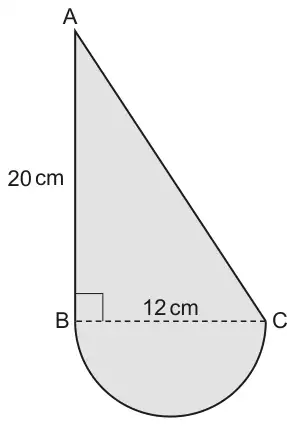
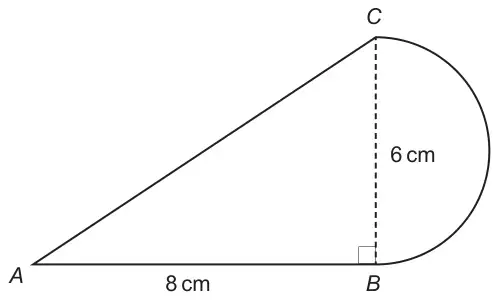
28 The shaded shape below is made from a right-angled triangle, ABC, and a semicircle. The length of AB is 20 cm and the diameter of the semicircle, BC, is of length 12 cm.
Not to scale
Calculate the perimeter of the shaded shape. You must show your working. [6]
Mark scheme
Answer
Marks
Part marks and guidance
62.16 to 62.18 or 62.2 with correct working or
\(4\sqrt{34} + 6\pi + 20\) oe with correct working
6
Correct working requires at least the first M1AND the second M1
M2 for \(\sqrt{20^2 + 12^2}\) or M1 for \(20^2 + 12^2\) maybe implied by 544
Award M and A marks even if not used to find final answer and not contradicted
A1 for 23.3… or \(4\sqrt{34}\) or \(\sqrt{544}\) oe with correct working
Award M2 A1 if M1A1 seen
AND M2 for \(\dfrac{12\pi}{2}\) maybe implied by \(6\pi\) or by 18.84 to 18.852 or M1 for \(12\pi\) maybe implied by 37.68 to 37.704
Award M marks even if not used to find final answer and not contradicted
Their \(12\pi\) must not come from area calculation or from \(2 \times \pi \times 12 \div 2\)
If 0,1 or 2 scored, instead award SC3 for answer 62.16 to 62.18 or 62.2 or \(4\sqrt{34} + 6\pi + 20\) or \(\sqrt{544} + 6\pi + 20\) with no working or insufficient working
If 0 or 1 scored, instead award SC2 for answer 42.16 to 42.18 or 42.2 or \(4\sqrt{34} + 6\pi\) or \(\sqrt{544} + 6\pi\) with no working or insufficient working
If 0 scored, instead award SC1 for 23.3… or \(4\sqrt{34}\) or \(\sqrt{544}\) or 43.3… or \(4\sqrt{34} + 20\) or \(\sqrt{544} + 20\) with no working or insufficient working
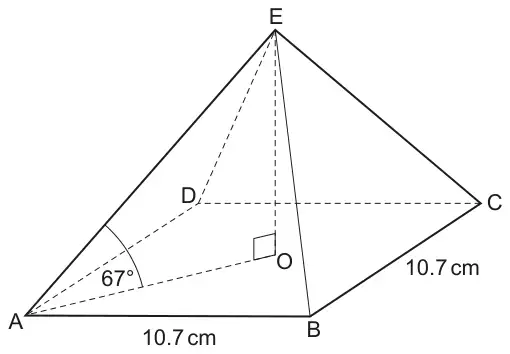
22 The diagram shows a square-based pyramid ABCDE. O is the centre of the base.
The length of the base is 10.7 cm. Angle EAO is 67°.
Calculate the length of AE. You must show your working. [6]
Mark scheme
Answer
Marks
Part marks and guidance
19.3[4…] to 19.3[7…] or 19.4 with correct working
6
M2 for \(\left[\frac{1}{2} \times\right]\sqrt{10.7^2 + 10.7^2}\) or for \(\sqrt{5.35^2 + 5.35^2}\) or for \(\left[\frac{1}{2} \times\right] \frac{10.7}{\cos 45}\) or \(\left[\frac{1}{2} \times\right] \frac{10.7}{\sin 45}\) or for \(\frac{5.35}{\cos 45}\) or \(\frac{5.35}{\sin 45}\) or M1 for \(10.7^2 + 10.7^2\) or \(5.35^2 + 5.35^2\) or for \(\cos 45 = \frac{10.7}{\text{AC}}\) oe or \(\sin 45 = \frac{10.7}{\text{AC}}\) oe or for \(\cos 45 = \frac{5.35}{\text{AO}}\) oe or \(\sin 45 = \frac{5.35}{\text{AO}}\) oe
Correct working requires evidence of at least M1 AND M1 Accept intermediate values rot to at least 3sf.
If M1A1 seen then award M2A1
AO
AE
7.5
19.19478
7.56
19.34834
7.566
19.3637
7.566043
19.36381
7.57
19.37394
7.6
19.45072
A1 for 7.56 to 7.57 or 7.6
AND
M2 for \(\frac{\textit{their } 7.566\ldots}{\cos 67}\) or \(\frac{\textit{their } 7.566\ldots}{\sin 23}\) or \(\frac{\text{AE}}{\sin 90} = \frac{\textit{their } 7.566\ldots}{\sin 23}\) or M1 for \(\cos 67 = \frac{\textit{their } 7.566\ldots}{\text{AE}}\) oe or \(\sin 23 = \frac{\textit{their } 7.566\ldots}{\text{AE}}\) oe or \(\frac{\sin 90}{\text{AE}} = \frac{\sin 23}{\textit{their } 7.566}\) oe
their 7.566…must follow from the award of the first M2
If 0, 1 or 2 scored, instead award SC3 for answer 19.3 to 19.4 with no or insufficient working If 0 or M1 scored, instead award SC2 for 7.56 to 7.57 or 7.6 with no or insufficient working If 0 scored instead award SC1 for 15.1[3…] or 57.2… with no or insufficient working
Mark less efficient methods by considering how many steps remain to reach the correct answer and match against the most comparable stage: eg Assuming AO has been found, then using trig to find EO is unnecessary and inefficient, so no further marks are awarded for just finding EO and stopping. However, if EO is then used in a correct Pythagoras expression with AO or a correct trig expression with 67° that lead directly or indirectly to finding AE, then M2 or M1 may be awarded.
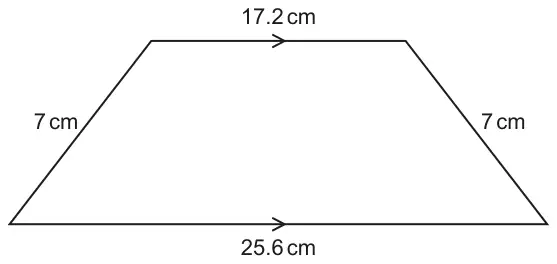
Calculate the area of the trapezium. You must show your working. [5]
Mark scheme
Answer
Marks
Part marks and guidance
119.8[4] with correct working
5
M1 for \(\frac{25.6 - 17.2}{2}\) oe or 4.2
Correct working requires evidence of at least M2 or M1M1
M2 for \(\sqrt{7^2 - (\textit{their}\,4.2)^2}\) or better or 5.6 or M1 for \([h]^2 + (\textit{their}\,4.2)^2 = 7^2\) or 31.36
their 4.2 must be an attempt at \(\frac{25.6 - 17.2}{2}\) and must be less than 7
M1 for \(\frac{25.6 + 17.2}{2} \times \textit{their height}\) oe
for their height do not allow 7 but condone e.g. 31.36
If 0 or 1 scored, instead SC3 for answer 119.8[4] with no or insufficient working
Longer methods must be complete and correct : e.g. M1 for 4.2 as before M1 for e.g. \(\cos^{-1}(4.2 \div 7) = 53.13\ldots\) M1 for e.g. \(7\sin(53.13) = 5.59\ldots\) or 5.6 M1 for area as before
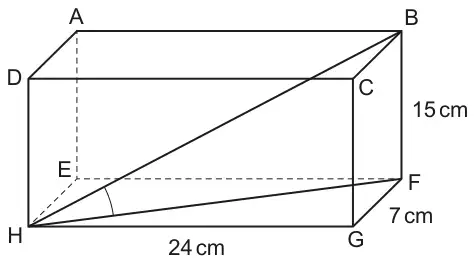
Calculate the angle BHF. You must show your working. [5]
Mark scheme
Answer
Marks
Part marks and guidance
30.9 to 31 with correct working
5
M2 for \(\sqrt{(24^2 + 7^2)}\) or M1 for \([\ldots]^2 = 24^2 + 7^2\)
and
M2 for \(\tan^{-1} \frac{15}{\textit{their } 25}\) oe or M1 for \(\tan(\text{BHF}) = \frac{15}{\textit{their } 25}\) oe
Correct working requires evidence of at least M1M1 Alternative method: M2 for \(\sqrt{(24^2 + 7^2 + 15^2)}\) or M1 for \([\ldots]^2 = 24^2 + 7^2 + 15^2\)
and
M2 for \(\sin^{-1} \frac{15}{\textit{their } \sqrt{850}}\) oe or M1 for \(\sin(\text{BHF}) = \frac{15}{\textit{their } \sqrt{850}}\) oe
Other methods: M2 for a correct expression that would give correct HF or HB or M1 for “one-step away” eg \(\sin\left(\tan^{-1}\left(\frac{7}{24}\right)\right) = \frac{7}{\text{HF}}\) and M2 for correct trig inverse expression with angle BHF or M1 for correct trig expression with angle BHF
If 0 or 1 scored, instead award SC2 for answer 30.9 to 31 with no or insufficient working If 0 scored, instead award SC1 for [HF =] 25 or for [HB =] \(\sqrt{850}\) oe or 29.1 to 29.2
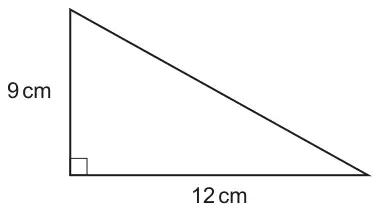
(a) The diagram shows the cross-section of a triangular prism.
Not to scale
Work out the area of the cross-section. [2]
(b) This diagram shows the triangular prism.
Not to scale
Work out the total surface area of the triangular prism. You must show your working. [5]
(c) Two of these triangular prisms are joined to make a new prism.
Give a reason why the total surface area of this prism is not two times your answer in part (b). [1]
Mark scheme (a)
Answer
Marks
Part marks and guidance
54
2
M1 for \(\dfrac{9 \times 12}{2}\) oe
Mark scheme (b)
Answer
Marks
Part marks and guidance
828 with correct working
5
Correct working requires evidence of at least M1or B2 (Pythagoras) and M2 (area)
B2 for [hypotenuse =] 15 or M1 for \(9^2 + 12^2\)
AND
M2 for 2 from 2 × theirpart(a), \(20 \times 9\), \(20 \times 12\), \(20 \times\) their \(\sqrt{9^2 + 12^2}\)
or
M1 for 1 from 2 × theirpart(a), \(20 \times 9\), \(20 \times 12\), \(20 \times\) their \(\sqrt{9^2 + 12^2}\)
Allow restart for area of triangle May be implied by 108, 180, 240, 300
If 0 or 1, scored instead award SC2 for 828 with no or insufficient working
Mark scheme (c)
Answer
Marks
Part marks and guidance
Reason that recognises the loss of part of the surface [of the triangular prisms] e.g. [The value of] two rectangular areas are lost /no longer on the surface oe
1
Accept e.g. faces/rectangles/slanting faces/sections for rectangular areas less/reduced for lost
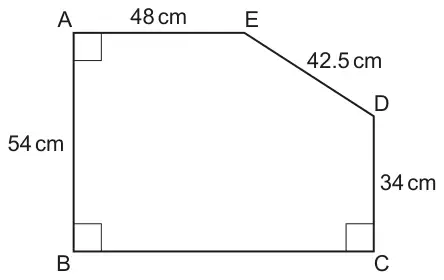
Find the area of the pentagon. You must show your working. [6]
Mark scheme
Answer
Marks
Part marks and guidance
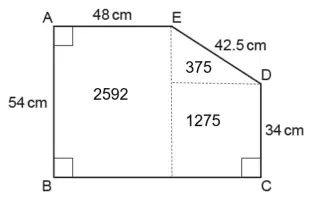
4242 with correct working
6
“Correct working” requires evidence of either M2 or M1 M1
M2 for \(\sqrt{42.5^2 - 20^2}\) or M1 for \([\ldots]^2 + 20^2 = 42.5^2\) or B1 for 20
M2 implied by 37.5
Accept any correct method for the area e.g. M1 for (48 + their 37.5) × 54 or 4617 M1 for \(\frac{1}{2} \times\) their 37.5 × 20 or 375 M1 for their 4617 – their 375
Alternative for area e.g. : M1 for 48 × 54 implied by 2592 M1 for \(\frac{1}{2} \times (54 + 34) \times\) their 37.5 implied by 1650 M1 for their 2592 + their 1650 OR M1 for 48 × 54 implied by 2592 M1 for 34 × their 37.5 + \(\frac{1}{2} \times\) their 37.5 × 20 implied by 1275 + 375 M1 for their 2592 + their 1275 + their 375 i.e adding all their areas together
If 0, 1 or 2 marks scored instead award SC3 for answer 4242 with no or insufficient working
If 0 or M1 scored instead award SC2 for 37.5 with no or insufficient working
Note : M1 M1 M1 for the area requires a correct method
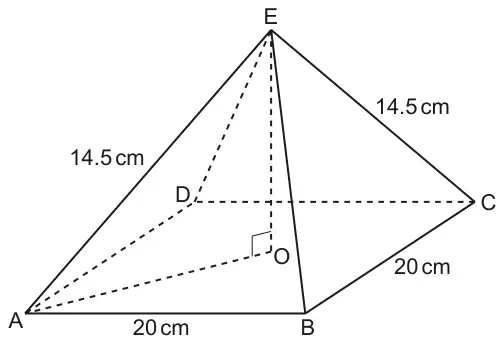
14 The diagram shows a square-based pyramid ABCDE. O is the centre of the base.
The pyramid has base length 20 cm and each sloping edge has length 14.5 cm.
(a) Draw the plan view of the pyramid on the one-centimetre grid below.
Scale: 1 cm represents 4 cm.
[2]
(b) Calculate the volume of the pyramid. You must show your working.
[The volume of a pyramid is \(\frac{1}{3}\) × area of base × perpendicular height] [5]
Mark scheme (a)
Answer
Marks
Part marks and guidance
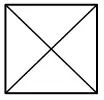
with side 5 cm
2
B1 for a square drawn with side 5 cm or for a square of any length with two diagonals
Mark intention 2mm tolerance radially on centre point by eye
Mark scheme (b)
Answer
Marks
Part marks and guidance
\(\frac{200\sqrt{41}}{3}\) or 426.6 to 427 with correct working
5
M3 for \(\sqrt{14.5^2 - 10^2 - 10^2}\) oe
or M2 for \(14.5^2 - 10^2 - 10^2\) oe or M1 for \(14.5^2 = 10^2 + 10^2 + h^2\) or for \(10^2 + 10^2\) oe implied by 200 or for \(\sqrt{10^2 + 10^2}\) oe implied by 14.1…or \(10\sqrt{2}\) or for \(20^2 + 20^2\) oe implied by 800 or for \(\sqrt{20^2 + 20^2}\) oe implied by 28.2[8..], 28.3 …or \(20\sqrt{2}\)
AND
M1 for \(\frac{1}{3} \times 20 \times 20 \times their\ 3.2[0]\) or for \(\frac{1}{3} \times 400 \times their\ 3.2[0]\)
If 0 or 1 scored, instead award SC2 for \(\frac{200\sqrt{41}}{3}\) or 426.6 to 427 with no or insufficient working
If 0 scored, SC1 for \(\frac{\sqrt{41}}{2}\) or \(\sqrt{10.25}\) or 3.2[0] to 3.211 with no or insufficient working
‘Correct working’ requires evidence of at least three M marks Working may be on diagram May be seen in stages Method must be seen for M3 (3.2[0] to 3.211 or \(\frac{\sqrt{41}}{2}\) or \(\sqrt{10.25}\) ) (10.25)
May be seen in stages
For M3 and M2 condone \(10\sqrt{2}{}^2\) for \((10\sqrt{2})^2\) which may lead to wrong answer for M2 of 190.25 or for M3 of 13.79…
Their 3.2[0] must be in the range 3.2[0] to 3.211 and must come from an attempt at 3D trig or 3D Pythagoras
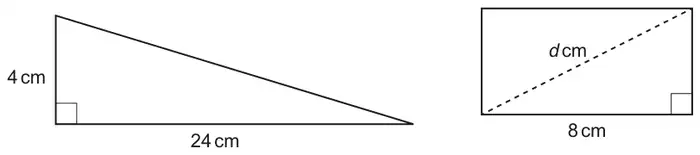
25 The diagram shows a right-angled triangle and a rectangle.
Not to scale
The triangle and rectangle have the same area.
Calculate the length, \(d\) cm, of the diagonal of the rectangle. You must show your working.
\(d =\) .................... cm [6]
Mark scheme
Answer
Marks
Part marks and guidance
10 with correct working
6
M1 for \(\dfrac{24 \times 4}{2}\)
M1 for height of rectangle = their \(\dfrac{24 \times 4}{2} \div 8\) A1 for [height of rectangle =] 6
AND
M2 for \(\sqrt{8^2 + (\textit{their } 6^2)}\) or better or M1 for [\(d^2 =\) ] \(8^2 + (\textit{their } 6)^2\)
If 0, 1 or 2 scored, instead award SC3 for answer 10 with no or insufficient working If 0 or 1 instead award SC2 for [height of rectangle =] 6 with no or insufficient working If 0 scored, instead award SC1 for [area of triangle =] 48 with no or insufficient working
“Correct working” requires evidence of at least M1A1 AND M1
M1 Allow embedded e.g. \(8 \times 6 = 48\)
Could be shown on the diagram
their 6 must be clearly identified as the height of the rectangle, e.g. written on the diagram.
Eg SC3 Insufficient working includes statement that 6, 8, 10 is a Pythagorean triple
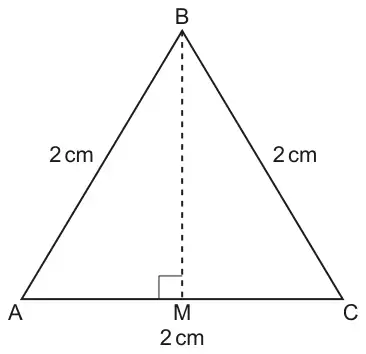
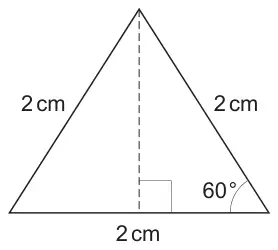
15 ABC is an equilateral triangle of side length 2 cm. M is the midpoint of AC.
Not to scale
Using this diagram, show that \(\tan 30^\circ = \dfrac{1}{\sqrt{3}}\). [4]
Mark scheme
Answer
Marks
Part marks and guidance
Correctly shows \(\tan 30^\circ = \frac{1}{\sqrt{3}}\) with supporting working
4
Using triangle MBC (mark similarly for use of triangle MBA):
B1 for MBC = 30° or MC = 1 [cm] soi by use in Pythagoras
M2 for [BM =] \(\sqrt{2^2 - 1^{[2]}}\) or \(\sqrt{4 - 1}\) [\(= \sqrt{3}\)] or for [BM2 =] \(2^2 - 1^{[2]}\) oe and \(\sqrt{3}\)
or M1 for \(\text{BM}^2 + 1^{[2]} = 2^2\) oe OR B1 for MCB = 60° or MC = 1 [cm] soi by use in cos rule
M2 for \(\sqrt{2^2 + 1^{[2]} - 2 \times 2 \times 1 \times \cos 60}\) and \(\cos 60 = \frac{1}{2}\) soi [\(= \sqrt{3}\)] or M1 for \(2^2 + 1^{[2]} - 2 \times 2 \times 1 \times \cos 60\) OR B1 for MCB = 60° soi by use in sine ratio or sine rule M2 for [\(x\) = ] 2sin 60 oe and \(\sin 60 = \frac{\sqrt{3}}{2}\) soi [\(= \sqrt{3}\)] or M1 for \(\frac{\sin 60}{x} = \frac{\sin 90}{2}\) oe AND A1dep for MBC = 30° stated/on diagram and \(\tan 30^\circ = \frac{1}{\sqrt{3}}\) and with no errors seen leading to the answer
If 0 or 1 scored, SC2 for \(\dfrac{\sin 30}{\cos 30} = \dfrac{\frac{1}{2}}{\frac{\sqrt{3}}{2}}\) and \(\tan 30 = \frac{1}{\sqrt{3}}\) May be on diagram
For M2 must show the subtraction, do not allow \(\text{BM}^2 + 1^{[2]} = 2^2\) and then \(\sqrt{3}\), this gets M1 only
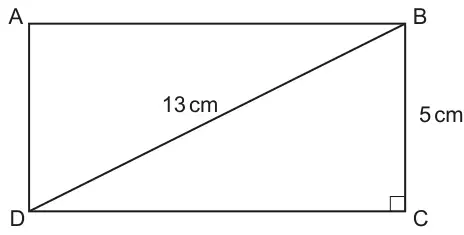
Calculate the area of the rectangle. You must show your working. [5]
Mark scheme
Answer
Marks
Part marks and guidance
60 with correct working
5
B3 for 12 as third side with correct working or M2 for \(\sqrt{13^2 - 5^2}\) oe or M1 for \(13^2 = 5^2 + [\text{DC}^2]\)
OR M1 for \(\angle\text{BDC} = \sin^{-1}\left(\dfrac{5}{13}\right)\) oe or \(\angle\text{CBD} = \cos^{-1}\left(\dfrac{5}{13}\right)\) oe M1 for \(13 \cos\) their \(\angle\text{BDC}\) or \(13 \sin\) their \(\angle\text{CBD}\)
AND
M1 for \(5 \times\) their DC (or AB)
If 0 or 1 scored with no/insufficient working SC2 for answer 60 or If 0 scored with no/insufficient working SC1 for 12 as third side
For full marks, correct working requires Pythagoras or trig leading to 12 For B3 “correct working” requires evidence of M2 or M1 or mention of 5:12:13 triangle
22.6… or 67.3 to 67.4 oe may be in \(\triangle\)ABD
Their DC (or AB) not = 13.
If M1 scored and SC2 available, award SC2 only May be on diagram
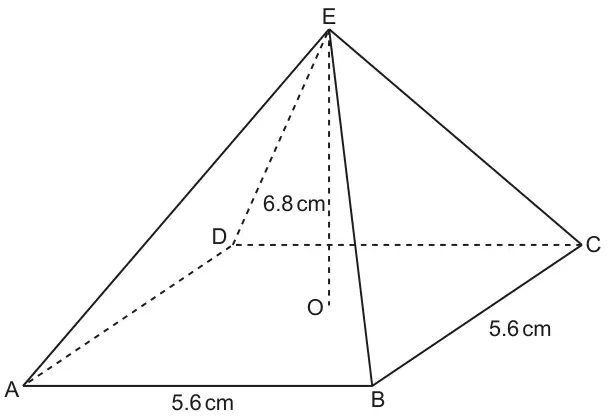
The pyramid has a square horizontal base ABCD with side 5.6 cm. The vertex E is vertically above the centre O of the base. The height OE of the pyramid is 6.8 cm.
Calculate the surface area of the pyramid. You must show your working. [5]
Mark scheme
Answer
Marks
Part marks and guidance
113 to 114 with correct working
5
Check diagram for incorrect triangle.
“Correct working” requires evidence of at least M2 AND M1 ie correct triangle with Pythagoras and area of a triangle
Correct triangle or no triangle indicated: M2 for \(\sqrt{6.8^2 + 2.8^2}\) [= 7.35…] or for full alternative method or M1 for \(6.8^2 + 2.8^2\) [= 54.08 or 54.1]
AND M2 for \(5.6 \times 5.6 + 4 \times \dfrac{1}{2} \times 5.6 \times \textit{their } 7.35\ldots\) or M1 for \(\dfrac{1}{2} \times 5.6 \times \textit{their } 7.35\ldots\)
eg Finding AC, AO, AE then the height (AC = 7.919…, AE = 7.868…)
Incorrect triangle indicated: M1 for complete Pythagoras to find hypotenuse with a maximum of one incorrect dimension
eg EB found as \(\sqrt{6.8^2 + 2.8^2}\) is using an incorrect dimension for OB
If 0 or M1 scored, instead award SC2 for answer 113 to 114 with no or insufficient working If 0 scored SC1 for 7.35 either correctly placed on diagram or with no working
18 A triangle has sides of length 14.1 cm, 14.8 cm and 19.5 cm.
Is this a right-angled triangle? Show how you decide.
.................. because .................. [4]
Mark scheme
Answer
Marks
Part marks and guidance
No, with full correct working and a statement referring to correct comparable values
4
M3 for \(\sqrt{14.1^2 + 14.8^2} = 20.4\) to 20.5 or \(14.1^2 + 14.8^2 = 417.8\) to 417.9 and \(19.5^2 = 380.2\) to 380.3
OR
M2 for \(\sqrt{14.1^2 + 14.8^2}\) or \(14.1^2 + 14.8^2\) and \(19.5^2\)
OR
M1 for \(14.1^2 + 14.8^2\)
If 0 scored, SC2 for 20.4 to 20.5 or 12.6 to 12.7 or 13.4 to 13.5 with no or insufficient working or SC1 for 417.8 - 417.9 or 161.2 - 161.21 or 181.4 to 181.44 with no or insufficient working
Do not accept a scale drawing method Need No and a comment for 4 marks Need to see evidence
Accept equivalent alternative methods e.g. using subtraction: M3 for \(\sqrt{19.5^2 - 14.8^2} = 12.6\) to 12.7 OR M2 for \(\sqrt{19.5^2 - 14.8^2}\) OR M1 for \(19.5^2 - 14.8^2\)
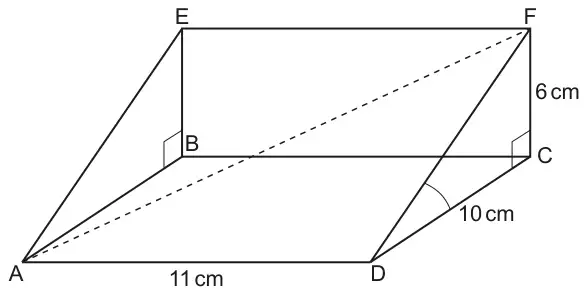
18 The diagram shows a right-angled triangular prism ABCDEF.
Length AD = 11 cm, length CD = 10 cm and length CF = 6 cm.
(a) Calculate the volume of the prism. [2]
(b) Use trigonometry to show that angle FDC = 31°, correct to the nearest degree. [2]
(c) Calculate the exact length of AF. [4]
Mark scheme (a)
Answer
Marks
Part marks and guidance
330
2
M1 for \(\frac{1}{2} \times 10 \times 6 \times 11\)
Mark scheme (b)
Answer
Marks
Part marks and guidance
tan […] = \(\frac{6}{10}\) oe
1
accept any correct method, equivalents include tan-1(0.6)
30.9[…]
1
Mark scheme (c)
Answer
Marks
Part marks and guidance
\(\sqrt{257}\) cao
4
M3 for \(\sqrt{11^2 + 10^2 + 6^2}\) or better or M2 for 112 + 102 + 62 or M1 for 112 + 102 or 102 + 62 or [FD =] \(\frac{10}{\cos 31}\) or \(\frac{6}{\sin 31}\)
implied by 16.0[3…]
implied by 257
implied by [FD =] \(\sqrt{136}\) or 11.6 to 11.7 or [AC =] \(\sqrt{221}\) or 14.8 to 14.9
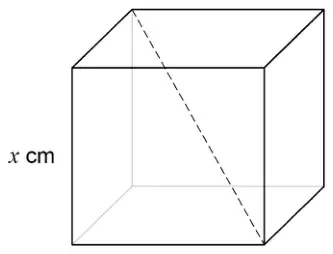
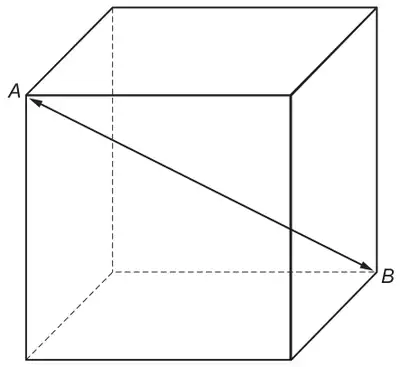
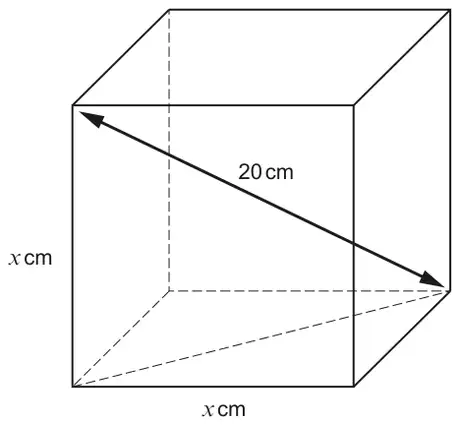
14 The length of the longest diagonal of a cube is 25 cm.
Calculate the total surface area of the cube. [5]
Mark scheme
Answer
Marks
Part marks and guidance
1250 nfww
5
M4 for [\(6x^2 =\)] 2 × 625 or B4 for final answer 1244 to 1250.05 OR M1 for \(3x^2\) oe or 625 and M1 for \(3x^2 = 625\) oe and A1 for [\(x =\)] \(\sqrt{\dfrac{625}{3}}\) or \(\dfrac{25\sqrt{3}}{3}\) oe or 14.4 to 14.434 soi (14.4 to 14.434 seen implies M1M1A1) and M1 for 6 × their \(x^2\)
If 0 scored, SC1 for starting from \(x^2 = 25\) and final answer 150 or starting from \(2x^2 = 25\) and final answer 75
Special cases: Starting from \(3x^2 = 25\) oe soi M1M0 for \(3x^2 = 25\) A1 for [\(x =\)] \(\sqrt{\dfrac{25}{3}}\) or \(\dfrac{5\sqrt{3}}{3}\) oe or 2.88 to 2.89 soi (2.88 to 2.89 seen implies M1M0A1) M1 for 6 × their \(x^2\) soi by 50
Starting from \(2x^2 = 625\) oe soi M1M0 for \(2x^2 = 625\) A1 for [\(x =\)] \(\sqrt{\dfrac{625}{2}}\) or \(\dfrac{25\sqrt{2}}{2}\) or 17.6 to 17.7 soi (17.6 to 17.7 seen implies M1M0A1) M1 for 6 × their \(x^2\) (1875 as final answer implies M1M0A1M1A0)
Starting from \(x^2 = 625\) oe soi M1M0 for \(x^2 = 625\) A0 (equation has been simplified and it is a more substantial error) M1 for 6 × their \(x^2\) (3750 as final answer implies M1M0A0M1A0)
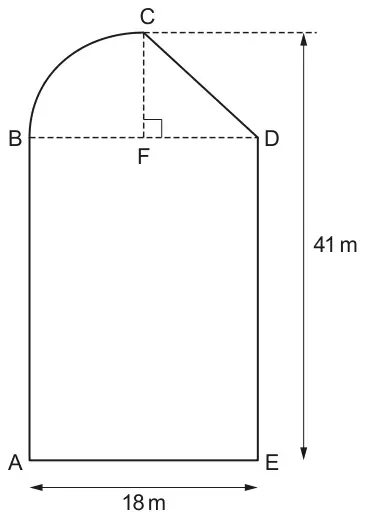
7 The diagram shows a shape ABCDE. The shape is made from a rectangle, a right-angled triangle and a quarter of a circle.
Not to scale
F is the mid-point of BD. AE = 18 m and the perpendicular distance from C to AE is 41 m.
Work out the perimeter of the shape ABCDE. [6]
Mark scheme
Answer
Marks
Part marks and guidance
109 or 108.8 to 108.9
6
figures and working may be on diagram B1 for [radius of circle =] 9 B1 for [AB or ED =] 32 soi by 41 – their 9 M1 for \(\frac{1}{4} \times 2 \times \pi \times\) their 9 soi by \(\frac{9\pi}{2}\), 14.1 or 14.13 to 14.14 M2 for \(\sqrt{(\textit{their }9)^2 + (\textit{their }9)^2}\) soi by \(9\sqrt{2}\), 12.7[2…] or 12.73 or M1 for \((\textit{their }9)^2 + (\textit{their }9)^2\) soi by 162 M1 for their 12.72… + their 14.1 + 2 × their 32 + 18 seen to a maximum of 5 marks
20 The diagram shows a right-angled triangular prism ABCDEF.
Calculate angle AFB. [6]
Mark scheme
Answer
Marks
Part marks and guidance
20.9 or 20.89 or 20.886… or 21 with correct working
6
B1 for triangle AFB indicated e.g. drawn on diagram and M2 for [BF =] \(\sqrt{25^2 + 40^2}\) or 47.16[9…] or 47.17 or 47.2 or [AF =] \(\sqrt{25^2 + 40^2 + 18^2}\) or 50.48… or 50.5 or M1 for \(25^2 + 40^2\) [\(+\ 18^2\)] and M2 for e.g. \(\tan^{-1}\)(18 ÷ their 47.169…) or \(\sin^{-1}\)(18 ÷ their 50.48…) or M1 for [tan =] 18 ÷ their 47.169… or [sin =] 18 ÷ their 50.48…
their 47.169 should be an attempt at BF and their 50.48 should be an attempt at AF
12 The diagram below shows two right-angled triangles.
Not to scale
Prove that triangles PQS and QRS are similar. [5]
Mark scheme
Answer
Marks
Part marks and guidance
[\(QS\) =] \(\sqrt{80}\), \(4\sqrt{5}\) oe or 8.9[4..]
2
M2 for [\(QS\) =] \(\sqrt{4^2 + 8^2}\) oe
or
M1 for \(4^2 + 8^2\)
Accept QS on diagram First M2 may be implied by \(QP = 2\sqrt{5}\) oe or 4.47[…]
Best two from: (i) shows a pair of corresponding angles are equal (ii) shows a second pair of corrresponding angles are equal or states [angle] QRS = [angle] PQS (iii) shows two pairs of corresponding sides are in the same ratio (iv) shows the third pair of corresponding sides have the same ratio. Ratios of corresponding sides need to be seen in equiavlent form.
2
B1 for each to a max of 2 For these marks, answers to calculations are sufficient, but corresponding pairs must be either exact or the same when rot to 3sf. In (ii) accept QRS and PQS are both right angles oe (iii) and (iv) can be shown using scale factors eg QS = 1.118 × RS and PS = 1.118 × QS
Note: there is no mark for just finding QP = \(\sqrt{20}\)
Example values: angle RSQ = \(\tan^{-1}\left(\dfrac{4}{8}\right) = \cos^{-1}\left(\dfrac{8}{\sqrt{80}}\right) = \sin^{-1}\left(\dfrac{4}{\sqrt{80}}\right)\) = 26.5(…) or 26.6 angle QSP = \(\tan^{-1}\left(\dfrac{\sqrt{20}}{\sqrt{80}}\right) = \cos^{-1}\left(\dfrac{\sqrt{80}}{10}\right) = \sin^{-1}\left(\dfrac{\sqrt{20}}{10}\right)\) = 26.5(…) or 26.6
Accept as fractions or ratios. \(\dfrac{PS}{QS} = \dfrac{10}{\sqrt{80}} = \dfrac{\sqrt{5}}{2}\) =1.118[…] \(PS : QS = 10 : \sqrt{80}\) oe \(\dfrac{QS}{RS} = \dfrac{\sqrt{80}}{8}\) with any of the above \(\dfrac{PS}{QS}\) is insufficient for (iii) and (iv) as it is not clear that the ratios are the same.
Conclusion: two (or three) equal angles oe after showing (i) and (ii) or three pairs of corresponding sides in the same ratio after showing (iii) and (iv) or two pairs of corresponding sides in the same ratio and an equal angle between them oe after showing relevant combination of (i)/(ii) and (iii)
1
In all cases, it must be clear which angles and ratios are being used to support the conclusion made, usually by using labels or from values on a diagram. If it is not clear, withold the final mark. Where more than two facts are shown, allow the final mark if the conclusion is fully supported.
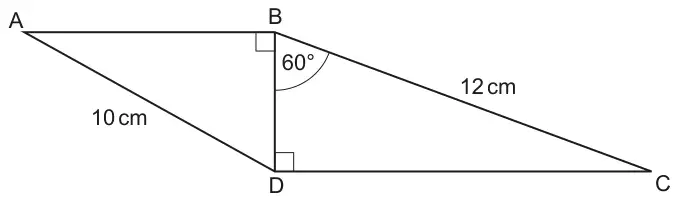
11 The diagram shows two right-angled triangles ABD and BCD, sharing a common side BD. AD = 10 cm, BC = 12 cm and angle DBC = 60°.
Not to scale
Work out the length of AB. [6]
Mark scheme
Answer
Marks
Part marks and guidance
8 nfww
6
nfww - must check method before giving 6 marks must not come from wrong working
B1 for cos 60 = 0.5 oe soi M1 for \(\dfrac{\text{BD}}{12} = \cos 60\) oe A1 for [BD =] 6 AND M2 for \(\sqrt{10^2 - \textit{their}\text{ BD}^2}\) or M1 for their \(\text{BD}^2 + \text{AB}^2 = 10^2\) oe or for \(10^2 -\) their \(\text{BD}^2\)
e.g. sin 30 = 0.5 e.g. \(\dfrac{\text{BD}}{12} = \sin 30\)
For M2 or M1 0 < their BD < 10 and BD must be identified first on diagram or in working
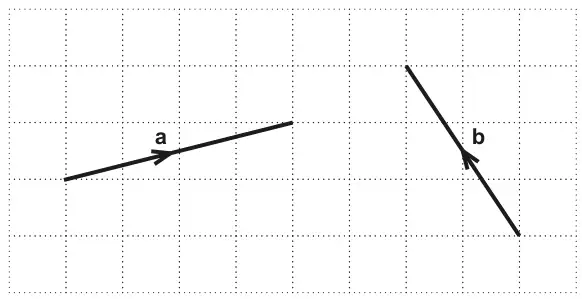
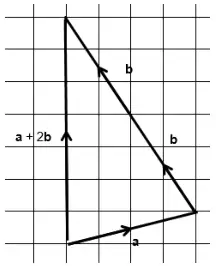
10 Two vectors, \(\mathbf{a}\) and \(\mathbf{b}\), are shown on the 1 centimetre grid below.
Show that the vector \(\mathbf{a} + 2\mathbf{b}\) has length 7 cm. You may use the grid below.
[3]
Mark scheme
Answer
Marks
Part marks and guidance
Correct triangle drawn with \(\mathbf{a} + 2\mathbf{b}\) labelled and with correct arrows or \(\mathbf{a}\) and \(2\mathbf{b}\) labelled and with correct arrows AND length 7cm indicated on diagram
3
M1 for vector \(2\mathbf{b}\) drawn on grid
M1 \(\mathbf{a} + k\mathbf{b}\) drawn on grid The two vectors must be joined end to end but arrows may be contradictory. \(k\mathbf{b}\) should be in the direction of \(\mathbf{b}\)
If both methods shown/started, mark the better one For M marks condone missing or incorrect arrows and labels on vectors
Mark intent: end of vectors within 2mm of of vertices of relevant square
Examples (ignore arrows): M1M1 for \(\mathbf{a} + 2\mathbf{b}\) drawn (3 marks if labelled and 7 cm indicated) M1M1 for \(\mathbf{a} - 2\mathbf{b}\) M1M0 for \(2\mathbf{b}\) or \(-2\mathbf{b}\) M0M1 for \(\mathbf{a} + \mathbf{b}\), \(\mathbf{a} - 1.5\mathbf{b}\) etc
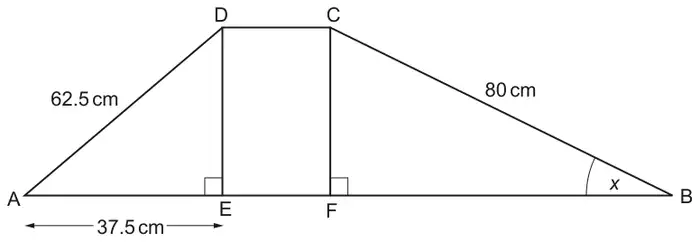
B3 for 50 for DE or CF nfww Or M1 for \(62.5^2 - 37.5^2\) M1 for \(\sqrt{62.5^2 \pm 37.5^2}\)
And
B3 FT for \(\sin^{-1}\left(\dfrac{\textit{their } 50}{80}\right)\) correctly evaluated or M2 FT for \(\sin^{-1}\left(\dfrac{\textit{their } 50}{80}\right)\) or M1 FT for \(\sin\) [\(x\)] = \(\dfrac{\textit{their } 50}{80}\)
Allow 39
May be in correct place on diagram 2500 implies M1
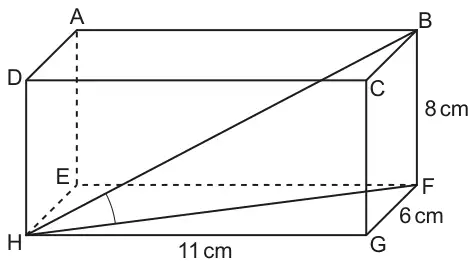
M2 for \(\sqrt{11^2 + 6^2}\) soi by 12.52 to 12.53 or M1 for \([\ldots]^2 = 11^2 + 6^2\) and M2 for tan [… =] 8 ÷ their 12.52 or M1 for 8 ÷ their 12.52
accept any correct and full method note: HB = 14.866…
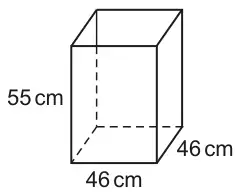
18 Alvin has a crate in the shape of a cuboid. The crate is open at the top. The internal dimensions of the crate are 46 cm long by 46 cm wide by 55 cm high.
Alvin has a stick of length 95 cm.
Alvin places the stick in the crate so that the shortest possible length extends out above the top of the crate.
(a) Calculate the length of the stick that extends out of the crate. [4]
(b) Calculate the angle the stick makes with the base of the crate. [3]
Mark scheme (a)
Answer
Marks
Part marks and guidance
9.8[1…] nfww
4
Accept answers rounding to 9.8 if correct working seen Condone for full marks minor inaccuracies from rounding, such as \(\sqrt{7256}\) seen
M3 for \(\sqrt{46^2 + 46^2 + 55^2}\) or 85.18 to 85.2 or \(\sqrt{7257}\)
OR
M2 for \(46^2 + 46^2 + 55^2\) or 7257 or \(\sqrt{46^2 + 46^2}\) or \(\sqrt{4232}\) or 65.05 to 65.1 or \(\sqrt{46^2 + 55^2}\) or \(\sqrt{5141}\) or 71.7[…]
OR
M1 for \(46^2 + 46^2\) or 4232 or \(46^2 + 55^2\) or 5141
May be done in steps
Mark scheme (b)
Answer
Marks
Part marks and guidance
40.2 nfww
3
M2 for sin […] = \(\dfrac{55}{\mathit{their}\,85.18 \text{ to } 85.2}\) or tan […] = \(\dfrac{55}{\mathit{their}\sqrt{46^2 + 46^2}}\) or cos […] = \(\dfrac{\mathit{their}\sqrt{46^2 + 46^2}}{\mathit{their}\,85.18 \text{ to } 85.2}\)
OR
M1 for indication of required angle
Accept 40° and answers rounding to 40.2 if correct working seen
0 for tan […] = \(\frac{55}{46}\) M2 for cosine rule with cos as subject
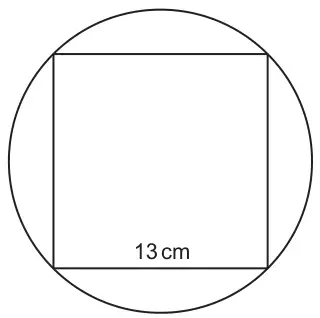
20. The diagram shows a square inside a circle. Each corner of the square lies on the circumference of the circle. The length of each side of the square is 13 cm.
Diagram not drawn to scale
Calculate the area of the circle. Give your answer correct to 1 decimal place.
You must show all your working.[5]
Mark scheme
Scheme
Marks
Comments
Correct method to calculate diameter
(\(d\) = ) \(\sqrt{13^2+13^2}\) or \(\sqrt{338}\) OR (\(d\) = ) \(\dfrac{13}{\sin(45)}\) or (\(d\) = ) \(\dfrac{13}{\cos(45)}\)
M2
Answer line takes precedence. Working may be seen in stages.
May be implied by \(\sqrt{338}\), \(13\sqrt{2}\), 18.3(84..) or 18.4
M1 for one of the following: (\(d^2\) =) \(13^2+13^2\) or (\(d^2\) =) 338 \(\sin(45) = \dfrac{13}{d}\) or \(\cos(45) = \dfrac{13}{d}\)
÷ 2 (to find radius)
m1
FT from M2 only May be implied by a radius of \(\dfrac{13\sqrt{2}}{2}\) or \(\sqrt{84.5}\) or 9.1(9..) or 9.2
(Area = ) \(\pi \times (9.19..)^2\) oe
m1
FT ‘their radius’ provided M2 m1 or M3 previously awarded.
= 265.5 (cm2)
A1
CAO Allow answers in the range 265.3 to 265.5 inclusive from correct working. Accept answers correct to 1 d.p. from correct working e.g. 265.9 (from \(\pi \times 9.2^2\)) 265.2 (from \(3.14 \times 9.19^2\)) 265.8 (from \(3.14 \times 9.2^2\))
Mark final answer Note: Award A0 if answer given in terms of \(\pi\) e.g. \(84.5\pi\)
If no marks, award SC1 for appropriate sight of \(13^2+13^2\) or 338 incorrectly labelled or for \(r = \sqrt{13^2+13^2}\)
(5)
Alternative
Alternative method for first 3 marks
Scheme
Marks
Comments
Correct method to calculate radius
(\(r\) =) \(\sqrt{6.5^2+6.5^2}\) or \(\sqrt{84.5}\) OR (\(r\) =) 13sin(45) or (\(r\) =) 13cos(45)
If a correct method for \(r\) seen but then spoiled e.g. (\(r\) =) \(\sqrt{6.5^2+6.5^2}\) ÷ 2 award M2 only
M3
Working may be seen in stages.
May be implied by a radius of \(\dfrac{13\sqrt{2}}{2}\) or \(\sqrt{84.5}\) or 9.1(9..) or 9.2 or \(\sqrt{\dfrac{13^2}{2}}\)
Allow M3 for \(r^2\) = 84.5 or \(\dfrac{13^2}{2}\) if used in area = \(\pi \times r^2\)
M2 for one of the following: (\(r^2\) =) \(6.5^2+6.5^2\) or (\(r^2\) =) 84.5 or (\(r^2\) =) \(\dfrac{13^2}{2}\) \(\sin(45) = \dfrac{r}{13}\) or \(\cos(45) = \dfrac{r}{13}\)
M1 for \(r^2 + r^2 = 13^2\) or \(2r^2 = 13^2\)
Corrected by Westie's Workshop
The board's mark scheme printed “(r² =) = 84.5”. Changed to “(r² =) 84.5” because an extra equals sign was printed.
Original: see the board's mark scheme PDF (link above).
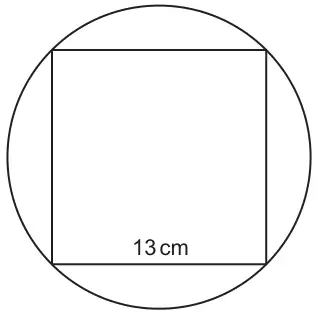
3. The diagram shows a square inside a circle. Each corner of the square lies on the circumference of the circle. The length of each side of the square is 13 cm.
Diagram not drawn to scale
Calculate the area of the circle. Give your answer correct to 1 decimal place. You must show all your working.[5]
Mark scheme
Scheme
Marks
Comments
Answer line takes precedence. Working may be seen in stages.
Correct method to calculate diameter
\((d =)\ \sqrt{13^2 + 13^2}\) or \(\sqrt{338}\) OR \((d =)\ \dfrac{13}{\sin(45)}\) or \((d =)\ \dfrac{13}{\cos(45)}\)
M2
May be implied by \(\sqrt{338}\), \(13\sqrt{2}\), 18.3(84..) or 18.4
M1 for one of the following: \((d^2 =)\ 13^2 + 13^2\) or \((d^2 =)\ 338\)
\(\sin(45) = \dfrac{13}{d}\) or \(\cos(45) = \dfrac{13}{d}\)
\(\div 2\) (to find radius)
m1
FT from M2 only May be implied by a radius of \(\dfrac{13\sqrt{2}}{2}\) or \(\sqrt{84.5}\) or 9.1(9..) or 9.2
(Area =) \(\pi \times (9.19..)^2\) oe
m1
FT ‘their radius’ provided M2 m1 or M3 previously awarded.
\(= 265.5\) (cm2)
A1
CAO Allow answers in the range 265.3 to 265.5 inclusive from correct working. Accept answers correct to 1 d.p. from correct working e.g. 265.9 (from \(\pi \times 9.2^2\)) 265.2 (from \(3.14 \times 9.19^2\)) 265.8 (from \(3.14 \times 9.2^2\))
Mark final answer Note: Award A0 if answer given in terms of \(\pi\) e.g. \(84.5\pi\)
If no marks, award SC1 for appropriate sight of \(13^2 + 13^2\) or 338 incorrectly labelled or for \(r = \sqrt{13^2 + 13^2}\)
Alternative method for first 3 marks
Scheme
Marks
Comments
Correct method to calculate radius
\((r =)\ \sqrt{6.5^2 + 6.5^2}\) or \(\sqrt{84.5}\) OR \((r =)\ 13\sin(45)\) or \((r =)\ 13\cos(45)\)
If a correct method for \(r\) seen but then spoiled e.g. \((r =)\ \sqrt{6.5^2 + 6.5^2} \div 2\) award M2 only
M3
Working may be seen in stages.
May be implied by a radius of \(\dfrac{13\sqrt{2}}{2}\) or \(\sqrt{84.5}\) or 9.1(9..) or 9.2 or \(\sqrt{\dfrac{13^2}{2}}\)
Allow M3 for \(r^2 = 84.5\) or \(\dfrac{13^2}{2}\) if used in area \(= \pi \times r^2\)
M2 for one of the following: \((r^2 =)\ 6.5^2 + 6.5^2\) or \((r^2 =)\ 84.5\) or \((r^2 =)\ \dfrac{13^2}{2}\) \(\sin(45) = \dfrac{r}{13}\) or \(\cos(45) = \dfrac{r}{13}\)
M1 for \(r^2 + r^2 = 13^2\) or \(2r^2 = 13^2\)
(5)
Corrected by Westie's Workshop
The board's mark scheme printed “(r² =) = 84.5”. Changed to “(r² =) 84.5” because an extra equals sign was printed.
Original: see the board's mark scheme PDF (link above).
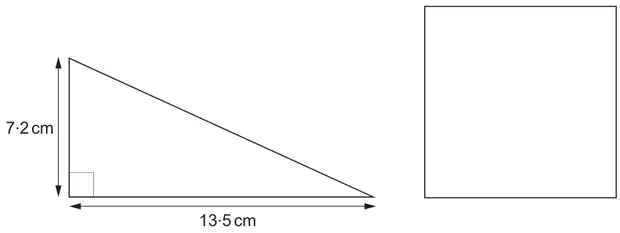
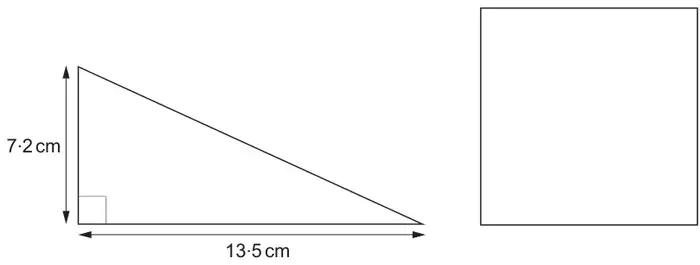
17. A right-angled triangle and a square are shown below.
Diagram not drawn to scale
The perimeter of the triangle is equal to the perimeter of the square.
Calculate the area of the square. You must show all your working.[6]
Area of square = ………… \(\text{cm}^2\)
Mark scheme
Scheme
Marks
Comments
No marks are awarded for an answer of 15.3 obtained from use of a scale drawing.
(h2 =) \(7.2^2 + 13.5^2\)
M1
May be implied in later working. Provided not spoiled by answers of 20.7, 20.72 or 428.49.
h2 = 234.09 or (h =) \(\sqrt{234.09}\)
A1
(h = ) 15.3
A1
FT from M1 for the correctly evaluated square root of ‘their 234.09’ provided ‘their answer’ > 13.5 (cm) Must be from correct working
(Area of square = ) ((7.2 + 13.5 + 15.3) ÷ 4)2
M2
FT ‘their 15.3’ provided M1 previously awarded. M1 for (7.2 + 13.5 + 15.3) ÷ 4 (= 9)
81 (cm2)
A1
FT
If no marks award SC1 for the correct evaluation of ((13.5 + 7.2 + 'their 15.3') ÷ 4)2
(6)
Corrected by Westie's Workshop
The board's mark scheme printed “(13.5 + 7.2 + 'their 15.3') ÷ 4)²”. Changed to “((13.5 + 7.2 + 'their 15.3') ÷ 4)²” because an opening bracket was missing.
Original: see the board's mark scheme PDF (link above).
FT ‘their 15.3’ provided M1 previously awarded. M1 for \((7.2 + 13.5 + 15.3) \div 4\ (= 9)\)
81 (cm2)
A1
FT
If no marks award SC1 for the correct evaluation of \(((13.5 + 7.2 + \text{‘their }15.3\text{’}) \div 4)^2\)
(6)
Corrected by Westie's Workshop
The board's mark scheme printed “(13.5 + 7.2 + ‘their 15.3’) ÷ 4)²”. Changed to “((13.5 + 7.2 + ‘their 15.3’) ÷ 4)²” because an opening bracket was missing.
Original: see the board's mark scheme PDF (link above).
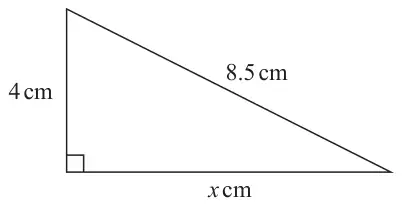
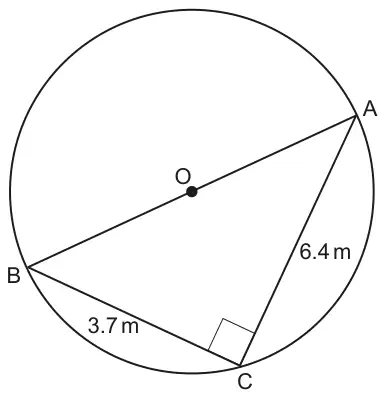
(a) Sam cycled south for 16 km. He then turned and cycled east. When he stopped for a rest, the shortest distance back to his starting point was 20 km.
Calculate how many kilometres Sam cycled while travelling east. [3]
(b) Sam cycled the 20 km back to his starting point at a constant speed of 25 km/h. How many minutes did this take? [2]
Mark scheme (a)
Scheme
Marks
Comments
\(16^2 + \text{east}^2 = 20^2\)
S1
Strategy of using Pythagoras; si by sight of e.g. 3, 4, 5
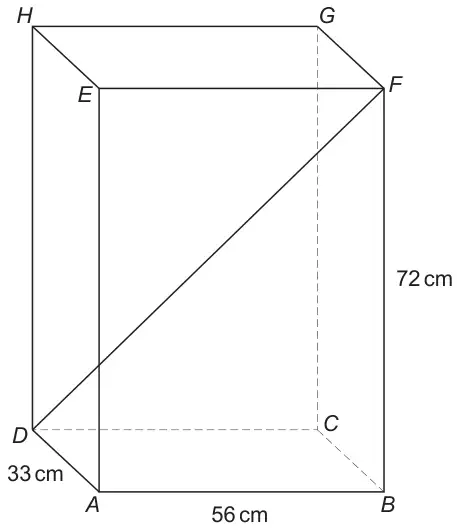
\(\sqrt{56^2 + 33^2 + 72^2}\) or \(\sqrt{56^2 + 33^2}\,(= 65)\) and \(\sqrt{65^2 + 72^2}\) or \(\sqrt{72^2 + 56^2}\,(= \sqrt{8320} = 8\sqrt{130})\) and \(\sqrt{8320 + 33^2}\) or \(\sqrt{72^2 + 33^2}\,(= \sqrt{6273} = 3\sqrt{697})\) and \(\sqrt{6273 + 56^2}\)
M2
M1 for \(DF^2 = 56^2 + 33^2 + 72^2\) OR for one correct application of Pythagoras in 2D e.g. \(\sqrt{56^2 + 33^2}\) or \(\sqrt{72^2 + 56^2}\) or \(\sqrt{72^2 + 33^2}\); implied by finding e.g. \(DB\) = 65
Allow for comment e.g. ‘Pythagorean triple is 6, 8, 10.’ or ‘6, 8, 10 is a right-angled triangle.’ (must be clear it is a triple and not just listing the 3 values from the diagram)
Allow poor use of notation if intent is clear.
10
A1
does not imply M1 unless it is clear that BD = 10 (either in a statement, on the diagram or from \(\tan x = \dfrac{10}{10}\)).
Find the value of \(x\). You must show all your working. [3]
Mark scheme
Scheme
Marks
Comments
\((BD =)\ \sqrt{6^2 + 8^2}\)
M1
Allow for comment e.g. ‘Pythagorean triple is 6, 8, 10.’ or ‘6, 8, 10 is a right-angled triangle.’ (must be clear it is a triple and not just listing the 3 values from the diagram)
Allow poor use of notation if intent is clear.
10
A1
does not imply M1 unless it is clear that BD = 10 (either in a statement, on the diagram or from \(\tan x = \dfrac{10}{10}\)).
(i) How many cones could Megan fill? You may assume that each cone is completely filled, level to the top, with ice cream. [7]
(ii) What impact does the assumption have on your answer in (a)(i)? [1]
(b) Two mathematically similar ice cream cones are shown below.
Diagram not drawn to scale
The smaller cone has a volume of 40 cm3.
Calculate the volume of the larger cone. [2]
Mark scheme (a)
Scheme
Marks
Comments
(i) \(h^2 = 15^2 - 3.5^2\)
M1
Accept \(15^2 = h^2 + 3.5^2\)
\(h^2 = 212.75\) or \(h = \sqrt{212.75}\)
A1
14.58595...(cm) or 14.6 (cm)
A1
Accept rounded answers, but NOT truncated answers FT from M1 for the correctly evaluated square root of ‘their 212.75’ provided ‘their answer’ < 15 (cm)
FT ‘their 14.58595...’ provided M1 previously awarded
Answer in the range 187.(...cm3)
A1
\(2000 \div 187.(\ldots)\)
M1
FT ‘their 187.(...)’ provided at least 3 marks previously awarded
10 (ice creams)
A1
Must be a whole number
(ii) Evaluation of results, e.g. ‘cone was full, if it wasn’t Megan could have made more ice creams’,
E1
Accept FT from reasoning behind rounding ‘their number of ice creams’ up or down
Allow, e.g. ‘inside measurements could be less, so could be 11 rather than 10 ice creams’, ‘could have extra ice cream on the top, so makes fewer’, ‘not practical, as impossible to fill to the bottom of the cone’
FT from M1 for the correctly evaluated square root of ‘their 96.05’ provided ‘their answer’ > 8.6 (cm)
Mark scheme (b)
Scheme
Marks
Comments
\((y=)\ \sin^{-1}8.6/12.1\) or \(\sin^{-1}0.7107..\)
M2
M1 for \(\sin y = 8.6/12.1\)
\(45(.295\ldots^\circ)\) or \(45.3(^\circ)\)
A1
ISW, i.e. do not accept \(45.2(^\circ)\) unless at least \(45.29(5\ldots^\circ)\) seen previously Do not accept \(45^\circ\) without further explanation
22. Sid has built the two walls, as shown in the diagram below.
Diagram not drawn to scale.
Sid measures the distance shown by the dotted line. He finds that it measures exactly 14 m. Sid thinks that his two walls meet at right angles. Is he correct? Show all your working and explain your answer. [3]
Mark scheme
Scheme
Marks
Comments
Use of Pythagoras Theorem \(7^2 + 12^2 = (\text{hypotenuse})^2\)
M1
(Hypotenuse =) 13.89 (m)
A1
Conclusion stated or implied that he is not correct, e.g. ‘Sid’s walls do not meet at right angles’ or equivalent.
16. Shireen is trying to find the area of a field, ABCDE. She has taken a few measurements and written them on a sketch, as shown below.
Diagram not drawn to scale
Shireen has indicated
\(D\hat{C}A = 90^\circ\)
DC = 20 metres
CA = 15 metres
\(E\hat{A}D = 60^\circ\)
\(B\hat{A}C = 45^\circ\)
She thinks that DA = EA and CA = BA. Shireen knows that BC and DE are not straight lines.
Using the information Shireen has collected, calculate the area of the field. You must state any assumption you make in deciding on your method. [9]
Mark scheme
Scheme
Marks
Comments
\((DA^2 =)\ 20^2 + 15^2\) or \(DA^2 = 625\) or \(DA = \sqrt{625}\)
M1
\(DA = 25\) (metres)
A1
Area triangle \((\tfrac12 \times 15 \times 20 =)\) 150 (m2)
B1
Area \(DAE\) in the range 327.08 to 327.4 or \(625\pi/6\) (m2)
B2
FT ‘their derived 25’ provided ≠15 and ≠20 B1 for \(\pi \times 25^2 \times 60 \div 360\), OR
B1 for an answer of 270.6 to 271 (m2) from Area DAE as a triangle, FT ‘their 25’ for DA: \(\tfrac12 \times 25 \times 25 \times \sin 60^\circ\) = 270.6(3.. m2) OR \(\tfrac12\)DE straight = \(25 \times \sin 30^\circ\) = 12.5(m) and A to midpoint DE = \(25 \times \cos 30^\circ\) = 21.65(… m), and 12.5 × 21.65(…) = 270.6(3…m2)
Area \(CAB\) in the range 88.3 to 88.4 or \(225\pi/8\) (m2)
B2
B1 for \(\pi \times 15^2 \times 45 \div 360\), OR
B1 for an answer of 79.5 to 80 (m2) from Area CAB as a triangle: \(\tfrac12 \times 15 \times 15 \times \sin 45^\circ\) = 79.5(4.. m2) OR \(\tfrac12\)CB straight = \(15 \times \sin 22.5^\circ\) = 5.7(4…m) and A to midpoint CB = \(15 \times \cos 22.5^\circ\) = 13.8(58… m), and 5.7(4…) × 13.8(58…) = 79.5(4…m2)
Total area answer in the range 565 to 566 (m2)
B1
CAO. Not FT from area of triangles
Assumption, e.g. ‘(area of) sector(s) of a circle’, ‘Shireen is correct to think DA = EA’, ‘Shireen is correct in thinking AC = AB’
E1
Allow descriptions of a sector of a circle FT assumption ‘(area of) triangle(s)’ provided implies knowing that ‘their area(s)’ will be less than the actual area(s)
The diagram shows a cuboid. \(A\), \(B\) and \(C\) are all vertices of the cuboid. Calculate the size of \(C\hat{A}B\). Give your answer correct to 3 significant figures. [5]
Mark scheme
Scheme
Marks
Comments
(\(AC^2 =\)) \(2.6^2 + 13.4^2\) OR (\(AC =\)) \(\sqrt{186.32}\) or \(AC^2 = 186.32\)
M1
\(AC = 13.6499\ldots\) (cm)
A1
Accept rounded or truncated May be implied in further calculation
\(\tan A = 8.7/13.6499\ldots\ (=0.637\ldots)\)
M1
FT ‘their derived \(AC\)’ provided M1 previously awarded
\(A = 32.5\)(°)
A2
CAO A1 for \(\tan^{-1}0.637\ldots\) or FT angle correct but not given to 3 sig. figs.
(5)
Alternative
Scheme
Marks
\(AB^2 = 2.6^2 + 13.4^2 + 8.7^2\ (=262.01)\)
M1
\(AB = 16.186\ldots\) (cm)
A1
\(\sin A = 8.7/16.186\ldots\ (=0.537\ldots)\) FT ‘their derived \(AB\)’ provided M1 previously awarded
M1
\(A = 32.5\)(°) CAO with FT and A1 as above
A2
Alternative
Scheme
Marks
\(AB^2 = 2.6^2 + 13.4^2 + 8.7^2\ (=262.01)\)
M1
\(AB = 16.186\ldots\) (cm)
A1
\(\cos A = 13.6499\ldots/16.186\ldots\) \((=0.843\ldots)\) FT ‘their derived \(AB\)’ provided M1 previously awarded and attempt (\(AC^2 =\)) \(2.6^2 + 13.4^2\)
M1
\(A = 32.5\)(°) CAO with FT and A1 as above
A2
Corrected by Westie's Workshop
The board's mark scheme printed “(=0.537…)”. Changed to “(=0.843…)” because 13.6499… ÷ 16.186… = 0.843…; the value 0.537… belongs to the sine method above it.
Original: see the board's mark scheme PDF (link above).
17. In this question all dimensions are in centimetres. The diagram shows a sketch of two circles, both with centre O.
Diagram not drawn to scale
The line AB is a chord of the outer circle and a tangent to the inner circle. The length of AB is 24. The equation of the outer circle is \(x^2 + y^2 = 13^2\).
Find the equation of the inner circle. [4]
Mark scheme
Scheme
Marks
Comments
Radius of outer circle = 13 or half the chord = 12
B1
May be on diagram
(radius inner circle)\(^2 + 12^2 = 13^2\)
M1
\(r = 5\) seen or implied
A1
\(x^2 + y^2 = 5^2\)
A1
FT ‘their derived 5’
If zero scored allow SC1 for \(12^2 + 5^2 = 13^2\) or \(12^2 + 5^2 = 169\) only
13. Dyfan has two different 25 g bars of chocolate, a Chocodusk bar and a Luxury Dark bar. The Chocodusk bar has a lower cocoa content than the Luxury Dark bar.
(a)
The nutritional information from these bars of chocolate is given below.
Chocodusk bar: lower cocoa content
Per 25 g bar
Saturated fat
6·6 g
Sugar
7·1 g
Protein
3·5 g
Salt
0·01 g
Luxury Dark bar: higher cocoa content
Per 25 g bar
Saturated fat
7·7 g
Sugar
3·5 g
Protein
2·9 g
Salt
0·09 g
(i)
Complete the following statement. [1]
‘The amount of salt in the Luxury Dark bar is …………… % of the amount of salt in the Chocodusk bar.’
(ii)
Dyfan eats 20 g of the Luxury Dark bar.
Calculate the percentage of the Chocodusk bar that gives Dyfan the same amount of saturated fat. You must show all your working. [3]
(b)
The diagram below shows the symmetrical uniform cross-section of one of the chocolate bars.
Diagram not drawn to scale
The label on this chocolate bar states,
‘The thickness of this chocolate bar is 6 mm, correct to the nearest millimetre.’
Use the measurements given on the diagram to decide whether this statement is true or false.
True ☐ False ☐
You must show all your working. [5]
Mark scheme (a)
Scheme
Mark
Comments
(i) 900 (%)
B1
(ii) \(\dfrac{20}{25}\) × 7.7 ÷ 6.6 (× 100) or equivalent
M2
May be seen in stages Accept equivalents to \(\dfrac{20}{25}\), e.g. \(\dfrac{4}{5}\), 0.8 or \(\dfrac{80}{100}\)
M1 for appropriate sight of any one of the following, or equivalent, may be embedded in further working:
\(\dfrac{20}{25}\) × 7.7 (= 6.16)
\(\dfrac{20}{25}\) ÷ 6.6 (= 0.1212…)
7.7 ÷ 6.6 (= 1.1666…)
6.6 ÷ 7.7 (= 0.85714…)
(% of the Chocodusk bar is) 93(.333... %)
A1
Allow an answer that rounds to 93(%) provided not from incorrect working
FT from M1 to award A1 for the mass of the bar eaten (20 × 7.7 ÷ 6.6 =) 23(.33...g)
If no marks, award SC1 for an answer of 68.57(..%) 68.6(%) or 69(%) (from 100 × \(\dfrac{20}{25}\) × 6.6 ÷ 7.7), i.e. starting with the incorrect bar
Corrected by Westie's Workshop
The board's mark scheme printed “(% of the 70% cocoa bar is)”. Changed to “(% of the Chocodusk bar is)” because the question never mentions a 70% cocoa bar; the percentage asked for is of the Chocodusk bar. The answer 93(.333…%) is unchanged.
Original: see the board's mark scheme PDF (link above).
thickness\(^2\) = 33 or (thickness =) \(\sqrt{33}\)
A1
(Thickness =) 5.7(4...mm) AND indicates ‘True’
A2
Allow appropriate sight of 5.7(4…) = 6 as implication of ‘True’’ provided not contradicted in the answer box
Ignore additional spurious statements
A1 for 5.7(4...mm)
FT from M1 for the correctly evaluated square root of ‘their 33’ provided ‘their answer’ < 7 (mm) for: either A2 (with appropriate conclusion true or false) or A1 (if no conclusion)
If M0 A0 A0, award: either SC2 for 3.6(0555 mm) (from \(\sqrt{(7^2 - 6^2)} = \sqrt{13}\) ) or SC1 for \(x^2 = 7^2 - 6^2\) or (\(x\) =) \(\sqrt{(7^2 - 6^2)}\) OR either SC2 for 7.2(11.. mm) (from \(\sqrt{(4^2 + 6^2)} = \sqrt{52}\) ) or SC1 for \(x^2 = 4^2 + 6^2\) or (\(x\) =) \(\sqrt{(4^2 + 6^2)}\)
13. Pizza-Rea is a company that makes outdoor pizza ovens.
(a) The diagram below shows the design for the metal front plate of its latest pizza oven.
The front of the oven is symmetrical. It has a rectangular hole, through which pizzas are placed in the oven.
Pizza-Rea wants to calculate an estimate of the area of the metal used for this front plate.
Diagram not drawn to scale
The diagram below is a sketch of the front plate of the pizza oven drawn on coordinate axes.
Diagram not drawn to scale
Pizza-Rea have accurately drawn one of the symmetrical halves of the front plate on graph paper.
Using 5 strips of equal width, calculate an estimate of the area of metal shown in the graph. Hence calculate the total area of metal in the complete front plate. [5]
(b) Pizzas are cooked in the inner part of the pizza oven. The inner part is in the shape of a half-cylinder.
A hole is needed in the top of the oven to let hot air out. The straight-line distance from the centre of this hole to either of the front bottom corners of the oven should be less than 50 cm.
The dotted line, \(AB\), in the diagram below represents one of these straight-line distances.
Diagram not drawn to scale
Show that the distance from \(A\) to \(B\) is less than 50 cm. [4]
(c) Pizza-Rea supplies spiked legs for the pizza oven. Each leg is made by connecting a cuboid to a pyramid. The perpendicular height of the pyramid is 42 cm.
The diagrams below show the design of the spiked legs.
Diagrams not drawn to scale
The volume of each leg is 750 cm3. Calculate the length \(x\). Give your answer in the form \(a\sqrt{b}\), where \(a\) and \(b\) are integers and \(b\) is as small as possible. [6]
If 5 strips of unequal width used, all marks available, but penalise -1 from accuracy marks gained
Each area may be seen as the sum of the area of a rectangle and triangle M1 for the sum of these 5 areas with at most one error (may be repeated) in the substitution of values from the vertical axis OR M1 for the sight of 5 correct areas with the intention to add them (possibly omitting one)
= 1540 (cm2)
A1
FT from M1
(Area of the front plate = ) 1540 − 20×20 (×2)
m1
FT ‘their 1540’ provided M1 or M2 previously awarded
= 2280 (cm2)
A1
FT ‘their 1540’
If final m0A0 awarded, and again FT ‘their 1540’ award SC1 for any one of the following:
If 5 strips of unequal width used, all marks available, but penalise -1 from accuracy marks gained
Each area may be seen as the sum of the area of a rectangle and triangle M2 for the sum of these 5 areas with 1 one error (possibly repeated) in the substitution of values from the vertical axis or 1 error in the values used for the rectangle being subtracted OR M2 for the sight of 5 correct areas with the intention to add them (possibly omitting one)
M1 for the sum of these 5 areas with 1 one error (possibly repeated) in the substitution of values from the vertical axis and 1 error in the values used for the rectangle being subtracted
= 1140 (cm2)
A1
FT from M2
(Area of the front plate = ) 2280 (cm2)
A1
FT provided M2 or M3 previously awarded FT 2 × ‘their 1140’
Mark scheme (b)
Scheme
Marks
Comments
Correct use of Pythagoras in 1 of the planes 302 + 302 or \(\sqrt{30^2 + 30^2}\) OR 302 + 202 or \(\sqrt{30^2 + 20^2}\)
M1
May be embedded in further working
(Distance2 =) 302 + 302 + 202
M1
May be seen as 2 applications of Pythagoras
Distance2 = 2200 or (Distance =) √2200 (= 46.9…)
A1
CAO
Correct comparison statement e.g. ‘2200 is less than 2500’, or ‘2200 is less than 502’, or ‘√2200 is less than √2500’, or ‘√22 is less than 5’, or ‘√22 is less than √25’
A1
FT ‘their 2200’ provided > 900 and M1M1 previously awarded
Alternative method 1
Scheme
Marks
Comments
502 − 302 or \(\sqrt{50^2 - 30^2}\)
M1
(Distance to hole2 =) 502 − 302 − 302
M1
May be seen as 2 applications of Pythagoras
Distance to hole2 = 700 or (Distance to hole =) √700
A1
CAO
Correct comparison statement e.g. ‘700 is greater than 400’, or ‘700 is greater than 202’, or ‘√700 is greater than √400’, or ‘√7 is greater than 2’, or ‘√7 is greater than √4’
A1
FT ‘their 700’ provided < 2500 and M1M1 previously awarded
Alternative method 2
Scheme
Marks
Comments
502 − 202 or \(\sqrt{50^2 - 20^2}\) OR 502 − 302 or \(\sqrt{50^2 - 30^2}\)
M1
May be embedded in further working
(Distance to hole2 =) 502 − 202 − 302
M1
May be seen as 2 applications of Pythagoras
Dist to hole2 = 1200 or (Distance to hole =) √1200
A1
CAO
Correct comparison statement e.g. ‘1200 is greater than 900’, or ‘1200 is greater than 302’, or ‘√1200 is greater than √900’, or ‘√12 is greater than 3’, or ‘√12 is greater than √9’
A1
FT ‘their 1200’ provided < 2500 and M1M1 previously awarded
Alternative method 3
Scheme
Marks
Comments
502 − 302 or \(\sqrt{50^2 - 30^2}\) OR 202 + 302 or \(\sqrt{20^2 + 30^2}\)
M1
Comparison of 502 − 302 with 202 + 302 OR \(\sqrt{50^2 - 30^2}\) with \(\sqrt{20^2 + 30^2}\)
M1
= 1600 AND 1300 or √1600 AND √1300 AND a correct statement e.g. 1600 > 1300
A2
A1 for any one of the following:
1600 AND 1300 or √1600 AND √1300 without a correct statement
1600 or 1300 correctly evaluated with a correct statement
Alternative method 4
Scheme
Marks
Comments
502 − 202 or \(\sqrt{50^2 - 20^2}\) OR 302 + 302 or \(\sqrt{30^2 + 30^2}\)
M1
Comparison of 502 − 202 with 302 + 302 OR \(\sqrt{50^2 - 20^2}\) with \(\sqrt{30^2 + 30^2}\)
M1
= 2100 AND 1800 or √2100 AND √1800 AND a correct statement e.g. 2100 > 1800
A2
A1 for any one of the following:
2100 AND 1800 or √2100 AND √1800 without a correct statement
2100 or 1800 correctly evaluated with a correct statement
Mark scheme (c)
Scheme
Marks
Comments
\(\dfrac{1}{3} \times x \times \dfrac{x}{2} \times 42 \;+\; x \times \dfrac{x}{2} \times 16 = 750\) or \(7x^2 + 8x^2 = 750\) or equivalent
M2
M1 for any one of the following:
\(\dfrac{1}{3} \times x \times \dfrac{x}{2} \times 42\) + …….. = 750 or
…………. + \(x \times \dfrac{x}{2} \times 16\) = 750 or
\(\dfrac{1}{3} \times x \times \dfrac{x}{2} \times 42 + x \times \dfrac{x}{2} \times 16\)
\(15x^2 = 750\)
m1
FT from M1 if possible Needs to be of the form \(ax^2 = 750\)
\(x^2 = 50\) or \(x = \sqrt{50}\)
A1
CAO
\(x = 5\sqrt{2}\) (cm)
B2
For B2 or B1, FT ‘their derived 50’ for equivalent level of difficulty provided it comes from \(ax^2 = 750\)
B1 for writing 50 as a product of 2 or more factors where one of the factors OR the product of 2 of their factors is a square number e.g. 25 × 2, 5 × 5 × 2, OR B1 for writing \(\sqrt{50}\) as a product of 2 or more surds where one of the surds OR the product of 2 of their surds gives a whole number e.g. \(\sqrt{25} \times \sqrt{2}\), \(\sqrt{5} \times \sqrt{5} \times \sqrt{2}\)
7. Dyfan has two different 25 g bars of chocolate, a Chocodusk bar and a Luxury Dark bar. The Chocodusk bar has a lower cocoa content than the Luxury Dark bar.
(a)
The nutritional information from these bars of chocolate is given below.
Chocodusk bar: lower cocoa content
Per 25 g bar
Saturated fat
6·6 g
Sugar
7·1 g
Protein
3·5 g
Salt
0·01 g
Luxury Dark bar: higher cocoa content
Per 25 g bar
Saturated fat
7·7 g
Sugar
3·5 g
Protein
2·9 g
Salt
0·09 g
(i)
Complete the following statement. [1]
‘The amount of salt in the Luxury Dark bar is …………… % of the amount of salt in the Chocodusk bar.’
(ii)
Dyfan eats 20 g of the Luxury Dark bar.
Calculate the percentage of the Chocodusk bar that gives Dyfan the same amount of saturated fat. You must show all your working. [3]
(b)
The diagram below shows the symmetrical uniform cross-section of one of the chocolate bars.
Diagram not drawn to scale
The label on this chocolate bar states,
‘The thickness of this chocolate bar is 6 mm, correct to the nearest millimetre.’
Use the measurements given on the diagram to decide whether this statement is true or false.
True ☐ False ☐
You must show all your working. [5]
Mark scheme (a)
Scheme
Mark
Comments
(i) 900 (%)
B1
(ii) \(\dfrac{20}{25}\) × 7.7 ÷ 6.6 (× 100) or equivalent
M2
May be seen in stages Accept equivalents to \(\dfrac{20}{25}\), e.g. \(\dfrac{4}{5}\), 0.8 or \(\dfrac{80}{100}\)
M1 for appropriate sight of any one of the following, or equivalent, may be embedded in further working:
\(\dfrac{20}{25}\) × 7.7 (= 6.16)
\(\dfrac{20}{25}\) ÷ 6.6 (= 0.1212…)
7.7 ÷ 6.6 (= 1.1666…)
6.6 ÷ 7.7 (= 0.85714…)
(% of the Chocodusk bar is) 93(.333... %)
A1
Allow an answer that rounds to 93(%) provided not from incorrect working
FT from M1 to award A1 for the mass of the bar eaten (20 × 7.7 ÷ 6.6 =) 23(.33...g)
If no marks, award SC1 for an answer of 68.57(..%) 68.6(%) or 69(%) (from 100 × \(\dfrac{20}{25}\) × 6.6 ÷ 7.7), i.e. starting with the incorrect bar
Corrected by Westie's Workshop
The board's mark scheme printed “(% of the 70% cocoa bar is)”. Changed to “(% of the Chocodusk bar is)” because the question never mentions a 70% cocoa bar; the percentage asked for is of the Chocodusk bar. The answer 93(.333…%) is unchanged.
Original: see the board's mark scheme PDF (link above).
thickness\(^2\) = 33 or (thickness =) \(\sqrt{33}\)
A1
(Thickness =) 5.7(4...mm) AND indicates ‘True’
A2
Allow appropriate sight of 5.7(4…) = 6 as implication of ‘True’’ provided not contradicted in the answer box
Ignore additional spurious statements
A1 for 5.7(4...mm)
FT from M1 for the correctly evaluated square root of ‘their 33’ provided ‘their answer’ < 7 (mm) for: either A2 (with appropriate conclusion true or false) or A1 (if no conclusion)
If M0 A0 A0, award: either SC2 for 3.6(0555 mm) (from \(\sqrt{(7^2 - 6^2)} = \sqrt{13}\) ) or SC1 for \(x^2 = 7^2 - 6^2\) or (\(x\) =) \(\sqrt{(7^2 - 6^2)}\) OR either SC2 for 7.2(11.. mm) (from \(\sqrt{(4^2 + 6^2)} = \sqrt{52}\) ) or SC1 for \(x^2 = 4^2 + 6^2\) or (\(x\) =) \(\sqrt{(4^2 + 6^2)}\)
12. The diagrams below show a solid cone and a circle.
Diagrams not drawn to scale
The cone has a base radius of 6 cm and a vertical height of 8 cm. The circle has a radius of \(r\) cm.
The curved surface area of the cone equals the area of the circle.
By expressing any areas in terms of \(\pi\), find the value of \(r\). Give your answer in the form \(a\sqrt{b}\),where \(a\) and \(b\) are integers, and \(b\) is as small as possible. [6]
From the formula list: Curved surface area of cone \(= \pi r l\)
Mark scheme
Scheme
Marks
Comments
(Slant height of cone =) \(\sqrt{6^2 + 8^2}\)
M1
Method for finding hypotenuse. Accept use of (3,4,5) x 2.
= 10 (cm)
A1
(Curved surface area of cone =) \(\pi \times 6 \times 10\)
M1
FT ‘their derived slant height’ (not 8).
= \(60\pi\) (cm2) or equivalent
A1
CAO [For reference, \(60\pi\) = 188.4] \(60\pi\) may be implied by later working (e.g. sight of \(r^2\) = 60)
For calculating the total surface area of the cone, award M1 A1 SC1 for an answer of \(96\pi\) (cm2) [= 301(.44)] (from including the area of the base of the cone)
(\(\pi r^2 = \pi \times 6 \times 10\)) \(r^2\) = 60 or \(r = \sqrt{60}\) or equivalent
M1
Isolating \(r^2\) or \(r\). FT for ‘their \(r^2\) = 60’ or ‘their \(r = \sqrt{60}\)’ from \(\pi r^2\) = ‘their \(60\pi\)’
\((r =)\) \(2\sqrt{15}\)
A1
FT from \(r^2 = k\), provided equivalent difficulty (with \(r\) in the form \(a\sqrt{b}\), where \(a\) and \(b\) are integers, and \(b\) is as small as possible).
SC1 for r = \(\sqrt{6L}\) (where \(L\) = slant height)
Note: after M0A0M0A0 for use of 8 as the slant height \(r^2\) = 48 or \(r = \sqrt{48}\) M1 \((r =)\) \(4\sqrt{3}\) A1
Corrected by Westie's Workshop
The board's mark scheme printed “as small as possible’).”. Changed to “as small as possible).” because there is a stray closing quotation mark before the bracket.
Original: see the board's mark scheme PDF (link above).
10. Square-Off is a company that has designed new offices for its workers.
(a) The main building has a square floor with an area of 500 m2. The reception has a square floor with an area of 80 m2. The triangular region outside the buildings is paved. A plan view of the buildings and the paved region is shown below.
Diagram not drawn to scale
(i) Calculate the total length of the two buildings. Give your answer in the form \(a\sqrt{b}\), where \(a\) and \(b\) are integers and \(b\) is a prime number. [3]
(ii) Calculate the area of the paved region. You must show all your working. [2]
(b) Square-Off has designed an entrance to the reception.
The symmetrical structure is made from 3 connected metal sheets, each in the shape of a trapezium.
Diagrams not drawn to scale
The 3 metal sheets are connected to each other along the edges \(AB\) and \(CD\). Adhesive strips are needed along the entire length of these edges.
Calculate the length of the adhesive strip \(AB\). Leave your answer as a surd. [4]
Mark scheme (a)
Scheme
Marks
Comments
(i) (Total length =) √500 + √80
M1
= 10√5 + 4√5 OR 5√20 + 2√20
m1
= 14√5 (m)
A1
If no marks awarded, SC1 for sight of 10√5 or 5√20 AND 4√5 or 2√20
(ii) (Area of triangle =) e.g. \(\dfrac{(10\sqrt{5} - 4\sqrt{5}) \times 4\sqrt{5}}{2}\) or \(\dfrac{(5\sqrt{20} - 2\sqrt{20}) \times 2\sqrt{20}}{2}\) or \(\dfrac{\sqrt{40000} - \sqrt{6400}}{2}\) or \(\dfrac{200 - 80}{2}\)
M1
FT the simplification of ‘their √500’ and ‘their √80’ provided they are surds For a step of simplification of \(\dfrac{(\sqrt{500} - \sqrt{80}) \times \sqrt{80}}{2}\)
Accept a mixture of the terms shown
= 60 (m2)
A1
CAO
Alternative method 1 (a)(ii): (Using half of (bottom rectangle – square))
Scheme
Marks
Comments
(Area of triangle =) e.g. \(\dfrac{10\sqrt{5} \times 4\sqrt{5} - 80}{2}\) or \(\dfrac{5\sqrt{20} \times 2\sqrt{20} - 80}{2}\) or \(\dfrac{200 - 80}{2}\)
M1
FT the simplification of ‘their √500’ and ‘their √80’ provided they are surds Accept a mixture of the terms shown
= 60 (m2)
A1
CAO
Alternative method 2 (a)(ii): (Using the bottom trapezium)
Scheme
Marks
Comments
(Area of triangle =) e.g. \(\dfrac{(10\sqrt{5} + 4\sqrt{5}) \times 4\sqrt{5}}{2}\) − 80 or \(\dfrac{(5\sqrt{20} + 2\sqrt{20}) \times 2\sqrt{20}}{2}\) − 80 or \(\dfrac{(\sqrt{40000} + \sqrt{6400})}{2}\) – 80 or \(\dfrac{200 + 80}{2}\) – 80
M1
Or equivalent FT the simplification of ‘their √500’ and ‘their √80’ provided they are surds For a step of simplification of \(\dfrac{(\sqrt{500} + \sqrt{80}) \times \sqrt{80}}{2}\) − 80 Accept a mixture of the terms shown
= 60 (m2)
A1
CAO
Mark scheme (b)
Scheme
Marks
Comments
Correct use of Pythagoras in 1 of the planes \(\left(\frac{6{\cdot}5 - 4{\cdot}5}{2}\right)^{2} + (4{\cdot}3 - 2{\cdot}3)^{2}\) or 12 + 22 OR (4·3 – 2·3)2 + 32 or 22 + 32 OR \(\left(\frac{6{\cdot}5 - 4{\cdot}5}{2}\right)^{2} + 3^{2}\) or 12 + 32
M1
Or the square roots of these expressions May be embedded in further working
(AB =) \(\sqrt{\left(\frac{6{\cdot}5 - 4{\cdot}5}{2}\right)^{2} + (4{\cdot}3 - 2{\cdot}3)^{2} + 3^{2}}\) or \(\sqrt{1^{2} + 2^{2} + 3^{2}}\)
M2
May be seen as 2 applications of Pythagoras M1 for \(\left(\frac{6{\cdot}5 - 4{\cdot}5}{2}\right)^{2} + (4{\cdot}3 - 2{\cdot}3)^{2} + 3^{2}\) or 12 + 22 + 32
Steffan uses 654 kWh of electricity in a three-month period.
Electricity costs £0.30 per kWh. The standing charge for the three-month period is £54. Steffan has to pay VAT at 5% on the total cost.
Calculate Steffan’s electricity bill. You must show all your working. [5]
(b)
Steffan always leaves his fridge-freezer turned on. His fridge-freezer uses electricity costing £2.31 per week. Electricity costs £0.30 per kWh. Calculate the number of kWh of electricity Steffan’s fridge-freezer uses per day. You must show all your working. [3]
(c)
Steffan is thinking of buying the fridge-freezer shown below.
Diagram not drawn to scale
Steffan needs to check that the freezer compartment of this fridge-freezer has enough room.
The height of the freezer door is \(\dfrac{2}{5}\) of the total height of the fridge-freezer. Calculate the length of the diagonal of the freezer door. Give your answer in millimetres. You must show all your working. [5]
Mark scheme (a)
Scheme
Marks
Comments
Incorrect unit of money is penalised -1 once only on the first occurrence, by withholding an A or B mark
(Electricity cost is) 654 × (£)0.30 (£)196.2(0) or 19620(p)
M1 A1
Accept 654 × 30(p) If units are given they must be correct Accept £196.20p
(Cost of electricity and standing charge is £196.20 + 54 =) (£) 250.2(0)
B1
FT provided 654 used in a calculation for ‘their cost of electricity’ Do not accept if embedded with an incorrect interpretation of the standing charge, e.g. 196.20 + 3 × 54 = (£)358.20 is B0
If previous M0 A0 B0 for (654 × (£)0.30 × 3 =) £588.60 AND (588.60 + 54 × 3 = 588.60 + 162 =) £750.60, award SC1 for this consistent misunderstanding and then FT
(Total bill including VAT) 1.05 × 250.2(0) or 250.2(0) + 12.51
M1
FT from ‘their derived total of electricity’ + ‘their standing charge’, accept rounding or truncation to a penny Allow M1 A0 for 1.05 × ‘their total rounded or truncated to a whole pound’
(£)262.71
A1
If M0 A0 for inclusive of VAT cost, allow SC1 for an answer of (£)262.70, provided not from incorrect working (allow from 250.20 + 12.50)
If final B0 M0 A0, award SC1 for the correct evaluation of 1.05 × ‘their derived cost of electricity’ having not considered and omitted the standing charge, or previously subtracted the standing charge from ‘their cost of electricity’
Mark scheme (b)
Scheme
Marks
Comments
(2.31 ÷ 7) ÷ 0.30 or (2.31 ÷ 0.30) ÷ 7 or (231 ÷ 7) ÷ 30 or (231 ÷ 30) ÷ 7 or equivalent
M2
Allow if brackets are implied in further working May be shown in stages
M1 for any of the following:
2.31 ÷ 0.30 (= 7.7)
2.31 ÷ 7 (= 0.33)
(231 ÷ 7) ÷ 0.30 (= 110)
(2.31 ÷ 7) ÷ 30 (= 0.011)
(231 ÷ 0.30) ÷ 7 (= 110)
(2.31 ÷ 30) ÷ 7 (= 0.011)
1.1 (kWh)
A1
CAO. Ignore incorrect units
Mark scheme (c)
Scheme
Marks
Comments
(Height freezer door) 2 × 1800 ÷ 5 or \(\dfrac{2}{5}\) × 1800 or 0.4 × 1800 or equivalent
M1
720 (mm)
A1
((Diagonal of freezer door)\(^2\) =) 600\(^2\) + 720\(^2\)
M1
Or alternative full method FT ‘their height of freezer door’ including 1080 or 1800 Accept working in m or cm for possible M1, A1
Diagonal\(^2\) = 878 400 or (Diagonal =) √878 400
A1
(Diagonal =) 937(.22... mm)
A1
Final answer must be given in mm FT from M1 for the correctly evaluated square root of ‘their 878 400’ provided ‘their answer’ > ‘their 720’ for possible A1
If final M0 A0 A0 awarded as a different length, not ‘their 720’, is used to calculate the diagonal, award SC1 for a correct statement of Pythagoras’ Theorem, and SC1 for a correct evaluation of ‘their diagonal’
Steffan always leaves his fridge-freezer turned on. His fridge-freezer uses electricity costing £2.31 per week. Electricity costs £0.30 per kWh. Calculate the number of kWh of electricity Steffan’s fridge-freezer uses per day. You must show all your working. [3]
(b)
Steffan is thinking of buying the fridge-freezer shown below.
Diagram not drawn to scale
Steffan needs to check that the freezer compartment of this fridge-freezer has enough room.
The height of the freezer door is \(\dfrac{2}{5}\) of the total height of the fridge-freezer.
Calculate the length of the diagonal of the freezer door. Give your answer in millimetres. You must show all your working. [5]
Mark scheme (a)
Scheme
Marks
Comments
(2.31 ÷ 7) ÷ 0.30 or (2.31 ÷ 0.30) ÷ 7 or (231 ÷ 7) ÷ 30 or (231 ÷ 30) ÷ 7 or equivalent
M2
Allow if brackets are implied in further working May be shown in stages
M1 for any of the following:
2.31 ÷ 0.30 (= 7.7)
2.31 ÷ 7 (= 0.33)
(231 ÷ 7) ÷ 0.30 (= 110)
(2.31 ÷ 7) ÷ 30 (= 0.011)
(231 ÷ 0.30) ÷ 7 (= 110)
(2.31 ÷ 30) ÷ 7 (= 0.011)
1.1 (kWh)
A1
CAO. Ignore incorrect units
Mark scheme (b)
Scheme
Marks
Comments
(Height freezer door) 2 × 1800 ÷ 5 or \(\dfrac{2}{5}\) × 1800 or 0.4 × 1800 or equivalent
M1
720 (mm)
A1
((Diagonal of freezer door)\(^2\) =) \(600^2 + 720^2\)
M1
Or alternative full method FT ‘their height of freezer door’ including 1080 or 1800 Accept working in m or cm for possible M1, A1
Diagonal\(^2\) = 878 400 or (Diagonal =) \(\sqrt{878\,400}\)
A1
(Diagonal =) 937(.22... mm)
A1
Final answer must be given in mm FT from M1 for the correctly evaluated square root of ‘their 878 400’ provided ‘their answer’ > ‘their 720’ for possible A1
If final M0 A0 A0 awarded as a different length, not ‘their 720’, is used to calculate the diagonal, award SC1 for a correct statement of Pythagoras’ Theorem, and SC1 for a correct evaluation of ‘their diagonal’
16. In the diagram below, \(ABD\) and \(BCD\) are both right-angled triangles.
Diagram not drawn to scale
\(AB\) = 7·3 cm, \(AD\) = 13·8 cm and \(CD\) = 5·5 cm.
Calculate the value of \(y\). [6]
Mark scheme
Scheme
Marks
Comments
13·82 = \(BD\)2 + 7·32 OR (\(BD\)2 =) 13·82 − 7·32 or equivalent
M1
Check diagram for answers. Note: 190·44 – 53·29 = 137·15
(\(BD\) = ) \(\sqrt{13.8^2 - 7.3^2}\) or equivalent
m1
Note: (\(BD\) =) √137·15 FT √’their 137·15’ for m1 only, provided M1 previously gained.
(\(BD\) =) 11·7(1…..) (cm)
A1
CAO. Final answer of \(BD\) = 137·15 is M1m0A0. Accept an answer rounded or truncated to at least 1 decimal place. If √137.15 is used correctly for \(BD\) in subsequent work, then award this A1 retrospectively. An unsupported answer of 11·7(1…..) (cm) is awarded M1m1A1.
\(y = \sin^{-1}\left(\frac{5.5}{11.7}\right)\) or
\(\sin^{-1} \dfrac{5{\cdot}5 \times \sin 90}{11{\cdot}7}\) or equivalent
M2
Check diagram for answers. FT ‘their stated \(BD\)’ (may be on diagram), provided > 5·5.
Award M1 for one of the following:
\(\sin y = \left(\frac{5.5}{11.7}\right)\) (= 0∙47(0..))
\(\dfrac{\sin y}{5{\cdot}5} = \dfrac{\sin 90}{11{\cdot}7}\) or equivalent
\(y\) = 28(·0..)
A1
Accept an answer rounded or truncated.
An unsupported answer of 28(·0..) is awarded M1m1A1M2A1. Allow correct angles given in radians or gradians:
12. The pyramid below has a horizontal rectangular base \(ABCD\). The point \(O\) is the top of the pyramid. It is vertically above the point \(A\). \(OC\) = 113 cm, \(AB\) = 72 cm and \(CB\) = 84 cm.
Diagram not drawn to scale
(a) Calculate the length of \(OA\), the vertical height of the pyramid. [4]
(b) Calculate the volume of this pyramid. [2]
Mark scheme (a)
Scheme
Marks
Comments
√(1132 – 722 – 842)
M3
May be seen in stages. (If the answer is completed in stages, then any arithmetic errors in intermediate answers can be ignored, allowing for a FT for any remaining M marks). M2 for 1132 – 722 – 842 (= 529). M1 for the correct method of finding a length in a triangle, which may be embedded in incorrect working, e.g.:
842 + 722 (= 12240) (√12240 = 110·63…)
1132 – 842 (=5713) (√5713 = 75·58…)
1132 – 722 (= 7585) (√7585 = 87·09…)
1132 + 842 + 722
1132 + 842 − 722
1132 − 842 + 722
= 23 (cm)
A1
CAO Allow answers in the range 22·6(cm) to 23·2(cm) provided OA² is in the range 510·76 to 538·24.
12(a) Alternative method
Scheme
Marks
Comments
A correct multi-step method, involving a trigonometric method leading to a correct answer.
M3
M2 for a correct multi-step method leading to OA2 (= 529). M1 for a method leading to:
(AC = ) 110·63…(cm) OR (AC2 = ) 12240
(OB = ) 75·58…(cm) OR (OB2 = ) 5713
(OD = ) 87·09…(cm) OR (OD2 = ) 7585
= 23 (cm)
A1
CAO Allow answers in the range 22·6(cm) to 23·2(cm) provided OA² is in the range 510·76 to 538·24.
Mark scheme (b)
Scheme
Marks
Comments
84×72×23÷3
M1
May be seen in stages. Or equivalent. FT ‘their derived height’ from 12(a).
= 46 368(cm3)
A1
Corrected by Westie's Workshop
The board's mark scheme printed “May be seen stages.”. Changed to “May be seen in stages.” because the word “in” is missing (the board uses “May be seen in stages” elsewhere).
Original: see the board's mark scheme PDF (link above).
(a) Geraint has bought a new front cog for his bike.
The cog has a mass of 150 g, correct to the nearest 10 g. The cog has been made from a metal that has a density of 3 g/cm3, correct to the nearest g/cm3. Calculate the maximum possible volume of the cog. [3]
(b) This picture shows part of Geraint’s bike.
A simplified diagram of the cogs and the chain is shown below.
Diagram not drawn to scale
X and Y are the centres of the cogs and XY is a line of symmetry. BC and AD are straight sections of the chain.
The larger cog has a radius of 12 cm. The smaller cog has a radius of 2 cm.
(i) Use Pythagoras’ theorem to show that the length of AD is \(10\sqrt{15}\) cm. You must show all your working. [3]
(ii)
Diagram not drawn to scale
\(A\hat{X}B\) = 150º, reflex \(C\hat{Y}D\) = 210º, BC = AD = \(10\sqrt{15}\) cm.
Calculate the total length of the chain.
Give your answer in the form \(a\sqrt{15} + b\pi\), where \(a\) and \(b\) are rational numbers. [5]
Mark scheme (a)
Scheme
Marks
Comments
Use of Volume = \(\dfrac{\text{Mass}}{\text{Density}}\)
B1
(Maximum possible volume =) \(\dfrac{155}{2.5}\)
M1
FT ‘their 155’ provided 150 < mass < 160 AND ‘their 2.5’ provided 2 < density < 3
= 62 (cm3)
A1
CAO
If no marks awarded, SC1 for use of 155 AND 2.5
Mark scheme (b)
(i)
Scheme
Marks
Comments
Identification of correct right-angled triangle
B1
May be implied by sight of 40 AND (12 – 2) or 10 in working
(AD2 =) 402 – (12 – 2)2 or (AD2 =) 402 – 102
M1
AD2 = 1500 OR (AD =) \(\sqrt{1500}\) AND (AD =) \(10\sqrt{15}\) (cm)
A1
Sight of AD2 = 1500 OR (AD =)\(\sqrt{1500}\) AND \(10\sqrt{15}\) need to be seen
Allow values of π from 3.14 to 3.142 for M marks only
Or equivalent M1 for \(\dfrac{150}{360}\) × 2 × π × 2 OR \(\dfrac{210}{360}\) × 2 × π × 12 or equivalents
= \(15\frac{2}{3}\pi\) or \(\dfrac{5640\pi}{360}\) or \(\dfrac{47\pi}{3}\) (cm) or equivalent
A2
CAO. Allow 15.66π, 15.67π or 15.7π A1 for any one of the following:
AB = 600π/360 or equivalent (= 5π/3 or 12/3π), allowing 1.66π, 1.67π or 1.7π
CD = 5040π/360 or equivalent (=14π or 42π/3)
On FT from M1 for a correct evaluation of ‘their \(\dfrac{150}{360}\)×2×π×2 + \(\dfrac{210}{360}\)×2×π×12’ with 1 correct term, accepting similar notation possibilities as A2
(Total length of chain =) \(20\sqrt{15}\) + \(\dfrac{5640\pi}{360}\) (cm) or equivalent
B1
ISW Accept use of \(15\frac{2}{3}\pi\) Allow use of 15.66π, 15.67π or 15.7π FT ‘their 5640π/360’ provided at least 2 marks previously awarded
If no marks awarded, and from using π × radius in their calculations, i.e. using the method 2×\(10\sqrt{15}\) + \(\dfrac{150}{360}\)×π×2 + \(\dfrac{210}{360}\)×π×12 SC3 for an answer of \(20\sqrt{15}\) + \(\dfrac{5640\pi}{720}\) (cm) or equivalent, allowing use of 7.83(…)π OR SC2 for … + \(\dfrac{5640\pi}{720}\) (cm) or equivalent, allowing use of 7.83(…)π OR SC1 for use of 2×\(10\sqrt{15}\) + \(\dfrac{150}{360}\)×π×2 + \(\dfrac{210}{360}\)×π×12
50 people living by the sea were asked how often they went for a walk along the sea wall each week.
The results were as follows:
Number of walks each week
Frequency
0 to 2
8
3 to 5
12
6 to 8
20
9 to 13
4
14 to 18
6
Calculate an estimate of the mean number of walks per person each week. [4]
(b)
High tide in the morning is, on average, 35 minutes later each day. The morning high tide on 3rd March was at 08:03. At what time was the morning high tide on 1st March? [1]
(c)
A new concrete sea-defence wall is to be built. The sea-defence wall will have a uniform cross-section. A sketch of the new wall is shown below.
Diagram not drawn to scale
Calculate the volume of concrete needed to make this new sea-defence wall. You must show all your working. [7]
From the formula list: Area of trapezium \(= \dfrac{1}{2}(a+b)h\); Volume of prism = area of cross-section × length
FT ‘their midpoints’ provided at least 4 lie within the appropriate group, including bounds throughout Use of lower bounds gives 276 Use of upper bounds gives 396
÷ 50
m1
6.72 or 6.7 (walks)
A1
Allow rounded to 7 (walks) from appropriate working Use of lower bounds gives 5.5(2 walks) or 6 (walks) Use of upper bounds gives 7.9(2 walks) or 8 (walks)
Mark scheme (b)
Scheme
Marks
Comments
06(:)53 or 6(:)53 a.m.
B1
Allow 06(:)53 a.m. or 6(:)53 Do not accept (0)6(:)53 p.m.
or \(\cos^{-1}\left(\dfrac{18.8-12.6}{7.6}\right)\) = 35(.3345…)° and sin 35(.33…)° = \(\dfrac{\text{Height}}{7.6}\) or tan 35(.33…)° = \(\dfrac{\text{Height}}{6.2}\)
M2
M1 for sight of 18.8 – 12.6 with
any attempt to use Pythagoras’ Theorem (including summing rather than subtraction)
\(\cos^{-1}\left(\dfrac{18.8-12.6}{7.6}\right)\) = 35(.33…)° and an attempt to use sine or tan
Height\(^2\) = 19.32 or (Height = ) \(\sqrt{19.32}\) or (Height =) 7.6 × sin 35(.33…)° or (Height =) 6.2 × tan 35(.33…)°
A1
(Height =) 4.39(54... m) or 4.4(m)
A1
Do not allow 4.3(m) from premature rounding of 35.3345…° May be implied in further working Provided at least M2 previously awarded, FT from √’their 19.32’ provided < 7.6 (m)
(Volume of concrete) ½ × (12.6 + 18.8) × 4.4 × 50 or ½ × 31.4 × 4.4 × 50 or ½ × (18.8 – 12.6) × 4.4 × 50 + 12.6 × 4.4 × 50 or ½ × 6.2 × 4.4 × 50 + 12.6 × 4.4 × 50
M2
FT ‘their derived 4.4’ provided
‘their derived 4.4’ < 7.6
‘their derived 4.4’ ≠ 6.2
‘their derived 4.4’ ≠ ‘their 18.8 – 12.6’
May be seen in stages, e.g. with ‘× 50’ in further working
M1 for any one of the following: (Area of cross-section)
½ × (12.6 + 18.8) × 4.4 (= 69.08 or 69.1m\(^{2}\))
6. In the diagram below, \(ABD\) and \(BCD\) are both right-angled triangles.
Diagram not drawn to scale
\(AB\) = 7·3 cm, \(AD\) = 13·8 cm and \(CD\) = 5·5 cm.
Calculate the value of \(y\). [6]
Mark scheme
Scheme
Marks
Comments
13·82 = \(BD^2\) + 7·32 OR (\(BD^2\) =) 13·82 − 7·32 or equivalent
M1
Check diagram for answers. Note: 190·44 – 53·29 = 137·15
(\(BD\) = ) \(\sqrt{13.8^2 - 7.3^2}\) or equivalent
m1
Note: (\(BD\) =) √137·15 FT √’their 137·15’ for m1 only, provided M1 previously gained.
(\(BD\) =) 11·7(1…..) (cm)
A1
CAO. Final answer of \(BD\) = 137·15 is M1m0A0. Accept an answer rounded or truncated to at least 1 decimal place. If √137.15 is used correctly for \(BD\) in subsequent work, then award this A1 retrospectively. An unsupported answer of 11·7(1…..) (cm) is awarded M1m1A1.
\(y = \sin^{-1}\left(\dfrac{5.5}{11.7}\right)\) or \(\sin^{-1}\dfrac{5{\cdot}5 \times \sin 90}{11{\cdot}7}\) or equivalent
M2
Check diagram for answers. FT ‘their stated \(BD\)’ (may be on diagram), provided > 5·5.
Award M1 for one of the following:
\(\sin y = \left(\dfrac{5.5}{11.7}\right)\) (= 0·47(0..))
\(\dfrac{\sin y}{5{\cdot}5} = \dfrac{\sin 90}{11{\cdot}7}\) or equivalent
\(y\) = 28(·0..)
A1
Accept an answer rounded or truncated.
An unsupported answer of 28(·0..) is awarded M1m1A1M2A1. Allow correct angles given in radians or gradians:
50 people living by the sea were asked how often they went for a walk along the sea wall each week.
The results were as follows:
Number of walks each week
Frequency
0 to 2
8
3 to 5
12
6 to 8
20
9 to 13
4
14 to 18
6
Calculate an estimate of the mean number of walks per person each week. [4]
(b)
High tide in the morning is, on average, 35 minutes later each day. The morning high tide on 3rd March was at 08:03. At what time was the morning high tide on 1st March? [1]
(c)
A new concrete sea-defence wall is to be built. The sea-defence wall will have a uniform cross-section. A sketch of the new wall is shown below.
Diagram not drawn to scale
Calculate the volume of concrete needed to make this new sea-defence wall. You must show all your working. [7]
From the formula list: Area of trapezium \(= \dfrac{1}{2}(a+b)h\); Volume of prism = area of cross-section × length
FT ‘their midpoints’ provided at least 4 lie within the appropriate group, including bounds throughout Use of lower bounds gives 276 Use of upper bounds gives 396
÷ 50
m1
6.72 or 6.7 (walks)
A1
Allow rounded to 7 (walks) from appropriate working Use of lower bounds gives 5.5(2 walks) or 6 (walks) Use of upper bounds gives 7.9(2 walks) or 8 (walks)
Mark scheme (b)
Scheme
Mark
Comments
06(:)53 or 6(:)53 a.m.
B1
Allow 06(:)53 a.m. or 6(:)53 Do not accept (0)6(:)53 p.m.
or cos\(^{-1}\)(\(\dfrac{18.8-12.6}{7.6}\)) = 35(.3345…)° and sin 35(.33…)° = \(\dfrac{\text{Height}}{7.6}\) or tan 35(.33…)° = \(\dfrac{\text{Height}}{6.2}\)
M2
M1 for sight of 18.8 – 12.6 with
any attempt to use Pythagoras’ Theorem (including summing rather than subtraction)
cos\(^{-1}\)(\(\dfrac{18.8-12.6}{7.6}\)) = 35(.3345…)° and an attempt to use sine or tan
Height\(^2\) = 19.32 or (Height = ) √19.32 or (Height =) 7.6 × sin 35(.33…)° or (Height =) 6.2 × tan 35(.33…)°
A1
(Height =) 4.39(54... m) or 4.4(m)
A1
Do not allow 4.3(m) from premature rounding of 35.3345…° May be implied in further working Provided at least M2 previously awarded, FT from √’their 19.32’ provided < 7.6 (m)
(Volume of concrete) ½ × (12.6 + 18.8) × 4.4 × 50 or ½ × 31.4 × 4.4 × 50 or ½ × (18.8 – 12.6) × 4.4 × 50 + 12.6 × 4.4 × 50 or ½ × 6.2 × 4.4 × 50 + 12.6 × 4.4 × 50
M2
FT ‘their derived 4.4’ provided
‘their derived 4.4’ < 7.6
‘their derived 4.4’ ≠ 6.2
‘their derived 4.4’ ≠ ‘their 18.8 – 12.6’
May be seen in stages, e.g. with ‘× 50’ in further working
M1 for any one of the following: (Area of cross-section)
10. The diagram below shows the dimensions of a goal in football. Players take a penalty kick from the penalty spot. The penalty spot is 10·97 m from the goal line and central to the goal.
Diagram not drawn to scale
Mark takes a penalty kick. He misses, and the ball hits the top left-hand corner of the goal.
Calculate the straight-line distance from the penalty spot to the top left-hand corner of the goal. [4]
Mark scheme
Scheme
Marks
Comments
10.97\(^2\) + (7.32÷2)\(^2\) OR (7.32÷2)\(^2\) + 2.44\(^2\) OR 2.44\(^2\) + 10.97\(^2\) or \(\sqrt{10.97^2 + (7.32 \div 2)^2}\) OR \(\sqrt{(7.32 \div 2)^2 + 2.44^2}\) OR \(\sqrt{2.44^2 + 10.97^2}\)
M1
May be embedded within incorrect work and possibly in stages
(Distance from penalty spot to A =) \(\sqrt{10.97^2 + (7.32 \div 2)^2 + 2.44^2}\)
M2
May be seen in stages Implies previous M1 M1 for 10.97\(^2\) + (7.32÷2)\(^2\) + 2.44\(^2\)
(Distance from penalty spot to A =) 11.82 (m) or an answer in the range 11.814 to 11.821 (m)
A1
Allow 11.8 or 11.81 (m) Needs to come from use of √139.5872 to √139.7332 if method done in stages with premature rounding
(a) Confetti for the party is packed in small boxes. Each box is in the shape of a triangular prism. The cross-section of each box is an isosceles triangle. The measurements are shown on the diagram below.
Diagram not drawn to scale
(i) Show that the perpendicular height of the cross-section of a confetti box is 40 mm. You must show all your working. [3]
(ii) This is the label on a confetti box.
The volume of this box is at least 20 000 mm3.
Calculate the volume of a confetti box to show that the statement on the label is correct. [3]
(b) Rhodri finds 2 venues that arrange party nights.
Friar Hall Party night special
£105 hall hire charge + £5 per person
Minfelin Lodge Party night special
£207 room hire charge + £3 per person
Rhodri calculates the total cost of organising the party at each venue. He finds that the total costs are the same. For how many people is Rhodri planning the 21st birthday party? You must show all your working. [3]
From the formula list: Volume of prism = area of cross-section × length
Mark scheme (a)
Scheme
Marks
Comments
(i) Correct statement of Pythagoras’ theorem
(Height2 =) 502 – (60 ÷ 2)2
(Height2 =) 502 – 302
502 = height2 + (60 ÷ 2)2
502 = height2 + 302
M1
Clear indication that all measurements have been converted to 3cm, 5cm, 4cm may be awarded all marks
Correct stage of evaluation
(Height2 =) 2500 – 900
(Height2 =) 1600
sight of √1600
(Height =) √(502 – 302)
A1
Working must be seen Allow M1 A1 for a slip in the initial notation then corrected at this evaluation stage
Mark final answer A0 for an incorrect statement, e.g. √1600 = 402
(ii) (Volume) ½ × 60 × 40 × 20 or equivalent
M2
M1 for sight of area of X-section possibly in stages, ½ × 60 × 40 or ½×30×40 + ½×30×40 (= 1200 mm2)
24 000 (mm3) (> 20 000 mm3)
A1
CAO
Alternative method 1 (a)(i)
Scheme
Marks
Comments
Identifies the relationship ‘3, 4, 5’ and relates to the given (right-angled) triangle, e.g. sight of
3, 4, 5 and 30(mm), 40(mm), 50(mm)
3cm, 4cm, 5cm
3, 4, 5 and ‘× 10’
30, 40, 50 and ‘÷ 10’
AND a statement or conclusion, e.g.
Pythagorean triple
Right-angled triangle
3, 4, 5 triangle means it would be 30, 40, 50 triangle
B3
For B3 there must be an accompanying statement or conclusion
B2 for identifying the relationship ‘3, 4, 5’ and relates to the given(right-angled) triangle
without a conclusion or statement, or
with an incorrect conclusion or statement
B1 for sight of any one of the following:
‘3, 4, 5’
30 (mm) and 40 (mm) appropriately indicated on the diagram
A right-angled triangle drawn (with or without 90° indicated) appropriately labelled 30 (mm), 40 (mm) and 50 (mm)
Alternative method 2 (a)(i)
Scheme
Marks
Comments
Assuming height as 40mm with use of 50mm or 30mm within a correct statement of Pythagoras’ Theorem, e.g.
((½ base)2 =) 502 – 402
502 = 402 + x2
((hypotenuse)2 =) 402 + 302
M1
Clear indication that all measurements have been converted to 3cm, 5cm, 4cm may be awarded all marks
Correct stage of evaluation, e.g.
((½ base)2 = 502 – 402 =) 900
( ½ base =) √900
((hypotenuse)2 = 402 + 302 =) 2500
(hypotenuse =) ( ½ base =) √2500
A1
Working must be seen
Appropriate full evaluation, e.g.
( ½ base =) 30 (mm)
(hypotenuse =) 50 (mm)
A1
Mark final answer
The alternative methods are printed in italics in the original.
Mark scheme (b)
Scheme
Marks
Comments
Sight of or implication that: 5 × number of people + 105 = 207 + 3 × number of people or 5x + 105 = 207 + 3x
M1
Implication includes attempt to balance costing for the same number of people ≥ 3 at each venue, e.g.
(10 people) 5 × 10 + 105 with 207 + 3 × 10
(110, 115,) 120 with (210, 213,) 216
(5 – 3) × number of people = 207 – 105 or number of people = \(\frac{207-105}{5-3}\) or 5x – 3x = 207 – 105 or 2x = 102
m1
Includes correctly evaluated trial to attempt to balance costing for the same number of people at each venue provided ‘their trial for 30 ≤ the number of people ≤ 70’, e.g. correct costing for both venues for 40 people as (FH) (£)305 and (ML) (£)327
From M1, allow 1 slip in the rearrangement of ‘their equation’ provided ‘their equation’ is then simplified to ax = b, where a ≠ 0 and b ≠ 0
Sight of cost (£)360 for each venue implies M1 m1
51 (people)
A1
CAO
If no marks, award SC1 for finding the number of (whole) people for the same cost at each venue, provided the cost is > (£) 220
(a) Confetti for the party is packed in small boxes. Each box is in the shape of a triangular prism. The cross-section of each box is an isosceles triangle. The measurements are shown on the diagram below.
Diagram not drawn to scale
(i) Show that the perpendicular height of the cross-section of a confetti box is 40 mm. You must show all your working. [3]
(ii) This is the label on a confetti box..
The volume of this box is at least 20 000 mm3.
Calculate the volume of a confetti box to show that the statement on the label is correct. [3]
(b) Rhodri finds 2 venues that arrange party nights.
Friar Hall Party night special
£105 hall hire charge + £5 per person
Minfelin Lodge Party night special
£207 room hire charge + £3 per person
Rhodri calculates the total cost of organising the party at each venue. He finds that the total costs are the same. For how many people is Rhodri planning the 21st birthday party? You must show all your working. [3]
From the formula list: Volume of prism = area of cross-section × length
Mark scheme (a)
Scheme
Marks
Comments
(i) Correct statement of Pythagoras’ theorem
(Height2 =) 502 – (60 ÷ 2)2
(Height2 =) 502 – 302
502 = height2 + (60 ÷ 2)2
502 = height2 + 302
M1
Clear indication that all measurements have been converted to 3cm, 5cm, 4cm may be awarded all marks
Correct stage of evaluation
(Height2 =) 2500 – 900
(Height2 =) 1600
sight of \(\sqrt{1600}\)
(Height =) \(\sqrt{(50^{2} - 30^{2})}\)
A1
Working must be seen Allow M1 A1 for a slip in the initial notation then corrected at this evaluation stage
Mark final answer A0 for an incorrect statement, e.g. \(\sqrt{1600}\) = 402
1(a)(i) Alternative method 1
Scheme
Marks
Comments
Identifies the relationship ‘3, 4, 5’ and relates to the given (right-angled) triangle, e.g. sight of
3, 4, 5 and 30(mm), 40(mm), 50(mm)
3cm, 4cm, 5cm
3, 4, 5 and ‘× 10’
30, 40, 50 and ‘÷ 10’
AND a statement or conclusion, e.g.
Pythagorean triple
Right-angled triangle
3, 4, 5 triangle means it would be 30, 40, 50 triangle
B3
For B3 there must be an accompanying statement or conclusion
B2 for identifying the relationship ‘3, 4, 5’ and relates to the given(right-angled) triangle
without a conclusion or statement, or
with an incorrect conclusion or statement
B1 for sight of any one of the following:
‘3, 4, 5’
30 (mm) and 40 (mm) appropriately indicated on the diagram
A right-angled triangle drawn (with or without 90° indicated) appropriately labelled 30 (mm), 40 (mm) and 50 (mm)
1(a)(i) Alternative method 2
Scheme
Marks
Comments
Assuming height as 40mm with use of 50mm or 30mm within a correct statement of Pythagoras’ Theorem, e.g.
((½ base)2 =) 502 – 402
502 = 402 + x2
((hypotenuse)2 =) 402 + 302
M1
Clear indication that all measurements have been converted to 3cm, 5cm, 4cm may be awarded all marks
Correct stage of evaluation, e.g.
((½ base)2 = 502 – 402 =) 900
( ½ base =) \(\sqrt{900}\)
((hypotenuse)2 = 402 + 302 =) 2500
(hypotenuse =) \(\sqrt{2500}\)
A1
Working must be seen
Appropriate full evaluation, e.g.
( ½ base =) 30 (mm)
(hypotenuse =) 50 (mm)
A1
Mark final answer
Scheme
Marks
Comments
(ii) (Volume) ½ × 60 × 40 × 20 or equivalent
M2
M1 for sight of area of X-section possibly in stages, ½×60×40 or ½×30×40 + ½×30×40 (= 1200 mm2)
24 000 (mm3) (> 20 000 mm3)
A1
CAO
Corrected by Westie's Workshop
The board's mark scheme printed “(hypotenuse =) ( ½ base =) \(\sqrt{2500}\)”. Changed to “(hypotenuse =) \(\sqrt{2500}\)” because the square root of 2500 is the hypotenuse (50 mm), not half the base (30 mm), so the extra “( ½ base =)” was removed.
Original: see the board's mark scheme PDF (link above).
Mark scheme (b)
Scheme
Marks
Comments
Sight of or implication that: 5 × number of people + 105 = 207 + 3 × number of people or 5x + 105 = 207 + 3x
M1
Implication includes attempt to balance costing for the same number of people ≥ 3 at each venue, e.g.
(10 people) 5 × 10 + 105 with 207 + 3 × 10
(110, 115,) 120 with (210, 213,) 216
(5 – 3) × number of people = 207 – 105 or number of people = \(\frac{207-105}{5-3}\) or 5x – 3x = 207 – 105 or 2x = 102
m1
Includes correctly evaluated trial to attempt to balance costing for the same number of people at each venue provided ‘their trial for 30 ≤ the number of people ≤ 70’, e.g. correct costing for both venues for 40 people as (FH) (£)305 and (ML) (£)327
From M1, allow 1 slip in the rearrangement of ‘their equation’ provided ‘their equation’ is then simplified to ax = b, where a ≠ 0 and b ≠ 0
Sight of cost (£)360 for each venue implies M1 m1
51 (people)
A1
CAO
If no marks, award SC1 for finding the number of (whole) people for the same cost at each venue, provided the cost is > (£) 220, e.g.
15. The shape below consists of a semicircle attached to one side of a right-angled triangle. \(A\hat{B}C = 90^\circ\), AB = 8 cm, BC = 6 cm. BC is the diameter of the semicircle.
Diagram not drawn to scale
Calculate the perimeter of the shape. Use \(\pi = 3{\cdot}14\). You must show all your working. [5]
Mark scheme
Scheme
Marks
Comments
\((AC^2 =)\ \ 8^2 + 6^2\)
M1
Check diagram. Note: \((AC^2 =)\ \ 64 + 36\)
\((AC =)\ \sqrt{8^2 + 6^2}\) or equivalent
m1
FT from \(\sqrt{\text{‘their }8^2\text{’} + \text{‘their }6^2\text{’}}\)
(AC =) 10 (cm)
A1
CAO. Final answer of AC = 100 is M1m0A0.
(Curved length =)
\(\dfrac{6 \times 3{\cdot}14}{2}\)
\(\dfrac{2 \times 3 \times 3{\cdot}14}{2}\)
3 × 3·14
\(3\pi\)
9·42 or equivalent
B1
Do not ignore subsequent working e.g. 3 × 3·14 = 9·42, then 9·42 × 2 or 9·42 ÷ 2 would gain B0.
(Perimeter of shape = 8 + 10 + 9·42 = ) 27·42(cm)
A1
Allow 27·4(cm). Award A0 for 18 + \(3\pi\). FT ‘their AC’ only if M1 gained. FT ‘their curved length’ only if B0 awarded and for one of the following:
3·14 used to find the circumference of a circle
area of a semicircle used.
For example, M1m1A1 awarded for 10 (cm), B1 for 3 × 3·14 = 9 (cm) A0 for 8 + 10 + 9 = 27 (cm) as B1 previously awarded.
Note, if a final answer of:
33·4(2)(cm) is given (6cm also included) award M1m1A1B1A0
36·8(4)(cm) is given (full circumference used) award M1m1A1B0A1
32·1(3) (cm) is given (area semicircle used) award M1m1A1B0A1.
14. The cube shown below has a volume of 10 648 cm3.
Diagram not drawn to scale
Calculate the length of the internal diagonal AB. [4]
Mark scheme
Scheme
Marks
Comments
Sight of 22(cm) OR \(\sqrt[3]{10648}\) (cm)
B1
√(222+222+222) OR √(1452)
M2
FT ‘their 22’ for M2. May be seen in stages. (If the answer is completed in stages, then any arithmetic errors in intermediate answers can be ignored, allowing for a FT for the M marks). M1 for 222+222+222 (=1452)
= 38·1(…cm) OR 22√3(cm) OR a value that rounds to 38·1(cm), e.g. 38·09(cm)
A1
CAO. Allow 38(cm) from correct working provided their answer would round to 38·1.
Evan’s room, in the roof space of his house, has a uniform triangular cross-section. The uniform cross-section is shown below.
Diagram not drawn to scale
The room is 8 m long. Calculate the volume of the room. [7]
(b)
Evan decides to add a symmetrical roof structure to bring light into the room. The diagrams below show a simple design for this roof structure. In the diagram below, \(AB\) = 3 m, \(DC\) = \(EF\) = 2 m and \(ED\) = \(FC\) = 2·4 m.
Diagram not drawn to scale
The width of the structure is 2·4 m and the vertical height from \(ED\) to \(A\) is 0·7 m.
Diagram not drawn to scale
(i)
Evan will need to put strips of lead from \(B\) to \(C\) and from \(B\) to \(F\). This is to ensure rainwater does not enter the room. Calculate the total length of lead that Evan will need. [5]
(ii)
The roof of the structure is to be tiled. For the top edge, Evan has chosen to use half-round clay tiles.
The cross-section of a tile is shown below.
Diagrams not drawn to scale
The length of each tile is 30 cm. \(XY\) is a semi-circular arc of radius 8 cm. Each tile has a uniform thickness of 1·2 cm.
The tile manufacturer covers all 6 surfaces of each tile with a protective glaze. Calculate the total surface area of one tile that is glazed. [5]
(c)
Evan has bought roof tiles for the structure from Tuff Tiles.
Tuff Tiles makes 2000 of these roof tiles every hour. They randomly sample some of these 2000 tiles to check their quality.
Use the following list of random numbers to select the first 7 tiles for the sample. You must start with the first number in the list, explaining clearly how you are using the numbers to select the sample. [3]
3205
2002
1924
1521
2735
1205
0114
9533
9507
3969
4941
1521
8377
1098
3473
0769
1003
5421
5533
4788
1003
6432
5630
2483
The tiles selected will be
………… ………… ………… ………… ………… ………… …………
From the formula list: Volume of prism = area of cross-section × length; In any triangle \(ABC\): Sine rule \(\dfrac{a}{\sin A} = \dfrac{b}{\sin B} = \dfrac{c}{\sin C}\); Area of triangle \(= \dfrac{1}{2}ab\sin C\)
Mark scheme (a)
Scheme
Marks
Comments
Strategy of attempting to use the sine rule followed by 0.5absinC or right-angled trigonometry
S1
(left side =) \(\dfrac{6.2 \times \sin 50}{\sin(180-50-35)}\) or \(\dfrac{6.2}{\sin 95} \times \sin 50\)
M2
M1 for \(\dfrac{\text{left side}}{\sin 50} = \dfrac{6.2}{\sin(180-50-35)}\) or equivalent
FT ‘their 4.76(…)’ provided sine rule attempted Note: This calculation may come from use of right-angled trigonometry to find height = 4.76(…) x sin35 and then use of ½ × base × height
= 8.44 to 8.56 (m\(^{2}\))
A1
(Volume of room =) 67.5 to 68.5 (m\(^{3}\))
B1
FT ‘their 8.44 to 8.56’ × 8 provided at least M1M1 (not M2M0) previously awarded
Alternative
10(a) Alternative method 1:
Scheme
Marks
Comments
Strategy of attempting to use the sine rule followed by 0.5absinC or right-angled trigonometry
S1
(right side =) \(\dfrac{6.2 \times \sin 35}{\sin(180-50-35)}\) or \(\dfrac{6.2}{\sin 95} \times \sin 35\)
M2
M1 for \(\dfrac{\text{right side}}{\sin 35} = \dfrac{6.2}{\sin(180-50-35)}\)
FT ‘their 3.56(…)’ provided sine rule attempted Note: This calculation may come from use of right-angled trigonometry to find height = 3.56(…) x sin50 and then use of ½ × base × height
= 8.44 to 8.56 (m\(^{2}\))
A1
(Volume of room =) 67.5 to 68.5 (m\(^{3}\))
B1
FT ‘their 8.44 to 8.56’ × 8 provided at least M1M1 (not M2M0) previously awarded
Alternative
10(a) Alternative method 2:
Scheme
Marks
Comments
Strategy of attempting to use the sine rule followed by 0.5absinC or right-angled trigonometry
S1
(left side =) \(\dfrac{6.2 \times \sin 50}{\sin(180-50-35)}\) or \(\dfrac{6.2}{\sin 95} \times \sin 50\) OR
(right side =) \(\dfrac{6.2 \times \sin 35}{\sin(180-50-35)}\) or \(\dfrac{6.2}{\sin 95} \times \sin 35\)
M2
M1 for \(\dfrac{\text{left side}}{\sin 50} = \dfrac{6.2}{\sin(180-50-35)}\) or equivalent OR
M1 for \(\dfrac{\text{right side}}{\sin 35} = \dfrac{6.2}{\sin(180-50-35)}\) OR
M1 for correct full method to calculate their 2nd side using sine or cosine rules following an incorrect method to initially calculate the left or right side
left side = 4.76(…) or 4.77 or 4.8 (m) AND right side = 3.56(…) or 3.57 or 3.6 (m)
FT ‘their 4.76(…)’ AND ‘their 3.56(…)’ AND ‘their 95’ provided sine rule attempted twice or the sine rule followed by the cosine rule attempted
= 8.44 to 8.61 (m\(^{2}\))
A1
(Volume of room =) 67.5 to 68.5 (m\(^{3}\))
B1
FT ‘their 8.44 to 8.5625’ × 8 provided at least M1M1 (not M2M0) previously awarded
Note: An area of e.g. 8.61 leads to a volume of 68.88 which is outside the acceptable range and is B0
Mark scheme (b)
Scheme
Marks
Comments
(i) Strategy of attempting to use 3D Pythagoras
S1
Must be for carrying through an initial Pythagoras step from one plane into a second plane
1\(^{2}\) + 0.7\(^{2}\) OR 1\(^{2}\) + 1.2\(^{2}\) OR 0.7\(^{2}\) + 1.2\(^{2}\) or \(\sqrt{1^2 + 0.7^2}\) OR \(\sqrt{1^2 + 1.2^2}\) OR \(\sqrt{0.7^2 + 1.2^2}\) (=1.22…) (=1.56…) (=1.389…)
M1
FT ‘their 2.4 ÷ 2’ May be embedded in further working
(Total length of lead =) \(\sqrt{1^2 + 0.7^2 + 1.2^2}\) (×2) or (= \(\sqrt{2.93}\) (×2))
M2
Implies S1 and previous M1 Note: √2.93 = 1.71(1…) and may come from sight of \(\sqrt{1.93 + 1}\) or \(\sqrt{2.44 + 0\ .49}\) or \(\sqrt{1.49 + 1.44}\)
M1 for 1\(^{2}\) + 0.7\(^{2}\) + 1.2\(^{2}\) or 1 + 0.49 + 1.44
(Total length of lead needed =) 3.4 to 3.5 (m)
A1
Do not accept answers outside this range that round to 3.4 or 3.5 i.e. needs to come from 2 × ( \(\sqrt{2.89}\) to \(\sqrt{3.0625}\) )
(ii) (Area of a curved surface =) \(\boldsymbol{\pi}\) × 9.2 × 30 OR \(\boldsymbol{\pi}\) × 8 × 30 (= 866.6 to 867.2 or 276\(\boldsymbol{\pi}\) cm\(^{2}\)) (= 753.6 to 754.1 or 240\(\boldsymbol{\pi}\) cm\(^{2}\))
B1
Or equivalents. Do not award if they go on to multiply by another length creating a volume
(Area of a semicircular ring =) \(\dfrac{\boldsymbol{\pi} \times 9.2^2}{2} - \dfrac{\boldsymbol{\pi} \times 8^2}{2}\) or equivalent (= 32.4 to 32.43 or 10.3(2)\(\boldsymbol{\pi}\) cm\(^{2}\))
B1
May be implied by sight of double these values i.e. 64.8 to 64.86 or 20.6(4)\(\boldsymbol{\pi}\) Do not award if they go on to multiply by another length creating a volume
(Total surface area =) \(\boldsymbol{\pi}\times9.2\times30 + \boldsymbol{\pi}\times8\times30 + 1.2\times30 + 1.2\times30\) \(+ \left(\dfrac{\boldsymbol{\pi}\times9.2^2}{2} - \dfrac{\boldsymbol{\pi}\times8^2}{2}\right) + \left(\dfrac{\boldsymbol{\pi}\times9.2^2}{2} - \dfrac{\boldsymbol{\pi}\times8^2}{2}\right)\) ( = (866.6 to 867.2) + (753.6 to 754.1) + 36 + 36 + (32.4 to 32.43) + (32.4 to 32.43))
M2
Must be 6 correct areas and no further incorrect areas added/subtracted M1 for the sum of 4 or 5 correct surface areas
= 1756.9 to 1758.3 (cm\(^{2}\))
A1
(Or 536.6(4)\(\boldsymbol{\pi}\) + 72) For an answer in this range only, and must come from M2
Mark scheme (c)
Scheme
Marks
Comments
Statements required:
E2
All 4 needed for E2 E1 for any 2 or 3 correct statements
• Number the tiles from 0001 to 2000
Allow (000)1 to 2000 Allow an equivalent numbering system e.g. (000)0 to 1999
• Consider successive 4-digit numbers
Allow this statement to be implied by their numbering of the tiles (from 0001) AND their use of 4-digit numbers in their answer OR 4-digit numbers used in their answer and 0114 or 0769 seen
• Do not use numbers outside the range
e.g. Do not use 0000 and 2001 – 9999, OR Use the numbers (000)1 to 2000 Do not allow ‘Use numbers less than 2000’ if they have numbered the tiles from 0001 to 2000
• Ignore repeats
(Working in rows would give tiles) 1924, 1521, 1205, (0)114, 1521, 1098, (0)769, 1003 ISW, OR (Working in columns would give tiles) (0)114, 1098, 1924, 1003, 1521, (0)769, 1003, 1205 ISW
B1
Allow in any order provided no repeats
Alternative
10(c) Alternative method:
Scheme
Marks
Comments
Statements required:
E2
All 4 needed for E2 E1 for any 2 or 3 correct statements
• Number the tiles from 0001 to 2000
Allow (000)1 to 2000 Allow an equivalent numbering system e.g. (000)0 to 1999 Their numbering system can be implied by the range of numbers they state they will choose from
• Consider successive 4-digit numbers
Allow this statement to be implied by their numbering of the tiles (from 0001) AND their use of 4-digit numbers in their answer OR 4-digit numbers used in their answer and e.g. 0002, 0735 or 0114 seen
• Divide each number by 2000 and use the remainder to choose a tile
0000 or remainder of 0 means tile 2000 is chosen If (000)0 to 1999 is used, when the remainder is 0, tile 0000 is selected
• Ignore repeats
(Working in rows would give tiles) 1205, (000)2, 1924, 1521, (0)735, 1205,(0)114, 1533 ISW OR (Working in columns would give tiles) 1205,(0)114,(0)377, 1533, (000)2, 1533, 1098, (0)788 ISW
Which paper size has an area of approximately 500 000 mm\(^{2}\)? Circle your answer. [1]
A0 A1 A2 A3 A4
(b)
The mass of paper is measured in grams. The quality of paper is given by its mass per square metre of paper.
The quality of a sheet of A2 paper used for printing is stated as 120 g/m\(^{2}\). Complete the following statement. [4]
‘This sheet of A2 paper has a mass of …………………… g.’
(c)
Sheets of A4 and A5 paper are mathematically similar.
Diagram not drawn to scale
Calculate the length of the diagonal of a sheet of A5 paper. You must show all your working. [5]
(d)
The measurements for the A1 sheet of paper in the table are correct to the nearest mm. Calculate the greatest possible perimeter of an A1 sheet of paper. [3]
Mark scheme (a)
Scheme
Marks
Comments
A1
B1
Mark scheme (b)
Scheme
Marks
Comments
59.4 × 42(.0) ÷ (100 × 100) or 0.594 × 0.42
M2
For a product using the correct place value in the conversion of units (= 0.249(48 m\(^{2}\)) or 0.25 (m\(^{2}\))) Do not accept use of 59 instead of 59.4 for M2
M1 for a calculation including the product of digits 59(.4) and 42(.0), which may include error(s) due to place value
× 120
m1
FT from M2 or M1
29.9376(g) or 29.94(g) or an answer in the range 29.8 (g) to 30 (g)
A1
CAO. Statement answer space takes precedence
If incorrect size of paper selected, award SC2 for the following answers, allow suitable rounding, or truncation at 1 or more decimal place(s):
A0*
A1
A3
A4
119.993..(g)*
59.946…(g)
14.9688(g)
7.4844(g)
*Paper size A0 appropriate working or 119.9(…) must be seen OR Award SC1 for the appropriate digits with a place value error
Mark scheme (c)
Scheme
Marks
Comments
(Diagonal A4\(^{2}\) =) 21\(^{2}\) + 29.7\(^{2}\)
M1
May be shown in further working
Diagonal\(^{2}\) = 1323.09 or (Diagonal =) √1323.09
A1
(Diagonal A4 =) 36 (cm) or 36.3(7... cm) or 36.4 (cm)
A1
FT from M1 for the correctly evaluated square root of ‘their 1323.09’ provided ‘their answer’ > 29.7 (cm) Must be from correct working
(Diagonal A5) 36.37... × 21(.0) ÷ 29.7 or 36.37... × 0.7(0....) or 36.37... ÷ (29.7 ÷ 21(.0)) or 36.37… ÷ 1.4(1…)
M1
FT ‘their derived diagonal’ or ‘their stated diagonal’ provided ≠ 21 or ≠ 29.7
Answer in the range 25.2 (cm) to 26(cm)
A1
Answer must be from correct working.
Alternative
8(c) Alternative method:
Scheme
Marks
Comments
(Side of A5) 21(.0) × 21(.0) ÷ 29.7 or 21 × 0.7(0...) or 21 ÷ 1.4(1...) or 29.7 ÷ 2
5.In this question, you will be assessed on the quality of your organisation, communication and accuracy in writing.
The shape below consists of a semicircle attached to one side of a right-angled triangle. \(A\hat{B}C = 90^\circ\), \(AB = 8\) cm, \(BC = 6\) cm. \(BC\) is the diameter of the semicircle.
Diagram not drawn to scale
Calculate the perimeter of the shape. Use \(\pi = 3{\cdot}14\). You must show all your working. [5 + 2 OCW]
Check diagram. Note: (\(AC^2\) =) 64 + 36 FT from \(\sqrt{\text{‘their }8^2\text{’} + \text{‘their }6^2\text{’}}\) CAO. Final answer of AC = 100 is M1m0A0.
(Curved length =)
\(\dfrac{6 \times 3{\cdot}14}{2}\)
\(\dfrac{2 \times 3 \times 3{\cdot}14}{2}\)
3 × 3·14
\(3\pi\)
9·42 or equivalent
B1
Do not ignore subsequent working e.g. 3 × 3·14 = 9·42, then 9·42 × 2 or 9·42 ÷ 2 would gain B0.
(Perimeter of shape = 8 + 10 + 9·42 = ) 27·42(cm)
A1
Allow 27·4(cm). Award A0 for 18 + 3\(\pi\). FT ‘their \(AC\)’ only if M1 gained. FT ‘their curved length’ only if B0 awarded and for one of the following:
3·14 used to find the circumference of a circle
area of a semicircle used.
For example, M1m1A1 awarded for 10 (cm), B1 for 3 × 3·14 = 9 (cm) A0 for 8 + 10 + 9 = 27 (cm) as B1 previously awarded.
Note, if a final answer of:
33·4(2)(cm) is given (6cm also included) award M1m1A1B1A0
36·8(4)(cm) is given (full circumference used) award M1m1A1B0A1
32·1(3) (cm) is given (area semicircle used) award M1m1A1B0A1.
Organisation and Communication.
OC1
For OC1, candidates will be expected to:
present their response in a structured way
explain to the reader what they are doing at each step of their response
lay out their explanation and working in a way that is clear and logical
write a conclusion that draws together their results and explains what their answer means
Accuracy of writing.
W1
For W1, candidates will be expected to:
show all their working
make few, if any, errors in spelling, punctuation and grammar
Which paper size has an area of approximately 500 000 mm\(^2\)? Circle your answer. [1]
A0 A1 A2 A3 A4
(b)
The mass of paper is measured in grams. The quality of paper is given by its mass per square metre of paper.
The quality of a sheet of A2 paper used for printing is stated as 120 g/m\(^2\). Complete the following statement. [4]
‘This sheet of A2 paper has a mass of …………………………… g.’
(c)
Sheets of A4 and A5 paper are mathematically similar.
Diagram not drawn to scale
Calculate the length of the diagonal of a sheet of A5 paper. You must show all your working. [5]
(d)
The measurements for the A1 sheet of paper in the table are correct to the nearest mm. Calculate the greatest possible perimeter of an A1 sheet of paper. [3]
Mark scheme (a)
Scheme
Marks
Comments
A1
B1
Mark scheme (b)
Scheme
Marks
Comments
59.4 × 42(.0) ÷ (100 × 100) or 0.594 × 0.42
M2
For a product using the correct place value in the conversion of units (= 0.249(48 m\(^{2}\)) or 0.25 (m\(^{2}\))) Do not accept use of 59 instead of 59.4 for M2
M1 for a calculation including the product of digits 59(.4) and 42(.0), which may include error(s) due to place value
× 120
m1
FT from M2 or M1
29.9376(g) or 29.94(g) or an answer in the range 29.8 (g) to 30 (g)
A1
CAO. Statement answer space takes precedence
If incorrect size of paper selected, award SC2 for the following answers, allow suitable rounding, or truncation at 1 or more decimal place(s):
A0*
A1
A3
A4
119.993..(g)*
59.946…(g)
14.9688(g)
7.4844(g)
*Paper size A0 appropriate working or 119.9(…) must be seen OR Award SC1 for the appropriate digits with a place value error
Mark scheme (c)
Scheme
Marks
Comments
(Diagonal A4\(^{2}\) =) 21\(^{2}\) + 29.7\(^{2}\)
M1
May be shown in further working
Diagonal\(^{2}\) = 1323.09 or (Diagonal =) \(\sqrt{1323.09}\)
A1
(Diagonal A4 =) 36 (cm) or 36.3(7... cm) or 36.4 (cm)
A1
FT from M1 for the correctly evaluated square root of ‘their 1323.09’ provided ‘their answer’ > 29.7 (cm) Must be from correct working
(Diagonal A5) 36.37... × 21(.0) ÷ 29.7 or 36.37... × 0.7(0....) or 36.37... ÷ (29.7 ÷ 21(.0)) or 36.37… ÷ 1.4(1…)
M1
FT ‘their derived diagonal’ or ‘their stated diagonal’ provided ≠ 21 or ≠ 29.7
Answer in the range 25.2 (cm) to 26(cm)
A1
Answer must be from correct working.
Alternative
4(c) Alternative method:
Scheme
Marks
Comments
(Side of A5) 21(.0) × 21(.0) ÷ 29.7 or 21 × 0.7(0...) or 21 ÷ 1.4(1...) or 29.7 ÷ 2
FT ‘their derived side of A5’ or ‘their stated side of A5’ provided ≠ 21 or ≠ 29.7
Diagonal\(^{2}\) = 661.4775.... or (Diagonal =) \(\sqrt{661.4775...}\)
A1
(Diagonal A5) Answer in the range 25.2 (cm) to 26(cm)
A1
Answer must be from correct working. FT from M1 for the correctly evaluated square root of ‘their 661.4775...’ provided ‘their answer’ > 21 (cm)
Note:
Side A5
Diagonal\(^{2}\)
Answer, in cm
14
637
25.23…
14.7
657.09
25.63…
14.8
660.04
25.69.. or 25.7
14.84
661.2256
25.71...
14.85
661.5225
25.72…
14.9
663.01
25.748… or 25.75
15
666
25.8…
Mark scheme (d)
Scheme
Marks
Comments
Sight of 84.15(cm) or 841.5(mm) and 59.45 (cm) or 594.5(mm) or equivalents in m
B1
Penalise incorrect unit -1 once (withhold B or A mark) Award B1 for sight of 4 × 0.05 in an appropriate calculation Allow 0.04999(....) for 0.05, must clearly be a recurring 9 digit
2 × (84.15 + 59.45) or 2 × (84.1 + 59.4) + 4 × 0.05 or equivalent
M1
Or equivalent in mm or m If B0, FT provided unambiguously chosen: 84.1 < ‘their 84.15’ ≤ 84.2 and 59.4 < ‘their 59.45’ ≤ 59.5
2872 (mm) or 287.2 (cm) or 2.872 (m)
A1
CAO. Allow 287.1999 (cm) or equivalent (Note: Not using bounds leads to an incorrect answer of 287cm B0 M0 A0)
If incorrect size of paper selected, award SC1 for the following answers, or equivalents:
13.A, B and C are points on the circumference of a circle with centre O. The length of BC is 10 cm. The diameter of the circle is 18 cm.
Diagram not drawn to scale
Calculate the shaded area. You must show all your working.[7]
Mark scheme
Scheme
Marks
Comments
(Length of AB) 182 = AB2 + 102 OR (AB2 =) 182 – 102 or equivalent
M1
note: (AB2 =) 324 – 100
(AB2 =) 224
A1
(AB =) 14·9(66…) or 15 or 4√14 or √224 (cm)
A1
FT √’their 224’ provided M1 gained for M1A0A1.
Alternative method to find AB A correct and complete method that would lead to a correct answer (using trigonometric relationships). M2 (AB =) 14·9(66…) or 15 or 4√14 or √224 (cm) A1
(Area of the circle =) π × 92
M1
(Area of the triangle = ) ½ × 10 × 14·9(66…) or equivalent
M1
Award M1 for sight of 75 or 20√14. FT ½ × 10 × ‘their AB’, provided not 18 or 10. Accept any valid method that leads to a correct answer.
254.4(69…) (cm2) or 81π AND 74·8(33..) or 20√14 (cm2)
A1
An answer between 254·3 and 254·51 (cm2). Allow 254. Allow 75.
(Area of the shaded region = 254.4(69) – 74·8(33..) =) 179 to 180 (cm2)
B1
Allow rounded or truncated answers. FT ‘their area of a circle’ – ‘their triangle’ (not ‘their AB’) provided at least one area M1 awarded previously.
On a sunny Saturday, Gerallt sold 400 ice creams in total in 4 hours in the 2 shops.
Gerallt is considering opening another ice cream shop. He expects the sales per hour in each of the 3 shops to be the same.
His ice cream shops will be open for 5 hours a day. Calculate how many ice creams Gerallt would expect to sell in total on a sunny Saturday in 5 hours in the 3 shops. You must show all your working. [3]
(b) Gerallt has decided to open a new ice cream shop at his local seafront. He has designed his new ice cream shop to look like half an ice cream cone. The design consists of half a hollow cone connected to half a hollow hemisphere, as shown below.
Diagrams not drawn to scale
The radius of the base of the half hemisphere is 3 m. The perpendicular height of the cone is shown as \(h\) on the diagram above.
Gerallt designed the shop so that the volume of the half cone is equal to the volume of the half hemisphere.
Calculate the length \(x\). Give your answer in the form \(a\sqrt{b}\), where \(a\) and \(b\) are both integers and \(b\) is as small as possible. [8]
From the formula list: Volume of sphere \(= \dfrac{4}{3}\pi r^3\); Volume of cone \(= \dfrac{1}{3}\pi r^2 h\)
Mark scheme (a)
Scheme
Marks
Comments
\(400 \times \dfrac{5}{4} \times \dfrac{3}{2}\) OR 400 × 1.25 × 1.5 OR 50 × 5 × 3
M2
A table method altering all 3 at the same time is M0
M1 for 400 × 5/4 (= 500) or 400 × 3/2 (= 600) or equivalent e.g.
Ice creams
Hours
Shops
500
5
2
or
600
4
3
or
50
1
1
= 750 (ice creams)
A1
CAO
Mark scheme (b)
Scheme
Marks
Comments
(Volume of half cone =) \(\dfrac{1}{6}\) × π × 32 × h
B1
or equivalent e.g. \(\dfrac{9\pi}{6}\) × h
(Volume of half hemisphere =) \(\dfrac{1}{3}\) × π × 33
B1
or equivalent e.g. 9π
\(\dfrac{1}{6}\) × π × 32 × h = \(\dfrac{1}{3}\) × π × 33 or equivalent
M1
FT their volumes provided B1 previously awarded and the incorrect volume is a multiple of the correct one
Note: An equation using consistent multiples of these expressions that, when correctly solved, would give the answer of 6(m) implies the previous B1 marks e.g. a cone equated to a hemisphere, \(\frac{1}{3}\pi \times 3^{2} \times h = \frac{2}{3}\pi \times 3^{3}\) is awarded B1B1M1 and possible A1, but a cone equated to a sphere, \(\frac{1}{3}\pi \times 3^{2} \times h = \frac{4}{3}\pi \times 3^{3}\) is awarded B0B0M0A0
h = 6 (m)
A1
Allow an unsupported answer of h = 6 (m) for B1B1M1A1 May be seen in further working
(x2 =) 62 + 32
M1
FT ‘their derived 6’
x2 = 45 or (x =) \(\sqrt{45}\)
A1
(x =) 3\(\sqrt{5}\) (m)
B2
For B2, FT ‘their derived 45 (their x, not their h)’ provided their surd can be written in the form \(a\sqrt{b}\) B1 for writing 45 as a product of 2 or more factors where one of the factors OR the product of a pair of their factors is a square number e.g. 9 × 5, 3 × 3 × 5, OR B1 for writing √45 as a product of 2 or more factors where one of the factors OR the product of a pair of their factors gives a whole number e.g. √3 × √3 × √5, √9 × √5
The Great Pyramid of Giza, in Egypt, is the oldest of the Seven Wonders of the Ancient World.
It is a square-based pyramid of base length 230 m. It stands on horizontal ground. Each of the sloping edges of the pyramid has a length of 217 m.
Diagram not drawn to scale
Calculate the volume of the Great Pyramid of Giza. [7]
(b)
(i)
A gift shop in Giza makes souvenir pyramids. They are based on the Great Pyramid. The shop paints all the faces of the souvenir pyramids. The base length of a souvenir pyramid is related to the total surface area to be painted by the formula:
\[b = \sqrt{\dfrac{A}{1 + \tan 58^\circ}}\]
where:
\(b\) is the base length
\(A\) is the total surface area to be painted.
Calculate the total surface area to be painted of a souvenir pyramid that has a base length of 12 cm. [3]
(ii)
The Sphinx is another ancient monument that sits next to the Great Pyramid. The shop sells two sizes of Sphinx souvenirs that are mathematically similar.
Diagrams not drawn to scale
The small souvenir has a length of 15 cm and a total surface area to be painted of 400 cm\(^2\). The large souvenir has a length of 31·5 cm. Calculate the total surface area to be painted of the large souvenir. [3]
Mark scheme (a)
Scheme
Marks
Comments
Strategy of using Pythagoras in 2 different planes to calculate the vertical height
S1
115\(^2\) + 115\(^2\) OR \(\dfrac{230^2 + 230^2}{4}\) OR 217\(^2\) − 115\(^2\)
M1
Or their square roots Note: 115\(^2\) + 115\(^2\) and \(\dfrac{230^2 + 230^2}{4}\) = 26 450, and \(\sqrt{115^2 + 115^2}\) and \(\dfrac{\sqrt{230^2 + 230^2}}{2}\) = 162.6(3…)
Awarding of M2 or M1 here implies previous S1M1 M1 for 217\(^2\) – (115\(^2\) + 115\(^2\)) or M1 for 217\(^2\) – \(\dfrac{230^2 + 230^2}{4}\) or equivalent, or M1 for 217\(^2\) = h\(^2\) + (115\(^2\) + 115\(^2\)) or M1 for 217\(^2\) = h\(^2\) + \(\dfrac{230^2 + 230^2}{4}\) or equivalent
6. Delyth and Ronnie are both students at the local college.
(a)
Their houses and the college are all joined by straight roads, as shown in the diagram.
Diagram not drawn to scale
Delyth usually walks directly to college. Calculate how much further Delyth has to walk if she passes Ronnie’s house on her way to college. [5]
(b)
35 students were asked how far they travelled to the college. The results are recorded in the table below.
Distance, \(d\) (metres)
Frequency
\(100 \lt d \leqslant 200\)
9
\(200 \lt d \leqslant 1000\)
10
\(1000 \lt d \leqslant 3000\)
15
\(3000 \lt d \leqslant 7000\)
1
(i) Ronnie is one of these 35 students. He walks 200 m directly to college.
Does Ronnie travel further than the median distance travelled by these 35 students?
Yes ☐ No ☐ Can’t tell ☐
You must give a reason for your answer. [1]
(ii) Calculate an estimate of the mean distance these 35 students travelled to the college. [4]
Estimate of the mean distance travelled by these 35 students is …………… m
(c)
There are 140 students who travel by bus to and from college.
Delyth wants to find out why these students do not walk to college. She has decided to use a systematic sampling method to select 7 of these students to form a discussion group.
The names of all the 140 students are in a list. Delyth has randomly selected the 2nd student in the list to join the discussion group.
Complete the table below to give the positions in the list of the 7 students selected to join the discussion group. [2]
Student
1
2
3
4
5
6
7
Position in the list
2nd
……………
……………
……………
……………
……………
……………
Mark scheme (a)
Scheme
Marks
Comments
(Direct2 =) 2002 + 3502
M1
Direct2 = 162500 or (Direct =) √162500
A1
(Direct =) 403(.11... m) or 50√65 (m) or √162500 (m)
A1
FT from M1 for the correctly evaluated square root of ‘their 162500’ provided ‘their answer’ > 350 (m) May be implied in further working Mark final answer or the answer they go on to use, but then FT
(Extra distance =) 200 + 350 – 403(.1...) or 200 + 350 – 50√65 or 200 + 350 – √162500
M1
FT ‘their derived 403(.11…)’ > 350 and from an attempt to use Pythagoras’ Theorem
146.8(87....m) or 146.9(m) or 147(m)
A1
Mark scheme (b)
Scheme
Marks
Comments
(i) Selects or unambiguously implies ‘No’ with a reason, e.g. ‘the median is in group >200m to 1000m (and he lives 200m away)’, ‘median is more than 200m away (but Ronnie is 200m away)’
E1
Needs to compare 200(m) with median >200(m) The 200(m) can be implied from selecting ‘No’
Ignore additional spurious statements
Allow ‘No’ with a reason, e.g. ‘Ronnie’s distance is in the first group, the median is in the second group’ ‘Ronnie only travels 200m which is less than the median (distance)’ ‘because the median distance travelled is between 200m and 1000m’ ‘Ronnie doesn’t travel the distance of the 17.5(th) person’ ‘Ronnie doesn’t travel the distance of the 17(th) (or 18th) person’ ‘the median 17.5(th)’ ‘the median 17(th) (or 18(th))’ ‘he only walks 200m when the (median) distance is higher’ ‘he only walks 200m which is less than the median’ ‘can’t estimate exact number from the group 200< d ≤ 1000’ ‘the median could be 880’ ‘9 less than half of 35’ ’26 students walk further than him’
Do not accept ‘No’ with a reason e.g. ‘Ronnie’s distance is in the first group’ ‘the median is 250m’
(ii) Midpoints 150, 600, 2000, 5000
B1
Check the table Sight of 7750 implies correct midpoints
4.In this question, you will be assessed on the quality of your organisation, communication and accuracy in writing.
\(A\), \(B\) and \(C\) are points on the circumference of a circle with centre \(O\). The length of \(BC\) is 10 cm. The diameter of the circle is 18 cm.
Diagram not drawn to scale
Calculate the shaded area. You must show all your working. [7 + 2 OCW]
Mark scheme
Scheme
Marks
Comments
(Length of AB) \(18^2 = AB^2 + 10^2\) OR \((AB^2 =)\ 18^2 - 10^2\) or equivalent
M1
note: \((AB^2 =)\ 324 - 100\)
\((AB^2 =)\ 224\)
A1
(\(AB\) =) 14·9(66…) or 15 or \(4\sqrt{14}\) or \(\sqrt{224}\) (cm)
A1
FT √’their 224’ provided M1 gained for M1A0A1.
Alternative method to find AB A correct and complete method that would lead to a correct answer (using trigonometric relationships). M2 (AB =) 14·9(66…) or 15 or \(4\sqrt{14}\) or \(\sqrt{224}\) (cm) A1
(Area of the circle =) \(\pi \times 9^2\)
M1
(Area of the triangle = ) \(\tfrac{1}{2} \times 10 \times 14{\cdot}9(66\ldots)\) or equivalent
M1
Award M1 for sight of 75 or \(20\sqrt{14}\). FT ½ × 10 × ‘their \(AB\)’, provided not 18 or 10. Accept any valid method that leads to a correct answer.
254.4(69…) (cm2) or 81π AND 74·8(33..) or \(20\sqrt{14}\) (cm2)
A1
An answer between 254·3 and 254·51 (cm2). Allow 254. Allow 75.
(Area of the shaded region = 254.4(69) – 74·8(33..) =) 179 to 180 (cm2)
B1
Allow rounded or truncated answers. FT ‘their area of a circle’ – ‘their triangle’ (not ‘their \(AB\)’) provided at least one area M1 awarded previously.
Organisation and Communication.
OC1
For OC1, candidates will be expected to:
present their response in a structured way
explain to the reader what they are doing at each step of their response
lay out their explanation and working in a way that is clear and logical
write a conclusion that draws together their results and explains what their answer means
Accuracy of writing.
W1
For W1, candidates will be expected to:
show all their working
make few, if any, errors in spelling, punctuation and grammar
use correct mathematical form in their working
use appropriate terminology, units, etc
Alternative method to first calculate angle BCA and then use ½absinC to calculate the area of the triangle
Scheme
Marks
Comments
(BCA =) \(\cos^{-1}\dfrac{10}{18}\)
M2
M1 for \(\cos BCA = \dfrac{10}{18}\) (= 0·555..)
Note: An alternative correct use of a ‘two-step’ method that would lead to the correct answer for BCA (e.g. finding angle BAC first) is M2. A partial method is M0.
Correct evaluation in the range 56·2 to 56·3
A1
Allow 56 from correct working. Note: cos BCA = 0·55, BCA = 56·632… OR cos BCA = 0·56, BCA = 55·944… is awarded M2A0.
(Area of the triangle = ) \(\tfrac{1}{2} \times 10 \times 18 \times \sin(56{\cdot}251\ldots)\)
M1
FT ‘their BCA’ if previous M1 awarded.
(Area of the circle =) \(\pi \times 9^2\)
M1
An answer between 254·3 and 254·51 (cm2). Allow 254.
254.4(69…) (cm2) or 81π AND 74·8(33..) or \(20\sqrt{14}\) (cm2)
A1
Allow 75.
(Area of the shaded region = 254.4(69) – 74·8(33..) =) 179 to 180 (cm2)
B1
Allow rounded or truncated answers. FT ‘their area of a circle’ – ‘their triangle’ provided at least one area M1 awarded previously.
2. Delyth and Ronnie are both students at the local college.
(a)
Their houses and the college are all joined by straight roads, as shown in the diagram.
Diagram not drawn to scale
Delyth usually walks directly to college. Calculate how much further Delyth has to walk if she passes Ronnie’s house on her way to college. [5]
(b)
35 students were asked how far they travelled to the college. The results are recorded in the table below.
Distance, \(d\) (metres)
Frequency
\(100 < d \leqslant 200\)
9
\(200 < d \leqslant 1000\)
10
\(1000 < d \leqslant 3000\)
15
\(3000 < d \leqslant 7000\)
1
(i)
Ronnie is one of these 35 students. He walks 200 m directly to college.
Does Ronnie travel further than the median distance travelled by these 35 students?
Yes ☐ No ☐ Can’t tell ☐
You must give a reason for your answer. [1]
(ii)
Calculate an estimate of the mean distance these 35 students travelled to the college. [4]
Estimate of the mean distance travelled by these 35 students is …………… m
(c)
There are 140 students who travel by bus to and from college.
Delyth wants to find out why these students do not walk to college. She has decided to use a systematic sampling method to select 7 of these students to form a discussion group.
The names of all the 140 students are in a list. Delyth has randomly selected the 2nd student in the list to join the discussion group.
Complete the table below to give the positions in the list of the 7 students selected to join the discussion group. [2]
(Direct =) 403(.11... m) or 50√65 (m) or √162500 (m)
A1
FT from M1 for the correctly evaluated square root of ‘their 162500’ provided ‘their answer’ > 350 (m) May be implied in further working Mark final answer or the answer they go on to use, but then FT
(Extra distance =) 200 + 350 – 403(.1...) or 200 + 350 – 50√65 or 200 + 350 – √162500
M1
FT ‘their derived 403(.11…)’ > 350 and from an attempt to use Pythagoras’ Theorem
146.8(87....m) or 146.9(m) or 147(m)
A1
Mark scheme (b)
(i)
Scheme
Marks
Comments
Selects or unambiguously implies ‘No’ with a reason, e.g. ‘the median is in group >200m to 1000m (and he lives 200m away)’, ‘median is more than 200m away (but Ronnie is 200m away)’
E1
Needs to compare 200(m) with median >200(m) The 200(m) can be implied from selecting ‘No’
Ignore additional spurious statements
Allow ‘No’ with a reason, e.g. ‘Ronnie’s distance is in the first group, the median is in the second group’ ‘Ronnie only travels 200m which is less than the median (distance)’ ‘because the median distance travelled is between 200m and 1000m’ ‘Ronnie doesn’t travel the distance of the 17.5(th) person’ ‘Ronnie doesn’t travel the distance of the 17(th) (or 18th) person’ ‘the median 17.5(th)’ ‘the median 17(th) (or 18(th))’ ‘he only walks 200m when the (median) distance is higher’ ‘he only walks 200m which is less than the median’ ‘can’t estimate exact number from the group 200< d ≤ 1000’ ‘the median could be 880’ ‘9 less than half of 35’ ’26 students walk further than him’
Do not accept ‘No’ with a reason e.g. ‘Ronnie’s distance is in the first group’ ‘the median is 250m’
(ii)
Scheme
Marks
Comments
Midpoints 150, 600, 2000, 5000
B1
Check the table Sight of 7750 implies correct midpoints
Or a complete method to find DB using the vertical height of the triangle and Pythagoras M1 for cos65 = \(\dfrac{3.5}{DB}\) OR \(\dfrac{DB}{\sin 65} = \dfrac{7}{\sin 50}\) or equivalent
= 8.28(1…) or 8.3 (cm)
A1
CAO Award A0 but FT if e.g. 8 or 8.2 used in next step
(AB2 =) 132 + 8.28(1…)2
M1
FT ‘their 8.28(1…)’ provided trigonometry attempted to find DB
AB2 = 237.58(6…) or 237.6 OR (AB =) \(\sqrt{237.58(6\ldots)}\) or \(\sqrt{237.6}\) or 15.4(138…) (cm)
A1
FT for similar accuracy Note: use of DB = 8.2 leads to AB2 = 236.24 OR AB = \(\sqrt{236.24}\) or 15.37(01…) use of DB = 8.3 leads to AB2 = 237.89 OR AB = \(\sqrt{237.89}\) or 15.4(236…)
(Length of tear strip needed =) 37.8(2…) or 37.83 or 38 (cm)
B1
FT the correct evaluation of ‘their \(\sqrt{237.58(6\ldots)}\)’ × 2 + 7 provided previous M1 awarded Note: use of DB = 8.2 leads to an answer of 37.7(40…cm) use of DB = 8.3 leads to an answer of 37.8(47…cm)
Alternative
7. Alternative method:
Scheme
Marks
Comments
Strategy of using trigonometry to find the vertical height of the triangle followed by 3-D Pythagoras
10. Mr Read is building a shelter against his house.
(a)
The length of the shelter is 6 m.
He has drawn a sketch of the side view of the shelter, as shown below.
Mr Read has started to place some panels on his roof. When fitted to the roof, each panel needs to slightly overlap the next panel. The plan view of placing the first 3 panels is also shown below.
Diagram not drawn to scale
The shelter roof panels are 1 metre wide and can be bought in different lengths.
Length of panel
4·1 m
4·2 m
4·3 m
4·4 m
4·5 m
4·6 m
Cost per panel
£21
£22
£23
£24
£25
£26
Mr Read bought the cheapest suitable panels to build his shelter roof. Calculate the cost of all of the panels Mr Read bought. You must show all your working. [6]
(b)
Diagram not drawn to scale
Calculate the size of the angle between the shelter roof and the outside wall of the house. Give your answer correct to 3 significant figures. [4]
Mark scheme (a)
Scheme
Marks
Comments
(Length2 =) 4.22 + 1.12
M1
Or alternative full method
Length2 = 18.85 or (Length =) √18.85
A1
(Length) 4.3(416…m)
A1
FT from M1, A0 for the correctly evaluated square root of ‘their 18.85’ provided ‘their answer’ > 4.2 (m) If 4.3(4...) not seen, this A1 may be implied by the sight of choice of panel 4.4(m) Do not accept an unsupported answer of 4.3 (m)
Selects 4.4 m length
A1
May be implied by use of £24 in further working FT where possible the length immediately > ‘their 4.3416...’ provided M1 previously awarded and ‘their 4.3416...’ has not been rounded down or truncated to give a different length from the table
(Number of panels needed is ) 7 (panels)
B1
Allow B1 for 8 (panels) (thinking overlap may be as much as approximately ¼ of the width of a panel) Do not award B1 for 7 or 8 panels if incorrect logic from misinterpretation seen, e.g. working with area 26.05m2 so buy 7 of the 4.1m panels with area 28.7m2
(Cost of the shelter roof £24 × 7) (£) 168
B1
FT provided B1 previously awarded FT ‘their derived 4.4’ provided > 4.2 m
4.3 m
23 × 7
(£)161
4.5 m
25 × 7
(£)175
4.6 m
26 × 7
(£)182
Allow for 8 panels:
4.3 m
23 × 8
(£)184
4.4 m
24 × 8
(£)192
4.5 m
25 × 8
(£)200
4.6 m
26 × 8
(£)208
Mark scheme (b)
Scheme
Marks
Comments
tan angle between roof and wall = \(\dfrac{4.2}{1.1}\)
M1
Or alternative full method
75.3(°)
A3
Ignore incorrect units Must be to 3 significant figures A2 for 75.32(3…°) or 75(°) OR A1 for \(\tan^{-1}\dfrac{4.2}{1.1}\)
From an alternative full method, award A2 maximum for ‘their accurate answer’ with errors due to rounding or truncation in stages of working, if the final answer is given correct to 3 significant figures, or A1 otherwise
Note: Use of tan angle between roof and wall = 1.1/4.2 is awarded M0 A0
If no marks, award SC1 for ‘their derived angle’ given correctly to 3 significant figures (tan-1 1.1/4.2 = 14.7(°) to 3 significant figures)
9. The entrance to a new hotel is to have two equal-sized sloping glass panels, symmetrically placed on either side of the main doors.
The glass panels, ABC and DEF, will be in the shape of right-angled triangles.
The diagrams below show some of the dimensions.
Diagrams not drawn to scale
(a) Calculate the length of AB. [5]
(b)
Metal edging strips are needed along the edges AB and DE. The metal edging strips come in 45 cm lengths and can be cut to any length.
What is the minimum number of edging strips needed to cover the two edges AB and DE? [2]
Mark scheme (a)
Scheme
Marks
Comments
(Hzntl distance from C to A =) 450 (cm)
B1
(AB =) \(\sqrt{400^2 + 450^2 + 480^2}\)
M3
May be seen in stages FT ‘their 450’ provided < 600 AND provided not an underived 300 or 400 or 480
M2 for
\(\sqrt{400^2 + \text{‘their }450\text{’}^2 + 480^2}\) where 600 ⩽ ‘their 450’ < 1200 OR ‘their 450’ = an underived 300 or 400 or 480, or
400\(^2\) + 450\(^2\) + 480\(^2\) with the same FT as for M3
M1 (may be embedded in further working), with the same FT as for M3, for
400\(^2\) + 450\(^2\) OR 450\(^2\) + 480\(^2\) OR 400\(^2\) + 480\(^2\) or
\(\sqrt{400^2 + 450^2}\) (= \(\sqrt{362500}\)) (=602.0(7…)) OR \(\sqrt{450^2 + 480^2}\) (= \(\sqrt{432900}\)) (=657.9(5…)) OR \(\sqrt{400^2 + 480^2}\) (= \(\sqrt{390400}\)) (=624.8(1…))
(AB =) 770 (cm)
A1
CAO. Must be from \(\sqrt{592900}\) Note: an answer of 770.0 (cm) is evidence of rounding an incorrect answer and is awarded A0
Mark scheme (b)
Scheme
Marks
Comments
2 × 770 ÷ 45 (=34.222…) (Number of strips =) 35
M1 A1
FT ‘their 770’ from (a) Needs to be correctly rounded up If FT ‘their 770’, must come from doubling then rounding, not rounding then doubling Note: if 2 × ‘their 770’ ÷ 45 results in an integer, then award M1A0
5. Mr Read is building a shelter against his house.
(a)
The length of the shelter is 6 m.
He has drawn a sketch of the side view of the shelter, as shown below.
Mr Read has started to place some panels on his roof. When fitted to the roof, each panel needs to slightly overlap the next panel. The plan view of placing the first 3 panels is also shown below.
Diagram not drawn to scale
The shelter roof panels are 1 metre wide and can be bought in different lengths.
Length of panel
4·1 m
4·2 m
4·3 m
4·4 m
4·5 m
4·6 m
Cost per panel
£21
£22
£23
£24
£25
£26
Mr Read bought the cheapest suitable panels to build his shelter roof. Calculate the cost of all of the panels Mr Read bought. You must show all your working. [6]
(b)
Diagram not drawn to scale
Calculate the size of the angle between the shelter roof and the outside wall of the house. Give your answer correct to 3 significant figures. [4]
Mark scheme (a)
Scheme
Marks
Comments
(Length\(^2\) =) 4.2\(^2\) + 1.1\(^2\)
M1
Or alternative full method
Length\(^2\) = 18.85 or (Length =) √18.85
A1
(Length) 4.3(416…m)
A1
FT from M1, A0 for the correctly evaluated square root of ‘their 18.85’ provided ‘their answer’ > 4.2 (m) If 4.3(4...) not seen, this A1 may be implied by the sight of choice of panel 4.4(m) Do not accept an unsupported answer of 4.3 (m)
Selects 4.4 m length
A1
May be implied by use of £24 in further working FT where possible the length immediately > ‘their 4.3416...’ provided M1 previously awarded and ‘their 4.3416...’ has not been rounded down or truncated to give a different length from the table
(Number of panels needed is ) 7 (panels)
B1
Allow B1 for 8 (panels) (thinking overlap may be as much as approximately ¼ of the width of a panel) Do not award B1 for 7 or 8 panels if incorrect logic from misinterpretation seen, e.g. working with area 26.05m\(^2\) so buy 7 of the 4.1m panels with area 28.7m\(^2\)
(Cost of the shelter roof £24 × 7) (£) 168
B1
FT provided B1 previously awarded FT ‘their derived 4.4’ provided > 4.2 m
4.3 m
23 × 7
(£)161
4.5 m
25 × 7
(£)175
4.6 m
26 × 7
(£)182
Allow for 8 panels:
4.3 m
23 × 8
(£)184
4.4 m
24 × 8
(£)192
4.5 m
25 × 8
(£)200
4.6 m
26 × 8
(£)208
Mark scheme (b)
Scheme
Marks
Comments
tan angle between roof and wall = \(\dfrac{4.2}{1.1}\)
M1
Or alternative full method
75.3(°)
A3
Ignore incorrect units Must be to 3 significant figures A2 for 75.32(3…°) or 75(°) OR A1 for tan\(^{-1}\) \(\dfrac{4.2}{1.1}\)
From an alternative full method, award A2 maximum for ‘their accurate answer’ with errors due to rounding or truncation in stages of working, if the final answer is given correct to 3 significant figures, or A1 otherwise
Note: Use of tan angle between roof and wall = 1.1/4.2 is awarded M0 A0
If no marks, award SC1 for ‘their derived angle’ given correctly to 3 significant figures (tan\(^{-1}\) 1.1/4.2 = 14.7(°) to 3 significant figures)
(a) A company makes a chicken run in the shape of a triangular prism, as shown below. The uniform cross-section of the chicken run is an isosceles triangle.
The run covers a rectangular ground area of 5·46 m2.
The vertical height of the run is 1·5 m.
Diagram not drawn to scale
Each face of the chicken run is to be covered in wire mesh, apart from the base. The wire mesh costs £5.60 per m2.
Calculate the cost of the wire mesh that is needed for the chicken run. [7]
Cost of the wire mesh = £ …………………………
(b) The company also makes chicken coops that are mathematically similar.
Medium coop
Capacity = 8 m3
Area of wire mesh = 3 m2
Large coop
Capacity = 27 m3
Use the above information to calculate the area of wire mesh in the large coop. [4]
Mark scheme (a)
Scheme
Marks
Comments
(Width of rectangle/Base of triangle =) 1.3 (m) (Sloping length2 =) 1.52 + 0.652 Sloping length2 = 2.6725 or
(Sloping length =) √2.6725
B1 M1 A1
May be implied by use of 0.65 in further work FT ‘their 1.3/2’
(Sloping length =) 1.63(…) (m)
A1
FT from M1 for the correctly evaluated square root of ‘their 2.6725’ provided their answer > 1.5 If trigonometry used to calculate the sloping length, M1 for base angle = tan-1(1.5/(1.3÷2)) (= 66.5(71…º)) or apex angle = tan-1((1.3÷2)/1.5) (= 23.4(28…º)) m1 for correct rearrangement of a sin or cos equation using their base or apex angle with 1.5 or 1.3÷2 A1 for (Sloping length =) 1.63(…) (m)
(Cost of wire mesh =) ( 2×0.5×1.3×1.5 + 2×1.63(…)×4.2 ) (× 5.6(0)) 2×0.5×1.3×1.5: 1.95 m2, (£) 10.92 2×1.63(…)×4.2: 13.69 to 13.73(…) m2, (£) 76.66(…) to (£) 76.91
M2
FT ‘their 1.63(…)’ provided Pythagoras or trigonometry attempted and ‘their 1.3’ M1 for
0.5×1.3×1.5 + 1.63(…)×4.2 or
…… + 2×1.63(…)×4.2 or
2×1.63(…)×4.2 × 5.6(0)
OR M1 for
2×0.5×1.3×1.5 + …… or
2×0.5×1.3×1.5 × 5.6(0)
where Pythagoras or trigonometry may not have been attempted
= (£) 87.58 to (£) 87.83
A1
FT from previous M2 only Note: A sloping length of 1.6 (m) leads to an answer of (£)86.18(4)
Mark scheme (b)
Scheme
Marks
Comments
\(\sqrt[3]{\dfrac{27}{8}}\) or \(\sqrt[3]{\dfrac{8}{27}}\) OR \(\left(\dfrac{27}{8}\right)^{2}\) or \(\left(\dfrac{8}{27}\right)^{2}\) or 3:2 or 2:3 or equivalent
B1
(= 1.5 or 0.666… OR 11.3(9…) or 0.08(7…))
\(\left(\sqrt[3]{\dfrac{27}{8}}\right)^{2}\) OR \(\left(\sqrt[3]{\dfrac{8}{27}}\right)^{2}\) or 32:22 or 22:32 or equivalent
B1
(= 2.25 OR 0.444…)
(Area of wire mesh = ) 3 × \(\left(\sqrt[3]{\dfrac{27}{8}}\right)^{2}\) or equivalent
12. Robyn has 5 planks of wood each of length 2 m and width 10 cm.
Diagram not drawn to scale
She lays the 5 planks horizontally on the floor. She leaves a 15 cm gap between each plank, as shown below.
Diagram not drawn to scale
Robyn is planning to make a gate. She uses these 5 planks and one other plank that is to be placed diagonally, as shown below.
Diagram not drawn to scale
(a)
(i) Calculate an estimate of the length of the plank that is to be placed diagonally. Give your answer in metres. [4]
(ii) What assumption did you make in calculating the length of the plank that is to be placed diagonally? [1]
(b) Robyn finishes the gate with two end planks of wood.
Diagram not drawn to scale
The costs of the different sizes of planks of wood are in the following ratio:
cost of 1 horizontal plank : cost of 1 diagonal plank : cost of 1 end plank
= 3 : 4 : 5
An end plank costs £8.55. Calculate the total cost of the planks needed to make the gate. [4]
Mark scheme (a)
Scheme
Marks
Comments
(i) Height of the gate 110 (cm) or 1.1(0 m)
B1
Allow other estimates of height of the gate (100 cm to 110 cm inclusive) If units are given they must be correct If incorrect conversion of units seen later, B0 and FT for possible M1 A1 A1
(Diagonal2 =) 22 + 1.12 or 2002 + 1102
M1
FT ‘their derived 110 or 1.1(0)’ provided units are consistent in the application of Pythagoras’ Theorem Allow use of 190 cm to 200 cm for the width of the gate in calculating the diagonal length
Diagonal2 = 5.21 or (Diagonal =) √5.21 or Diagonal2 = 52100 or (Diagonal =) √52100 or 228.(...cm)
A1
(Diagonal = ) 2.28(...m) or 2.3(m)
A1
Answer must be in metres Allow truncation to 2.2(m) Do not accept truncation to 2(m) FT from M1 for the correctly evaluated square root of ‘their 5.21’ provided ‘their answer’ > 2 (m) for possible A1
(ii) Assumption, e.g. ‘diagonal plank went to each end’, ‘thought of the planks as lines’, ‘that it is a right angle (triangle)’, ‘it goes from corner to corner’
E1
Allow, e.g. ‘no thickness’ (allow as implying width) ‘width (or length) of gate is not exact’ (could mean diagonal plank not quite touching across full width of the gate)
Do not accept, e.g. ‘all planks have the same thickness’ (as not an assumption whether meaning width or not), ‘the gaps are not exact’ (as question defines the gaps) ‘lengths are not exact’, ‘that this diagonal plank is longer than the others’, ‘it’s straight’
Ignore additional spurious comments
Mark scheme (b)
Scheme
Marks
Comments
(Cost of 1 horizontal plank is) (£) 3 × 8.55 ÷ 5 OR (Cost of 1 diagonal plank is) (£) 4 × 8.55 ÷ 5
10.In this question, you will be assessed on the quality of your organisation, communication and accuracy in writing.
The diagrams below show a solid cone and a solid hemisphere.
Diagrams not drawn to scale
The cone has a base radius of 9 cm and a vertical height of 12 cm. The hemisphere has a radius of 8 cm.
Which of the two solids has the greater curved surface area? You should express any areas in terms of \(\pi\). You must show all your working. [7 + 2 OCW]
From the formula list: Surface area of sphere \(= 4\pi r^2\); Curved surface area of cone \(= \pi r l\)
Mark scheme
Scheme
Marks
Comments
(Slant height of cone =) \(\sqrt{(12^2 + 9^2)}\)
M1
Method for finding hypotenuse. Accept use of (3,4,5) x 3.
= 15 (cm)
A1
(Curved surface area of cone =) \(\pi \times 9 \times 15\)
M1
F.T. ‘their derived slant height’ (not 12).
\(= 135\,\pi\) (cm2)
A1
ISW. [For reference, \(135\,\pi\) = 423.9]
SC1 for an answer of \(108\,\pi\) (cm2) [= 339.1(2)] (from taking 12 cm as the slant height)
An answer of \(216\,\pi\) (cm2) [= 678.2(4)] (from including area of circle) gains M1 A1 SC1
(Curved surface area of hemisphere =) ½ × (4 × \(\pi\) × 82) or equivalent
M1
\(= 128\,\pi\) (cm2)
A1
ISW. [\(128\,\pi\) = 401.9(2)]
SC1 for an answer of \(256\,\pi\) (cm2) [= 803.8(4)] (from omitting ½) or for an answer of \(192\,\pi\) (cm2) [= 602.8(8)] (from including area of circle).
Penalise -1 once only if any A or SC marks have previously been awarded for (correct) decimal answers.
Cone (has the greater curved surface area)
B1
Do not accept an unsupported statement. F.T. ‘their areas’ provided at least M1 or SC1 awarded for each solid (regardless of any penalty for decimal answers). (For the cone, either M1 mark can contribute to this FT.)
Organisation and Communication.
OC1
For OC1, candidates will be expected to:
present their response in a structured way
explain to the reader what they are doing at each step of their response
lay out their explanation and working in a way that is clear and logical
write a conclusion that draws together their results and explains what their answer means
Accuracy of writing.
W1
For W1, candidates will be expected to:
show all their working
make few, if any, errors in spelling, punctuation and grammar
9. The velocity-time graph below shows the velocity of an aircraft for the first 20 seconds of take-off.
(a) Calculate an estimate of the acceleration of the aircraft at time 16 seconds. [3]
(b) Calculate an estimate of the distance travelled by the aircraft during the first 20 seconds of take-off. Use 5 strips of equal width. You must convert your answer into miles. Give your answer as a decimal. [5]
Distance is …………… miles
(c)
The aircraft carries cargo. One customer wants to use the aircraft to transport a new product that is to be packaged in cuboid boxes, as shown below.
Diagram not drawn to scale
The boxes will meet the following conditions:
The boxes will be of width 8 cm and length 10 cm.
The length of the diagonal AB will be 14 cm.
Calculate the height of a box. Give your answer in the form \(a\sqrt{b}\) cm, where \(a\) and \(b\) are integers, and \(b\) is as small as possible. [6]
From the formula list: Area of trapezium \(= \dfrac{1}{2}(a+b)h\)
Mark scheme (a)
Scheme
Marks
Comments
Tangent drawn at time 16 seconds
M1
Difference in y ÷ difference in x
m1
M1m1A0 if only 1 correct difference in the division
Correctly evaluated gradient from their tangent
A1
ISW Approximately 4 Accept a correct improper fraction (unless it gives a whole number), mixed number or decimal If they give a decimal answer, it needs to be correct to 1 decimal place, rounded or truncated
Each area may be seen as the sum of the area of a rectangle and triangle M1 for the sum of these 5 areas with one error (possibly repeated) in reading the scale
= 480 (m) or equivalent
A1
FT from M1
(480 ÷ 1000) × 5 ÷ 8 OR (480 ÷ 1000) ÷ 1.6 OR (480 ÷ 1000) × 0.625
M1
FT ‘their 480’ provided an attempt made to sum the area of the 5 trapeziums
= 0.3 (miles)
A1
On FT, needs to be correct to 1 decimal place, rounded or truncated
Mark scheme (c)
Scheme
Marks
Comments
82 + 102 or 142 – 102 or 142 – 82 OR \(\sqrt{8^2+10^2}\) or \(\sqrt{14^2-10^2}\) or \(\sqrt{14^2-8^2}\)
M1
\(\sqrt{14^2-(8^2+10^2)}\)
M2
M1 for 142 – (82 + 102). May be seen in stages. Only award this M1 or M2 if ‘their 142 is greater than ‘their (82 + 102)’
(Height =) √32
A1
May be implied by Height2 = 32
= 4√2 (cm)
B2
For B2, FT ‘their derived 32’ provided they have attempted to work with 2 triangles, is of equivalent difficulty, AND their 'b' is as small as possible when in the form a√b
For B1, FT 'their derived 32' B1 for writing 32 as a product of 2 or more factors where one of the factors OR the product of a pair of their factors is a square number e.g. 16 × 2, 2 × 2 × 8, OR B1 for writing √32 as a product of 2 or more factors where one of the factors OR the product of a pair of their factors gives a whole number e.g. √2 × √2 × √8, 2 × √8
5. Robyn has 5 planks of wood each of length 2 m and width 10 cm.
Diagram not drawn to scale
She lays the 5 planks horizontally on the floor. She leaves a 15 cm gap between each plank, as shown below.
Diagram not drawn to scale
Robyn is planning to make a gate. She uses these 5 planks and one other plank that is to be placed diagonally, as shown below.
Diagram not drawn to scale
(a)
(i) Calculate an estimate of the length of the plank that is to be placed diagonally. Give your answer in metres. [4]
(ii) What assumption did you make in calculating the length of the plank that is to be placed diagonally? [1]
(b) Robyn finishes the gate with two end planks of wood.
Diagram not drawn to scale
The costs of the different sizes of planks of wood are in the following ratio:
cost of 1 horizontal plank : cost of 1 diagonal plank : cost of 1 end plank
= 3 : 4 : 5
An end plank costs £8.55. Calculate the total cost of the planks needed to make the gate. [4]
Mark scheme (a)
Scheme
Marks
Comments
(i) Height of the gate 110 (cm) or 1.1(0 m)
B1
Allow other estimates of height of the gate (100 cm to 110 cm inclusive) If units are given they must be correct If incorrect conversion of units seen later, B0 and FT for possible M1 A1 A1
(Diagonal2 =) 22 + 1.12 or 2002 + 1102
M1
FT ‘their derived 110 or 1.1(0)’ provided units are consistent in the application of Pythagoras’ Theorem Allow use of 190 cm to 200 cm for the width of the gate in calculating the diagonal length
Diagonal2 = 5.21 or (Diagonal =) √5.21 or Diagonal2 = 52100 or (Diagonal =) √52100 or 228.(...cm)
A1
(Diagonal = ) 2.28(...m) or 2.3(m)
A1
Answer must be in metres Allow truncation to 2.2(m) Do not accept truncation to 2(m) FT from M1 for the correctly evaluated square root of ‘their 5.21’ provided ‘their answer’ > 2 (m) for possible A1
(ii) Assumption, e.g. ‘diagonal plank went to each end’, ‘thought of the planks as lines’, ‘that it is a right angle (triangle)’, ‘it goes from corner to corner’
E1
Allow, e.g. ‘no thickness’ (allow as implying width) ‘width (or length) of gate is not exact’ (could mean diagonal plank not quite touching across full width of the gate)
Do not accept, e.g. ‘all planks have the same thickness’ (as not an assumption whether meaning width or not), ‘the gaps are not exact’ (as question defines the gaps) ‘lengths are not exact’, ‘that this diagonal plank is longer than the others’, ‘it’s straight’
Ignore additional spurious comments
Mark scheme (b)
Scheme
Marks
Comments
(Cost of 1 horizontal plank is) (£) 3 × 8.55 ÷ 5 OR (Cost of 1 diagonal plank is) (£) 4 × 8.55 ÷ 5
10. A tent company is designing a new 2-person tent. The base of the tent is in the shape of a kite, as shown below. The width of the kite is 160 cm, and the two shorter sides are of length 100 cm. The point where the diagonals of the kite intersect has been marked \(O\) on the diagram below.
Diagram not drawn to scale
\(E\) is the highest point of the tent, and is 110 cm vertically above \(O\). Part of the frame that supports the tent cover is a straight pole that goes from \(A\) to \(E\).
Diagram not drawn to scale
Calculate the length of pole \(AE\). Give your answer as a surd. You do not need to simplify your answer. [4]
10. Is it possible to draw a right-angled triangle with the measurements shown below? You must use calculations (not a scale drawing) to support your answer. You must show all your working. [4]
Diagram not drawn to scale
Mark scheme
Scheme
Marks
Comments
Intent to square at least two of the three values.
Comparing (25·6)2 with (12·8)2 + (22·7)2 or Any intent to compare any other relevant values. (e.g. (25·6)2 − (22·7)2 with (12·8)2 or √[(12·8)2 + (22·7)2] (with 25·6) )
M1
The comparison attempted must show both intended calculations e.g. (25·6)2 AND (12·8)2 + (22·7)2 unless intention is to compare with a given side e.g. √[(12·8)2 + (22·7)2] with 25·6
Correct evaluation of value(s) to be compared. ( e.g ‘sight of 655·36 WITH 679·13’ or ‘sight of 140·07 WITH 163·84’ or ‘sight of 26·06 (WITH 25·6)’ )
A1
C.A.O. but allow evaluated answers to be given to the nearest whole number. e.g. 655 WITH 679.
Statement that it is NOT possible
A1
Allow FT if M1 awarded. If all marks gained ISW.
Alternative method 1
Scheme
Marks
Comments
Intent to use two right-angled trig ratios using 2 different pairs of given sides
S1
i.e. In order to find the value of either the same angle OR two different angles, whilst sufficient to show that it isn’t a right-angled triangle.
Correct right-angled trig ratio used twice, using 2 different given sides, in order to compare
the values of the same angle or
the sum of the two angles with 90°.
M1
Correct evaluation of value(s) to be compared. e.g. sight of any two of 30(°), 27.5…(°) and 29.4…(°) OR sight of 30(°) and 60.58…(°) (and the sum to be compared with 90°)
A1
CAO
Ratio
Opp
Adj
Hyp
Angle
Sin
12.8
25.6
30(°)
Cos
22.7
25.6
27.5…(°)
Tan
12.8
22.7
29.4…(°)
Sin
22.7
25.6
62.46…(°)
Cos
12.8
25.6
60(°)
Tan
22.7
12.8
60.58…(°)
Statement that it is NOT possible
A1
If comparing the sum of two angles (with 90°), the sum must be shown. Allow FT if M1 awarded. If all marks gained ISW.
Alternative method 2 (using the cosine rule)
Scheme
Marks
Comments
NOTE The cosine rule is not on the intermediate tier specification, but as it is a common question, it may be seen by Higher tier candidates.
(cos A =) (12.82 + 22.72 – 25.62) / (2×12.8×22.7) (= 2377/58112 or 0·0409..)
2.In this question, you will be assessed on the quality of your organisation, communication and accuracy in writing.
Is it possible to draw a right-angled triangle with the measurements shown below? You must use calculations (not a scale drawing) to support your answer. You must show all your working. [4 + 2 OCW]
Diagram not drawn to scale
Mark scheme
Scheme
Marks
Comments
Intent to square at least two of the three values.
Comparing (25·6)2 with (12·8)2 + (22·7)2 or Any intent to compare any other relevant values. (e.g. (25·6)2 − (22·7)2 with (12·8)2 or √[(12·8)2 + (22·7)2] (with 25·6) )
M1
The comparison attempted must show both intended calculations e.g. (25·6)2 AND (12·8)2 + (22·7)2 unless intention is to compare with a given side e.g. √[(12·8)2 + (22·7)2] with 25·6
Correct evaluation of value(s) to be compared. ( e.g ‘sight of 655·36 WITH 679·13’ or ‘sight of 140·07 WITH 163·84’ or ‘sight of 26·06 (WITH 25·6)’ )
A1
C.A.O. but allow evaluated answers to be given to the nearest whole number. e.g. 655 WITH 679.
Statement that it is NOT possible
A1
Allow FT if M1 awarded. If all marks gained ISW.
Organisation and Communication
OC1
For OC1, candidates will be expected to:
present their response in a structured way
explain to the reader what they are doing at each step of their response
lay out their explanation and working in a way that is clear and logical
write a conclusion that draws together their results and explains what their answer means
Accuracy of writing.
W1
For W1, candidates will be expected to:
show all their working
make few, if any, errors in spelling, punctuation and grammar
use correct mathematical form in their working
use appropriate terminology, units, etc
In the mark scheme the OC1 and W1 rows are printed after the two alternative methods; they apply to every method.
2. Alternative method 1
Scheme
Marks
Comments
Intent to use two right-angled trig ratios using 2 different pairs of given sides
S1
i.e. In order to find the value of either the same angle OR two different angles, whilst sufficient to show that it isn’t a right-angled triangle.
Correct right-angled trig ratio used twice, using 2 different given sides, in order to compare
the values of the same angle or
the sum of the two angles with 90°.
M1
Correct evaluation of value(s) to be compared. e.g. sight of any two of 30(°), 27.5…(°) and 29.4…(°) OR sight of 30(°) and 60.58…(°) (and the sum to be compared with 90°)
A1
CAO
Ratio
Opp
Adj
Hyp
Angle
Sin
12.8
25.6
30(°)
Cos
22.7
25.6
27.5…(°)
Tan
12.8
22.7
29.4…(°)
Sin
22.7
25.6
62.46…(°)
Cos
12.8
25.6
60(°)
Tan
22.7
12.8
60.58…(°)
Statement that it is NOT possible
A1
If comparing the sum of two angles (with 90°), the sum must be shown. Allow FT if M1 awarded. If all marks gained ISW.
2. Alternative method 2 (using the cosine rule)
Scheme
Marks
Comments
(cos A =) (12.82 + 22.72 – 25.62) / (2×12.8×22.7) (= 2377/58112 or 0·0409..)
M2
NOTE The cosine rule is not on the intermediate tier specification, but as it is a common question, it may be seen by Higher tier candidates. M1 for 25.62 = 12.82 + 22.72 – 2×12.8×22.7×cos A
12. An architect has been asked to design a square-based glass pyramid that is to be built in a park. The vertex at the top of the pyramid will be directly above the centre of the square base. The edges of the pyramid will be made from steel. Each sloping face will be made from glass.
Diagram not drawn to scale
(a)
The architect first plans to make a scale model of the pyramid. The scale model will have base sides of length 14 cm and a vertical height of 8 cm.
The architect has drawn the following diagram of the model.
Diagram not drawn to scale
Calculate the length of each sloping edge of the model.
Give your answer in the form \(a\sqrt{b}\), where a is an integer and b is a prime number. [6]
(b)
The area of each glass face on the scale model is 74 cm2. The full-size pyramid is to have a vertical height of 1·6 metres.
Use these values to calculate the area of each glass face on the full-size pyramid. Give your answer in cm2. [5]
Mark scheme (a)
Scheme
Marks
Comments
(Half base diagonal2 =) 72 + 72 OR Half base diagonal2 = 98 OR (Half base diagonal =) \(\sqrt{98}\) OR Half base diagonal = ½ \(\sqrt{14^2 + 14^2}\)
M1
Allow M1 for an appropriate 72 + 82 OR 113 OR \(\sqrt{113}\)
For B2, FT ‘their derived 162’ provided their 'b' is a prime number
For B1, FT 'their derived 162' B1 for writing 162 as a product of 2 or more factors where one of the factors OR the product of a pair of their factors is a square number e.g. 2 × 81, 3 × 3 × 18, OR B1 for writing \(\sqrt{162}\) as a product of 2 or more factors where one of the factors OR the product of a pair of their factors is a whole number e.g. \(\sqrt{2} \times \sqrt{9} \times \sqrt{9}\)
Mark scheme (b)
Scheme
Marks
Comments
(Area factor =) \(\left(\dfrac{160}{8}\right)^2\) or equivalent
M2
M1 for \(\dfrac{160}{8}\) or equivalent OR sight of 20 OR M1 for \(\left(\dfrac{160}{8}\right)^2\) with place value errors e.g. 22 or 0·04
= 400
A1
CAO. May be implied in further working
(Area of glass =) 400 × 74
M1
FT ‘their \(\left(\dfrac{160}{8}\right)^2\)’ or ‘their \(\left(\dfrac{1{\cdot}6}{8}\right)^2\)’ Must be from an area scale factor
(Perpendicular height is) h = 1.658(...m) or 1.66 (m) or 1.7 (m)
A1
Accept √11 ⁄ 2 Do not accept truncation to 1.6(m) or 1.65 (m) (But FT allowed) FT from M1, A0 for the correctly evaluated square root of ‘their 2.75’ provided ‘their answer’ <1.8 (m)
(Volume of Luned’s tent =) ½ × (0.7+0.7) × 1.658.... × 2.5 or equivalent
M1
FT ‘their derived 1.658(....)’ provided ≠1.8 or ≠0.7
(Volume) Answer in the inclusive range 2.9 (m3) to 2.98(m3) or 3(.0m3)
A1
Check from correct working (in particular for an answer of 3(m3)) FT 1.6m or 1.65m to an answer in the range 2.8(m3) to 2.89(m3) FT from previous M1 awarded for a similar range
h2 = 2.75 or (h =) √2.75 (Perpendicular height is) h = 1.658(...m) or 1.66 (m) or 1.7 (m)
A1 A1
Accept √11 ⁄ 2 Accept √11 ⁄ 2 Do not accept truncation to 1.6(m) or 1.65 (m) (But FT allowed) FT from M1, A0 for the correctly evaluated square root of ‘their 2.75’ provided ‘their answer’ <1.8 (m)
(Volume of Luned’s tent =) ½ × (0.7+0.7) × 1.658.... × 2.5 or equivalent
M1
FT ‘their derived 1.658(....)’ provided ≠1.8 or ≠0.7
(Volume) Answer in the inclusive range 2.9 (m3) to 2.98(m3) or 3(.0m3)
A1
Check from correct working (in particular for an answer of 3(m3)) FT 1.6m or 1.65m to an answer in the range 2.8(m3) to 2.89(m3) FT from previous M1 awarded for a similar range
Organisation and communication
OC1
For OC1, candidates will be expected to: • present their response in a structured way • explain to the reader what they are doing at each step of their response • lay out their explanations and working in a way that is clear and logical • write a conclusion that draws together their results and explains what their answer means
Writing
W1
For W1, candidates will be expected to: • show all their working • make few, if any, errors in spelling, punctuation and grammar • use correct mathematical form in their working • use appropriate terminology, units, etc.
15. \(PQR\) is a right-angled triangle, as shown below. \(PQ = 1{\cdot}41\) m and \(PR = 0{\cdot}89\) m.
Diagram not drawn to scale
Calculate the length of \(QR\). [3]
Mark scheme
Scheme
Marks
Comments
(QR2 = ) 1·412 + 0·892
M1
(QR2) = 2·78(02) or (QR) = √2·78(02)
A1
Allow 2·8 for 2·78.
(QR =) 1·66(…)(m) or 1·67 (m) or 1·7(m) OR 166·7(..) cm or 167cm
A1
FT from M1 for the correctly evaluated square root of 'their 2.78(02)' provided their answer > 1.41 Allow working in centimetres but penalise −1 from any A marks gained if units not shown for final answer e.g. QR2 = 27802 (A1) , QR = 166·74 (A1) then −1 BUT QR = 166·74 cm OR 167 cm is M1A1A1.
Alternative method.
Scheme
Marks
Comments
Correct use of ‘two-step’ trigonometric relationship.
M2
A partial trigonometric method is M0.
(QR =) 1·66(…)(m) or 1·67 (m) or 1·7(m) OR 166·7(..) cm or 167cm
11. A sensor can detect any movement up to a distance of 6·5 m.
Diagram not drawn to scale
(a) A storeroom is in the shape of a cuboid, as shown below. The sensor is placed at A, so that
it is aimed directly at B, where BD = 2 m,
the front of the sensor is 20 cm from A along the line AB.
Diagram not drawn to scale
Will the sensor be able to detect movement at B? You must show all your working. [5]
(b) Show that \(B\hat{A}E\) = 61·3°, correct to 1 decimal place. [3]
Mark scheme (a)
Scheme
Marks
Comments
(BE2 =) 22 + 5·52 BE2 = 34·25 or (BE =) √34·25 or (BE =) 5·8(5…)
M1 A1
(AB2 =) 34·25 + 3·22 or 5·8(5…)2 + 3·22
M1
FT ‘their derived BE’
(AB =) 6·67(00..) (m)
A1
Accept an answer that would round to 6·67 (m) Accept an answer of 6·7 (m) provided √44·42(...) to √44·55(...) seen in workings
Alternative method: M1 for (AD2 =) 3·22 + 5·52 A1 for AD2 = 40·49 or (AD =) √40·49 or (AD =) 6·3(6…) M1 for (AB2 =) 40·49 + 22 or 6·3(6…)2 + 22 FT ‘their derived AD’ A1 for (AB =) 6·67(00..) (m) Accept an answer that would round to 6·67 (m) Accept an answer of 6·7 (m) provided √44·42(...) to √44·55(...) seen in workings
(Dist = 6·67(00..) – 0·2 =) 6·47(00..) (m) AND e.g. ‘Yes, it will detect movement at B’
E1
FT correct interpretation of ‘their 6·67(00..)’ – 0.2 provided M1M1 awarded Allow ‘Yes as distance < 6.5 (m)’
Mark scheme (b)
Scheme
Marks
Comments
(BÂE =) cos-1(3.2 ÷ 6·67(00..) or tan−1 (5·8(523…) ÷ 3·2) or sin-1 (5·8(523…) ÷ 6·67(00..))
M2
M1 for cos (BÂE) = (3.2 ÷ 6·67(00…) or tan (BÂE) = (5·8(523..) ÷ 3·2) or sin (BÂE) = (5·8(523..) ÷ 6·67(00..)) FT “their derived 5·8(523..) and 'their derived 6·67(00…)’ Do not allow use of 20 for ‘their 6·67(00…)’
(BÂE =) 61·3(306…) (°)
A1
CAO Accept an answer that rounds to 61·3(°)
Alternative method: M2 for cos-1\(\dfrac{6{\cdot}67(...)^{2} + 3{\cdot}2^{2} - 5{\cdot}8(5\ldots)^{2}}{2 \times 6{\cdot}67(...) \times 3{\cdot}2}\) M1 for cos(angle) = \(\dfrac{6{\cdot}67(...)^{2} + 3{\cdot}2^{2} - 5{\cdot}8(5\ldots)^{2}}{2 \times 6{\cdot}67(...) \times 3{\cdot}2}\) FT “their derived 5·8(523..) and 'their derived 6·67(00…)’ Do not allow use of 20 for ‘their 6·67(00…)’
A1 for (BÂE =) 61·3(306…) (°) CAO Accept an answer that rounds to 61·3(°)
The cross-section of the wedge is shown below. The horizontal length is 12 cm and the vertical height is 3 cm.
Diagram not drawn to scale
(i)
Calculate the length \(x\).
Give your answer correct to 3 significant figures. [4]
\(x\) = …………… cm
(ii)
The wedge must fit under Yared’s door. The angle \(y\) must be less than 15°. Show that this wedge will fit under Yared’s door. You must show all your working. [3]
(b)
Yared decides to make a larger wedge that is mathematically similar to the one shown in part (a). This wedge is to have a vertical height of 4·5 cm.
Diagram not drawn to scale
Calculate the horizontal length of this door wedge. [2]
The wedge will be …………… cm long
Mark scheme (a)
Scheme
Marks
Comments
(i) (x2 =) 32 + 122
M1
Or alternative full method
x2 = 153 or (x =) √153
A1
Or accurate first stage of alternative full method
12.4 (cm)
A2
Must be 3 s.f. A1 for sight of (x =) 12.40 or 12.3(69…cm), NOT for 12 (cm) FT from M1 for the correctly evaluated square root of ‘their 153’ provided ‘their answer’ > 12 (cm)
(ii) (y=) tan-13/12 or tan-1 0.25, or cos-1 12/12.4 or cos-1 0.967.. or cos-1 0.97.., or sin-13/12.4 or sin-10.24…,
M2
FT ‘their 12.4’ provided > 12 (cm) M1 for tany = 3/12 or cosy = 12/12.4 or siny = 3/12.4
5.PQR is a right-angled triangle, as shown below. PQ = 1·41 m and PR = 0·89 m.
Diagram not drawn to scale
Calculate the length of QR. [3]
Mark scheme
Scheme
Marks
Comments
(QR2 = ) 1·412 + 0·892
M1
(QR2) = 2·78(02) or (QR) = √2·78(02)
A1
Allow 2·8 for 2·78.
(QR =) 1·66(…)(m) or 1·67 (m) or 1·7(m) OR 166·7(..) cm or 167cm
A1
FT from M1 for the correctly evaluated square root of 'their 2.78(02)' provided their answer > 1.41 Allow working in centimetres but penalise −1 from any A marks gained if units not shown for final answer e.g. QR2 = 27802 (A1) , QR = 166·74 (A1) then −1 BUT QR = 166·74 cm OR 167 cm is M1A1A1.
Alternative method.
Scheme
Marks
Comments
Correct use of ‘two-step’ trigonometric relationship.
M2
A partial trigonometric method is M0.
(QR =) 1·66(…)(m) or 1·67 (m) or 1·7(m) OR 166·7(..) cm or 167cm
(a) The cross-section of the wedge is shown below. The horizontal length is 12 cm and the vertical height is 3 cm.
Diagram not drawn to scale
(i) Calculate the length \(x\).
Give your answer correct to 3 significant figures. [4]
\(x\) = …………………… cm
(ii) The wedge must fit under Yared’s door. The angle \(y\) must be less than 15°. Show that this wedge will fit under Yared’s door. You must show all your working. [3]
(b) Yared decides to make a larger wedge that is mathematically similar to the one shown in part (a). This wedge is to have a vertical height of 4·5 cm.
Diagram not drawn to scale
Calculate the horizontal length of this door wedge. [2]
The wedge will be …………………… cm long
Mark scheme (a)
Scheme
Marks
Comments
(i) (x2 =) 32 + 122 x2 = 153 or (x =) √153
M1 A1
Or alternative full method Or accurate first stage of alternative full method
12.4 (cm)
A2
Must be 3 s.f. A1 for sight of (x =) 12.40 or 12.3(69…cm), NOT for 12 (cm) FT from M1 for the correctly evaluated square root of ‘their 153’ provided ‘their answer’ > 12 (cm)
(ii) (y=) tan-13/12 or tan-1 0.25, or cos-1 12/12.4 or cos-1 0.967.. or cos-1 0.97.., or sin-13/12.4 or sin-10.24…,
M2
FT ‘their 12.4’ provided > 12 (cm) M1 for tany = 3/12 or cosy = 12/12.4 or siny = 3/12.4
(y =)14(.0..°) (which is < 15°)
A1
Accept 14.(59...°) from use of 12.4 cm
Mark scheme (b)
Scheme
Marks
Comments
12 × 4.5 ÷ 3 or 4.5/tan14(.0..°) 18(cm) or 18.0(… cm)
M1 A1
FT ‘their angle y’ ISW to calculate the hypotenuse
12. A triangular prism of length 2 metres is shown below.
Diagram not drawn to scale
AC = 21 cm, BC = 35 cm and \(B\widehat{A}C\) = 90°.
(a) Calculate the area of triangle ABC. Give your answer in cm2. You must show all your working.[5]
(b) Calculate the volume of the prism. You must give the units of your answer. [3]
From the formula list: Volume of prism = area of cross-section × length
Mark scheme (a)
Scheme
Marks
Comments
Work for 12(a) must be seen in 12(a) and not awarded retrospectively from work in 12(b). In (a) allow correctly working in metres BUT final answer must be in cm2.
352 = 212 + AB2 OR (AB2 =) 352 − 212
M1
( AB2 =) 784 or (AB =) √784
A1
F.T. ’their784’ if M1 gained and if <1225
(AB =) 28(cm)
A1
(Area ABC =) \(\dfrac{21 \times 28}{2}\)
M1
F.T. (21 × ‘their stated or shown AB’) / 2 AND (AB ≠ 35 and ≠ 21)
= 294(cm2)
A1
Alternative method.
Scheme
Marks
Comments
Cos C = 21/35
M1
C = cos−1 0·6
m1
ACB = 53(·13..)(°)
A1
F.T. ‘their 53°’
Area ABC = ½ × 21 × 35 × sin 53·13°
M1
= 294(cm2)
A1
Answer from a ‘FT angle’ must be correct to at least 1dp. (Note using 53° leads to 293·498….)
Mark scheme (b)
Scheme
Marks
Comments
Work for 12(b) must be seen in 12(b).
Use of ‘Volume = area ABC × length’.
M1
Allow this M1 even if using ‘mixed units’. Where ‘area ABC’ is that shown in 12(a) or calculated using ‘their AB’ from 12(a) AND the length is ‘2×10n’. (Note: using ‘their AB’ as an area is M0.)
(Volume =) 294 × 200 OR 0·0294 × 2
m1
F.T. ‘their area of ABC’ OR 294 AND using ‘consistent’ units.
= 58800 cm3 OR 0·0588 m3.
A1
Correct units must be shown. Mark final answer. An unsupported 588 × 10n implies M1.
9. Bethan has a plan of her rectangular lawn, which she has labelled ABCD. She wants to cut out a triangular flowerbed from her lawn, labelled GHD. Bethan decides that AG : GD should be 1 : 2 and that DH = HC.
She has made a sketch shown below.
Diagram not drawn to scale
(a) Calculate the length of GH. [4]
(b) The flowerbed, GHD, is to have a flexible edging strip placed around its perimeter. The edging strip costs £3.50 per metre and can only be bought in strips of complete metres.
How much will the edging strip cost Bethan?
What length of strip will be left over? Give your answer in centimetres. [4]
Cost £ ……………
…………… cm left over
Mark scheme (a)
Scheme
Marks
Comments
DG = 3.2 (m) and DH = 3.4 (m)
B1
May be seen on the diagram
(GH2 =) 3.22 + 3.42
M1
FT ‘their 3.2’ and ‘their 3.4’ provided they are ≠4.8(m) and ≠ 6.8(m)
(GH)2 = 21.8 or (GH =) \(\sqrt{21.8}\)
M1
FT ‘their 3.2’ (DG) and ‘their 3.4’ (DH) including use of 4.8(m) and 6.8(m)
4.7(m) or 4.67(m) or 4.66(9…m) or 4.6(m)
A1
Allow FT from M0, M1 including use of 4.8 and 6.8(m) to give 8.3(2…m) (i.e. B0, M0, M1, A1) FT from M1, M0 for the correctly evaluated square root of ‘their 21.8’ provided ‘their answer’ > 3.4 (m)
Corrected by Westie's Workshop
The board's mark scheme printed “provided ‘their answer’ > 3.4 (cm)”. Changed to “3.4 (m)” because all the lengths in this question are in metres.
Original: see the board's mark scheme PDF (link above).
Mark scheme (b)
Scheme
Marks
Comments
(Perimeter) 4.669… + 3.2 + 3.4
M1
(11.2m, 11.269..m, 11.27m or 11.3m) FT ‘their derived 4.669…’ (from (a)) + ‘their DG <4.8’ + ‘their DH <6.8’, however if no response in (a) accept ‘their GH’ if clearly stated provided >3.3 but <8.4 (m)
Cost 12 × 3.50
M1
FT ‘their derived perimeter’ provided:
the perimeter has been derived from the sum of 3 lengths, AND
rounded up correctly to a whole number
(£)42
A1
Do not FT further for premature rounding of lengths to find ‘their perimeter’, no further marks (Otherwise FT)
Appropriate for the perimeter 70(cm) or 73.(095….cm) or 74(cm) or 80 (cm) left over
B1
Strict FT 100 × (‘their 12’ – ‘their correctly evaluated derived perimeter<12’), which leads to left over bit ≥ 0 e.g. 74(cm) from a perimeter 11.26m Answer must be in cm Accept use of rounded or truncated answers for ‘their derived perimeter’
A fully correct FT for rounding lengths up prematurely, e.g. if 4.7m used: 4.7 is 5 strips, 3.4 and 3.2 is 4 strips each, gives 13 m, so 13 × £3.50 = (£)45.5(0) with 170(cm) left over, this is awarded M0, M1, A0, B0
8. A baker makes cake slices to sell in her shop. All of the cake slices are identical. They have been cut from a cylindrical cake of radius 10 cm and depth 4 cm.
Piped icing is placed on the curved surface of each cake slice, as shown in the diagram. It connects opposite vertices of this curved surface, and follows the shortest path between these vertices.
Diagram not drawn to scale
What length of piped icing will be needed to decorate all the slices that make up a whole cylindrical cake? [7]
Length of piped icing needed for a whole cake = …………… cm
Length2 = 28·1104 to 28·25 or (Length =) √(28·1104 to 28·25)
A1
(Length =) 5·3 to 5·32 (cm)
A1
FT the square root of 'their 28·…' provided their answer is the longest length of their triangle. On FT, accept an answer that is correct to 1dp for ‘their 3∙48(888…)’.
(Total length of piping needed =) \(\dfrac{360}{20}\) × (5·3 to 5·32)
4. A triangular prism of length 2 metres is shown below.
Diagram not drawn to scale
\(AC\) = 21 cm, \(BC\) = 35 cm and \(B\hat{A}C\) = 90°.
(a)
In this part of the question, you will be assessed on the quality of your organisation, communication and accuracy in writing.
Calculate the area of triangle \(ABC\). Give your answer in cm2. You must show all your working. [5 + 2 OCW]
(b) Calculate the volume of the prism. You must give the units of your answer. [3]
From the formula list: Volume of prism = area of cross-section × length
Mark scheme (a)
Scheme
Marks
Comments
Work for 4(a) must be seen in 4(a) and not awarded retrospectively from work in 4(b). In (a) allow correctly working in metres BUT final answer must be in cm2.
352 = 212 + AB2 OR (AB2 =) 352 − 212
M1
( AB2 =) 784 or (AB =) √784
A1
F.T. ’their784’ if M1 gained and if <1225
(AB =) 28(cm)
A1
(Area ABC =) \(\dfrac{21 × 28}{2}\)
M1
F.T. (21 × ‘their stated or shown AB’) / 2 AND (AB ≠ 35 and ≠ 21)
= 294(cm2)
A1
OC1
Organisation and Communication. For OC1, candidates will be expected to:
present their response in a structured way
explain to the reader what they are doing at each step of their response
lay out their explanation and working in a way that is clear and logical
W1
Accuracy of writing. For W1, candidates will be expected to:
show all their working
make few, if any, errors in spelling, punctuation and grammar
use correct mathematical form in their working
use appropriate terminology, units, etc
Alternative method.
Scheme
Marks
Comments
Cos C = 21/35
M1
C = cos−1 0·6
m1
ACB = 53(·13..)(°)
A1
Area ABC = ½ × 21 × 35 × sin 53·13°
M1
F.T. ‘their 53°’
= 294(cm2)
A1
Answer from a ‘FT angle’ must be correct to at least 1dp. (Note using 53° leads to 293·498….)
Mark scheme (b)
Scheme
Marks
Comments
Use of ‘Volume = area ABC × length’.
M1
Work for 4(b) must be seen in 4(b). Allow this M1 even if using ‘mixed units’. Where ‘area ABC’ is that shown in 4(a) or calculated using ‘their AB’ from 4(a) AND the length is ‘2×10n’’. (Note: using ‘their AB’ as an area is M0.)
(Volume =) 294 × 200 OR 0·0294 × 2
m1
F.T. ‘their area of ABC’ OR 294 AND using ‘consistent’ units.
= 58800 cm3 OR 0·0588 m3.
A1
Correct units must be shown. Mark final answer. An unsupported 588 × 10n implies M1.
4. Bethan has a plan of her rectangular lawn, which she has labelled ABCD. She wants to cut out a triangular flowerbed from her lawn, labelled GHD. Bethan decides that AG : GD should be 1 : 2 and that DH = HC.
She has made a sketch shown below.
Diagram not drawn to scale
(a) Calculate the length of GH. [4]
(b) The flowerbed, GHD, is to have a flexible edging strip placed around its perimeter. The edging strip costs £3.50 per metre and can only be bought in strips of complete metres.
How much will the edging strip cost Bethan?
What length of strip will be left over? Give your answer in centimetres. [4]
Cost £ ……………
…………… cm left over
Mark scheme (a)
Scheme
Marks
Comments
DG = 3.2 (m) and DH = 3.4 (m)
B1
May be seen on the diagram
(GH2 =) 3.22 + 3.42
M1
FT ‘their 3.2’ and ‘their 3.4’ provided they are ≠4.8 and ≠ 6.8(m)
(GH)2 = 21.8 or (GH =) √21.8
M1
FT ‘their 3.2’ (DG) and ‘their 3.4’ (DH) including use of 4.8 and 6.8(m)
4.7(m) or 4.67(m) or 4.66(9…m) or 4.6(m)
A1
Allow FT from M0, M1 including use of 4.8 and 6.8(m) to give 8.3(2…m) (i.e. B0, M0, M1, A1) FT from M1, M0 for the correctly evaluated square root of ‘their 21.8’ provided ‘their answer’ > 3.4 (m)
Corrected by Westie's Workshop
The board's mark scheme printed “provided ‘their answer’ > 3.4 (cm)”. Changed to “3.4 (m)” because all the lengths in this question are in metres.
Original: see the board's mark scheme PDF (link above).
Mark scheme (b)
Scheme
Marks
Comments
(Perimeter) 4.669… + 3.2 + 3.4
M1
(11.2m, 11.269..m, 11.27m or 11.3m) FT ‘their derived 4.669…’ (from (a)) + ‘their DG <4.8’ + ‘their DH <6.8’, however if no response in (a) accept ‘their GH’ if clearly stated provided >3.3 but <8.4 (m)
Cost 12 × 3.50
M1
FT ‘their derived perimeter’ provided:
the perimeter has been derived from the sum of 3 lengths, AND
rounded up correctly to a whole number
(£)42
A1
Do not FT further for premature rounding of lengths to find ‘their perimeter’, no further marks (Otherwise FT)
Appropriate for the perimeter 70(cm) or 73.(095….cm) or 74(cm) or 80 (cm) left over
B1
Strict FT 100 × (‘their 12’ – ‘their correctly evaluated derived perimeter<12’), which leads to left over bit ≥ 0 e.g. 74(cm) from a perimeter 11.26m Answer must be in cm Accept use of rounded or truncated answers for ‘their derived perimeter’
A fully correct FT for rounding lengths up prematurely, e.g. if 4.7m used: 4.7 is 5 strips, 3.4 and 3.2 is 4 strips each, gives 13 m, so 13 × £3.50 = (£)45.5(0) with 170(cm) left over, this is awarded M0, M1, A0, B0
14. The diagram shows a 5 m wide section of road that has a uniform gradient. The shaded area represents level ground. Two cyclists, Delyth and Ioan, approach this section of road.
Diagram not drawn to scale
Delyth cycles straight up the middle of the road as shown by the arrow. Ioan thinks this section of road is too steep to cycle straight up, so he decides to cycle from A to B in a straight line.
(a) How far does Ioan cycle in going from A to B? [6]
(b) Show that Ioan’s route up this section of road is less steep than Delyth’s route. You must show all your working. [3]
Mark scheme (a)
Scheme
Marks
Comments
(Hyp of triangle =) 1 ÷ (sin7∙1(°))
M2
Or equivalent M1 for sin7∙1(°) = 1 ÷ (Hyp of triangle)
= 8∙0(9051…) or 8∙1 (m)
A1
Accept 8 (m) from correct working
(AB2 =) 52 + 8∙0(9051…)2
M1
FT their 8∙0(9051…) provided trigonometry attempted
AB2 = 90∙4(564…) or (AB =) √90∙4(564…)
A1
FT their rounded 8∙0(9051…)
(AB =) 9∙5(108…) (m)
A1
Do not accept 9∙4 (m) from use of 8 (m) Needs to be correct to 1 d.p. FT from previous M1 for the correctly evaluated square root of ‘their 90∙4(564…) ’ provided ‘their answer’ > ‘their 8∙09(051…)’
Alternative method: Base of triangle = 1/tan7∙1 (=8∙0284…) M1 52 + 8∙0(284…)2 (= 89∙456…) M1 Base diagonal = 9∙4(581…) or 9∙5 (m) A1 12 + 9∙4(581…)2 M1 FT ‘their rounded 9∙4(581…)’ AB2 = 90∙4(564…) or (AB =) √90∙4(564…) A1 (AB =) 9∙5(108…) (m) A1 Needs to be correct to 1 d.p. FT from previous M1 for the correctly evaluated square root of ‘their 90∙4(564…)’ provided ‘their answer’ > ‘their 8∙09(051…)’
Mark scheme (b)
Scheme
Marks
Comments
sin−1 (1/9∙5(108…))
M2
FT ‘their 9∙5(108…)’ M1 for sin(angle) = 1/9∙5(108…)
= 6(∙0354…)(°)
A1
Needs to be an answer that is < 7∙1 Needs to be correct to 1 d.p. Do not penalise premature rounding on FT if already penalised in (a)
Alternative method: tan−1 (1/9∙4(581…)) M2 = 6∙0(354…)(°) A1, OR cos−1 (9∙4(581…) / 9∙5(108…)) M2 = 6∙0(354…)(°) A1 OR
Alternative method: B1 for ‘Delyth’s route is going up 1(m) in (travelling) 8∙0(9051… m).’ OR ‘The gradient of Delyth’s route is (1/8∙0(284…)) 0∙12(455..)’ B1 for ‘Ioan’s route is going up 1(m) in (travelling) 9∙5(108…m)’ OR ‘The gradient of Ioan’s route is (1/9∙4(581…)) 0∙10(572…)’ B1 for ‘So Ioan’s route is less steep.’ This B1 is dependent on previous B1B1 being awarded and provided Ioan’s gradient is less steep than Delyth’s FT their values from (a)
Marta wants to fit the television in a bookcase on the wall. In the shop she forgot to write down the length of the television. She did write down the height and the diagonal of the screen.
Diagram not drawn to scale
Marta needs to know the length of the screen before she opens the box, in case she wants to return the television. Calculate the length of the screen. Give your answer correct to 2 significant figures. [4]
Length is …………… inches, correct to 2 significant figures.
(b)
The television was reduced in the sale by 26% of its original price. It cost Marta £710.40 in the sale. What was the original price of the television? [2]
Original price £ ……………
(c)
A television uses 1 unit of electricity every 10 hours. A unit of electricity costs 9.8 p.
(i)
Calculate the cost of having a television turned on for 24 hours. Circle your answer. [1]
£23.52£2.3540.83 p23.52 p2.45 p
(ii)
On average, Marta watches 4 hours of television each day. On average, how much a week does it cost her to watch television? Circle your answer. [1]
27.44 p£27.44£39.2039.2 p10.78 p
Mark scheme (a)
Scheme
Marks
Comments
(Length2 =) 442 - 162 or 442 = Length2 + 162
M1
(Length =) √1680 or Length2 = 1680
A1
41 (inches)
A2
2 sig.fig. is required A1 for 41.0, 41.00 or 40.9878… rounded or truncated FT from M1 for the correctly evaluated square root of ‘their 1680’ provided ‘their answer’ < 44 (inches) for possible A2 or A1
11. The diagram below shows a wooden end-piece for a curtain pole. It is in the shape of a cone with measurements as shown in the diagram.
Diagram not drawn to scale
The curtain pole sits in a cylindrical hole that has been drilled into the end-piece. The hole is of radius 3 cm and depth 4 cm.
From the formula list: Volume of cone \(= \dfrac{1}{3}\pi r^2 h\); Curved surface area of cone \(= \pi r l\)
(a) Show that the volume of wood that remains is 64\(\pi\) cm3. [4]
(b) The surface area of the end-piece is to be painted, except for the area inside the hole. Calculate the surface area that is to be painted. Give your answer in terms of \(\pi\). [6]
Mark scheme (a)
Scheme
Marks
Comments
Allow the use of numerical values of pi for the B2 and M1 marks
⅓×\(\pi\)×52×12 and \(\pi\)×32×4
B2
B1 for either of these expressions
(Vol remaining =) ⅓×\(\pi\)×52×12 − \(\pi\)×32×4
M1
FT use of ⅓×\(\pi\)×102×12
= 100\(\pi\) − 36\(\pi\) (= 64\(\pi\) cm3)
A1
Convincing. Must be in terms of \(\pi\).
Mark scheme (b)
Scheme
Marks
Comments
(Slant length2 =) 122 + 52
M1
Slant length2 = 169 OR (Slant length =) √169
A1
(Slant length =) 13 (cm)
A1
May be unsupported
(Surface area =) \(\pi\)×52 – \(\pi\)×32 + \(\pi\)×5×13
M2
Allow the use of numerical values of pi FT ‘their 13’ provided Pythagoras attempted M1 for the appropriate addition/subtraction of 2 correct terms
(a) Marta wants to fit the television in a bookcase on the wall. In the shop she forgot to write down the length of the television. She did write down the height and the diagonal of the screen.
Diagram not drawn to scale
Marta needs to know the length of the screen before she opens the box, in case she wants to return the television. Calculate the length of the screen. Give your answer correct to 2 significant figures. [4]
Length is …………………… inches, correct to 2 significant figures.
(b) The television was reduced in the sale by 26% of its original price. It cost Marta £710.40 in the sale. What was the original price of the television? [2]
Original price £ ……………………
(c) A television uses 1 unit of electricity every 10 hours. A unit of electricity costs 9.8 p.
(i) Calculate the cost of having a television turned on for 24 hours. Circle your answer. [1]
£23.52 £2.35 40.83 p 23.52 p 2.45 p
(ii) On average, Marta watches 4 hours of television each day. On average, how much a week does it cost her to watch television? Circle your answer. [1]
27.44 p £27.44 £39.20 39.2 p 10.78 p
Mark scheme (a)
Scheme
Marks
Comments
(Length2 =) 442 - 162 or 442 = Length2 + 162
M1
(Length =) √1680 or Length2 = 1680
A1
41 (inches)
A2
2 sig.fig. is required A1 for 41.0, 41.00 or 40.9878… rounded or truncated FT from M1 for the correctly evaluated square root of ‘their 1680’ provided ‘their answer’ < 44 (inches) for possible A2 or A1
8. A confectionary company is designing a new chocolate-covered biscuit in the shape of a square-based pyramid. The centre of the square base is labelled \(O\). Each biscuit will have base sides of length 3·4 cm, and a vertical height of 2·1 cm.
Diagram not drawn to scale
(a) Calculate the angle that one of the triangular faces makes with the base of the pyramid. [4]
(b) The company knows that it costs 0·08p per cm2 to apply a chocolate covering. Calculate the cost of applying a chocolate covering to all 5 faces of a biscuit. [6]
Mark scheme (a)
Scheme
Marks
Comments
Identifying the length 1·7 on a correct triangle
S1
May be seen or implied If (a) is unanswered, may be awarded from (b)
(Angle =) tan−1(2·1/1·7)
M2
If hypotenuse used, a complete method needed M1 for tan(angle) = 2·1/1·7
= 51(·009…)(°)
A1
Allow an answer that rounds to 51(°)
Mark scheme (b)
Scheme
Marks
Comments
(Slant height of triangular face2 =) 2·12 + 1·72 Height2 = 7·3 (Height =) 2·7(018…) OR √7·3 (cm)
M1 A1 A1
FT from M1 for the correctly evaluated square root of ‘their 7·3’ provided ‘their answer’ > 2·1 (cm)
Alternative methods: M2 for (Height =) 2·1/sin 51(·009…)(°) OR M2 for (Height =) 1·7/cos 51(·009…)(°) FT ‘their derived 51(·009…)(°)’
M1 for sin 51(·009…)(°) = 2·1/Height OR M1 for cos 51(·009…)(°) = 1·7/Height A1 for 2·7(018…) (cm)
(Total s. area =) 4×½×3·4×2·7(018…) + 3·42 OR 4×½×3·4×√7·3 + 3·42 = 29·9(325…)(cm2)
M1
A1
FT ‘their derived 2·7(018…)’ Note: 3·42 = 11·56
(Cost of chocolate =) 2·39(46…) or 2·4 (p)
B1
FT 0·08בtheir 29·9(325…)’ provided at least one of the previous M1 marks awarded Allow an answer of 2 (p) from correct working If units are given, they must be correct
8. The wire window guard shown below is to be made.
Diagram not drawn to scale
The length of the sides of each small wire square shown is 3·3 cm.
Diagram not drawn to scale
Llinos considers the length of the diagonal of each small square.
Diagram not drawn to scale
She says,
The height of the window guard is equal to 9·5 diagonals of the square. The width of the window guard is equal to 11 diagonals of the square.
(a) Calculate the length of the diagonal of a small square. Give your answer correct to 1 decimal place. [3]
(b) Calculate the area of the window guard. You must show all your working. [3]
Mark scheme (a)
Scheme
Marks
Comments
Scale drawings are not accepted in Q8
(diagonal2 =) 3.32 + 3.32
M1
diagonal2 = 21.78 or diagonal = √21.78
A1
diagonal is 4.7 (cm)
A1
FT from M1 for the correctly evaluated square root of ‘their 21.78’ provided ‘their answer’ > 3.3 (cm) Must be to 1 d.p. Accept an unsupported 4.7(cm)
Mark scheme (b)
Scheme
Marks
Comments
11 × 4.6(669…) × 9.5 × 4.6(669…) or 11 × 4.7 × 9.5 × 4.7 or 104.5 × (4.7)2
M2
FT for ‘their derived diagonal’, but not 3.3 cm M1 for sight of either 11 × 4.6(669…) or 9.5 × 4.6(669…) (Height 44.3355… cm; width 51.3359…cm)
(Area =) 2276(.01cm2)
A1
Accept answers in the range 2211 (cm2) to 2308.41 (cm2) from appropriate working
(Note: e.g. use of a diagonal such as 5.27(cm) allow appropriate calculation with 5.2 (cm) or 5.3 (cm) for M2, A1; however use of 5 throughout is a possible M2, A0)
3. The wire window guard shown below is to be made.
Diagram not drawn to scale
The length of the sides of each small wire square shown is 3·3 cm.
Diagram not drawn to scale
Llinos considers the length of the diagonal of each small square.
Diagram not drawn to scale
She says,
The height of the window guard is equal to 9·5 diagonals of the square. The width of the window guard is equal to 11 diagonals of the square.
(a) Calculate the length of the diagonal of a small square. Give your answer correct to 1 decimal place. [3]
(b) Calculate the area of the window guard. You must show all your working. [3]
Mark scheme (a)
Scheme
Marks
Comments
(diagonal2 =) 3.32 + 3.32 diagonal2 = 21.78 or diagonal = √21.78 diagonal is 4.7 (cm)
M1 A1 A1
Scale drawings are not accepted in Q3
FT from M1 for the correctly evaluated square root of ‘their 21.78’ provided ‘their answer’ > 3.3 (cm) Must be to 1 d.p. Accept an unsupported 4.7(cm)
Mark scheme (b)
Scheme
Marks
Comments
11 × 4.6(669…) × 9.5 × 4.6(669…) or 11 × 4.7 × 9.5 × 4.7 or 104.5 × (4.7)2
M2
FT for ‘their derived diagonal’, but not 3.3 cm M1 for sight of either 11 × 4.6(669…) or 9.5 × 4.6(669…) (Height 44.3355… cm; width 51.3359…cm)
(Area =) 2276(.01cm2)
A1
Accept answers in the range 2211 (cm2) to 2308.41 (cm2) from appropriate working
(Note: e.g. use of a diagonal such as 5.27(cm) allow appropriate calculation with 5.2 (cm) or 5.3 (cm) for M2, A1; however use of 5 throughout is a possible M2, A0)
We'd like to use Google Analytics cookies to count visits and see which pages help most. They're optional, and the site works exactly the same either way. Privacy policy