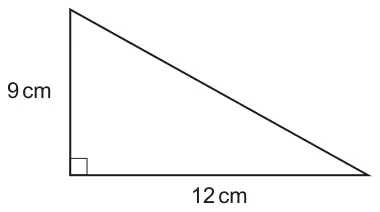
(a) The diagram shows the cross-section of a triangular prism.
Not to scale
Work out the area of the cross-section. [2]
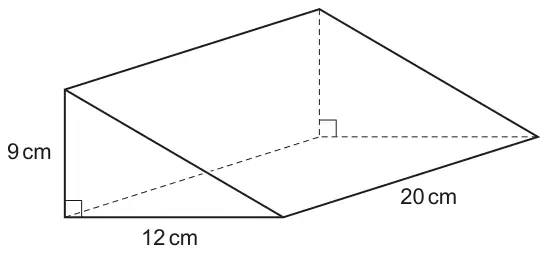
(b) This diagram shows the triangular prism.
Not to scale
Work out the total surface area of the triangular prism. You must show your working. [5]
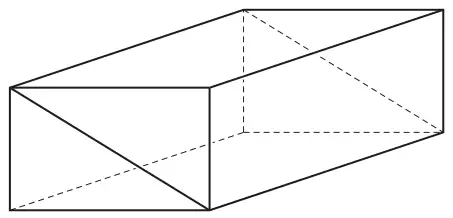
(c) Two of these triangular prisms are joined to make a new prism.
Give a reason why the total surface area of this prism is not two times your answer in part (b). [1]
Mark scheme (a)
Answer
Marks
Part marks and guidance
54
2
M1 for \(\dfrac{9 \times 12}{2}\) oe
Mark scheme (b)
Answer
Marks
Part marks and guidance
828 with correct working
5
Correct working requires evidence of at least M1or B2 (Pythagoras) and M2 (area)
B2 for [hypotenuse =] 15 or M1 for \(9^2 + 12^2\)
AND
M2 for 2 from 2 × theirpart(a), \(20 \times 9\), \(20 \times 12\), \(20 \times\) their \(\sqrt{9^2 + 12^2}\)
or
M1 for 1 from 2 × theirpart(a), \(20 \times 9\), \(20 \times 12\), \(20 \times\) their \(\sqrt{9^2 + 12^2}\)
Allow restart for area of triangle May be implied by 108, 180, 240, 300
If 0 or 1, scored instead award SC2 for 828 with no or insufficient working
Mark scheme (c)
Answer
Marks
Part marks and guidance
Reason that recognises the loss of part of the surface [of the triangular prisms] e.g. [The value of] two rectangular areas are lost /no longer on the surface oe
1
Accept e.g. faces/rectangles/slanting faces/sections for rectangular areas less/reduced for lost