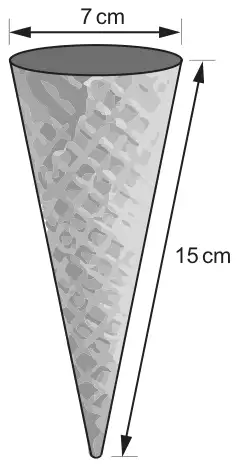
(i) How many cones could Megan fill? You may assume that each cone is completely filled, level to the top, with ice cream. [7]
(ii) What impact does the assumption have on your answer in (a)(i)? [1]
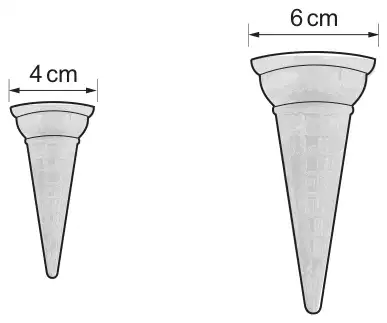
(b) Two mathematically similar ice cream cones are shown below.
Diagram not drawn to scale
The smaller cone has a volume of 40 cm3.
Calculate the volume of the larger cone. [2]
Mark scheme (a)
Scheme
Marks
Comments
(i) \(h^2 = 15^2 - 3.5^2\)
M1
Accept \(15^2 = h^2 + 3.5^2\)
\(h^2 = 212.75\) or \(h = \sqrt{212.75}\)
A1
14.58595...(cm) or 14.6 (cm)
A1
Accept rounded answers, but NOT truncated answers FT from M1 for the correctly evaluated square root of ‘their 212.75’ provided ‘their answer’ < 15 (cm)
FT ‘their 14.58595...’ provided M1 previously awarded
Answer in the range 187.(...cm3)
A1
\(2000 \div 187.(\ldots)\)
M1
FT ‘their 187.(...)’ provided at least 3 marks previously awarded
10 (ice creams)
A1
Must be a whole number
(ii) Evaluation of results, e.g. ‘cone was full, if it wasn’t Megan could have made more ice creams’,
E1
Accept FT from reasoning behind rounding ‘their number of ice creams’ up or down
Allow, e.g. ‘inside measurements could be less, so could be 11 rather than 10 ice creams’, ‘could have extra ice cream on the top, so makes fewer’, ‘not practical, as impossible to fill to the bottom of the cone’
We'd like to use Google Analytics cookies to count visits and see which pages help most. They're optional, and the site works exactly the same either way. Privacy policy