
Higher June 2024 Paper 1 Q20
20.
(a) Complete the table below.
Write both missing values in surd form.
The sketch of the equilateral triangle may help you. [2]
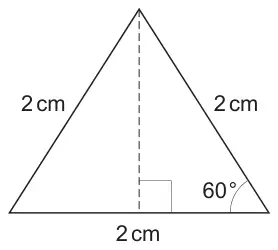
Write both missing values in surd form.
The sketch of the equilateral triangle may help you. [2]
| \(\sin 30^\circ\) | \(\dfrac{1}{2}\) |
| \(\cos 30^\circ\) | |
| \(\tan 30^\circ\) |
Diagram not drawn to scale
(b) The diagram shows a cuboid.
\(A\), \(B\), \(C\) and \(D\) are vertices of the cuboid.
\(BD = 10\) cm, \(AC = 12\) cm and \(D\hat{B}C = 30^\circ\).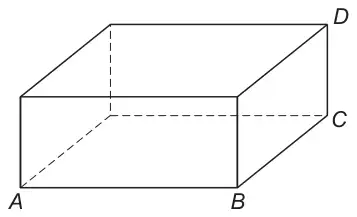
\(A\), \(B\), \(C\) and \(D\) are vertices of the cuboid.
\(BD = 10\) cm, \(AC = 12\) cm and \(D\hat{B}C = 30^\circ\).
Diagram not drawn to scale
Calculate the distance AD.
You must show all your working. [6]
| Scheme | Marks | Comments |
|---|---|---|
| \((\cos 30 =)\ \dfrac{\sqrt{3}}{2}\) | B1 | |
| \((\tan 30 =)\ \dfrac{1}{\sqrt{3}}\) OR \(\dfrac{\sqrt{3}}{3}\) | B1 | Allow \(\dfrac{\sqrt{1}}{\sqrt{3}}\) |
| Scheme | Marks | Comments |
|---|---|---|
| \((CD =)\ 10\times\sin 30\) | M2 | Allow 10 x ½ OR 10 ÷ 2 M1 for \(\sin 30 = \dfrac{CD}{10}\) |
| 5(cm) | A1 | An unsupported 5 (cm) is awarded M0 A0 |
| \((AD^2 =)\ 12^2 + 5^2\) | M1 | FT ‘their derived 5’, from use of trigonometry or unsupported 5. Allow M1 only for \(AD^2 = 12^2 + CD^2\) |
| \((AD =)\ \sqrt{169}\) or \(AD^2 = 169\) | A1 | FT ‘their derived 5’. |
| (AD =) 13 (cm) | A1 | CAO |
| (8) |