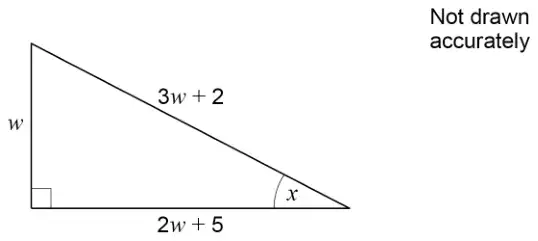
\((2w + 3)(2w - 7)\) or \(\dfrac{- -8 \pm \sqrt{(-8)^2 - 4 \times 4 \times -21}}{2 \times 4}\) or 3.5
M1
oe eg \(1 \pm \sqrt{\dfrac{25}{4}}\) or \(\dfrac{7}{2}\) in quadratic formula or completing the square allow \(\pm\) to be \(+\)
\(\sin x = \dfrac{3.5}{3 \times 3.5 + 2}\) or \(\cos x = \dfrac{2 \times 3.5 + 5}{3 \times 3.5 + 2}\) or \(\tan x = \dfrac{3.5}{2 \times 3.5 + 5}\)
M1dep
oe eg \(\sin^{-1}\dfrac{7}{25}\) or \(\sin^{-1} 0.28\) or \(\cos^{-1}\dfrac{24}{25}\) or \(\cos^{-1} 0.96\) or \(\tan^{-1}\dfrac{7}{24}\) or \(\tan^{-1}\) [0.29, 0.292]
[16.17, 16.3] with no other solution
A1
accept 16 with no other solution with M2 awarded
Additional guidance
Up to M2 may be awarded for correct work with no answer or incorrect answer, even if this is seen amongst multiple attempts
In the quadratic formula \(-8^2\) is M0 unless recovered
2nd M1 Using the sine rule or cosine rule must have \(\sin x\) or \(\cos x\) as the subject and a correct numerical expression or a correct value
\(\sin x = \dfrac{3.5 \sin 90}{12.5}\) with no further correct working
M1M0
Check 14(a) and diagram for working that may be valid in 14(b)
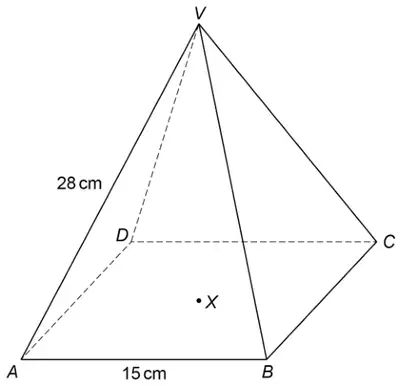
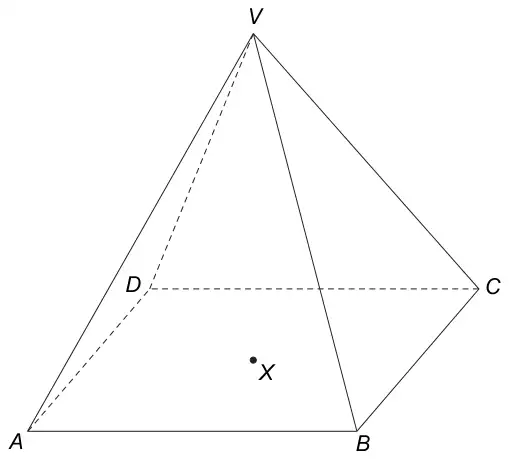
The square horizontal base, \(ABCD\), has side length 15 cm
\(V\) is directly above the centre, \(X\), of the base.
\(VA = 28\) cm
Work out the size of the angle that \(VA\) makes with \(ABCD\). [3 marks]
Mark scheme
Answer
Mark
Comments
(\(AC =\)) \(\sqrt{15^2 + 15^2}\) or \(\sqrt{450}\) or \(15\sqrt{2}\) or 21.2(…) or (\(AX =\)) \(\sqrt{7.5^2 + 7.5^2}\) or \(\sqrt{112.5}\) or \(\dfrac{15\sqrt{2}}{2}\) or [10.6, 10.61]
M1
oe eg (\(DB =\)) \(\sqrt{225 + 225}\) or (\(BX =\)) \(\sqrt{56.25 + 56.25}\) or (\(AX =\)) \(\sqrt{\dfrac{15^2}{2}}\) or (\(AX =\)) \(15\sin 45\) allow any unambiguous indication of side may be seen on diagram
\(\cos y = \dfrac{0.5\sqrt{15^2 + 15^2}}{28}\) or \(\cos y = \dfrac{\sqrt{7.5^2 + 7.5^2}}{28}\) or \(\cos y = \dfrac{15\sqrt{2}}{56}\) or \(\cos^{-1}[0.37, 0.38]\)
M1dep
oe eg \(\sin y = \dfrac{\sqrt{28^2 - 7.5^2 - 7.5^2}}{28}\) or \(\tan y = \dfrac{\sqrt{28^2 - 7.5^2 - 7.5^2}}{\sqrt{7.5^2 + 7.5^2}}\) or \(90 - \sin^{-1}\dfrac{\sqrt{7.5^2 + 7.5^2}}{28}\)
[66.9, 68.435]
A1
SC2 [21.565, 23.1]
Additional guidance
Up to M2 may be awarded for correct work with no answer or incorrect answer, even if this is seen amongst multiple attempts
M1dep \(y\) may be \(x\) or \(A\) or \(VAX\) etc
M1dep oe must be of the form \(\cos y =\) (or \(\sin y =\) or \(\tan y =\)) or be a calculation that evaluates to [66.9, 68.435] eg applying cosine rule to triangle \(VAC\) \(\cos y = \dfrac{28^2 + 450 - 28^2}{2 \times 28 \times \sqrt{450}}\)
M2
M1dep allow \(\sin y = [0.92, 0.93]\) or \(\tan y = [2.44, 2.45]\) or \(90 - [21.565, 23.1]\)
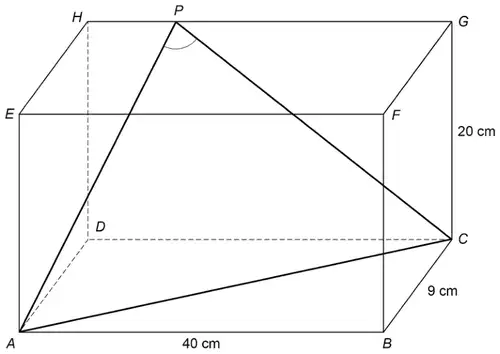
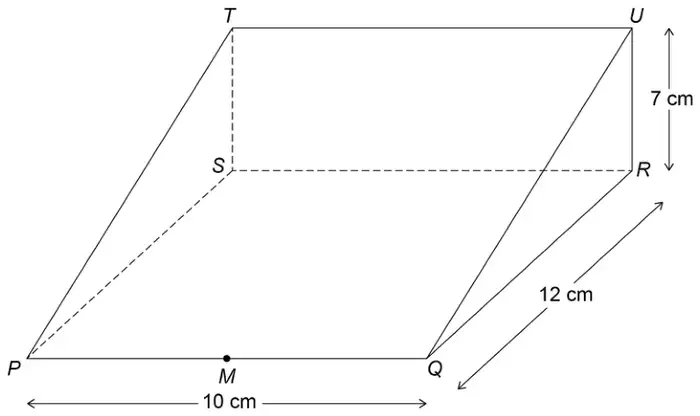
\(P\) is a point on \(HG\) such that \(\quad HP : PG = 3 : 7\)
\(AP = 25\text{ cm}\)
Work out the size of angle \(APC\). [5 marks]
Mark scheme
Answer
Mark
Comments
\(\dfrac{40}{3 + 7} \times 7\) or 28
M1
oe eg \(40 - \dfrac{40}{3 + 7} \times 3\) or \(40 - 12\) may be seen on diagram may be implied
\(20^2 + \text{their } 28^2\) or \(400 + 784\) or 1184 or \(4\sqrt{74}\) or [34.4, 34.41]
M1
oe eg \(\sqrt{20^2 + \text{their } 28^2}\) or \(\sqrt{1184}\) their 28 must be \(\lt 40\) may be seen on diagram
\(40^2 + 9^2\) or \(1600 + 81\) or 1681 or 41
M1
oe eg \(\sqrt{40^2 + 9^2}\) or \(\sqrt{1681}\) may be seen on diagram
their 1681 \(= 25^2 +\) their 1184 \(- 2 \times 25 \times \sqrt{\text{their } 1184} \times \cos x\)
M1dep
oe eg \(\cos^{-1}\dfrac{25^2 + \text{their } 1184 - \text{their } 1681}{2 \times 25 \times \sqrt{\text{their } 1184}}\) or \(\cos^{-1}[0.07, 0.07442]\) dep on 2nd and 3rd M1 \(x\) may be \(APC\) or \(A\) etc
[85.7, 86]
A1
Additional guidance
Up to M4 may be awarded for correct work with no, or incorrect answer, even if this is seen amongst multiple attempts
If their \(PG\) is 28 do not allow use of a value other than 28 in subsequent working
4th M1 Condone \(\cos^{-1} = 0.07\) for \(\cos^{-1} 0.07\) etc
4th M1 oes must be a fully correct method eg Uses cosine rule to work out angle \(PCA\) then uses sine rule to work out angle \(APC\) Must get to correct sine rule equation with no errors in method
Missing brackets must be recovered eg 4th M1 Do not allow \(4\sqrt{74}^2\) unless recovered in subsequent working
oe eg \((-2 - -1)^2 + \left(5\dfrac{3}{4} - 5\right)^2\) \(\sqrt{1.5625}\) or \(\sqrt{\dfrac{25}{16}}\) or \(\sqrt{1\dfrac{9}{16}}\) would imply this mark
(\(BC =\)) \(\dfrac{5}{4}\) or \(1\dfrac{1}{4}\) or 1.25
A1
Additional guidance
Candidates may spot it’s a \(\dfrac{3}{4}\), 1, \(\dfrac{5}{4}\) Pythagorean triple which gains the M marks and will probably go on to score all marks Ignore further rounding or truncating after correct answer seen eg \(\dfrac{5}{4}\) followed by = 1.2 would score the A mark Condone \(\dfrac{3}{4}^2\) without the brackets. Condone \(-1^2\) without the brackets
M2A1
\(\dfrac{5}{4}\) followed by = 0.8 is incorrect further working
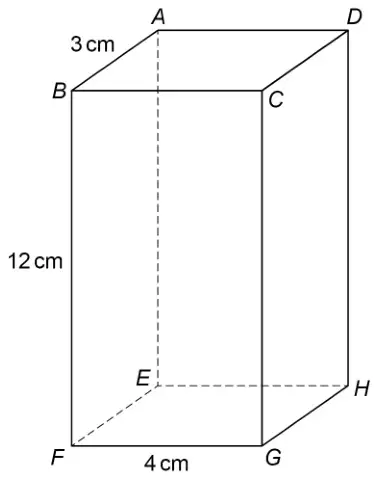
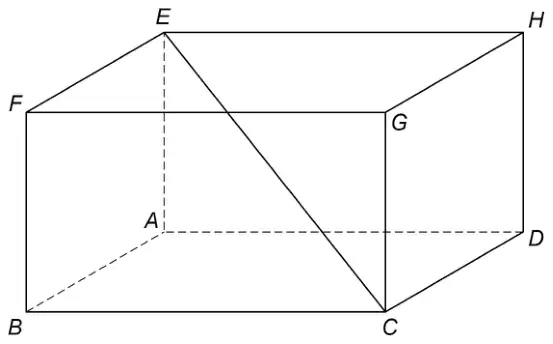
\(BC = 15\) cm \(\qquad CD = 12\) cm \(\qquad DH = 8\) cm
Work out the size of the angle between the line \(CE\) and the plane \(CDHG\). [4 marks]
Mark scheme
Answer
Mark
Comments
\(8^2 + 12^2\) or \(64 + 144\) or 208 or \(8^2 + 12^2 + 15^2\) or \(64 + 144 + 225\) or 433
M1
\(HC^2\) or \(CE^2\)
implied by 2nd M1
\(\sqrt{8^2 + 12^2}\) or \(\sqrt{208}\) or \(4\sqrt{13}\) or 14.4… or \(\sqrt{8^2 + 12^2 + 15^2}\) or \(\sqrt{433}\) or 20.8…
M1dep
oe may be on diagram fully correct trigonometry method leading to 14.4… or 20.8… can score M2 eg \(8 \div \sin\left(\tan^{-1} \dfrac{8}{12}\right)\) or \(8 \div \sin\left(\tan^{-1} \dfrac{8}{\sqrt{12^2 + 15^2}}\right)\)
\(\tan x = \dfrac{15}{\sqrt{8^2 + 12^2}}\) or \(\cos x = \dfrac{\sqrt{8^2 + 12^2}}{\sqrt{8^2 + 12^2 + 15^2}}\) or \(\sin x = \dfrac{15}{\sqrt{8^2 + 12^2 + 15^2}}\)
M1dep
oe eg \(\tan x = [1.04,\ 1.042]\) or or \(\cos x = [0.69,\ 0.6934]\) or \(\sin x = [0.72,\ 0.7212]\) or \(90 - \tan^{-1} \dfrac{\sqrt{8^2 + 12^2}}{15}\) dep on M2 any letter
46(.1…)
A1
Additional guidance
3rd M1 If using sine rule or cosine rule, must be in the form \(\cos x =\) or \(\sin x =\) eg \(\cos x = \dfrac{20.8^2 + 14.4^2 - 15^2}{2 \times 20.8 \times 14.4}\) (oe eg \(\cos^{-1} [0.69,\ 0.6934]\))
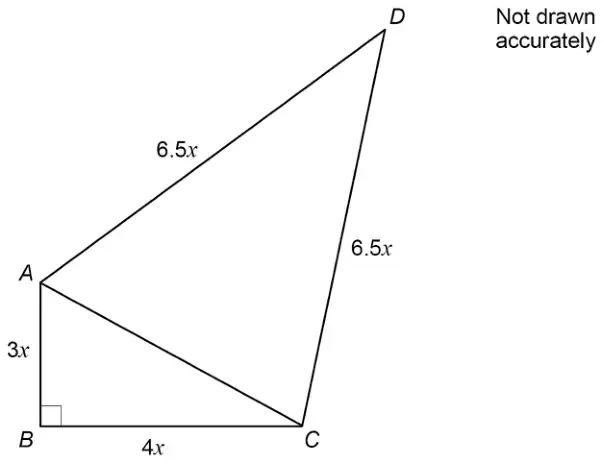
\(\cos^{-1} \dfrac{(6.5x)^2 + (6.5x)^2 - (5x)^2}{2 \times 6.5x \times 6.5x}\) or \(\cos^{-1} \dfrac{119}{169}\) or 45(.2…)
M1dep
oe dep on 2nd M1
\(0.5 \times 6.5x \times 6.5x \times \sin\) their 45(.2…) or \(15x^2\)
M1dep
oe dep on 2nd and 3rd M1
\(21x^2\)
A1
allow \(p = 21\) if areas \(6x^2\) and \(15x^2\) seen
Additional guidance
Allow recovery of algebra eg1 \(\ 0.5 \times 4 \times 3 = 6\) is 1st M0 but if recovered to \(6x^2\) scores 1st M1 eg2 Alt 1 \(\sqrt{42.25 - 6.25} = 6\) is 2nd M0 and 3rd M0 but if recovered to \(6x\) scores 2nd M1 and 3rd M1
Do not allow final mark if an incorrect area is seen eg do not allow answer \(21x^2\) if their two areas are \(6x^2\) and \(15x\)
Answer \(21x^2\) with no incorrect working eg fully correct working with numbers and final answer \(21x^2\)
11 A cone has base radius \(r\) cm, perpendicular height \(h\) cm and slant height \(l\) cm
The curved surface area is \(60\pi\) cm2 \(l = 3r\)
Work out the value of \(h\).
Give your answer in the form \(a\sqrt{10}\) where \(a\) is an integer greater than 1 You must show your working. [5 marks]
Mark scheme
Answer
Mark
Comments
Alternative method 1
\(\pi \times r \times 3r = 60\pi\)
M1
oe
\(r^2 = 20\) or \(r = \sqrt{20}\) or \(r = 2\sqrt{5}\)
A1
oe
\((l =)\ 3\sqrt{20}\) or \((l =)\ 6\sqrt{5}\) or \((l =)\ \sqrt{180}\) or \(l^2 = 180\)
A1
oe
\((h^2 =)\ (3\sqrt{20})^2 - (\sqrt{20})^2\) or \((h^2 =)\ (6\sqrt{5})^2 - (2\sqrt{5})^2\) or \((h^2 =)\ (\sqrt{180})^2 - (\sqrt{20})^2\) or \((h^2 =)\ 160\)
M1
oe using their \(l\) and \(r\) (this is independent so \(l\) and \(r\) can be anything) condone missing brackets
\((h =)\ 4\sqrt{10}\)
A1
Alternative method 2
\(\pi \times \dfrac{l}{3} \times l = 60\pi\)
M1
oe
\(l^2 = 180\) or \(l = \sqrt{180}\) or \(l = 3\sqrt{20}\) or \(l = 6\sqrt{5}\)
A1
oe
\(r^2 = 20\) or \((r =)\ \sqrt{20}\) or \((r =)\ 2\sqrt{5}\)
A1
oe
\((h^2 =)\ (3\sqrt{20})^2 - (\sqrt{20})^2\) or \((h^2 =)\ (6\sqrt{5})^2 - (2\sqrt{5})^2\) or \((h^2 =)\ (\sqrt{180})^2 - (\sqrt{20})^2\) or \((h^2 =)\ 160\)
M1
oe using their \(l\) and \(r\) (this is independent so \(l\) and \(r\) can be anything) condone missing brackets
\((h =)\ 4\sqrt{10}\)
A1
Alternative method 3
\(\pi \times r \times 3r = 60\pi\) or \(\pi \times \dfrac{l}{3} \times l = 60\pi\)
M1
oe
\(r^2 = 20\) or \(r = \sqrt{20}\) or \(r = 2\sqrt{5}\) or \(l = 3\sqrt{20}\) or \(l = 6\sqrt{5}\) or \(l = \sqrt{180}\) or \(l^2 = 180\)
A1
oe
\(r^2 + h^2 = (3r)^2\) or \((h^2 =)\ 9r^2 - r^2\) or \(\left(\dfrac{l}{3}\right)^2 + h^2 = l^2\) or \((h^2 =)\ l^2 - \dfrac{l^2}{9}\)
M1
oe to form an equation with only 2 variables using their \(l\) or \(r\) (this is independent so \(l\) and \(r\) can be anything)
\((h =)\ r\sqrt{8}\) or \((h^2 =)\ 160\)
A1
oe
\((h =)\ 4\sqrt{10}\)
A1
Additional guidance
Second M mark is independent of first M mark
Answer with no working will not gain any marks
Minimum working for full marks would be a correct expression in the second M mark for alt method 1 and alt method 2. In this the candidate would show \(l\) and \(r\) so the first M mark would be implied. On alt method 3 they would need to show correct evidence in the first A mark and second M mark as a minimum expectation
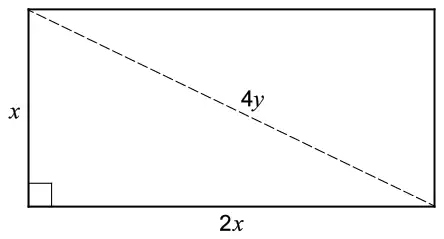
oe eg \(5x^2 = (4y)^2\) Missing brackets may be recovered
\(x^2 = \dfrac{16}{5}y^2\) or \(5x^2 = 16y^2\) or \(x = \sqrt{\dfrac{16y^2}{5}}\) or \(x\sqrt{5} = 4y\)
M1
oe equation of the form \(ax^2 = by^2\) or \(cx = dy\) or \(x = \sqrt{ky^2}\) eg \(x^2 = 16y^2 \div 5\) ft if Pythagoras used with only error being missing brackets
\(2 \times\) their \(\dfrac{16}{5}y^2\) or their \(16y^2 \div \dfrac{\text{their } 5}{2}\)
M1dep
oe \(2 \times\) their \(x^2\) or \(2 \times\) (their \(x\))\(^2\) dep on at least one M
\(\dfrac{32}{5}y^2\) or \(6\dfrac{2}{5}y^2\) or \(6.4y^2\)
A1
Additional guidance
\(5x^2 = (4y)^2\) with no further work
M1M0M0
\(x^2 + 4x^2 = 4y^2\) with answer \(\dfrac{8}{5}y^2\)
M0M1M1A0
\(x^2 + 2x^2 = 16y^2\) with answer \(\dfrac{32}{3}y^2\)
M0M1M1A0
\(x^2 + 2x^2 = 4y^2\) with answer \(\dfrac{8}{3}y^2\)
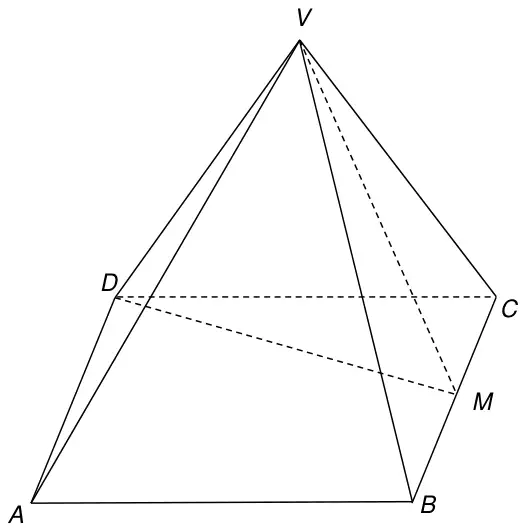
22 Pyramid \(VABCD\) has a horizontal rectangular base.
\(X\) is the centre of the base.
\(V\) is vertically above \(X\).
\[VB = VC = 17\text{ cm} \qquad AB = 22\text{ cm} \qquad BC = 16\text{ cm}\]
Work out the angle between the planes \(VBC\) and \(ABCD\). [4 marks]
Mark scheme
Answer
Mark
Comments
Alternative method 1 Triangles \(VMB\) and \(VXM\) (\(M\) is the midpoint of \(BC\))
\(17^2 - (16 \div 2)^2\) or 225 or \(17^2 = VM^2 + (16 \div 2)^2\)
M1
oe
\((VM =)\ \sqrt{17^2 - (16 \div 2)^2}\) or \(\sqrt{225}\) or 15
M1
Implies M1 M1 May be seen on diagram
\(\cos x = \dfrac{22 \div 2}{\text{their } 15}\) or \(\sin x = \dfrac{\sqrt{15^2 - (22 \div 2)^2}}{\text{their } 15}\) or \(\tan x = \dfrac{\sqrt{15^2 - (22 \div 2)^2}}{22 \div 2}\)
M1dep
\(x\) is required angle dep on M1 M1 oe eg correct method using cosine rule or sine rule simplified to \(\cos x =\) or \(\sin x =\) or \(90 - \sin^{-1}\dfrac{22 \div 2}{\text{their } 15}\)
42.8…
A1
Allow 43 with correct working SC2 Answer 36.8... or 36.9
Alternative method 2 Triangles \(BXM\) and \(VXB\) and \(VXM\) (\(M\) is the midpoint of \(BC\))
\(BX^2 = (16 \div 2)^2 + (22 \div 2)^2\) or 185 and \(17^2\) − their \(BX^2\) or \(17^2 = VX^2\) + their \(BX^2\)
\((VX =)\ \sqrt{17^2 - (\text{their } BX)^2}\) or \(\sqrt{104}\) or \(2\sqrt{26}\) or [10.19, 10.2]
M1
Implies M1 M1 May be seen on diagram
\(\tan x = \dfrac{\text{their } [10.19, 10.2]}{22 \div 2}\) or \(\sin x = \dfrac{\text{their } [10.19, 10.2]}{\text{their } VM}\) or \(\cos x = \dfrac{22 \div 2}{\text{their } VM}\)
M1dep
\(x\) is required angle dep on M1 M1 oe eg correct method using cosine rule or sine rule simplified to \(\cos x =\) or \(\sin x =\) or \(90 - \tan^{-1}\dfrac{22 \div 2}{\text{their } [10.19, 10.2]}\)
42.8…
A1
Allow 43 with correct working SC2 Answer 36.8... or 36.9
Alternative method 3 Triangles \(VMB\) and \(VMN\) (\(M\) is the midpoint of \(BC\), \(N\) is the midpoint of \(AD\))
\(17^2 - (16 \div 2)^2\) or 225 or \(17^2 = VM^2 + (16 \div 2)^2\)
M1
oe
\((VM =)\ \sqrt{17^2 - (16 \div 2)^2}\) or \(\sqrt{225}\) or 15
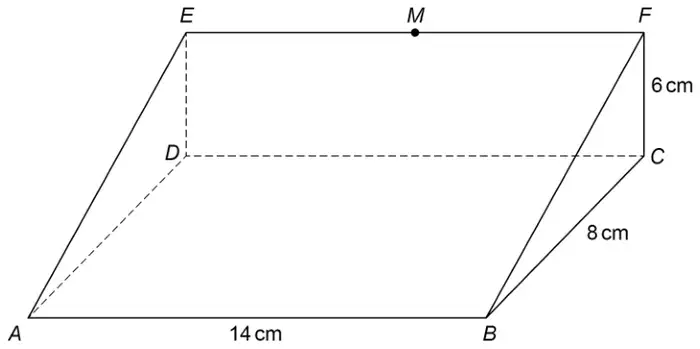
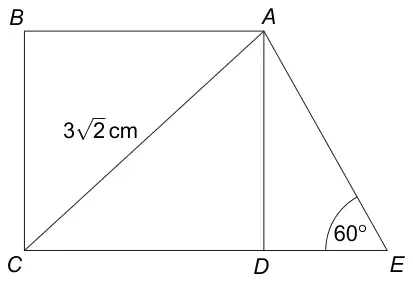
\(AC\) is \(3\sqrt{2}\) cm and angle \(DEA = 60^\circ\)
Not drawn accurately
(a) Show that the side of the square is 3 cm [2 marks]
(b) Show that the perimeter of trapezium \(ABCE\) is \(\ 3(3 + \sqrt{3})\) cm [4 marks]
Mark scheme (a)
Answer
Mark
Comments
Alternative method 1
\(x^2 + x^2 = (3\sqrt{2})^2\)
M1
where \(x\) is the side of the square It must say \((3\sqrt{2})^2\) ... \(x^2 + x^2 = 18\) is M0
\(2x^2 = 18\)
A1
oe
Alternative method 2
\(\sin 45^\circ = \dfrac{x}{3\sqrt{2}}\) or \(\cos 45^\circ = \dfrac{x}{3\sqrt{2}}\)
M1
where \(x\) is the side of the square allow use of the sine rule
\(\dfrac{1}{\sqrt{2}} = \dfrac{x}{3\sqrt{2}}\)
A1
oe
Additional guidance
In alt 1 ... Ignore further work after \(2x^2 = 18\) \(1 : 1 : \sqrt{2}\) scaled up by a factor of 3 to give \(3 : 3 : 3\sqrt{2}\) is 'verify' so scores SC1 or \(3^2 + 3^2 = 9 + 9 = 18\) and \((3\sqrt{2})^2 = 9 \times 2 = 18\) is also 'verify', so SC1
SC1
Mark scheme (b)
Answer
Mark
Comments
Alternative method 1
\(\tan 60 = \dfrac{3}{DE}\) or \(DE = \dfrac{3}{\sqrt{3}}\) or \(1 : \sqrt{3} : 2\) triangle
M1
oe
\(DE = \sqrt{3}\)
A1
oe eg \(\dfrac{3}{\sqrt{3}}\)
\(AE = 2\sqrt{3}\)
A1
oe eg \(\dfrac{6}{\sqrt{3}}\) or \(\sqrt{12}\)
\(3 \times 3 + \sqrt{3} + 2\sqrt{3}\)
A1
oe
Alternative method 2
\(\sin 60 = \dfrac{3}{AE}\) or \(AE = \dfrac{3}{(\sqrt{3}/2)}\)
M1
oe
\(AE = 2\sqrt{3}\)
A1
oe eg \(\dfrac{6}{\sqrt{3}}\) or \(\sqrt{12}\)
\(DE = \sqrt{3}\)
A1
oe eg \(\dfrac{3}{\sqrt{3}}\)
\(3 \times 3 + \sqrt{3} + 2\sqrt{3}\)
A1
oe
Additional guidance
They can leave \(DE\) and \(AE\) in unsimplified form for the first two A marks but must then simplify their expression for the perimeter to clearly show the required result for the final A mark.
\[\tan y = \frac{p + 1}{p - 1} \qquad \text{where } p \text{ is a constant greater than 1}\]
(a) Which of the statements below is correct?
Circle your answer. [1 mark]
\(y = 45^\circ\)
\(y \lt 45^\circ\)
\(y \gt 45^\circ\)
\(y\) could be any acute angle
(b) Work out the expression for \(\sin y\)
Give your answer in the form \(\ \dfrac{ap + b}{\sqrt{cp^2 + d}}\ \) where \(a\), \(b\), \(c\) and \(d\) are integers.
You may use a diagram to help you. [4 marks]
Mark scheme (a)
Answer
Mark
Comments
\(y \gt 45^\circ\)
B1
Mark scheme (b)
Answer
Mark
Comments
\((p + 1)^2 + (p - 1)^2\)
M1
oe May be within a square root
\(p^2 + p + p + 1 + p^2 - p - p + 1\) or \(p^2 + 1 + p^2 + 1\)
M1
oe May be within a square root Implies M1 M1
\(2p^2 + 2\) or \(2(p^2 + 1)\)
A1
May be within a square root Must be simplified May be implied by final mark
\(\dfrac{p + 1}{\sqrt{2p^2 + 2}}\)
A1
Allow \(a = b = 1 \quad c = d = 2\) SC2 \(\dfrac{p + 1}{\sqrt{(p + 1)^2 + (p - 1)^2}}\)
Additional guidance
\(\dfrac{p + 1}{\sqrt{2p^2 + 2}}\) and further incorrect work
M2 A1 A0
Allow \(1p\) for \(p\)
Use of \(\dfrac{\sin y}{\cos y} = \dfrac{p + 1}{p - 1}\) can be marked by the scheme eg \((p - 1)^2\sin^2 y = (p + 1)^2\cos^2 y\) \((p - 1)^2\sin^2 y = (p + 1)^2(1 - \sin^2 y)\) \(((p - 1)^2 + (p + 1)^2)\sin^2 y = (p + 1)^2\) First M1 gained here (M1 A1 A1 may subsequently be gained)