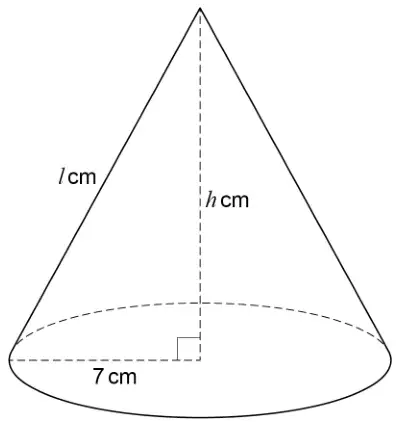
A solid cone has base radius 7 cm, perpendicular height \(h\) cm and slant height \(l\) cm
\[\text{Curved surface area of a cone} = \pi r l\]
The total surface area of the cone is \(224\pi\) cm\(^2\)
Work out the size of the angle between the slant height and the base. [4 marks]
(b)
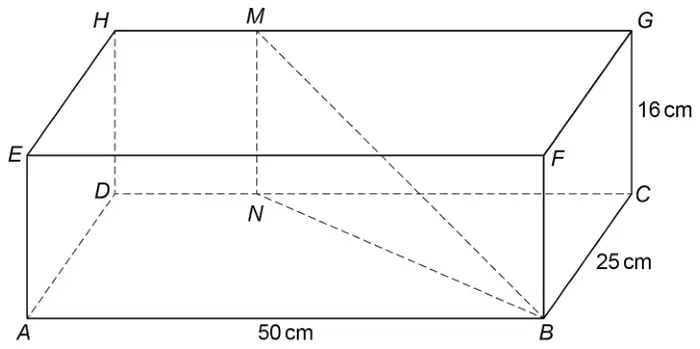
\(ABCDEFGH\) is a cuboid.
\(ABCD\) is horizontal.
\(MN\) is vertical.
The acute angle between the planes \(MNB\) and \(HDCG\) is \(36^\circ\)
Work out the length \(CN\). [2 marks]
Mark scheme (a)
Answer
Mark
Comments
Alternative method 1: works out value for slant height
\(224\pi - \pi \times 7 \times 7\) or \(175\pi\) or \(224 - 7 \times 7 = 7l\) or \(175 = 7l\)
M1
oe curved surface area accept a value [3.14, 3.142] for \(\pi\) eg \(224 \times 3.14 - 3.14 \times 49\) or oe equation with \(7l\) as the subject eg \(7l = 224 - 49\)
\((224\pi - \pi \times 7 \times 7) \div (\pi \times 7)\) or \(175 \div 7\) or 25
\(\cos x = \dfrac{7}{\text{their } 25}\) or \(\cos x = 0.28\) or \(\cos^{-1}\dfrac{7}{\text{their } 25}\) or \(\cos^{-1} 0.28\)
M1dep
oe eg \(\sin x = \dfrac{\sqrt{\text{their } 25^2 - 7^2}}{\text{their } 25}\) or \(\sin x = 0.96\) or \(\tan x = \dfrac{\sqrt{\text{their } 25^2 - 7^2}}{7}\) or \(\tan x =\) [3.4, 3.43]
[73.7, 73.74]
A1
accept 74 with correct method seen SC2 [76.5, 76.51] or [77.3, 77.4]
Alternative method 2: works out expression for slant height
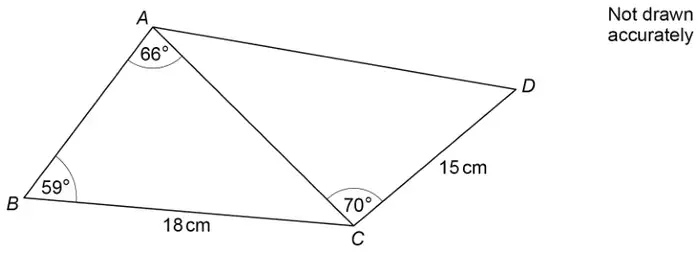
oe equation in \(AC\) eg \(\dfrac{\sin 59}{AC} = \dfrac{\sin 66}{18}\) accept [0.85, 0.86] for \(\sin 59\) accept [0.91, 0.914] for \(\sin 66\)
\(\dfrac{18}{\sin 66} \times \sin 59\) or [16.7, 17.011]
M1dep
oe calculation for \(AC\) accept [0.85, 0.86] for \(\sin 59\) accept [0.91, 0.914] for \(\sin 66\)
\(\dfrac{1}{2} \times 15 \times\) their [16.7, 17.011] \(\sin 70\)
M1dep
oe accept [0.93, 0.94] for \(\sin 70\)
[119, 119.11]
A1
Additional guidance
Up to M2 may be awarded for correct work with no answer or incorrect answer, even if this is seen amongst multiple attempts
Allow any indication of \(AC\) eg \(x\) or \(b\)
An equivalent method for the first two marks may be from using sine rule and cosine rule eg \(AB = \dfrac{18}{\sin 66} \times \sin(180 - 59 - 66)\) or [16.1, 16.140124] \(AC^2 = 18^2 + 16.14^2 - 2 \times 18 \times 16.14 \times \cos 59\) \(AC = \sqrt{18^2 + 16.14^2 - 2 \times 18 \times 16.14 \times \cos 59}\)
M1 M1dep
[119, 119.11] seen with area of \(ABCD\) or \(ABC\) as final answer
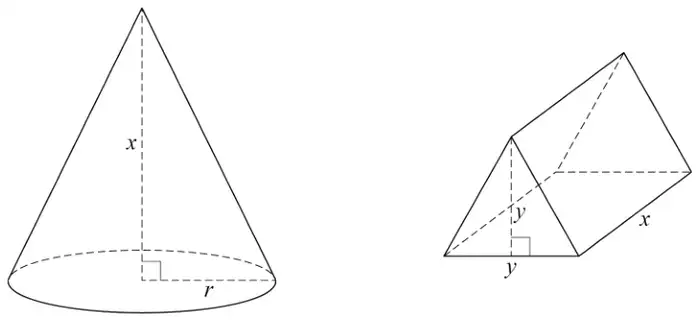
The cone has base radius \(r\) and perpendicular height \(x\).
The prism has a triangular cross section with base \(y\) and perpendicular height \(y\).
The length of the prism is \(x\).
Volume of a cone \(= \dfrac{1}{3} \times\) area of base \(\times\) perpendicular height
The volume of the cone is four times the volume of the prism.
Express \(r\) in terms of \(y\). [4 marks]
Mark scheme
Answer
Mark
Comments
(Cone =) \(\dfrac{1}{3}\pi r^2x\) or (Prism =) \(\dfrac{1}{2}y^2x\)
M1
could appear in M1 dep working height must be \(x\)
\(\dfrac{1}{3}\pi r^2x = 2y^2x\)
M1dep
for correctly processing the 4 must be a correct equation oe eg \(\dfrac{\frac{1}{3} \times \pi r^2 \times x}{2} = \dfrac{2y^2 \times x}{2}\) or \(\dfrac{\pi r^2 \times x}{6} = \dfrac{2y^2 \times x}{2}\) \(\dfrac{1}{3}\pi r^2x = 4\left(\dfrac{1}{2}y^2x\right)\) is not enough for M1 here because the 4 has not been processed
\(\dfrac{1}{3}\pi r^2 = 2y^2\) or \(r^2 = \dfrac{6y^2}{\pi}\) or \(\dfrac{1}{3}r^2 = \dfrac{2y^2}{\pi}\) or \(\pi r^2 = 6y^2\)
M1
oe for eliminating \(x\) dependent on both formulae being correct may have been numerical errors in previous M mark allow multiplication signs unprocessed numerical values can be condoned
\(r = \sqrt{\dfrac{6}{\pi}}\;y\) or \(r = \sqrt{\dfrac{6y^2}{\pi}}\)
A1
numbers need to be simplified \(\sqrt{\dfrac{12y^2}{2\pi}}\) or \(\sqrt{\dfrac{2y^2}{\frac{1}{3}\pi}}\) are A0 ensure that root is over the whole fraction (or separate roots over the numerator and denominator)
Additional guidance
\(r = \sqrt{\dfrac{6y^2x}{\pi x}}\)
M1 M1 M0 A0
\(\dfrac{4}{3}\pi r^2x = \dfrac{1}{2}y^2x\) (multiplying the wrong side by 4) followed by eg \(\dfrac{4}{3}\pi r^2 = \dfrac{1}{2}y^2\) or \(8r^2 = \dfrac{3y^2}{\pi}\) or \(\dfrac{4}{3}r^2 = \dfrac{y^2}{2\pi}\) or \(\pi r^2 = \dfrac{3}{8}y^2\)
M1 M0 M1 A0
Penalise \(\pm\) on answer line
M3 A0
Either formula incorrect would result in maximum mark of M1
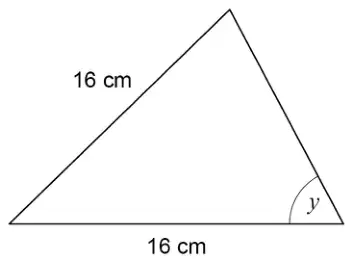
oe eg \(\dfrac{1}{2} \times 16 \times 16 \times \sin(180 - 2y)\) \(x\) can be any letter or expression may be implied
\(\sin x = 120 \div \left(\dfrac{1}{2} \times 16 \times 16\right)\) or \(\sin x = \dfrac{15}{16}\) or \(\sin^{-1}\dfrac{15}{16}\) or \(\sin^{-1}[0.93, 0.94]\) or [68.4, 70.12313]
M1dep
oe eg \(\sin x = \dfrac{240}{256}\) or \(\sin x = [0.93, 0.94]\) equation must have \(\sin x =\) \(x\) can be any letter or expression
\(\dfrac{180 - \text{their}[68.4, 70.12313]}{2}\)
M1dep
oe
[54.93, 55.8]
A1
SC2 [75.82, 76.4]
Alternative method 2 Works out perpendicular height
\(120 \div \left(\dfrac{1}{2} \times 16\right)\) or \(120 \div 8\) or 15
M1
\(\cos x = \dfrac{\sqrt{16^2 - (\text{their } 15)^2}}{16}\) or \(\cos^{-1}\dfrac{\sqrt{31}}{16}\) or \(\tan x = \dfrac{15}{\sqrt{16^2 - (\text{their } 15)^2}}\) or \(\tan^{-1}\dfrac{15}{\sqrt{31}}\) or [68.4, 70.12313]
M1dep
oe eg \(\sin x = \dfrac{15}{16}\) or \(\sin x = [0.93, 0.94]\) or \(\cos x = [0.34, 0.35]\) or \(\tan x = [2.69, 2.7]\) \(x\) can be any letter or expression
\(\dfrac{180 - \text{their}[68.4, 70.12313]}{2}\)
M1dep
oe
[54.93, 55.8]
A1
SC2 [75.82, 76.4]
Alternative method 3 Works out perpendicular height
\(120 \div \left(\dfrac{1}{2} \times 16\right)\) or \(120 \div 8\) or 15
M1
oe
\(16 - \sqrt{16^2 - (\text{their } 15)^2}\) or \(16 - \sqrt{31}\) or [10.4, 10.44]
M1dep
oe eg \(\tan y = \dfrac{15}{16 - \sqrt{16^2 - (\text{their } 15)^2}}\) \(y\) can be any letter or expression
Condone \(\sin =\) for \(\sin x =\) etc Condone \(\sin^{-1} = 0.9375\) for \(\sin^{-1} 0.9375\) etc
SC2 is for omitting the 0.5 from the area of triangle formula
After scoring M1M1, the 3rd M1 is for any full method eg Alt 1 68.6 Cosine rule used to work out the third side of the triangle followed by sine rule to work out \(y\) (up to \(\sin^{-1}\ldots\)) If there are no errors seen in the method the 3rd M1 is awarded and possibly the A1 as well
11 A cone has base radius \(r\) cm, perpendicular height \(h\) cm and slant height \(l\) cm
The curved surface area is \(60\pi\) cm2 \(l = 3r\)
Work out the value of \(h\).
Give your answer in the form \(a\sqrt{10}\) where \(a\) is an integer greater than 1 You must show your working. [5 marks]
Mark scheme
Answer
Mark
Comments
Alternative method 1
\(\pi \times r \times 3r = 60\pi\)
M1
oe
\(r^2 = 20\) or \(r = \sqrt{20}\) or \(r = 2\sqrt{5}\)
A1
oe
\((l =)\ 3\sqrt{20}\) or \((l =)\ 6\sqrt{5}\) or \((l =)\ \sqrt{180}\) or \(l^2 = 180\)
A1
oe
\((h^2 =)\ (3\sqrt{20})^2 - (\sqrt{20})^2\) or \((h^2 =)\ (6\sqrt{5})^2 - (2\sqrt{5})^2\) or \((h^2 =)\ (\sqrt{180})^2 - (\sqrt{20})^2\) or \((h^2 =)\ 160\)
M1
oe using their \(l\) and \(r\) (this is independent so \(l\) and \(r\) can be anything) condone missing brackets
\((h =)\ 4\sqrt{10}\)
A1
Alternative method 2
\(\pi \times \dfrac{l}{3} \times l = 60\pi\)
M1
oe
\(l^2 = 180\) or \(l = \sqrt{180}\) or \(l = 3\sqrt{20}\) or \(l = 6\sqrt{5}\)
A1
oe
\(r^2 = 20\) or \((r =)\ \sqrt{20}\) or \((r =)\ 2\sqrt{5}\)
A1
oe
\((h^2 =)\ (3\sqrt{20})^2 - (\sqrt{20})^2\) or \((h^2 =)\ (6\sqrt{5})^2 - (2\sqrt{5})^2\) or \((h^2 =)\ (\sqrt{180})^2 - (\sqrt{20})^2\) or \((h^2 =)\ 160\)
M1
oe using their \(l\) and \(r\) (this is independent so \(l\) and \(r\) can be anything) condone missing brackets
\((h =)\ 4\sqrt{10}\)
A1
Alternative method 3
\(\pi \times r \times 3r = 60\pi\) or \(\pi \times \dfrac{l}{3} \times l = 60\pi\)
M1
oe
\(r^2 = 20\) or \(r = \sqrt{20}\) or \(r = 2\sqrt{5}\) or \(l = 3\sqrt{20}\) or \(l = 6\sqrt{5}\) or \(l = \sqrt{180}\) or \(l^2 = 180\)
A1
oe
\(r^2 + h^2 = (3r)^2\) or \((h^2 =)\ 9r^2 - r^2\) or \(\left(\dfrac{l}{3}\right)^2 + h^2 = l^2\) or \((h^2 =)\ l^2 - \dfrac{l^2}{9}\)
M1
oe to form an equation with only 2 variables using their \(l\) or \(r\) (this is independent so \(l\) and \(r\) can be anything)
\((h =)\ r\sqrt{8}\) or \((h^2 =)\ 160\)
A1
oe
\((h =)\ 4\sqrt{10}\)
A1
Additional guidance
Second M mark is independent of first M mark
Answer with no working will not gain any marks
Minimum working for full marks would be a correct expression in the second M mark for alt method 1 and alt method 2. In this the candidate would show \(l\) and \(r\) so the first M mark would be implied. On alt method 3 they would need to show correct evidence in the first A mark and second M mark as a minimum expectation