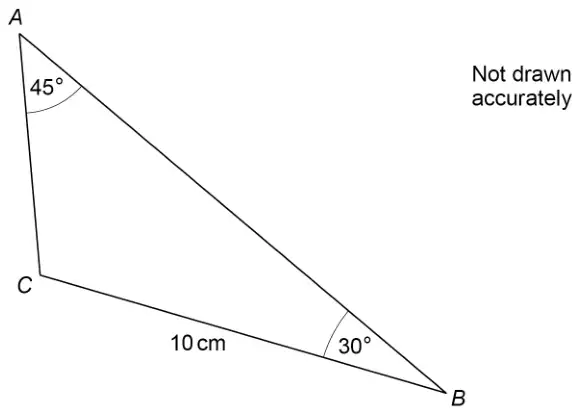
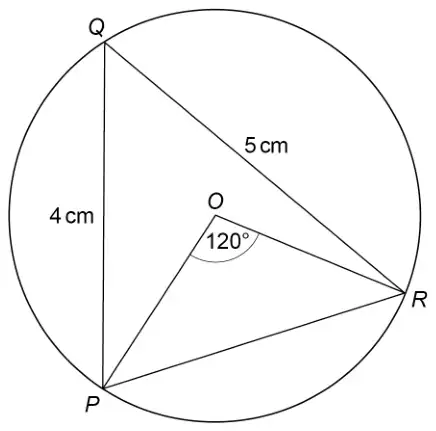
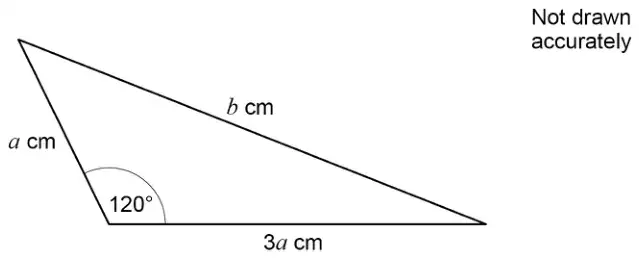
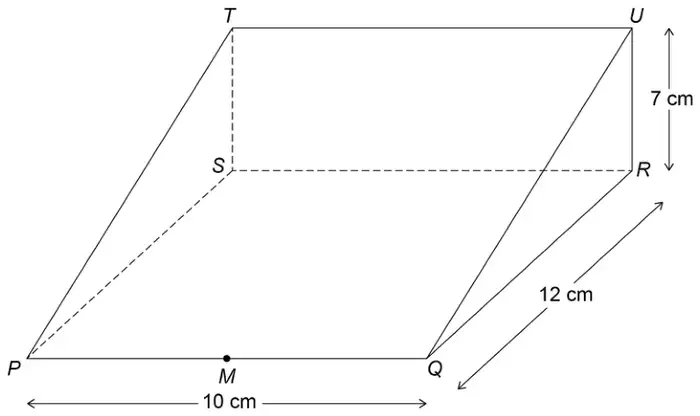
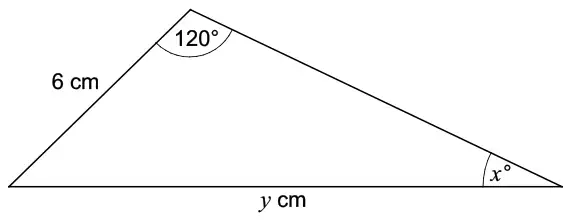
Give your answer in the form \(a\sqrt{2}\) where \(a\) is an integer. [3 marks]
Mark scheme
Answer
Mark
Comments
Alternative method 1: sine rule
\(\dfrac{10}{\sin 45} = \dfrac{AC}{\sin 30}\)
M1
oe could be seen by implication in further working
\(\sin 30 = \dfrac{1}{2}\) and \(\sin 45 = \dfrac{1}{\sqrt{2}}\) or \(\dfrac{\sqrt{2}}{2}\)
B1
oe could be seen by implication in working must be clearly selected if part of a list of values
\(5\sqrt{2}\)
A1
Alternative method 2: splitting the triangle into 2 right angled triangles with a perpendicular from C to the side AB at a point D
\(CD = 10\sin 30\) and \(AC = \dfrac{CD}{\sin 45}\) or \(\sqrt{CD^2 + CD^2}\)
M1
oe
\(\sin 30 = \dfrac{1}{2}\) and \(\sin 45 = \dfrac{1}{\sqrt{2}}\) or \(\dfrac{\sqrt{2}}{2}\)
B1
oe could be seen by implication in further working must be clearly selected if part of a list of values if Pythagoras used in M mark sin45 not needed so \(\sin 30 = \dfrac{1}{2}\) is enough for B1
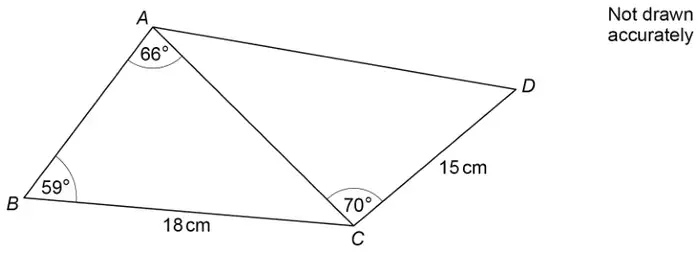
oe equation in \(AC\) eg \(\dfrac{\sin 59}{AC} = \dfrac{\sin 66}{18}\) accept [0.85, 0.86] for \(\sin 59\) accept [0.91, 0.914] for \(\sin 66\)
\(\dfrac{18}{\sin 66} \times \sin 59\) or [16.7, 17.011]
M1dep
oe calculation for \(AC\) accept [0.85, 0.86] for \(\sin 59\) accept [0.91, 0.914] for \(\sin 66\)
\(\dfrac{1}{2} \times 15 \times\) their [16.7, 17.011] \(\sin 70\)
M1dep
oe accept [0.93, 0.94] for \(\sin 70\)
[119, 119.11]
A1
Additional guidance
Up to M2 may be awarded for correct work with no answer or incorrect answer, even if this is seen amongst multiple attempts
Allow any indication of \(AC\) eg \(x\) or \(b\)
An equivalent method for the first two marks may be from using sine rule and cosine rule eg \(AB = \dfrac{18}{\sin 66} \times \sin(180 - 59 - 66)\) or [16.1, 16.140124] \(AC^2 = 18^2 + 16.14^2 - 2 \times 18 \times 16.14 \times \cos 59\) \(AC = \sqrt{18^2 + 16.14^2 - 2 \times 18 \times 16.14 \times \cos 59}\)
M1 M1dep
[119, 119.11] seen with area of \(ABCD\) or \(ABC\) as final answer
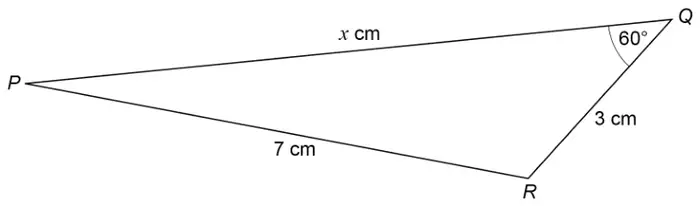
\(PR\) must have a value oe eg \(PO = \dfrac{\sqrt{21}}{2} \div \dfrac{\sqrt{3}}{2}\) could use cosine rule again or sine rule at this stage but it would need to lead directly in one calculation to \(\sqrt{7}\) eg \(\left(\dfrac{\text{their}\sqrt{21}\sin 30^\circ}{\sin 120^\circ}\right)\) must be explicit: \(\left(\dfrac{PO}{\sin 30^\circ} = \dfrac{\text{their}\sqrt{21}}{\sin 120^\circ}\right)\) is not M1 but this then followed by \(\left(\dfrac{PO}{\frac{1}{2}} = \dfrac{\text{their}\sqrt{21}}{\frac{1}{3}}\right)\) (error in denominator) and \(\left(PO = \dfrac{\frac{1}{2}\text{their}\sqrt{21}}{\frac{1}{3}}\right)\) (rearranged correctly) would be M1
(\(PO =\)) \(\sqrt{7}\)
A1
Additional guidance
\(POM = 60^\circ\) where \(M\) is the midpoint of \(PR\)
B0
Final answer coming from double errors in surd manipulation
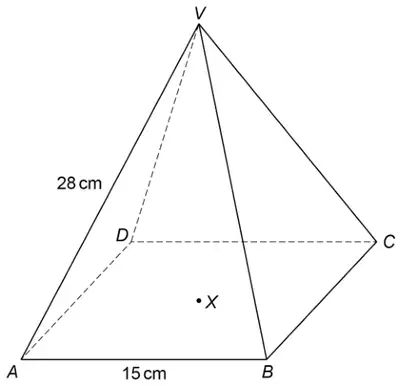
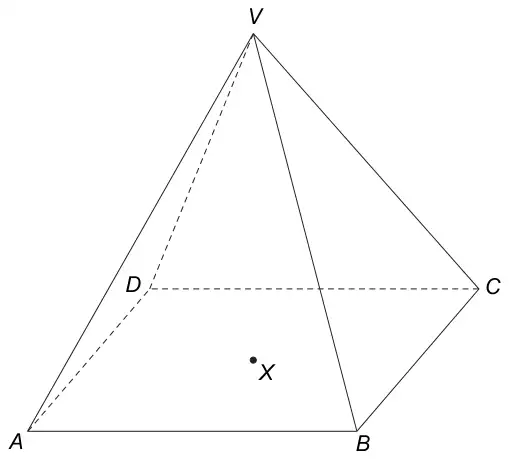
The square horizontal base, \(ABCD\), has side length 15 cm
\(V\) is directly above the centre, \(X\), of the base.
\(VA = 28\) cm
Work out the size of the angle that \(VA\) makes with \(ABCD\). [3 marks]
Mark scheme
Answer
Mark
Comments
(\(AC =\)) \(\sqrt{15^2 + 15^2}\) or \(\sqrt{450}\) or \(15\sqrt{2}\) or 21.2(…) or (\(AX =\)) \(\sqrt{7.5^2 + 7.5^2}\) or \(\sqrt{112.5}\) or \(\dfrac{15\sqrt{2}}{2}\) or [10.6, 10.61]
M1
oe eg (\(DB =\)) \(\sqrt{225 + 225}\) or (\(BX =\)) \(\sqrt{56.25 + 56.25}\) or (\(AX =\)) \(\sqrt{\dfrac{15^2}{2}}\) or (\(AX =\)) \(15\sin 45\) allow any unambiguous indication of side may be seen on diagram
\(\cos y = \dfrac{0.5\sqrt{15^2 + 15^2}}{28}\) or \(\cos y = \dfrac{\sqrt{7.5^2 + 7.5^2}}{28}\) or \(\cos y = \dfrac{15\sqrt{2}}{56}\) or \(\cos^{-1}[0.37, 0.38]\)
M1dep
oe eg \(\sin y = \dfrac{\sqrt{28^2 - 7.5^2 - 7.5^2}}{28}\) or \(\tan y = \dfrac{\sqrt{28^2 - 7.5^2 - 7.5^2}}{\sqrt{7.5^2 + 7.5^2}}\) or \(90 - \sin^{-1}\dfrac{\sqrt{7.5^2 + 7.5^2}}{28}\)
[66.9, 68.435]
A1
SC2 [21.565, 23.1]
Additional guidance
Up to M2 may be awarded for correct work with no answer or incorrect answer, even if this is seen amongst multiple attempts
M1dep \(y\) may be \(x\) or \(A\) or \(VAX\) etc
M1dep oe must be of the form \(\cos y =\) (or \(\sin y =\) or \(\tan y =\)) or be a calculation that evaluates to [66.9, 68.435] eg applying cosine rule to triangle \(VAC\) \(\cos y = \dfrac{28^2 + 450 - 28^2}{2 \times 28 \times \sqrt{450}}\)
M2
M1dep allow \(\sin y = [0.92, 0.93]\) or \(\tan y = [2.44, 2.45]\) or \(90 - [21.565, 23.1]\)
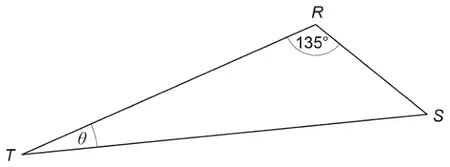
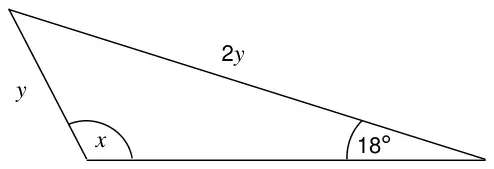
Work out the exact value of \(\sin\theta\). [3 marks]
Mark scheme
Answer
Mark
Comments
\(\sin 135^\circ = \dfrac{\sqrt{2}}{2}\) or \(\dfrac{1}{\sqrt{2}}\)
B1
oe could be embedded in the calculation
\(\dfrac{\sin\theta}{x} = \dfrac{\sin 135}{4x}\)
M1
oe \(x\) may be a different letter (would need to be the same letter for both sides) or numerical values using multiples of 1 and 4 used
(\(\sin\theta =\)) \(\dfrac{\sqrt{2}}{8}\)
A1
oe eg \(\dfrac{1}{4\sqrt{2}}\)
Additional guidance
Penalise incorrect further working Condone \(\theta = \sin^{-1}\dfrac{\sqrt{2}}{8}\) seen in answer as long as \(\sin\theta = \dfrac{\sqrt{2}}{8}\) seen in working
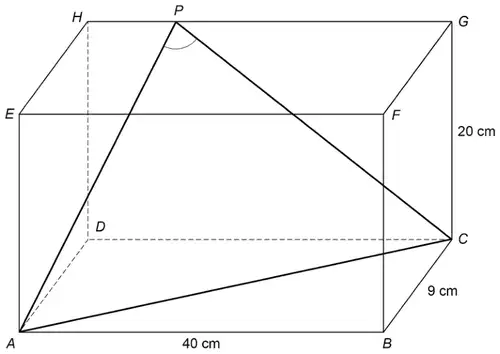
\(P\) is a point on \(HG\) such that \(\quad HP : PG = 3 : 7\)
\(AP = 25\text{ cm}\)
Work out the size of angle \(APC\). [5 marks]
Mark scheme
Answer
Mark
Comments
\(\dfrac{40}{3 + 7} \times 7\) or 28
M1
oe eg \(40 - \dfrac{40}{3 + 7} \times 3\) or \(40 - 12\) may be seen on diagram may be implied
\(20^2 + \text{their } 28^2\) or \(400 + 784\) or 1184 or \(4\sqrt{74}\) or [34.4, 34.41]
M1
oe eg \(\sqrt{20^2 + \text{their } 28^2}\) or \(\sqrt{1184}\) their 28 must be \(\lt 40\) may be seen on diagram
\(40^2 + 9^2\) or \(1600 + 81\) or 1681 or 41
M1
oe eg \(\sqrt{40^2 + 9^2}\) or \(\sqrt{1681}\) may be seen on diagram
their 1681 \(= 25^2 +\) their 1184 \(- 2 \times 25 \times \sqrt{\text{their } 1184} \times \cos x\)
M1dep
oe eg \(\cos^{-1}\dfrac{25^2 + \text{their } 1184 - \text{their } 1681}{2 \times 25 \times \sqrt{\text{their } 1184}}\) or \(\cos^{-1}[0.07, 0.07442]\) dep on 2nd and 3rd M1 \(x\) may be \(APC\) or \(A\) etc
[85.7, 86]
A1
Additional guidance
Up to M4 may be awarded for correct work with no, or incorrect answer, even if this is seen amongst multiple attempts
If their \(PG\) is 28 do not allow use of a value other than 28 in subsequent working
4th M1 Condone \(\cos^{-1} = 0.07\) for \(\cos^{-1} 0.07\) etc
4th M1 oes must be a fully correct method eg Uses cosine rule to work out angle \(PCA\) then uses sine rule to work out angle \(APC\) Must get to correct sine rule equation with no errors in method
Missing brackets must be recovered eg 4th M1 Do not allow \(4\sqrt{74}^2\) unless recovered in subsequent working
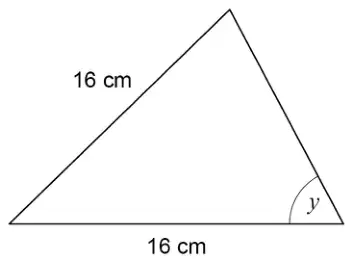
oe eg \(\dfrac{1}{2} \times 16 \times 16 \times \sin(180 - 2y)\) \(x\) can be any letter or expression may be implied
\(\sin x = 120 \div \left(\dfrac{1}{2} \times 16 \times 16\right)\) or \(\sin x = \dfrac{15}{16}\) or \(\sin^{-1}\dfrac{15}{16}\) or \(\sin^{-1}[0.93, 0.94]\) or [68.4, 70.12313]
M1dep
oe eg \(\sin x = \dfrac{240}{256}\) or \(\sin x = [0.93, 0.94]\) equation must have \(\sin x =\) \(x\) can be any letter or expression
\(\dfrac{180 - \text{their}[68.4, 70.12313]}{2}\)
M1dep
oe
[54.93, 55.8]
A1
SC2 [75.82, 76.4]
Alternative method 2 Works out perpendicular height
\(120 \div \left(\dfrac{1}{2} \times 16\right)\) or \(120 \div 8\) or 15
M1
\(\cos x = \dfrac{\sqrt{16^2 - (\text{their } 15)^2}}{16}\) or \(\cos^{-1}\dfrac{\sqrt{31}}{16}\) or \(\tan x = \dfrac{15}{\sqrt{16^2 - (\text{their } 15)^2}}\) or \(\tan^{-1}\dfrac{15}{\sqrt{31}}\) or [68.4, 70.12313]
M1dep
oe eg \(\sin x = \dfrac{15}{16}\) or \(\sin x = [0.93, 0.94]\) or \(\cos x = [0.34, 0.35]\) or \(\tan x = [2.69, 2.7]\) \(x\) can be any letter or expression
\(\dfrac{180 - \text{their}[68.4, 70.12313]}{2}\)
M1dep
oe
[54.93, 55.8]
A1
SC2 [75.82, 76.4]
Alternative method 3 Works out perpendicular height
\(120 \div \left(\dfrac{1}{2} \times 16\right)\) or \(120 \div 8\) or 15
M1
oe
\(16 - \sqrt{16^2 - (\text{their } 15)^2}\) or \(16 - \sqrt{31}\) or [10.4, 10.44]
M1dep
oe eg \(\tan y = \dfrac{15}{16 - \sqrt{16^2 - (\text{their } 15)^2}}\) \(y\) can be any letter or expression
Condone \(\sin =\) for \(\sin x =\) etc Condone \(\sin^{-1} = 0.9375\) for \(\sin^{-1} 0.9375\) etc
SC2 is for omitting the 0.5 from the area of triangle formula
After scoring M1M1, the 3rd M1 is for any full method eg Alt 1 68.6 Cosine rule used to work out the third side of the triangle followed by sine rule to work out \(y\) (up to \(\sin^{-1}\ldots\)) If there are no errors seen in the method the 3rd M1 is awarded and possibly the A1 as well
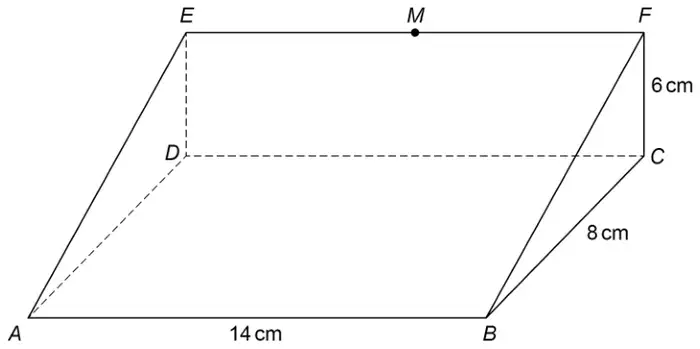
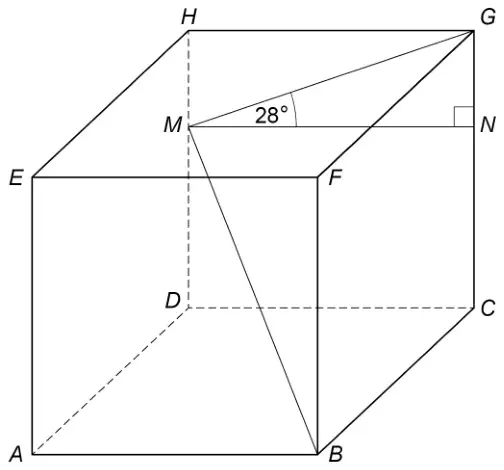
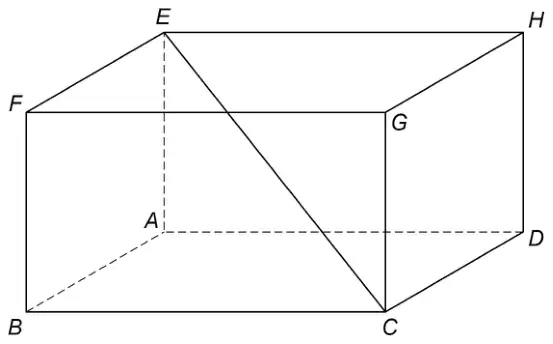
\(BC = 15\) cm \(\qquad CD = 12\) cm \(\qquad DH = 8\) cm
Work out the size of the angle between the line \(CE\) and the plane \(CDHG\). [4 marks]
Mark scheme
Answer
Mark
Comments
\(8^2 + 12^2\) or \(64 + 144\) or 208 or \(8^2 + 12^2 + 15^2\) or \(64 + 144 + 225\) or 433
M1
\(HC^2\) or \(CE^2\)
implied by 2nd M1
\(\sqrt{8^2 + 12^2}\) or \(\sqrt{208}\) or \(4\sqrt{13}\) or 14.4… or \(\sqrt{8^2 + 12^2 + 15^2}\) or \(\sqrt{433}\) or 20.8…
M1dep
oe may be on diagram fully correct trigonometry method leading to 14.4… or 20.8… can score M2 eg \(8 \div \sin\left(\tan^{-1} \dfrac{8}{12}\right)\) or \(8 \div \sin\left(\tan^{-1} \dfrac{8}{\sqrt{12^2 + 15^2}}\right)\)
\(\tan x = \dfrac{15}{\sqrt{8^2 + 12^2}}\) or \(\cos x = \dfrac{\sqrt{8^2 + 12^2}}{\sqrt{8^2 + 12^2 + 15^2}}\) or \(\sin x = \dfrac{15}{\sqrt{8^2 + 12^2 + 15^2}}\)
M1dep
oe eg \(\tan x = [1.04,\ 1.042]\) or or \(\cos x = [0.69,\ 0.6934]\) or \(\sin x = [0.72,\ 0.7212]\) or \(90 - \tan^{-1} \dfrac{\sqrt{8^2 + 12^2}}{15}\) dep on M2 any letter
46(.1…)
A1
Additional guidance
3rd M1 If using sine rule or cosine rule, must be in the form \(\cos x =\) or \(\sin x =\) eg \(\cos x = \dfrac{20.8^2 + 14.4^2 - 15^2}{2 \times 20.8 \times 14.4}\) (oe eg \(\cos^{-1} [0.69,\ 0.6934]\))
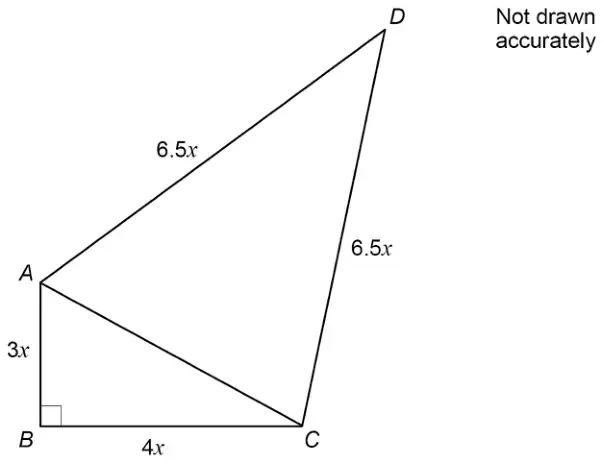
\(\cos^{-1} \dfrac{(6.5x)^2 + (6.5x)^2 - (5x)^2}{2 \times 6.5x \times 6.5x}\) or \(\cos^{-1} \dfrac{119}{169}\) or 45(.2…)
M1dep
oe dep on 2nd M1
\(0.5 \times 6.5x \times 6.5x \times \sin\) their 45(.2…) or \(15x^2\)
M1dep
oe dep on 2nd and 3rd M1
\(21x^2\)
A1
allow \(p = 21\) if areas \(6x^2\) and \(15x^2\) seen
Additional guidance
Allow recovery of algebra eg1 \(\ 0.5 \times 4 \times 3 = 6\) is 1st M0 but if recovered to \(6x^2\) scores 1st M1 eg2 Alt 1 \(\sqrt{42.25 - 6.25} = 6\) is 2nd M0 and 3rd M0 but if recovered to \(6x\) scores 2nd M1 and 3rd M1
Do not allow final mark if an incorrect area is seen eg do not allow answer \(21x^2\) if their two areas are \(6x^2\) and \(15x\)
Answer \(21x^2\) with no incorrect working eg fully correct working with numbers and final answer \(21x^2\)
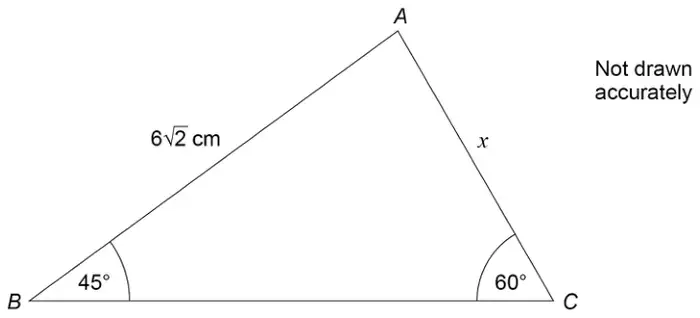
\((x =)\ \dfrac{6\sqrt{2} \times \frac{1}{\sqrt{2}}}{\frac{\sqrt{3}}{2}}\) or \(\dfrac{6\sqrt{2} \times \frac{\sqrt{2}}{2}}{\frac{\sqrt{3}}{2}}\)
M1dep
oe a correct expression or equation coming from both surds correct eg \(\ \dfrac{\sqrt{3}}{2}x = 6\sqrt{2} \times \dfrac{1}{\sqrt{2}}\) or \(\dfrac{6}{x} = \dfrac{\sqrt{3}}{2}\)
\((x =)\ \dfrac{12}{\sqrt{3}}\) or \(\sqrt{3}x = 12\)
A1
\((x =)\ 4\sqrt{3}\)
A1
Alternative method 2
\(\sin 45 = \dfrac{1}{\sqrt{2}}\) or \(\dfrac{\sqrt{2}}{2}\) or \(\sin 60 = \dfrac{\sqrt{3}}{2}\)
B1
look for these in their working … one of them correct will gain the mark at any stage of their working
\(\dfrac{AD}{6\sqrt{2}} = \sin 45\) or \((AD =)\ 6\sqrt{2} \times \sin 45\) or \((AD =)\ 6\)
M1
where D is the foot of the perpendicular from A to BC
\((x =)\ \dfrac{6\sqrt{2} \times \frac{1}{\sqrt{2}}}{\frac{\sqrt{3}}{2}}\) or \(\dfrac{6\sqrt{2} \times \frac{\sqrt{2}}{2}}{\frac{\sqrt{3}}{2}}\)
M1dep
oe a correct expression or equation coming from both surds correct eg \(\ \dfrac{\sqrt{3}}{2}x = 6\sqrt{2} \times \dfrac{1}{\sqrt{2}}\) or \(\dfrac{6}{x} = \dfrac{\sqrt{3}}{2}\)
\((x =)\ \dfrac{12}{\sqrt{3}}\) or \(\sqrt{3}x = 12\)
A1
\((x =)\ 4\sqrt{3}\)
A1
Additional guidance
If one surd value is incorrect they can only score a maximum of 2 marks
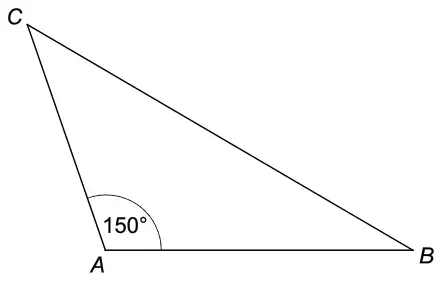
10 \(ABC\) is an isosceles triangle with \(AB = AC\)
The area of \(ABC\) is 57.76 cm\(^2\)
Not drawn accurately
Work out the length of \(AB\). [3 marks]
Mark scheme
Answer
Mark
Comments
Alternative method 1
\(\dfrac{1}{2} \times x \times x \times \sin 150\) or \(\dfrac{1}{4}x^2\) or \(\dfrac{1}{2} \times b \times c \times \sin 150 = 57.76\) or \(\dfrac{1}{4} \times b \times c = 57.76\)
M1
oe Any letter(s)
\(x^2 = \dfrac{57.76 \times 2}{\sin 150}\) or \(x^2 = 57.76 \times 4\) or \(x^2 = 231(.04)\) or \(\dfrac{1}{2}x = \sqrt{57.76}\) or \(\sqrt{231(.04)}\) or \(2\sqrt{57.76}\)
M1dep
oe eg \(x^2 = \dfrac{57.76}{\frac{1}{2}\sin 150}\) Must have either \(x^2 =\) or \(\dfrac{1}{2}x = \sqrt{57.76}\) or \(\sqrt{231(.04)}\) or \(2\sqrt{57.76}\) Any letter
15.2
A1
Alternative method 2
\(\dfrac{1}{2} \times x \times x\cos\dfrac{150}{2} \times \sin\dfrac{150}{2}\) \(= \dfrac{57.76}{2}\)
M1
oe Any letter
\(x^2 = \dfrac{57.76}{\cos\frac{150}{2}\sin\frac{150}{2}}\) or \(x^2 = 231(.04)\) or \(\sqrt{231(.04)}\) or \(2\sqrt{57.76}\)
M1dep
oe Must have either \(x^2 =\) or \(\sqrt{231(.04)}\) or \(2\sqrt{57.76}\) Any letter
15.2
A1
Additional guidance
Do not allow 15 as a misread of 150
\(x\) can be \(b\) or \(AB\) or \(AC\) etc
\(b\) and \(c\) can be \(a\) and \(b\) or \(AB\) and \(AC\) etc
Allow as two 6s labelled on \(BC\) after perpendicular drawn from \(A\)
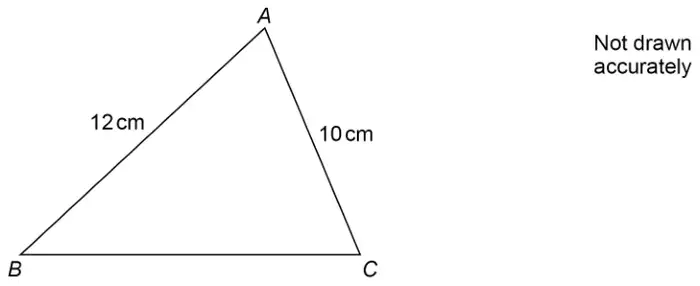
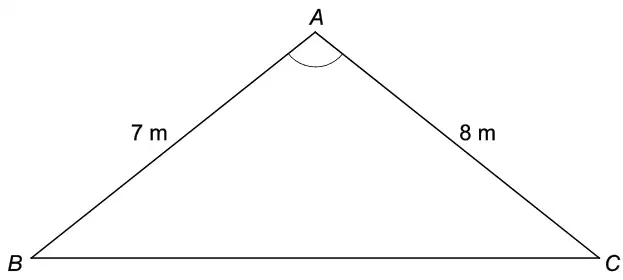
(angle \(ABC\) =) \(\cos^{-1}\left(\dfrac{7^2 + \text{their } 12^2 - 8^2}{2 \times 7 \times \text{their } 12}\right)\) or 39.8… and \(\sin A = \dfrac{\sin \text{their } 39.8}{8} \times\) their 12 or \(\sin A = 0.96\ldots\)
M1
oe eg works out angle \(ACB\) (= 34.09(…) or 34.1) and uses sine rule Do not allow if their 12 comes from use of Pythagoras’ theorem ie (\(BC\) =) \(\sqrt{7^2 + 8^2}\) or \(\sqrt{113}\) or 10.6(…) is B0M0
\(180 - \sin^{-1}\)(their 0.96…)
M1dep
oe May be implied by final answer
[106, 106.1]
A1ft
Only ft B0M2
Additional guidance
\(\cos^{-1}\) or \(\cos^{-1}\)ans does not score M1dep unless recovered
For the M1dep must have correct rearrangement but allow arithmetic errors
Answer outside range is A0 eg 106.2(…) from \(\cos^{-1}(-0.28)\)
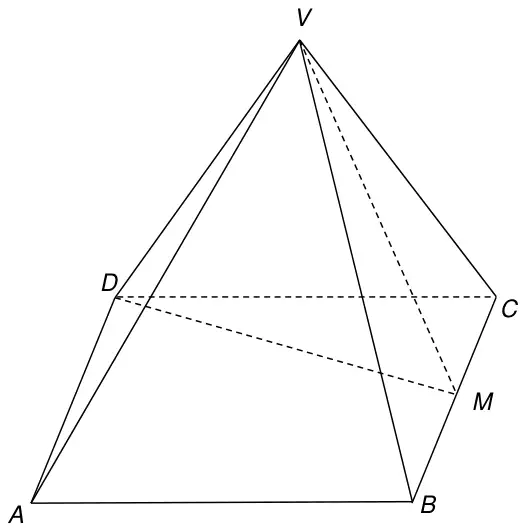
22 Pyramid \(VABCD\) has a horizontal rectangular base.
\(X\) is the centre of the base.
\(V\) is vertically above \(X\).
\[VB = VC = 17\text{ cm} \qquad AB = 22\text{ cm} \qquad BC = 16\text{ cm}\]
Work out the angle between the planes \(VBC\) and \(ABCD\). [4 marks]
Mark scheme
Answer
Mark
Comments
Alternative method 1 Triangles \(VMB\) and \(VXM\) (\(M\) is the midpoint of \(BC\))
\(17^2 - (16 \div 2)^2\) or 225 or \(17^2 = VM^2 + (16 \div 2)^2\)
M1
oe
\((VM =)\ \sqrt{17^2 - (16 \div 2)^2}\) or \(\sqrt{225}\) or 15
M1
Implies M1 M1 May be seen on diagram
\(\cos x = \dfrac{22 \div 2}{\text{their } 15}\) or \(\sin x = \dfrac{\sqrt{15^2 - (22 \div 2)^2}}{\text{their } 15}\) or \(\tan x = \dfrac{\sqrt{15^2 - (22 \div 2)^2}}{22 \div 2}\)
M1dep
\(x\) is required angle dep on M1 M1 oe eg correct method using cosine rule or sine rule simplified to \(\cos x =\) or \(\sin x =\) or \(90 - \sin^{-1}\dfrac{22 \div 2}{\text{their } 15}\)
42.8…
A1
Allow 43 with correct working SC2 Answer 36.8... or 36.9
Alternative method 2 Triangles \(BXM\) and \(VXB\) and \(VXM\) (\(M\) is the midpoint of \(BC\))
\(BX^2 = (16 \div 2)^2 + (22 \div 2)^2\) or 185 and \(17^2\) − their \(BX^2\) or \(17^2 = VX^2\) + their \(BX^2\)
\((VX =)\ \sqrt{17^2 - (\text{their } BX)^2}\) or \(\sqrt{104}\) or \(2\sqrt{26}\) or [10.19, 10.2]
M1
Implies M1 M1 May be seen on diagram
\(\tan x = \dfrac{\text{their } [10.19, 10.2]}{22 \div 2}\) or \(\sin x = \dfrac{\text{their } [10.19, 10.2]}{\text{their } VM}\) or \(\cos x = \dfrac{22 \div 2}{\text{their } VM}\)
M1dep
\(x\) is required angle dep on M1 M1 oe eg correct method using cosine rule or sine rule simplified to \(\cos x =\) or \(\sin x =\) or \(90 - \tan^{-1}\dfrac{22 \div 2}{\text{their } [10.19, 10.2]}\)
42.8…
A1
Allow 43 with correct working SC2 Answer 36.8... or 36.9
Alternative method 3 Triangles \(VMB\) and \(VMN\) (\(M\) is the midpoint of \(BC\), \(N\) is the midpoint of \(AD\))
\(17^2 - (16 \div 2)^2\) or 225 or \(17^2 = VM^2 + (16 \div 2)^2\)
M1
oe
\((VM =)\ \sqrt{17^2 - (16 \div 2)^2}\) or \(\sqrt{225}\) or 15
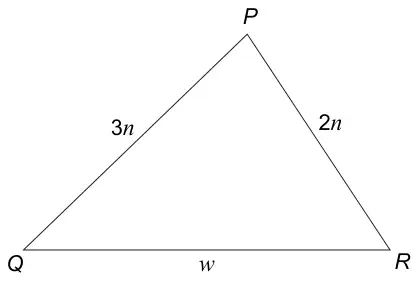
\(w = 3n\) so the triangle is isosceles or \(QP = QR\)
A1
Alternative method 3
Drop a perpendicular from \(Q\) to \(PR\)
M1
let this be \(QS\)
\(\cos P = \dfrac{PS}{3n}\) or \(\dfrac{1}{3} = \dfrac{PS}{3n}\)
M1
\(PS = n\)
A1
\(PR\) is bisected by the perpendicular from \(Q\) hence \(\triangle QPR\) is isosceles
A1
oe
Additional guidance
The final A1 is for a statement saying that two sides have been shown to be equal.
Substituting \(w = 3n\) in either version of the cosine rule and verifying that \(\cos P = \dfrac{1}{3}\) scores SC2
alt 3 ... if they drop a perpendicular from \(Q\) to \(PR\) then assume that \(PS = n\) and then verify that \(\cos P = \frac{1}{3}\) ... eg \(PS = n\), \(QP = 3n\), \(\cos P = \dfrac{PS}{QP} = \dfrac{n}{3n} = \dfrac{1}{3}\) ... they score SC2