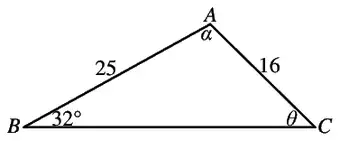
One of awrt \(21.1^\circ,\ 38.9^\circ,\ 81.1^\circ\)
A1
1.1b
Awrt \(21.1^\circ,\ 38.9^\circ,\ 81.1^\circ\)
A1
2.2a
(5)
(5 marks)
Notes
Allow to work in any variable e.g. \(\theta\) for all marks.
B1: Accurately recalls and applies either \(\dfrac{\sin^2 3x}{\cos^2 3x} = \tan^2 3x\) or \(\cos^2 3x = 1 - \sin^2 3x\) or \(\sin^2 3x = 1 - \cos^2 3x\) to the given equation. Note that e.g. \(\sin^2 3x = 4\cos^2 3x \Rightarrow \sin^2 3x = 4 \times 1 - \sin^2 3x\) scores B0 unless the missing brackets are recovered.
M1: Reaches \(\tan^2 3x = \alpha\) or \(\sin^2 3x = \beta\) or \(\cos^2 3x = \gamma\) where \(\alpha \gt 0,\ 0 \lt \beta \lt 1,\ 0 \lt \gamma \lt 1\) Condone the use of \(\pm\sin^2\theta \pm \cos^2\theta = \pm 1\) for this mark or e.g. a slip in losing the 3 from \(3x\) or e.g. \(1 - \cos^2 3x = 4\cos^2 3x \Rightarrow 3\cos^2 3x = 1 \Rightarrow \cos^2 3x = \dfrac{1}{3}\) but the process should be essentially correct. May be implied by e.g. \(5\cos^2 3x = 1 \Rightarrow \cos 3x = \sqrt{\dfrac{1}{5}}\).
dM1: Uses the correct order of operations to find a value for \(x\), i.e., attempts to take the square root, inverse sin/cos/tan as appropriate and attempts to divide by 3 You may need to check. Note that e.g. \(\sin^2 3x = \dfrac{4}{5} \Rightarrow \sin 3x = \sqrt{\dfrac{4}{5}} \Rightarrow 3x = 23.6 \Rightarrow x = 7.86\) scores M1 but e.g. \(\sin^2 3x = \dfrac{4}{5} \Rightarrow 3x = 23.6 \Rightarrow x = 7.86\) scores M0
A1: One of awrt \(21.1^\circ,\ 38.9^\circ,\ 81.1^\circ\) (Must be in degrees)
A1: All three of awrt \(21.1^\circ,\ 38.9^\circ,\ 81.1^\circ\) (Must be in degrees) and no others between \(0^\circ\) and \(90^\circ\)
A less likely but correct alternative is to use “double” angles e.g.
One of awrt \(21.1^\circ,\ 38.9^\circ,\ 81.1^\circ\) Awrt \(21.1^\circ,\ 38.9^\circ,\ 81.1^\circ\)
B1: Accurately recalls and applies \(\sin^2 3x = \dfrac{1 - \cos 6x}{2}\) and \(\cos^2 3x = \dfrac{1 + \cos 6x}{2}\) or equivalent to the given equation.
M1: Reaches \(\cos 6x = \alpha\) where \(|\alpha| \lt 1\) Condone the use of \(\sin^2 3x = \dfrac{\pm 1 \pm \cos 6x}{2}\) and \(\cos^2 3x = \dfrac{\pm 1 \pm \cos 6x}{2}\) for this mark but the process should be essentially correct.
dM1: Uses the correct order of operations to find a value for \(x\), i.e., takes inverse cos and attempts to divide by 6 You may need to check.
A1: One of awrt \(21.1^\circ,\ 38.9^\circ,\ 81.1^\circ\) (Must be in degrees)
A1: All three of awrt \(21.1^\circ,\ 38.9^\circ,\ 81.1^\circ\) and no others between \(0^\circ\) and \(90^\circ\) (Must be in degrees)
In this question you must show all stages of your working.
Solutions relying entirely on calculator technology are not acceptable.
(a) Show that the equation\[\sin\theta(7\sin\theta - 4\cos\theta) = 4\]can be written as\[3\tan^2\theta - 4\tan\theta - 4 = 0\] (4)
(b) Hence solve, for \(0 \lt x \lt 360^\circ\)\[\sin x(7\sin x - 4\cos x) = 4\]giving your answers to one decimal place. (4)
(c) Hence find the smallest solution of the equation\[\sin 4\alpha(7\sin 4\alpha - 4\cos 4\alpha) = 4\]in the range \(720^\circ \lt \alpha \lt 1080^\circ\), giving your answer to one decimal place. (1)
There are various ways of proceeding to the given answer. May work in \(\theta\) or another variable which is acceptable. Condone a mixture of \(\theta\) and e.g. \(x\) in the same equation or expression within their working. Condone poor notation e.g. \(\cos\theta^2\), \(\sin^2 + \cos^2 = 1\) provided the intention is clear.
You may see multiple attempts so score the attempt which is most complete
M1: Score for any one of the following (somewhere in their same attempt which may already have errors in their working)
ddM1: A full attempt to rearrange the equation to the form \(a\tan^2\theta + b\tan\theta + c = 0\). It is dependent on the previous two method marks. When rearranging condone sign slips or a missing trailing bracket only.
A1*: Proceeds to the given answer with all steps shown and no errors other than what is condoned (see above). Condone a missing trailing bracket only. The final answer must be in terms of \(\theta\) and written using the correct notation.
Note they may work in reverse from \(3\tan^2\theta - 4\tan\theta - 4 = 0\) to \(7\sin^2\theta - 4\sin\theta\cos\theta = 4\) or meet somewhere in the middle. In these cases there must be some minimal conclusion e.g. QED or tick The first two method marks should be applied in the same way as the main scheme. The dM1 mark will be scored for reaching a form of \(\sin\theta(d\sin\theta + e\cos\theta) = f\)
Mark scheme (b)
Scheme
Marks
AO
Roots: \(-\dfrac{2}{3},\ 2\)
B1
1.1b
\(\tan^{-1}\left(\text{``}{-\dfrac{2}{3}}\text{''}\right) = \ldots\) or \(\tan^{-1}(\text{``}2\text{''}) = \ldots\)
M1
1.1b
Two of awrt 63, awrt 146, awrt 243, awrt 326
A1
1.1b
All four of awrt 63.4, awrt 146.3, awrt 243.4, awrt 326.3
A1
1.1b
(4)
Notes
Answers with no working scores 0 marks. Beware of correct angles following incorrect roots which cannot score the A marks
B1: Roots: \(-\dfrac{2}{3},\ 2\)
M1: Attempts to find at least one of the angles for one of their roots. This may be implied by a correct answer. You may need to check this on your calculator.
A1: Two of awrt 63, awrt 146, awrt 243, awrt 326 (must come from a correct root)
A1: All four of awrt 63.4, awrt 146.3, awrt 243.4, awrt 326.3 and no others in the range Withhold the final mark if they solve for \(4\alpha\) (and subsequently divide their angles by 4)
Do not allow verification attempts using \(x = 10.5\) by substituting into formulae
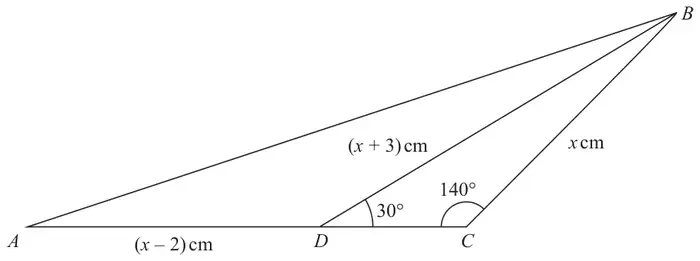
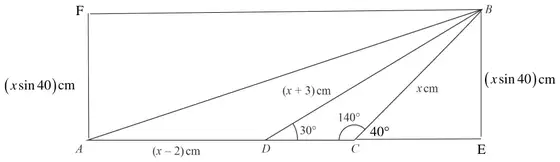
M1: Recognises the need to apply the sine rule and attempts to use it with the sides in the correct positions to form an equation in \(x\). Alternatively, uses trigonometric ratios twice to form an equation in \(x\) e.g. \(BE = x\sin 40^\circ \Rightarrow \sin 30^\circ = \dfrac{x\sin 40^\circ}{x + 3}\) or e.g. \(AF = x\sin 40^\circ \Rightarrow \cos 60^\circ = \dfrac{x\sin 40^\circ}{x + 3}\) May also see an attempt at Pythagoras’ Theorem: \(BD^2 = BE^2 + DE^2 \Rightarrow (x + 3)^2 = \big((x + 3)\cos 30^\circ\big)^2 + (x\sin 40^\circ)^2\)
dM1: Attempts to rearrange the equation by collecting terms in \(x\) on one side of the equation and non \(x\) terms on the other. It is dependent on the previous method mark. Condone sign slips only in their rearrangement but allow miscopying/arithmetical slips when rounding. Do not allow this mark to be scored for proceeding directly to a numerical value for \(x\). In the attempt using Pythagoras’ Theorem, look for an attempt to multiply out and rearrange to form a three-term quadratic.
A1*: Achieves 10.5 with sufficient working shown. Condone invisible brackets to be recovered. They must have achieved either a correct expression for \(x\) or \(x(2\sin 140^\circ - 1) = 3\) o.e. before stating 10.5 or better. It is acceptable to use rounded decimals for trigonometric values provided they are correct to at least 3sf. e.g. \(\sin 140^\circ = 0.64278\ldots\) e.g. \(2x = \dfrac{x + 3}{\sin 140^\circ} \Rightarrow x = \dfrac{1.5}{\sin 40^\circ - 0.5} = 10.5\) scores M1dM1A1* (allow 0.5 in their initial equation for sin30 and allow interchanging of equivalent angles such as sin140 and sin40) e.g. \(x\sin 140 = (x + 3)\sin 30^\circ \Rightarrow x = \dfrac{3\sin 30^\circ}{0.643 - \sin 30^\circ} = 10.5\) scores M1dM1A1* e.g. \(\dfrac{x}{\sin 30^\circ} = \dfrac{x + 3}{\sin 140^\circ} \Rightarrow x\sin 140^\circ = (x + 3)\sin 30^\circ \Rightarrow x = 10.505\ldots\) is M1dM0A0* (insufficient working shown as they do not reach an expression for \(x\) or \(x(2\sin 140^\circ - 1) = 3\) o.e.) In the method using Pythagoras’ Theorem usual rules apply for solving a quadratic but it cannot be awarded for proceeding to the answer via a calculator (e.g. must see use of the quadratic formula or completing the square).
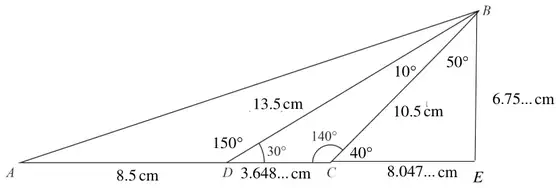
M1: Applies the cosine rule correctly using \(150^\circ\) (or \(180^\circ - 30^\circ\) seen if incorrect) for angle \(ADB\) with the correct numerical lengths by attempting to substitute in \(x = 10.5\) or better and proceeds to obtain a value for \(AB\). Look for other methods such as finding lengths \(DC\) and \(CE\) followed by using trigonometry or Pythagoras’ Theorem on triangle \(ABE\). (see below)
A1: awrt 21.3 (cm) Units not required but if they are given they must be correct. (Using full calculator display 21.29959497/using \(x = 10.5\) gives 21.28…)
Alt (b)
Note that there are various longer methods to finding \(AB\). General principles of marking alternative methods:
M1: A complete attempt to find a value for \(AB\), but condone slips. The angles and lengths in formulae should be in the correct positions, but allow slips when rearranging or calculating values. e.g. \(BE = 6.75\ldots,\ AE = 8.5 + 3.648\ldots + 8.047\ldots = 20\ldots \Rightarrow AB = \sqrt{6.75\ldots^2 + 20\ldots^2} = \ldots\)
A1: awrt 21.3 (cm) Units not required but if they are given they must be correct. (Using full calculator display 21.29959497/using \(x = 10.5\) gives 21.28…)
In this question you must show detailed reasoning.
Solutions relying entirely on calculator technology are not acceptable.
(a) Show that the equation\[4\tan x = 5\cos x\]can be written as\[5\sin^2 x + 4\sin x - 5 = 0\] (3)
(b) Hence solve, for \(0 \lt x \leqslant 360^\circ\)\[4\tan x = 5\cos x\]giving your answers to one decimal place. (4)
(c) Hence find the number of solutions of the equation\[4\tan 3x = 5\cos 3x\]in the interval \(0 \lt x \leqslant 1800^\circ\), explaining briefly the reason for your answer. (2)
Mark scheme (a)
Scheme
Marks
AO
States or uses \(\tan x = \dfrac{\sin x}{\cos x}\)
B1
1.2
\(4\sin x = 5\cos^2 x \Rightarrow 4\sin x = 5\left(1 - \sin^2 x\right)\)
M1
1.1b
\(5\sin^2 x + 4\sin x - 5 = 0\ *\)
A1*
2.1
(3)
Notes
Allow use of e.g. \(\theta\) but the final mark requires the equation to be in terms of \(x\)
B1: States or uses \(\tan x = \dfrac{\sin x}{\cos x}\) e.g., \(4\tan x = 5\cos x \Rightarrow 4\dfrac{\sin x}{\cos x} = 5\cos x\) Allow e.g. \(\tan x = \dfrac{\sin\theta}{\cos\theta}\)
M1: Multiplies by \(\cos x\) and uses \(\cos^2 x = 1 - \sin^2 x\) to set up a quadratic equation in just \(\sin x\) Condone mixed arguments here.
A1*: Proceeds to \(5\sin^2 x + 4\sin x - 5 = 0\) with correct notation and algebra, showing all key steps. The = 0 must be present in the final answer line. Condone a single slip in notation, e.g., \(\sin x^2\) or \(\sin\theta\) seen once.
Mark scheme (b)
Scheme
Marks
AO
Attempts to solve \(5\sin^2 x + 4\sin x - 5 = 0 \Rightarrow \sin x = \ldots\)
M1
1.1b
\(\sin x = \dfrac{-2 \pm \sqrt{29}}{5}\) \((\sin x = \text{awrt } 0.677)\)
A1
1.1b
Takes \(\sin^{-1}\) leading to at least one answer in the range
dM1
1.1b
\(x =\) awrt \(42.6\{^\circ\}\) and \(x =\) awrt \(137.4\{^\circ\}\) only
A1
1.1b
(4)
Notes
M1: Attempts to solve \(5\sin^2 x + 4\sin x - 5 = 0 \Rightarrow\) \(\sin x = \ldots\) using the usual rules. \(\sin x =\) may be implied later. Allow solution(s) from a calculator but one must be correct (0.6 or 0.7 or –1.4 or –1.5)
A1: Achieves \(\sin x = \dfrac{-4 \pm \sqrt{116}}{10}\) \((\sin x = \text{awrt } 0.677)\) \(\sin x =\) may be implied later.
dM1: Finds one value of \(x\) in the range 0 to \(360^\circ\) from their \(\sin x =\) May be scored for working in radians. If using \(\sin x = 0.677\) they should have awrt 0.744 or awrt 2.40 If they have made a slip in solving the quadratic, e.g., by the formula, then their values will need checking both in degrees and radians to see if this mark can be implied.
A1: \(x =\) awrt \(42.6\{^\circ\}\) and \(x =\) awrt \(137.4\{^\circ\}\) only. Ignore any values outside of 0 to \(360^\circ\) isw if they round their values to e.g., 3sf after stating acceptable answers. There must be some evidence that the quadratic has been solved.
Mark scheme (c)
Scheme
Marks
AO
\(15 \times \text{``}2\text{''} = 30\) following through on their "2"
B1ft
2.2a
Explains either "mathematically" by stating \(3 \times 5 \times\) their number in range 0 to \(360^\circ\) or "in words" e.g., stating \(3 \times \text{``}2\text{''}\) values every \(360^\circ\) and 5 lots of \(360^\circ\)
B1ft
2.4
(2)
(9 marks)
Notes
B1ft: Follow through on 15 multiplied by the number of solutions in (b) in the range 0 to \(360^\circ\) If working in radians in (b), they must state 30 (solutions).
B1ft: Explains either mathematically or in words. See scheme. Note that you might see arguments expanding the range from 1800 to 5400 to account for the stretch parallel to the \(x\) axis. \(\dfrac{5400}{360} = 15\) and \(15 \times 2 = 30\) which is also acceptable.
Note: If candidates list 30 values and conclude that there are 30 solutions, score B1ftB1ft There is no need to check their 30 values are correct, but there must be 30.
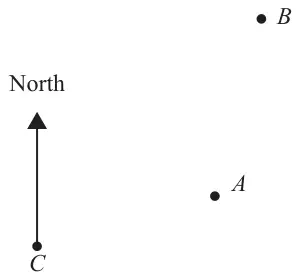
B1: 33 seen anywhere but allow 72 – 39. May be indicated on a diagram (including incorrectly) or on the given Figure 1 and it might be named incorrectly.
M1: Uses the given model and attempts to use the cosine rule to find the distance or distance2 Award for \(8.2^2 + 15.6^2 - 2 \times 8.2 \times 15.6\cos\ldots\) where \(\ldots\) must be a value.
A1: awrt 9.8 {km} isw
Alternative (a)
B1: \(\left\{\overrightarrow{AB} =\right\} \pm\begin{pmatrix} 15.6\cos 51 - 8.2\cos 18 \\ 15.6\sin 51 - 8.2\sin 18 \end{pmatrix}\) or \(\pm\begin{pmatrix} 15.6\sin 39 - 8.2\sin 72 \\ 15.6\cos 39 - 8.2\cos 72 \end{pmatrix}\) o.e. May be implied by calculation that leads to \(\begin{pmatrix} \text{awrt } \pm 2.0 \\ \text{awrt } \pm 9.6 \end{pmatrix}\) e.g. \(\begin{pmatrix} 9.8 \\ 12.1 \end{pmatrix} - \begin{pmatrix} 7.8 \\ 2.5 \end{pmatrix}\) Note: they may find components separately and condone, e.g., \(\begin{pmatrix} \text{awrt } \pm 9.6 \\ \text{awrt } \pm 2.0 \end{pmatrix}\)
M1: Attempts to find \(\overrightarrow{AB}\) (as above) and uses Pythagoras to find distance or distance2
A1: awrt 9.8 {km} isw
Mark scheme (b)
Scheme
Marks
AO
Explains that the road is not likely to be straight {and therefore the distance will be greater}.
Explains that there are likely to be objects in the way {that they must go around and therefore the distance travelled will be greater}.
The {bases of the} masts are not likely to lie in the same {horizontal} plane {and so the distance will be greater}.
B1
3.2b
(1)
(4 marks)
Notes
B1: A valid reason based on the assumptions, i.e., the plane is not really horizontal or the journey not being in a straight line. Do not accept answers referencing the accuracy of the answer to part (a) being to 1d.p. or the accuracy of the values given in the question, but ignore if there is a separate, valid reason.
Some examples: “Because it is unlikely the bearings are exact” – B0 see above. “Because they may not walk in a straight line because they could take another longer or shorter route as their route could be more curved” – B0 – incorrect comment about there being a shorter route. “Because they won’t travel in one direction due to the roads” – B1 BOD “Impossible and unrealistic to walk in a straight line” – B1
(a) If starting with the LHS: Condone if another variable for \(\theta\) is used except for the final mark
M1: Combines terms with a common denominator. The numerator must be correct for their common denominator.
dM1: Either:
\(\dfrac{1 + \sin\theta}{\cos\theta}\): Multiplies numerator and denominator by \(1 - \sin\theta\), uses the difference of two squares and applies \(\cos^2\theta = 1 - \sin^2\theta\)
\(\dfrac{(1 + \sin\theta)\cos\theta}{\cos^2\theta}\): Uses \(\cos^2\theta = 1 - \sin^2\theta\) on the denominator, applies the difference of two squares
It is dependent on the previous method mark.
A1*: Fully correct proof with correct notation and no errors in the main body of their work. Withhold this mark for writing eg sin instead of \(\sin\theta\) anywhere in the solution and for eg \(\sin\theta^2\) instead of \(\sin^2\theta\)
Alt(a) If starting with the RHS: Condone if another variable is used for \(\theta\) except for the final mark
M1: Multiplies by \(\dfrac{1 + \sin\theta}{1 + \sin\theta}\) leading to \(\dfrac{\cos\theta(1 + \sin\theta)}{1 - \sin^2\theta}\) or Multiplies by \(\dfrac{\cos\theta}{\cos\theta}\) leading to \(\dfrac{\cos^2\theta}{\cos\theta(1 - \sin\theta)}\)
dM1: Applies \(\cos^2\theta = 1 - \sin^2\theta\) and cancels the \(\cos\theta\) factor from the numerator and denominator leading to \(\dfrac{1 + \sin\theta}{\cos\theta}\) or Applies \(\cos^2\theta = 1 - \sin^2\theta\) and uses the difference of two squares leading to \(\dfrac{(1 + \sin\theta)(1 - \sin\theta)}{\cos\theta(1 - \sin\theta)}\) It is dependent on the previous method mark.
A1*: Fully correct proof with correct notation and no errors in the main body of their work. If they work from both the LHS and the RHS and meet in the middle with both sides the same then they need to conclude at the end by stating the original equation.
*Be aware that this can be done entirely on their calculator which is not acceptable*
M1: Either multiplies through by \(\cos 2x\) and applies \(\cos^2 2x = 1 - \sin^2 2x\) to obtain an equation in \(\sin 2x\) only or alternatively sets \(\dfrac{\cos 2x}{1 - \sin 2x} = 3\cos 2x\) and multiplies by \(1 - \sin 2x\)
A1: Correct equation or equivalent. The \(= 0\) may be implied by their later work (Condone notational slips in their working)
M1: Solves for \(\sin 2x\), uses arcsin to obtain at least one value for \(2x\) and divides by 2 to obtain at least one value for \(x\). The roots of the quadratic can be found using a calculator. They cannot just write down values for \(x\) from their quadratic in \(\sin 2x\)
A1: For 1 of the required angles. Accept awrt 21 or awrt 69. Also accept awrt 0.36 rad or awrt 1.21 rad
A1: For both angles (awrt 20.9 and awrt 69.1) and no others inside the range. If they find \(x = 45\) it must be rejected. (Condone notational slips in their working)
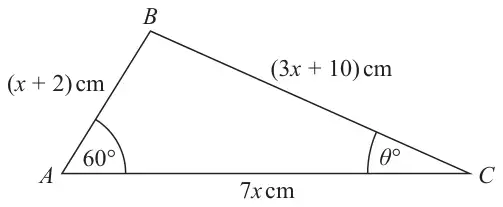
Figure 1 shows a sketch of triangle \(ABC\) with \(AB = (x + 2)\) cm, \(BC = (3x + 10)\) cm, \(AC = 7x\) cm, angle \(BAC = 60^\circ\) and angle \(ACB = \theta^\circ\)
(a)
(i) Show that \(17x^2 - 35x - 48 = 0\) (3)
(ii) Hence find the value of \(x\). (1)
(b) Hence find the value of \(\theta\) giving your answer to one decimal place. (2)
Uses \(\cos 60^\circ = \frac{1}{2}\), expands the brackets and proceeds to a 3 term quadratic equation
dM1
1.1b
\(17x^2 - 35x - 48 = 0\) *
A1*
2.1
(3)
(ii) \(x = 3\)
B1
3.2a
(1)
Notes
(a)(i) Mark (a) and (b) together
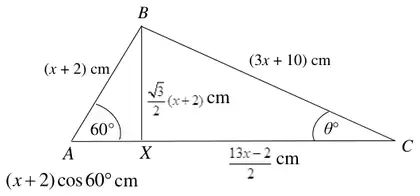
M1: Recognises the need to apply the cosine rule and attempts to use it with the sides in the correct positions and the formula applied correctly. Condone invisible brackets and slips on \(3x + 10\) as \(3x - 10\). Alternatively, uses trigonometry to find \(AX\) and then equates two expressions for the length \(BX\). You may see variations of this if they use Pythagoras or trigonometry to find \(BX\) and then apply Pythagoras to the triangle \(BXC\). See the diagram below to help you. The angles and lengths must be in the correct positions. Cos 60 may be \(\dfrac{1}{2}\) from the start
dM1: Uses \(\cos 60^\circ = \frac{1}{2}\), expands the brackets and proceeds to a 3TQ. You may see the use of \(\cos 60^\circ = \frac{1}{2}\) in earlier work, but they must proceed to a 3TQ as well to score this mark. It is dependent on the first method mark.
A1*: Obtains the correct quadratic equation with the \(= 0\) with no errors seen in the main body of their solution. Condone the recovery of invisible brackets as long as the intention is clear. You do not need to explicitly see cos 60 to score full marks.
(a)(ii)
B1: Selects the appropriate value i.e. \(x = 3\) only. The other root must either be rejected if found or \(x = 3\) must be the only root used in part (b). Can be implied by awrt 13.2 in (b)
M1: Using their value for \(x\) this mark is for either:
applying the sine rule correctly (or considers 2 right angled triangles) and proceeding to obtain a value for \(\sin ACB\) or
applying the cosine rule correctly and proceeding to obtain a value for \(\cos ACB\).
Condone slips calculating the lengths \(AB\), \(BC\) and \(AC\). At least one of them should be found correctly for their value for \(x\) (Also allow if the sine rule or cosine rule is applied correctly to find a value for \(\sin ABC\) \(\left(= \dfrac{21\sqrt{3}}{38}\right)\) or \(\cos ABC\) \(\left(= -\dfrac{11}{38}\right)\)) (corrected from the printed mark scheme: “\(\cos ACB\) \(\left(= -\dfrac{11}{38}\right)\)”; \(-\dfrac{11}{38}\) is \(\cos ABC\))
A1: awrt 13.2 (answers with little working eg just lengths on the diagram can score M1A1)
dM1: Solves their 3TQ in \(\sin\theta\) to produce one value for \(\theta\). It is dependent upon having used \(\cos^2\theta = \pm 1 \pm \sin^2\theta\)
A1: Two of awrt \(\theta = 34.5^\circ, 145.5^\circ, 394.5^\circ\) (or if in radians two of awrt 0.60, 2.54, 6.89)
A1: All three of awrt \(\theta = 34.5^\circ, 145.5^\circ, 394.5^\circ\) and no other values
Mark scheme (ii)(a)
Scheme
Marks
AO
One of
They cancel by \(\sin x\) (and hence they miss the solution \(\sin x = 0 \Rightarrow x = 0\))
They do not find all the solutions of \(\cos x = \dfrac{3}{5}\) (in the given range) or they missed the solution \(x = -53.1^\circ\)
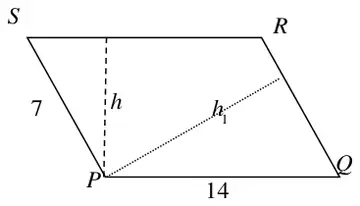
M1: Attempts the correct method of finding obtuse \(\angle SPQ\). See scheme.
A1: awrt \(149.32^\circ\)
Alt (a)
Scheme
Marks
AO
States or uses \(14h = 50\) or \(7h_1 = 50\)
B1
1.2
Full method to find obtuse \(\angle SPQ\). In this case it is \(90^\circ + \arccos\left(\dfrac{h}{7}\right)\) or \(90^\circ + \arccos\left(\dfrac{h_1}{14}\right)\)
M1
1.1b
awrt \(149.32^\circ\)
A1
1.1b
B1: States or uses \(14h = 50\) or \(7h_1 = 50\)
M1: Full method to find obtuse \(\angle SPQ\). In this case it is \(90^\circ + \arccos\left(\dfrac{h}{7}\right)\) or \(90^\circ + \arccos\left(\dfrac{h_1}{14}\right)\)
M1: A correct method of finding \(SQ\) using their \(\angle SPQ\). \(SQ^2 = 14^2 + 7^2 - 2 \times 14 \times 7\cos\text{``}149.32\text{''}\) scores this mark.
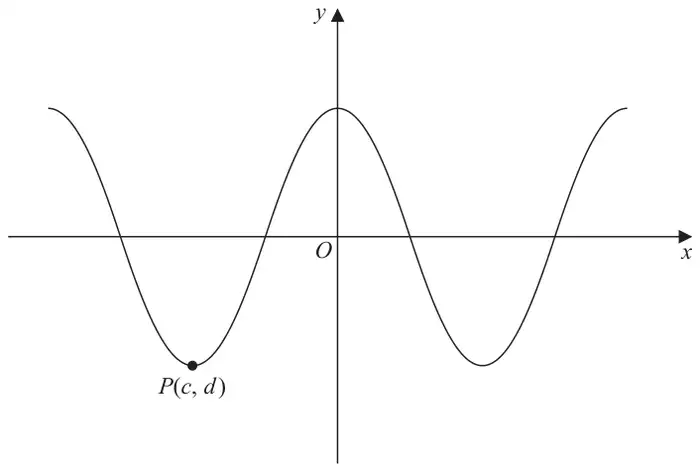
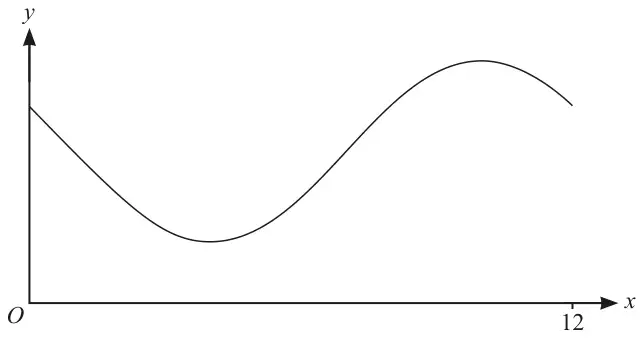
Figure 3 shows part of the curve with equation \(y = 3\cos x^\circ\).
The point \(P(c, d)\) is a minimum point on the curve with \(c\) being the smallest negative value of \(x\) at which a minimum occurs.
(a) State the value of \(c\) and the value of \(d\). (1)
(b) State the coordinates of the point to which \(P\) is mapped by the transformation which transforms the curve with equation \(y = 3\cos x^\circ\) to the curve with equation
(i) \(y = 3\cos\left(\dfrac{x^\circ}{4}\right)\)
(ii) \(y = 3\cos(x - 36)^\circ\) (2)
(c) Solve, for \(450^\circ \leqslant \theta \lt 720^\circ\),\[3\cos\theta = 8\tan\theta\]giving your solution to one decimal place.
In part (c) you must show all stages of your working.
Solutions relying entirely on calculator technology are not acceptable.(5)
Mark scheme (a)
Scheme
Marks
AO
\((-180^\circ, -3)\)
B1
1.1b
(1)
Notes
B1: Deduces that \(P(-180^\circ, -3)\) or \(c = -180^{(\mathrm{o})}, d = -3\)
Mark scheme (b)
Scheme
Marks
AO
(i) \((-720^\circ, -3)\)
B1ft
2.2a
(ii) \((-144^\circ, -3)\)
B1 ft
2.2a
(2)
Notes
(b)(i)
B1ft: Deduces that \(P^{\prime}(-720^\circ, -3)\) Follow through on their \((c, d) \to (4c, d)\) where \(d\) is negative
(b)(ii)
B1ft: Deduces that \(P^{\prime}(-144^\circ, -3)\) Follow through on their \((c, d) \to (c + 36^\circ, d)\) where \(d\) is negative
Mark scheme (c)
Scheme
Marks
AO
Attempts to use both \(\tan\theta = \dfrac{\sin\theta}{\cos\theta}\), \(\sin^2\theta + \cos^2\theta = 1\) and solves a quadratic equation in \(\sin\theta\) to find at least one value of \(\theta\)
M1: An overall problem solving mark, condoning slips, for an attempt to
use \(\tan\theta = \dfrac{\sin\theta}{\cos\theta}\),
use \(\pm\sin^2\theta \pm \cos^2\theta = \pm 1\)
find at least one value of \(\theta\) from a quadratic equation in \(\sin\theta\)
B1: Uses the correct identity and multiplies across to give \(3\cos\theta = 8\tan\theta \Rightarrow 3\cos^2\theta = 8\sin\theta\) oe
M1: Uses the correct identity \(\sin^2\theta + \cos^2\theta = 1\) to form a 3TQ in \(\sin\theta\) which they attempt to solve using an appropriate method. It is OK to use a calculator to solve this
A1: \(\sin\theta = \dfrac{1}{3}\) Accept sight of \(\dfrac{1}{3}\). Ignore any reference to the other root even if it is "used"
A1: Full method with all identities correct leading to the answer of awrt \(520.5^\circ\) and no other values.
Figure 1 shows the design for a structure used to support a roof.
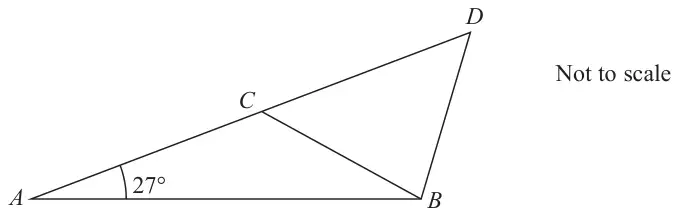
The structure consists of four steel beams, \(AB\), \(BD\), \(BC\) and \(AD\).
Given \(AB = 12\) m, \(BC = BD = 7\) m and angle \(BAC = 27^\circ\)
(a) find, to one decimal place, the size of angle \(ACB\). (3)
The steel beams can only be bought in whole metre lengths.
(b) Find the minimum length of steel that needs to be bought to make the complete structure. (3)
Mark scheme (a)
Scheme
Marks
AO
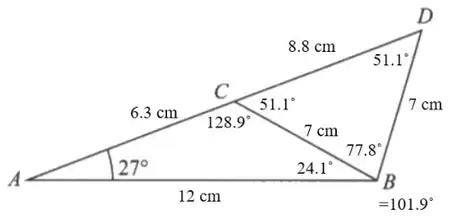
States \(\dfrac{\sin\theta}{12} = \dfrac{\sin 27}{7}\)
M1
1.1b
Finds \(\theta =\) awrt \(51^\circ\) or awrt \(129^\circ\)
A1
1.1b
= awrt \(128.9^\circ\)
A1
1.1b
(3)
Notes
M1: States \(\dfrac{\sin\theta}{12} = \dfrac{\sin 27}{7}\) oe with the sides and angles in the correct positions Alternatively they may use the cosine rule on \(\angle ACB\) and then solve the subsequent quadratic to find \(AC\) and then use the cosine rule again
A1: awrt \(51^\circ\) or awrt \(129^\circ\)
A1: Awrt \(128.9^\circ\) only (must be seen in part a))
Mark scheme (b)
Scheme
Marks
AO
Attempts to find part or all of \(AD\) Eg \(AD^2 = 7^2 + 12^2 - 2 \times 12 \times 7\cos 101.9 = (AD = 15.09)\) Eg \((AC)^2 = 7^2 + 12^2 - 2 \times 12 \times 7\cos(180 - \text{``}128.9\text{''} - 27)\) Eg \(12\cos 27\) or \(7\cos\text{``}51\text{''}\)
M1
1.1b
Full method for the total length = \(12 + 7 + 7 + \text{``}15.09\text{''} =\)
dM1
3.1a
= 42 m
A1
3.2a
(3)
(6 marks)
Notes
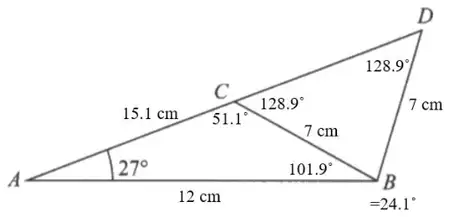
M1: Attempts a "correct" method of finding either \(AD\) or a part of \(AD\) eg (\(AC\) or \(CD\) or forming a perpendicular to split the triangle into two right angled triangles to find \(AX\) or \(XD\)) which may be seen in (a). You should condone incorrect labelling of the side. Look for attempted application of the cosine rule\[(AD)^2 = 7^2 + 12^2 - 2 \times 12 \times 7\cos(\text{``}128.9\text{''} - 27)\]\[\text{or } (AC)^2 = 7^2 + 12^2 - 2 \times 12 \times 7\cos(180 - \text{``}128.9\text{''} - 27)\]Or an attempted application of the sine rule \(\dfrac{(AD)}{\sin(\text{``}128.9\text{''} - 27)} = \dfrac{7}{\sin 27}\)\[\text{Or } \frac{(AC)}{\sin(180 - \text{``}128.9\text{''} - 27)} = \frac{7}{\sin 27}\]Or an attempt using trigonometry on a right-angled triangle to find part of \(AD\)\[12\cos 27 \text{ or } 7\cos\text{``}51\text{''}\]This method can be implied by sight of awrt 15.1 or awrt 6.3 or awrt 8.8 or awrt 10.7 or awrt 4.4
dM1: A complete method of finding the TOTAL length. There must have been an attempt to use the correct combination of angles and sides. Expect to see \(7 + 7 + 12 + \text{``}AD\text{''}\) found using a correct method. This is scored by either \(7 + 7 + 12 + \text{``}AD\text{''}\) if \(\angle ACB = 128.9^\circ\) in a) or \(7 + 7 + 12 +\) awrt 15.1 by candidates who may have assumed \(\angle ACB = 51.1^\circ\) in a)
A1: Rounds correct 41.09 m (or correct expression) up to 42 m to find steel bought Candidates who assumed \(\angle ACB = 51.1^\circ\) (acute) in (a): Full marks can still be achieved as candidates may have restarted in (b) or not used the acute angle in their calculation which is often unclear. We are condoning any reference to \(AC = 15.1\) so ignore any labelling of the lengths they are finding.
Diagram of the correct triangle with lengths and angles:
M1: Uses the identity \(\sin^2\theta = 1 - \cos^2\theta\) within the fraction
A1: Correct (simplified) expression in just \(\cos\theta\) \(\dfrac{12 - 7\cos\theta - 10\cos^2\theta}{3 + 2\cos\theta}\) or exact equivalent such as \(\dfrac{(3 + 2\cos\theta)(4 - 5\cos\theta)}{3 + 2\cos\theta}\) Allow for \(\dfrac{12 - 7u - 10u^2}{3 + 2u}\) where they introduce \(u = \cos\theta\) We would condone mixed variables here.
M1: A correct attempt to factorise the numerator, usual rules. Allow candidates to use \(u = \cos\theta\) oe
A1*: A fully correct proof with correct notation and no errors. Only withhold the last mark for (1) Mixed variable e.g. \(\theta\) and \(x\)’s (2) Poor notation \(\cos\theta^2 \leftrightarrow \cos^2\theta\) or \(\sin^2 = 1 - \cos^2\) within the solution. Don’t penalise incomplete lines if it is obvious that it is just part of their working E.g. \(\dfrac{10\sin^2\theta - 7\cos\theta + 2}{3 + 2\cos\theta} \equiv \dfrac{10\left(1 - \cos^2\theta\right) - 7\cos\theta + 2}{\phantom{3 + 2\cos\theta}} = \dfrac{12 - 7\cos\theta - 10\cos^2\theta}{3 + 2\cos\theta}\)
Alternative proof in part (a)
M1: Multiplies across and form 3TQ in \(\cos\theta\) on rhs \(10\sin^2\theta - 7\cos\theta + 2 = (4 - 5\cos\theta)(3 + 2\cos\theta) \Rightarrow 10\sin^2\theta - 7\cos\theta + 2 = A\cos^2\theta + B\cos\theta + C\)
dM1: Uses \(\cos^2\theta = 1 - \sin^2\theta\) on the rhs or \(\sin^2\theta = 1 - \cos^2\theta\) on the lhs Alternatively proceeds to \(10\sin^2\theta + 10\cos^2\theta = 10\) and makes a statement about \(\sin^2\theta + \cos^2\theta = 1\) oe
A1*: Shows that \((4 - 5\cos\theta)(3 + 2\cos\theta) \equiv 10\sin^2\theta - 7\cos\theta + 2\) oe AND makes a minimal statement "hence true"
Mark scheme (b)
Scheme
Marks
AO
\(4 + 3\sin x = 4 - 5\cos x \Rightarrow \tan x = -\dfrac{5}{3}\)
M1
2.1
\(x = \text{awrt } 121^\circ, 301^\circ\)
A1 A1
1.1b 1.1b
(3)
(7 marks)
Notes
M1: Attempts to use part (a) and proceeds to an equation of the form \(\tan x = k,\ k \neq 0\) Condone \(\theta \leftrightarrow x\) Do not condone \(a\tan x = 0 \Rightarrow \tan x = b \Rightarrow x = \ldots\) Alternatively squares \(3\sin x = -5\cos x\) and uses \(\sin^2 x = 1 - \cos^2 x\) oe to reach \(\sin x = A, -1 < A < 1\) or \(\cos x = B, -1 < B < 1\)
A1: Either \(x = \text{awrt } 121^\circ\) or \(301^\circ\). Condone awrt 2.11 or 5.25 which are the radian solutions
A1: Both \(x = \text{awrt } 121^\circ\) and \(301^\circ\) and no other solutions.
Answers without working, or with no incorrect working in (b). Question states hence or otherwise so allow For 3 marks both \(x = \text{awrt } 121^\circ\) and \(301^\circ\) and no other solutions. For 1 marks scored SC 100 for either \(x = \text{awrt } 121^\circ\) or \(301^\circ\)
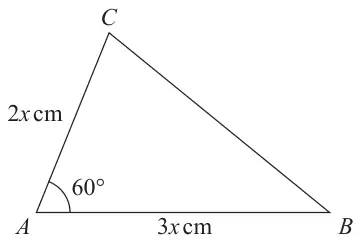
Sight of \(\sin 60^\circ = \dfrac{\sqrt{3}}{2}\) and proceeds to \(x^2 = k\) oe
M1
1.1b
\(x = \sqrt{12} = 2\sqrt{3}\) *
A1*
2.1
(3)
Notes
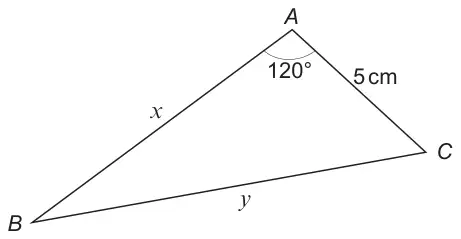
M1: Attempts to use the formula \(A = \dfrac{1}{2}ab\sin C\). If the candidate writes \(18\sqrt{3} = \dfrac{1}{2} \times 5x \times \sin 60^\circ\) without sight of a previous correct line then this would be M0
M1: Sight of \(\sin 60^\circ = \dfrac{\sqrt{3}}{2}\) or awrt 0.866 and proceeds to \(x^2 = k\) oe such as \(px^2 = q\) This may be awarded from the correct formula or \(A = ab\sin C\)
A1*: Look for \(x^2 = 12 \Rightarrow x = 2\sqrt{3}\), \(x^2 = 4 \times 3 \Rightarrow x = 2\sqrt{3}\) or \(x = \sqrt{12} = 2\sqrt{3}\) This is a given answer and all aspects must be correct including one of the above intermediate lines. It cannot be scored by using decimal equivalents to \(\sqrt{3}\)
Alternative using the given answer of \(x = 2\sqrt{3}\)
M1: Attempts to use the formula \(A = \dfrac{1}{2} \times 4\sqrt{3} \times 6\sqrt{3}\sin 60^\circ\) oe
M1: Sight of \(\sin 60^\circ = \dfrac{\sqrt{3}}{2}\) and proceeds to \(A = 18\sqrt{3}\)
M1: Attempts the cosine rule with the sides in the correct position. This can be scored from \(BC^2 = (3x)^2 + (2x)^2 - 2 \times 3x \times 2x \times \cos 60^\circ\) as long as there is some attempt to substitute \(x\) in later. Condone slips on the squaring
A1: \(BC^2 = 84\) Accept \(BC^2 = 7 \times 12\), \(BC = \sqrt{84}\) or \(BC = 2\sqrt{21}\) If they replace the surds with decimals they can score the A1 for \(BC^2 = \text{awrt } 84.0\)
A1: \(BC = 2\sqrt{21}\) Condone other variables, say \(x = 2\sqrt{21}\), but it cannot be scored via decimals.
(a) Show that the equation\[4\cos\theta - 1 = 2\sin\theta\tan\theta\]can be written in the form\[6\cos^2\theta - \cos\theta - 2 = 0\] (4)
(b) Hence solve, for \(0 \leqslant x \lt 90^\circ\)\[4\cos 3x - 1 = 2\sin 3x\tan 3x\]giving your answers, where appropriate, to one decimal place. (Solutions based entirely on graphical or numerical methods are not acceptable.) (4)
M1: Recall and use the identity \(\tan\theta = \dfrac{\sin\theta}{\cos\theta}\) Note that it cannot just be stated.
A1: \(4\cos^2\theta - \cos\theta = 2\sin^2\theta\) oe. This is scored for a correct line that does not contain any fractional terms. It may be awarded later in the solution after the identity \(1 - \cos^2\theta = \sin^2\theta\) has been used Eg for \(\cos\theta(4\cos\theta - 1) = 2\left(1 - \cos^2\theta\right)\) or equivalent
M1: Attempts to use the correct identity \(1 - \cos^2\theta = \sin^2\theta\) to form an equation in just \(\cos\theta\)
A1*: Proceeds to correct answer through rigorous and clear reasoning. No errors in notation or bracketing. For example \(\sin^2\theta = \sin\theta^2\) is an error in notation
Mark scheme (b)
Scheme
Marks
AO
For attempting to solve given quadratic
M1
1.1b
\((\cos 3x) = \dfrac{2}{3}, -\dfrac{1}{2}\)
B1
1.1b
\(x = \dfrac{1}{3}\arccos\left(\dfrac{2}{3}\right)\) or \(\dfrac{1}{3}\arccos\left(-\dfrac{1}{2}\right)\)
M1
1.1b
\(x = 40^\circ, 80^\circ\), awrt \(16.1^\circ\)
A1
2.2a
(4)
(8 marks)
Notes
M1: For attempting to solve the given quadratic "\(6y^2 - y - 2 = 0\)" where \(y\) could be \(\cos 3x\), \(\cos x\), or even just \(y\). When factorising look for \((ay + b)(cy + d)\) where \(ac = \pm 6\) and \(bd = \pm 2\) This may be implied by the correct roots (even award for \(\left(y \pm \dfrac{2}{3}\right)\left(y \pm \dfrac{1}{2}\right)\)), an attempt at factorising, an attempt at the quadratic formula, an attempt at completing the square and even \(\pm\) the correct roots.
B1: For the roots \(\dfrac{2}{3}, -\dfrac{1}{2}\) oe
M1: Finds at least one solution for \(x\) from \(\cos 3x\) within the given range for their \(\dfrac{2}{3}, -\dfrac{1}{2}\)
A1: \(x = 40^\circ, 80^\circ\), awrt \(16.1^\circ\) only Withhold this mark if there are any other values even if they are outside the range. Condone 40 and 80 appearing as 40.0 and 80.0
7. In a triangle \(ABC\), side \(AB\) has length 10 cm, side \(AC\) has length 5 cm, and angle \(BAC = \theta\) where \(\theta\) is measured in degrees. The area of triangle \(ABC\) is 15 cm2
(a) Find the two possible values of \(\cos\theta\) (4)
Given that \(BC\) is the longest side of the triangle,
M1: Uses the formula \(\text{Area} = \dfrac{1}{2}ab\sin C\) in an attempt to find the value of \(\sin\theta\) or \(\theta\)
A1: \(\sin\theta = \dfrac{3}{5}\) oe This may be implied by \(\theta =\) awrt \(36.9^\circ\) or awrt 0.644 (radians)
M1: Uses their value of \(\sin\theta\) to find two values of \(\cos\theta\) This may be scored via the formula \(\cos^2\theta = 1 - \sin^2\theta\) or by a triangle method. Also allow the use of a graphical calculator or good candidates may just write down the two values. The values must be symmetrical \(\pm k\)
A1: \(\cos\theta = \pm\dfrac{4}{5}\) or \(\pm 0.8\) Condone these values appearing from \(\pm 0.79\ldots\)
M1: Uses a suitable method of finding the longest side. For example chooses the negative value (or the obtuse angle) and proceeds to find \(BC\) using the cosine rule. Alternatively works out \(BC\) using both values and chooses the larger value. If stated the cosine rule should be correct (with a minus sign). Note if the sign is +ve and the acute angle is chosen the correct value will be seen. It is however M0 A0
(a) Show that the equation\[\cos^2 x = 8\sin^2 x - 6\sin x\]can be written in the form\[(3\sin x - 1)^2 = 2\] (3)
(b) Hence solve, for \(0 \leqslant x < 360^\circ\),\[\cos^2 x = 8\sin^2 x - 6\sin x\]giving your answers to 2 decimal places. (5)
Mark scheme (a)
Scheme
Marks
Way 1
Way 2
\(1 - \sin^2 x = 8\sin^2 x - 6\sin x\)
\(2 = (3\sin x - 1)^2\) gives \(9\sin^2 x - 6\sin x + 1 = 2\) so \(\sin^2 x + 8\sin^2 x - 6\sin x + 1 = 2\)
B1
E.g. \(9\sin^2 x - 6\sin x = 1\) or \(9\sin^2 x - 6\sin x - 1 = 0\) or \(9\sin^2 x - 6\sin x + 1 = 2\)
so \(8\sin^2 x - 6\sin x = 1 - \sin^2 x\)
M1
So \(9\sin^2 x - 6\sin x + 1 = 2\) or \((3\sin x - 1)^2 - 2 = 0\) so \((3\sin x - 1)^2 = 2\) or \(2 = (3\sin x - 1)^2\) *
\(8\sin^2 x - 6\sin x = \cos^2 x\) *
A1cso*
(3)
Notes
Way 1
B1: Uses \(\cos^2 x = 1 - \sin^2 x\) M1: Collects \(\sin^2 x\) terms to form a three term quadratic or into a suitable completed square format. May be sign slips in the collection of terms. A1*: cso This needs an intermediate step from 3 term quadratic and no errors in answer and printed answer stated but allow \(2 = (3\sin x - 1)^2\). If sin is used throughout instead of \(\sin x\) it is A0.
Way 2
B1:Needs correct expansion and split M1: Collects \(1 - \sin^2 x\) together A1*: Conclusion and no errors seen
Mark scheme (b)
Scheme
Marks
Way 1: \((3\sin x - 1) = (\pm)\sqrt{2}\) Way 2: Expands \((3\sin x - 1)^2 = 2\) and uses quadratic formula on 3TQ
M1
\(\sin x = \dfrac{1 \pm \sqrt{2}}{3}\) or awrt 0.8047 and awrt \(-0.1381\)
A1
\(x = 53.58\), 126.42 (or 126.41), 352.06, 187.94
dM1A1 A1
(5)
[8]
Notes
M1: Square roots both sides(Way 1), or expands and uses quadratic formula (Way 2) Attempts at factorization after expanding are M0.
A1:Both correct answers for \(\sin x\) (need plus and minus). Need not be simplified.
dM1: Uses inverse sin to give one of the given correct answers
1st A1: Need two correct angles (allow awrt) Note that the scheme allows 126.41 in place of 126.42 though 126.42 is preferred
A1: All four solutions correct (Extra solutions in range lose this A mark, but outside range - ignore) (Premature approximation:– in the final three marks lose first A1 then ft other angles for second A mark) Do not require degrees symbol for the marks
Special case: Working in radians M1A1A0 for the correct 0.94, 2.21, 6.14, 3.28
M1: use sine formula correctly in any form. Allow awrt 0.77 for \(\sin 50^\circ\)
A1: give the correct value or correct expression for \(\sin x\) (this implies the M1 mark). If it is given as expression they do not need degrees symbol. \(\dfrac{\sin 50 \times 16}{13}\) is fine, If this is given as a decimal allow answers which round to 0.94. Allow awrt \(-0.323\) (radians) here but no further marks are available. If they give this as \(x\) (not \(\sin x\)) and do not recover this is A0
dM1: Correct work leading to \(x = \ldots\) (via inverse sin) expression or value for \(\sin x\) If the previous A mark has been awarded for a correct expression then this is for getting to awrt 70.5 or 109.5 (allow for 70.6 or 109.4). If the previous A mark was not gained, e.g. rounding errors were made in rearranging the correct sine formula then award dM1 for evidence of use of inverse sin in degrees on their value for \(\sin x\) (may need to check on calculator). NB 70.5 following a correct sine formula will gain M1A1M1.
A1: deduce and state both of the answers \(x = 70.5\) and 109.5 (do not need degrees) Accept awrt these. Also accept 70.6 and 109.4. (Second answer is sometimes obtained by a long indirect route but still scores A1)
If working in radians throughout, answers are 1.23 and 1.91 and this can be awarded M1 A1 M1 A0 (Working with 50 radians gives probable answers of -0.3288 and 3.47 giving M1A1M0A0)
Special case: Wrong labelling of triangle. This simplifies the problem as there is only one solution for angle \(x\). So it is not treated as a misread. If they find the missing side as awrt 12.6 then proceed to find an angle or its sine or cosine then give M1A0M0A0
Alternative Method using cosine rule
Let \(BC = a\). M1: uses the cosine rule to form to form a three term quadratic equation in \(a\) (e.g. \(a^2 - 32a\cos 50^\circ + 87 = 0\) or \(a^2 -\) awrt\(20.6a + 87 = 0\) though allow slips in signs rearranging) A1: Solves and obtains a correct value for \(a\) of awrt 14.6 or awrt 5.95. dM1: A correct full method to find (at least) one of the two angles. May use cosine rule again, or find angle \(BAC\) and then use sine rule. As in the main scheme, if the previous A mark has been awarded then they should obtain one of the correct angles for this mark. A1: deduces both correct answer as in main scheme.
NB obtaining only one correct angle will usually score M1A1M1A0 in any method.
(i) Solve, for \(0 \leqslant \theta < 180^\circ\)\[\sin(2\theta - 30^\circ) + 1 = 0.4\]giving your answers to 1 decimal place. (5)
(ii) Find all the values of \(x\), in the interval \(0 \leqslant x < 360^\circ\), for which\[9\cos^2 x - 11\cos x + 3\sin^2 x = 0\]giving your answers to 1 decimal place. (7)
You must show clearly how you obtained your answers.
Mark scheme (i)
Scheme
Marks
\(\sin(2\theta - 30) = -0.6\) or \(2\theta - 30 = -36.9\) or implied by 216.9
B1
\(2\theta - 30 = 216.87\ \ = (180 + 36.9)\)
M1
\(\theta = \dfrac{216.87 + 30}{2} = 123.4\) or \(123.5\)
A1
\(2\theta - 30 = 360 - 36.9\) or \(323.1\)
M1
\(\theta = \dfrac{323.1 + 30}{2} = 176.6\)
A1
(5)
Notes
B1: This statement seen and must contain no errors or may implied by \(-36.9\)
M1: Uses 180 – arcsin (-0.6) i.e. 180 + 36.9 ( or \(\pi + \arcsin(0.6)\) in radians) (in 3rd quadrant)
A1: allow answers which round to 123.4 or 123.5 must be in degrees
M1: Uses 360 + arcsin (-0.6) i.e. 360 – 36.9 ( or \(2\pi + \arcsin(-0.6)\) in radians) ( in 4th quadrant)
A1: allow answers which round to 176.6 must be in degrees (A1 implies M1)
Ignore extra answers outside range but lose final A1 for extra answers in the range if both B and A marks have been earned) Working in radians may earn B1M1A0M1A0
(The mark scheme labels these parts (a) and (b).)
Mark scheme (ii)
Scheme
Marks
\(9\cos^2 x - 11\cos x + 3\left(1 - \cos^2 x\right) = 0\) or \(6\cos^2 x - 11\cos x + 3\left(\sin^2 x + \cos^2 x\right) = 0\)
M1
\(6\cos^2 x - 11\cos x + 3 = 0\) \(\{\text{as } \left(\sin^2 x + \cos^2 x\right) = 1\}\)
A1
\((3\cos x - 1)(2\cos x - 3) = 0\) implies \(\cos x =\)
M1
\(\cos x = \dfrac{1}{3},\ \left(\dfrac{3}{2}\right)\)
A1
\(x = 70.5\)
B1
\(x = 360 - \text{"}70.5\text{"}\)
M1
\(x = 289.5\)
A1cao
(7)
Total 12
Notes
M1: Use of \(\sin^2 x = \left(1 - \cos^2 x\right)\) or \(\left(\sin^2 x + \cos^2 x\right) = 1\) in the given equation
A1: Correct three term quadratic in any equivalent form
M1: Uses standard method to solve quadratic and obtains \(\cos x =\)
A1: A1 for \(\dfrac{1}{3}\) with \(\dfrac{3}{2}\) ignored but A0 if \(\dfrac{3}{2}\) is incorrect
B1: 70.5 or answers which round to this value
M1: 360 –arcos(their1/3) ( or \(2\pi - \arccos(their\,1/3)\) in radians)
A1: Second answer
Working in radians in (b) may earn M1A1M1A1B0M1A0 Extra values in the range coming from arcos (1/3) – deduct final A mark - so A0
A1: completes proof correctly, with no errors to give printed answer*. Need at least three steps in proof and need to achieve the correct quadratic with all terms on one side and “=0”
One solution is \(72^\circ\) or \(144^\circ\), Two solutions are \(72^\circ\) and \(144^\circ\)
A1, A1
\(\theta = \{72, 144, 216, 288\}\)
M1 A1
(5)
[11]
Notes
M1: Attempts to solve quadratic by correct quadratic formula, or completion of the square . Factorisation attempts score M0.
1st A1: Either 72 or 144, 2nd A1: both 72 and 144 (allow 72.0 etc.)
M1: 360 – "a previous solution" (provided that cos was being used) (not dependent on previous M)
A1: All four solutions correct (Extra solutions in range lose this A mark, but outside range - ignore) (Premature approximation: e.g. 71.9, 144.1, 288.1 and 215.9 – lose first A1 then ft other angles) Do not require degrees symbol for the marks
Special case: Working in radians M1: as before, A1 for either \(\theta = \tfrac{2}{5}\pi\) or \(\theta = \tfrac{4}{5}\pi\) or decimal equivalents, and 2nd A1: both M1: \(2\pi - \alpha_1\) or \(2\pi - \alpha_2\) then A0 so 4/5
4. Solve, for \(0 \leqslant x < 180^\circ\),\[\cos(3x - 10^\circ) = -0.4\]giving your answers to 1 decimal place. You should show each step in your working. (7)
M1: Statement that \(\tan\theta = \dfrac{\sin\theta}{\cos\theta}\) or Replacement of tan (wherever it appears). Must be a correct statement but may involve \(\theta\) instead of \(2x\).
A1: the answer is given so all steps should be given. N.B. \(\sin 2x - 5\sin 2x\cos 2x = 0\) or \(-5\sin 2x\cos 2x + \sin 2x = 0\) or \(\sin 2x\left(\dfrac{1}{\cos 2x} - 5\right) = 0\) o.e. must be seen and be followed by printed answer for A1 mark \(\sin 2x = 5\sin 2x\cos 2x\) is not sufficient.
Mark scheme (b)
Scheme
Marks
\(\sin 2x = 0\) gives \(2x = 0, 180, 360\) so \(x = 0, 90, 180\) B1 for two correct answers, second B1 for all three correct. Excess in range – lose last B1
B1, B1
\(\cos 2x = \tfrac{1}{5}\) gives \(2x = 78.46\) (or 78.5 or 78.4) or \(2x = 281.54\) (or 281.6)
M1
\(x = 39.2\) (or 39.3), 140.8 (or 141)
A1, A1
(5)
7 marks
Notes
Statement of 0 and 180 with no working gets B1 B0 (bod) as it is two solutions
M1: This mark for one of the two statements given (must relate to \(2x\) not just to \(x\))
A1, A1: first A1 for 39.2, second for 140.8
Special case solving \(\cos 2x = -1/5\) giving \(2x = 101.5\) or 258.5 is awarded M1A0A0 140.8 omitted would give M1A1A0
Allow answers which round to 39.2 or 39.3 and which round to 140.8 and allow 141
Answers in radians lose last A1 awarded (These are 0, 0.68, 1.57, 2.46 and 3.14)
Excess answers in range lose last A1 Ignore excess answers outside range.
All 5 correct answers with no extras and no working gets full marks in part (b). The answers imply the method here
(a) Show that the equation\[3\sin^2 x + 7\sin x = \cos^2 x - 4\]can be written in the form\[4\sin^2 x + 7\sin x + 3 = 0\] (2)
(b) Hence solve, for \(0 \leqslant x \lt 360^\circ\),\[3\sin^2 x + 7\sin x = \cos^2 x - 4\]giving your answers to 1 decimal place where appropriate. (5)
Mark scheme (a)
Scheme
Marks
\(3\sin^2 x + 7\sin x = \cos^2 x - 4\); \(0 \leqslant x \lt 360^\circ\)
\(3\sin^2 x + 7\sin x = (1 - \sin^2 x) - 4\)
M1
\(4\sin^2 x + 7\sin x + 3 = 0\) AG
A1 * cso
(2)
Notes
M1 for a correct method to change \(\cos^2 x\) into \(\sin^2 x\) (must use \(\cos^2 x = 1 - \sin^2 x\)). Note that applying \(\cos^2 x = \sin^2 x - 1\), scores M0.
A1 for obtaining the printed answer without error (except for implied use of zero.), although the equation at the end of the proof must be = 0. Solution just written only as above would score M1A1.
Mark scheme (b)
Scheme
Marks
\((4\sin x + 3)(\sin x + 1)\ \{= 0\}\) Valid attempt at factorisation and \(\sin x = \ldots\)
M1
\(\sin x = -\dfrac{3}{4}\), \(\sin x = -1\) Both \(\sin x = -\dfrac{3}{4}\) and \(\sin x = -1\).
A1
\(\left(|\alpha| = 48.59\ldots\right)\)
\(x = 180 + 48.59\) or \(x = 360 - 48.59\) Either \(\left(180 + |\alpha|\right)\) or \(\left(360 - |\alpha|\right)\)
dM1
\(x = 228.59\ldots,\ x = 311.41\ldots\) Both awrt 228.6 and awrt 311.4
A1
\(\{\sin x = -1\} \Rightarrow x = 270\) 270
B1
(5)
[7]
Notes
1st M1 for a valid attempt at factorisation, can use any variable here, \(s, y, x\) or \(\sin x\), and an attempt to find at least one of the solutions. Alternatively, using a correct formula for solving the quadratic. Either the formula must be stated correctly or the correct form must be implied by the substitution.
1st A1 for the two correct values of \(\sin x\). If they have used a substitution, a correct value of their \(s\) or their \(y\) or their \(x\).
2nd M1 for solving \(\sin x = -k\), \(0 \lt k \lt 1\) and realising a solution is either of the form \(\left(180 + |\alpha|\right)\) or \(\left(360 - |\alpha|\right)\) where \(\alpha = \sin^{-1}(k)\). Note that you cannot access this mark from \(\sin x = -1 \Rightarrow x = 270\). Note that this mark is dependent upon the 1st M1 mark awarded.
2nd A1 for both awrt 228.6 and awrt 311.4
B1 for 270.
If there are any EXTRA solutions inside the range \(0 \leqslant x \lt 360^\circ\) and the candidate would otherwise score FULL MARKS then withhold the final bA2 mark (the fourth mark in this part of the question). Also ignore EXTRA solutions outside the range \(0 \leqslant x \lt 360^\circ\).
Working in Radians: Note the answers in radians are \(x = 3.9896\ldots,\ 5.4351\ldots,\ 4.7123\ldots\) If a candidate works in radians then mark part (b) as above awarding the 2nd A1 for both awrt 4.0 and awrt 5.4 and the B1 for awrt 4.7 or \(\tfrac{3\pi}{2}\). If the candidate would then score FULL MARKS then withhold the final bA2 mark (the fourth mark in this part of the question.)
No working: Award B1 for 270 seen without any working. Award M0A0M1A1 for awrt 228.6 and awrt 311.4 seen without any working. Award M0A0M1A0 for any one of awrt 228.6 or awrt 311.4 seen without any working.
(a) Given that \(5\sin\theta = 2\cos\theta\), find the value of \(\tan\theta\). (1)
(b) Solve, for \(0 \leqslant x < 360^\circ\),\[5\sin 2x = 2\cos 2x,\]giving your answers to 1 decimal place. (5)
Mark scheme (a)
Scheme
Marks
(a) \(\tan\theta = \dfrac{2}{5}\) (or 0.4) (i.s.w. if a value of \(\theta\) is subsequently found) Requires the correct value with no incorrect working seen.
B1
(1)
Mark scheme (b)
Scheme
Marks
(b) awrt 21.8 (\(\alpha\)) (Also allow awrt 68.2, ft from \(\tan\theta = \dfrac{5}{2}\) in (a), but no other ft) (This value must be seen in part (b). It may be implied by a correct solution, e.g. 10.9)
B1
\(180 + \alpha\ \ (= 201.8)\), or \(90 + (\alpha/2)\) (if division by 2 has already occurred) (\(\alpha\) found from \(\tan 2x = \ldots\) or \(\tan x = \ldots\) or \(\sin 2x = \pm\ldots\) or \(\cos 2x = \pm\ldots\))
M1
\(360 + \alpha\ \ (= 381.8)\), or \(180 + (\alpha/2)\) (\(\alpha\) found from \(\tan 2x = \ldots\) or \(\sin 2x = \ldots\) or \(\cos 2x = \ldots\)) OR \(540 + \alpha\ \ (= 561.8)\), or \(270 + (\alpha/2)\) (\(\alpha\) found from \(\tan 2x = \ldots\))
M1
Dividing at least one of the angles by 2 (\(\alpha\) found from \(\tan 2x = \ldots\) or \(\sin 2x = \ldots\) or \(\cos 2x = \ldots\))
M1
\(x = 10.9,\ 100.9,\ 190.9,\ 280.9\) (Allow awrt)
A1
(5)
6
Notes
(b) Extra solution(s) in range: Loses the final A mark. Extra solutions outside range: Ignore (whether correct or not). Common answers: 10.9 and 100.9 would score B1 M1 M0 M1 A0 (Ensure that these M marks are awarded) 10.9 and 190.9 would score B1 M0 M1 M1 A0 (Ensure that these M marks are awarded)
The M marks are scored as in the main scheme, but extra solutions will be likely, losing the A mark.
Using radians: B1: Can be given for awrt 0.38 (\(\beta\)) M1: For \(\pi + \beta\) or \(180 + \beta\) M1: For \(2\pi + \beta\) or \(3\pi + \beta\) (Must now be consistently radians) M1: For dividing at least one of the angles by 2 A1: For this mark, the answers must be in degrees.
(Correct) answers only (or by graphical methods): B and M marks can be awarded by implication, e.g. 10.9 scores B1 M0 M0 M1 A0 10.9, 100.9 scores B1 M1 M0 M1 A0 10.9, 100.9, 190.9, 280.9 scores full marks. Using 11, etc. instead of 10.9 can still score the M marks by implication.
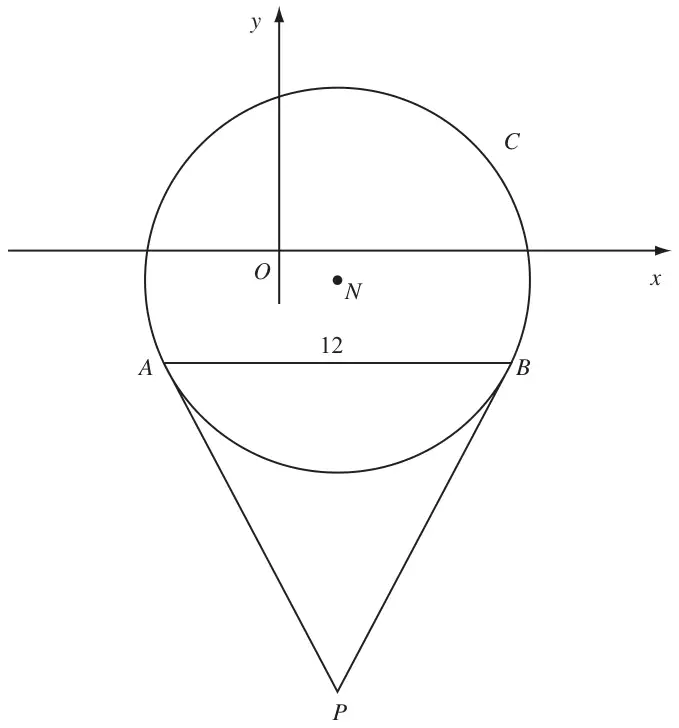
Complete Method to find \(x\) coordinates, \(x_2 - x_1 = 12\) and \(\dfrac{x_1 + x_2}{2} = 2\) then solve
M1
To obtain \(\ x_1 = -4,\quad x_2 = 8\)
A1ft A1ft
Complete Method to find \(y\) coordinates, using equation of circle or Pythagoras i.e. let \(d\) be the distance below \(N\) of \(A\) then \(d^2 = 6.5^2 - 6^2\ \Rightarrow\ d = 2.5 \Rightarrow y = ..\)
M1
So \(\ y_2 = y_1 = -3.5\)
A1
(5)
Notes
1st M1 for finding \(x\) coordinates – may be awarded if either \(x\) co-ord is correct A1ft,A1ft are for \(\alpha - 6\) and \(\alpha + 6\) if \(x\) coordinate of \(N\) is \(\alpha\) 2nd M1 for a method to find \(y\) coordinates – may be given if \(y\) co-ordinate is correct A marks is for –3.5 only.
M1 for a full method to find \(\theta\) or angle \(ANB\) (eg sine rule or cosine rule directly or finding another angle and using angles of triangle.) ft their 6.5 from radius or wrong \(\boldsymbol{y}\). (cos \(AN\)B \(= \dfrac{\text{"}6.5\text{"}^2 + \text{"}6.5\text{"}^2 - 12^2}{2 \times \text{"}6.5\text{"} \times \text{"}6.5\text{"}} = \)-0.704) A1 is a printed answer and must be 134.8 – do not accept 134.76.
Mark scheme (e)
Scheme
Marks
\(AP\) is perpendicular to \(AN\) so using triangle \(ANP\quad \tan\theta = \dfrac{AP}{\text{"}6.5\text{"}}\)
M1
Therefore \(\quad AP = 15.6\)
A1cao
(2)
[12]
Notes
M1 for a full method to find \(AP\)
Alternative Methods N.B. May use triangle \(AXP\) where \(X\) is the mid point of \(AB\). Or may use triangle ABP. From circle theorems may use angle \(BAP\) = 67.38 or some variation. Eg \(\dfrac{AP}{\sin 67.4} = \dfrac{12}{\sin 45.2}\), \(AP = \dfrac{6}{\sin 22.6}\) or \(AP = \dfrac{6}{\cos 67.4}\) are each worth M1
(a) Show that the equation\[5\sin x = 1 + 2\cos^2 x\]can be written in the form\[2\sin^2 x + 5\sin x - 3 = 0\] (2)
(b) Solve, for \(0 \leqslant x < 360^\circ\),\[2\sin^2 x + 5\sin x - 3 = 0\] (4)
Mark scheme (a)
Scheme
Marks
\(5\sin x = 1 + 2\left(1 - \sin^2 x\right)\)
M1
\(2\sin^2 x + 5\sin x - 3 = 0\) (*)
A1cso
(2)
Notes
M1 for a correct method to change \(\cos^2 x\) into \(\sin^2 x\) (must use \(\cos^2 x = 1 - \sin^2 x\) ) A1 need 3 term quadratic printed in any order with =0 included
Mark scheme (b)
Scheme
Marks
\((2s - 1)(s + 3) = 0\) giving \(s =\)
M1
\(\left[\sin x = -3 \text{ has no solution}\right]\) so \(\sin x = \tfrac{1}{2}\)
A1
\(\therefore\quad x = 30,\ 150\)
B1, B1ft
(4)
[6]
Notes
M1 for attempt to solve given quadratic (usual rules for solving quadratics) (can use any variable here, \(s\), \(y\), \(x\), or sin\(x\) ) A1 requires no incorrect work seen and is for \(\sin x = \tfrac{1}{2}\) or \(x = \sin^{-1}\tfrac{1}{2}\) \(y = \tfrac{1}{2}\) is A0 (unless followed by \(x = 30\)) B1 for 30 (\(\alpha\)) not dependent on method 2nd B1 for 180 - \(\alpha\) provided in required range (otherwise 540 - \(\alpha\)) Extra solutions outside required range: Ignore Extra solutions inside required range: Lose final B1 Answers in radians: Lose final B1 S.C. Merely writes down two correct answers is M0A0B1B1 Or \(\sin x = \tfrac{1}{2}\quad \therefore\ x = 30,\ 150\) is M1A1B1B1 Just gives one answer : 30 only is M0A0B1B0 or 150 only is M0A0B0B1
NB Common error is to factorise wrongly giving \((2\sin x + 1)(\sin x - 3) = 0\) \(\left[\sin x = 3 \text{ gives no solution}\right]\ \sin x = -\tfrac{1}{2}\quad\Rightarrow\quad x = 210,\ 330\) This earns M1 A0 B0 B1ft
Another common error is to factorise correctly \((2\sin x - 1)(\sin x + 3) = 0\) and follow this with \(\sin x = \dfrac{1}{2}\), \(\sin x = 3\) then \(x = 30^\circ, 150^\circ\) This would be M1 A0 B1 B1
1st B1 for \(-45\) seen (\(\alpha\), where \(|\alpha| < 90\)) 2nd B1 for 135 seen, or ft (180 + \(\alpha\) ) if \(\alpha\) is negative, or (\(\alpha\) – 180) if \(\alpha\) is positive. If \(\tan\theta = k\) is obtained from wrong working, 2nd B1ft is still available. 3rd B1 for awrt 24 (\(\beta\), where \(|\beta| < 90\)) 4th B1 for awrt 156, or ft (180 – \(\beta\) ) if \(\beta\) is positive, or – (180 + \(\beta\)) if \(\beta\) is negative. If \(\sin\theta = k\) is obtained from wrong working, 4th B1ft is still available.
For both parts of the question:
Extra solutions outside required range: Ignore
Extra solutions inside required range: For each pair of B marks, the 2nd B mark is lost if there are two correct values and one or more extra solution(s), e.g. \(\tan\theta = -1 \Rightarrow \theta = 45, -45, 135\) is B1 B0 Answers in radians: Loses a maximum of 2 B marks in the whole question (to be deducted at the first and second occurrence).
Mark scheme (ii)
Scheme
Marks
\(4\sin x = \dfrac{3\sin x}{\cos x}\)
M1
\(4\sin x\cos x = 3\sin x\quad \Rightarrow\quad \sin x(4\cos x - 3) = 0\) Other possibilities (after squaring): \(\sin^2 x(16\sin^2 x - 7) = 0\), \((16\cos^2 x - 9)(\cos^2 x - 1) = 0\)
M1
\(x = 0,\ \ 180\) seen
B1, B1
\(x = 41.4,\quad 318.6\) (AWRT: 41, 319)
B1, B1ft
(6)
[10]
Notes
1st M1 for use of \(\tan x = \dfrac{\sin x}{\cos x}\). Condone \(\dfrac{3\sin x}{3\cos x}\). 2nd M1 for correct work leading to 2 factors (may be implied). 1st B1 for 0, 2nd B1 for 180. 3rd B1 for awrt 41 (\(\gamma\), where \(|\gamma| < 180\)) 4th B1 for awrt 319, or ft (360 – \(\gamma\)). If \(\cos\theta = k\) is obtained from wrong working, 4th B1ft is still available. N.B. Losing \(\sin x = 0\) usually gives a maximum of 3 marks M1M0B0B0B1B1
Alternative: (squaring both sides) 1st M1 for squaring both sides and using a 'quadratic' identity. e.g. \(16\sin^2\theta = 9(\sec^2\theta - 1)\) 2nd M1 for reaching a factorised form. e.g. \((16\cos^2\theta - 9)(\cos^2\theta - 1) = 0\) Then marks are equivalent to the main scheme. Extra solutions, if not rejected, are penalised as in the main scheme.
For both parts of the question:
Extra solutions outside required range: Ignore
Extra solutions inside required range: For each pair of B marks, the 2nd B mark is lost if there are two correct values and one or more extra solution(s), e.g. \(\tan\theta = -1 \Rightarrow \theta = 45, -45, 135\) is B1 B0 Answers in radians: Loses a maximum of 2 B marks in the whole question (to be deducted at the first and second occurrence).
M1: Solves the quadratic with usual conventions A1: Obtains ¼ accurately- ignore extra answer 2 but penalise e.g. -2. B1: allow answers which round to 75.5 M1: \(360 - \alpha\) ft their value, M1: \(360 + \alpha\) ft their value or \(720 - \alpha\) ft A1: Three and only three correct exact answers in the range achieves the mark
Special cases
In part (b) Error in solving quadratic (4cosx-1)(cosx+2) Could yield, M1A0B1M1M1A1 losing one mark for the error
Works in radians: Complete work in radians :Obtains 1.3 B0. Then allow M1 M1 for \(2\pi - \alpha\), \(2\pi + \alpha\) or \(4\pi - \alpha\) Then gets 5.0, 7.6, 11.3 A0 so 2/4 Mixed answer 1.3, 360 – 1.3, 360 + 1.3, 720 – 1.3 still gets B0M1M1A0
45 \((\alpha)\) (This mark can be implied by an answer 65)
B1
\(180 - \alpha\), Add 20 (for at least one angle)
M1, M1
65 155
A1
(4)
Notes
Extra solution(s) in range: Loses the A mark. Extra solutions outside range: Ignore (whether correct or not). Common solutions: 65 (only correct solution) will score B1 M0 M1 A0 (2 marks) 65 and 115 will score B1 M0 M1 A0 (2 marks)
44.99 (or similar) for \(\alpha\) is B0, and 64.99, 155.01 (or similar) is A0.
Answers without working: Full marks can be given (in both parts), B and M marks by implication.
Answers given in radians: Deduct a maximum of 2 marks (misread) from B and A marks. (Deduct these at first and second occurrence.)
Answers that begin with statements such as \(\sin(x - 20) = \sin x - \sin 20\) or \(\cos x = -\dfrac{1}{6}\), then go on to find a value of ‘\(\alpha\)’ or ‘\(\beta\)’, however badly, can continue to earn the first M mark in either part, but will score no further marks.
Mark scheme (b)
Scheme
Marks
120 or 240 \((\beta)\): (This mark can be implied by an answer 40 or 80) (Could be achieved by working with 60, using \(180 - 60\) and/or \(180 + 60\))
B1
\(360 - \beta\), \(360 + \beta\) (or 120 + an angle that has been divided by 3)
M1, M1
Dividing by 3 (for at least one angle)
M1
40 80 160 200 280 320 First A1: at least 3 correct
A1 A1
(6)
10
Notes
Extra solution(s) in range: Loses the final A mark. Extra solutions outside range: Ignore (whether correct or not). Common solutions: 40 (only correct solution) will score B1 M0 M0 M1 A0 A0 (2 marks) 40 and 80 (only correct solutions) B1 M1 M0 M1 A0 A0 (3 marks) 40 and 320 (only correct solutions) B1 M0 M0 M1 A0 A0 (2 marks)
Answers without working: Full marks can be given (in both parts), B and M marks by implication.
Answers given in radians: Deduct a maximum of 2 marks (misread) from B and A marks. (Deduct these at first and second occurrence.)
Answers that begin with statements such as \(\sin(x - 20) = \sin x - \sin 20\) or \(\cos x = -\dfrac{1}{6}\), then go on to find a value of ‘\(\alpha\)’ or ‘\(\beta\)’, however badly, can continue to earn the first M mark in either part, but will score no further marks.
Possible misread: \(\cos 3x = \dfrac{1}{2}\), giving 20, 100, 140, 220, 260, 340 Could score up to 4 marks B0 M1 M1 M1 A0 A1 for the above answers.
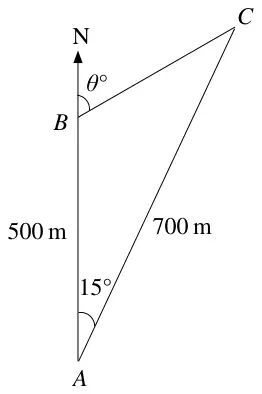
Figure 1 shows 3 yachts \(A\), \(B\) and \(C\) which are assumed to be in the same horizontal plane. Yacht \(B\) is 500 m due north of yacht \(A\) and yacht \(C\) is 700 m from \(A\). The bearing of \(C\) from \(A\) is 015°.
(a) Calculate the distance between yacht \(B\) and yacht \(C\), in metres to 3 significant figures. (3)
The bearing of yacht \(C\) from yacht \(B\) is \(\theta^\circ\), as shown in Figure 1.
If use \(\cos 15^\circ = \ldots\), then A1 not scored until written as \(BC^2 = \ldots\) correctly
Splitting into 2 triangles BAX and CAX, where X is foot of perp. from B to AC Finding value for \(BX\) and \(CX\) and using Pythagoras M1 \(BC^2 = (500\sin 15^\circ)^2 + (700 - 500\cos 15^\circ)^2\) A1 \(BC = 253\) awrt A1
\(\sin B = \sin 15\times 700/253_c = 0.716..\) and giving an obtuse \(B\) \((134.2^\circ)\) dep
M1
\(\theta = 180^\circ - \text{candidate’s angle } B\) (Dep. on first M only, B can be acute)
M1
\(\theta = 180 - 134.2 = (0)45.8\) (allow 46 or awrt 45.7, 45.8, 45.9) [46 needs to be from correct working]
A1
(4)
[7]
Notes
Several alternative methods: (Showing the M marks, 3rd M dep. on first M))
(i) \(\cos B = \dfrac{500^2 + \text{candidate’s } BC^2 - 700^2}{2\times 500\times\text{candidate’s } BC}\) or \(700^2 = 500^2 + BC_c^{\,2} - 2\times 500\times BC_c\) M1 Finding angle \(B\) M1, then M1 as above
(ii) 2 triangle approach, as defined in notes for (a) \(\tan CBX = \dfrac{700 - \text{value for } AX}{\text{value for } BX}\) M1 Finding value for \(\angle CBX\) (\(\approx 59^\circ\)) M1 \(\theta = [180^\circ - (75^\circ + \text{candidate’s } \angle CBX)]\) M1
(iii) Using sine rule (or cos rule) to find \(C\) first: Correct use of sine or cos rule for \(C\) M1, Finding value for \(C\) M1 Either \(B = 180^\circ - (15^\circ + \text{candidate’s } C)\) or \(\theta = (15^\circ + \text{candidate’s } C)\) M1
(iv) \(700\cos 15^\circ = 500 + BC\cos\theta\) M2 {first two Ms earned in this case} Solving for \(\theta\); \(\theta = 45.8\) (allow 46 or 45.7, 45.8, 45.9) M1;A1 (corrected from the printed mark scheme, which shows “46 or5.7”)
First M1: Using \(5\sin^2\theta = 3\) to find value for \(\sin\theta\) or \(\theta\) Second M1: Considering the – value for \(\sin\theta\). (usually later) First A1: Given for awrt \(50.8^\circ\). Not dependent on second M. Third M1: For \((180 - 50.8_c)^\circ\), need not see written down Final M1: Dependent on second M (but may be implied by answers) For \((180 + \text{candidate’s } 50.8)^\circ\) or \((360 - 50.8_c)^\circ\) or equiv. Final A1: Requires both values. (no follow through)
[Finds \(\cos^2\theta = k\) (\(k = 2/5\)) and so \(\cos\theta = (\pm)\ldots\) M1, then mark equivalently]
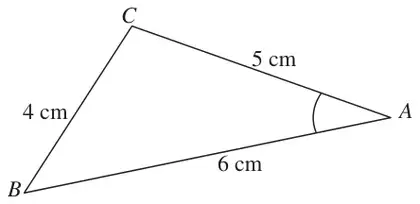
M: Is also scored for \(5^2 = 4^2 + 6^2 - (2\times 4\times 6\cos\theta)\) or \(6^2 = 5^2 + 4^2 - (2\times 5\times 4\cos\theta)\) or \(\cos\theta = \dfrac{4^2 + 6^2 - 5^2}{2\times 4\times 6}\) or \(\cos\theta = \dfrac{5^2 + 4^2 - 6^2}{2\times 5\times 4}\).
1st A: Rearranged correctly and numerically correct (possibly unsimplified), in the form \(\cos\theta = \ldots\) or \(60\cos\theta = 45\) (or equiv. in the form \(p\cos\theta = q\)).
Alternative (verification): \(4^2 = 5^2 + 6^2 - \left(2\times 5\times 6\times\dfrac{3}{4}\right)\) [M1] Evaluate correctly, at least to \(16 = 25 + 36 - 45\) [A1] Conclusion (perhaps as simple as a tick). [A1cso] (Just achieving 16 = 16 is insufficient without at least a tick).
Mark scheme (b)
Scheme
Marks
\(\sin^2 A + \left(\dfrac{3}{4}\right)^2 = 1\) (or equiv. Pythag. method)
M1
\(\left(\sin^2 A = \dfrac{7}{16}\right)\quad \sin A = \dfrac{1}{4}\sqrt{7}\) or equivalent exact form, e.g. \(\sqrt{\dfrac{7}{16}}\), \(\sqrt{0.4375}\)
A1
(2)
5
Notes
M: Using a correct method to find an equation in \(\sin^2 A\) or \(\sin A\) which would give an exact value. Correct answer without working (or with unclear working or decimals): Still scores both marks.
(a) Given that \(\sin\theta = 5\cos\theta\), find the value of \(\tan\theta\). (1)
(b) Hence, or otherwise, find the values of \(\theta\) in the interval \(0 \leqslant \theta \lt 360^\circ\) for which\[\sin\theta = 5\cos\theta,\]giving your answers to 1 decimal place. (3)
Mark scheme (a)
Scheme
Marks
\(\tan\theta = 5\)
B1
(1)
Notes
Must be seen explicitly, e.g. \(\tan\theta = \tan^{-1} 5 = 78.7\) or equiv. is B0, unless \(\tan\theta = 5\) is also seen.
Mark scheme (b)
Scheme
Marks
\(\tan\theta = k \qquad \left(\theta = \tan^{-1} k\right)\)
M1
\(\theta = 78.7, \quad 258.7\) (Accept awrt)
A1, A1ft
(3)
(4 marks)
Notes
The M mark may be implied by working in (a).
A1ft for \(180 + \alpha\). \((\alpha \neq k)\).
Answers in radians would lose both the A marks.
Extra answers between 0 and 360: Deduct the final mark.
Alternative: Using \(\cos^2\theta = 1 - \sin^2\theta\) (or equiv.) and proceeding to \(\sin\theta = k\) (or equiv.): M1 then A marks as in main scheme.
(a) Find all the values of \(\theta\), to 1 decimal place, in the interval \(0^\circ \leqslant \theta \lt 360^\circ\) for which\[5\sin(\theta + 30^\circ) = 3.\] (4)
(b) Find all the values of \(\theta\), to 1 decimal place, in the interval \(0^\circ \leqslant \theta \lt 360^\circ\) for which\[\tan^2\theta = 4.\] (5)
Mark scheme (a)
Scheme
Marks
\(\sin(\theta + 30) = \dfrac{3}{5}\) (\(\tfrac{3}{5}\) on RHS)
B1
\(\theta + 30 = 36.9\) (\(\alpha =\) AWRT 37)
B1
or \(\quad = 143.1\) \((180 - \alpha)\)
M1
\(\underline{\theta = 6.9,\ 113.1}\)
A1cao
(4)
Notes
M1 for 180 \(-\) their first solution. Must be at the correct stage i.e. for \(\theta + 30\)
Answers Only can score full marks in both parts
Not 1 d.p.: loses A1 in part (a). In (b) all answers are AWRT.
Ignore extra solutions outside range
Radians Allow M marks for consistent work with radians only, but all A and B marks for angles must be in degrees. Mixing degrees and radians is M0.
Mark scheme (b)
Scheme
Marks
\(\tan\theta = \pm 2\) or \(\sin\theta = \pm\dfrac{2}{\sqrt{5}}\) or \(\cos\theta = \pm\dfrac{1}{\sqrt{5}}\)
(a) Show that the equation\[5\cos^2 x = 3(1 + \sin x)\]can be written as\[5\sin^2 x + 3\sin x - 2 = 0.\] (2)
(b) Hence solve, for \(0 \leqslant x \lt 360^\circ\), the equation\[5\cos^2 x = 3(1 + \sin x),\]giving your answers to 1 decimal place where appropriate. (5)
Mark scheme (a)
Scheme
Marks
\(5(1 - \sin^2 x) = 3(1 + \sin x)\)
M1
\(5 - 5\sin^2 x = 3 + 3\sin x\)
\(\underline{0 = 5\sin^2 x + 3\sin x - 2}\ *\)
A1 cso
(2)
Notes
M1 for use of \(\cos^2 x = 1 - \sin^2 x\). Condone missing ( )
Mark scheme (b)
Scheme
Marks
\(0 = (5\sin x - 2)(\sin x + 1)\)
M1
\(\sin x = \dfrac{2}{5}, -1\) (both)
A1
\(\sin x = \dfrac{2}{5} \Rightarrow x = \underline{23.6}\) \((\alpha = 23.6\) or \(156.4)\)
B1
\(, \underline{156.4}\) \((180 - \alpha)\)
M1
\(\sin x = -1 \Rightarrow x = \underline{270}\)
B1
(5)
(7 marks)
Notes
1st M1 for attempt to solve \(\to \sin x =\)
1st B1 for correct solution, \(\alpha\) to \(\sin x = \dfrac{2}{5}\). Must be 1 d.p.
2nd M1 for \(180 - \alpha\), accept nearest degree or awrt.
Answer only in (b) scores M0A0 but then could score B1M1B1 Incorrect factorisation probably only gets \(\dfrac{2}{5}\).
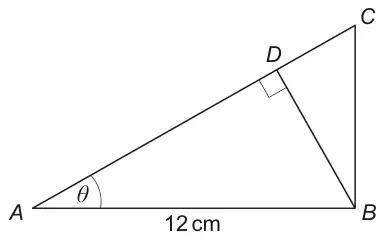
Expresses \(CD\) as the difference between \(AC\) and their \(AD\) Or Expresses \(BD\) as \(12\sin\theta\) and uses \(\tan\theta\) in triangle \(BCD\)
M1
3.1a
Completes reasoned argument to obtain given result Must see two separate fractions with a common denominator Or \(CD = \dfrac{12\sin^2\theta}{\cos\theta}\) Or \(CD\cos\theta = 12 - 12\cos^2\theta\)
for \(0^\circ \leqslant \theta \leqslant 180^\circ\)
Give your answers to the nearest degree. [3 marks]
Mark scheme
Scheme
Marks
AO
Obtains one correct value for \(3\theta\) or \(\theta\) Condone missing or incorrect labelling
M1
1.1a
Obtains AWRT 56, 236 and 416 and no others within the range Condone missing or incorrect labelling
M1
1.1a
Divides their solutions for \(3\theta\) by 3 to obtain solutions for \(\theta\) FT their values for \(3\theta\) Must be at least 2 solutions for \(3\theta\)
4 It is given that \(5\cos^2\theta - 4\sin^2\theta = 0\)
(a) Find the possible values of \(\tan\theta\), giving your answers in exact form. [3 marks]
(b) Hence, or otherwise, solve the equation\[5\cos^2\theta - 4\sin^2\theta = 0\]
giving all solutions of \(\theta\) to the nearest 0.1° in the interval \(0^\circ \leqslant \theta \leqslant 360^\circ\) [2 marks]
Mark scheme (a)
Scheme
Marks
AO
Uses a trig identity, either \(\tan\theta = \dfrac{\sin\theta}{\cos\theta}\) or \(\sin^2\theta + \cos^2\theta = 1\) correctly to obtain an equation in a single trig function.
M1
1.1a
Obtains \(\tan^2\theta = \dfrac{5}{4}\) or \(\sin^2\theta = \dfrac{5}{9}\) or \(\cos^2\theta = \dfrac{4}{9}\) PI by one correct value for \(\tan\theta\), \(\sin\theta\) or \(\cos\theta\)
A1
1.1b
Obtains \(\tan\theta = \pm\dfrac{\sqrt{5}}{2}\) OE Must be in exact form
(i) Show that the equation\[3\sin\theta\tan\theta = 5\cos\theta - 2\]is equivalent to the equation\[(4\cos\theta - 3)(2\cos\theta + 1) = 0\] [3 marks]
(ii) Solve the equation\[3\sin\theta\tan\theta = 5\cos\theta - 2\]for \(-180^\circ \leqslant \theta \leqslant 180^\circ\) [2 marks]
(b) Hence, deduce all the solutions of the equation\[3\sin\left(\frac{1}{2}\theta\right)\tan\left(\frac{1}{2}\theta\right) = 5\cos\left(\frac{1}{2}\theta\right) - 2\]for \(-180^\circ \leqslant \theta \leqslant 180^\circ\), giving your answers to the nearest degree. [2 marks]
Uses substitution \(\cos^2 x = 1 - \sin^2 x\) in any form
B1
1.2
Solves ‘their’ quadratic to obtain two values for \(\sin x\)
M1
1.1a
Finds two correct solutions for \(x\)
A1
1.1b
Finds all four solutions for \(x\) and no extras (condone 14.5, 165.5 AWRT)
A1
1.1b
(4 marks)
Typical solution
\[9\sin^2 x - 6\sin x + (1 - \sin^2 x) = 0\]\[8\sin^2 x - 6\sin x + 1 = 0\]\[(4\sin x - 1)(2\sin x - 1)\]\[\sin x = \tfrac{1}{4}\]\[\sin x = \tfrac{1}{2}\]\[14^\circ,\ 30^\circ,\ 150^\circ,\ 166^\circ\]
10 On 18 March 2019 there were 12 hours of daylight in Inverness.
On 16 June 2019, 90 days later, there will be 18 hours of daylight in Inverness.
Jude decides to model the number of hours of daylight in Inverness, \(N\), by the formula\[N = A + B\sin t^\circ\]where \(t\) is the number of days after 18 March 2019.
(a)
(i) State the value that Jude should use for \(A\). [1 mark]
(ii) State the value that Jude should use for \(B\). [1 mark]
(iii) Using Jude’s model, calculate the number of hours of daylight in Inverness on 15 May 2019, 58 days after 18 March 2019. [1 mark]
(iv) Using Jude’s model, find how many days during 2019 will have at least 17.4 hours of daylight in Inverness. [4 marks]
(v) Explain why Jude’s model will become inaccurate for 2020 and future years. [1 mark]
(b) Anisa decides to model the number of hours of daylight in Inverness with the formula\[N = A + B\sin\left(\frac{360}{365}t\right)^\circ\]Explain why Anisa’s model is better than Jude’s model. [1 mark]
Mark scheme (a)
Scheme
Marks
AO
(i) States \(A = 12\)
B1
3.3
(1)
(ii) States \(B = 6\)
B1
3.3
(1)
(iii) Applies formula using their \(A\) and \(B\) 2 sf or better provided their answer >12 and <24
B1F
1.1b
(1)
(iv) Substitutes 17.4 into formula with their \(A\) and \(B\)
M1
1.1a
Evaluates first value of \(t\). AWFW 64 to 65
A1
1.1b
Evaluates second value of \(t\) as 180 – their first value ±1 Or Subtracts their first value from 90 and doubles
M1
3.4
Obtains final answer AWRT 50
A1
3.2a
(4)
(v) Explains 360 days is not the same as a year. Must mention 360
E1
3.5b
(1)
Typical solution
(i)
\[A = 12\]
(ii)
\[B = 6\]
(iii)
\[12 + 6\sin 58 = 17.1\]
(iv)
\[17.4 = 12 + 6\sin t\]\[\sin t = 0.9\]\[t = 64\]
second value of \(t\) is 116
So answer is 53 days
(v)
Jude’s model will repeat after 360 days but a year has 365 days.
Mark scheme (b)
Scheme
Marks
AO
Explains that Anisa’s model adjusts the repeating pattern to match the number of days in a year. Mark may be supported by response seen in part (a)(v)
E1
3.5c
(1)
(9 marks)
Typical solution
Anisa’s model will repeat after 365 days because of the fraction
(i) Show that \(\cos\theta = \dfrac{1}{2}\) is one solution of the equation\[6\sin^2\theta + 5\cos\theta = 7\] [2 marks]
(ii) Find all the values of \(\theta\) that solve the equation\[6\sin^2\theta + 5\cos\theta = 7\]for \(0^\circ \leqslant \theta \leqslant 360^\circ\)
Give your answers to the nearest degree. [2 marks]
(b) Hence, find all the solutions of the equation\[6\sin^2 2\theta + 5\cos 2\theta = 7\]for \(0^\circ \leqslant \theta \leqslant 360^\circ\)
Give your answers to the nearest degree. [2 marks]
Mark scheme (a)
Scheme
Marks
AO
(i) Uses identity to replace \(\sin^2\theta\) with \((1 - \cos^2\theta)\) or uses \(\sin\theta = \frac{\sqrt{3}}{2}\)
M1
1.2
Solves quadratic equation to get one solution \(\cos\theta = \frac{1}{2}\). Or verifying using \(\cos\theta = \frac{1}{2}\)
A1
1.1a
(2)
(ii) States any two correct solutions
B1
1.1b
States two additional correct solutions. Condone answers of 70.5 and 289.5 or greater accuracy. Ignore any additional answers outside the range but any additional answers inside range lose second B1
3 It is given that \(\sin\theta = -0.1\) and \(180^\circ \lt \theta \lt 270^\circ\)
Find the exact value of \(\cos\theta\) [2 marks]
Mark scheme
Scheme
Marks
AO
Substitutes \(\sin\theta\) value into the equation \(\sin^2\theta + \cos^2\theta = 1\) ACF or Uses \(\sin\theta = -0.1\) and right-angled triangle to get magnitude of \(\cos\theta\) or Obtains \(\cos^2\theta = 0.99\) CAO
M1
1.1a
Solves and selects correct sign Accept \(\cos\theta = -\sqrt{0.99}\) or exact equivalent \(-\frac{3}{10}\sqrt{11}\)
Squares and multiplies by appropriate \(\dfrac{\text{conjugate}}{\text{conjugate}}\) or vice versa
A1
1.1b
Obtains correct values of \(a\) and \(b\) \((a = 7,\ b = -4)\) If no explicit evidence of the use of \(\dfrac{\text{conjugate}}{\text{conjugate}}\) seen award max 1/3 (M1 A0 R0)
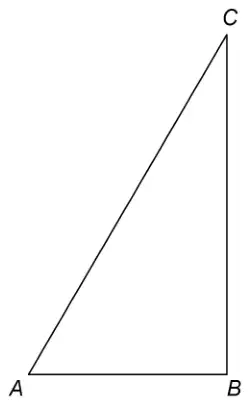
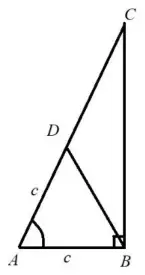
\(D\) is the point on hypotenuse \(AC\) such that \(AD = AB\).
The area of \(\Delta ABD\) is equal to half that of \(\Delta ABC\).
(a) Show that \(\tan A = 2\sin A\) [4 marks]
(b)
(i) Show that the equation given in part (a) has two solutions for \(0^\circ \leqslant A \leqslant 90^\circ\) [2 marks]
(ii) State the solution which is appropriate in this context. [1 mark]
Mark scheme (a)
Scheme
Marks
AO
Uses area of \(ADB\) = area of \(CDB\) or area of \(ADB = \frac{1}{2}\) area of \(ABC\) Possibly by use of “\(\frac{1}{2}ab\sin C\)” twice
M1
3.1a
Deduces that \(AC = 2 \times AD = 2 \times AB\) or equivalent
A1
1.1b
Uses trigonometry involving sin and tan based on triangle with \(AC = 2 \times AB\)
M1
1.1a
Obtains correct conclusion (AG) Sets out a well-constructed mathematical argument. Use of \(60^\circ\) or equivalent must be justified
R1
2.1
(4)
Typical solution
Area of \(ADB\) = Area of \(CDB\)
\[CD = AD = c\]\[AC = 2c\]\[\cos A = \frac{c}{2c} = \frac{1}{2} \text{ so } A = 60^\circ\]\[\tan A = \sqrt{3}\]\[\sin A = \frac{\sqrt{3}}{2}\]\[2\sin A = \sqrt{3} = \tan A\]
Alternative (a)
Scheme
Marks
AO
Obtains area formula for \(ABD\) using \(\sin A\)
M1
3.1a
Obtains expression for \(BC\) using \(\tan A\)
M1
1.1a
Obtains correct expression for area of \(ABC\)
A1
1.1b
Simplifies to correct conclusion (AG) Sets out a well-constructed mathematical argument.
R1
2.1
(4)
Typical solution
\[\text{Area of } ADB = \tfrac{1}{2}c^2\sin A\]\[\frac{BC}{c} = \tan A\]\[BC = c\tan A\]\[\text{Area of } ABC = \tfrac{1}{2}c^2\tan A\]\[\tfrac{1}{2}c^2\tan A = 2 \times \tfrac{1}{2}c^2\sin A\]\[\tan A = 2\sin A\]
Mark scheme (b)
Scheme
Marks
AO
(i) Uses \(\tan A = \dfrac{\sin A}{\cos A}\) and multiplies Or Uses sketch of two graphs to show two intersections
M1
1.1a
Solves the equation to give \(A = 0^\circ\) and \(60^\circ\) Or interprets intersections of graphs of the correct shape between \(0^\circ\) and \(90^\circ\) to be the solutions
A1
1.1b
(2)
(ii) Selects \(A = 60^\circ\). (Can be earned with no other working shown)
B1
3.2a
(1)
(7 marks)
Typical solution
(i)
\[\frac{\sin A}{\cos A} = 2\sin A\]\[\sin A = 2\sin A\cos A\]\[\sin A(1 - 2\cos A) = 0\]\[\sin A = 0 \text{ or } \cos A = \tfrac{1}{2}\]\[A = 0^\circ \text{ and } A = 60^\circ\]
(ii)
We need \(A = 60^\circ\)
Notes
(b)(i) Special case: \(0^\circ\) and \(60^\circ\) stated but not justified award B1. Stated and verified award B2
4 Solve the equation \(\tan^2 2\theta - 3 = 0\) giving all the solutions for \(0^\circ \leqslant \theta \leqslant 360^\circ\) [4 marks]
Mark scheme
Scheme
Marks
AO
Solves to find \(\tan 2\theta\) (allow M1 even if only \(+\sqrt{3}\) given PI by any correct final value of \(\theta\))
M1
1.1a
Obtains at least 3 correct final values for \(\theta\) ignore extra incorrect terms or terms outside range
A1
1.1b
Obtains at least 3 correct final values of \(\theta\) from \(\tan 2\theta = \sqrt{3}\) and at least 3 correct values from \(\tan 2\theta = -\sqrt{3}\) ignore extra incorrect terms or terms outside range
M1
1.1a
Obtains complete set of exactly 8 correct values for \(\theta\)
(a) Show that \(\dfrac{\cos\theta}{1 - \sin\theta} - \dfrac{1}{\cos\theta} \equiv \tan\theta\) (where \(\theta \neq 90n^\circ\) for any odd integer \(n\)). [3]
(b) Hence solve the equation \(\dfrac{\cos 3x}{1 - \sin 3x} - \dfrac{1}{\cos 3x} = 1\) for \(0 \leqslant x \leqslant 90^\circ\). [4]
M1*: Multiply first term by \(\dfrac{\cos\theta}{\cos\theta}\) and use \(\sin^2\theta + \cos^2\theta \equiv 1\) so that the numerator is in \(\sin\theta\) only.
M1dep*: Using difference of two squares in first term.
M1*: Multiply first term by \(\dfrac{1 + \sin\theta}{1 + \sin\theta}\)
M1dep*: Use of \(\sin^2\theta + \cos^2\theta \equiv 1\) so that the denominator is in \(\cos\theta\) only.
A1: Correct completion to AG www
May see variations on each method and/or equivalent work done to both sides of identity in ‘parallel’ – mark to either method above as each step appears.
Mark scheme (b)
Scheme
Marks
AO
\(\tan 3x = 1\)
B1
3.1a
\(\tan^{-1}(1)\)
M1
1.1
\([3x =]\ 45^\circ\) or \(225^\circ\)
A1
1.1
\(x = 15^\circ\) or \(75^\circ\)
A1
1.1
[4]
Notes
B1: soi
M1: soi, eg by \(45^\circ\) seen
A1: Both, ignore extras (may be implied by final A1)
3 In a triangle \(ABC\), \(AB = 9\) cm, \(BC = 7\) cm and \(AC = 4\) cm.
(a) Show that \(\cos CAB = \tfrac{2}{3}\). [2]
(b) Hence find the exact value of \(\sin CAB\). [2]
(c) Find the exact area of triangle \(ABC\). [2]
Mark scheme (a)
Scheme
Marks
AO
\(\cos CAB = \dfrac{4^2 + 9^2 - 7^2}{2(4)(9)}\)
M1
1.1
\(= \dfrac{16 + 81 - 49}{72} = \dfrac{2}{3}\)
A1
2.1
[2]
Notes
M1: Correct application of cosine rule \(\cos CAB\) does not have to be the subject Condone \(\cos\theta\) oe May see \(7^2 = 4^2 + 9^2 - 2(4)(9)\left(\tfrac{2}{3}\right)\)
A1:AG – at least one step of simplification from applying the formula to given answer \(49 = 49\) without intermediate step is A0
Mark scheme (b)
Scheme
Marks
AO
\(\sin^2 CAB + \left(\dfrac{2}{3}\right)^2 = 1\)
M1
3.1a
\(\dfrac{\sqrt{5}}{3}\)
A1
1.1
[2]
Notes
M1: Correct use of \(\sin^2 X + \cos^2 X = 1\) (oe) soi Or using Pythagoras correctly with a right-angle triangle with hypotenuse 3 and another side 2 and attempt to find \(\sin CAB\)
A1: cao – accept any equivalent exact form \(\pm\tfrac{\sqrt{5}}{3}\) only is M1 A0
Mark scheme (c)
Scheme
Marks
AO
Area \(= \dfrac{1}{2}(4)(9)\left(\dfrac{\sqrt{5}}{3}\right)\)
M1
1.1
\(= 6\sqrt{5}\) (cm\(^2\))
A1
1.1
[2]
Notes
M1: Correct use of \(\tfrac{1}{2}(AC)(AB)\sin CAB\) with \(AC = 4\), \(AB = 9\) and their \(\sin CAB\) soi This mark can be earned for non-exact working as long as \(CAB\) is acute
3 In the triangle \(ABC\), \(AB = 3\), \(AC = 5\) and angle \(BAC = \alpha\). The area of the triangle is \(\dfrac{5}{2}\). Determine the two possible values of \(\cos\alpha\). Give your answers in exact form. [5]
The diagram shows a parallelogram \(ABCD\) where \(AB = 14\,\mathrm{cm}\), \(AD = 5\,\mathrm{cm}\) and angle \(DAB\) is obtuse. The area of \(ABCD\) is \(50\,\mathrm{cm}^2\).
(a) Determine, in degrees, the size of angle \(DAB\). Give your answer correct to 1 decimal place. [3]
(b) Find the length, in centimetres, of the diagonal \(BD\). Give your answer correct to 1 decimal place. [2]
Mark scheme (a)
Scheme
Marks
AO
\(14(5\sin\theta) = 50\)
M1*
1.1
\(\theta = \sin^{-1}\tfrac{5}{7} = 45.6\) or better or \(\alpha = \cos^{-1}\tfrac{5}{7} = 44.4\) or better
M1dep*
1.1
Angle \(DAB = 134.4\)
A1
1.1
[3]
Notes
M1*: Correct method for finding either the supplement of the required angle \(DAB\) (e.g. \(2\left(\tfrac{1}{2} \times 5 \times 14 \times \sin\theta\right) = 50\)) or the angle \((\alpha)\) between \(DA\) and the vertical (e.g. \(14(5\cos\alpha) = 50\)) Where \(\theta\) is the supplement to the required angle \(DAB\)
3 A Ferris wheel at a fairground rotates in a vertical plane. The height above the ground of a seat on the wheel is \(h\) metres at time \(t\) seconds after the seat is at its lowest point.
The height is given by the equation \(h = 15 - 14\cos(kt)^\circ\), where \(k\) is a positive constant.
(a)
(i) Write down the greatest height of a seat above the ground. [1]
(ii) Write down the least height of a seat above the ground. [1]
(b) Given that a seat first returns to its lowest point after 150 seconds, calculate the value of \(k\). [2]
(c) Determine for how long a seat is 20 metres or more above the ground during one complete revolution. Give your answer correct to the nearest tenth of a second. [4]
M1: Setting given expression equal to (a)(ii) and re-arranging to get \(\cos(150k) = \ldots\) or for stating \(150k = 360\) Must substitute/use \(t = 150\) for this method mark. May use \(t = 75\) with \(h = 29\) \(150k = 2\pi\), (i.e. using radians) M1
A1: The correct answer only implies the M mark so “\(k = 2.4\)” without working is M1A1.
\(103.7813\ldots - 46.2186\ldots\) or \(150 - (2 \times 46.2186)\) o.e.
M1
1.1
Therefore above 20 m for 57.6 (s)
A1
3.2a
[4]
Notes
M1*: Setting given expression equal to 20 to obtain an equation of the form \(\cos(kt) = k_1\) Could use inequalities Need \(-1 \leqslant k_1 \leqslant 1\)
M1dep*: Obtaining at least one value of \(t\) correctly from their equation above \(2.4t = 110.9248\ldots,\ 249.0751\ldots\)
M1: Subtracting their two positive values of \(t\) (both obtained correctly from their equation above) or \(150 - (2 \times \text{their } t)\) Dependent on previous two M marks
A1: Must be to 1 decimal place 57.562639… A0 if using radians.
(a) Prove that \(\cos x + \sin x \tan x \equiv \dfrac{1}{\cos x}\) (where \(x \neq \tfrac{1}{2}n\pi\) for any odd integer \(n\)). [3]
(b) Solve the equation \(2\sin^2 x = \cos^2 x\) for \(0^\circ \leqslant x \leqslant 180^\circ\). [2]
Mark scheme (a)
Scheme
Marks
AO
LHS \(= \cos x + \sin x \times \dfrac{\sin x}{\cos x}\)
M1*
1.1a
\(= \dfrac{\cos^2 x + \sin^2 x}{\cos x}\)
dM1
1.1
\(= \dfrac{1}{\cos x}\) AG
A1
2.2a
[3]
Notes
M1*: Use of tan = sin/cos
dM1: Attempt common denominator (by multiplying numerator) OR apply \(\sin^2 x + \cos^2 x \equiv 1\) in correct working to reach \(\cos x + \dfrac{1 - \cos^2 x}{\cos x}\) oe
A1: www, Must see previous line and answer
Mark scheme (b)
Scheme
Marks
AO
\(\tan^2 x = \tfrac{1}{2}\) \(\tan x = \pm\dfrac{1}{\sqrt{2}}\)
M1
1.1a
\(x = 35.3^\circ\) or \(x = 145^\circ\) (Both)
A1
1.1
[2]
Notes
M1: or \(3\sin^2 x = 1\) or \(2 = 3\cos^2 x\) and attempt to solve \(\sin x = \pm\dfrac{1}{\sqrt{3}}\) \(\cos x = \pm\dfrac{\sqrt{2}}{\sqrt{3}}\)
A1: \((35.26\ldots^\circ,\ 144.7\ldots^\circ)\) A0 if any additional solutions within range (isw any outside)
The diagram shows the parallelogram \(OACB\) where \(\overrightarrow{OA} = 2\mathbf{i} + 4\mathbf{j}\) and \(\overrightarrow{OB} = 4\mathbf{i} - 3\mathbf{j}\).
(a) Show that \(\cos AOB = -\dfrac{2\sqrt{5}}{25}\). [5]
(b) Hence find the exact value of \(\sin AOB\). [2]
M1: Correct method to find either \(\overrightarrow{AB}\) or \(\overrightarrow{BA}\)
A1: cao
B1: Correct lengths for \(OA\) and \(OB\) (or their squares)
M1: Correct use of cosine rule for their \(OA\), \(OB\) and \(AB\). \(\cos AOB\) may not be the subject, but substitutions must be correct for their values
A1:AG – sufficient working must be shown. Condone this result from calculator without intermediate working.
M1: Correct order of operation to find one value of \(\theta\) (or all values of \(3\theta\) correct) \((3\theta =)\ 66.42\ldots\), 180, \(293.57\ldots\)
A1: Correct value (to at least 1 dp)
A1: Correct value (to at least 1 dp) Any additional values in the range loses final A mark if earned
The diagram shows triangle \(ABC\), with \(AB = x\,\text{cm}\), \(AC = y\,\text{cm}\) and angle \(BAC = 60^\circ\). It is given that the area of the triangle is \((x+y)\sqrt{3}\,\text{cm}^2\).
(a) Show that \(4x + 4y = xy\). [2]
When the vertices of the triangle are placed on the circumference of a circle, \(AC\) is a diameter of the circle.
(b) Determine the value of \(x\) and the value of \(y\). [4]
Mark scheme (a)
Scheme
Marks
AO
\(\dfrac{1}{2}xy\sin 60 = \sqrt{3}(x+y)\) Must have \(xy\), not \(ab\) May be implied by next line
M1: Correct use of both \(\cos^2\theta = 1 - \sin^2\theta\) and \(\tan\theta = \dfrac{\sin\theta}{\cos\theta}\)
A1:AG Must show sufficient working to justify the given answer
Mark scheme (b)
Scheme
Marks
AO
DR \((2\sin\theta - 1)(3\sin\theta + 2)\)
M1
1.1a
Critical values occur when \(\sin\theta = \dfrac{1}{2}\) and \(\sin\theta = -\dfrac{2}{3}\)
B1
1.1
Critical values are \(\theta = 30, 150, 222, 318\)
B1
1.1
\(0 \lt \theta \lt 30\) or \(150 \lt \theta \lt 222\) or \(318 \lt \theta \lt 360\)
B1
1.1
A1
2.5
[5]
Notes
M1: Attempt to solve 3-term quadratic. Ignore incorrect use of inequalities for first three marks
B1: Any three correct critical values (221.8103…, 318.1896…)
B1: B1 for one correct interval – 3sf or better (condone use of \(x\)). Condone \(\leqslant\) oe
A1: Cao (all three intervals) – 3 sf or better. Allow \(\theta \lt 30\), \(150 \lt \theta \lt 222\), \(318 \lt \theta\)
For those that have \(\sin\theta = -\frac{1}{2}\) and \(\sin\theta = \frac{2}{3}\) can score M1 (if DR seen) then SC B1 for one ‘correct’ interval (condone \(\leqslant\) oe) or SC B2 for all three ‘correct’ intervals which are \(\theta \lt 42, 138 \lt \theta \lt 210, \theta \gt 330\) (so max. 3/5)
Attempt find other (quadratic) factor, by any method, but must be seen \((x-1)(2x^2 + 5x - 3)\)
M1
1.1
\((x-1)(2x-1)(x+3)\)
A1f*
1.1
\(x = 1\) or \(\frac{1}{2}\) or \(-3\)
A1
2.2a
[4]
Notes
(i) B1: Correct working and result seen
(ii) B1: stated or implied, eg by attempt \(\div\) by \((x-1)\) or \((2x-1)\) or \((x+3)\) is factor
M1: or show that \(\mathrm{f}(-3) = 0\) or \(\mathrm{f}(\frac{1}{2}) = 0\). Inspection: Must have \(2x^2\) and \(\pm 3\) oe
A1f*: or \(x = \dfrac{-5 \pm \sqrt{25 - 4 \times 2 \times (-3)}}{4}\) ft their quad factor
A1: Dep A1* cao. SC correct answer no working: B1 only eg correct factors, no working B1 only
Mark scheme (b)
Scheme
Marks
AO
\(\sin\theta = 1\) or \(\sin\theta = \dfrac{1}{2}\)
M1
3.2a
\(\theta = 90^\circ, 30^\circ, 150^\circ\)
A3f
3.1a 1.1 1.1
\(\sin\theta = -3\) gives no solution, or it doesn't exist oe or outside range or impossible or not acceptable oe
B1
2.3
[5]
Notes
M1: Use of a root from (a). May be implied
A3f: Three correct, none incorrect: A3 Three correct and \(\geqslant 1\) incorrect: A2 Two correct: A2 One correct: A1 ft their (a) for all A-marks. Ignore any "correct" solutions outside range
B1: Statement needed. Ignore all else. Not incorrect reason, eg "no solutionn because minus": B0 Just "✗" or "Error" not enough because DR
1 In triangle \(ABC\), \(AB = 20\,\text{cm}\) and angle \(B = 45^\circ\).
(i) Given that \(AC = 16\,\text{cm}\), find the two possible values for angle \(C\), correct to 1 decimal place. [4]
(ii) Given instead that the area of the triangle is \(75\sqrt{2}\,\text{cm}^2\), find \(BC\). [2]
Mark scheme (i)
Scheme
Marks
AO
\(\dfrac{\sin x}{20} = \dfrac{\sin 45}{16}\)
M1*
1.1a
\(\sin x = \dfrac{20\sin 45}{16}\) \(\left(= \dfrac{5\sqrt{2}}{8}\right)\)
A1
1.1
Dep*M1
1.1
\(62.1\) and \(117.9\)
A1
1.1
[4]
Notes
M1*: Use sine formula correctly in any form SC B1 \(\dfrac{\sin x}{16} = \dfrac{\sin 45}{20}\)
A1: Correct expression for \(\sin x\) or \(0.883\ldots\)
Dep*M1: Correct work leading to a value for \(x\) – if previous A mark awarded then this mark is for getting to either 62.1 or 117.9 If the previous A mark was not awarded then award for evidence of using inverse sin on their value of \(\sin x\)
A1: Cao
Mark scheme (ii)
Scheme
Marks
AO
\(\dfrac{1}{2}(BC)(20)\sin(45) = 75\sqrt{2}\)
M1
1.1a
\((BC =)\ 15\) (cm)
A1
1.1
[2]
Notes
M1: Use \(\dfrac{1}{2}ab\sin C\) correctly and equate to \(75\sqrt{2}\)
3 You are given that \(5\sin\theta = 9\cos\theta\) and \(0^\circ \lt \theta \lt 360^\circ\).
Determine the possible values of \(\theta\) correct to 3 significant figures. [2]
Mark scheme
Scheme
Marks
AO
\(\tan\theta = \frac{9}{5}\)
M1
1.1
\(60.9^\circ, 241^\circ\)
isw
A1
1.1
[2]
Notes
M1: may be implied by eg \(\theta = \tan^{-1}\left(\frac{9}{5}\right)\) also accept \(\sin^2\theta = \frac{81}{106}\) or \(\cos^2\theta = \frac{25}{106}\) oe
A1:NB 60.9453959009; condone awrt 60.9, 241 if M0 allow SC1 for both values unsupported correct to 3 sf no other solutions within range allowed ignore additional solutions outside of range \(0 \lt \theta \lt 360\)
2 Triangle ABC is shown in the diagram. The length of AC is \(2p\) cm and the length of BC is \(3p\) cm, where \(p\) is a positive constant. The angle ABC is \(25^\circ\).
14In this question you must show detailed reasoning.
Solve the equation \(5 - \cos\theta - 6\sin^2\theta = 0\) for \(0^\circ \lt \theta \lt 360^\circ\). [6]
Mark scheme
Scheme
Marks
AO
\(5 - \cos\theta - 6(1 - \cos^2\theta) = 0\)
B1
3.1a
\(6\cos^2\theta - \cos\theta - 1 = 0\)
M1
2.1
eg \((3\cos\theta + 1)(2\cos\theta - 1) = 0\)
M1
1.1
\(\cos\theta = \frac{1}{2}\) and \(\cos\theta = -\frac{1}{3}\) seen
A1
1.1
\(60^\circ\) and \(300^\circ\)or\(109^\circ\) and \(251^\circ\)
or \(60^\circ\) and \(109^\circ\)
A1
1.1
all 4 correct with no extras
A1
1.1
[6]
Notes
B1: Using the correct identity. May be seen anywhere in the working. Condone poor notation such as missing arguments.
M1: Simplifies to 3 term quadratic in cosine and sets equal to 0. Can score this mark if \(1 + \cos^2\theta\) used (gives an unsolvable quadratic).
M1: Attempt to solve a quadratic in cosine – may see use of quadratic formula; allow sign errors only in either method. Calculator methods not acceptable here – detailed reasoning required. If using QF a correctly quoted formula followed by a slip in the substitution of values scores M1, but if the formula isn’t quoted and there are errors in the substitution then M0.
A1: A complete solve for either trig equation or two ‘first values’ obtained: allow 109.47… and 250.53…; or e.g. 109.5 and 250.5 (or awrt 109 and 251)
SC 1: If the candidate uses a calculator to obtain \(\cos\theta = \frac{1}{2}\) and \(\cos\theta = -\frac{1}{3}\) then proceeds to a fully correct solution, then award SC 4/6
SC 2: If the candidate uses a calculator to obtain \(\cos\theta = \frac{1}{2}\) and \(\cos\theta = -\frac{1}{3}\) then proceeds to partially correct solution with at least two correct values then award SC 3/6
4 The perpendicular lines AC and BD intersect at E as shown in the diagram. The point E is the midpoint of AC. The angles BAC and BDC are each equal to \(x^\circ\). The lengths of AB and CD are 4 cm and 7 cm respectively.
M1: Or \(\cos B = \dfrac{4.5^2 + 3.9^2 - 3.5^2}{2 \times 3.9 \times 4.5}\) or \(\cos C = \dfrac{3.5^2 + 4.5^2 - 3.9^2}{2 \times 4.5 \times 3.5}\)
Correct use of cosine rule – might not see the ‘Cos A’ etc till next line, but must be a correct use so no ‘sin’ etc. Can be in form \(a^2 = b^2 + c^2 - 2bc\cos A\) e.g.
A1: (\(\cos A\)) \(\cos B = 0.66125\ldots\) or \(\cos C = 0.5488889\)
A1: (\(A\)) \(B = 48.604^\circ\) or \(C = 56.709^\circ\)
M1FT: or \(\frac{1}{2} \times 4.5 \times 3.9 \times \sin 48.604\) or \(\frac{1}{2} \times 3.5 \times 4.5 \times \sin 56.709\). Must be using their included angle for their two adjacent sides
For the Final two marks: They could also find an altitude, \(h\), using one of the angles e.g using angle at C ‘\(h = 3.5\) their \(\sin C = 2.9256\ldots\)’ then \(\frac{1}{2}bh = \frac{1}{2}(4.5)(2.9256..) = 6.58267..\)
4In this question you must show detailed reasoning.
Solve the equation \(6\cos^2 x + \sin x = 5\), giving all the roots in the interval \(-180^\circ \leqslant x \leqslant 180^\circ\). [5]
Mark scheme
Scheme
Marks
AO
DR
\(6\left(1 - \sin^2 x\right) + \sin x = 5\)
M1
3.1a
\(6\sin^2 x - \sin x - 1 = 0\)
M1
1.1a
\(\sin x = \dfrac{1}{2},\ -\dfrac{1}{3}\)
A1
1.1b
When \(\sin x = \dfrac{1}{2}\), \(x = 30^\circ,\ 150^\circ\)
A1
1.1b
When \(\sin x = -\dfrac{1}{3}\), \(x = -19.5^\circ,\ -160.5^\circ\)
A1
1.1b
[5]
Notes
M1: Uses the identity \(\sin^2 x + \cos^2 x = 1\)
M1: Collects terms and attempts to solve their quadratic
A1: soi. May be BC. FT their quadratic
A1: At least one correct root in the interval for either value of \(\sin x\). FT their valid value for \(\sin x\)
A1: All roots seen from complete working – no extras in the range. FT their other valid value for \(\sin x\). Ignore additional answers outside the range.
2 The height of the first part of a rollercoaster track is \(h\) m at a horizontal distance of \(x\) m from the start. A student models this using the equation \(h = 17 + 15\cos 6x\), for \(0 \leqslant x \leqslant 40\), using the values of \(h\) given when their calculator is set to work in degrees.
(a) Find the height that the student’s model predicts when the horizontal distance from the start is 40 m. [1]
(b) The student argues that the model predicts that the rollercoaster track will achieve a maximum height of 32 m more than once because the cosine function is periodic.
Comment on the validity of the student’s argument. [2]
but the model is only valid for \(0 \leqslant x \leqslant 40\) So Tom’s argument is invalid.
E1
2.3
[2]
Notes
M1: Attempt to use the period of the \(\cos 6x\) function. Must include a reference to either 60 or 240 or a sketch illustrating the \(x\)-direction stretch. Allow if wrong conclusion reached. Do not allow for an argument based on mechanics principles alone
10 A triangle has vertices A (1, 4), B (7, 0) and C (−4, −1).
(a) Show that the equation of the line AC is \(y = x + 3\). [2]
M is the midpoint of AB. The line AC intersects the \(x\)-axis at D.
(b) Determine the angle DMA. [7]
Mark scheme (a)
Scheme
Marks
AO
gradient AC \(= \dfrac{4 - (-1)}{1 - (-4)} = 1\)
M1
2.1
A on the line so the equation of the line is \(y - 4 = 1(x - 1)\) so the equation is \(y = x + 3\)
A1
2.1
[2]
Notes
M1: Gradient calculation must be seen. o.e. using C (−4, −1). Also allow using \(y = x + c\) and evaluating \(c\)
A1: AG Must be clearly shown
Alternative method
Scheme
Marks
AO
When \(x = 1\) \(y = 1 + 3 = 4\) so A lies on the line When \(x = -4\) \(y = -4 + 3 = -1\) so C lies on the line
M1
So the equation of the line AC is \(y = x + 3\)
A1
M1: checking both points lie on the line
A1: clear conclusion must be seen
Mark scheme (b)
Scheme
Marks
AO
M is (4, 2)
B1
1.1b
\(y = x + 3\) crosses the \(x\)-axis at D (−3, 0)
B1
1.1b
length DM is \(\sqrt{49 + 4} = \sqrt{53}\) length MA is \(\sqrt{9 + 4} = \sqrt{13}\) length DA is \(\sqrt{16 + 16} = \sqrt{32}\)
M1
A1
3.1a
1.1b
using the cosine rule \(\cos \mathrm{D\hat{M}A} = \dfrac{13 + 53 - 32}{2 \times \sqrt{13} \times \sqrt{53}}\)
M1 A1
1.1a 1.1b
\(\mathrm{D\hat{M}A} = 49.6^\circ\)
A1
1.1b
[7]
Notes
M1: Attempt to find at least two of the sides of triangle DMA. Also allow for the AC\(^2\) etc found if clear
A1: At least 2 correct lengths soi. FT their coordinates
M1: Allow sign errors Any form
A1: FT their lengths. Must be correct expression for \(\cos \mathrm{D\hat{M}A}\)
Allow M1A0A0 for cosine rule used leading to one of the other two angles of the triangle. (\(101.3^\circ\) or \(29.1^\circ\)) and not used to find \(49.6^\circ\)
5 The diagram shows the triangle ABC in which AC = 13 cm and AB is the shortest side. The perimeter of the triangle is 32 cm. The area is 24 cm\(^2\) and \(\sin \mathrm{B} = \frac{4}{5}\).
Determine the lengths of AB and BC. [5]
Mark scheme
Scheme
Marks
AO
Let AB = \(c\) and BC = \(a\) Using perimeter \(a + c + 13 = 32\) giving \(a + c = 19\)
M1
3.1a
Using area \(\frac{1}{2}ac \sin \mathrm{B} = \frac{1}{2}ac \times \frac{4}{5} = 24\) giving \(ac = 60\)
2 Fig. 2 shows a quadrilateral ABCD. The lengths AB and BC are 5 cm and 6 cm respectively. The angles ABC, ACD and DAC are \(60^\circ\), \(60^\circ\) and \(75^\circ\) respectively.
(i) Sketch the graphs of \(y = 4\cos x\) and \(y = 2\sin x\) for \(0^\circ \leqslant x \leqslant 180^\circ\) on the same axes. [2]
(ii) Find the exact coordinates of the point of intersection of these graphs, giving your answer in the form \(\left(\arctan a,\ k\sqrt{b}\right)\), where \(a\) and \(b\) are integers and \(k\) is rational. [4]
(iii) A student argues that without the condition \(0^\circ \leqslant x \leqslant 180^\circ\) all the points of intersection of the graphs would occur at intervals of \(360^\circ\) because both \(\sin x\) and \(\cos x\) are periodic functions with this period. Comment on the validity of the student’s argument. [1]
Mark scheme (i)
Scheme
Marks
AO
B1
1.2
B1
1.2
[2]
Notes
B1: Correct shapes and relative sizes
B1: Graphs labelled with correct amplitudes clear. Ignore any graph beyond the given interval
Mark scheme (ii)
Scheme
Marks
AO
\(4\cos x = 2\sin x\) \(\tan x = 2\)
M1
3.1a
\(x = \arctan 2\)
A1
1.1b
\(4\cos x = 4 \times \dfrac{1}{\sqrt{5}} = \dfrac{4}{5}\sqrt{5}\)
M1
1.1a
Point of intersection is \(\left(\arctan 2,\ \dfrac{4}{5}\sqrt{5}\right)\)
A1
1.1b
[4]
Notes
M1: Forming equation leading to \(\tan x = k\) oe
A1: Award for \(63.4^\circ\) for this first A mark
M1: Attempting to find exact value for \(\cos x\) or \(\sin x\)
A1: Must be a coordinate in this form
Do not allow for using \(63.4^\circ\)
Mark scheme (iii)
Scheme
Marks
AO
The student’s argument is invalid as the period of \(\tan x\) is \(180^\circ\).
E1
2.3
[1]
Notes
E1: Must state or imply that the argument is invalid and give a correct reason
7. The triangle \(ABC\) is such that \(AB=20\sqrt{3}\text{ cm}\), \(AC=20\text{ cm}\), and angle \(ABC=30^\circ\). Find the two possible exact values of the area of the triangle \(ABC\). [6]
Mark scheme
Scheme
Marks
Comments
sine rule: \(\dfrac{20}{\sin 30}=\dfrac{20\sqrt{3}}{\sin C}\)
15. The diagram shows a sketch of part of the curve with equation \(y=2\sin x+3\cos^2x-3\). The curve crosses the \(x\)-axis at the points O, A, B and C.
Find the value of \(x\) at each of the points A, B and C. [7]
Mark scheme
Scheme
Marks
Comments
\(2\sin x+3\cos^2x-3=0\)
M1
\(2\sin x+3(1-\sin^2x)-3=0\)
M1
\(\sin^2x+\cos^2x=1\)
\(3\sin^2x-2\sin x=0\)
A1
si by \(\sin x=0\) AND \(\sin x=\frac{2}{3}\)
\(\sin x(3\sin x-2)=0\)
\(\sin x=\frac{2}{3}\) or \(\sin x=0\)
A1
cao both roots (no extra roots)
FT their \(\sin x=k\) for \(0\lt k\leq1\).
(At A,) \(x=41.81^\circ\)
B1
(At B,) \(x=138.19^\circ\)
B1
(At C,) \(x=180^\circ\)
B1
Note
Do not follow through for trig functions other than sine.
Area \(=\frac{1}{2}\times6\times13\sin\left(\cos^{-1}\left(\frac{7}{13}\right)\right)\) Area \(=\frac{1}{2}\times6\times11\sin\left(\cos^{-1}\left(-\frac{1}{11}\right)\right)\) Area \(=\frac{1}{2}\times11\times13\sin\left(\cos^{-1}\left(\frac{127}{143}\right)\right)\)
Given that \(AB=3\), \(BC=2\sqrt{5}\), \(AC=4+\sqrt{3}\), find the value of \(\cos A\hat{B}C\). Show all your working and give your answer in the form \(\dfrac{\left(a-b\sqrt{3}\right)}{6\sqrt{5}}\), where \(a\), \(b\) are integers. [7]
Mark scheme
Scheme
Marks
Comments
Cosine rule used correctly \(AC^2=AB^2+BC^2-2(AB)(BC)\cos B\)
For each branch, \(-1\) for a 3rd root in the range \(0^\circ<\theta<360^\circ\), \(\qquad\qquad\quad -1\) for a 4th root in the range \(0^\circ<\theta<360^\circ\).
Ignore roots outside the range \(0^\circ<\theta<360^\circ\).
14. The diagram below shows a triangle \(ABC\) with \(AC=5\,\text{cm}\), \(AB=x\,\text{cm}\), \(BC=y\,\text{cm}\) and angle \(BAC=120^\circ\). The area of the triangle \(ABC\) is \(14\,\text{cm}^2\).
Find the value of \(x\) and the value of \(y\). Give your answers correct to 2 decimal places. [6]
Use of quadratic formula only earns m1 if correct substitution seen to have been made, or implied by the right answers being obtained.
Ignore all solutions outside required range.
Full follow through for one positive and one negative value for \(\sin\theta>0\) for B1 and \(\sin\theta<0\) for B1 for one correct value and B1 for a second correct value.
Two negative values for \(\sin\theta\), award B1 B1 for one pair of correct solutions, ignore other pair even if incorrect. Award B1 for only one correct solution.
Two positive values for \(\sin\theta\), award B1 for one pair of correct solutions, ignore other pair even if incorrect.
We'd like to use Google Analytics cookies to count visits and see which pages help most. They're optional, and the site works exactly the same either way. Privacy policy