Vectors

More questions on this topic: GCSE Shape & Space: Vectors (115) IGCSE Shape & Space: Vectors (66) A2 Pure: Vectors (32)

Your progress
0 of 27 done
Ticks are kept only in this browser: clearing your browsing data or changing device loses them. · ·

Edexcel

OCR A

OCR MEI

WJEC

June 2025 Paper 1 Q3

EdexcelCurrent spec6 marksVectors

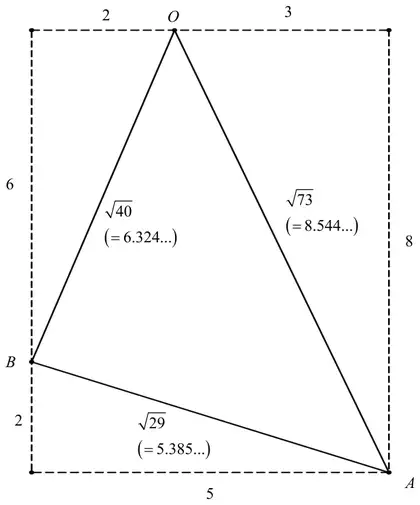
3. Relative to a fixed origin \(O\)

  • the point \(A\) has coordinates \((3,\ -8)\)
  • the point \(B\) is such that \(\overrightarrow{AB} = -5\mathbf{i} + 2\mathbf{j}\)
(a) Find the exact value of \(\left|\overrightarrow{OB}\right|\) (3)
(b) Find the size of angle \(OAB\), giving your answer in degrees to one decimal place. (3)

June 2024 Paper 1 Q3

EdexcelCurrent spec8 marksVectors

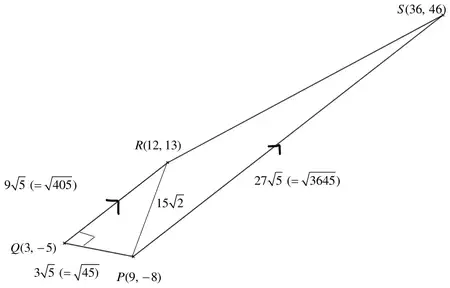
3. Relative to a fixed origin \(O\),

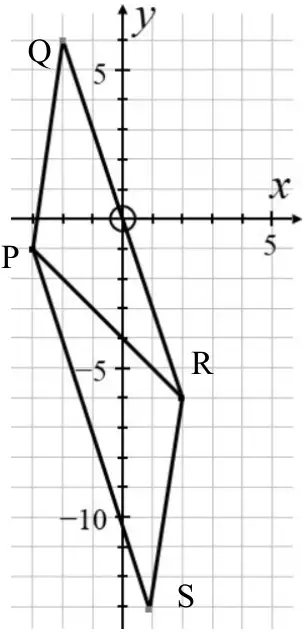
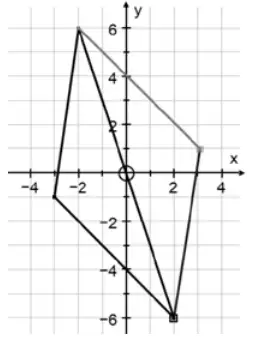
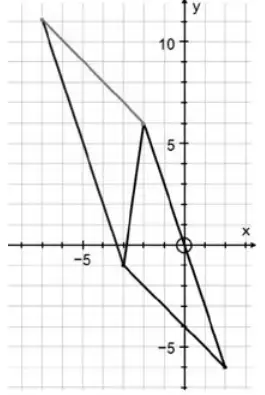
  • point \(P\) has position vector \(9\mathbf{i} - 8\mathbf{j}\)
  • point \(Q\) has position vector \(3\mathbf{i} - 5\mathbf{j}\)
(a) Find \(\overrightarrow{PQ}\) (2)

Given that \(R\) is the point such that \(\overrightarrow{QR} = 9\mathbf{i} + 18\mathbf{j}\)

(b) show that angle \(PQR = 90^\circ\) (2)

Given also that \(S\) is the point such that \(\overrightarrow{PS} = 3\overrightarrow{QR}\)

(c) find the exact area of \(PQRS\) (4)

June 2023 Paper 1 Q13

EdexcelCurrent spec7 marksVectors

13. Relative to a fixed origin \(O\)

  • point \(A\) has position vector \(10\mathbf{i} - 3\mathbf{j}\)
  • point \(B\) has position vector \(-8\mathbf{i} + 9\mathbf{j}\)
  • point \(C\) has position vector \(-2\mathbf{i} + p\mathbf{j}\) where \(p\) is a constant
(a) Find \(\overrightarrow{AB}\) (2)
(b) Find \(\left|\overrightarrow{AB}\right|\) giving your answer as a fully simplified surd. (2)

Given that points \(A\), \(B\) and \(C\) lie on a straight line,

(c)
(i) find the value of \(p\),
(ii) state the ratio of the area of triangle \(AOC\) to the area of triangle \(AOB\). (3)

June 2022 Paper 1 Q3

EdexcelCurrent spec6 marksVectors

3. The triangle \(PQR\) is such that \(\overrightarrow{PQ} = 3\mathbf{i} + 5\mathbf{j}\) and \(\overrightarrow{PR} = 13\mathbf{i} - 15\mathbf{j}\)

(a) Find \(\overrightarrow{QR}\) (2)
(b) Hence find \(\left|\overrightarrow{QR}\right|\) giving your answer as a simplified surd. (2)

The point \(S\) lies on the line segment \(QR\) so that \(QS : SR = 3 : 2\)

(c) Find \(\overrightarrow{PS}\) (2)

November 2021 Paper 1 Q4

EdexcelCurrent spec5 marksModellingVectors

4. [In this question the unit vectors \(\mathbf{i}\) and \(\mathbf{j}\) are due east and due north respectively.]

A stone slides horizontally across ice.

Initially the stone is at the point \(A(-24\mathbf{i} - 10\mathbf{j})\) m relative to a fixed point \(O\).

After 4 seconds the stone is at the point \(B(12\mathbf{i} + 5\mathbf{j})\) m relative to the fixed point \(O\).

The motion of the stone is modelled as that of a particle moving in a straight line at constant speed.

Using the model,

(a) prove that the stone passes through \(O\), (2)
(b) calculate the speed of the stone. (3)

October 2020 Paper 1 Q2

EdexcelCurrent spec6 marksModellingVectors

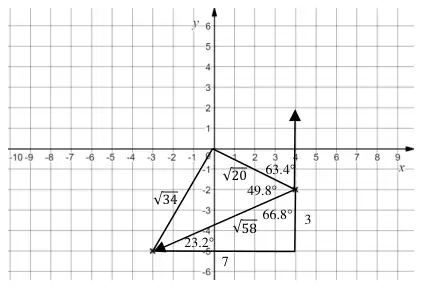
2. [In this question the unit vectors \(\mathbf{i}\) and \(\mathbf{j}\) are due east and due north respectively.]

A coastguard station \(O\) monitors the movements of a small boat.

At 10:00 the boat is at the point \((4\mathbf{i} - 2\mathbf{j})\) km relative to \(O\).

At 12:45 the boat is at the point \((-3\mathbf{i} - 5\mathbf{j})\) km relative to \(O\).

The motion of the boat is modelled as that of a particle moving in a straight line at constant speed.

(a) Calculate the bearing on which the boat is moving, giving your answer in degrees to one decimal place. (3)
(b) Calculate the speed of the boat, giving your answer in \(\mathrm{km\,h^{-1}}\) (3)

June 2019 Paper 1 Q16

EdexcelCurrent spec5 marksVectors

16.

(i) Two non-zero vectors, \(\mathbf{a}\) and \(\mathbf{b}\), are such that\[|\mathbf{a} + \mathbf{b}| = |\mathbf{a}| + |\mathbf{b}|\]Explain, geometrically, the significance of this statement. (1)
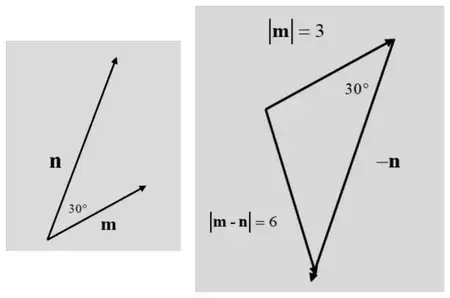
(ii) Two different vectors, \(\mathbf{m}\) and \(\mathbf{n}\), are such that \(|\mathbf{m}| = 3\) and \(|\mathbf{m} - \mathbf{n}| = 6\)
The angle between vector \(\mathbf{m}\) and vector \(\mathbf{n}\) is \(30^\circ\)

Find the angle between vector \(\mathbf{m}\) and vector \(\mathbf{m} - \mathbf{n}\), giving your answer, in degrees, to one decimal place. (4)

June 2018 Paper 1 Q3

EdexcelCurrent spec4 marksVectors

3. Given that the point \(A\) has position vector \(4\mathbf{i} - 5\mathbf{j}\) and the point \(B\) has position vector \(-5\mathbf{i} - 2\mathbf{j}\),

(a) find the vector \(\overrightarrow{AB}\), (2)
(b) find \(\left|\overrightarrow{AB}\right|\).
Give your answer as a simplified surd. (2)

June 2025 Paper 1 Q7

OCR ACurrent spec7 marksVectors

7 In this question you must show detailed reasoning.

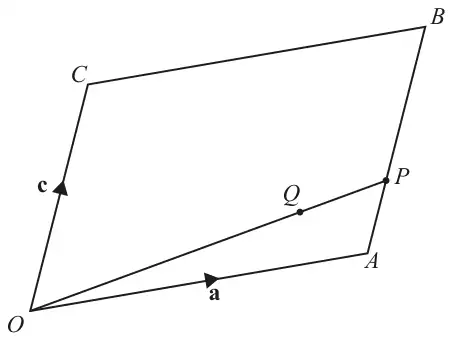
Parallelogram OABC with vector a along OA and vector c along OC; P is a point on AB, and Q is a point on the line OP

The diagram shows a parallelogram \(OABC\). The position vectors of \(A\) and \(C\) are \(\mathbf{a}\) and \(\mathbf{c}\) respectively.

  • The point \(P\) lies on \(AB\) such that \(AP = \tfrac{1}{3}AB\).
  • The point \(Q\) lies on \(OP\) such that \(OQ = \tfrac{3}{4}OP\).
(a) Show that \(\overrightarrow{OQ} = \tfrac{3}{4}\mathbf{a} + \tfrac{1}{4}\mathbf{c}\). [4]
(b) Hence show that \(Q\) lies on \(AC\). [3]

June 2024 Paper 1 Q2

OCR ACurrent spec6 marksVectors

2 Points \(A\) and \(B\) have position vectors \(\overrightarrow{OA} = 2\mathbf{i} + 3\mathbf{j}\) and \(\overrightarrow{OB} = -\mathbf{i} + 5\mathbf{j}\), respectively, where \(O\) is the origin.

(a) Find the position vector of the midpoint of \(AB\). [1]
(b) Find the exact magnitude of the vector \(\overrightarrow{AB}\). [3]
(c) Find the angle between the vector \(\overrightarrow{OA}\) and the positive \(x\)-axis. [2]

June 2023 Paper 1 Q2

OCR ACurrent spec8 marksVectors

2

(a) The points \(A\), \(B\) and \(C\) have position vectors \(\begin{pmatrix}-4\\3\end{pmatrix}\), \(\begin{pmatrix}-3\\6\end{pmatrix}\) and \(\begin{pmatrix}-1\\12\end{pmatrix}\) respectively.
(i) Show that \(B\) lies on \(AC\). [2]
(ii) Find the ratio \(AB : BC\). [1]
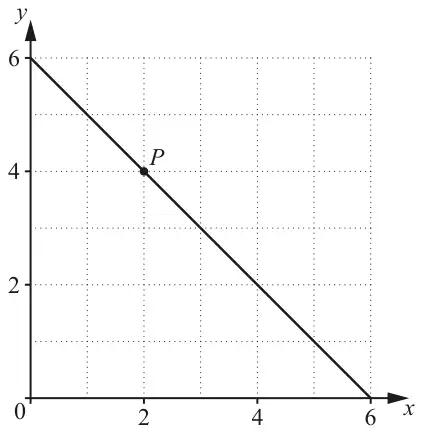
(b) The diagram shows the line \(x + y = 6\) and the point \(P(2, 4)\) that lies on the line.

A copy of the diagram is given in the Printed Answer Booklet.

Grid from 0 to 6 on both axes showing the line x + y = 6 from (0, 6) to (6, 0), with the point P(2, 4) marked on it

The distinct point \(Q\) also lies on the line \(x + y = 6\) and is such that \(\left|\overrightarrow{OQ}\right| = \left|\overrightarrow{OP}\right|\), where \(O\) is the origin.

Find the magnitude and direction of the vector \(\overrightarrow{PQ}\). [3]

(c) The point \(R\) is such that \(\overrightarrow{PR}\) is perpendicular to \(\overrightarrow{OP}\) and \(\left|\overrightarrow{PR}\right| = \tfrac{1}{2}\left|\overrightarrow{OP}\right|\).

Write down the position vectors of the two possible positions of the point \(R\). [2]

June 2022 Paper 2 Q7

OCR ACurrent spec9 marksTrigonometryVectors

7

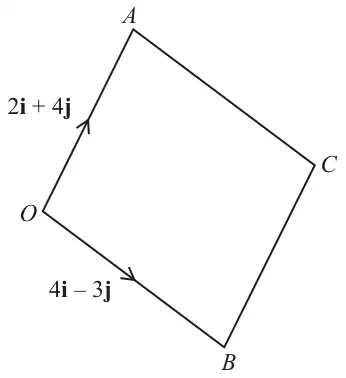
Parallelogram OACB with OA labelled 2i + 4j and OB labelled 4i - 3j, arrows from O

The diagram shows the parallelogram \(OACB\) where \(\overrightarrow{OA} = 2\mathbf{i} + 4\mathbf{j}\) and \(\overrightarrow{OB} = 4\mathbf{i} - 3\mathbf{j}\).

(a) Show that \(\cos AOB = -\dfrac{2\sqrt{5}}{25}\). [5]
(b) Hence find the exact value of \(\sin AOB\). [2]
(c) Determine the area of \(OACB\). [2]

October 2021 Paper 1 Q4

OCR ACurrent spec7 marksVectors

4

(a) Simplify \(2\begin{pmatrix} 6 \\ -3 \end{pmatrix} - 3\begin{pmatrix} -1 \\ 2 \end{pmatrix}\). [2]
(b) The vector \(\mathbf{a}\) is defined by \(\mathbf{a} = r\begin{pmatrix} 6 \\ -3 \end{pmatrix} + s\begin{pmatrix} -1 \\ 2 \end{pmatrix}\), where \(r\) and \(s\) are constants.

Determine two pairs of values of \(r\) and \(s\) such that \(\mathbf{a}\) is parallel to the \(y\)-axis and \(|\mathbf{a}| = 3\). [5]

October 2020 Paper 1 Q2

OCR ACurrent spec5 marksVectors

2 Points \(A\) and \(B\) have position vectors \(\begin{pmatrix} -3 \\ 4 \end{pmatrix}\) and \(\begin{pmatrix} 1 \\ 2 \end{pmatrix}\) respectively.

Point \(C\) has position vector \(\begin{pmatrix} p \\ 1 \end{pmatrix}\) and \(ABC\) is a straight line.

(a) Find \(p\). [2]

Point \(D\) has position vector \(\begin{pmatrix} q \\ 1 \end{pmatrix}\) and angle \(ABD = 90^\circ\).

(b) Determine the value of \(q\). [3]

June 2019 Paper 2 Q5

OCR ACurrent spec6 marksVectors

5 Points \(A\), \(B\), \(C\) and \(D\) have position vectors \(\mathbf{a} = \begin{pmatrix} 1 \\ 2 \end{pmatrix}\), \(\mathbf{b} = \begin{pmatrix} 3 \\ 5 \end{pmatrix}\), \(\mathbf{c} = \begin{pmatrix} 7 \\ 4 \end{pmatrix}\) and \(\mathbf{d} = \begin{pmatrix} 4 \\ k \end{pmatrix}\).

(a) Find the value of \(k\) for which \(D\) is the midpoint of \(AC\). [1]
(b) Find the two values of \(k\) for which \(\left|\overrightarrow{AD}\right| = \sqrt{13}\). [3]
(c) Find one value of \(k\) for which the four points form a trapezium. [2]

June 2018 Paper 1 Q7

OCR ACurrent spec7 marksVectors

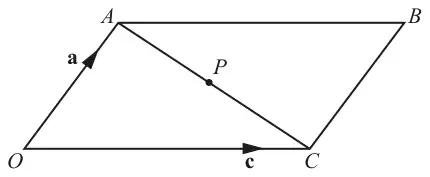
7 \(OABC\) is a parallelogram with \(\overrightarrow{OA} = \mathbf{a}\) and \(\overrightarrow{OC} = \mathbf{c}\). \(P\) is the midpoint of \(AC\).

Parallelogram OABC with OA = a and OC = c marked by arrows, diagonal AC drawn and its midpoint P marked
(i) Find the following in terms of \(\mathbf{a}\) and \(\mathbf{c}\), simplifying your answers.
(a) \(\overrightarrow{AC}\) [1]
(b) \(\overrightarrow{OP}\) [2]
(ii) Hence prove that the diagonals of a parallelogram bisect one another. [4]

June 2025 Paper 1 Q7

OCR MEICurrent spec5 marksVectors

7 The point A has position vector \(\begin{pmatrix}-2\\1\end{pmatrix}\). The vector \(\overrightarrow{\text{AB}}\) is \(\begin{pmatrix}8\\6\end{pmatrix}\).

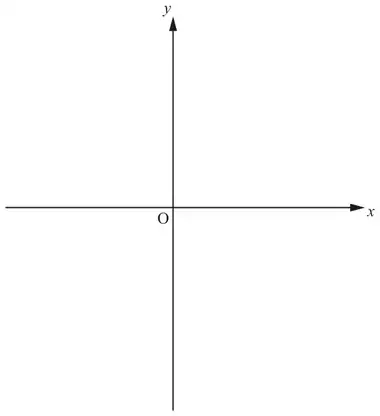
(a) On the axes in your Printed Answer Book, draw the position of the points A and B. [2]
Blank axes from the Printed Answer Booklet: x-axis and y-axis crossing at the origin O, with no scale
Axes printed in the Printed Answer Booklet
(b) Calculate the distance AB. [1]
(c) Show that the midpoint of AB lies on the line \(y = 2x\). [2]

June 2023 Paper 1 Q3

OCR MEICurrent spec4 marksVectors

3 The points A and B have position vectors \(\begin{pmatrix} 2 \\ -1 \end{pmatrix}\) and \(\begin{pmatrix} 5 \\ 4 \end{pmatrix}\) respectively. The vector \(\overrightarrow{\text{AC}}\) is \(\begin{pmatrix} -2 \\ 2 \end{pmatrix}\).

(a) Write down the position vector of C as a column vector. [1]
(b) Show that B is equidistant from A and C. [3]

June 2022 Paper 2 Q4

OCR MEICurrent spec4 marksVectors

4 The position vector of \(P\) is \(\mathbf{p} = \begin{pmatrix} 4 \\ 3 \end{pmatrix}\) and the position vector of \(Q\) is \(\mathbf{q} = \begin{pmatrix} 28 \\ 10 \end{pmatrix}\).

(a) Determine the magnitude of \(\overrightarrow{PQ}\). [2]
(b) Determine the angle between \(\overrightarrow{PQ}\) and the positive \(x\)-direction. [2]

October 2021 Paper 2 Q8

OCR MEICurrent spec4 marksVectors

8 With respect to an origin O, the position vectors of the points A and B are

\(\overrightarrow{\mathrm{OA}} = \begin{pmatrix} -3 \\ 20 \end{pmatrix}\) and \(\overrightarrow{\mathrm{OB}} = \begin{pmatrix} 6 \\ 8 \end{pmatrix}\).

(a) Determine whether \(\left|\overrightarrow{\mathrm{AB}}\right| > 200\). [2]

The point C is such that \(\overrightarrow{\mathrm{AC}} = \begin{pmatrix} 18 \\ -24 \end{pmatrix}\).

(b) Determine whether A, B and C are collinear. [2]

October 2020 Paper 1 Q3

OCR MEICurrent spec5 marksVectors

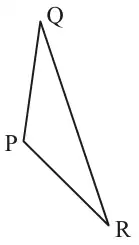
3 Fig. 3 shows a triangle PQR. The vector \(\overrightarrow{\text{PQ}}\) is \(\mathbf{i} + 7\mathbf{j}\) and the vector \(\overrightarrow{\text{QR}}\) is \(4\mathbf{i} - 12\mathbf{j}\).

Triangle PQR with Q at the top, P to the lower left and R at the bottom right
Fig. 3
(a) Show that the triangle PQR is isosceles. [3]

The point P has position vector \(-3\mathbf{i} - \mathbf{j}\). The point S is added so that PQRS is a parallelogram.

(b) Find the position vector of S. [2]

June 2025 Unit 1 Q14

WJECCurrent spec4 marksVectors

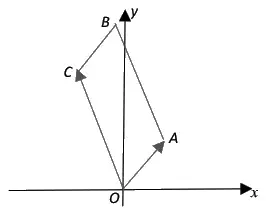
14. The position vectors of the points \(A\) and \(C\), relative to a fixed origin \(O\), are given by \(\mathbf{a}=(3\mathbf{i}+4\mathbf{j})\) and \(\mathbf{c}=(-5\mathbf{i}+12\mathbf{j})\) respectively. The point \(B\) is such that \(OABC\) is a parallelogram. Find the position vector of \(B\) and hence calculate the length of \(OB\). [4]

June 2024 Unit 1 Q13

WJECCurrent spec8 marksVectors

13. The position vectors of the points A and B, relative to a fixed origin O, are given by

\[\mathbf{a}=4\mathbf{i}+7\mathbf{j},\qquad\qquad\mathbf{b}=\mathbf{i}+3\mathbf{j},\]

respectively.

(a) Find the vector AB. [2]
(b) Determine the distance between the points A and B. [2]
(c) The position vector of the point C is given by \(\mathbf{c}=-2\mathbf{i}+5\mathbf{j}\). The point D is such that the distance between C and D is equal to the distance between A and B, and CD is parallel to AB. Find the possible position vectors of the point D. [4]

June 2023 Unit 1 Q12

WJECCurrent spec8 marksVectors

12. The position vectors of the points \(A\) and \(B\), relative to a fixed origin \(O\), are given by

\[\mathbf{a}=-3\mathbf{i}+4\mathbf{j},\quad \mathbf{b}=5\mathbf{i}+8\mathbf{j},\]

respectively.

(a) Find the vector \(\mathbf{AB}\). [2]
(b)
(i) Find a unit vector in the direction of \(\mathbf{a}\). [2]
(ii) The point \(C\) is such that the vector \(\mathbf{OC}\) is in the direction of \(\mathbf{a}\).
Given that the length of \(\mathbf{OC}\) is 7 units, write down the position vector of \(C\). [1]
(c) Calculate the angle \(AOB\). [3]

June 2022 Unit 1 Q16

WJECCurrent spec9 marksVectors

16. The vectors \(\mathbf{a}\) and \(\mathbf{b}\) are defined by \(\mathbf{a}=2\mathbf{i}-\mathbf{j}\) and \(\mathbf{b}=\mathbf{i}-3\mathbf{j}\).

(a) Find a unit vector in the direction of \(\mathbf{a}\). [2]
(b) Determine the angle \(\mathbf{b}\) makes with the \(x\)-axis. [2]
(c) The vector \(\mu\mathbf{a}+\mathbf{b}\) is parallel to \(4\mathbf{i}-5\mathbf{j}\).
(i) Find the vector \(\mu\mathbf{a}+\mathbf{b}\) in terms of \(\mu\), \(\mathbf{i}\) and \(\mathbf{j}\). [1]
(ii) Determine the value of \(\mu\). [4]

June 2019 Unit 1 Q6

WJECCurrent spec5 marksVectors

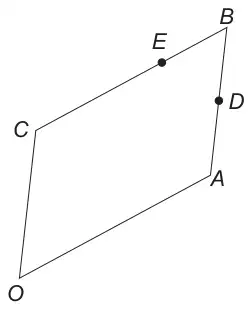
6. \(OABC\) is a parallelogram with \(O\) as origin.

Parallelogram OABC with D on AB and E on CB

The position vector of \(A\) is \(\mathbf{a}\) and the position vector of \(C\) is \(\mathbf{c}\). The midpoint of \(AB\) is \(D\). The point \(E\) divides the line \(CB\) such that \(CE:EB=2:1\).

(a) Find, in terms of \(\mathbf{a}\) and \(\mathbf{c}\),
(i) the vector \(\mathbf{AC}\),
(ii) the position vector of \(D\),
(iii) the position vector of \(E\). [3]
(b) Determine whether or not \(DE\) is parallel to \(AC\), clearly stating your reason. [2]

June 2018 Unit 1 Q11

WJECCurrent spec6 marksVectors

11.

(a) The vectors \(\mathbf{u}\) and \(\mathbf{v}\) are defined by \(\mathbf{u}=9\mathbf{i}-40\mathbf{j}\) and \(\mathbf{v}=3\mathbf{i}-4\mathbf{j}\). Determine the range of values for \(\mu\) such that \(\mu|\mathbf{v}|>|\mathbf{u}|\). [3]
(b) The point A has position vector \(11\mathbf{i}-4\mathbf{j}\) and the point B has position vector \(21\mathbf{i}+\mathbf{j}\). Determine the position vector of the point C, which lies between A and B, such that AC : CB is 2 : 3. [3]