Variable Acceleration (Calculus)

Edexcel

AQA

OCR A

OCR MEI

June 2025 Paper 3 Mechanics Q4

EdexcelCurrent spec9 marksVariable Acceleration (Calculus)Vectors

4. [In this question, position vectors are given relative to a fixed origin \(O\).]

At time \(t\) seconds, where \(t \gt 0\), the position vector of a particle \(P\) is \(\mathbf{r}\) metres where

\[\mathbf{r} = 4t^{\frac{3}{2}}\mathbf{i} - t^2\mathbf{j}\]
(a) Find the position vector of \(P\) at \(t = 4\) (1)
(b) Find the exact distance of \(P\) from \(O\) at \(t = 4\) (2)
(c) Find an expression for the velocity of \(P\) at time \(t\) seconds, where \(t \gt 0\), giving your answer in terms of \(t\), \(\mathbf{i}\) and \(\mathbf{j}\) (2)

At \(t = T\), the acceleration of \(P\) is in a direction that is perpendicular to the line with equation \(y = \dfrac{1}{3}x\)

(d) Find the value of \(T\). (4)

June 2024 Paper 3 Mechanics Q4

EdexcelCurrent spec11 marksVariable Acceleration (Calculus)Vectors

4.

In this question you must show all stages of your working.

Solutions relying entirely on calculator technology are not acceptable.

[In this question, \(\mathbf{i}\) is a unit vector due east and \(\mathbf{j}\) is a unit vector due north. Position vectors are given relative to a fixed origin \(O\).]

At time \(t\) seconds, \(t \geqslant 1\), the position vector of a particle \(P\) is \(\mathbf{r}\) metres, where

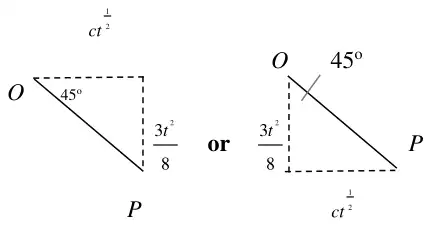
\[\mathbf{r} = ct^{\frac{1}{2}}\mathbf{i} - \frac{3}{8}t^2\mathbf{j}\]

and \(c\) is a constant.

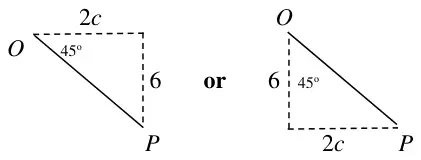
When \(t = 4\), the bearing of \(P\) from \(O\) is \(135^\circ\)

(a) Show that \(c = 3\) (3)
(b) Find the speed of \(P\) when \(t = 4\) (4)

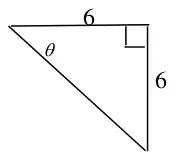
When \(t = T\), \(P\) is accelerating in the direction of \((-\mathbf{i} - 27\mathbf{j})\).

(c) Find the value of \(T\). (4)

June 2023 Paper 3 Mechanics Q3

EdexcelCurrent spec9 marksVariable Acceleration (Calculus)Vectors

3. At time \(t\) seconds, where \(t \geqslant 0\), a particle \(P\) has velocity \(\mathbf{v}\ \text{m s}^{-1}\) where

\[\mathbf{v} = (t^2 - 3t + 7)\mathbf{i} + (2t^2 - 3)\mathbf{j}\]

Find

(a) the speed of \(P\) at time \(t = 0\) (3)
(b) the value of \(t\) when \(P\) is moving parallel to \((\mathbf{i} + \mathbf{j})\) (2)
(c) the acceleration of \(P\) at time \(t\) seconds (2)
(d) the value of \(t\) when the direction of the acceleration of \(P\) is perpendicular to \(\mathbf{i}\) (2)

June 2022 Paper 3 Mechanics Q1

EdexcelCurrent spec8 marksVariable Acceleration (Calculus)Vectors

1. [In this question, position vectors are given relative to a fixed origin.]

At time \(t\) seconds, where \(t > 0\), a particle \(P\) has velocity \(\mathbf{v}\ \text{m s}^{-1}\) where

\[\mathbf{v} = 3t^2\mathbf{i} - 6t^{\frac{1}{2}}\mathbf{j}\]
(a) Find the speed of \(P\) at time \(t = 2\) seconds. (2)
(b) Find an expression, in terms of \(t\), \(\mathbf{i}\) and \(\mathbf{j}\), for the acceleration of \(P\) at time \(t\) seconds, where \(t > 0\) (2)

At time \(t = 4\) seconds, the position vector of \(P\) is \((\mathbf{i} - 4\mathbf{j})\) m.

(c) Find the position vector of \(P\) at time \(t = 1\) second. (4)

October 2021 Paper 3 Mechanics Q5

EdexcelCurrent spec14 marksVariable Acceleration (Calculus)Vectors

5. At time \(t\) seconds, a particle \(P\) has velocity \(\mathbf{v}\ \text{m s}^{-1}\), where

\[\mathbf{v} = 3t^{\frac{1}{2}}\,\mathbf{i} - 2t\,\mathbf{j} \qquad t \gt 0\]
(a) Find the acceleration of \(P\) at time \(t\) seconds, where \(t \gt 0\) (2)
(b) Find the value of \(t\) at the instant when \(P\) is moving in the direction of \(\mathbf{i} - \mathbf{j}\) (3)

At time \(t\) seconds, where \(t \gt 0\), the position vector of \(P\), relative to a fixed origin \(O\), is \(\mathbf{r}\) metres.

When \(t = 1\), \(\mathbf{r} = -\mathbf{j}\)

(c) Find an expression for \(\mathbf{r}\) in terms of \(t\). (3)
(d) Find the exact distance of \(P\) from \(O\) at the instant when \(P\) is moving with speed \(10\ \text{m s}^{-1}\) (6)

October 2020 Paper 3 Mechanics Q3

EdexcelCurrent spec12 marksVariable Acceleration (Calculus)Vectors

3.

(i) At time \(t\) seconds, where \(t \geqslant 0\), a particle \(P\) moves so that its acceleration \(\mathbf{a}\ \text{m s}^{-2}\) is given by\[\mathbf{a} = (1 - 4t)\,\mathbf{i} + (3 - t^2)\,\mathbf{j}\]At the instant when \(t = 0\), the velocity of \(P\) is \(36\mathbf{i}\ \text{m s}^{-1}\)
(a) Find the velocity of \(P\) when \(t = 4\) (3)
(b) Find the value of \(t\) at the instant when \(P\) is moving in a direction perpendicular to \(\mathbf{i}\) (3)
(ii) At time \(t\) seconds, where \(t \geqslant 0\), a particle \(Q\) moves so that its position vector \(\mathbf{r}\) metres, relative to a fixed origin \(O\), is given by\[\mathbf{r} = (t^2 - t)\,\mathbf{i} + 3t\,\mathbf{j}\]Find the value of \(t\) at the instant when the speed of \(Q\) is \(5\ \text{m s}^{-1}\) (6)

June 2019 Paper 3 Mechanics Q1

EdexcelCurrent spec6 marksVariable Acceleration (Calculus)Vectors

1. [In this question position vectors are given relative to a fixed origin \(O\)]

At time \(t\) seconds, where \(t \geqslant 0\), a particle, \(P\), moves so that its velocity \(\mathbf{v}\ \text{m s}^{-1}\) is given by

\[\mathbf{v} = 6t\mathbf{i} - 5t^{\frac{3}{2}}\mathbf{j}\]

When \(t = 0\), the position vector of \(P\) is \((-20\mathbf{i} + 20\mathbf{j})\) m.

(a) Find the acceleration of \(P\) when \(t = 4\) (3)
(b) Find the position vector of \(P\) when \(t = 4\) (3)

June 2025 Paper 2 Q19

19 The displacement, \(\mathbf{s}\) metres, of a particle \(P\), at time \(t\) seconds, is given by

\[\mathbf{s} = (2t^3)\,\mathbf{i} + (2t^2 + qt)\,\mathbf{j}\]
(a) Find an expression for the velocity of particle \(P\) after \(t\) seconds. [2 marks]
(b) The acceleration, \(\mathbf{a}\ \text{m s}^{-2}\), of a particle \(Q\), at time \(t\) seconds, is given by\[\mathbf{a} = 6t\,\mathbf{i} + 7\mathbf{j}\]

Particle \(Q\) has an initial velocity of \(4\mathbf{j}\ \text{m s}^{-1}\)

Particles \(P\) and \(Q\) are moving parallel to each other when \(t = 2\)

Find the value of \(q\)

[6 marks]

June 2024 Paper 2 Q18

AQACurrent spec7 marksVariable Acceleration (Calculus)

18 A particle is moving in a straight line through the origin \(O\)

The displacement of the particle, \(r\) metres, from \(O\), at time \(t\) seconds is given by

\[r = p + 2t - q\mathrm{e}^{-0.2t}\]

where \(p\) and \(q\) are constants.

When \(t = 3\), the acceleration of the particle is \(-1.8\) m s−2

(a) Show that \(q \approx 82\) [5 marks]
(b) The particle has an initial displacement of 5 metres.

Find the value of \(p\)

Give your answer to two significant figures. [2 marks]

June 2024 Paper 2 Q14

AQACurrent spec3 marksVariable Acceleration (Calculus)

14 The displacement, \(r\) metres, of a particle at time \(t\) seconds is

\[r = 6t - 2t^2\]
(a) Find the value of \(r\) when \(t = 4\) [1 mark]
(b) Determine the range of values of \(t\) for which the displacement is positive. [2 marks]

June 2023 Paper 2 Q14

AQACurrent spec4 marksVariable Acceleration (Calculus)

14 A car has an initial velocity of 1 m s−1

The car is moving in a straight line.

The acceleration \(a\) m s−2 of the car at time \(t\) seconds is given by

\[a = 3kt^2 - 2kt + 1\]

where \(k\) is a constant.

When \(t = 3\) the car has a velocity of 10 m s−1

Show that \(k = \dfrac{1}{3}\) [4 marks]

June 2022 Paper 2 Q17

17 A particle is moving such that its position vector, \(\mathbf{r}\) metres, at time \(t\) seconds, is given by

\[\mathbf{r} = \mathrm{e}^t\cos t\,\mathbf{i} + \mathrm{e}^t\sin t\,\mathbf{j}\]

Show that the magnitude of the acceleration of the particle, \(a\) m s−2, is given by

\[a = 2\mathrm{e}^t\]

Fully justify your answer. [7 marks]

June 2025 Paper 3 Q9

OCR ACurrent spec6 marksVariable Acceleration (Calculus)

9

In this question you must show detailed reasoning.

A particle moves in a straight line. Its velocity \(t\) seconds after leaving a fixed point on the line is \(v\) m s−1 where \(v = 2 + 3t + 0.6t^2\).

Find the distance travelled by the particle from time \(t = 0\) until the instant when its acceleration is 15 m s−2. [6]

June 2024 Paper 3 Q12

OCR ACurrent spec10 marksVariable Acceleration (Calculus)

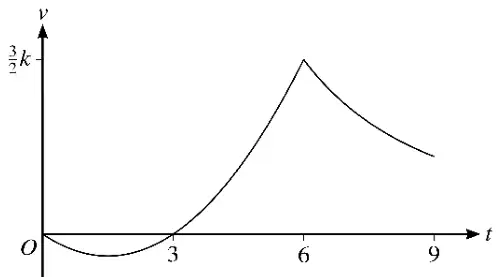
12 A particle \(P\) moves in a straight line. The velocity \(v\,\mathrm{m\,s^{-1}}\) of \(P\) at time \(t\) seconds is given by

\(v = \frac{1}{12}kt(t - 3)\)     for \(0 \leqslant t \leqslant 6\),

\(v = \dfrac{54k}{t^2}\)     for \(6 \leqslant t \leqslant 9\),

where \(k\) is a positive constant.

(a) Sketch, on the axes in the Printed Answer Booklet, the velocity-time graph for \(P\) for values of \(t\) from 0 to 9. [3]
(b) State the value of \(t\) in the interval \(0 \leqslant t \leqslant 9\) when the acceleration of \(P\) is zero. [1]
(c) In this question you must show detailed reasoning.
You are given that the total distance travelled by \(P\) in the interval \(0 \leqslant t \leqslant 9\) is 84 m.
Find the value of \(k\). [6]

June 2023 Paper 3 Q12

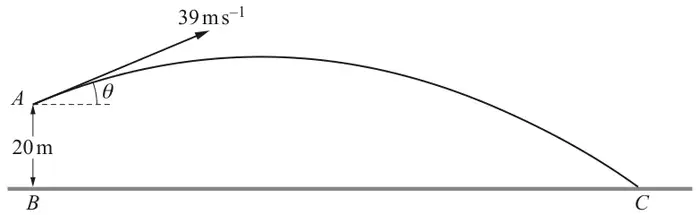
12 In this question you should take the acceleration due to gravity to be \(10\,\mathrm{m\,s^{-2}}\).

A ball is projected from point A, 20 m vertically above point B on horizontal ground, with speed 39 m s^-1 at angle theta above the horizontal; its path curves up and then down to land at point C on the ground

A small ball \(P\) is projected from a point \(A\) with speed \(39\,\mathrm{m\,s^{-1}}\) at an angle of elevation \(\theta\), where \(\sin\theta = \frac{5}{13}\) and \(\cos\theta = \frac{12}{13}\). Point \(A\) is \(20\,\mathrm{m}\) vertically above a point \(B\) on horizontal ground. The ball first lands at a point \(C\) on the horizontal ground (see diagram).

The ball \(P\) is modelled as a particle moving freely under gravity.

(a) Find the maximum height of \(P\) above the ground during its motion. [3]

The time taken for \(P\) to travel from \(A\) to \(C\) is \(T\) seconds.

(b) Determine the value of \(T\). [3]
(c) State one limitation of the model, other than air resistance or the wind, that could affect the answer to part (b). [1]

At the instant that \(P\) is projected, a second small ball \(Q\) is released from rest at \(B\) and moves towards \(C\) along the horizontal ground.

At time \(t\) seconds, where \(t \geqslant 0\), the velocity \(v\,\mathrm{m\,s^{-1}}\) of \(Q\) is given by

\(v = kt^3 + 6t^2 + \frac{3}{2}t,\)

where \(k\) is a positive constant.

(d) Given that \(P\) and \(Q\) collide at \(C\), determine the acceleration of \(Q\) immediately before this collision. [6]

June 2022 Paper 3 Q12

12 In this question the unit vectors \(\mathbf{i}\) and \(\mathbf{j}\) are in the directions east and north respectively.

A particle \(P\) is moving on a smooth horizontal surface under the action of a single force \(\mathbf{F}\) N. At time \(t\) seconds, where \(t \geqslant 0\), the velocity \(\mathbf{v}\,\mathrm{m\,s^{-1}}\) of \(P\), relative to a fixed origin \(O\), is given by

\(\mathbf{v} = (1 - 2t)\mathbf{i} + (2t^2 + t - 13)\mathbf{j}\).

(a) Show that \(P\) is never stationary. [2]
(b) Find, in terms of \(\mathbf{i}\) and \(\mathbf{j}\), the acceleration of \(P\) at time \(t\). [1]

The mass of \(P\) is 0.5 kg.

(c) Determine the magnitude of \(\mathbf{F}\) when \(P\) is moving in the direction of the vector \(-2\mathbf{i} + \mathbf{j}\). Give your answer correct to 3 significant figures. [5]

When \(t = 1\), \(P\) is at the point with position vector \(\frac{1}{6}\mathbf{j}\).

(d) Determine the bearing of \(P\) from \(O\) at time \(t = 1.5\). [5]

October 2021 Paper 3 Q13

13 In this question the unit vectors \(\mathbf{i}\) and \(\mathbf{j}\) are in the directions east and north respectively.

At time \(t\) seconds, where \(t \geqslant 0\), a particle \(P\) of mass \(2\,\mathrm{kg}\) is moving on a smooth horizontal surface under the action of a constant horizontal force \((-8\mathbf{i} - 54\mathbf{j})\,\mathrm{N}\) and a variable horizontal force \(\left(4t\mathbf{i} + 6(2t - 1)^2\mathbf{j}\right)\mathrm{N}\).

(a) Determine the value of \(t\) when the forces acting on \(P\) are in equilibrium. [2]

It is given that \(P\) is at rest when \(t = 0\).

(b) Determine the speed of \(P\) at the instant when \(P\) is moving due north. [6]
(c) Determine the distance between the positions of \(P\) when \(t = 0\) and \(t = 3\). [5]

June 2025 Paper 1 Q13

OCR MEICurrent spec9 marksVariable Acceleration (Calculus)Vectors

13 The displacement \(\mathbf{r}\) m of a parachutist \(t\) s after opening their parachute is modelled by

\[\mathbf{r} = \begin{pmatrix} 50t \\ 280 + 5t - 280\mathrm{e}^{-0.16t} \end{pmatrix}\]

where the \(x\)-direction is horizontal and the \(y\)-direction is vertically downwards.

(a) Calculate the distance from the parachutist’s initial position that the model predicts after 10 s. [3]
(b) Find a vector expression for the velocity of the parachutist according to the model. [3]
(c) Determine what velocity the model predicts for large values of \(t\). [2]
(d) Parachutists usually land travelling approximately vertically.

Explain a factor that should be included in the model to better reflect this. [1]

June 2024 Paper 1 Q12

OCR MEICurrent spec6 marksVariable Acceleration (Calculus)Vectors

12 In this question the unit vectors \(\mathbf{i}\) and \(\mathbf{j}\) are in the \(x\)- and \(y\)-directions respectively.

The velocity \(\mathbf{v}\ \text{m s}^{-1}\) of a particle is given by \(\mathbf{v} = 3\mathbf{i} + (6t^2 - 5)\mathbf{j}\). The initial position of the particle is \(7\mathbf{j}\) m.

(a) Find an expression for the position vector of the particle at time \(t\) s. [4]
(b) Find the Cartesian equation of the path of the particle. [2]

June 2022 Paper 1 Q9

OCR MEICurrent spec8 marksVariable Acceleration (Calculus)Vectors

9 In this question, the vectors \(\mathbf{i}\) and \(\mathbf{j}\) are directed east and north respectively.

The velocity \(\mathbf{v}\ \mathrm{m\,s^{-1}}\) of a particle at time \(t\) s is given by \(\mathbf{v} = kt^2\mathbf{i} + 6t\mathbf{j}\), where \(k\) is a positive constant. The magnitude of the acceleration when \(t = 2\) is \(10\ \mathrm{m\,s^{-2}}\).

(a) Calculate the value of \(k\). [4]

The particle is at the origin when \(t = 0\).

(b) Determine an expression for the position vector of the particle at time \(t\). [2]
(c) Determine the time when the particle is directly north-east of the origin. [2]

October 2021 Paper 1 Q13

OCR MEICurrent spec13 marksVariable Acceleration (Calculus)Vectors

13 In this question \(\mathbf{i}\) and \(\mathbf{j}\) are unit vectors in the \(x\)- and \(y\)-directions respectively.

The velocity of a particle at time \(t\) s is given by \((3t^2\mathbf{i} + 7\mathbf{j})\,\text{m}\,\text{s}^{-1}\). At time \(t = 0\) the position of the particle with respect to the origin is \((-\mathbf{i} + 2\mathbf{j})\) m.

(a) Determine the distance of the particle from the origin when \(t = 2\). [6]
(b) Show that the cartesian equation of the path of the particle is \(x = \left(\dfrac{y-2}{7}\right)^3 - 1\). [3]
(c) At time \(t = 2\), the magnitude of the resultant force acting on the particle is 48 N.

Find the mass of the particle. [4]

October 2020 Paper 1 Q9

OCR MEICurrent spec6 marksVariable Acceleration (Calculus)

9 A particle is moving in a straight line. The acceleration \(a\,\mathrm{m\,s^{-2}}\) of the particle at time \(t\) s is given by \(a = 0.8t + 0.5\). The initial velocity of the particle is \(3\,\mathrm{m\,s^{-1}}\) in the positive \(x\)-direction.

Determine whether the particle is ever stationary. [6]