June 2025 Paper 3 Mechanics Q5
5.
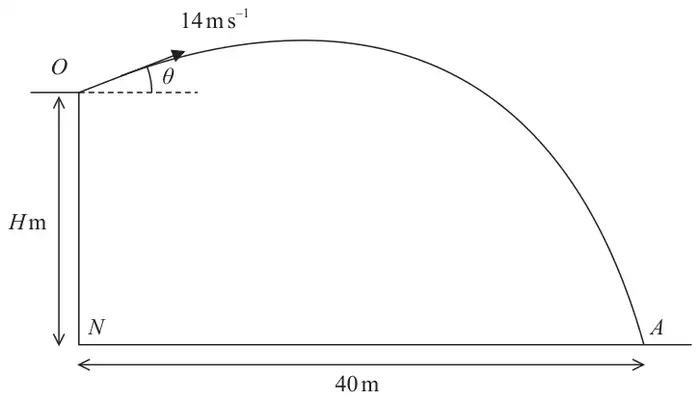
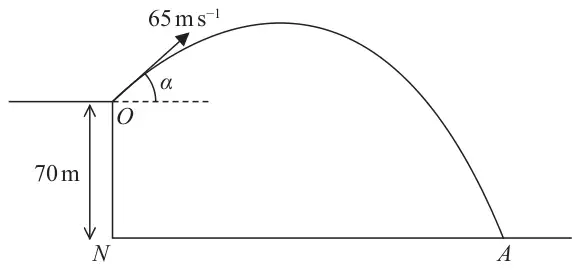
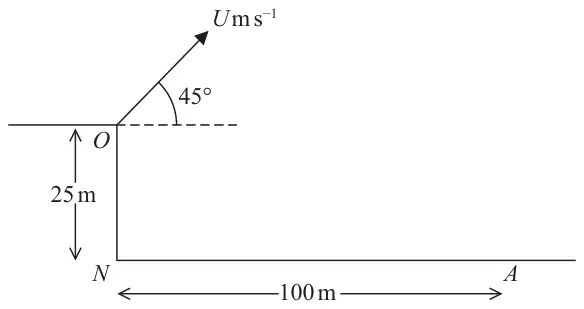
A small stone is projected with speed \(14\ \text{m s}^{-1}\) from a point \(O\) on the top of a cliff.
The point \(O\) is \(H\) metres vertically above the point \(N\).
Point \(N\) is on horizontal ground.
The stone is projected at an angle \(\theta\) above the horizontal, where \(\tan\theta = \dfrac{1}{2}\)
The stone strikes the horizontal ground at the point \(A\), where \(NA = 40\) m, as shown in Figure 3.
The stone is modelled as a particle moving freely under gravity.
Using this model, find
| Scheme | Marks | AO |
|---|---|---|
| Using horizontal motion | M1 | 3.3 |
| \(14\cos\theta \times t = 40\) | A1 | 1.1b |
| Using vertical motion | M1 | 3.4 |
| \((s =)\, 14\sin\theta \times t - \dfrac{1}{2}gt^2\) oe with down as positive. | A1 | 1.1b |
| OR | ||
| Using the equation of the path | ||
| \((s =)\, 40\tan\theta - \dfrac{g \times 40^2}{2 \times 14^2\cos^2\theta}\) oe | M2 A2 | |
| \((H =)\ 30\) or 30.0 | A1 | 1.1b |
| (5) |
Notes
N.B. Penalise the use of \(g = 9.81\) once (the first time it is used) for the whole question.
All marks available if they use a different letter for \(\theta\)
M1: Complete method, using the horizontal motion, to give an equation in \(t\) and \(\theta\) only, condone sin/cos confusion and sign errors
(\(\theta\) may or may not be substituted for)
A1: Correct equation (\(t\) and/or \(\theta\) may or may not be substituted for)
M1: Complete method, using the vertical motion, to give an equation in \(t\) and \(\theta\) only, condone sin/cos confusion and sign errors
(\(t\) and/or \(\theta\) may or may not be substituted for)
A1: Correct equation (\(t\) and/or \(\theta\) may or may not be substituted for)
N.B. Just mark the RHS of the equation for this A mark.
OR
M2 A2: Quoting and using correctly the equation of the path.
N.B. No marks if they misquote the equation and no marks if they put in 14 and/or 40 incorrectly.
These 4 marks are indivisible i.e. all 4 or 0.
A1: \(H = 30\) or 30.0 to 2 or 3 sf, after use of \(g = 9.8\), obtained correctly.
| Scheme | Marks | AO |
|---|---|---|
| Using vertical motion OR Using cons. of energy | M1 | 2.1 |
| \(0^2 = (14\sin\theta)^2 - 2gh\) OR \(\dfrac{1}{2}m\left(14^2 - (14\cos\theta)^2\right) = mgh\) | A1 | 1.1b |
| 32 (m) | A1ft | 1.1b |
| (3) | ||
| (8 marks) |
Notes
N.B. Penalise the use of \(g = 9.81\) once (the first time it is used) for the whole question.
All marks available if they use a different letter for \(\theta\)
M1: Complete method to give equation in \(h\) and \(\theta\) only, condone sin/cos confusion and sign errors
They may find \(t\) first: \(0 = 14\sin\theta - gt \Rightarrow t = \dfrac{14\sin\theta}{g}\)
then \(h = (14\sin\theta)\dfrac{14\sin\theta}{g} - \dfrac{1}{2}g\left(\dfrac{14\sin\theta}{g}\right)^2\)
or \(h = -\dfrac{1}{2}(-g)\left(\dfrac{14\sin\theta}{g}\right)^2\)
or \(h = \dfrac{(14\sin\theta + 0)}{2}\left(\dfrac{14\sin\theta}{g}\right)\)
A1: Correct equation
A1ft: \(\lvert\text{their } H\rvert + 2\), to 2sf or 3sf