
June 2023 Paper 3 Mechanics Q5
5.
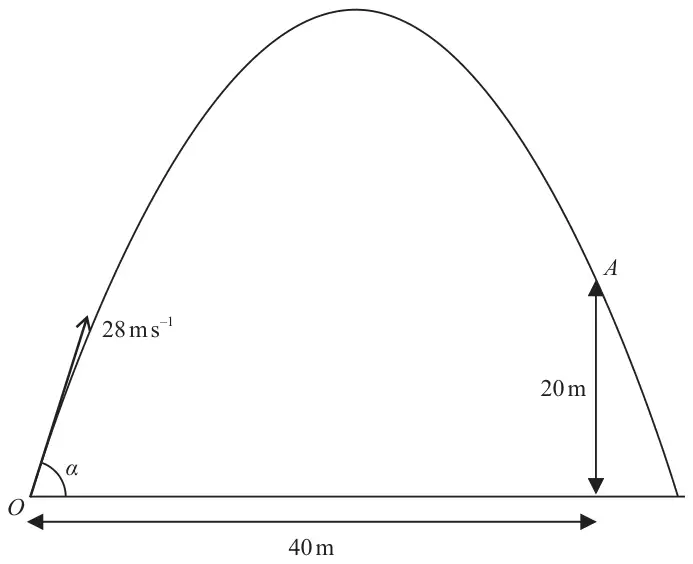
A small ball is projected with speed \(28\ \text{m s}^{-1}\) from a point \(O\) on horizontal ground.
After moving for \(T\) seconds, the ball passes through the point \(A\).
The point \(A\) is 40 m horizontally and 20 m vertically from the point \(O\), as shown in Figure 2.
The motion of the ball from \(O\) to \(A\) is modelled as that of a particle moving freely under gravity.
Given that the ball is projected at an angle \(\alpha\) to the ground, use the model to
The model does not include air resistance.
| Scheme | Marks | AO |
|---|---|---|
| Use horizontal motion to give an equation in \(T\) and \(\alpha\) only: \(28\cos\alpha \times T = 40\) | M1 | 3.4 |
| \(T = \dfrac{10}{7\cos\alpha}\) * | A1* | 1.1b |
| (2) |
Notes
N.B. In this question, allow misread of \(\alpha\) for \(a\).
M1: Correct no. of terms, dim correct, condone sin/cos confusion and sign errors
A1*: Correct printed answer correctly obtained.
Allow \(\dfrac{10}{7\cos\alpha} = T\) OR \(T = \dfrac{40}{28\cos\alpha} = \dfrac{10}{7\cos\alpha}\) OR \(\dfrac{40}{28\cos\alpha} = \dfrac{10}{7\cos\alpha} = T\)
OR \(t\) instead of \(T\)
| Scheme | Marks | AO |
|---|---|---|
| Use vertical motion to give an equation in \(T\) and \(\alpha\) only | M1 | 3.3 |
| \(20 = (28\sin\alpha)T - \dfrac{1}{2}gT^2\) | A1 | 1.1b |
| Eliminate \(T\) to give an unsimplified equation in \(\alpha\) only: \(20 = (28\sin\alpha) \times \dfrac{10}{7\cos\alpha} - \dfrac{1}{2}g\left(\dfrac{10}{7\cos\alpha}\right)^2\) | M1 | 1.1b |
| Use \(\sec^2\alpha = 1 + \tan^2\alpha\) oe to give an unsimplified equation in tan \(\alpha\) only: \(20 = 40\tan\alpha - \dfrac{1}{2}g \times \dfrac{100}{49}(1 + \tan^2\alpha)\) | M1 | 3.1b |
| \(\tan^2\alpha - 4\tan\alpha + 3 = 0\) * (allow \(0 = \tan^2\alpha - 4\tan\alpha + 3\)) | A1* | 2.2a |
| (5) |
Notes
N.B. In this question, allow misread of \(\alpha\) for \(a\).
M1: Correct no. of terms, dim correct, condone sin/cos confusion and sign errors
A1: Correct equation
M1: Eliminate \(T\), using either the given answer in (a) or their own \(T\) expression, from their equation to give an unsimplified equation in \(\alpha\) only
M1: Use \(\sec^2\alpha = 1 + \tan^2\alpha\) to produce an equation in \(\tan\alpha\) only
A1*: Given answer correctly obtained.
N.B. Must be \(\alpha\) (or \(a\)) in the final answer but allow a different angle in the working.
| Scheme | Marks | AO |
|---|---|---|
| Solve and use of \(\tan\alpha = 3\) or \(\sin\alpha = \dfrac{3}{\sqrt{10}}\) or \(\alpha = 71.565..^\circ\) to find an equation in \(H\) only. | M1 | 3.1b |
| \(0 = (28\sin\alpha)^2 - 2gH\) where \(\tan\alpha = 3\) \((\alpha = 71.565..^\circ)\) | M1 | 3.4 |
| \(H = 36\) or 36.0 (m) | A1 | 1.1b |
| (3) |
Notes
N.B. In this question, allow misread of \(\alpha\) for \(a\).
M1: Solve given equation and select larger value of \(\tan\alpha\) and use it to try to obtain an equation in \(H\) only.
M1: Complete method to give an equation in H only, using larger value of \(\alpha\), correct no. of terms, dim correct, condone sin/cos confusion and sign errors.
A1: cao. Must be positive, (allow a negative value, changed to a positive answer).
N.B. This answer comes from use of \(g = 9.8\), so must be rounded to 2 or 3 sf.
| Scheme | Marks | AO |
|---|---|---|
| e.g. spin of the ball, the wind, the dimensions or shape of the ball, ball is modelled as a particle, uses an inaccurate value of \(g\), motion takes place in 3D not in 2D, \(g\) could be variable. B0 if mass or weight are mentioned. B0 for ground may not be horizontal. | B1 | 3.5b |
| (1) | ||
| (11 marks) |
Notes
B1: B0 if any incorrect extras