
June 2024 Paper 3 Mechanics Q5
5.
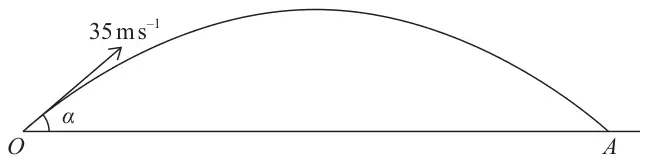
At time \(t = 0\), a small stone is projected with velocity \(35\ \text{m s}^{-1}\) from a point \(O\) on horizontal ground.
The stone is projected at an angle \(\alpha\) to the horizontal, where \(\tan\alpha = \dfrac{3}{4}\)
In an initial model
- the stone is modelled as a particle \(P\) moving freely under gravity
- the stone hits the ground at the point \(A\)
Figure 4 shows the path of \(P\) from \(O\) to \(A\).
For the motion of \(P\) from \(O\) to \(A\)
- at time \(t\) seconds, the horizontal distance of \(P\) from \(O\) is \(x\) metres
- at time \(t\) seconds, the vertical distance of \(P\) above the ground is \(y\) metres
Using the model, the greatest height of the stone above the ground is found to be \(H\) metres.
- The model is refined to include air resistance.
Using this new model, the greatest height of the stone above the ground is found to be \(K\) metres.
| Scheme | Marks | AO |
|---|---|---|
| Using horizontal motion, \(s = ut\), with 35 resolved | M1 | 3.3 |
| \(x = 35\cos\alpha \times t\) | A1 | 1.1b |
| Using vertical motion, \(s = ut + \dfrac{1}{2}at^2\), with 35 resolved | M1 | 3.4 |
| \(y = 35\sin\alpha \times t - \dfrac{1}{2}gt^2\) | A1 | 1.1b |
| Eliminate \(t\): \(y = 35\sin\alpha \times \dfrac{x}{35\cos\alpha} - \dfrac{1}{2}g\left(\dfrac{x}{35\cos\alpha}\right)^2\) | DM1 | 3.1b |
| \(y = \dfrac{3}{4}x - \dfrac{1}{160}x^2\) * | A1* | 1.1b |
| N.B. No marks available if they just quote the equation of the path. | ||
| ALTERNATIVE: they do (b) and/or (c) first using a suvat method Assume \(y = ax^2 + bx + c\) Use any three of (0,0), (120,0) from part (b), (60,22.5) from part (c) or \(\dfrac{\mathrm{d}y}{\mathrm{d}x} = \dfrac{3}{4}\) at \(x = 0\) to find \(a\), \(b\), and \(c\). M1A1, M1A1, DM1A1* for finding each of \(a\), \(b\) and \(c\) and stating final answer in correct form. N.B. If they realise that \(c = 0\), and just use \(y = ax^2 + bx\), that could score M1A1. Enter marks on ePEN in the order in which \(a\), \(b\) and \(c\) are found: e.g. \(x = 0,\ y = 0 \Rightarrow c = 0\) M1A1 \(x = 0,\ \dfrac{\mathrm{d}y}{\mathrm{d}x} = 2ax + b = \dfrac{3}{4} \Rightarrow b = \dfrac{3}{4}\) M1 A1 \(x = 120,\ y = 0 \Rightarrow 0 = 120^2a + 120 \times \dfrac{3}{4} \Rightarrow a = \dfrac{-1}{160}\) DM1 so, \(y = \dfrac{3}{4}x - \dfrac{1}{160}x^2\) A1* | ||
| (6) |
Notes
M1: Correct terms but condone sin/cos confusion and sign errors
Available if they use \(s\) instead of \(x\)
A1: Correct equation in \(x\) and \(t\)
N.B. they may have the wrong value for \(\cos\alpha\)
M1: Correct terms but condone sin/cos confusion and sign errors
Available if they use a different letter for \(y\) provided it’s not the same as they’ve used for \(x\).
N.B. M0 if they subsequently use a value for \(y\) e.g. 0
A1: Correct equation in \(y\) and \(t\)
N.B. they may have the wrong value for \(\sin\alpha\)
They may have \(t\) in terms of \(x\), from their first equation.
DM1: Dependent on the two previous M marks for eliminating \(t\) to give an equation in \(y\) and \(x\) only.
A1*: Given answer correctly obtained, with at least one further line of working with trig ratios and \(g = 9.8\) explicitly seen or 4.9 oe used for \(0.5g\).
Allow \(y = \dfrac{3x}{4} - \dfrac{x^2}{160}\) and with \(y\) on the RHS
| Scheme | Marks | AO |
|---|---|---|
| ALT 1 \(0 = \dfrac{3}{4}x - \dfrac{1}{160}x^2\) and solve for \(x\) ALT 2 \(\dfrac{\mathrm{d}y}{\mathrm{d}x} = \dfrac{3}{4} - \dfrac{x}{80} = 0 \Rightarrow x = 60\) and \(OA = 2 \times 60\) ALT 3 A complete suvat method to find \(OA\): e.g. \(0 = 35\sin\alpha \times t - \dfrac{1}{2}gt^2\) or \(0 = 35\sin\alpha - g\dfrac{t}{2}\) or \(-35\sin\alpha = 35\sin\alpha - gt\) to find \(t\) \(\left(= \dfrac{70\sin\alpha}{g} = \dfrac{30}{7}\right)\) AND \((OA =)\, 35\cos\alpha \times t = 35\cos\alpha \times \dfrac{70\sin\alpha}{g}\) N.B. OR use the calculator to input the equation of the path which then gives \(y_{\max} = 45/2\) when \(x = 60\) with no working, so \(OA = 2 \times 60\) | M1 | 3.1b |
| \((OA =)\ 120\) (m) | A1 | 1.1b |
| (2) |
Notes
M1: ALT 1: Use of \(y = 0\) in equation of path and solve for \(x\).
ALT 2: Use calculus to find the \(x\)-coordinate of the max point and double it
ALT 3: Any other complete suvat method to find \(OA\), condone sin/cos confusion and sign errors
A1: cao
| Scheme | Marks | AO |
|---|---|---|
| ALT 1 \(H = \dfrac{3}{4} \times 60 - \dfrac{1}{160} \times 60^2\) ALT 2 \(y = \dfrac{-1}{160}(x^2 - 120x) = 22.5 - \dfrac{1}{160}(x - 60)^2\) so max \(y = 45/2\) or 22.5 ALT 3 \(\dfrac{\mathrm{d}y}{\mathrm{d}x} = \dfrac{3}{4} - \dfrac{2x}{160} = 0 \Rightarrow x = 60\) then find \(y\) when \(x = 60\) ALT 4 A complete suvat method: e.g. \(H = \dfrac{(35\sin\alpha)^2}{2g}\) or \(0 = 35\sin\alpha - gt\) to find the time to top, \(t = \dfrac{35\sin\alpha}{g}\), or use half their time they found in (b) AND \(H = 35\sin\alpha \times \frac{35\sin\alpha}{g} - \dfrac{1}{2}g\left(\frac{35\sin\alpha}{g}\right)^2\) or \(\left(\dfrac{35\sin\alpha + 0}{2}\right) \times \dfrac{35\sin\alpha}{g}\) N.B. OR use the calculator to input the equation of the path which then gives \(y_{\max} = 45/2\) (when \(x = 60\)) with no working. | M1 | 3.1b |
| \((H =)\ 22.5\) Accept 23 | A1 | 1.1b |
| (2) |
Notes
M1: ALT 1: Use of \(x = \left(\dfrac{1}{2} \times \text{their } OA\right)\) in equation of path
ALT 2: Complete the square for the equation of the path and deduce maximum value of \(y\): Need to see \(p - q(x - r)^2\) with \(p\) as the answer
ALT 3: Use \(\dfrac{\mathrm{d}y}{\mathrm{d}x} = 0\) to find the \(x\)-coordinate of the max point and then use the path equation to find the \(y\)-coordinate
ALT 4: Any complete suvat method to find \(H\), condone sin/cos confusion and sign errors
A1: A0 for \(\dfrac{45}{2}\)
| Scheme | Marks | AO |
|---|---|---|
| \(H\) is greater (or \(K\) is smaller), as air resistance would slow the particle down oe. | B1 | 3.5a |
| (1) |
Notes
B1: Possible justifications for \(H\) greater (or \(K\) smaller):
air resistance will provide an extra force acting against the stone or opposing the motion
air resistance would take away energy from the stone
work would be done against air resistance
air resistance will mean the acceleration will be less (or deceleration greater)
air resistance would reduce the velocity/speed
Allow ‘it’ for air resistance
B0 if no justification given.
B0 for air resistance would reduce the initial velocity of the stone
B0 for air resistance will limit the vertical height (not a reason) or oppose the vertical force.
Ignore extras.
| Scheme | Marks | AO |
|---|---|---|
| e.g. the inaccuracy of using \(9.8\ \text{m s}^{-2}\) for \(g\) | B1 | 3.5b |
| (1) | ||
| (12 marks) |
Notes
B1: Any single correct answer.
Acceptable answer:
the inaccuracy of using \(9.8\ \text{m s}^{-2}\) for \(g\)
or wind or weather effects
or the spin of the stone
or the size (or shape or surface area) of the stone oe
or the stone is still modelled as a particle
N.B. Allow if the stone is referred to as e.g. a ball
B0 if any incorrect extras
Unacceptable answers:
The model (it) does not take account of:
the mass or weight of the stone
air resistance.
The ground may not be horizontal.
B0 for consequences of air resistance being included e.g.
the path won’t be a parabola
the path won’t be symmetrical