
October 2021 Paper 1 Q10
10 A ball is thrown upwards with a velocity of \(29.4\,\text{m}\,\text{s}^{-1}\).
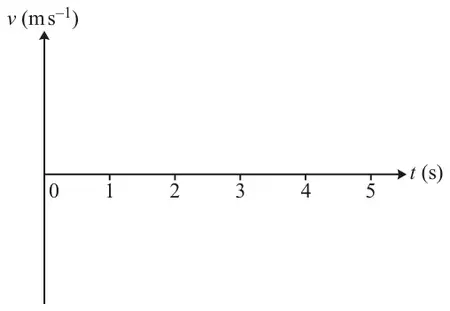
Axes printed in the Printed Answer Booklet for part (b):
A second ball is thrown at \(u\,\text{m}\,\text{s}^{-1}\) at an angle of \(\alpha^\circ\) above the horizontal. It reaches the same maximum height as the first ball.
- the vertical component of the second ball’s initial velocity,
- the time taken for the second ball to reach its greatest height.
This second ball reaches its greatest height at a point which is 48 m horizontally from the point of projection.
| Scheme | Marks | AO |
|---|---|---|
| Time when \(v = 0\) given by \(0 = 29.4 - 9.8t\), so \(t = 3\) s | E1 | 2.1 |
| [1] |
Notes
E1: Using suvat equation(s) leading to correct value for \(t\) with \(v = 0\)
Allow for verifying that \(t = 3\) gives \(v = 0\) if identified as the maximum point oe
| Scheme | Marks | AO |
|---|---|---|
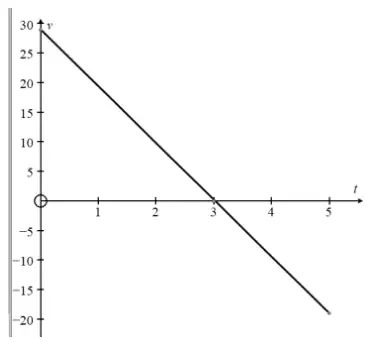 | B1 B1 | 1.1b 1.1b |
| [2] |
Notes
B1: straight line with negative gradient through either (3, 0) or (0, 29.4)
B1: Both (3, 0) and (0, 29.4) clearly seen
Must include negative values of \(v\) for \(t > 3\)
| Scheme | Marks | AO |
|---|---|---|
| When \(t = 5\), \(v = 29.4 - 9.8 \times 5\) | M1 | 1.1a |
| \(v = -19.6\) | A1 | 1.1b |
| Speed is \(19.6\,\text{m}\,\text{s}^{-1}\) | A1 | 1.1b |
| [3] |
Notes
M1: Using suvat equation(s) leading to a value for \(v\) with \(t = 5\). Allow sign errors
A1: May be implied by 19.6 seen
A1: FT their negative velocity
If motion from the highest point considered \(u = 0\), \(t = 2\), \(g = +9.8\) then \(v = 19.6\) is fully correct.
Allow M1A1A0 if \(29.4 - 9.8 \times 5 = 19.6\) seen
| Scheme | Marks | AO |
|---|---|---|
| Max height unchanged so \(u_y = 29.4\,\text{m}\,\text{s}^{-1}\) | B1 | 3.1b |
| Time to max height unchanged, so 3 s | B1 | 3.3 |
| [2] |
Notes
B1: Allow if calculated from \(y = 44.1\) m
| Scheme | Marks | AO |
|---|---|---|
| \(u_x \times 3 = 48\) | M1 | 1.1a |
| \(u = \sqrt{u_x^2 + u_y^2} = \sqrt{16^2 + 29.4^2} = 33.5\) | M1 | 1.1b |
| \(\tan\alpha = \dfrac{u_y}{u_x} = \dfrac{29.4}{16}\) giving \(\alpha = 61.4^\circ\) | A1 | 1.1b |
| [3] |
Notes
M1: Using (their) \(t = 3\) to find \(u_x\)
M1: Combining their components to find either one of \(u\) and \(\alpha\)
A1: Both values correct