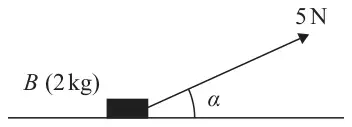
A small box \(B\) of mass 2 kg is dragged in a straight line, along a rough horizontal plane, at a constant speed by a force of magnitude 5 N.
The line of action of the force makes an angle \(\alpha\) with the plane, where \(\sin\alpha = \dfrac{3}{5}\), as shown in Figure 2.
(a) Show that the magnitude of the normal reaction of the plane on the box is 16.6 N. (3)
At the instant when \(B\) is at the point \(O\) on the plane, the force of magnitude 5 N is removed.
(b) Describe the motion of the box after the force of magnitude 5 N is removed. (1)
(c) Find the magnitude of the normal reaction of the plane on the box after the force of magnitude 5 N is removed. (1)
Given that after the force of magnitude 5 N is removed
the box is modelled as a particle
air resistance is modelled as being negligible
the coefficient of friction between the box and the plane is modelled as 0.2
the speed of the box as it passes through \(O\) is \(4\ \text{m s}^{-1}\)
the box comes to rest at the point \(X\) on the plane
(d) use the model to find the length \(OX\). (4)
(e) State one limitation of the model, apart from ignoring air resistance, that could affect your answer to part (d). (1)
Mark scheme (a)
Scheme
Marks
AO
Resolve vertically
M1
3.4
\((\uparrow)\ 5\sin\alpha + R = 2g\) oe
A1
1.1b
\((R =)\ 19.6 - 3 = 16.6\) (N)*
A1*
1.1b
(3)
Notes
N.B. Penalise the use of \(g = 9.81\) ONCE (the first time it is used) for the whole question.
M1: Form an equation in \(R\) and \(\alpha\) only, with correct number of terms, condone sign errors and sin/cos confusion, \(\sin\alpha\) may or may not be substituted. N.B. \(3 + R = 2g\) oe, with no evidence of resolving the 5 N, e.g. not using \(\sin\alpha\), is M0.
A1: Correct equation, \(\sin\alpha\) may or may not be be substituted.
A1*: Given answer correctly obtained, with at least one line of working.
Mark scheme (b)
Scheme
Marks
AO
The box decelerates, slows down, loses speed or velocity, will come to a stop or rest, loses momentum
B1
2.4
(1)
Notes
B1: Any equivalent statement. B0 if any incorrect extras e.g. box is stationary or at rest, doesn’t move, will stop moving.
Mark scheme (c)
Scheme
Marks
AO
\((S =)\ 19.6\) or 20 (N)
B1
3.3
(1)
Notes
N.B. Penalise the use of \(g = 9.81\) ONCE (the first time it is used) for the whole question.
B1: Accept \(2g\) if \(g\) is not substituted for. B0 if they use \(g = 9.81\) unless they have already been penalised in part (a).
Mark scheme (d)
Scheme
Marks
AO
Equation of motion along the plane: \(-F = 2a\) or \(F = 2a\)
N.B. Penalise the use of \(g = 9.81\) ONCE (the first time it is used) for the whole question.
M1: Correct number of terms. Condone an extra \(g\) in \(ma\) term. M0 if 2 is missing. N.B. M0 if they use a vertical force for \(F\) e.g. \(2g\) or 16.6
B1: Seen (e.g. on a diagram) or implied.
M1: Complete method to form an equation in \(d\) (= \(OX\)) only, condone sign errors, using their calculated acceleration from an attempt at using \(F = ma\) M0 if clearly using \(\mu\) (0.2) or \(-\mu\) for \(a\) without any calculation. e.g. may find \(t\) first: \(0 = 4 - 0.2gt \Rightarrow t = \dfrac{20}{g}\ \left(= \dfrac{100}{49}\right)\) then \(d = 4 \times \dfrac{20}{g} - \dfrac{1}{2} \times 0.2g \times \left(\dfrac{20}{g}\right)^2\) or \(d = 0 - \dfrac{1}{2} \times (-0.2g) \times \left(\dfrac{20}{g}\right)^2\) or \(0^2 = 4^2 + 2 \times (-0.2g) \times d\)
A1: Either answer. A0 for \(\dfrac{40}{g}\)
Mark scheme (e)
Scheme
Marks
AO
the box (it) has been modelled as a particle the box (it) will have size or shape or dimensions the coefficient of friction has been modelled as being constant the coefficient of friction may not be exactly 0.2 or may vary the friction may vary B0: the ground may not be horizontal, an inaccurate value of \(g\) has been used, has not considered wind, the angle may not be accurate, any reference to the particle having mass (or not having mass).
Ignore any reference to air resistance.
B1
3.5b
(1)
(10 marks)
Notes
B1: Any equivalent statement which refers to the model. B0 if incorrect extras.
1. A car moves in a straight line along a horizontal road with constant acceleration \(2\ \text{m s}^{-2}\)
The car is moving with speed \(15\ \text{m s}^{-1}\) in the direction of the acceleration when it passes a signpost on the road.
The car is modelled as a particle.
(a) Use the model to find the speed of the car 4 s after passing the signpost. (2)
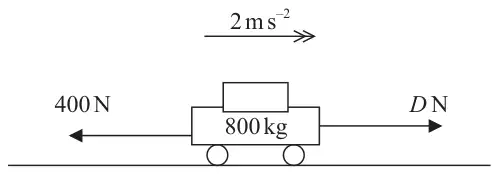
Figure 1 below shows the horizontal forces acting on the car.
Given that
the car has mass 800 kg
the driving force of the engine has magnitude \(D\) newtons
the resistance to the motion of the car has magnitude 400 N
the acceleration of the car is \(2\ \text{m s}^{-2}\) in the direction of the driving force
(b) use the model to find the value of \(D\). (2)
Figure 1
Mark scheme (a)
Scheme
Marks
AO
\(v = 15 + (2 \times 4)\)
M1
3.1b
\(= 23\ (\text{m s}^{-1})\)
A1
1.1b
(2)
Notes
M1: Use of \(v = u + at\) or any other complete method to form an equation in \(v\) only. Condone sign errors. e.g. May find \(s\) first: \(s = (15 \times 4) + \dfrac{1}{2} \times 2 \times 4^2 = 76\) then either: \(76 = 4v - \dfrac{1}{2} \times 2 \times 4^2\) or: \(76 = \dfrac{(15 + v)}{2} \times 4\) or: \(v^2 = 15^2 + 2 \times 2 \times 76\) N.B. If they use \(v = u + at\) and have \(15 = u + (2 \times 4)\), M1A0 M0 if they clearly use an incorrect suvat formula or \(u = 0\)
A1: cao. Must be positive. A0 if they get 23 but go on and do something with it. i.e. not ISW N.B. 23 with no working can score both marks.
Mark scheme (b)
Scheme
Marks
AO
\(D - 400 = 800 \times 2\)
M1
3.1b
\((D =)\ 2000\)
A1
1.1b
(2)
(4 marks)
Notes
M1: Use of \(F = ma\) to form an equation in \(D\) or a complete expression for \(D\), with correct number of terms, condone sign errors and \(g\) in the \(ma\) term.
A1: cao N.B. 2000 with no working can score both marks.
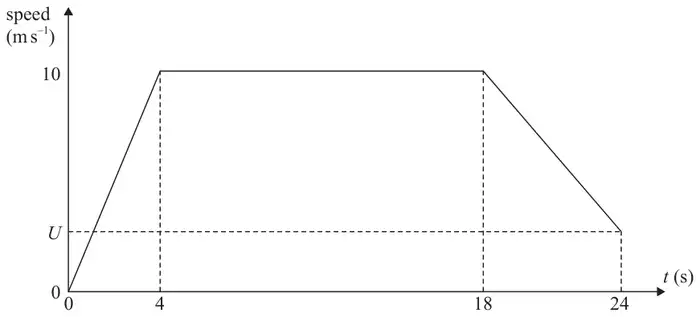
Figure 2 shows a speed-time graph for a model of the motion of an athlete running a 200 m race in 24 s.
The athlete
starts from rest at time \(t = 0\) and accelerates at a constant rate, reaching a speed of \(10\ \text{m s}^{-1}\) at \(t = 4\)
then moves at a constant speed of \(10\ \text{m s}^{-1}\) from \(t = 4\) to \(t = 18\)
then decelerates at a constant rate from \(t = 18\) to \(t = 24\), crossing the finishing line with speed \(U\ \text{m s}^{-1}\)
Using the model,
(a) find the acceleration of the athlete during the first 4 s of the race, stating the units of your answer, (2)
(b) find the distance covered by the athlete during the first 18 s of the race, (3)
(c) find the value of \(U\). (3)
Mark scheme (a)
Scheme
Marks
AO
\(\dfrac{10}{4}\)
M1
3.4
\(2.5,\ \dfrac{5}{2},\ \dfrac{10}{4}\ \text{m s}^{-2}\) units needed.
A1
1.1b
(2)
Notes
M1: Any complete suvat method to find \(a\) e.g. use \(s = 20\) and \(20 = \dfrac{1}{2}a \times 4^2\) N.B. Ignore units at this stage
A1:Any equivalent number with correct units. Accept m/s², m/s/s, m per s per s.
Mark scheme (b)
Scheme
Marks
AO
Find the area, with correct structure, from \(t = 0\) to 18
M1
3.1b
\(\dfrac{1}{2} \times 4 \times 10 + (14 \times 10)\) triangle + rectangle or \(\dfrac{1}{2} \times 10 \times (14 + 18)\) trapezium or \((18 \times 10) - \dfrac{1}{2} \times 4 \times 10\) rectangle – triangle N.B. \(\dfrac{1}{2} \times 4 \times 10\) may be replaced by \(\dfrac{1}{2} \times 2.5 \times 4^2\) using \(s = ut + \dfrac{1}{2}at^2\) or by \(\dfrac{10^2 - 0^2}{2 \times 2.5}\) using \(v^2 = u^2 + 2as\)
A1
1.1b
160 (m)
A1
1.1b
(3)
Notes
M1: Complete method, they may use suvat on one or more sections, to find the TOTAL area. M0 if a single suvat equation is used for the whole motion M0 if \(\dfrac{1}{2}\) not seen used in an area method
A1: Correct unsimplified expression.
A1: cao. Ignore units. N.B. Correct answer, with no working, can score all 3 marks.
Mark scheme (c)
Scheme
Marks
AO
Using area, from \(t = 18\) to \(t = 24\), \(= (200 - \text{their (b)})\) with correct structure OR \(s = (200 - \text{their (b)})\), using suvat to find \(s\) N.B. If their (b) is incorrect and they don’t use it, allow a correct restart.
M1: Complete method, using area or suvat, to give an equation in \(U\) only, with correct structure M0 if \(\dfrac{1}{2}\) not seen used in an area method M0 if 10 is used instead of \((10 - U)\) or \((10 - U)\) is used instead of \((10 + U)\) in any equation
A1ft: Correct unsimplified equation in \(U\) only (allow \(V\) or \(v\) instead of \(U\)), ft on their 160.
A1: Accept 3.3 or better. Ignore units. Allow use of \(V\) throughout instead of \(U\), including in the answer. N.B. Correct answer, with no working, can score all 3 marks.
\(\sqrt{20} = 2\sqrt{5}\), 4.5 or better \((\text{m s}^{-1})\)
A1
1.1b
(4)
Notes
Accept column vectors throughout
M1: Use of \(\mathbf{v} = \mathbf{u} + \mathbf{a}t\) with \(t = 5\) to give an unsimplified \(\mathbf{v}_B\) M0 if \(\mathbf{u} = \mathbf{0}\) N.B. If using integration, they must get to the same stage i.e. have found the constant and put \(t = 5\) M0 if they omit the constant altogether
A1: Correct \(\mathbf{v}_B\) with \(\mathbf{i}\)’s and \(\mathbf{j}\)’s collected
M1: Use of Pythagoras on their \(\mathbf{v}_B\) to give a magnitude (need the root)
A1: Must be positive
Mark scheme (b)
Scheme
Marks
AO
Using \(A\) as the initial position: \(\mathbf{r}_C = \mathbf{v}_A t + \dfrac{1}{2}\mathbf{a}t^2 + \mathbf{r}_A\) where \(t = T\) \((4\mathbf{i} + c\mathbf{j}) = (-16\mathbf{i} - 3\mathbf{j})T + \dfrac{1}{2}(2.4\mathbf{i} + \mathbf{j})T^2 + (44\mathbf{i} - 10\mathbf{j})\) OR \(\begin{pmatrix}4\\c\end{pmatrix} = \begin{pmatrix}-16\\-3\end{pmatrix}T + \dfrac{1}{2}\begin{pmatrix}2.4\\1\end{pmatrix}T^2 + \begin{pmatrix}44\\-10\end{pmatrix}\)
Equating \(\mathbf{i}\)-components, to give a quadratic equation in \(T\) only. Allow \(t\) instead of \(T\).
N.B. Allow omission of 44 for this M mark. Also allow \(\pm 4\) but M0 if 4 is not used at all i.e. \(4 = -16T + \dfrac{1}{2} \times 2.4T^2\) scores M1A0A0
M1
3.1a
\(4 = -16T + \dfrac{1}{2} \times 2.4T^2 + 44\)
A1
1.1b
\((T =)\ 10\)
A1
1.1b
(3)
Alternative
Scheme
Marks
ALTERNATIVEusing \(B\) as the initial position: (The position vector of \(B\), \(\mathbf{r}_B\), should be \(-6\mathbf{i} - 12.5\mathbf{j}\) but no credit for finding this) \(\mathbf{r}_C = \mathbf{v}_B t + \dfrac{1}{2}\mathbf{a}t^2 + \mathbf{r}_B\) using their \(\mathbf{v}_B\) from (a) and their \(\mathbf{r}_B\) \((4\mathbf{i} + c\mathbf{j}) = (-4\mathbf{i} + 2\mathbf{j})t + \dfrac{1}{2}(2.4\mathbf{i} + \mathbf{j})t^2 + (-6\mathbf{i} - 12.5\mathbf{j})\) \(\begin{pmatrix}4\\c\end{pmatrix} = \begin{pmatrix}-4\\2\end{pmatrix}t + \dfrac{1}{2}\begin{pmatrix}2.4\\1\end{pmatrix}t^2 + \begin{pmatrix}-6\\-12.5\end{pmatrix}\)
Equating \(\mathbf{i}\)-components, to give a quadratic equation in \(t\) only. Allow if they have \(T\) instead of \(t\). N.B. Allow omission of their \(-6\) or if they use 44 for this M mark. Also allow \(\pm 4\) but M0 if 4 is not used at all. e.g. \(4 = -4t + \dfrac{1}{2} \times 2.4t^2\) scores M1A0A0
M1
\(4 = -4t + \dfrac{1}{2} \times 2.4t^2 - 6\)
A1
\(t = 5\) so \((T =)\ 10\)
A1
(3)
Notes
Accept column vectors throughout
M1: Equating components of \(\mathbf{i}\) to give an equation in \(T\) or \(t\) only. N.B. (they could use integration to get to the same stage) for this M mark, they only need to be equating the \(\mathbf{i}\)-components, and receive no credit until they do so. M0 if \(\mathbf{u} = \mathbf{0}\)
A1: A correct equation in \(T\) or \(t\) only (could be in \((T - 5)\) if using \(B\) as initial position)
A1: \(T = 10\)
Mark scheme (c)
Scheme
Marks
AO
Equating \(\mathbf{j}\)-components, with their value of \(T\) or \(t\) substituted, to give an equation, which must have a square term, in \(c\) only. N.B. Allow \(\pm c\) in their equation.
(N.B. Allow omission of \(-10\) or their \(-12.5\) for this M mark i.e. if using \(A\) as initial position \(c = (-3 \times 10) + \dfrac{1}{2} \times 1 \times 10^2\) scores M1M0A0 OR if using \(B\) as initial position \(c = (2 \times 5) + \dfrac{1}{2} \times 1 \times 5^2\) scores M1M0A0)
M1
2.1
if using \(A\) as initial position \(c = (-3 \times 10) + \dfrac{1}{2} \times 1 \times 10^2 + (-10)\) N.B. Allow \(\pm c\) and/or \(\pm(-10)\) in their equation
OR if using \(B\) as initial position \(c = (2 \times 5) + \dfrac{1}{2} \times 1 \times 5^2 + (-12.5)\) N.B. Allow \(\pm c\) and/or \(\pm(-12.5)\) in their equation
M1
1.1b
\(c = 10\)
A1
1.1b
(3)
(10 marks)
Notes
Accept column vectors throughout
M1: Equating components of \(\mathbf{j}\) to give an equation in \(c\) only but allow omission of their initial position
M1: With their value of \(T\) or \(t\) and must include \(t = 0\) position (should be \(-10\) if using \(A\) OR their \(-12.5\) if using \(B\))
1. A car is initially at rest on a straight horizontal road.
The car then accelerates along the road with a constant acceleration of \(3.2\ \text{m s}^{-2}\)
Find
(a) the speed of the car after 5 s, (1)
(b) the distance travelled by the car in the first 5 s. (2)
Mark scheme (a)
Scheme
Marks
AO
16 \((\text{m s}^{-1})\) seen as the answer
B1
1.1b
(1)
Notes
B1: cao. Must be positive. Ignore any working.
Mark scheme (b)
Scheme
Marks
AO
\(s = \dfrac{1}{2} \times 3.2 \times 5^2\) OR \(s = \dfrac{(0+16)}{2} \times 5\) OR \(s = (16 \times 5) - \dfrac{1}{2} \times 3.2 \times 5^2\) OR \(16^2 = 2 \times 3.2 \times s\) OR from a v-t graph, \(s = \dfrac{1}{2} \times 5 \times 16\)
M1
3.1b
\(s = 40\) (m)
A1
1.1b
(2)
(3 marks)
Notes
M1: Complete method to find an equation in \(s\) only, possibly using their ‘16’ Allow ‘reversed motion’: use of \(s = vt - \dfrac{1}{2}at^2\) with \(v = 0\) i.e. \(s = -\dfrac{1}{2} \times 3.2 \times 5^2\) can score M1 and \(s = -40\) so distance is 40 (m) can score the A1
A1: cao. Must be positive.
N.B. correct answer only, in (b), can score both marks.
OR integration: \(\mathbf{r} = (\mathbf{i} + \mathbf{j}) + \left[(2\mathbf{i} - 3\mathbf{j})\dfrac{1}{2}t^2 + 4t\mathbf{i}\right]\), with \(t = 3\)
M1
3.1a
\(\mathbf{r} = 22\mathbf{i} - 12.5\mathbf{j}\)
A1
2.2a
(2)
(4 marks)
Notes
Accept column vectors throughout
M1: Complete method to find the p.v. but this mark can be scored if they omit \((\mathbf{i} + \mathbf{j})\) i.e. the M1 is for the expression in the square bracket If they integrate, the M1 is earned once the expression in the square bracket is seen with \(t = 3\) (M0 if \(\mathbf{i}\) and/or \(\mathbf{j}\) is missing)
M1: For any complete method to give a \(\mathbf{v}\) expression with correct no. of terms with \(t = 2\) used, so if integrating, must see the initial velocity as the constant. Allow sign errors.
A1: Cao isw if they go on to find the speed.
Mark scheme (b)
Scheme
Marks
AO
Solve problem through use of \(\mathbf{r} = \mathbf{u}t + \dfrac{1}{2}\mathbf{a}t^2\) or integration (M0 if \(\mathbf{u} = \mathbf{0}\)) Or any other complete method e.g use \(\mathbf{v} = \mathbf{u} + \mathbf{a}T\) and \(\mathbf{r} = \dfrac{(\mathbf{u} + \mathbf{v})T}{2}\):
The first two marks could be implied if they go straight to an algebraic equation.
Attempt to equate \(\mathbf{j}\) components to give equation in \(T\) only \(\left(-4.5 = 2T - \dfrac{5}{2}T^2\right)\)
M1
2.1
\(T = 1.8\)
A1
1.1b
(4)
Notes
Accept column vectors throughout
M1: For any complete method to give a vector expression for \(\mathbf{j}\) component of displacement in \(t\) (or \(T\)) only, using \(\mathbf{a} = (4\mathbf{i} - 5\mathbf{j})\), so if integrating, RHS of equation must have the correct structure. Allow sign errors.
A1: Correct \(\mathbf{j}\) vector equation in \(t\) or \(T\). Ignore \(\mathbf{i}\) terms.
M1: Must have earned 1st M mark. Equate \(\mathbf{j}\) components to give equation in \(T\) (allow \(t\)) only (no \(\mathbf{j}\)’s) which has come from a displacement. Equation must be a 3 term quadratic in \(T\).
A1: cao
Mark scheme (c)
Scheme
Marks
AO
Solve problem by substituting their \(T\) value (M0 if \(T \lt 0\)) into the \(\mathbf{i}\) component equation to give an equation in \(\lambda\) only: \(\lambda = -2T + \dfrac{1}{2}T^2 \times 4\)
M1
3.1a
\(\lambda = 2.9\) or 2.88 or \(\dfrac{72}{25}\) oe
A1
1.1b
(2)
(8 marks)
Notes
Accept column vectors throughout
M1: Must have earned 1st M mark in (b) Complete method - must have an equation in \(\lambda\) only (no \(\mathbf{i}\)’s) which has come from an appropriate displacement.. (e.g M0 if \(\mathbf{a} = \mathbf{0}\) has been used) Expression for \(\lambda\) must be a quadratic in \(T\)
M1: Use of \(\mathbf{v} = \mathbf{u} + \mathbf{a}t\) OR integration to give an expression of the form \(\mathbf{C} + (2\mathbf{i} - 3\mathbf{j})t\), where C is a non-zero constant vector M0 if \(\mathbf{u}\) and \(\mathbf{a}\) are reversed Condone use of \(\mathbf{a} = (2\mathbf{i} + 3\mathbf{j})\) for this M mark
A1: Any correct unsimplified expression seen or implied
M1: Correct use of ratios, using a velocity vector (must be using \(\dfrac{-4}{3}\)) to give equation in \(T\) only M0 if they equate \(4 - 3T = -4\) and/or \(-1 + 2T = 3\) and therefore M0 if they then divide to produce their equation
A1: Correct only
N.B. (i) Can score the second M1A1 if they get \(T = 8\), using a calculator to solve two simultaneous equations, but if answer is wrong, and no equation in \(T\) only, second M0 (ii) Can score M1A1 M1A1 if they get \(T = 8\), using trial and error, but if they don’t get \(T = 8\), can only score max M1A1M0A0
\(AB = \sqrt{12^2 + 8^2}\) N.B. Beware you may see 4(2i – 3j) which leads to \(\sqrt{(8^2 + 12^2)}\) this is M0A0M0A0.
M1
3.1a
\(= 4\sqrt{13}\ (= 14.422051....)\) (m)
A1cso
1.1b
(4)
(8 marks)
Notes
M1: Use of \(\mathbf{s} = \mathbf{u}t + \dfrac{1}{2}\mathbf{a}t^2\) with \(\mathbf{a} = (2\mathbf{i} - 3\mathbf{j})\) OR integration to give an expression of the form \(\mathbf{C}t + (2\mathbf{i} - 3\mathbf{j})\dfrac{1}{2}t^2\), where C is their non-zero constant vector from (a) Condone use of \(\mathbf{a} = (2\mathbf{i} + 3\mathbf{j})\) for this M mark OR any other complete method using vector suvat equations
A1: Correct unsimplified expression seen or implied
M1: Use of \(t = 4\) in their \(\mathbf{s}\) (which must be a displacement vector) and then Pythagoras with the root sign N.B. This M mark can be implied by a correct answer, otherwise we need to see Pythagoras used, with the root sign, for the M mark.
13 A car moves, in a straight line on a horizontal road, from a point \(A\) to a point \(B\)
The distance \(AB\) is 225 metres.
At the point \(B\), the velocity of the car is \(30\ \text{m s}^{-1}\)
The car is modelled as having a constant acceleration of \(2\ \text{m s}^{-2}\)
(a) Show that the car starts from rest at point \(A\) [2 marks]
(b) The car continues to move past the point \(B\) in the same straight line.
Explain why the model would eventually become invalid.
[1 mark]
Mark scheme (a)
Scheme
Marks
AO
Substitutes \(a = 2\) \(s = 225\), \(v = 30\) and \(u\) into \(v^2 = u^2 + 2as\) OE
M1
3.3
Completes reasoned argument, with at least one intermediate step after the initial substitution, to obtain \(u = 0\) or \(u^2 = 0\) and concludes the car starts from rest AG Accept making \(u\) the subject of \(v^2 = u^2 + 2as\) before substitution as the intermediate step
Explains why the model becomes invalid, eg: • That acceleration is unlikely to remain constant Or gives a contextual reason as to why the car may have to slow down or stop, eg: • That the car reaches its maximum speed • The road will not remain straight or there will be an obstacle • The car will run out of fuel
E1
3.5b
(1)
(3 marks)
Typical solution
A car’s acceleration is unlikely to stay at the same rate.
A toy shoots balls upwards with an initial velocity of 7 m s−1
The advertisement for this toy claims the balls can reach a maximum height of 2.5 metres from the ground.
(a) Suppose that the toy shoots the balls vertically upwards.
(i) Verify the claim in the advertisement. [2 marks]
(ii) State two modelling assumptions you have made in verifying this claim. [2 marks]
(b) In fact the toy shoots the balls anywhere between 0 and 11 degrees from the vertical.
The range of maximum heights, \(h\) metres, above the ground which can be reached by the balls may be expressed as
\[k \lt h \leqslant 2.5\]
Find the value of \(k\) [4 marks]
Mark scheme (a)
Scheme
Marks
AO
(i) Substitutes three of the four given values into \(v^2 = u^2 + 2as\) Condone inconsistent signs for the substituted values
M1
3.1b
Completes reasoned argument to obtain the correct fourth value and concludes the claim is correct Must have clearly stated three out of the following four \(v = 0\) \(u = 7\) \(a = -9.8\) or \(-g\) \(s = 2.5\) Allow a consistent swapping of signs AG
The beach surface can be assumed to be level and horizontal.
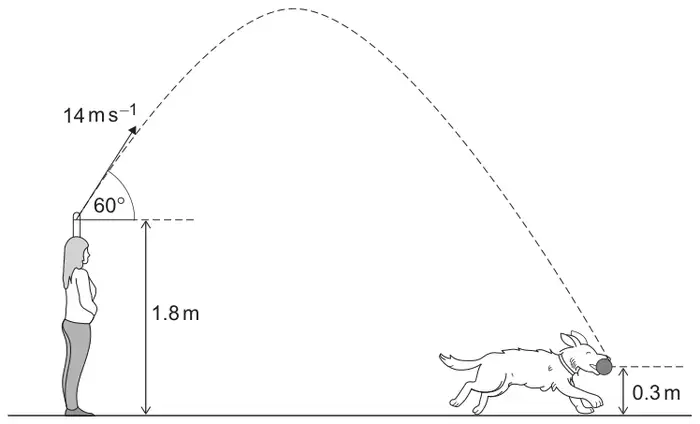
Nell and Maia are initially standing next to each other.
Nell throws a ball forward, from a height of 1.8 metres above the surface of the beach, at an angle of 60° above the horizontal with a speed of 14 m s−1
Exactly 0.2 seconds after the ball is thrown, Maia sets off from Nell and runs across the surface of the beach, in a straight line with a constant acceleration \(a\) m s−2
Maia catches the ball when it is 0.3 metres above ground level as shown in the diagram below.
Find \(a\) [7 marks]
Mark scheme
Scheme
Marks
AO
States or uses \(14\cos 60\) for the horizontal component.
B1
3.1b
States or uses \(14\sin 60\) for the vertical component.
B1
3.1b
Uses \(s = ut + \dfrac{1}{2}at^2\) with \(u\) = their vertical component of velocity, \(a = -g\) and \(s = \pm 1.5\) OE PI by \(t\) = AWFW [2.54, 2.60]
M1
3.3
Obtains \(t\) = 2.592 AWFW [2.54, 2.60] Exact value is \(\dfrac{3\sqrt{10} + 5\sqrt{3}}{7}\)
A1
1.1b
Multiplies their \(t\) value by their horizontal component provided their \(t\) > 0.2
M1
1.1b
Substitutes \(u\) = 0, their \(t\) – 0.2 into \(ut + \dfrac{1}{2}at^2\) to obtain an expression for the horizontal distance travelled by the dog.
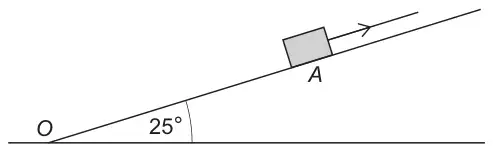
A rough wooden ramp is 10 metres long and is inclined at an angle of 25° above the horizontal.
The bottom of the ramp is at the point \(O\).
A crate of mass 20 kg is at rest at the point \(A\) on the ramp.
The crate is pulled up the ramp using a rope attached to the crate.
Once in motion, the rope remains taut and parallel to the line of greatest slope of the ramp.
(a) The tension in the rope is 230 N
The crate accelerates up the ramp at 1.2 m s−2
Find the coefficient of friction between the crate and the ramp. [7 marks]
(b)
(i) The crate takes 3.8 seconds to reach the top of the ramp.
Find the distance \(OA\). [3 marks]
(ii) Other than air resistance, state one assumption you have made about the crate in answering part (b)(i). [1 mark]
Mark scheme (a)
Scheme
Marks
AO
States \(F = \mu R\) seen anywhere PI by use of \(\mu R\) in their 4-term equation of motion or on diagram
B1
3.3
Resolves the weight parallel to the slope to obtain \(mg\sin 25\) or better
B1
1.1b
Resolves perpendicular to the slope to obtain \(R = mg\cos 25\) or better
B1
1.1b
Uses F = ma to form a four-term equation with consistent signs. eg \(T - \text{weight} - \text{Friction} = ma\) Condone omission of \(g\) in weight and friction component
M1
3.3
Substitutes \(T\) = 230 and \(F = \mu mg\cos 25\) into their four term \(F = ma\) equation with consistent signs. Condone ‘\(mga\)’ in \(F = ma\) for this mark
M1
1.1a
Obtains single correct equation with all numerical values substituted. eg \(230 - 196\sin 25 - 196\cos 25\,\mu = 24\) Scores B1B1B1M1M1A1
16 Two particles, \(P\) and \(Q\), move in the same horizontal plane.
Particle \(P\) is initially at rest at the point with position vector \((-4\mathbf{i} + 5\mathbf{j})\) metres and moves with constant acceleration \((3\mathbf{i} - 4\mathbf{j})\) m s−2
Particle \(Q\) moves in a straight line, passing through the points with position vectors \((\mathbf{i} - \mathbf{j})\) metres and \((10\mathbf{i} + c\mathbf{j})\) metres.
\(P\) and \(Q\) are moving along parallel paths.
(a) Show that \(c = -13\) [4 marks]
(b)
(i) Find an expression for the position vector of \(P\) at time \(t\) seconds. [1 mark]
(ii) Hence, prove that the paths of \(P\) and \(Q\) are not collinear. [3 marks]
Mark scheme (a)
Scheme
Marks
AO
States or uses the direction of motion is \(\begin{bmatrix} 3 \\ -4 \end{bmatrix}\) or \(\begin{bmatrix} 9 \\ c + 1 \end{bmatrix}\) Or States or uses the gradient of the direction of motion is \(-\dfrac{4}{3}\) or \(\dfrac{c + 1}{9}\)
M1
3.1a
Obtains a correct vector equation eg \(\begin{bmatrix} 10 \\ c \end{bmatrix} = \begin{bmatrix} 1 \\ -1 \end{bmatrix} + k\begin{bmatrix} 3 \\ -4 \end{bmatrix}\) OE Or Obtains both gradients or both direction vectors \(\begin{bmatrix} 3 \\ -4 \end{bmatrix}\), \(\begin{bmatrix} 9 \\ c + 1 \end{bmatrix}\) or Obtains a correct cartesian equation for \(Q\). eg \(y + 1 = -\dfrac{4}{3}(x - 1)\)
A1
1.1b
Obtains or eliminates parameter in their vector equation Or Equates gradients or the reciprocals \(\dfrac{c + 1}{9} = -\dfrac{4}{3}\) Or substitutes \(x\) = 10 into their cartesian equation
M1
1.1a
Shows that \(c = -13\) AG A correct verification method using the given \(c = -13\) scores a maximum of M1A1M0A0
A1
1.1b
(4)
Typical solution
\[\begin{bmatrix} 10 \\ c \end{bmatrix} - \begin{bmatrix} 1 \\ -1 \end{bmatrix} = \begin{bmatrix} 9 \\ c + 1 \end{bmatrix}\]\[\begin{bmatrix} 9 \\ c + 1 \end{bmatrix} = k\begin{bmatrix} 3 \\ -4 \end{bmatrix}\]\[k = 3\]\[c + 1 = -12\]\[\Rightarrow c = -13\]
(ii) Equates their position vector from (b)(i) to one of the two known position vectors given for \(Q\). Their position vector must be quadratic in \(t\) for both components Or Substitutes a known point for \(P\) into their Cartesian equation for the path of \(Q\) from part (a) OE Or Substitutes a known point for \(Q\) into their Cartesian equation for the path of \(P\) from part (a) OE Or forms Cartesian equations for the path of \(P\) and the path of \(Q\) Or Calculates the difference between \((-4\mathbf{i} + 5\mathbf{j})\) and \((\mathbf{i} - \mathbf{j})\) or between \((-4\mathbf{i} + 5\mathbf{j})\) and \((10\mathbf{i} - 13\mathbf{j})\)
M1
3.1b
Obtains \(t^2 = \dfrac{10}{3}\) or 3 or \(t = \sqrt{\dfrac{10}{3}} = 1.82\ldots\) or \(\sqrt{3} = 1.73\ldots\) Or Shows that \(y \ne 5\) for \(x = -4\) OE Or Writes the two correct cartesian equations in a comparable form eg \(y = -\dfrac{4}{3}x + \dfrac{1}{3}\) and \(y = -\dfrac{4}{3}x - \dfrac{1}{3}\) Or Compares two appropriate direction vectors
A1
1.1b
Completes reasoned argument by explaining that there is an inconsistency and deduces that paths are not collinear CSO
8 A particle \(P\) is moving with constant acceleration \((-5\mathbf{i} + 2\mathbf{j})\,\mathrm{m\,s^{-2}}\). At time \(t = 0\) seconds, \(P\) is at the origin and has velocity \((\mathbf{i} + 3\mathbf{j})\,\mathrm{m\,s^{-1}}\).
(a) Find, in terms of \(\mathbf{i}\) and \(\mathbf{j}\), the displacement of \(P\) at time \(t = 2\) seconds. [2]
(b) Determine the speed of \(P\) at time \(t = 2\) seconds. [4]
M1: Apply \(\mathbf{s} = \mathbf{u}t + 0.5\mathbf{a}t^2\) correctly with correct values of \(\mathbf{u}\), \(\mathbf{a}\) and \(t\) – if using integration then for this mark we must see the correct expression \(\begin{pmatrix}1\\3\end{pmatrix}t + \frac{1}{2} \times \begin{pmatrix}-5\\2\end{pmatrix}t^2\) with \(t = 2\) subst.
A1: or \(\begin{pmatrix}-8\\10\end{pmatrix}\) ISW if correct vector converted to scalar
M1*: Apply \(\mathbf{v} = \mathbf{u} + \mathbf{a}t\) with correct values of \(\mathbf{u}\), \(\mathbf{a}\) and \(t\) (or other complete method to find \(\mathbf{v}\)) Allow from integration but must have correct expression for \(\mathbf{v}\) with \(t = 2\) substituted
A1: or as a column vector (possibly implied by correct magnitude)
M1dep*: Correct method for the speed of \(P\) at time \(t = 2\) – condone \(\sqrt{-9^2 + 7^2} = \sqrt{\pm 81 + 49}\)
A1: Allow \(\sqrt{130}\) or awrt 11.4 www – must follow from correct \(\mathbf{v} = -9\mathbf{i} + 7\mathbf{j}\) (so M1 A0 M1 A1 is not possible) 11.4017542…
8 A particle \(P\) moves with constant acceleration \((3\mathbf{i} - 2\mathbf{j})\,\mathrm{m\,s^{-2}}\). At time \(t = 4\) seconds, \(P\) has velocity \(6\mathbf{i}\,\mathrm{m\,s^{-1}}\).
Determine the speed of \(P\) at time \(t = 0\) seconds. [4]
M1*: Applying \(\mathbf{v} = \mathbf{u} + \mathbf{a}t\) correctly - working must imply that \(\mathbf{v}\) and \(\mathbf{a}\) are vectors Or for \(\mathbf{v} = 3t\mathbf{i} - 2t\mathbf{j} + \mathbf{c}\) and using \(t = 4\), \(\mathbf{v} = 6\mathbf{i}\) to find \(\mathbf{c}\) M0 if \(\mathbf{u} = -6\mathbf{i} \pm 14\mathbf{j}\)
A1: or for \(\mathbf{v} = (3t - 6)\mathbf{i} + (-2t + 8)\mathbf{j}\) and setting \(t = 0\) to obtain correct \(\mathbf{u}\)
M1dep*: Correctly taking the magnitude of their \(\mathbf{u}\) but condone \(\sqrt{-6^2 + 8^2} = \sqrt{\pm 36 + 64}\) Correct answer following \(-6\mathbf{i} + 8\mathbf{j}\) (with no wrong working) scores full marks
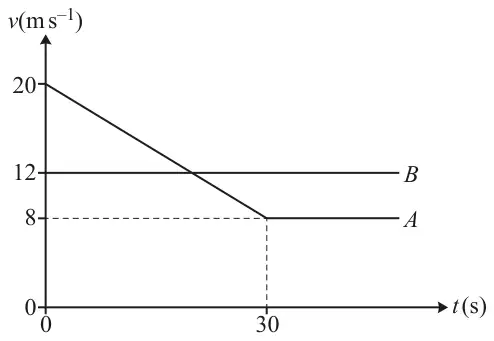
The diagram shows a velocity-time graph representing the motion of two cars \(A\) and \(B\) which are both travelling along a horizontal straight road. At time \(t = 0\), car \(B\), which is travelling with constant speed \(12\,\mathrm{m\,s^{-1}}\), is overtaken by car \(A\) which has initial speed \(20\,\mathrm{m\,s^{-1}}\).
From \(t = 0\) car \(A\) travels with constant deceleration for 30 seconds. When \(t = 30\) the speed of car \(A\) is \(8\,\mathrm{m\,s^{-1}}\) and the car maintains this speed in its subsequent motion.
(a) Calculate the deceleration of car \(A\). [2]
(b) Determine the value of \(t\) when \(B\) overtakes \(A\). [4]
Mark scheme (a)
Scheme
Marks
AO
\(8 = 20 + 30a\)
M1
3.4
\(a = -0.4\) so deceleration is 0.4 (\(\mathrm{m\,s^{-2}}\))
A1
1.1
[2]
Notes
M1: Use of \(v = u + at\) with given values (allow \(v = 20\) and \(u = 8\))
A1: Allow 0.4 or \(-0.4\)
Mark scheme (b)
Scheme
Marks
AO
Distance travelled by \(B\): \(12t\)
B1
1.1
Distance travelled by \(A\): \(\dfrac{1}{2}(8 + 20)(30) + 8(t - 30)\) or \(\dfrac{1}{2}(30)(12) + 8t\)
B1
1.1
\(12t =\) ‘420’ \(+ 8t -\) ‘240’
M1
3.1b
\(t = 45\)
A1
1.1
[4]
Notes
B1: Or first 30 seconds: \(B\) travels \(12(30)\) \((= 360)\)
B1: Or first 30 seconds: \(A\) travels \(0.5(8 + 20)(30)\) \((= 420)\)
M1: M1 for a (possibly unsimplified) correct equation/inequality in \(t\) where ‘360’ and ‘420’ must have been correct unsimplified e.g. ‘420’ − ‘360’ \(= (t - 30)(12 - 8)\), \(12(t - 30) +\) ‘360’ \(= 8(t - 30) +\) ‘420’, ‘420’ \(+ 8(t - 30) = 12t\) etc. Or for a correct equation in another time variable e.g. \(12T +\) ‘360’ \(= 8T +\) ‘420’ and \(T = t - 30\) seen or implied If an inequality used, then allow incorrect direction or strict inequality symbol for this mark
9 There are three checkpoints, \(A\), \(B\) and \(C\), in that order, on a straight horizontal road. A car travels along the road, in the direction from \(A\) to \(C\), with constant acceleration. The car takes \(20\,\mathrm{s}\) to travel from \(B\) to \(C\). The speed of the car at \(B\) is \(14\,\mathrm{m\,s^{-1}}\) and the speed of the car at \(C\) is \(18\,\mathrm{m\,s^{-1}}\).
(a) Find the acceleration of the car. [1]
It is given that the distance between \(A\) and \(B\) is \(330\,\mathrm{m}\).
(b) Determine the speed of the car at \(A\). [2]
Mark scheme (a)
Scheme
Marks
AO
\(18 = 14 + 20a \Rightarrow a = 0.2\ \left(\mathrm{m\,s^{-2}}\right)\)
B1
1.1
[1]
Mark scheme (b)
Scheme
Marks
AO
\(14^2 = u^2 + 2(0.2)(330)\)
M1
3.3
\(u = 8\ \left(\mathrm{m\,s^{-1}}\right)\)
A1
1.1
[2]
Notes
M1: Use of SUVAT equation to determine \(u\) with their \(a\) or other complete method to find \(u\) M0 if using 18 for \(v\)
B1: Soi. Allow \(\boldsymbol{F} = -9\mathbf{i}\) or \(F = -9\)
M1: Soi Vertical equation – weight and 20 involved and not 9. Allow sign errors
A1: Correct equation soi
M1: Uses their \(F\) and \(R\) to evaluate \(\mu\). Where \(F = \mu\times 5g\) is seen it must be explicit that \(5g\) is their reaction and not weight
A1FT: FT their \(R\) and \(F\). Final answer must follow from their working and be positive Ignore unsupported \(\mu = 0.310\) seen.
Mark scheme (b)
Scheme
Marks
AO
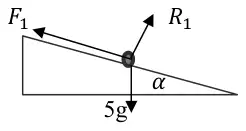
Resolve perpendicular \(R_1 = 5g\cos\alpha\)
B1
3.4
Resolve parallel \(F_1 = 5g\sin\alpha\)
B1
3.3
\(F_1 = \dfrac{9}{29}R_1\) so \(\tan\alpha = \mu\left[=\dfrac{9}{29}\right]\)
M1
1.1
\(\tan^{-1}\dfrac{9}{29} = 17.2^\circ\)
A1
2.1
[4]
Notes
Condone repeated use of \(F\) and \(R\) throughout even though their values have changed
B1: Allow \(R - 5g\cos\alpha = 0\) or \(F = \mu\times 5g\cos\alpha\) seen explicitly
B1: Allow for \(5g\sin\alpha = \mu\times 5g\cos\alpha\) Allow sin/cos interchange if consistent with their \(R_1\)
M1: Allow for fraction which simplifies to 0.310 or better. FT their \(\mu\) or 0.310 May be a quoted formula following B0B0
A1:AG must follow \(\mu = 0.310\) correctly calculated in (a)
Mark scheme (c)
Scheme
Marks
AO
N2L up the slope \(-\left(5g\sin 17.2^\circ + \dfrac{9}{29}5g\cos 17.2^\circ\right) = 5a\)
B1 B1FT M1
3.3 3.4 3.1b
\(a = -5.80\ldots\)
A1
1.1
\(v = u + at\) with \(v = 0,\ u = 5\) and their \(a\)
M1
3.4
\(t = 0.862\) s
A1FT
1.1
[6]
Notes
B1: Correct weight term seen (Allow \(\pm 14.5\) oe)
B1FT: Friction term seen FT their \(\mu\) (Allow \(\pm 14.5\) oe)
M1: Formulate equation of motion with their weight. Allow wrong or missing friction. Allow sign errors No extra forces.
A1: Soi Allow 5.8 if down the slope used as positive direction clear (eg on diagram, or \(u = -5\) or \(a = -5.8\) used subsequently)
M1:suvat equation(s) leading to a value for \(t\). Allow sign errors
A1FT: FT their acceleration \(\neq \pm g\) Using \(\alpha = \tan^{-1}\frac{9}{29}\) gives 0.86067
12 In this question \(x\) and \(y\) are the horizontal and upwards vertical directions respectively.
An astronaut is standing on the surface of the moon exploring the motion of a ball.
(a) The astronaut drops a ball from rest from 1 m above the surface. It takes 1.1 s to hit the surface.
Calculate the value of the acceleration due to the moon’s gravity. Give your answer correct to 3 significant figures. [2]
The astronaut stands in a crater of the moon and hits the ball with a golf club from the moon’s surface. The initial velocity of the ball is \(25\,\mathrm{m\,s^{-1}}\) at an angle of \(40^\circ\) above the horizontal in the \(x\)-direction.
(b) Taking the origin to be the point of projection, determine the equation of the trajectory of the ball. Give your answer in the form \(y = \mathrm{f}(x)\), with each of the coefficients correct to 3 significant figures. [4]
(c) The edge of the crater is 40 m away from the point of projection and 15 m above it.
Determine whether the ball goes over the crater’s edge. [2]
Mark scheme (a)
Scheme
Marks
AO
\(s = ut + \frac{1}{2}at^2\) with \(s = -1,\ u = 0,\ t = 1.1\)
B1: Oe eg \(t = \dfrac{x}{25\cos 40^\circ}\), \(t = 0.0522x\) or \(\dfrac{x}{19.15}\) or \(\dfrac{x}{19.2}\)
M1: Forms equation of motion in the vertical direction Soi. Allow sign errors. Do not allow if \(a = \pm 9.8\) used here or subsequently
M1: Substitutes expression for \(t\) in their \(y\) equation
A1: Cao. Coefficients must be 3sf.
Mark scheme (c)
Scheme
Marks
AO
When \(x = 40,\ y = 30.0\ [\gt 15]\)
M1
3.4
So the ball goes over the crater’s edge
A1
3.2a
[2]
Notes
M1: Use their model and \(x = 40\) (29.72 if exact values used)
A1: Conclusion based on correct working. No FT from wrong (b) Possible interpretation of the question gives \(x = \sqrt{40^2 - 15^2} = 5\sqrt{55} = 37.1\) giving \(y = 28.0\)
Alternative method
Scheme
Marks
When \(y = 15,\ x = 18.8,\ 354\)
M1
So the ball is above 15m as 40 m is between these values
A1
M1: Use the model with \(y = 15\)
A1: Conclusion based on correct working No FT for wrong (b) Possible interpretation \(x = \sqrt{1375} = 37.1\) which is between these values.
When \(x = 40,\ t = 2.09\) when \(y = 15,\ t = 0.983,\ 18.5\)
9 A child throws a pebble of mass 40 g vertically downwards with a speed of \(6\ \text{m s}^{-1}\) from a point 0.8 m above a sandy beach.
(a) Calculate the speed at which the pebble hits the beach. [2]
The pebble travels 3 cm through the sand before coming to rest.
(b) Find the magnitude of the resistance force of the sand on the pebble, assuming it is constant. Give your answer correct to 3 significant figures. [5]
Mark scheme (a)
Scheme
Marks
AO
Using \(v^2 = u^2 + 2as\) with \(s = 0.8, u = 6, a = 9.8\) \(v^2 = 6^2 + 2 \times 9.8 \times 0.8\)
M1
1.1a
\(v = \sqrt{51.68} = 7.19\ \text{m s}^{-1}\)
A1
1.1
[2]
Notes
M1: Allow for suvat equation(s) used leading to a value for \(v\) or \(v^2\) Allow sign errors
A1: Allow even if the sign of \(u\) does not match the sign of \(s\) and \(a\)
Mark scheme (b)
Scheme
Marks
AO
Using \(v^2 = u^2 + 2as\) with \(s = 0.03, u = \sqrt{51.68}, v = 0\) \(0^2 = 51.68 + 2 \times 0.03a\)
M1
3.1b
\(a = -861.3\ldots\ \text{m s}^{-2}\)
A1
1.1
N2L for pebble (downwards positive) \(0.04g - R = 0.04a\) \(0.04g - R = -0.04 \times 861.3\)
M1 A1
3.1b 1.1
\(R = 34.8\ \text{N}\)
A1
1.1
[5]
Notes
M1: Allow for suvat equation(s) used leading to a value for \(a\) Allow for \(s = 3\) used. FT their (a) Allow sign errors
A1: Need not be evaluated
M1: Use of N2L allow one error or omission
A1: Fully correct equation FT their acceleration. Weight must be included.
A1: Must be rounded to 3 sf. Accept 34.8 or 34.9 only
Further Maths students may attempt an energy method for (b)
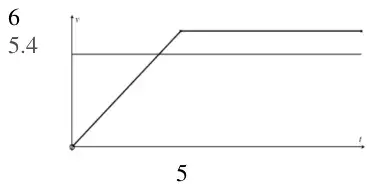
8 A bus is travelling along a straight road at \(5.4\,\mathrm{m\,s^{-1}}\). At \(t = 0\), as the bus passes a boy standing on the pavement, the boy starts running in the same direction as the bus, accelerating at \(1.2\,\mathrm{m\,s^{-2}}\) from rest for 5 s. He then runs at constant speed until he catches up with the bus.
(a) The diagram in the Printed Answer Booklet shows the velocity-time graph for the bus. Draw the velocity-time graph for the boy on this diagram. [3]
(b) Determine the time at which the boy is running at the same speed as the bus. [2]
(c) Find the maximum distance between the bus and the boy. [3]
(d) Find the distance the boy has run when he catches up with the bus. [3]
Mark scheme (a)
Scheme
Marks
AO
B1 B1 B1
3.3 3.3 3.3
[3]
Notes
B1: Straight line segment with positive gradient from the origin
B1: Subsequent line segment horizontal and above the given line
B1: Gradient change in their graph labelled with 5 and 6. (May be on axes)
Mark scheme (b)
Scheme
Marks
AO
velocity of the boy \([t < 5\text{ s}]\) \(v = 1.2t = 5.4\)
M1
3.1b
giving \(t = 4.5\) s
A1
1.1b
[2]
Notes
M1: Equates an expression for boy’s velocity to 5.4
A1: Mark final answer
Mark scheme (c)
Scheme
Marks
AO
Max distance when \(t = 4.5\)
M1
3.1b
boy travels \(\frac{1}{2} \times 1.2 \times 4.5^2 = 12.15\)
M1
3.1b
bus travels \(4.5 \times 5.4 = 24.3\) m Max distance is \(24.3 - 12.15 = 12.15\) m
A1
1.1b
[3]
Notes
M1: recognises that max distance occurs when speeds are equal. Allow for their \(t < 5\) from (b) used. Allow for \(u = 0,\ v = 5.4\) and \(a = 1.2\) in \(v^2 = u^2 + 2as\)
M1: attempt to use suvat or area under the graph and their time \(t \leqslant 5\) to find distance travelled by boy.
A1: Cao
Alternative method 1
Scheme
Marks
Max distance gained by the bus ahead of the boy is represented by the area of the triangle on velocity-time graph
M1
Distance \(= \frac{1}{2} \times 5.4 \times 4.5 = 12.15\) m
M1 A1
M1: recognises that max distance occurs when the speeds are equal. Allow for their time from (b) used
M1: Attempt to find area of the triangle
A1: Cao
Alternative method 2
Scheme
Marks
Distance \(S\) at time \(t\) between \([t < 5]\) \([S =]\ 5.4t - \frac{1}{2} \times 1.2t^2\)
M1
Max occurs when \(\frac{\mathrm{d}S}{\mathrm{d}t} = 5.4 - 1.2t = 0\)
M1
When \(t = 4.5\), max distance is 12.15 m
A1
M1: Combines expressions from suvat equations to find expression for the distance between
M1: Equates the derivative of their expression to zero leading to a value for \(t\)
A1: Cao
Mark scheme (d)
Scheme
Marks
AO
Let the time from start to catch the bus be \(T\) s Boy’s distance is area of trapezium \(\frac{1}{2} \times 6(T + T - 5)\ [= 6T - 15]\)
12 A box of mass \(m\) kg slides down a rough slope inclined at \(15^\circ\) to the horizontal. The coefficient of friction between the box and the slope is 0.4. The box has an initial velocity of \(1.2\,\text{m}\,\text{s}^{-1}\) down the slope.
Calculate the distance the box travels before coming to rest. [7]
Mark scheme
Scheme
Marks
AO
Normal reaction \(mg\cos 15^\circ\)
B1
3.1b
Max friction \(\mu N = 0.4mg\cos 15^\circ\)
M1
1.1b
Resolve down the slope \(mg\sin 15^\circ - F = ma\)
M1: Attempt to evaluate friction FT their normal reaction. Only allow \(0.4mg\) if it is clear that \(mg\) is their normal reaction and not just weight
B1: Correct component of weight seen \((2.536m)\)
M1: All terms present; allow sign errors, sin/cos interchange for weight and their \(F\)
A1: Correct equation (\(a\) need not be explicitly evaluated here)
M1: Use of suvat equation(s) leading to a value for \(s\) using \(v = 0\)
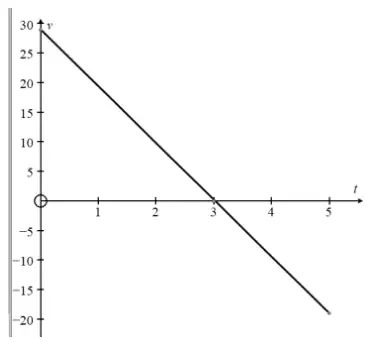
10 A ball is thrown upwards with a velocity of \(29.4\,\text{m}\,\text{s}^{-1}\).
(a) Show that the ball reaches its maximum height after 3 s. [1]
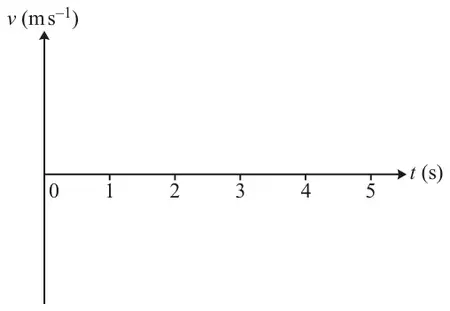
(b) Sketch a velocity-time graph for the first 5 s of motion. [2]
Axes printed in the Printed Answer Booklet for part (b):
(c) Calculate the speed of the ball 5 s after it is thrown. [3]
A second ball is thrown at \(u\,\text{m}\,\text{s}^{-1}\) at an angle of \(\alpha^\circ\) above the horizontal. It reaches the same maximum height as the first ball.
(d) Use this information to write down
the vertical component of the second ball’s initial velocity,
the time taken for the second ball to reach its greatest height.
[2]
This second ball reaches its greatest height at a point which is 48 m horizontally from the point of projection.
(e) Calculate the values of \(u\) and \(\alpha\). [3]
Mark scheme (a)
Scheme
Marks
AO
Time when \(v = 0\) given by \(0 = 29.4 - 9.8t\), so \(t = 3\) s
E1
2.1
[1]
Notes
E1: Using suvat equation(s) leading to correct value for \(t\) with \(v = 0\) Allow for verifying that \(t = 3\) gives \(v = 0\) if identified as the maximum point oe
Mark scheme (b)
Scheme
Marks
AO
B1 B1
1.1b 1.1b
[2]
Notes
B1: straight line with negative gradient through either (3, 0) or (0, 29.4)
B1: Both (3, 0) and (0, 29.4) clearly seen Must include negative values of \(v\) for \(t > 3\)
Mark scheme (c)
Scheme
Marks
AO
When \(t = 5\), \(v = 29.4 - 9.8 \times 5\)
M1
1.1a
\(v = -19.6\)
A1
1.1b
Speed is \(19.6\,\text{m}\,\text{s}^{-1}\)
A1
1.1b
[3]
Notes
M1: Using suvat equation(s) leading to a value for \(v\) with \(t = 5\). Allow sign errors
A1: May be implied by 19.6 seen
A1: FT their negative velocity
If motion from the highest point considered \(u = 0\), \(t = 2\), \(g = +9.8\) then \(v = 19.6\) is fully correct. Allow M1A1A0 if \(29.4 - 9.8 \times 5 = 19.6\) seen
Mark scheme (d)
Scheme
Marks
AO
Max height unchanged so \(u_y = 29.4\,\text{m}\,\text{s}^{-1}\)
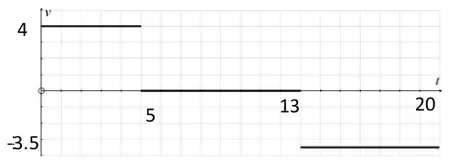
5 A child is running up and down a path. A simplified model of the child’s motion is as follows:
he first runs north for 5 s at \(4\,\mathrm{m\,s^{-1}}\);
he then suddenly stops and waits for 8 s;
finally he runs in the opposite direction for 7 s at \(3.5\,\mathrm{m\,s^{-1}}\).
(a) Taking north to be the positive direction, sketch a velocity-time graph for this model of the child’s motion. [2]
Using this model,
(b) calculate the total distance travelled by the child, [2]
(c) find his final displacement from his original position. [1]
Mark scheme (a)
Scheme
Marks
AO
B1
B1
1.1
1.1
[2]
Notes
B1: Graph from 3 horizontal line segments. Correct velocities labelled Any lines joining the horizontal lines should be vertical
B1: Times seen – either \(t\) = 5, 13, 20 or lengths of line segments 5, 8, 7 seen.
Mark scheme (b)
Scheme
Marks
AO
Distance \(= (4 \times 5) + (7 \times 3.5)\) m
M1
1.1a
\(= 44.5\)
A1
1.1
[2]
Notes
M1: finding the area of at least one region from their graph oe May work directly from the information in the question without reference to their graph
A1: cao
Mark scheme (c)
Scheme
Marks
AO
Displacement \(= 20 - 24.5 = -4.5\) m
B1
1.1
[1]
Notes
B1: Allow for –4.5 m or for 4.5 m south Do not allow -4.5 m south