Forces & Newton's Laws

Edexcel

AQA

OCR A

OCR MEI

June 2025 Paper 3 Mechanics Q3

EdexcelCurrent spec8 marksForces & Newton's LawsVectors

3. [In this question, \(\mathbf{i}\) and \(\mathbf{j}\) are horizontal unit vectors due east and due north respectively.]

A particle \(P\) of mass 0.5 kg moves with constant acceleration \((2\mathbf{i} - 2.4\mathbf{j})\ \text{m s}^{-2}\) on a smooth horizontal plane under the action of a constant horizontal force \(\mathbf{F}\) N.

(a) Find \(\mathbf{F}\) in terms of \(\mathbf{i}\) and \(\mathbf{j}\). (1)

At time \(t = 0\), \(P\) is moving with velocity \((-7\mathbf{i} + 7.8\mathbf{j})\ \text{m s}^{-1}\)

(b) Find the velocity of \(P\) at time \(t = 2\) seconds. (2)
(c) Find the direction of motion of \(P\) at time \(t = 2\) seconds, giving your answer as a bearing in degrees. (3)

At time \(t = 0\), \(P\) passes through the point \(O\).

At time \(t = 5\) seconds, \(P\) passes through the point \(A\).

(d) Find \(\overrightarrow{OA}\) in terms of \(\mathbf{i}\) and \(\mathbf{j}\). (2)

June 2025 Paper 3 Mechanics Q1

EdexcelCurrent spec4 marksForces & Newton's LawsSUVAT

1. A car moves in a straight line along a horizontal road with constant acceleration \(2\ \text{m s}^{-2}\)

The car is moving with speed \(15\ \text{m s}^{-1}\) in the direction of the acceleration when it passes a signpost on the road.

The car is modelled as a particle.

(a) Use the model to find the speed of the car 4 s after passing the signpost. (2)

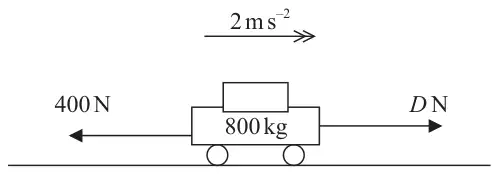
Figure 1 below shows the horizontal forces acting on the car.

Given that

  • the car has mass 800 kg
  • the driving force of the engine has magnitude \(D\) newtons
  • the resistance to the motion of the car has magnitude 400 N
  • the acceleration of the car is \(2\ \text{m s}^{-2}\) in the direction of the driving force
(b) use the model to find the value of \(D\). (2)
Figure 1: car of mass 800 kg on a horizontal road with acceleration 2 m/s² to the right, driving force D N to the right and resistance 400 N to the left
Figure 1

June 2024 Paper 3 Mechanics Q3

EdexcelCurrent spec7 marksForces & Newton's LawsResolving Forces

3.

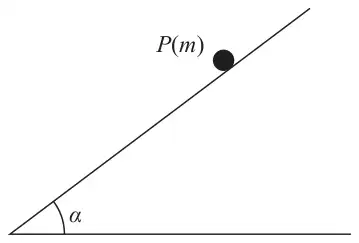
Figure 3: particle P of mass m on a plane inclined at angle alpha to the horizontal
Figure 3

A particle \(P\) of mass \(m\) is held at rest at a point on a rough inclined plane, as shown in Figure 3.

It is given that

  • the plane is inclined to the horizontal at an angle \(\alpha\), where \(\tan\alpha = \dfrac{5}{12}\)
  • the coefficient of friction between \(P\) and the plane is \(\mu\), where \(\mu \lt \dfrac{5}{12}\)

The particle \(P\) is released from rest and slides down the plane.
Air resistance is modelled as being negligible.

Using the model,

(a) find, in terms of \(m\) and \(g\), the magnitude of the normal reaction of the plane on \(P\), (2)
(b) show that, as \(P\) slides down the plane, the acceleration of \(P\) down the plane is\[\frac{1}{13}g(5 - 12\mu)\] (4)
(c) State what would happen to \(P\) if it is released from rest but \(\mu \geqslant \dfrac{5}{12}\) (1)

June 2024 Paper 3 Mechanics Q1

EdexcelCurrent spec3 marksForces & Newton's LawsResolving Forces

1.

Figure 1: particle P of mass 0.5 kg resting on a horizontal line
Figure 1

Figure 1 shows a particle \(P\) of mass 0.5 kg at rest on a rough horizontal plane.

(a) Find the magnitude of the normal reaction of the plane on \(P\). (1)

The coefficient of friction between \(P\) and the plane is \(\dfrac{2}{7}\)

A horizontal force of magnitude \(X\) newtons is applied to \(P\).

Given that \(P\) is now in limiting equilibrium,

(b) find the value of \(X\). (2)

June 2023 Paper 3 Mechanics Q2

EdexcelCurrent spec4 marksForces & Newton's LawsResolving Forces

2.

Figure 1: particle P of mass 5 kg on a horizontal line, with a force of 28 N to the right and a force F N to the left
Figure 1

A particle \(P\) has mass 5 kg.

The particle is pulled along a rough horizontal plane by a horizontal force of magnitude 28 N.

The only resistance to motion is a frictional force of magnitude \(F\) newtons, as shown in Figure 1.

(a) Find the magnitude of the normal reaction of the plane on \(P\) (1)

The particle is accelerating along the plane at \(1.4\ \text{m s}^{-2}\)

(b) Find the value of \(F\) (2)

The coefficient of friction between \(P\) and the plane is \(\mu\)

(c) Find the value of \(\mu\), giving your answer to 2 significant figures. (1)

June 2022 Paper 3 Mechanics Q3

EdexcelCurrent spec9 marksForces & Newton's LawsVectors

3. [In this question, \(\mathbf{i}\) and \(\mathbf{j}\) are horizontal unit vectors.]

A particle \(P\) of mass 4 kg is at rest at the point \(A\) on a smooth horizontal plane.

At time \(t = 0\), two forces, \(\mathbf{F}_1 = (4\mathbf{i} - \mathbf{j})\) N and \(\mathbf{F}_2 = (\lambda\mathbf{i} + \mu\mathbf{j})\) N, where \(\lambda\) and \(\mu\) are constants, are applied to \(P\)

Given that \(P\) moves in the direction of the vector \((3\mathbf{i} + \mathbf{j})\)

(a) show that\[\lambda - 3\mu + 7 = 0\] (4)

At time \(t = 4\) seconds, \(P\) passes through the point \(B\).

Given that \(\lambda = 2\)

(b) find the length of \(AB\). (5)

June 2022 Paper 3 Mechanics Q2

EdexcelCurrent spec10 marksForces & Newton's LawsResolving Forces

2.

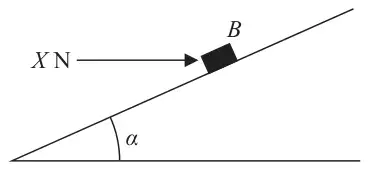
Figure 1: block B on a plane inclined at angle alpha to the horizontal, with a horizontal force X N acting on B towards the plane
Figure 1

A rough plane is inclined to the horizontal at an angle \(\alpha\), where \(\tan\alpha = \dfrac{3}{4}\)

A small block \(B\) of mass 5 kg is held in equilibrium on the plane by a horizontal force of magnitude \(X\) newtons, as shown in Figure 1.

The force acts in a vertical plane which contains a line of greatest slope of the inclined plane.

The block \(B\) is modelled as a particle.

The magnitude of the normal reaction of the plane on \(B\) is 68.6 N.

Using the model,

(a)
(i) find the magnitude of the frictional force acting on \(B\), (3)
(ii) state the direction of the frictional force acting on \(B\). (1)

The horizontal force of magnitude \(X\) newtons is now removed and \(B\) moves down the plane.

Given that the coefficient of friction between \(B\) and the plane is 0.5

(b) find the acceleration of \(B\) down the plane. (6)

June 2025 Paper 2 Q16

16 In this question use \(g = 9.8\ \text{m s}^{-2}\)

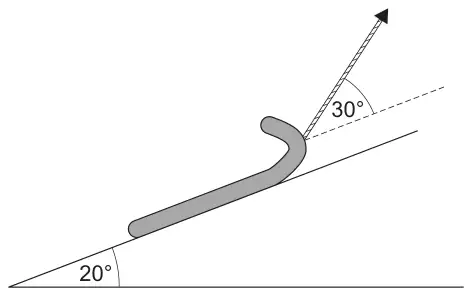
A sledge is pulled in a straight line up a rough path, as shown in the diagram.

The path is inclined at an angle of 20° to the horizontal.

The sledge is pulled by a light, inextensible rope inclined at an angle of 30° to the path.

A sledge on a path inclined at 20° to the horizontal, pulled up the slope by a rope at 30° to the path

The mass of the sledge is 10 kilograms.

(a) In one model, the sledge moves at a constant speed and experiences a combined resistance force of 15 newtons.

Find the tension in the rope for this model.

[4 marks]
(b) In a different model, the sledge experiences no air resistance.

The tension in the rope for this model is 54 N

The coefficient of friction between the sledge and the path is 0.2

Find the acceleration of the sledge for this model.

[7 marks]
(c) State an assumption you have used to answer both parts (a) and (b). [1 mark]

June 2024 Paper 2 Q15

AQACurrent spec4 marksForces & Newton's LawsVectors

15 Two forces, \(\mathbf{F_1}\) and \(\mathbf{F_2}\), are acting on a particle of mass 3 kilograms.

It is given that

\[\mathbf{F_1} = \begin{bmatrix} a \\ 23 \end{bmatrix} \text{ newtons} \quad \text{and} \quad \mathbf{F_2} = \begin{bmatrix} 4 \\ b \end{bmatrix} \text{ newtons}\]

where \(a\) and \(b\) are constants.

The particle has an acceleration of \(\begin{bmatrix} 4b \\ a \end{bmatrix}\) m s−2

Find the value of \(a\) and the value of \(b\) [4 marks]

June 2024 Paper 2 Q12

AQACurrent spec1 markForces & Newton's Laws

12 Two constant forces act on a particle, of mass 2 kilograms, so that it moves forward in a straight line.

The two forces are:

  • a forward driving force of 10 newtons
  • a resistance force of 4 newtons.

Find the acceleration of the particle.

Circle your answer. [1 mark]

  • 2 m s−2
  • 3 m s−2
  • 5 m s−2
  • 12 m s−2

June 2023 Paper 2 Q16

AQACurrent spec4 marksForces & Newton's LawsVectors

16 A particle moves under the action of two forces, \(\mathbf{F}_1\) and \(\mathbf{F}_2\)

It is given that

\[\mathbf{F}_1 = (1.6\mathbf{i} - 5\mathbf{j})\text{ N}\]\[\mathbf{F}_2 = (k\mathbf{i} + 5k\mathbf{j})\text{ N}\]

where \(k\) is a constant.

The acceleration of the particle is \((3.2\mathbf{i} + 12\mathbf{j})\) m s−2

Find \(k\) [4 marks]

June 2023 Paper 2 Q15

15 In this question use \(g = 9.8\) m s−2

A particle, \(Q\), moves in a straight line across a rough horizontal surface.

A horizontal driving force of magnitude \(D\) newtons acts on \(Q\)

\(Q\) moves with a constant acceleration of 0.91 m s−2

\(Q\) has a weight of 0.65 N

The only resistance force acting on \(Q\) is due to friction.

The coefficient of friction between \(Q\) and the surface is 0.4

Find \(D\) [4 marks]

June 2023 Paper 2 Q11

AQACurrent spec1 markForces & Newton's Laws

11 A decoration is hanging freely from a fixed point on a ceiling.

The decoration has a mass of 0.2 kilograms.

The decoration is hanging by a light, inextensible wire.

The wire is 0.1 metres long.

Find the tension in the wire.

Circle your answer. [1 mark]

  • 0.02 N
  • 0.02\(g\) N
  • 0.2 N
  • 0.2\(g\) N

June 2022 Paper 2 Q11

AQACurrent spec1 markForces & Newton's Laws

11 A moon vehicle has a mass of 212 kg and a length of 3 metres.

On the moon the vehicle has a weight of 345 N

Calculate a value for acceleration due to gravity on the moon.

Circle your answer. [1 mark]

  • 0.614 m s−2
  • 1.63 m s−2
  • 1.84 m s−2
  • 4.89 m s−2

June 2025 Paper 3 Q12

12

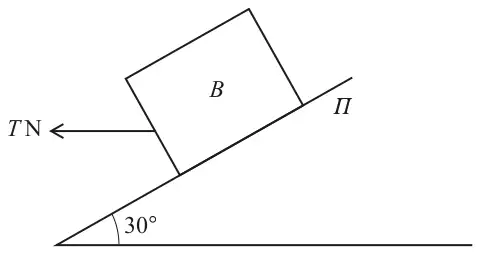
Fig. 1: rectangular block B resting on a plane labelled Pi inclined at 30 degrees to the horizontal, with a horizontal force T N applied to the block, pointing away from the slope
Fig. 1

A rectangular block \(B\) of mass 10 kg lies at rest in limiting equilibrium on a rough plane \(\Pi\) inclined at 30° to the horizontal. A horizontal force of magnitude \(T\) N, acting above a line of greatest slope, is applied to \(B\) (see Fig. 1).

The coefficient of friction between \(B\) and the plane is 0.8.

(a) Show that the value of \(T\) is 14.9, correct to 3 significant figures. [6]

For the remainder of the question, you should you use this value of \(T\).

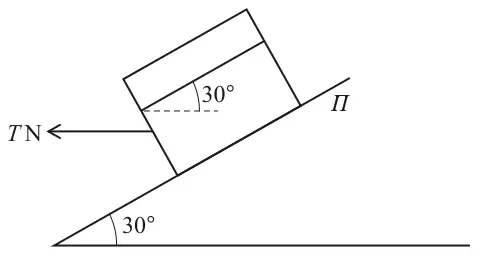
Fig. 2: the block on the same 30 degree plane, now cut into an upper and a lower block along a line at 30 degrees to the horizontal (shown by a dashed horizontal reference line); the horizontal force T N acts on the lower block
Fig. 2

Block \(B\) is now cut at an angle of 30° to the horizontal into two smaller blocks. The upper block has a mass of 4 kg, and the lower block has a mass of 6 kg. The two blocks are held at rest with the lower block on \(\Pi\). The horizontal force of magnitude \(T\) N is now applied to the lower block (see Fig. 2).

The two blocks are released from rest and in the subsequent motion the upper block starts to move with acceleration 3.5 m s−2.

(b) Determine the coefficient of friction between the two blocks. [4]
(c) Show that the lower block does not move. [3]

June 2025 Paper 3 Q7

OCR ACurrent spec5 marksForces & Newton's LawsVectors

7 A particle \(P\) of mass 3 kg is moving on a smooth horizontal surface under the action of two constant horizontal forces \((5\mathbf{i} + 3\mathbf{j})\) N and \((a\mathbf{i} + 3b\mathbf{j})\) N. The acceleration of \(P\) is \((2\mathbf{i} - 3\mathbf{j})\) m s−2.

(a) Find the value of \(a\) and the value of \(b\). [3]

At time \(t = 0\) seconds the velocity of \(P\) is \(\mathbf{u}\) m s−1 and at time \(t = 5\) seconds the velocity of \(P\) is \((7\mathbf{i} - 6\mathbf{j})\) m s−1.

(b) Find, in terms of \(\mathbf{i}\) and \(\mathbf{j}\), an expression for \(\mathbf{u}\). [2]

June 2023 Paper 3 Q10

OCR ACurrent spec7 marksForces & Newton's LawsVectors

10 A particle \(P\) of mass \(m\,\mathrm{kg}\) is moving on a smooth horizontal surface under the action of two constant horizontal forces \((-4\mathbf{i} + 2\mathbf{j})\,\mathrm{N}\) and \((a\mathbf{i} + b\mathbf{j})\,\mathrm{N}\). The resultant of these two forces is \(\mathbf{R}\,\mathrm{N}\). It is given that \(\mathbf{R}\) acts in a direction which is parallel to the vector \(-\mathbf{i} + 3\mathbf{j}\).

(a) Show that \(3a + b = 10\). [3]

It is given that \(a = 6\) and that \(P\) moves with an acceleration of magnitude \(5\sqrt{10}\,\mathrm{m\,s^{-2}}\).

(b) Determine the value of \(m\). [4]

June 2024 Paper 1 Q9

OCR MEICurrent spec7 marksForces & Newton's LawsSUVAT

9 A child throws a pebble of mass 40 g vertically downwards with a speed of \(6\ \text{m s}^{-1}\) from a point 0.8 m above a sandy beach.

(a) Calculate the speed at which the pebble hits the beach. [2]

The pebble travels 3 cm through the sand before coming to rest.

(b) Find the magnitude of the resistance force of the sand on the pebble, assuming it is constant. Give your answer correct to 3 significant figures. [5]

June 2024 Paper 1 Q2

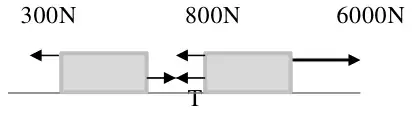
2 A car of mass 1400 kg pulls a trailer of mass 400 kg along a straight horizontal road. The engine of the car produces a driving force of 6000 N. A resistance of 800 N acts on the car. A resistance of 300 N acts on the trailer. The tow-bar between the car and the trailer is light and horizontal.

(a) Draw a force diagram showing all the horizontal forces on the car and the trailer. [2]
(b) Calculate the acceleration of the car and trailer. [3]

June 2023 Paper 1 Q12

OCR MEICurrent spec7 marksForces & Newton's LawsVectors

12 In this question the unit vectors \(\mathbf{i}\) and \(\mathbf{j}\) are horizontal and vertically upwards respectively.

A particle has mass 2 kg.

(a) Write down its weight as a vector. [1]

A horizontal force of 3 N in the \(\mathbf{i}\) direction and a force \(\mathbf{F} = (-4\mathbf{i} + 12\mathbf{j})\) N act on the particle.

(b) Determine the acceleration of the particle. [3]
(c) The initial velocity of the particle is \(5\mathbf{i}\,\mathrm{m\,s^{-1}}\).
Find the velocity of the particle after 4 s. [2]
(d) Find the extra force that must be applied to the particle for it to move at constant velocity. [1]

October 2021 Paper 1 Q9

9 The diagram shows a toy caterpillar consisting of a head and three body sections each connected by a light inextensible ribbon. The head has a mass of 120 g and the body sections each have a mass of 90 g.

The toy is pulled on level ground using a horizontal string attached to the head. The tension in the string is 12 N. There are resistances to motion of 2.5 N for the head and each section of the body.

Toy caterpillar on level ground: three body sections on the left joined in a line to the head on the right, with a horizontal string attached to the head
(a)
(i) State the equation of motion for the toy caterpillar modelled as a single particle. [2]
(ii) Calculate the acceleration of the toy caterpillar. [1]
(b) Draw a diagram showing all the forces acting on the head of the toy caterpillar. [3]
(c) Calculate the tension in the ribbon that joins the head to the body. [2]

October 2021 Paper 1 Q2

OCR MEICurrent spec3 marksForces & Newton's Laws

2 An unmanned spacecraft has a weight of 5200 N on Earth. It lands on the surface of the planet Mars where the acceleration due to gravity is \(3.7\,\text{m}\,\text{s}^{-2}\).

Calculate the weight of the spacecraft on Mars. [3]