October 2021 Paper 3 Mechanics Q2
2.
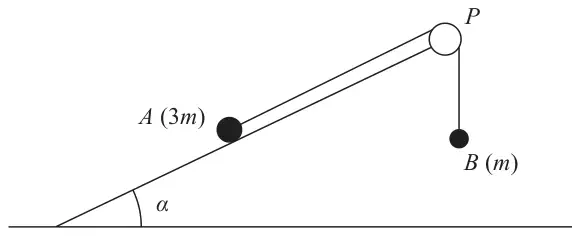
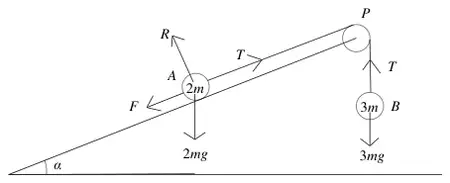
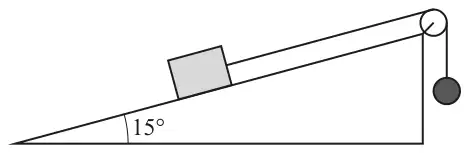
A small stone \(A\) of mass \(3m\) is attached to one end of a string.
A small stone \(B\) of mass \(m\) is attached to the other end of the string.
Initially \(A\) is held at rest on a fixed rough plane.
The plane is inclined to the horizontal at an angle \(\alpha\), where \(\tan\alpha = \dfrac{3}{4}\)
The string passes over a pulley \(P\) that is fixed at the top of the plane.
The part of the string from \(A\) to \(P\) is parallel to a line of greatest slope of the plane.
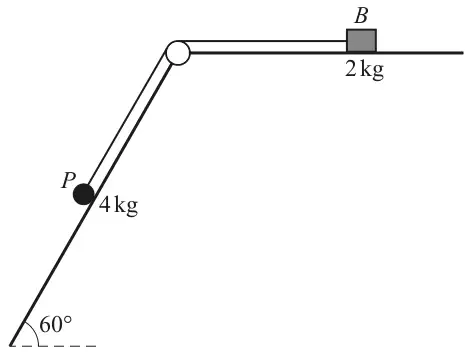
Stone \(B\) hangs freely below \(P\), as shown in Figure 1.
The coefficient of friction between \(A\) and the plane is \(\dfrac{1}{6}\)
Stone \(A\) is released from rest and begins to move down the plane.
The stones are modelled as particles.
The pulley is modelled as being small and smooth.
The string is modelled as being light and inextensible.
Using the model for the motion of the system before \(B\) reaches the pulley,
In reality, the string is not light.
| Scheme | Marks | AO |
|---|---|---|
| Equation of motion for \(A\) | M1 | 3.3 |
| \(3mg\sin\alpha - F - T = 3ma\) | A1 | 1.1b |
| (2) |
Notes
Mark parts (a) and (b) together
N.B. If m’s are consistently missing treat as a MR, so max
(a) M1A0 (b) M1A0B0M1A1M1A1 (c) B1B1 (d) B1
For (a) and (b), allow verification, but must see full equations of motion.
M1: Equation in \(T\) and \(a\) with correct no. of terms, condone sign errors and sin/cos confusion (If one of the 3’s is missing, allow M1)
N.B. Treat \(\sin(3/5)\) etc as an A error but allow recovery
A1: Correct equation (allow \((-a)\) instead of \(a\) in both equations)
| Scheme | Marks | AO |
|---|---|---|
| Resolve perpendicular to the plane | M1 | 3.4 |
| \(R = 3mg\cos\alpha\) | A1 | 1.1b |
| \(F = \dfrac{1}{6}R\) | B1 | 1.2 |
| Equation of motion for \(B\) OR for whole system | M1 | 3.3 |
| \(T - mg = ma\) OR \(3mg\sin\alpha - F - mg = 3ma + ma\) | A1 | 1.1b |
| Complete method to solve for \(a\) | DM1 | 3.1b |
| \(a = \dfrac{1}{10}g\) * | A1* | 2.2a |
| (7) |
Notes
Mark parts (a) and (b) together
N.B. If m’s are consistently missing treat as a MR, so max
(a) M1A0 (b) M1A0B0M1A1M1A1 (c) B1B1 (d) B1
For (a) and (b), allow verification, but must see full equations of motion.
M1: Correct no. of terms, condone sign errors and sin/cos confusion
Allow if appears in (a)
A1: Correct equation
B1: Seen anywhere in (a) or (b), including on a diagram
M1: Equation (for \(B\)) in \(T\) and \(a\) with correct no. of terms, condone sign errors and sin/cos confusion
OR Whole system equation with correct no. of terms, condone sign errors and sin/cos confusion
A1: Correct equation
DM1: Complete method (trig may not be substituted), dependent on M1 in (a) and second M1 in (b) if they use two equations, or second M1 in (b) if they use one equation.
A1*: Correct answer correctly obtained.
| Scheme | Marks | AO |
|---|---|---|
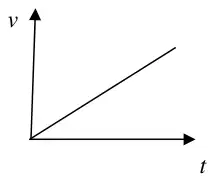 | B1 | 1.1b |
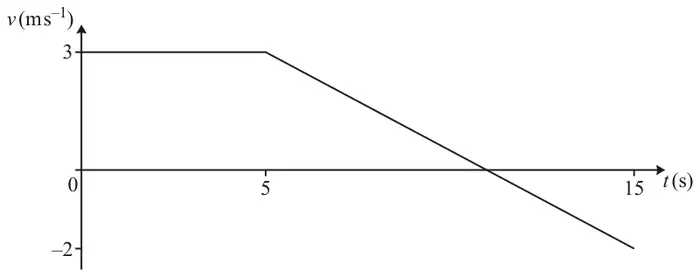
| e.g. acceleration (of \(B\)) is constant; dependent on first B1 | DB1 | 2.4 |
| (2) |
Notes
N.B. If m’s are consistently missing treat as a MR, so max
(a) M1A0 (b) M1A0B0M1A1M1A1 (c) B1B1 (d) B1
For (a) and (b), allow verification, but must see full equations of motion.
B1: Straight line starting at the origin (could be reflected in the \(t\)-axis). B0 if continuous vertical line at the end.
DB1: Dependent on first B1, for any equivalent statement
| Scheme | Marks | AO |
|---|---|---|
| e.g. the tensions in the two equations of motion would be different. Tension on \(A\) would be different to tension on \(B\) | B1 | 3.5a |
| (1) | ||
| (12 marks) |
Notes
N.B. If m’s are consistently missing treat as a MR, so max
(a) M1A0 (b) M1A0B0M1A1M1A1 (c) B1B1 (d) B1
For (a) and (b), allow verification, but must see full equations of motion.
B1: B0 if incorrect extras

![Force diagram for the head: R upwards, 0.12g N downwards, 12 N to the right, and to the left the tension [in the ribbon] and 2.5 N](https://www.westiesworkshop.com/wp-content/uploads/question-bank/a2-mei/mei-h64001-oct21-q9-ms-fig1.webp)