
June 2022 Paper 3 Q10
10
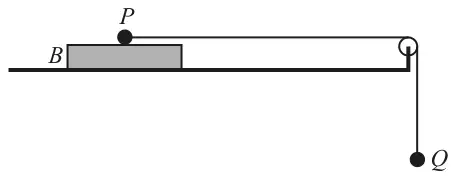
A rectangular block \(B\) is at rest on a horizontal surface. A particle \(P\) of mass 2.5 kg is placed on the upper surface of \(B\). The particle \(P\) is attached to one end of a light inextensible string which passes over a smooth fixed pulley. A particle \(Q\) of mass 3 kg is attached to the other end of the string and hangs freely below the pulley. The part of the string between \(P\) and the pulley is horizontal (see diagram).
The particles are released from rest with the string taut. It is given that \(B\) remains in equilibrium while \(P\) moves on the upper surface of \(B\). The tension in the string while \(P\) moves on \(B\) is 16.8 N.
| Scheme | Marks | AO |
|---|---|---|
| \(3g - 16.8 = 3a\) | M1 | 3.3 |
| \(a = \dfrac{3g - 16.8}{3} = 4.2\) (\(\mathrm{m\,s^{-2}}\)) | A1 | 1.1 |
| [2] |
Notes
M1: N2L for \(Q\) – correct number of terms with the correct mass. Condone sign errors
M0 if using \(3g\) for the mass but allow \(g\) missing from the net force
| Scheme | Marks | AO |
|---|---|---|
| \(16.8 - F_P = 2.5(4.2)\) | M1* | 3.3 |
| \(16.8 - 2.5(4.2) = \mu(2.5g)\) | M1dep* | 3.4 |
| \(\mu = 0.257\) | A1 | 1.1 |
| [3] |
Notes
M1*: N2L for \(P\) horizontally using \(T = 16.8\) and their \(a\) (but not \(\pm 9.8\)) from (a) – allow sign errors but must have correct number of terms and correct mass (\(\ne 3\)) – if correct \(F_P = 6.3\)
\(F_P\) is the friction between \(P\) and \(B\)
M1dep*: Use of \(F = \mu R\) for \(P\) with \(R = 2.5g\)
A1: awrt 0.257 – condone working with \(F \leqslant \mu R\) provided that the value of \(\mu\) is explicitly stated (and not left in an inequality)
0.257142857…
allow \(\dfrac{9}{35}\)
| Scheme | Marks | AO |
|---|---|---|
| \(R_B = 2.5g + Mg\) | M1* | 3.1b |
| \(6.3 \leqslant \dfrac{5}{49}(2.5g + Mg)\) | M1dep* | 3.4 |
| \(M \geqslant 3.8\) so least possible value for the mass of \(B\) is 3.8 (kg) | A1 | 2.2a |
| [3] |
Notes
M1*: Resolving vertically for \(B\) – correct number of terms, allow sign errors and condone \(g\)’s missing
Where \(M\) is the mass of \(B\)
M1dep*: Use of \(F \leqslant \mu R\) or \(F = \mu R\) with correct \(R\) and \(\mu = \frac{5}{49}\) with \(F\) being their \(F_P\) from (b) where \(F_P \ne 16.8\)
No \(g\)’s missing for this mark
A1: 3.8 - allow use of ‘=’ throughout this part
No justification required