
June 2023 Paper 3 Q13
13
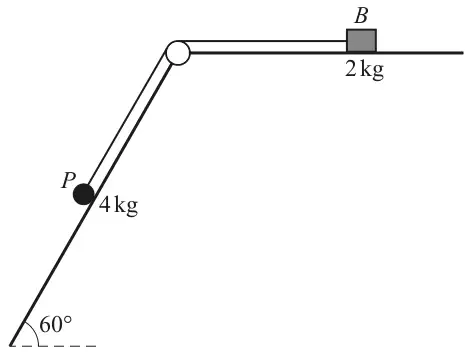
The diagram shows a small block \(B\), of mass \(2\,\mathrm{kg}\), and a particle \(P\), of mass \(4\,\mathrm{kg}\), which are attached to the ends of a light inextensible string. The string is taut and passes over a small smooth pulley fixed at the intersection of a horizontal surface and an inclined plane. The particle can move on the inclined plane, which is rough, and which makes an angle of \(60^\circ\) with the horizontal. The block can move on the horizontal surface, which is also rough.
The system is released from rest, and in the subsequent motion \(P\) moves down the plane and \(B\) does not reach the pulley.
It is given that the coefficient of friction between \(P\) and the inclined plane is twice the coefficient of friction between \(B\) and the horizontal surface.
When \(P\) is moving at \(2\,\mathrm{m\,s^{-1}}\) the string breaks. In the 0.5 seconds after the string breaks \(P\) moves \(1.9\,\mathrm{m}\) down the plane.
See appendix at the end of the MS for important information regarding this part
| Scheme | Marks | AO |
|---|---|---|
| M1* | 2.1 | |
| \(4g\sin 60 - F_P - T = 4a\) | A1 | 1.1 |
| \(R_P = 4g\cos 60\) | B1 | 3.3 |
| \(4g\sin 60 - \mu_P(4g\cos 60) - T = 4a\) \(\Rightarrow 2\sqrt{3}g - 2\mu_P g - T = 4a\) | M1dep* | 3.4 |
| \(T - \mu_B(2g) = 2a\) | M1 | 3.3 |
| \(2\sqrt{3}g - 2\mu_P g - T = 4a\) and \(2T - 4\mu_B g = 4a\) with \(\mu_P = 2\mu_B\) gives \(2\sqrt{3}g - T = 2T\) | A1 | 3.3 |
| \(2\sqrt{3}g - T = 2T \Rightarrow T = \dfrac{2\sqrt{3}}{3}g\) | A1 | 2.2a |
| [7] |
Notes
For the first five marks condone: \(\mu\) used as the coefficient of friction for both \(P\) and \(B\), or implying that \(\mu_B = 2\mu_P\) rather than the correct \(\mu_P = 2\mu_B\)
M1*: Applying N2L parallel to the plane for \(P\) – correct number of terms and weight component resolved – allow sign errors and sin/cos confusion. Allow \(g\) missing but M0 if \(4ga\) in N2L
A1: NB \(T + F_P - 4g\sin 60 = 4a\) is A1 (taking up the plane as +ve dir.)
Where \(F_P\) is the frictional force for \(P\)
B1: Resolving correctly perpendicular to the plane for \(P\)
Where \(R_P\) is the normal contact force for \(P\)
M1dep*: Use of \(F = \mu R\) in the attempt at N2L for \(P\) with their \(R\) which must be a component of \(4g\) only
Where \(\mu_P\) is the coefficient of friction between \(P\) and the plane
M1: Applying N2L parallel to the surface for \(B\) – correct number of terms – allow sign errors but note that \(\mu_B(2g) - T = 2a\) is consistent with \(T + F_P - 4g\sin 60 = 4a\) and therefore gives the correct answer (and is not incorrect working)
Where \(\mu_B\) is the coefficient of friction between \(B\) and the plane
Allow \(g\) missing but M0 if \(2ga\) in N2L or for \(T - F_B = 2a\) only
A1: Solving simultaneously with \(\mu_P = 2\mu_B\) (soi) to obtain a correct equation in \(T\) only
A1: Must be seen in terms of \(g\)
Accept awrt \(1.15g\)
Appendix: exemplar responses for Q13(a)
See main MS for Guidance for the requirements/conditions to award each of these marks.
Case 1 (max 7): candidates who immediately set \(\mu\) as the coefficient of friction for \(B\) and \(2\mu\) as the coefficient of friction for \(P\) (correct)
| Response | Marks |
|---|---|
| \(4g\sin 60 - F_P - T = 4a\) | M1 A1 |
| \(R_P = 4g\cos 60\) | B1 |
| \(4g\sin 60 - 2\mu(4g\cos 60) - T = 4a\) | M1 |
| \(T - \mu(2g) = 2a\) | M1 |
| \(2\sqrt{3}g - T = 2T\) | A1 |
| \(T = \dfrac{2\sqrt{3}}{3}g\) | A1 |
Or equivalent e.g. replace \(2\mu\) above with \(\mu\) and \(\mu\) above with \(0.5\mu\)
Case 2 (max 5): candidates who immediately set \(2\mu\) as the coefficient of friction for \(B\) and \(\mu\) as the coefficient of friction for \(P\) or set both coefficients of frictions equal to \(\mu\) (both of these are incorrect)
| Response (\(2\mu\) for \(B\), \(\mu\) for \(P\)) | Marks |
|---|---|
| \(4g\sin 60 - F_P - T = 4a\) | M1 A1 |
| \(R_P = 4g\cos 60\) | B1 |
| \(4g\sin 60 - \mu(4g\cos 60) - T = 4a\) | M1 |
| \(T - 2\mu(2g) = 2a\) | M1 |
| \(4g\sin 60 - 4g\mu\cos 60 - T = 2T - 8\mu g\) | A0 A0 |
| Response (\(\mu\) for both) | Marks |
|---|---|
| \(4g\sin 60 - F_P - T = 4a\) | M1 A1 |
| \(R_P = 4g\cos 60\) | B1 |
| \(4g\sin 60 - \mu(4g\cos 60) - T = 4a\) | M1 |
| \(T - \mu(2g) = 2a\) | M1 |
| \(4g\sin 60 - 4g\mu\cos 60 - T = 2T - 4\mu g\) | A0 A0 |
Case 3 (max 3): assuming that as \(\mu_P = 2\mu_B\) then this implies that \(F_P = 2F_B\) without justification (e.g. no calculation of the normal contact forces for \(P\) and \(B\) considered – so while it turns out to be correct in this case it is not true in general) – if this is assumed then
| Response | Marks |
|---|---|
| \(4g\sin 60 - 2F - T = 4a\) | M1 A1 |
| \(T - F = 2a\) | M1 |
(so now allow this M mark even though in the main MS this would have been M0)
leading to \(2g\sqrt{3} - 2(T - 2a) - T = 4a\) and therefore \(T = \dfrac{2\sqrt{3}}{3}g\) no further marks (3 marks max. also if assuming that \(2F_P = F_B\))
Case 4 (max 1): if assuming that \(a = 0\) or \(g\) or any other value then they can score the B mark only for \(R_P = 4g\cos 60\)
| Scheme | Marks | AO |
|---|---|---|
| \(1.9 = 2(0.5) + \frac{1}{2}a_P(0.5)^2\) | B1 | 3.4 |
| \(a_P = 7.2\) | B1 | 1.1 |
| \(4g\sin 60 - \mu_P(4g\cos 60) = 4a_P\) | M1 | 3.1b |
| \(\mu_P = 0.26266\ldots \Rightarrow \mu_B = 0.13(1\ldots)\) | A1 | 3.4 |
| \(a_B = -\mu_B g \Rightarrow\) deceleration is 1.29 \((\mathrm{m\,s^{-2}})\) | A1 | 3.2a |
| [5] |
Notes
B1: Applying \(s = ut + \frac{1}{2}at^2\) correctly to find \(a_P\)
M1: Set \(T = 0\) (or apply N2L) to obtain an expression for the acceleration of \(P\) when the string breaks
Correct number of terms, dimensionally correct (so \(g\) not missing), must be using the correct mass of 4 – allow sin/cos mix and sign errors only
A1: Using their acceleration of \(P\) to correctly calculate the coefficient of friction for \(B\). Can be implied from a correct deceleration of \(B\). Accept 0.13 (so 2 sf) or better
For reference: exact value is \(\dfrac{-72 + 49\sqrt{3}}{98}\) (which scores A1)
A1: Accept awrt 1.29 or \(-1.29\)
\(1.28704895\ldots\) or, for reference, exact value is \(\dfrac{-72 + 49\sqrt{3}}{10}\) (which scores A1)