
June 2022 Paper 1 Q13
13 A toy train consists of an engine of mass 0.5 kg pulling a coach of mass 0.4 kg. The coupling between the engine and the coach is light and inextensible. The train is pulled along with a string attached to the front of the engine.
At first, the train is pulled from rest along a horizontal carpet where there is a resistance to motion of 0.8 N on each part of the train. The string is horizontal, and the tension in the string is 5 N.
The train is then pulled up a track inclined at \(20^\circ\) to the horizontal. The string is parallel to the track and the tension in the string is \(P\) N. The resistance on each part of the train along the track is \(R\) N.
Calculate the value of \(R\). [3]
| Scheme | Marks | AO |
|---|---|---|
| Newton’s second law for the train \(5 - 2 \times 0.8 = (0.5 + 0.4)a\) | M1 | 3.1b |
| giving \(a = \frac{34}{9} = 3.78\ \mathrm{m\,s^{-2}}\). | A1 | 1.1b |
| Using \(v = u + at\) with \(u = 0,\ t = 1.5\) | M1 | 3.1b |
| \(v = \frac{34}{9} \times 1.5 = \frac{17}{3} = 5.67\ \mathrm{m\,s^{-1}}\) (3sf) | A1 | 1.1b |
| [4] |
Notes
M1: N2L for whole train with correct mass and all forces present
Alternative: \(5 - 0.8 - T = 0.5a\), \(T - 0.8 = 0.4a\). Also allow for 2 equations where both have correct mass and all forces present in each
M1: using suvat equation(s) with \(u = 0\) and their \(a \neq g\) leading to a value for \(v\)
A1: FT their \(a\). Any form
| Scheme | Marks | AO |
|---|---|---|
 | B1 B1 B1 | 1.1b 1.1b 1.1b |
| [3] |
Notes
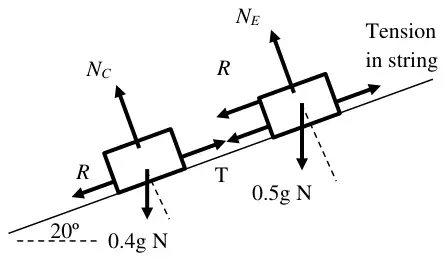
B1: weights and normal reactions (must be distinct and not vertical)
Allow if both components of weight given instead. Allow in addition to weight only if clear they are for working purposes only
B1: tensions in string and coupling parallel to inclined plane
B1: \(R\) marked for both parts of the train. No additional forces
Allow if distinct if it is clear they are equal in later work
| Scheme | Marks | AO |
|---|---|---|
| Newton’s second law \(P - 2R - 0.9g\sin 20^\circ = 0.9a\) | M1 A1 | 1.1b 3.3 |
| [2] |
Notes
M1: Newton’s law with \(m = 0.9\). Allow for incorrect weight term(s) or \(R\) used instead of \(2R\)
A1: Fully correct
Any form
| Scheme | Marks | AO |
|---|---|---|
| When \(P = 5\) the equation gives \(5 - 2R - 0.9g\sin 20^\circ = 0.9a\) | M1 | 3.1b |
| When \(P = 5.5\) the equation gives \(5.5 - 2R - 0.9g\sin 20^\circ = 0.9 \times 2a\) | M1 | 3.1b |
| Solve simultaneously giving \(R = 0.742\) \(\left[a = \frac{5}{9}\right]\) | A1 | 1.1b |
| [3] |
Notes
M1: establishes one equation linking \(R\) and \(a\). FT their (c)
M1: establishes another equation linking \(R\) and \(a\). Consistent with their first equation
A1: method need not be seen BC
correct value for \(R\) (\(a\) is not required)
Alternative method
| Scheme | Marks |
|---|---|
| When \(P = 5\) \(a = \dfrac{5 - 2R - 0.9g\sin 20^\circ}{0.9}\) When \(P = 5.5\) \(a_1 = \dfrac{5.5 - 2R - 0.9g\sin 20^\circ}{0.9}\) | M1 |
| So \(\dfrac{5.5 - 2R - 0.9g\sin 20^\circ}{0.9} = 2\left(\dfrac{5 - 2R - 0.9g\sin 20^\circ}{0.9}\right)\) | M1 |
| giving \(R = 0.742\) \(\left[a = \frac{5}{9}\right]\) | A1 |
M1: Finds expression for \(a\) when \(P = 5\) or \(P = 5.5\). Soi
M1: Links corresponding acceleration for the other value of \(P\)
Do not allow factor of 2 on the wrong side
A1: correct value for \(R\) (\(a\) is not required)