
June 2019 Paper 3 Mechanics Q3
3.
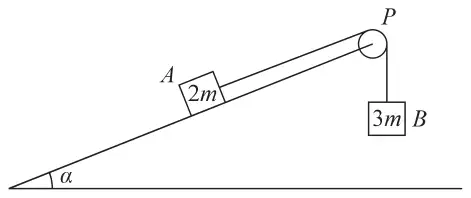
Two blocks, \(A\) and \(B\), of masses \(2m\) and \(3m\) respectively, are attached to the ends of a light string.
Initially \(A\) is held at rest on a fixed rough plane.
The plane is inclined at angle \(\alpha\) to the horizontal ground, where \(\tan\alpha = \dfrac{5}{12}\)
The string passes over a small smooth pulley, \(P\), fixed at the top of the plane.
The part of the string from \(A\) to \(P\) is parallel to a line of greatest slope of the plane. Block \(B\) hangs freely below \(P\), as shown in Figure 1.
The coefficient of friction between \(A\) and the plane is \(\dfrac{2}{3}\)
The blocks are released from rest with the string taut and \(A\) moves up the plane.
The tension in the string immediately after the blocks are released is \(T\).
The blocks are modelled as particles and the string is modelled as being inextensible.
After \(B\) reaches the ground, \(A\) continues to move up the plane until it comes to rest before reaching \(P\).
| Scheme | Marks | AO |
|---|---|---|
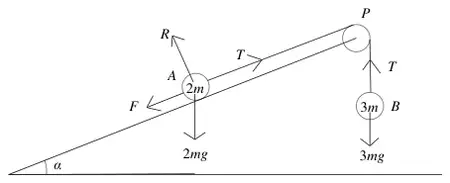 | ||
| \(R = 2mg\cos\alpha\) | B1 | 3.4 |
| \(F = \dfrac{2}{3}R\) | B1 | 1.2 |
| Equation of motion for \(A\): | M1 | 3.3 |
| \(T - F - 2mg\sin\alpha = 2ma\) | A1 | 1.1b |
| Equation of motion for \(B\): | M1 | 3.3 |
| \(3mg - T = 3ma\) | A1 | 1.1b |
| Complete strategy to find an equation in \(T\), \(m\) and \(g\) only. | M1 | 3.1b |
| \(T = \dfrac{12mg}{5}\) * | A1* | 2.2a |
| (8) |
Notes
B1: Normal reaction between \(A\) and the plane seen or implied, \(\cos\alpha\) does not need to be substituted.
B1: \(F = \dfrac{2}{3}R\) seen or implied anywhere, including part (b)
M1: Form an equation of motion for \(A\). Must include all relevant terms. Must be the correct mass but condone consistent missing \(m\)’s. Condone sign errors and sin/cos confusion
A1: Correct unsimplified equation (\(F\) does not need to be substituted). Allow consistent use of \((-a)\)
N.B. If \(T - 2mg = 2ma\) is seen with no working, M0A0 unless both B1 marks have been scored.
M1: Form an equation of motion for \(B\). Must be the correct mass on RHS but condone consistent missing \(m\)’s. Condone sign errors and sin/cos confusion.
A1: Correct unsimplified equation (\(F\) does not need to be substituted). Allow consistent use of \((-a)\)
N.B. Allow the ‘whole system’ equation to replace the equation for \(A\) or \(B\).
\(3mg - F - 2mg\sin\alpha = 5ma\)
Must be the correct mass on RHS but condone consistent missing \(m\)’s. Condone sign errors and sin/cos confusion.
M1: Complete method to give an equation in \(T\), \(m\) and \(g\) only. N.B. Allow \(\theta\) in the equation if they have defined what \(\theta\) is: e.g. \(\theta = \tan^{-1}\left(\dfrac{5}{12}\right)\)
This is an independent mark but they must have two simultaneous equations in \(T\) and \(a\) unless one of the equations is the whole system equation in which case one equation will be in \(T\) and \(a\) and the other equation will be in \(a\) only.
A1*: Obtain the given answer from correct working using EXACT trig ratios. (not available if using a decimal angle)
| Scheme | Marks | AO |
|---|---|---|
| \((F_{\max} =)\ \dfrac{16mg}{13} > \dfrac{10mg}{13}\) | M1 | 2.1 |
| …… so \(A\) will not move. | A1 | 2.2a |
| (2) |
Notes
M1: Comparison of their \(F_{\max}\) \(\left(\dfrac{2}{3}R\right)\) and their component of weight down the slope, must be comparing numerical values. oe e.g. if they consider the difference
N.B. Allow comparison of \(\mu\) and \(\tan\alpha\) with numerical values
A1: Correctly justified conclusion and no errors seen
N.B. If they equate their difference to an ‘\(ma\)’ term then A0
| Scheme | Marks | AO |
|---|---|---|
| B1 B1 | 3.5c 3.5c |
| (2) | ||
| (12 marks) |
Notes
B1 B1: Deduct 1 mark for each extra (more than 2) incorrect answer up to a maximum of 2 incorrect answers. Ignore extra correct answers.
e.g. two correct, one incorrect B1 B0
one correct, one incorrect B1 B0
one correct, two incorrect B0 B0
Ignore incorrect reasons or consequences.
Ignore any mention of wind or a general reference to friction.