(a) Find the position vector of \(P\) at \(t = 4\) (1)
(b) Find the exact distance of \(P\) from \(O\) at \(t = 4\) (2)
(c) Find an expression for the velocity of \(P\) at time \(t\) seconds, where \(t \gt 0\), giving your answer in terms of \(t\), \(\mathbf{i}\) and \(\mathbf{j}\) (2)
At \(t = T\), the acceleration of \(P\) is in a direction that is perpendicular to the line with equation \(y = \dfrac{1}{3}x\)
(d) Find the value of \(T\). (4)
Mark scheme (a)
Scheme
Marks
AO
\(\mathbf{r} = (32\mathbf{i} - 16\mathbf{j})\)
B1
1.1b
(1)
Notes
N.B. Accept column vectors throughout apart from in the answer to (c).
B1: cao. N.B. Must be using correct vector notation, including brackets if using column vectors.
Mark scheme (b)
Scheme
Marks
AO
Use Pythagoras: \(\sqrt{32^2 + 16^2}\) oe for their \(\mathbf{r}\)
M1
3.1a
\(16\sqrt{5}\) (m)
A1
1.1b
(2)
Notes
N.B. Accept column vectors throughout apart from in the answer to (c).
M1: For an unsimplified expression, using their \(\mathbf{r}\), with the square root
A1: Accept any surd equivalent isw N.B. Must come from \(\mathbf{r} = (32\mathbf{i} - 16\mathbf{j})\)
Mark scheme (c)
Scheme
Marks
AO
Differentiate \(\mathbf{r}\) wrt \(t\) to obtain \(\mathbf{v}\)
N.B. Accept column vectors throughout apart from in the answer to (c).
M1: Both powers of \(t\) decreasing by 1 (but not just division by \(t\)) N.B. M0 if \(\mathbf{i}\) and/or \(\mathbf{j}\) are missing and never reappear.
A1: Must be in terms of \(t\), \(\mathbf{i}\) and \(\mathbf{j}\)
Mark scheme (d)
Scheme
Marks
AO
Differentiate their \(\mathbf{v}\) wrt \(t\) to obtain \(\mathbf{a}\)
M1
3.4
\(3t^{-\frac{1}{2}}\mathbf{i} - 2\mathbf{j}\)
A1
1.1b
\(\dfrac{3T^{-\frac{1}{2}}}{-2} = -\dfrac{1}{3}\) must see \(\dfrac{\mathbf{i}\text{ component of their }\mathbf{a}}{\mathbf{j}\text{ component of their }\mathbf{a}} = -\dfrac{1}{3}\) oe
M1
2.1
\((T =)\ \dfrac{81}{4}\) oe
A1
1.1b
(4)
(9 marks)
Notes
N.B. Accept column vectors throughout apart from in the answer to (c).
M1: Both powers of \(t\) decreasing by 1 (but not just division by \(t\)) If no i’s and/or j’s, can score M1 if EITHER they have 2 separate components, provided they are clearly treated as such in the subsequent working OR the i’s and j’s reappear otherwise M0.
A1: Correct vector or 2 correct separate components, provided they are clearly treated as such in the subsequent working
M1: Complete method to form a correct equation in \(T\) (\(t\)) only, for their a, using the 2 components from their a
A1: Accept 20.3 or 20.25 or any equivalent fraction (allow \(t\) instead of \(T\))
3. [In this question, \(\mathbf{i}\) and \(\mathbf{j}\) are horizontal unit vectors due east and due north respectively.]
A particle \(P\) of mass 0.5 kg moves with constant acceleration \((2\mathbf{i} - 2.4\mathbf{j})\ \text{m s}^{-2}\) on a smooth horizontal plane under the action of a constant horizontal force \(\mathbf{F}\) N.
(a) Find \(\mathbf{F}\) in terms of \(\mathbf{i}\) and \(\mathbf{j}\). (1)
At time \(t = 0\), \(P\) is moving with velocity \((-7\mathbf{i} + 7.8\mathbf{j})\ \text{m s}^{-1}\)
(b) Find the velocity of \(P\) at time \(t = 2\) seconds. (2)
(c) Find the direction of motion of \(P\) at time \(t = 2\) seconds, giving your answer as a bearing in degrees. (3)
At time \(t = 0\), \(P\) passes through the point \(O\).
At time \(t = 5\) seconds, \(P\) passes through the point \(A\).
(d) Find \(\overrightarrow{OA}\) in terms of \(\mathbf{i}\) and \(\mathbf{j}\). (2)
Mark scheme (a)
Scheme
Marks
AO
\((\mathbf{F} =)\ (\mathbf{i} - 1.2\mathbf{j})\)
B1
3.4
(1)
Notes
Accept column vectors throughout apart from in the final answer for (a) and (d) which must be in terms of \(\mathbf{i}\) and \(\mathbf{j}\), but only penalise ONCE for the whole question. N.B. For final answers to (a), (b) and (d), penalise incorrect vector notation.
B1: Must be in terms of \(\mathbf{i}\) and \(\mathbf{j}\) Do not accept \(0.5 \times (2\mathbf{i} - 2.4\mathbf{j})\) Do not need \(\mathbf{F} =\)
Accept column vectors throughout apart from in the final answer for (a) and (d) which must be in terms of \(\mathbf{i}\) and \(\mathbf{j}\), but only penalise ONCE for the whole question. N.B. For final answers to (a), (b) and (d), penalise incorrect vector notation.
M1: Use of \(\mathbf{v} = \mathbf{u} + \mathbf{a}t\) or any other complete method, e.g. integration, to find an unsimplified expression for \(\mathbf{v}\) at \(t = 2\), condone sign errors. N.B. If using integration, must have used \(t = 0\), \(\mathbf{v} = (-7\mathbf{i} + 7.8\mathbf{j})\) to find the constant of integration and included it in their expression for \(\mathbf{v}\) at \(t = 2\).
A1: cao. N.B. Ignore if they go on and find the speed.
Mark scheme (c)
Scheme
Marks
AO
Use trig to find an equation in a relevant angle
M1
2.1
e.g. \(\tan\alpha = 1\) or \(-1\) or \(\sin\alpha = \dfrac{3}{\sqrt{3^2 + 3^2}}\) or \(\dfrac{-3}{\sqrt{3^2 + 3^2}}\) or \(\cos\alpha = \dfrac{3}{\sqrt{3^2 + 3^2}}\) or \(\dfrac{-3}{\sqrt{3^2 + 3^2}}\)
A1
1.1b
\(315^\circ\)
A1
2.2a
(3)
Notes
Accept column vectors throughout apart from in the final answer for (a) and (d) which must be in terms of \(\mathbf{i}\) and \(\mathbf{j}\), but only penalise ONCE for the whole question. N.B. For final answers to (a), (b) and (d), penalise incorrect vector notation.
M1: Use trig to find an equation in a relevant angle for their \(\mathbf{v}\)
A1: Correct equation.
A1: Cao (with or without the degree sign), must come from a correct \(\mathbf{v}\) N.B. \(\pm 45^\circ, \pm 135^\circ, \pm 225^\circ, -315^\circ\) with no working scores M1A1 \(315^\circ\) with no working scores all 3 marks.
Accept column vectors throughout apart from in the final answer for (a) and (d) which must be in terms of \(\mathbf{i}\) and \(\mathbf{j}\), but only penalise ONCE for the whole question. N.B. For final answers to (a), (b) and (d), penalise incorrect vector notation.
M1: Use of \(\mathbf{r} = \mathbf{u}t + \dfrac{1}{2}\mathbf{a}t^2\) with \(t = 5\) or any other complete method, e.g. integration of their \(\mathbf{v} = f(t)\) and use of \(t = 5\), to find an unsimplified expression for \(\overrightarrow{OA}\) (No need to show that \(\mathbf{C} = \mathbf{0}\)) M0 if they use \(\mathbf{u} = \mathbf{0}\)
A1: Must be in terms of \(\mathbf{i}\) and \(\mathbf{j}\) N.B. Ignore if they go on and find the length \(OA\)
In this question you must show all stages of your working.
Solutions relying entirely on calculator technology are not acceptable.
[In this question, \(\mathbf{i}\) is a unit vector due east and \(\mathbf{j}\) is a unit vector due north. Position vectors are given relative to a fixed origin \(O\).]
At time \(t\) seconds, \(t \geqslant 1\), the position vector of a particle \(P\) is \(\mathbf{r}\) metres, where
When \(t = 4\), the bearing of \(P\) from \(O\) is \(135^\circ\)
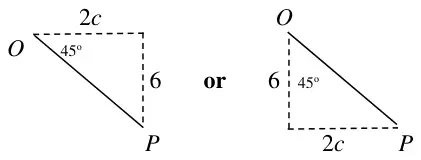
(a) Show that \(c = 3\) (3)
(b) Find the speed of \(P\) when \(t = 4\) (4)
When \(t = T\), \(P\) is accelerating in the direction of \((-\mathbf{i} - 27\mathbf{j})\).
(c) Find the value of \(T\). (4)
Mark scheme (a)
Scheme
Marks
AO
ALTERNATIVES when \(t = 4\) is substituted at the beginning.
\(2c\mathbf{i} - 6\mathbf{j}\) or as a column vector, seen or implied.
B1
1.1b
ALT 1 AND either \(\tan 45^\circ = \dfrac{2c}{6} \Rightarrow 2c = 6\) orstates isosceles triangle so \(2c = 6\) N.B. In both of the above, we must see the justification for the equation.
ALT 2 \(\tan 135^\circ = \dfrac{2c}{-6} \Rightarrow 2c = 6\) N.B. M0 if they are using the wrong bearing.
M1
3.1a
\(c = 3\) *
A1*
2.2a
SC 1 M1A0: no right-angled triangle \(2c\mathbf{i} - 6\mathbf{j} = k(\mathbf{i} - \mathbf{j}) \Rightarrow 2c = 6\) or \(\mathbf{i}\)-cpt \(= -\,\mathbf{j}\)-cpt \(\Rightarrow 2c = 6\) N.B. In both of the above, we must see the justification for the equation.
SC 2 M1A0: no right-angled triangle \(\tan 45^\circ = \dfrac{2c}{6}\) or \(\dfrac{6}{2c} \Rightarrow 2c = 6\) N.B. In the above, we must see the justification for the equation.
ALTERNATIVES when \(t = 4\) is substituted at the end:
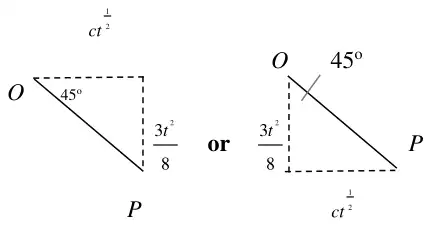
\(ct^{\frac{1}{2}} = 2c\) and \((-)\dfrac{3t^2}{8} = (-)6\) when \(t = 4\), seen or implied
B1
ALT 3 AND either \(\tan 45^\circ = \dfrac{\frac{3t^2}{8}}{ct^{\frac{1}{2}}} \Rightarrow 2c = 6\) when \(t = 4\) orstates isosceles triangle, so \(ct^{\frac{1}{2}} = \dfrac{3t^2}{8} \Rightarrow 2c = 6\) when \(t = 4\) N.B. In both of the above, we must see the justification for the equation. N.B. M0 if they are using the wrong bearing.
M1
\(c = 3\)
A1*
SC 3 M1A0: no right-angled triangle \(\left(ct^{\frac{1}{2}}\mathbf{i} - \dfrac{3t^2}{8}\mathbf{j}\right) = k(\mathbf{i} - \mathbf{j}) \Rightarrow 2c = 6\) when \(t = 4\) or \(\mathbf{i}\)-cpt \(= -\,\mathbf{j}\)-cpt \(\Rightarrow ct^{\frac{1}{2}} = \dfrac{3t^2}{8} \Rightarrow 2c = 6\) when \(t = 4\) N.B. In both of the above, we must see the justification for the equation.
SC 4 M1A0: no right-angled triangle \(\tan 45^\circ = \dfrac{\frac{3t^2}{8}}{ct^{\frac{1}{2}}} \Rightarrow 2c = 6\) when \(t = 4\)
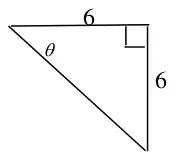
N.B. Allow a verification: i.e. use \(c = 3\) and \(t = 4\) to show that \(P\) is on a bearing of \(135^\circ\) from \(O\). \(6\mathbf{i} - 6\mathbf{j}\)
B1
then a diagram: AND \(\tan\theta = \dfrac{6}{6}\) or isosceles triangle \(\Rightarrow \theta = 45^\circ\) N.B. In the above, we must see the justification for the equation.
M1
bearing \(= 45^\circ + 90^\circ = 135^\circ\)
A1*
(3)
Notes
Accept column vectors throughout
B1: \(2c\mathbf{i} - 6\mathbf{j}\) seen or implied. B0 for \(\mathbf{r} = 2c - 6\) if no evidence of components.
M1:ALT 1: Use the bearing to obtain a CORRECT diagram showing a right-angled triangle with at least one \(45^\circ\) angle marked or clearly explained (i.e. \(135^\circ\) marked on the diagram and either \(135^\circ - 90^\circ = 45^\circ\) or \(180^\circ - 135^\circ = 45^\circ\)), and \(2c\) and \(\pm 6\) marked AND use of isosceles triangle or tan or (sin/cos and Pythag) to obtain \(2c = 6\) ALT 2: No diagram required Use \(\tan 135^\circ = \dfrac{2c}{-6} \Rightarrow 2c = 6\)
A1*: Given answer correctly obtained
ALTERNATIVE when \(t = 4\) is substituted at the end:
B1: \(ct^{\frac{1}{2}} = 2c\) and \((-)\dfrac{3t^2}{8} = (-)6\) when \(t = 4\), seen or implied
M1:ALT 3: Use the bearing to obtain a CORRECT diagram showing a right-angled triangle with at least one \(45^\circ\) angle marked or clearly explained (i.e. \(135^\circ\) marked on the diagram and either \(135^\circ - 90^\circ = 45^\circ\) or \(180^\circ - 135^\circ = 45^\circ\)), and \(ct^{\frac{1}{2}}\) and \(\pm\dfrac{3t^2}{8}\) marked AND use of isosceles triangle or tan or (sin/cos and Pythag) to obtain \(2c = 6\) when \(t = 4\)
A1*: Given answer correctly obtained
Mark scheme (b)
Scheme
Marks
AO
Differentiate \(\mathbf{r}\) wrt \(t\) to obtain \(\mathbf{v}\)
Put \(t = 4\) into both components and use Pythagoras: \(\sqrt{\left(\dfrac{3}{4}\right)^2 + (-3)^2}\)
M1
3.1a
\(\sqrt{\dfrac{153}{16}}\) or \(\dfrac{\sqrt{153}}{4}\) or \(\dfrac{3\sqrt{17}}{4}\) or \(3\sqrt{\dfrac{17}{16}} = 3.0923\ldots\) \((\text{m s}^{-1})\)
A1
1.1b
(4)
Notes
Accept column vectors throughout
M1: Both powers of \(t\) decreasing by 1 (M0 if \(\mathbf{i}\) or \(\mathbf{j}\) is missing but allow recovery or working with components only) N.B. This mark is available if \(c\) has not been substituted for.
A1: Correct unsimplified derivative or two correct components
M1: Put \(t = 4\) in their \(\mathbf{v}\) (must be using an attempted derivative of \(\mathbf{r}\)) and then use Pythagoras with the root, allow a missing \(-\) sign N.B. If they state \(t = 4\), allow a slip when they substitute in, for this M mark. This mark is available if \(c\) has not been substituted for.
A1: Accept 3.1 or better
Mark scheme (c)
Scheme
Marks
AO
Differentiate their \(\mathbf{v}\) wrt \(t\) to obtain \(\mathbf{a}\)
M1: Both powers of \(t\) decreasing by 1 N.B. This mark is available if \(c\) has not been substituted for (M0 if \(\mathbf{i}\) or \(\mathbf{j}\) is missing but allow recovery or working with components only).
A1: Correct unsimplified derivative
M1: Use of an appropriate ratio (must be using an attempted derivative of their \(\mathbf{v}\)), condone sign error and the reciprocal, to obtain an equation in \(t\) or \(T\) only. N.B. If they state that \(-\dfrac{3}{4}T^{-\frac{3}{2}}\mathbf{i} - \dfrac{3}{4}\mathbf{j} = k(-\mathbf{i} - 27\mathbf{j})\) and then equate coefficients to give two simultaneous equations in \(k\) and \(T\), these need to be used to produce an equation in \(T\) only, before the M mark is earned.
\(\sqrt{20} = 2\sqrt{5}\), 4.5 or better \((\text{m s}^{-1})\)
A1
1.1b
(4)
Notes
Accept column vectors throughout
M1: Use of \(\mathbf{v} = \mathbf{u} + \mathbf{a}t\) with \(t = 5\) to give an unsimplified \(\mathbf{v}_B\) M0 if \(\mathbf{u} = \mathbf{0}\) N.B. If using integration, they must get to the same stage i.e. have found the constant and put \(t = 5\) M0 if they omit the constant altogether
A1: Correct \(\mathbf{v}_B\) with \(\mathbf{i}\)’s and \(\mathbf{j}\)’s collected
M1: Use of Pythagoras on their \(\mathbf{v}_B\) to give a magnitude (need the root)
A1: Must be positive
Mark scheme (b)
Scheme
Marks
AO
Using \(A\) as the initial position: \(\mathbf{r}_C = \mathbf{v}_A t + \dfrac{1}{2}\mathbf{a}t^2 + \mathbf{r}_A\) where \(t = T\) \((4\mathbf{i} + c\mathbf{j}) = (-16\mathbf{i} - 3\mathbf{j})T + \dfrac{1}{2}(2.4\mathbf{i} + \mathbf{j})T^2 + (44\mathbf{i} - 10\mathbf{j})\) OR \(\begin{pmatrix}4\\c\end{pmatrix} = \begin{pmatrix}-16\\-3\end{pmatrix}T + \dfrac{1}{2}\begin{pmatrix}2.4\\1\end{pmatrix}T^2 + \begin{pmatrix}44\\-10\end{pmatrix}\)
Equating \(\mathbf{i}\)-components, to give a quadratic equation in \(T\) only. Allow \(t\) instead of \(T\).
N.B. Allow omission of 44 for this M mark. Also allow \(\pm 4\) but M0 if 4 is not used at all i.e. \(4 = -16T + \dfrac{1}{2} \times 2.4T^2\) scores M1A0A0
M1
3.1a
\(4 = -16T + \dfrac{1}{2} \times 2.4T^2 + 44\)
A1
1.1b
\((T =)\ 10\)
A1
1.1b
(3)
Alternative
Scheme
Marks
ALTERNATIVEusing \(B\) as the initial position: (The position vector of \(B\), \(\mathbf{r}_B\), should be \(-6\mathbf{i} - 12.5\mathbf{j}\) but no credit for finding this) \(\mathbf{r}_C = \mathbf{v}_B t + \dfrac{1}{2}\mathbf{a}t^2 + \mathbf{r}_B\) using their \(\mathbf{v}_B\) from (a) and their \(\mathbf{r}_B\) \((4\mathbf{i} + c\mathbf{j}) = (-4\mathbf{i} + 2\mathbf{j})t + \dfrac{1}{2}(2.4\mathbf{i} + \mathbf{j})t^2 + (-6\mathbf{i} - 12.5\mathbf{j})\) \(\begin{pmatrix}4\\c\end{pmatrix} = \begin{pmatrix}-4\\2\end{pmatrix}t + \dfrac{1}{2}\begin{pmatrix}2.4\\1\end{pmatrix}t^2 + \begin{pmatrix}-6\\-12.5\end{pmatrix}\)
Equating \(\mathbf{i}\)-components, to give a quadratic equation in \(t\) only. Allow if they have \(T\) instead of \(t\). N.B. Allow omission of their \(-6\) or if they use 44 for this M mark. Also allow \(\pm 4\) but M0 if 4 is not used at all. e.g. \(4 = -4t + \dfrac{1}{2} \times 2.4t^2\) scores M1A0A0
M1
\(4 = -4t + \dfrac{1}{2} \times 2.4t^2 - 6\)
A1
\(t = 5\) so \((T =)\ 10\)
A1
(3)
Notes
Accept column vectors throughout
M1: Equating components of \(\mathbf{i}\) to give an equation in \(T\) or \(t\) only. N.B. (they could use integration to get to the same stage) for this M mark, they only need to be equating the \(\mathbf{i}\)-components, and receive no credit until they do so. M0 if \(\mathbf{u} = \mathbf{0}\)
A1: A correct equation in \(T\) or \(t\) only (could be in \((T - 5)\) if using \(B\) as initial position)
A1: \(T = 10\)
Mark scheme (c)
Scheme
Marks
AO
Equating \(\mathbf{j}\)-components, with their value of \(T\) or \(t\) substituted, to give an equation, which must have a square term, in \(c\) only. N.B. Allow \(\pm c\) in their equation.
(N.B. Allow omission of \(-10\) or their \(-12.5\) for this M mark i.e. if using \(A\) as initial position \(c = (-3 \times 10) + \dfrac{1}{2} \times 1 \times 10^2\) scores M1M0A0 OR if using \(B\) as initial position \(c = (2 \times 5) + \dfrac{1}{2} \times 1 \times 5^2\) scores M1M0A0)
M1
2.1
if using \(A\) as initial position \(c = (-3 \times 10) + \dfrac{1}{2} \times 1 \times 10^2 + (-10)\) N.B. Allow \(\pm c\) and/or \(\pm(-10)\) in their equation
OR if using \(B\) as initial position \(c = (2 \times 5) + \dfrac{1}{2} \times 1 \times 5^2 + (-12.5)\) N.B. Allow \(\pm c\) and/or \(\pm(-12.5)\) in their equation
M1
1.1b
\(c = 10\)
A1
1.1b
(3)
(10 marks)
Notes
Accept column vectors throughout
M1: Equating components of \(\mathbf{j}\) to give an equation in \(c\) only but allow omission of their initial position
M1: With their value of \(T\) or \(t\) and must include \(t = 0\) position (should be \(-10\) if using \(A\) OR their \(-12.5\) if using \(B\))
M1: Equating \(\mathbf{i}\) and \(\mathbf{j}\) components of \(\mathbf{v}\) or a ratio of 1:1 to obtain a quadratic in \(t\) only. If they use a constant, e.g. \(t^2 - 3t + 7 = k\) and \(2t^2 - 3 = k\), \(k\) must be eliminated to earn this mark. N.B. M0 (since wrong working seen) if they write down \(\mathbf{i} + \mathbf{j} = (t^2 - 3t + 7)\mathbf{i} + (2t^2 - 3)\mathbf{j}\) OR \(\begin{pmatrix}1\\1\end{pmatrix} = \begin{pmatrix}t^2 - 3t + 7\\2t^2 - 3\end{pmatrix}\) OR \(t^2 - 3t + 7 = 1\) and \(2t^2 - 3 = 1\) and then \(t^2 - 3t + 7 = 2t^2 - 3\)
A1: \(t = 2\)
N.B. Allow M1A1 for a correct trial and error method where they obtain \(\mathbf{v} = 5\mathbf{i} + 5\mathbf{j}\) when \(t = 2\) but M0 if they don’t get \(t = 2\)
Mark scheme (c)
Scheme
Marks
AO
Differentiate \(\mathbf{v}\) wrt \(t\) to give a vector.
M1
3.1a
\((2t - 3)\mathbf{i} + 4t\mathbf{j}\)
A1
1.1b
(2)
Notes
Allow column vectors throughout.
M1: At least one power decreasing by 1 in each component in their \(\mathbf{v}\) (M0 if clearly dividing by \(t\)) Both \(\mathbf{i}\) and \(\mathbf{j}\) needed in their answer or a column vector Allow recovery if the \(\mathbf{i}\) and \(\mathbf{j}\) disappear and then reappear.
A1: cao (must be a vector) isw e.g. if they find the magnitude or put \(t = 0\) or differentiate again \(\mathbf{i}\)’s and \(\mathbf{j}\)’s do not need to be collected. N.B. Allow M1A0 for \(2t - 3\mathbf{i} + 4t\mathbf{j}\)
Mark scheme (d)
Scheme
Marks
AO
\(2t - 3 = 0\)
M1
3.1a
\(t = 1.5\)
A1
1.1b
(2)
(9 marks)
Notes
Allow column vectors throughout.
M1: \(2t - 3 = 0\) or (their derivative of the \(\mathbf{i}\)-component of \(\mathbf{v}\)) = 0 N.B. M0 if they equate the derivative of both components of \(\mathbf{v}\) to zero.
A1: cao N.B. Correct answer, with no working, can score both marks.
3.[In this question, \(\mathbf{i}\) and \(\mathbf{j}\) are horizontal unit vectors.]
A particle \(P\) of mass 4 kg is at rest at the point \(A\) on a smooth horizontal plane.
At time \(t = 0\), two forces, \(\mathbf{F}_1 = (4\mathbf{i} - \mathbf{j})\) N and \(\mathbf{F}_2 = (\lambda\mathbf{i} + \mu\mathbf{j})\) N, where \(\lambda\) and \(\mu\) are constants, are applied to \(P\)
Given that \(P\) moves in the direction of the vector \((3\mathbf{i} + \mathbf{j})\)
(a) show that\[\lambda - 3\mu + 7 = 0\] (4)
At time \(t = 4\) seconds, \(P\) passes through the point \(B\).
M1: Adding the two forces, \(\mathbf{i}\)’s and \(\mathbf{j}\)’s must be collected (or must be a single column vector) seen or implied
M1: Must be using ratios; Ignore an equation e.g. \((4 + \lambda)\mathbf{i} + (-1 + \mu)\mathbf{j} = 3\mathbf{i} + \mathbf{j}\) if they go on to use ratios. However, if they write \(4 + \lambda = 3\) and \(-1 + \mu = 1\) then \(3(-1 + \mu) = 3\) so \(4 + \lambda = 3(-1 + \mu)\) with no use of a constant, it’s M0 They may use the acceleration, with a factor of \(\dfrac{1}{4}\) top and bottom, see alternative Allow one side of the equation to be inverted
A1: Correct equation
A1*: Given answer correctly obtained. Must see at least one line of working, with the LH fraction ‘removed’.
Use of \(\mathbf{r} = \mathbf{u}t + \dfrac{1}{2}\mathbf{a}t^2\) with \(\mathbf{u} = \mathbf{0}\), their \(\mathbf{a}\) and \(t = 4\) : Or they may integrate their \(\mathbf{a}\) twice with \(\mathbf{u} = \mathbf{0}\) and put \(t = 4\) : \(\mathbf{r} = \dfrac{1}{2} \times \dfrac{(6\mathbf{i} + 2\mathbf{j})}{4}4^2 = (12\mathbf{i} + 4\mathbf{j})\)
DM1
2.1
\(\sqrt{12^2 + 4^2}\)
M1
1.1b
\(\sqrt{160},\ 2\sqrt{40},\ 4\sqrt{10}\) oe or 13 or better (m)
A1
1.1b
(5)
(9 marks)
Alternative 1 for last two M marks
Scheme
Marks
Use of \(s = ut + \dfrac{1}{2}at^2\), with \(u = 0\), their \(a\) and \(t = 4\) : \(s = \dfrac{1}{2} \times \sqrt{1.5^2 + 0.5^2} \times 4^2\)
DM1
Use of Pythagoras to find mag of \(\mathbf{a}\) : \(a = \sqrt{1.5^2 + 0.5^2}\)
M1
Alternative 2 for last two M marks
Scheme
Marks
Use of \(s = ut + \dfrac{1}{2}at^2\), with \(u = 0\), their \(a\) and \(t = 4\) : \(s = \dfrac{1}{2} \times \left(\dfrac{\sqrt{6^2 + 2^2}}{4}\right) \times 4^2\)
DM1
Use of Pythagoras to find \(|(6\mathbf{i} + 2\mathbf{j})|\) : \(= \sqrt{6^2 + 2^2}\)
M1
Notes
Accept column vectors throughout
M1: Adding \(\mathbf{F}_1\) and \(\mathbf{F}_2\) to find the resultant force, \(\lambda\) and \(\mu\) must be substituted N.B. M0 if they use \(\mu = 2\) coming from \(-1 + \mu = 1\) in part (a).
M1: Use of \(\mathbf{F} = 4\mathbf{a}\) Or \(|\mathbf{F}| = 4a\), where \(\mathbf{F}\) is their resultant. (including \(3\mathbf{i} + \mathbf{j}\)) This is an independent mark, so could be earned, for example, if they have subtracted the forces to find the ‘resultant’ N.B. M0 if only using \(\mathbf{F}_1\) or \(\mathbf{F}_2\)
DM1: Dependent on previous M mark for Either: use of \(\mathbf{r} = \mathbf{u}t + \dfrac{1}{2}\mathbf{a}t^2\) with \(\mathbf{u} = \mathbf{0}\), their \(\mathbf{a}\) and \(t = 4\) to produce a displacement vector Or : integrate twice, with \(\mathbf{u} = \mathbf{0}\), their \(\mathbf{a}\) and \(t = 4\) to produce a displacement Vector Or: use of \(s = ut + \dfrac{1}{2}at^2\) with \(u = 0\), their \(a\) and \(t = 4\) to produce a length
M1: Use of Pythagoras, with square root, to find the magnitude of their displacement vector, \(\mathbf{a}\) or \(\mathbf{F}\) (M0 if only using \(\mathbf{F}_1\) or \(\mathbf{F}_2\)) depending on which method they have used.
(a) Find the speed of \(P\) at time \(t = 2\) seconds. (2)
(b) Find an expression, in terms of \(t\), \(\mathbf{i}\) and \(\mathbf{j}\), for the acceleration of \(P\) at time \(t\) seconds, where \(t > 0\) (2)
At time \(t = 4\) seconds, the position vector of \(P\) is \((\mathbf{i} - 4\mathbf{j})\) m.
(c) Find the position vector of \(P\) at time \(t = 1\) second. (4)
Mark scheme (a)
Scheme
Marks
AO
Put \(t = 2\) in \(\mathbf{v}\) and use Pythagoras: \(\sqrt{12^2 + (-6\sqrt{2})^2}\)
M1
3.1a
\(\sqrt{216},\ 6\sqrt{6}\) or 15 or better \((\text{m s}^{-1})\)
A1
1.1b
(2)
Notes
Accept column vectors throughout apart from the answer to (b).
M1: Need square root but -ve sign not required. Allow \(\mathbf{i}\)’s and/or \(\mathbf{j}\)’s to go missing from their \(\mathbf{v}\) at \(t = 2\), provided they have applied Pythagoras correctly.
A1: cao N.B. Correct answer with no working can score 2 marks.
Mark scheme (b)
Scheme
Marks
AO
Differentiate \(\mathbf{v}\) wrt \(t\) to obtain \(\mathbf{a}\)
\((-62\mathbf{i} + 24\mathbf{j})\) (m) isw e.g. if they go on to find the distance.
A1
1.1b
(4)
(8 marks)
Notes
Accept column vectors throughout apart from the answer to (b).
M1: Both powers increasing by 1 M0 if \(\mathbf{i}\) or \(\mathbf{j}\) is missing but allow recovery.
A1: (\(\mathbf{r} =\)) not required
M1: Putting \(\mathbf{r} = (\mathbf{i} - 4\mathbf{j})\) and \(t = 4\) into their displacement vector expression which must have \(\mathbf{C}\) (allow \(C\)) to give an equation in \(\mathbf{C}\) only, seen or implied. Must have attempted to integrate \(\mathbf{v}\) for this mark to be available. N.B. \(\mathbf{C}\) does not need to be found and this is a method mark, so allow slips.
OR integration: \(\mathbf{r} = (\mathbf{i} + \mathbf{j}) + \left[(2\mathbf{i} - 3\mathbf{j})\dfrac{1}{2}t^2 + 4t\mathbf{i}\right]\), with \(t = 3\)
M1
3.1a
\(\mathbf{r} = 22\mathbf{i} - 12.5\mathbf{j}\)
A1
2.2a
(2)
(4 marks)
Notes
Accept column vectors throughout
M1: Complete method to find the p.v. but this mark can be scored if they omit \((\mathbf{i} + \mathbf{j})\) i.e. the M1 is for the expression in the square bracket If they integrate, the M1 is earned once the expression in the square bracket is seen with \(t = 3\) (M0 if \(\mathbf{i}\) and/or \(\mathbf{j}\) is missing)
(i) At time \(t\) seconds, where \(t \geqslant 0\), a particle \(P\) moves so that its acceleration \(\mathbf{a}\ \text{m s}^{-2}\) is given by\[\mathbf{a} = (1 - 4t)\,\mathbf{i} + (3 - t^2)\,\mathbf{j}\]At the instant when \(t = 0\), the velocity of \(P\) is \(36\mathbf{i}\ \text{m s}^{-1}\)
(a) Find the velocity of \(P\) when \(t = 4\) (3)
(b) Find the value of \(t\) at the instant when \(P\) is moving in a direction perpendicular to \(\mathbf{i}\) (3)
(ii) At time \(t\) seconds, where \(t \geqslant 0\), a particle \(Q\) moves so that its position vector \(\mathbf{r}\) metres, relative to a fixed origin \(O\), is given by\[\mathbf{r} = (t^2 - t)\,\mathbf{i} + 3t\,\mathbf{j}\]Find the value of \(t\) at the instant when the speed of \(Q\) is \(5\ \text{m s}^{-1}\) (6)
Mark scheme (i)(a)
Scheme
Marks
AO
Integrate \(\mathbf{a}\) wrt \(t\) to obtain velocity
M1: Solve a 3 term quadratic for \(t\) which has come from differentiating and using a magnitude. This M mark can be implied by a correct answer with no working.
M1: For any complete method to give a \(\mathbf{v}\) expression with correct no. of terms with \(t = 2\) used, so if integrating, must see the initial velocity as the constant. Allow sign errors.
A1: Cao isw if they go on to find the speed.
Mark scheme (b)
Scheme
Marks
AO
Solve problem through use of \(\mathbf{r} = \mathbf{u}t + \dfrac{1}{2}\mathbf{a}t^2\) or integration (M0 if \(\mathbf{u} = \mathbf{0}\)) Or any other complete method e.g use \(\mathbf{v} = \mathbf{u} + \mathbf{a}T\) and \(\mathbf{r} = \dfrac{(\mathbf{u} + \mathbf{v})T}{2}\):
The first two marks could be implied if they go straight to an algebraic equation.
Attempt to equate \(\mathbf{j}\) components to give equation in \(T\) only \(\left(-4.5 = 2T - \dfrac{5}{2}T^2\right)\)
M1
2.1
\(T = 1.8\)
A1
1.1b
(4)
Notes
Accept column vectors throughout
M1: For any complete method to give a vector expression for \(\mathbf{j}\) component of displacement in \(t\) (or \(T\)) only, using \(\mathbf{a} = (4\mathbf{i} - 5\mathbf{j})\), so if integrating, RHS of equation must have the correct structure. Allow sign errors.
A1: Correct \(\mathbf{j}\) vector equation in \(t\) or \(T\). Ignore \(\mathbf{i}\) terms.
M1: Must have earned 1st M mark. Equate \(\mathbf{j}\) components to give equation in \(T\) (allow \(t\)) only (no \(\mathbf{j}\)’s) which has come from a displacement. Equation must be a 3 term quadratic in \(T\).
A1: cao
Mark scheme (c)
Scheme
Marks
AO
Solve problem by substituting their \(T\) value (M0 if \(T \lt 0\)) into the \(\mathbf{i}\) component equation to give an equation in \(\lambda\) only: \(\lambda = -2T + \dfrac{1}{2}T^2 \times 4\)
M1
3.1a
\(\lambda = 2.9\) or 2.88 or \(\dfrac{72}{25}\) oe
A1
1.1b
(2)
(8 marks)
Notes
Accept column vectors throughout
M1: Must have earned 1st M mark in (b) Complete method - must have an equation in \(\lambda\) only (no \(\mathbf{i}\)’s) which has come from an appropriate displacement.. (e.g M0 if \(\mathbf{a} = \mathbf{0}\) has been used) Expression for \(\lambda\) must be a quadratic in \(T\)
M1: Use of \(\mathbf{v} = \mathbf{u} + \mathbf{a}t\) OR integration to give an expression of the form \(\mathbf{C} + (2\mathbf{i} - 3\mathbf{j})t\), where C is a non-zero constant vector M0 if \(\mathbf{u}\) and \(\mathbf{a}\) are reversed Condone use of \(\mathbf{a} = (2\mathbf{i} + 3\mathbf{j})\) for this M mark
A1: Any correct unsimplified expression seen or implied
M1: Correct use of ratios, using a velocity vector (must be using \(\dfrac{-4}{3}\)) to give equation in \(T\) only M0 if they equate \(4 - 3T = -4\) and/or \(-1 + 2T = 3\) and therefore M0 if they then divide to produce their equation
A1: Correct only
N.B. (i) Can score the second M1A1 if they get \(T = 8\), using a calculator to solve two simultaneous equations, but if answer is wrong, and no equation in \(T\) only, second M0 (ii) Can score M1A1 M1A1 if they get \(T = 8\), using trial and error, but if they don’t get \(T = 8\), can only score max M1A1M0A0
\(AB = \sqrt{12^2 + 8^2}\) N.B. Beware you may see 4(2i – 3j) which leads to \(\sqrt{(8^2 + 12^2)}\) this is M0A0M0A0.
M1
3.1a
\(= 4\sqrt{13}\ (= 14.422051....)\) (m)
A1cso
1.1b
(4)
(8 marks)
Notes
M1: Use of \(\mathbf{s} = \mathbf{u}t + \dfrac{1}{2}\mathbf{a}t^2\) with \(\mathbf{a} = (2\mathbf{i} - 3\mathbf{j})\) OR integration to give an expression of the form \(\mathbf{C}t + (2\mathbf{i} - 3\mathbf{j})\dfrac{1}{2}t^2\), where C is their non-zero constant vector from (a) Condone use of \(\mathbf{a} = (2\mathbf{i} + 3\mathbf{j})\) for this M mark OR any other complete method using vector suvat equations
A1: Correct unsimplified expression seen or implied
M1: Use of \(t = 4\) in their \(\mathbf{s}\) (which must be a displacement vector) and then Pythagoras with the root sign N.B. This M mark can be implied by a correct answer, otherwise we need to see Pythagoras used, with the root sign, for the M mark.
N.B. Accept column vectors throughout and condone missing brackets in working but they must be there in final answers
M1: Use of \(\mathbf{a} = \dfrac{\mathrm{d}\mathbf{v}}{\mathrm{d}t}\) with attempt to differentiate (both powers decreasing by 1) M0 if \(\mathbf{i}\)’s and \(\mathbf{j}\)’s omitted and they don’t recover
A1: Correct differentiation in any form
A1: Correct and simplified. Ignore subsequent working (ISW) if they go on and find the magnitude.
N.B. Accept column vectors throughout and condone missing brackets in working but they must be there in final answers
M1: Use of \(\mathbf{r} = \displaystyle\int \mathbf{v}\,\mathrm{d}t\) with attempt to integrate (both powers increasing by 1) M0 if \(\mathbf{i}\)’s and \(\mathbf{j}\)’s omitted and they don’t recover
A1: Correct integration in any form. Condone \(\mathbf{r}_0\) not present
(a) Find an expression for the velocity of particle \(P\) after \(t\) seconds. [2 marks]
(b) The acceleration, \(\mathbf{a}\ \text{m s}^{-2}\), of a particle \(Q\), at time \(t\) seconds, is given by\[\mathbf{a} = 6t\,\mathbf{i} + 7\mathbf{j}\]
Particle \(Q\) has an initial velocity of \(4\mathbf{j}\ \text{m s}^{-1}\)
Particles \(P\) and \(Q\) are moving parallel to each other when \(t = 2\)
Find the value of \(q\)
[6 marks]
Mark scheme (a)
Scheme
Marks
AO
Uses \(\mathbf{v} = \dfrac{\mathrm{d}\mathbf{s}}{\mathrm{d}t}\) with one component correct
Uses \(\mathbf{v} = \displaystyle\int \mathbf{a}\,\mathrm{d}t\) with one component correct Ignore c
M1
3.4
Substitutes \(t = 0\) into a velocity vector and equates to \(4\mathbf{j}\) to obtain a value or values for their constant of integration. PI by \(3t^2\mathbf{i} + (7t + 4)\mathbf{j}\)
M1
3.4
Obtains \(3t^2\mathbf{i} + (7t + 4)\mathbf{j}\)
A1
1.1b
Finds their \(\mathbf{v}_p\) and their \(\mathbf{v}_q\) when \(t = 2\). Must come from use of calculus Condone missing brackets for \(8 + q\)
B1F
1.1b
Uses \(\mathbf{v}_p = k\mathbf{v}_q\) Where \(k \neq 1\) Or Compares the ratios of the components of their \(\mathbf{v}_p\) and their \(\mathbf{v}_q\) Must come from use of calculus
Uses vector geometry to work out \(\overrightarrow{OC} - \overrightarrow{OA}\) or \(\overrightarrow{OC} - \overrightarrow{OB}\) OE PI \(\pm\begin{bmatrix}4\\-6\\-1\end{bmatrix}\) or \(\pm\begin{bmatrix}-4\\-5\\2\end{bmatrix}\) Condone missing arrows Condone missing or incorrect labels
M1
1.1a
Obtain the correct vectors for \(\overrightarrow{AC}\) or \(\overrightarrow{CA}\) and \(\overrightarrow{BC}\) or \(\overrightarrow{CB}\) The vectors must be correctly labelled Condone missing arrows
A1
1.1b
Find the magnitude of their \(\overrightarrow{AC}\) or \(\overrightarrow{BC}\) OE PI \(\sqrt{53}\) or \(3\sqrt{5}\) OE AWRT 7.3 or 6.7 If \(3\sqrt{5}\) is obtained from \(\overrightarrow{OB}\) score M0
M1
3.1a
Obtains \(\sqrt{53}\) and \(3\sqrt{5}\) OE from correct vectors. AWRT 7.3 and 6.7
A1
1.1b
Completes reasoned argument to obtain the three lengths: \(\left|BC\right| = \sqrt{45}\) \(\left|AC\right| = \sqrt{53}\) OE \(\left|AB\right| = \sqrt{74}\) and Concludes that \(ABC\) is a scalene triangle with no incorrect reasoning. Must have scored M1A1M1A1 Must not equate a vector to a length. AG
15 A particle moves under the actions of two forces, \(\mathbf{F}_1\) and \(\mathbf{F}_2\)
\(\mathbf{F}_1\) has magnitude 17 newtons and acts due East. \(\mathbf{F}_2\) has magnitude 26 newtons and acts at a bearing of 310°
The resultant of \(\mathbf{F}_1\) and \(\mathbf{F}_2\) is \(\mathbf{R}\)
(a) Show that the magnitude of \(\mathbf{R}\) is 17.0 newtons, correct to three significant figures. [4 marks]
(b) Find the angle that \(\mathbf{R}\) makes with \(\mathbf{F}_1\)
Give your answer to the nearest degree.
[2 marks]
(c) A third force, \(\mathbf{F}_3\), acts upon the particle so that the particle is in equilibrium.
(i) State the magnitude of \(\mathbf{F}_3\) [1 mark]
(ii) State the bearing on which \(\mathbf{F}_3\) acts. [1 mark]
Mark scheme (a)
Scheme
Marks
AO
Resolves horizontally or vertically to find a correct expression for one of the i or j components of the resultant force. Or Uses the cosine rule with b = 17 and c = 26
M1
3.3
Resolves horizontally and vertically to find a correct expression for both i and j components of the resultant force PI by H: AWRT \(\pm\) 2.9 V: AWRT \(\pm\)16.7 Or Uses the cosine rule to obtain a2 = AWRT 287.8
A1
1.1b
Finds the magnitude of the resultant vector of their horizontal and vertical components Or Finds the square root of their expression for b2 + c2 − 2bcCosA PI by AWFW [16.96, 16.97]
M1
1.1a
Completes reasoned argument showing a full method to obtain AWFW [16.96, 16.97] and concludes that the magnitude of R is 17.0 Condone 17 AG
Uses an appropriate trigonometric equation using their components for R Or Deduces that the two 17N forces make this an isosceles triangle, eg: 180 − (2 x 40) PI AWRT 79 or 80
M1
3.1a
Obtains any of the following angles AWRT 100, 101, \(\pm 259\), \(\pm 260\)
20 Two particles \(P\) and \(Q\) are moving in separate straight lines across a smooth horizontal surface.
\(P\) moves with constant velocity \((3\mathbf{i} + 4\mathbf{j})\) m s−1
\(Q\) moves from position vector \((5\mathbf{i} - 7\mathbf{j})\) metres to position vector \((14\mathbf{i} + 5\mathbf{j})\) metres during a 3 second period.
(a) Show that \(P\) and \(Q\) move along parallel lines. [3 marks]
(b) Stevie says
\(Q\) is also moving with a constant velocity of \((3\mathbf{i} + 4\mathbf{j})\) m s−1
Explain why Stevie may be incorrect. [1 mark]
(c) A third particle \(R\) is moving with a constant speed of 4 m s−1, in a straight line, across the same surface.
\(P\) and \(R\) move along lines that intersect at a fixed point \(X\)
It is given that:
\(P\) passes through \(X\) exactly 2 seconds after \(R\) passes through \(X\)
\(P\) and \(R\) are exactly 13 metres apart 3 seconds after \(R\) passes through \(X\)
Show that \(P\) and \(R\) move along perpendicular lines. [5 marks]
Mark scheme (a)
Scheme
Marks
AO
Subtracts the two given position vectors for \(Q\) Condone either order
M1
3.1a
Obtains \(9\mathbf{i} + 12\mathbf{j}\) for the displacement of \(Q\) ACF Or Demonstrates that the average velocity for \(Q\) is \(3\mathbf{i} + 4\mathbf{j}\)
A1
1.1b
Completes reasoned argument to show that \(9\mathbf{i} + 12\mathbf{j} = 3(3\mathbf{i} + 4\mathbf{j})\) and concludes that \(P\) and \(Q\) move along parallel lines
constant velocity is not the same as average velocity
\(Q\)’s speed may change
\(Q\) could accelerate
E1
2.3
(1)
Typical solution
Constant velocity is not the same as average velocity
Mark scheme (c)
Scheme
Marks
AO
Obtains 12 m for distance from \(X\) to \(R\)
B1
1.1b
Obtains 5 m s−1 for the speed of \(P\) PI by \(XP\) = 5 m
B1
3.1a
Calculates the distance travelled by \(P\) using their speed for \(P\) and \(t\) = 1 Condone \(t\) = 2
M1
1.1a
Identifies 5, 12 and 13 as a Pythagorean triple May be seen on a diagram Or Correctly applies the cosine rule \(13^2 = 12^2 + 5^2 - 2 \times 12 \times 5 \times \cos\theta\) and concludes that \(\theta = 90^\circ\)
A1
1.1b
Completes a reasoned argument that \(PXR\) is a right-angled triangle with hypotenuse \(PR\) and concludes that \(P\) and \(R\) move along perpendicular lines Or Completes a reasoned argument that angle \(PXR\) is a right angle and concludes that \(P\) and \(R\) move along perpendicular lines
R1
2.1
(5)
(9 marks)
Typical solution
\(P\)’s speed \(= |3\mathbf{i} + 4\mathbf{j}| = 5\) m s−1
Distance from \(X\) to \(P = 5(3 - 2) = 5\) m
Distance from \(X\) to \(R\) = 12 metres
\[5^2 + 12^2 = 13^2\]
\(P\) and \(R\) are moving along perpendicular lines.
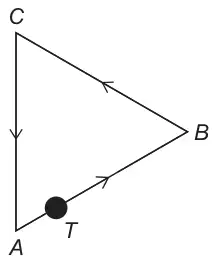
18 In this question \(\mathbf{i}\) and \(\mathbf{j}\) are perpendicular unit vectors representing due east and due north respectively.
A particle, \(T\), is moving on a plane at a constant speed.
The path followed by \(T\) makes the exact shape of a triangle \(ABC\).
\(T\) moves around \(ABC\) in an anticlockwise direction as shown in the diagram below.
On its journey from \(A\) to \(B\) the velocity vector of \(T\) is \(\left(3\mathbf{i} + \sqrt{3}\mathbf{j}\right)\) m s−1
(a) Find the speed of \(T\) as it moves from \(A\) to \(B\) [1 mark]
(b) On its journey from \(B\) to \(C\) the velocity vector of \(T\) is \(\left(-3\mathbf{i} + \sqrt{3}\mathbf{j}\right)\) m s−1
Show that the acute angle \(ABC = 60^\circ\) [2 marks]
(c) It is given that \(ABC\) is an equilateral triangle.
\(T\) returns to its initial position after 9 seconds.
Vertex \(B\) lies at position vector \(\begin{bmatrix} 1 \\ 0 \end{bmatrix}\) metres with respect to a fixed origin \(O\)
Find the position vector of \(C\) [3 marks]
Mark scheme (a)
Scheme
Marks
AO
Obtains correct speed of \(\sqrt{12}\) OE AWRT 3.46 Condone missing units
B1
1.1b
(1)
Typical solution
Speed \(= \sqrt{(3)^2 + \left(\sqrt{3}\right)^2} = 2\sqrt{3}\) m s−1
Mark scheme (b)
Scheme
Marks
AO
Uses \(\tan^{-1}\dfrac{\sqrt{3}}{3}\) or \(\tan^{-1}\dfrac{3}{\sqrt{3}}\) to find the angle between one of the velocity vectors relative to the \(\mathbf{i}\) direction or the \(\mathbf{j}\) direction.
Sight of sine rule or cosine rule using a magnitude for \(AC\) scores M0 R0
M1
3.1a
Completes a reasoned argument to obtain 30° for both angles relative to the \(\mathbf{i}\) direction and adds them together to obtain angle \(ABC\) = 60° or Completes a reasoned argument to obtain 60° for both angles relative to the \(\mathbf{j}\) direction and adds them together and subtracts them from 180° to obtain angle \(ABC\) = 60°
Solution must include clear reference to angle \(ABC\) or indicate angle \(ABC\) with a letter on a diagram.
When using trigonometric ratios the vectors \(\mathbf{i}\) and \(\mathbf{j}\) must not be included.
R1
2.1
(2)
Typical solution
Angle between \(AB\) and \(\mathbf{i}\) direction
\[= \tan^{-1}\frac{\sqrt{3}}{3} = 30^\circ\]
Angle between \(BC\) and \(\mathbf{i}\) direction
\[= \tan^{-1}\frac{\sqrt{3}}{3} = 30^\circ\]
Angle ABC = 30° + 30° = 60°
Mark scheme (c)
Scheme
Marks
AO
Deduces time taken from \(B\) to \(C\) is 3 seconds.
R1
2.2a
Obtains an expression for displacement from \(B\) to \(C\) of the form \(t\begin{bmatrix} -3 \\ \sqrt{3} \end{bmatrix}\) where \(1 \lt t \leqslant 9\)
The acceleration of the particle is \((3.2\mathbf{i} + 12\mathbf{j})\) m s−2
Find \(k\) [4 marks]
Mark scheme
Scheme
Marks
AO
Adds the two forces together. ACF
B1
1.1b
Uses \(\mathbf{F} = m\boldsymbol{a}\) and substitutes their \(\mathbf{F}_1 \pm \mathbf{F}_2\) and \(\boldsymbol{a} = \begin{bmatrix} 3.2 \\ 12 \end{bmatrix}\)
PI by use of ratios For example: \(\dfrac{5k - 5}{12} = \dfrac{1.6 + k}{3.2}\) OE
M1
3.1a
Obtains two correct equations For example: \(1.6 + k = 3.2m\) and \(5k - 5 = 12m\) Only award if vectors are removed or Obtains a correct linear equation in \(k\) For example: \(\dfrac{5k - 5}{12} = \dfrac{1.6 + k}{3.2}\)
Show that the magnitude of the acceleration of the particle, \(a\) m s−2, is given by
\[a = 2\mathrm{e}^t\]
Fully justify your answer. [7 marks]
Mark scheme
Scheme
Marks
AO
Differentiates with evidence of correct use of product rule. Condone sign errors
M1
3.4
Finds expression for \(\mathbf{v}\) or \(\dfrac{\mathrm{d}\mathbf{r}}{\mathrm{d}t}\) with either \(\mathbf{i}\) or \(\mathbf{j}\) component fully correct
M1
1.1a
Finds fully correct expression for \(\mathbf{v}\) or \(\dfrac{\mathrm{d}\mathbf{r}}{\mathrm{d}t}\) \((\mathrm{e}^t\cos t - \mathrm{e}^t\sin t)\mathbf{i} + (\mathrm{e}^t\sin t + \mathrm{e}^t\cos t)\mathbf{j}\) Condone poor use of brackets provided fully correct acceleration seen
A1
1.1b
Differentiates their \(\mathbf{v}\) or \(\dfrac{\mathrm{d}\mathbf{r}}{\mathrm{d}t}\) with evidence of correct use of product rule to find an expression for \(\mathbf{a}\) with at least one component correct. Condone sign errors
M1
3.4
Finds correct expression for \(\mathbf{a}\) May be unsimplified
A1
1.1b
Obtains an expression for the magnitude of their \(\mathbf{a}\) provided their \(\mathbf{a}\) has non-zero \(\mathbf{i}\) and \(\mathbf{j}\) components
M1
1.1a
Completes reasoned argument from a correct \(\mathbf{a}\) to show given result. Must see a factor of \((\sin^2 t + \cos^2 t)\) eg \(\sqrt{4\mathrm{e}^{2t}(\sin^2 t + \cos^2 t)}\) AG
R1
2.1
(7 marks)
Typical solution
\[\mathbf{v} = \frac{\mathrm{d}\mathbf{r}}{\mathrm{d}t} = (\mathrm{e}^t\cos t - \mathrm{e}^t\sin t)\mathbf{i} + (\mathrm{e}^t\sin t + \mathrm{e}^t\cos t)\mathbf{j}\]\[\mathbf{a} = \frac{\mathrm{d}\mathbf{v}}{\mathrm{d}t} = (\mathrm{e}^t\cos t - \mathrm{e}^t\sin t - \mathrm{e}^t\sin t - \mathrm{e}^t\cos t)\mathbf{i}\]\[+ (\mathrm{e}^t\sin t + \mathrm{e}^t\cos t + \mathrm{e}^t\cos t - \mathrm{e}^t\sin t)\mathbf{j}\]\[= -2\mathrm{e}^t\sin t\,\mathbf{i} + 2\mathrm{e}^t\cos t\,\mathbf{j}\]\[|\mathbf{a}| = \sqrt{(-2\mathrm{e}^t\sin t)^2 + (2\mathrm{e}^t\cos t)^2}\]\[= \sqrt{4\mathrm{e}^{2t}(\sin^2 t + \cos^2 t)}\]\[\therefore |\mathbf{a}| = 2\mathrm{e}^t\]
16 Two particles, \(P\) and \(Q\), move in the same horizontal plane.
Particle \(P\) is initially at rest at the point with position vector \((-4\mathbf{i} + 5\mathbf{j})\) metres and moves with constant acceleration \((3\mathbf{i} - 4\mathbf{j})\) m s−2
Particle \(Q\) moves in a straight line, passing through the points with position vectors \((\mathbf{i} - \mathbf{j})\) metres and \((10\mathbf{i} + c\mathbf{j})\) metres.
\(P\) and \(Q\) are moving along parallel paths.
(a) Show that \(c = -13\) [4 marks]
(b)
(i) Find an expression for the position vector of \(P\) at time \(t\) seconds. [1 mark]
(ii) Hence, prove that the paths of \(P\) and \(Q\) are not collinear. [3 marks]
Mark scheme (a)
Scheme
Marks
AO
States or uses the direction of motion is \(\begin{bmatrix} 3 \\ -4 \end{bmatrix}\) or \(\begin{bmatrix} 9 \\ c + 1 \end{bmatrix}\) Or States or uses the gradient of the direction of motion is \(-\dfrac{4}{3}\) or \(\dfrac{c + 1}{9}\)
M1
3.1a
Obtains a correct vector equation eg \(\begin{bmatrix} 10 \\ c \end{bmatrix} = \begin{bmatrix} 1 \\ -1 \end{bmatrix} + k\begin{bmatrix} 3 \\ -4 \end{bmatrix}\) OE Or Obtains both gradients or both direction vectors \(\begin{bmatrix} 3 \\ -4 \end{bmatrix}\), \(\begin{bmatrix} 9 \\ c + 1 \end{bmatrix}\) or Obtains a correct cartesian equation for \(Q\). eg \(y + 1 = -\dfrac{4}{3}(x - 1)\)
A1
1.1b
Obtains or eliminates parameter in their vector equation Or Equates gradients or the reciprocals \(\dfrac{c + 1}{9} = -\dfrac{4}{3}\) Or substitutes \(x\) = 10 into their cartesian equation
M1
1.1a
Shows that \(c = -13\) AG A correct verification method using the given \(c = -13\) scores a maximum of M1A1M0A0
A1
1.1b
(4)
Typical solution
\[\begin{bmatrix} 10 \\ c \end{bmatrix} - \begin{bmatrix} 1 \\ -1 \end{bmatrix} = \begin{bmatrix} 9 \\ c + 1 \end{bmatrix}\]\[\begin{bmatrix} 9 \\ c + 1 \end{bmatrix} = k\begin{bmatrix} 3 \\ -4 \end{bmatrix}\]\[k = 3\]\[c + 1 = -12\]\[\Rightarrow c = -13\]
(ii) Equates their position vector from (b)(i) to one of the two known position vectors given for \(Q\). Their position vector must be quadratic in \(t\) for both components Or Substitutes a known point for \(P\) into their Cartesian equation for the path of \(Q\) from part (a) OE Or Substitutes a known point for \(Q\) into their Cartesian equation for the path of \(P\) from part (a) OE Or forms Cartesian equations for the path of \(P\) and the path of \(Q\) Or Calculates the difference between \((-4\mathbf{i} + 5\mathbf{j})\) and \((\mathbf{i} - \mathbf{j})\) or between \((-4\mathbf{i} + 5\mathbf{j})\) and \((10\mathbf{i} - 13\mathbf{j})\)
M1
3.1b
Obtains \(t^2 = \dfrac{10}{3}\) or 3 or \(t = \sqrt{\dfrac{10}{3}} = 1.82\ldots\) or \(\sqrt{3} = 1.73\ldots\) Or Shows that \(y \ne 5\) for \(x = -4\) OE Or Writes the two correct cartesian equations in a comparable form eg \(y = -\dfrac{4}{3}x + \dfrac{1}{3}\) and \(y = -\dfrac{4}{3}x - \dfrac{1}{3}\) Or Compares two appropriate direction vectors
A1
1.1b
Completes reasoned argument by explaining that there is an inconsistency and deduces that paths are not collinear CSO
7 A particle \(P\) of mass 3 kg is moving on a smooth horizontal surface under the action of two constant horizontal forces \((5\mathbf{i} + 3\mathbf{j})\) N and \((a\mathbf{i} + 3b\mathbf{j})\) N. The acceleration of \(P\) is \((2\mathbf{i} - 3\mathbf{j})\) m s−2.
(a) Find the value of \(a\) and the value of \(b\). [3]
At time \(t = 0\) seconds the velocity of \(P\) is \(\mathbf{u}\) m s−1 and at time \(t = 5\) seconds the velocity of \(P\) is \((7\mathbf{i} - 6\mathbf{j})\) m s−1.
(b) Find, in terms of \(\mathbf{i}\) and \(\mathbf{j}\), an expression for \(\mathbf{u}\). [2]
B1: Applying \(\mathbf{v} = \mathbf{u} + \mathbf{a}t\) correctly - no misreads of vectors. Or consider two correct linear equations i.e. \(7 = u_1 + 5 \times 2\) and \(-6 = u_2 - 5 \times 3\) (condone \(u\) for both \(u_1, u_2\))
oe correct expression/equation for \(\mathbf{u}\) if using calculus
B1: Condone given as a column vector
ISW if magnitude of correct \(\mathbf{u}\) is then considered Correct answer with no working scores full marks
8 A particle \(P\) is moving with constant acceleration \((-5\mathbf{i} + 2\mathbf{j})\,\mathrm{m\,s^{-2}}\). At time \(t = 0\) seconds, \(P\) is at the origin and has velocity \((\mathbf{i} + 3\mathbf{j})\,\mathrm{m\,s^{-1}}\).
(a) Find, in terms of \(\mathbf{i}\) and \(\mathbf{j}\), the displacement of \(P\) at time \(t = 2\) seconds. [2]
(b) Determine the speed of \(P\) at time \(t = 2\) seconds. [4]
M1: Apply \(\mathbf{s} = \mathbf{u}t + 0.5\mathbf{a}t^2\) correctly with correct values of \(\mathbf{u}\), \(\mathbf{a}\) and \(t\) – if using integration then for this mark we must see the correct expression \(\begin{pmatrix}1\\3\end{pmatrix}t + \frac{1}{2} \times \begin{pmatrix}-5\\2\end{pmatrix}t^2\) with \(t = 2\) subst.
A1: or \(\begin{pmatrix}-8\\10\end{pmatrix}\) ISW if correct vector converted to scalar
M1*: Apply \(\mathbf{v} = \mathbf{u} + \mathbf{a}t\) with correct values of \(\mathbf{u}\), \(\mathbf{a}\) and \(t\) (or other complete method to find \(\mathbf{v}\)) Allow from integration but must have correct expression for \(\mathbf{v}\) with \(t = 2\) substituted
A1: or as a column vector (possibly implied by correct magnitude)
M1dep*: Correct method for the speed of \(P\) at time \(t = 2\) – condone \(\sqrt{-9^2 + 7^2} = \sqrt{\pm 81 + 49}\)
A1: Allow \(\sqrt{130}\) or awrt 11.4 www – must follow from correct \(\mathbf{v} = -9\mathbf{i} + 7\mathbf{j}\) (so M1 A0 M1 A1 is not possible) 11.4017542…
10 A particle \(P\) of mass \(m\,\mathrm{kg}\) is moving on a smooth horizontal surface under the action of two constant horizontal forces \((-4\mathbf{i} + 2\mathbf{j})\,\mathrm{N}\) and \((a\mathbf{i} + b\mathbf{j})\,\mathrm{N}\). The resultant of these two forces is \(\mathbf{R}\,\mathrm{N}\). It is given that \(\mathbf{R}\) acts in a direction which is parallel to the vector \(-\mathbf{i} + 3\mathbf{j}\).
(a) Show that \(3a + b = 10\). [3]
It is given that \(a = 6\) and that \(P\) moves with an acceleration of magnitude \(5\sqrt{10}\,\mathrm{m\,s^{-2}}\).
\(k = 4 - a\) therefore \(2 + b = 3(4 - a)\) so \(3a + b = 10\)
A1
2.2a
[3]
Notes
B1: oe e.g. \(\begin{pmatrix} -4 \\ 2 \end{pmatrix} + \begin{pmatrix} a \\ b \end{pmatrix}\)
M1: Sets their \(\mathbf{R}\) equal to \(k\) times \(-\mathbf{i} + 3\mathbf{j}\) (or \(k\) times \(\mathbf{R}\)) where \(k\) is non-numerical/unknown Implied by a correct equation in \(a\) and \(b\) e.g. \(\frac{a - 4}{2 + b} = -\frac{1}{3}\) but not from stating \(-4 + a = -1\) and \(2 + b = 3\) (so must have come from a ‘gradient’ approach if \(k\) not seen)
A1:AG Eliminate \(k\) and derive given result Using an assumed value of \(k\) is A0
8 A particle \(P\) moves with constant acceleration \((3\mathbf{i} - 2\mathbf{j})\,\mathrm{m\,s^{-2}}\). At time \(t = 4\) seconds, \(P\) has velocity \(6\mathbf{i}\,\mathrm{m\,s^{-1}}\).
Determine the speed of \(P\) at time \(t = 0\) seconds. [4]
M1*: Applying \(\mathbf{v} = \mathbf{u} + \mathbf{a}t\) correctly - working must imply that \(\mathbf{v}\) and \(\mathbf{a}\) are vectors Or for \(\mathbf{v} = 3t\mathbf{i} - 2t\mathbf{j} + \mathbf{c}\) and using \(t = 4\), \(\mathbf{v} = 6\mathbf{i}\) to find \(\mathbf{c}\) M0 if \(\mathbf{u} = -6\mathbf{i} \pm 14\mathbf{j}\)
A1: or for \(\mathbf{v} = (3t - 6)\mathbf{i} + (-2t + 8)\mathbf{j}\) and setting \(t = 0\) to obtain correct \(\mathbf{u}\)
M1dep*: Correctly taking the magnitude of their \(\mathbf{u}\) but condone \(\sqrt{-6^2 + 8^2} = \sqrt{\pm 36 + 64}\) Correct answer following \(-6\mathbf{i} + 8\mathbf{j}\) (with no wrong working) scores full marks
12 In this question the unit vectors \(\mathbf{i}\) and \(\mathbf{j}\) are in the directions east and north respectively.
A particle \(P\) is moving on a smooth horizontal surface under the action of a single force \(\mathbf{F}\) N. At time \(t\) seconds, where \(t \geqslant 0\), the velocity \(\mathbf{v}\,\mathrm{m\,s^{-1}}\) of \(P\), relative to a fixed origin \(O\), is given by
(b) Find, in terms of \(\mathbf{i}\) and \(\mathbf{j}\), the acceleration of \(P\) at time \(t\). [1]
The mass of \(P\) is 0.5 kg.
(c) Determine the magnitude of \(\mathbf{F}\) when \(P\) is moving in the direction of the vector \(-2\mathbf{i} + \mathbf{j}\). Give your answer correct to 3 significant figures. [5]
When \(t = 1\), \(P\) is at the point with position vector \(\frac{1}{6}\mathbf{j}\).
(d) Determine the bearing of \(P\) from \(O\) at time \(t = 1.5\). [5]
Mark scheme (a)
Scheme
Marks
AO
\(\mathbf{v} = (1 - 2t)\mathbf{i} + (2t^2 + t - 13)\mathbf{j}\) If \(P\) is stationary, then \(1 - 2t = 0\) and \(2t^2 + t - 13 = 0\)
M1
3.1b
\(\mathbf{i}: 1 - 2t = 0 \Rightarrow t = \frac{1}{2}\) \(\mathbf{j}: 2t^2 + t - 13 = 0 \Rightarrow t = 2.3117\ldots, -2.8117\ldots\) No value of \(t\) is common to both components, so \(P\) is never stationary
A1
2.2a
[2]
Notes
M1: Considers either the i or j component equal to zero or forms a five-term quartic equation for \(|\mathbf{v}|^2 = 0\) (oe) \((4t^4 + 4t^3 - 47t^2 - 30t + 170 = 0)\)
A1:BC – need not see the negative value of \(t\) or for substituting \(t = 0.5\) into quadratic expression for \(\mathbf{j}\) and showing this gives a non-zero answer (oe) with correct working and conclusion A1 for the correct quartic equation with roots stated as \(2.3 \pm 0.35\mathrm{i}\), \(-2.8 \pm 0.65\mathrm{i}\) + correct conclusion
M1*: Setting up a quadratic equation in \(t\) only – allow sign errors (including on the 1 and 2) and the 1 and \(-2\) on the wrong side Or multiples of 1 and \(-2\)
M1dep*: Solves their (two or three term) quadratic and selects their positive value of \(t\) Check unsupported solutions if incorrect quadratic equation
M1*: Substitute their \(\mathbf{a}\) into \(\mathbf{F} = 0.5\mathbf{a}\) or their \(|\mathbf{a}|\) into \(|\mathbf{F}| = 0.5|\mathbf{a}|\). If \(\mathbf{F}\) not stated in terms of \(t\) then one component must be correct following through from their \(\mathbf{a}\) (and possibly \(t\)) Must use correct value of 0.5 for \(m\) but can be in terms of \(t\)
M1dep*: Dependent on previous M mark only From a value of \(t \gt 0\)
M1*: Integrates \(\mathbf{v}\) wrt \(t\) – at least three terms correct Allow without \(+\mathbf{c}\)
A1: Uses given conditions to find correct \(\mathbf{c}\) – dependent on a completely correct integrated expression for \(\mathbf{s}\) www
M1dep*: Substitute \(t = 1.5\) into their \(\mathbf{s}\)
M1: Attempt to find a relevant angle using the components of their \(\mathbf{s}\) (allow use of sin/cos with the magnitude of \(\mathbf{s}\)) Dependent on both previous M marks. Written in terms of arctan is sufficient
A1: awrt 190 (or from \(270 - \tan^{-1}\left(\frac{33/8}{3/4}\right)\)) 190.3048465…
13 In this question the unit vectors \(\mathbf{i}\) and \(\mathbf{j}\) are in the directions east and north respectively.
At time \(t\) seconds, where \(t \geqslant 0\), a particle \(P\) of mass \(2\,\mathrm{kg}\) is moving on a smooth horizontal surface under the action of a constant horizontal force \((-8\mathbf{i} - 54\mathbf{j})\,\mathrm{N}\) and a variable horizontal force \(\left(4t\mathbf{i} + 6(2t - 1)^2\mathbf{j}\right)\mathrm{N}\).
(a) Determine the value of \(t\) when the forces acting on \(P\) are in equilibrium. [2]
It is given that \(P\) is at rest when \(t = 0\).
(b) Determine the speed of \(P\) at the instant when \(P\) is moving due north. [6]
(c) Determine the distance between the positions of \(P\) when \(t = 0\) and \(t = 3\). [5]
B1: Using \(\mathbf{F} = 2\mathbf{a}\) correctly Allow \(2\mathbf{a} = \ldots\)
M1*: Attempt to integrate \(\mathbf{a}\) (or \(\mathbf{F}\)) wrt \(t\) – two of their terms integrated correctly M0 if only considering one force or one component for \(\mathbf{a}\) or \(\mathbf{F}\)
A1: Condone no \(+\mathbf{c}\) for this mark \(\mathbf{v} = \left(t^2 - 4t\right)\mathbf{i} + \left(4t^3 - 6t^2 - 24t\right)\mathbf{j}\) (oe) Allow \(2\mathbf{v} = \ldots\)
M1dep*: Uses correct initial conditions to find \(\mathbf{c}\) (or \(\mathbf{c} = \mathbf{0}\) if expanded version used)
M1: Sets \(\mathbf{i}\)-component of \(\mathbf{v}\) equal to 0 to obtain a quadratic equation in \(t\) Dependent on first M mark
M1*: Attempt to integrate \(\mathbf{v}\) wrt \(t\) – two of their terms integrated correctly – dependent on first M mark in (b) no vector constant of integration required in (c)
12 In this question the unit vectors \(\mathbf{i}\) and \(\mathbf{j}\) are in the \(x\)- and \(y\)-directions respectively.
The velocity \(\mathbf{v}\ \text{m s}^{-1}\) of a particle is given by \(\mathbf{v} = 3\mathbf{i} + (6t^2 - 5)\mathbf{j}\). The initial position of the particle is \(7\mathbf{j}\) m.
(a) Find an expression for the position vector of the particle at time \(t\) s. [4]
(b) Find the Cartesian equation of the path of the particle. [2]
When \(t = 0, \mathbf{r}_0 = 0\mathbf{i} + 7\mathbf{j}\)
M1
1.1a
So position is \(= 3t\mathbf{i} + (2t^3 - 5t + 7)\mathbf{j}\)
A1
2.5
[4]
Notes
M1: Attempt to integrate velocity either as a vector or 2 separate components
A1: Condone missing constant
M1: Either as a vector constant or 2 separate components evaluated. May be implied by correct vector answer
A1: Must be in vector form (could be column vector but must be exact vector notation eg brackets and not \(\mathbf{i}\) and \(\mathbf{j}\) as well) Allow \(3t\mathbf{i} + (2t^3 - 5t)\mathbf{j} + 7\mathbf{j}\)
Mark scheme (b)
Scheme
Marks
AO
Using \(x = 3t\) and \(y = 2t^3 - 5t + 7\)
M1
3.1a
We get \(y = 2\left(\dfrac{x}{3}\right)^3 - 5\left(\dfrac{x}{3}\right) + 7\)
A1
1.1
[2]
Notes
M1: Attempt to eliminate \(t\) from the parametric equations
9 In this question, the vectors \(\mathbf{i}\) and \(\mathbf{j}\) are directed east and north respectively.
The velocity \(\mathbf{v}\ \mathrm{m\,s^{-1}}\) of a particle at time \(t\) s is given by \(\mathbf{v} = kt^2\mathbf{i} + 6t\mathbf{j}\), where \(k\) is a positive constant. The magnitude of the acceleration when \(t = 2\) is \(10\ \mathrm{m\,s^{-2}}\).
(a) Calculate the value of \(k\). [4]
The particle is at the origin when \(t = 0\).
(b) Determine an expression for the position vector of the particle at time \(t\). [2]
(c) Determine the time when the particle is directly north-east of the origin. [2]
particle at the origin when \(t = 0\) so \(\mathbf{c} = \mathbf{0}\) So \(\mathbf{r} = \dfrac{kt^3}{3}\mathbf{i} + 3t^2\mathbf{j} = \left[\dfrac{2t^3}{3}\mathbf{i} + 3t^2\mathbf{j}\right]\)
A1
1.1b
[2]
Notes
M1: integrating with their \(k\) or general \(k\). Allow for a vector or for both components separately integrated.
A1: Condone missing \(+\mathbf{c}\) or \(+\mathbf{c}\) still in their answer FT their \(k\) if positive or general \(k\) used Must be in vector form
Mark scheme (c)
Scheme
Marks
AO
Northeast when the \(\mathbf{i}\) component = \(\mathbf{j}\) component \(\dfrac{2t^3}{3} = 3t^2\)
M1
3.1b
giving \(t = 4.5\) s [\(t = 0\) rejected as the particle is at the origin]
13 In this question \(\mathbf{i}\) and \(\mathbf{j}\) are unit vectors in the \(x\)- and \(y\)-directions respectively.
The velocity of a particle at time \(t\) s is given by \((3t^2\mathbf{i} + 7\mathbf{j})\,\text{m}\,\text{s}^{-1}\). At time \(t = 0\) the position of the particle with respect to the origin is \((-\mathbf{i} + 2\mathbf{j})\) m.
(a) Determine the distance of the particle from the origin when \(t = 2\). [6]
(b) Show that the cartesian equation of the path of the particle is \(x = \left(\dfrac{y-2}{7}\right)^3 - 1\). [3]
(c) At time \(t = 2\), the magnitude of the resultant force acting on the particle is 48 N.
The force must be in that direction, so \(\mathbf{F} = 48\mathbf{i} = m\mathbf{a}\)
M1*
3.1b
So \(m = 4\) kg
A1 dep*
1.1b
[4]
Notes
M1*: Must be vector acceleration
M1*: Evaluating when \(t = 2\) \(a = 12\) is sufficient here
M1*: Newton’s second law in vector form, or in \(x\)-direction only If their \(\mathbf{a}\) has two non-zero components, allow for dividing 48 by the magnitude of their \(\mathbf{a}\)
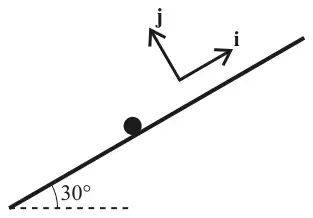
15 Fig. 15 shows a particle of mass \(m\) kg on a smooth plane inclined at \(30^\circ\) to the horizontal. Unit vectors \(\mathbf{i}\) and \(\mathbf{j}\) are parallel and perpendicular to the plane, in the directions shown.
Fig. 15
(a) Express the weight \(\mathbf{W}\) of the particle in terms of \(m\), \(g\), \(\mathbf{i}\) and \(\mathbf{j}\). [2]
The particle is held in equilibrium by a force \(\mathbf{F}\), and the normal reaction of the plane on the particle is denoted by \(\mathbf{R}\). The units for both \(\mathbf{F}\) and \(\mathbf{R}\) are newtons.
(b) Write down an equation relating \(\mathbf{W}\), \(\mathbf{R}\) and \(\mathbf{F}\). [1]
(c) Given that \(\mathbf{F} = 6\mathbf{i} + 8\mathbf{j}\),
show that \(m = 1.22\) correct to 3 significant figures,
B1: Allow for any clear indication that \(\mathbf{R}\) is a multiple of \(\mathbf{j}\) or that it has no component in the \(\mathbf{i}\) direction May be implied with an equation for the i direction with two terms and an equation in the j direction with three terms
M1: Forming equation from their \(\mathbf{i}\) terms, or equivalent by resolving parallel to the plane. FT their \(\mathbf{W}\)
A1: Correct equation in \(\mathbf{i}\) direction
A1:AG
M1: Equation from the \(\mathbf{j}\) terms (must include all three terms), oe, and using value of \(m\) 12 is the value for \(mg\). \(1.22 \times 9.8 = 11.956\)