
June 2024 Paper 2 Q20
20 Two particles \(P\) and \(Q\) are moving in separate straight lines across a smooth horizontal surface.
\(P\) moves with constant velocity \((3\mathbf{i} + 4\mathbf{j})\) m s−1
\(Q\) moves from position vector \((5\mathbf{i} - 7\mathbf{j})\) metres to position vector \((14\mathbf{i} + 5\mathbf{j})\) metres during a 3 second period.
\(Q\) is also moving with a constant velocity of \((3\mathbf{i} + 4\mathbf{j})\) m s−1
Explain why Stevie may be incorrect. [1 mark]
\(P\) and \(R\) move along lines that intersect at a fixed point \(X\)
It is given that:
- \(P\) passes through \(X\) exactly 2 seconds after \(R\) passes through \(X\)
- \(P\) and \(R\) are exactly 13 metres apart 3 seconds after \(R\) passes through \(X\)
Show that \(P\) and \(R\) move along perpendicular lines. [5 marks]
| Scheme | Marks | AO |
|---|---|---|
| Subtracts the two given position vectors for \(Q\) Condone either order | M1 | 3.1a |
| Obtains \(9\mathbf{i} + 12\mathbf{j}\) for the displacement of \(Q\) ACF Or Demonstrates that the average velocity for \(Q\) is \(3\mathbf{i} + 4\mathbf{j}\) | A1 | 1.1b |
| Completes reasoned argument to show that \(9\mathbf{i} + 12\mathbf{j} = 3(3\mathbf{i} + 4\mathbf{j})\) and concludes that \(P\) and \(Q\) move along parallel lines | R1 | 2.1 |
| (3) |
Typical solution
\[(14\mathbf{i} + 5\mathbf{j}) - (5\mathbf{i} - 7\mathbf{j})\]\[= 9\mathbf{i} + 12\mathbf{j}\]\[= 3(3\mathbf{i} + 4\mathbf{j})\]\(P\) and \(Q\) move along parallel lines.
| Scheme | Marks | AO |
|---|---|---|
States one of the following expressions
| E1 | 2.3 |
| (1) |
Typical solution
Constant velocity is not the same as average velocity
| Scheme | Marks | AO |
|---|---|---|
| Obtains 12 m for distance from \(X\) to \(R\) | B1 | 1.1b |
| Obtains 5 m s−1 for the speed of \(P\) PI by \(XP\) = 5 m | B1 | 3.1a |
| Calculates the distance travelled by \(P\) using their speed for \(P\) and \(t\) = 1 Condone \(t\) = 2 | M1 | 1.1a |
| Identifies 5, 12 and 13 as a Pythagorean triple May be seen on a diagram Or Correctly applies the cosine rule \(13^2 = 12^2 + 5^2 - 2 \times 12 \times 5 \times \cos\theta\) and concludes that \(\theta = 90^\circ\) | A1 | 1.1b |
| Completes a reasoned argument that \(PXR\) is a right-angled triangle with hypotenuse \(PR\) and concludes that \(P\) and \(R\) move along perpendicular lines Or Completes a reasoned argument that angle \(PXR\) is a right angle and concludes that \(P\) and \(R\) move along perpendicular lines | R1 | 2.1 |
| (5) | ||
| (9 marks) |
Typical solution
\(P\)’s speed \(= |3\mathbf{i} + 4\mathbf{j}| = 5\) m s−1
Distance from \(X\) to \(P = 5(3 - 2) = 5\) m
Distance from \(X\) to \(R\) = 12 metres
\[5^2 + 12^2 = 13^2\]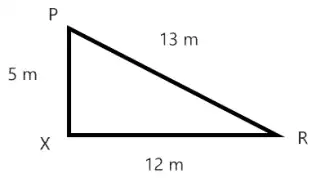
\(P\) and \(R\) are moving along perpendicular lines.