
June 2023 Paper 1 Q8
8 A bus is travelling along a straight road at \(5.4\,\mathrm{m\,s^{-1}}\). At \(t = 0\), as the bus passes a boy standing on the pavement, the boy starts running in the same direction as the bus, accelerating at \(1.2\,\mathrm{m\,s^{-2}}\) from rest for 5 s. He then runs at constant speed until he catches up with the bus.
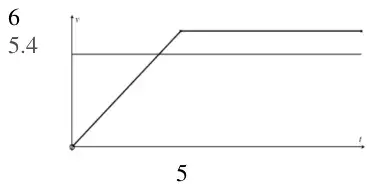
Draw the velocity-time graph for the boy on this diagram. [3]
| Scheme | Marks | AO |
|---|---|---|
 | B1 B1 B1 | 3.3 3.3 3.3 |
| [3] |
Notes
B1: Straight line segment with positive gradient from the origin
B1: Subsequent line segment horizontal and above the given line
B1: Gradient change in their graph labelled with 5 and 6. (May be on axes)
| Scheme | Marks | AO |
|---|---|---|
| velocity of the boy \([t < 5\text{ s}]\) \(v = 1.2t = 5.4\) | M1 | 3.1b |
| giving \(t = 4.5\) s | A1 | 1.1b |
| [2] |
Notes
M1: Equates an expression for boy’s velocity to 5.4
A1: Mark final answer
| Scheme | Marks | AO |
|---|---|---|
| Max distance when \(t = 4.5\) | M1 | 3.1b |
| boy travels \(\frac{1}{2} \times 1.2 \times 4.5^2 = 12.15\) | M1 | 3.1b |
| bus travels \(4.5 \times 5.4 = 24.3\) m Max distance is \(24.3 - 12.15 = 12.15\) m | A1 | 1.1b |
| [3] |
Notes
M1: recognises that max distance occurs when speeds are equal. Allow for their \(t < 5\) from (b) used.
Allow for \(u = 0,\ v = 5.4\) and \(a = 1.2\) in \(v^2 = u^2 + 2as\)
M1: attempt to use suvat or area under the graph and their time \(t \leqslant 5\) to find distance travelled by boy.
A1: Cao
Alternative method 1
| Scheme | Marks |
|---|---|
| Max distance gained by the bus ahead of the boy is represented by the area of the triangle on velocity-time graph | M1 |
| Distance \(= \frac{1}{2} \times 5.4 \times 4.5 = 12.15\) m | M1 A1 |
M1: recognises that max distance occurs when the speeds are equal. Allow for their time from (b) used
M1: Attempt to find area of the triangle
A1: Cao
Alternative method 2
| Scheme | Marks |
|---|---|
| Distance \(S\) at time \(t\) between \([t < 5]\) \([S =]\ 5.4t - \frac{1}{2} \times 1.2t^2\) | M1 |
| Max occurs when \(\frac{\mathrm{d}S}{\mathrm{d}t} = 5.4 - 1.2t = 0\) | M1 |
| When \(t = 4.5\), max distance is 12.15 m | A1 |
M1: Combines expressions from suvat equations to find expression for the distance between
M1: Equates the derivative of their expression to zero leading to a value for \(t\)
A1: Cao
| Scheme | Marks | AO |
|---|---|---|
| Let the time from start to catch the bus be \(T\) s Boy’s distance is area of trapezium \(\frac{1}{2} \times 6(T + T - 5)\ [= 6T - 15]\) | B1 | 3.1b |
| Bus’s distance \(5.4T\) equate distances \(5.4T = 6T - 15\) | M1 | 3.1b |
| distance travelled in 25 s is 135 m | A1 | 1.1b |
| [3] |
Notes
B1: Expression for the total distance for the boy (area method)
oe, e.g. sum of two distances \(\frac{1}{2} \times 5 \times 6 + (T - 5) \times 6\)
M1: equates their expression for distance to the distance travelled by the bus and attempt to solve for \(T\)
A1: Cao. The value for \(T\) need not be seen explicitly
Alternative method (relative speed)
| Scheme | Marks |
|---|---|
| At \(t = 5\) the boy has travelled \(\frac{1}{2} \times 5 \times 6 = 15\) m and the bus \(5.4 \times 5 = 27\) m Boy needs to catch up 12 m | B1 |
| Boy catches up 12 m at \(0.6\,\mathrm{m\,s^{-1}}\) So time is \(\frac{12}{0.6}\ [= 20\text{ s}]\) | M1 |
| Total time 25 s gives distance 135 m | A1 |
B1: 12 m seen if clear that it is a distance between the boy and the bus
M1: Uses relative speed to find the time to catch up
A1: Cao. 25 s need not be seen explicitly
Alternative (numerical) method
| Scheme | Marks |
|---|---|
| Finds at least one correct distance for boy for \(t > 5\) | B1 |
| Working towards the time and distance at which the distances are equal | M1 |
| For 25 s distance travelled 135 m | A1 |
M1: May be awarded for incorrect time and distances eg \(0.6t^2\) used for the boy
A1: 25 s must be seen as well as 135 m
No method seen
SC2 for 135 m www where \(t = 25\) not seen