October 2020 Paper 1 Q3
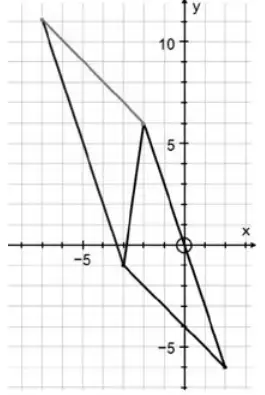
3 Fig. 3 shows a triangle PQR. The vector \(\overrightarrow{\text{PQ}}\) is \(\mathbf{i} + 7\mathbf{j}\) and the vector \(\overrightarrow{\text{QR}}\) is \(4\mathbf{i} - 12\mathbf{j}\).
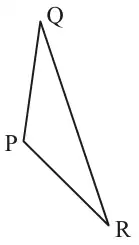
The point P has position vector \(-3\mathbf{i} - \mathbf{j}\). The point S is added so that PQRS is a parallelogram.
| Scheme | Marks | AO |
|---|---|---|
| \(\left|\overrightarrow{\text{PQ}}\right| = \sqrt{1^2 + 7^2} = \sqrt{50}\) | B1 | 1.1a |
| \(\overrightarrow{\text{PR}} = (\mathbf{i} + 7\mathbf{j}) + (4\mathbf{i} - 12\mathbf{j}) = 5\mathbf{i} - 5\mathbf{j}\) | M1 | 1.1a |
| \(\left|\overrightarrow{\text{PR}}\right| = \sqrt{5^2 + 5^2} = \sqrt{50}\) So the triangle is isosceles | A1 | 2.2a |
| [3] |
Notes
B1: Allow for \(\text{PQ}^2\)
M1: Attempt to add vectors
Allow finding \(\overrightarrow{\text{RP}} = -5\mathbf{i} + 5\mathbf{j}\)
A1: Must deduce the triangle is isosceles from correct working
| Scheme | Marks | AO |
|---|---|---|
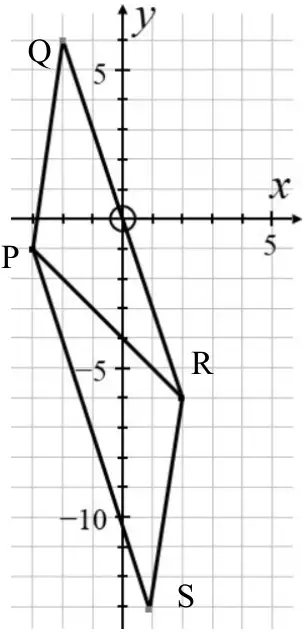
| PQRS parallelogram so \(\overrightarrow{\text{PS}} = \overrightarrow{\text{QR}} = 4\mathbf{i} - 12\mathbf{j}\) | M1 | 3.1a |
| Position vector \(\overrightarrow{\text{OS}} = \overrightarrow{\text{OP}} + \overrightarrow{\text{PS}} = (-3\mathbf{i} - \mathbf{j}) + (4\mathbf{i} - 12\mathbf{j}) = \mathbf{i} - 13\mathbf{j}\) | A1 | 1.1 |
 | ||
| [2] |
Notes
M1: Using the properties of the parallelogram
A1: cao
SPECIAL CASES
Allow SC1 for correct answer for either PQSR or PSQR
If PQSR used, then \(\overrightarrow{\text{OS}} = 3\mathbf{i} + \mathbf{j}\)
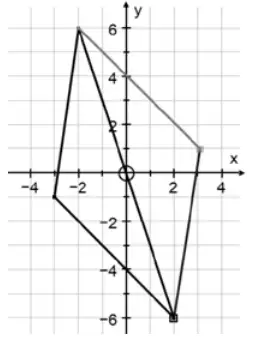
If PSQR used, then \(\overrightarrow{\text{OS}} = -7\mathbf{i} + 11\mathbf{j}\)