
October 2020 Paper 1 Q2
2. [In this question the unit vectors \(\mathbf{i}\) and \(\mathbf{j}\) are due east and due north respectively.]
A coastguard station \(O\) monitors the movements of a small boat.
At 10:00 the boat is at the point \((4\mathbf{i} - 2\mathbf{j})\) km relative to \(O\).
At 12:45 the boat is at the point \((-3\mathbf{i} - 5\mathbf{j})\) km relative to \(O\).
The motion of the boat is modelled as that of a particle moving in a straight line at constant speed.
| Scheme | Marks | AO |
|---|---|---|
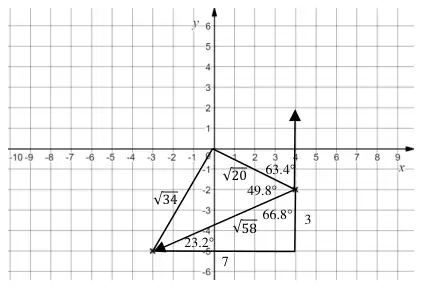 | ||
| Attempts to find an "allowable" angle Eg \(\tan\theta = \dfrac{7}{3}\) | M1 | 1.1b |
| A full attempt to find the bearing Eg \(180^\circ + \text{``}67^\circ\text{''}\) | dM1 | 3.1b |
| Bearing = awrt \(246.8^\circ\) | A1 | 1.1b |
| (3) |
Notes
Score these two parts together.
M1: Attempts an allowable angle. (Either the “66.8”, “23.2” or (“49.8” and “63.4”))
\(\tan\theta = \pm\dfrac{7}{3},\ \tan\theta = \pm\dfrac{3}{7},\ \tan\theta = \pm\dfrac{-2 - -5}{4 - -3}\) etc
There must be an attempt to subtract the coordinates (seen or applied at least once)
If part (b) is attempted first, look for example for \(\sin\theta = \pm\dfrac{7}{\text{``}\sqrt{58}\text{''}},\ \cos\theta = \pm\dfrac{7}{\text{``}\sqrt{58}\text{''}}\), etc
They may use the cosine rule and trigonometry to find the two angles in the scheme. See above. Eg award for \(\cos\theta = \dfrac{\text{``}58\text{''} + \text{``}20\text{''} - \text{``}34\text{''}}{2 \times \text{``}\sqrt{58}\text{''} \times \text{``}\sqrt{20}\text{''}}\) and \(\tan\theta = \pm\dfrac{4}{2}\) or equivalent.
dM1: A full attempt to find the bearing. \(180^\circ + \arctan\dfrac{7}{3},\ 270^\circ - \arctan\dfrac{3}{7},\ 360^\circ - \text{``}49.8^\circ\text{''} - \text{``}63.4^\circ\text{''}\). It is dependent on the previous method mark.
A1: Bearing = awrt \(246.8^\circ\) oe. Allow S \(66.8^\circ\) W
| Scheme | Marks | AO |
|---|---|---|
| Attempts to find the distance travelled = \(\sqrt{(4 - -3)^2 + (-2 + 5)^2} = \left(\sqrt{58}\right)\) | M1 | 1.1b |
| Attempts to find the speed = \(\dfrac{\sqrt{58}}{2.75}\) | dM1 | 3.1b |
| = awrt 2.77 \(\mathrm{km\ h^{-1}}\) | A1 | 1.1b |
| (3) | ||
| (6 marks) |
Notes
M1: Attempts to find the distance travelled. Allow for \(d^2 = (4 - -3)^2 + (-2 + 5)^2\)
You may see this on a diagram and allow if they attempt to find the magnitude from their “resultant vector” found in part (a).
dM1: Attempts to find the speed. There must have been an attempt to find the distance using the coordinates and then divide it by 2.75. Alternatively they could find the speed in \(\mathrm{km\ min^{-1}}\) and then multiply by 60
A1: awrt 2.77 \(\mathrm{km\ h^{-1}}\)