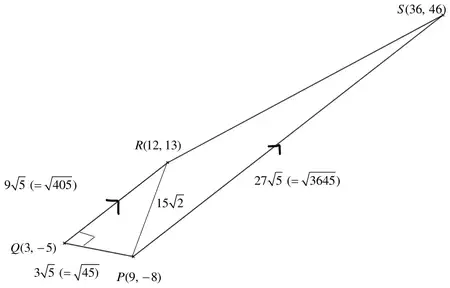
June 2024 Paper 1 Q3
3. Relative to a fixed origin \(O\),
- point \(P\) has position vector \(9\mathbf{i} - 8\mathbf{j}\)
- point \(Q\) has position vector \(3\mathbf{i} - 5\mathbf{j}\)
Given that \(R\) is the point such that \(\overrightarrow{QR} = 9\mathbf{i} + 18\mathbf{j}\)
Given also that \(S\) is the point such that \(\overrightarrow{PS} = 3\overrightarrow{QR}\)
| Scheme | Marks | AO |
|---|---|---|
| \(\overrightarrow{PQ} = (3 - 9)\mathbf{i} + (-5 + 8)\mathbf{j}\) | M1 | 1.1a |
| \(= -6\mathbf{i} + 3\mathbf{j}\) | A1 | 1.1b |
| (2) |
Notes
Note that work seen must be used in the relevant part. If there is a lack of labelling of parts then award the marks to the parts which leads to the highest total overall.
M1: Attempts subtraction either way round (does not need to be evaluated). It cannot be awarded for adding the two vectors. If no method shown it may be implied by one correct component or sight of \(\mp 6\mathbf{i} \pm 3\mathbf{j}\).
A1: Correct answer. Allow \(-6\mathbf{i} + 3\mathbf{j}\) or \(\begin{pmatrix} -6 \\ 3 \end{pmatrix}\) but do not allow \(\begin{pmatrix} -6\mathbf{i} \\ 3\mathbf{j} \end{pmatrix}\) isw once a correct answer is seen.
| Scheme | Marks | AO |
|---|---|---|
| Gradient of \(PQ = \dfrac{-5 - -8}{3 - 9}\left(= -\dfrac{1}{2}\right)\) and Gradient of \(QR = \dfrac{18}{9}(= 2)\) or \(\left|\overrightarrow{PQ}\right| = \sqrt{\text{``}(-6)\text{''}^2 + \text{``}3\text{''}^2}\ \left(= 3\sqrt{5}\right)\) and \(\left|\overrightarrow{QR}\right| = \sqrt{9^2 + 18^2}\ (= 9\sqrt{5})\) and \(\left|\overrightarrow{PR}\right| = \sqrt{\text{``}3\text{''}^2 + \text{``}21\text{''}^2}\ (= 15\sqrt{2})\) | M1 | 3.1a |
| e.g. shows that \(-\dfrac{1}{2} \times 2 = -1\) and deduces angle \(PQR = 90^\circ\ *\) or e.g. shows \(\left|\overrightarrow{PQ}\right|^2 + \left|\overrightarrow{QR}\right|^2 = \left|\overrightarrow{PR}\right|^2\) and deduces angle \(PQR = 90^\circ\ *\) | A1* | 2.4 |
| (2) |
Notes
Note that work seen must be used in the relevant part. If there is a lack of labelling of parts then award the marks to the parts which leads to the highest total overall.
Condone lack of labelling / poor notation for lengths/angles provided the intention is clear
M1: Attempts to find the gradient of the line \(PQ\) and the gradient of the line \(QR\). If they find the reciprocals of both they must be labelled e.g. \(\dfrac{\mathrm{d}x}{\mathrm{d}y}\) o.e. (but not gradient or \(m\))
Do not allow sign slips for this mark. Alternatively they may find the lengths \(PQ\), \(QR\) and \(PR\) or \(PQ^2\), \(QR^2\) and \(PR^2\)
Be aware of Further Maths methods such as attempting the dot product \(\begin{pmatrix} -6 \\ 3 \end{pmatrix} \cdot \begin{pmatrix} 9 \\ 18 \end{pmatrix} = (-6 \times 9) + (3 \times 18)\)
A1*: Correct working and conclusion that angle \(PQR = 90^\circ\)
- Using gradients or their reciprocals they need to state or show that the product is equal to -1 o.e. or refer to the values being negative reciprocals of each other
- Using Pythagoras’ Theorem they must state or show that \(\left|\overrightarrow{PQ}\right|^2 + \left|\overrightarrow{QR}\right|^2 = \left|\overrightarrow{PR}\right|^2\)
- Using the cosine rule and finding angle \(PQR = 90^\circ\)
- Using the scalar dot product they must show that \(\begin{pmatrix} -6 \\ 3 \end{pmatrix} \cdot \begin{pmatrix} 9 \\ 18 \end{pmatrix} = 0\)
In all cases there must be some sort of minimal conclusion that angle \(PQR = 90^\circ\) e.g. “hence right angle” or if they start with a preamble it is acceptable to state “hence proven”, “QED” or a tick. Use of e.g. cosine rule resulting in \(90^\circ\) is sufficient.
| Scheme | Marks | AO |
|---|---|---|
| Attempts to find the length \(PQ\) and at least one of \(QR\) or \(PS\) using Pythagoras’ Theorem correctly e.g. \(\left|\overrightarrow{PQ}\right| = \sqrt{\text{``}(-6)\text{''}^2 + \text{``}3\text{''}^2}\) and either \(\left|\overrightarrow{QR}\right| = \sqrt{9^2 + 18^2}\) or \(\left|\overrightarrow{PS}\right| = \sqrt{\text{``}27\text{''}^2 + \text{``}54\text{''}^2}\) | M1 | 2.1 |
| \(\left|\overrightarrow{PQ}\right| = \text{``}\sqrt{45}\text{''}\ \left(= 3\sqrt{5}\right)\) and either \(\left|\overrightarrow{QR}\right| = \sqrt{405}\ \left(= 9\sqrt{5}\right)\) or \(\left|\overrightarrow{PS}\right| = 27\sqrt{5}\) | A1ft | 1.1b |
| e.g. Area \(= \dfrac{1}{2} \times \left(\text{``}9\sqrt{5}\text{''} + \text{``}27\sqrt{5}\text{''}\right) \times \text{``}\sqrt{45}\text{''}\) or \(\dfrac{1}{2} \times 4 \times \text{``}9\sqrt{5}\text{''} \times \text{``}3\sqrt{5}\text{''}\) | dM1 | 3.1a |
| \(= 270\) | A1 | 1.1b |
| (4) | ||
| (8 marks) |
Notes
Note that work seen must be used in the relevant part. If there is a lack of labelling of parts then award the marks to the parts which leads to the highest total overall.
Condone lack of labelling / poor notation for lengths provided the intention is clear
M1: Correct use of Pythagoras’ Theorem to find the length of \(PQ\) and at least one of \(QR\) or \(PS\). Must be used or seen in (c) to score this mark. Condone working using rounded or truncated values.
A1ft: Correct length of \(PQ\) and at least one of \(QR\) or \(PS\). Follow through on their vectors for \(PQ\) and \(PS\) but \(QR\) must be \(\sqrt{405}\) or equivalent. Lengths do not need to be simplified but they must be exact. Must be used or seen in (c) to score this mark.
dM1: Correct method to find the area of the trapezium. It is dependent on the first method mark and the method to find any lengths must be correct.
This may be achieved by calculating \(\dfrac{1}{2} \times 4\left|QR\right| \times \left|PQ\right|\)
Alternatively, they may find the area of a rectangle + triangle so look for:
e.g. \(\left|PQ\right| \times \left|QR\right| + \dfrac{1}{2} \times \left(\left|PS\right| - \left|QR\right|\right) \times \left|PQ\right| = \text{``}\sqrt{45}\text{''} \times \text{``}9\sqrt{5}\text{''} + \dfrac{1}{2} \times \text{``}18\sqrt{5}\text{''} \times \text{``}\sqrt{45}\text{''}\)
Note that there are other combinations of lengths to find the area of a rectangle and either add or subtract triangles as appropriate. Condone working using rounded values.
A1: 270
Alt (c) “Shoelace method” or other methods using position vectors
M1: Correct method to find either the position vector of \(R\) or the position vector of \(S\). May be seen as coordinates. Check any diagram drawn.
A1: \(R\) has position vector \(12\mathbf{i} + 13\mathbf{j}\) and \(S\) has position vector \(36\mathbf{i} + 46\mathbf{j}\) (or equivalent). May be seen as coordinates. Check any diagram drawn.
dM1: Correct method to find the area of the trapezium via the “shoelace” method:
\[\frac{1}{2}\begin{vmatrix} 9 & -8 \\ 3 & -5 \\ 12 & 13 \\ 36 & 46 \\ 9 & -8 \end{vmatrix} = \frac{1}{2}\left|\big(9 \times (-5) + 3 \times 13 + 12 \times 46 + 36 \times (-8)\big) - \big(3 \times (-8) + 12 \times (-5) + 36 \times 13 + 9 \times 46\big)\right|\]\[= \frac{1}{2}\left|258 - 798\right|\]A1: 270