9. An equation\[x^2 - 3px + 5q + 4 = 0\]where \(p\) and \(q\) are constants, has equal roots.
Show that\[q = \frac{1}{20}(3p+4)(3p-4)\](3)
Mark scheme
Scheme
Marks
AO
\(x^2 - 3px + 5q + 4 = 0\)
\((3p)^2 - 4(5q + 4)\)
B1
1.1b
\(9p^2 - 20q - 16 = 0\) \((3p+4)(3p-4) = 20q\)
M1
3.1a
\(q = \dfrac{1}{20}(3p+4)(3p-4)\,*\)
A1*
2.1
(3)
Notes
Note we are marking this B1M1A1 not M1M1A1
B1:Correct expression for the discriminant e.g. \((-3p)^2 - 4(5q + 4)\) or \((3p)^2 - 4(5q + 4)\) Do not condone missing brackets around the “\(3p\)” or \(5q + 4\) unless they are recovered but missing brackets around the “\(3p\)” must be recovered before using the difference of 2 squares below. E.g. \(3p^2 - 16 = (3p+4)(3p+4)\) scores M0 below. Allow to be seen embedded in at attempt at the quadratic formula. Allow for \(9p^2 - 20q - 16\) just written down.
M1: Sets their discriminant in terms of \(p\) and \(q\) \(= 0\) with the correct use of \(\alpha p^2 - \beta = \left(\sqrt{\alpha}\,p + \sqrt{\beta}\right)\left(\sqrt{\alpha}\,p - \sqrt{\beta}\right)\) so \(9p^2 - 16 = 20q = (9p+12)(9p-12)\) scores M0 even if “recovered”
A1*: cso Arrives at \(q = \dfrac{1}{20}(3p+4)(3p-4)\) with no errors seen. Or expands \(q = \dfrac{1}{20}(3p+4)(3p-4)\) and compares with their q and gives a (minimal) conclusion. Any missing brackets must be recovered before reaching the printed answer. A correct intermediate line must be seen, such as \(q = \dfrac{9p^2 - 16}{20}\) or \(20q = (3p+4)(3p-4)\)
B1:Correct completion of the square \(x^2 - 3px + 5q + 4 = \left(x - \dfrac{3p}{2}\right)^2 - \left(\dfrac{3p}{2}\right)^2 + 5q + 4\) Do not condone missing brackets around the \(\dfrac{3p}{2}\) unless they are recovered.
M1: Sets their \(-\left(\dfrac{3p}{2}\right)^2 + 5q + 4\) which must be in terms of \(p\) and \(q\) equal to 0 with the correct use of \(\alpha p^2 - \beta = \left(\sqrt{\alpha}\,p + \sqrt{\beta}\right)\left(\sqrt{\alpha}\,p - \sqrt{\beta}\right)\) so \(9p^2 - 16 = 20q = (9p+12)(9p-12)\) scores M0 even if “recovered”
A1*: cso Arrives at \(q = \dfrac{1}{20}(3p+4)(3p-4)\) with no errors seen. Any missing brackets must be recovered before reaching the printed answer. A correct intermediate line must be seen, such as \(q = \dfrac{9p^2 - 16}{20}\) or \(20q = (3p+4)(3p-4)\)
M1: Sets their \(\dfrac{\mathrm{d}y}{\mathrm{d}x}\) which must be in terms of \(p\) and \(x\) equal to 0 to find \(x\) in terms of \(p\), substitutes into \(x^2 - 3px + 5q + 4\) and with the correct use of \(\alpha p^2 - \beta = \left(\sqrt{\alpha}\,p + \sqrt{\beta}\right)\left(\sqrt{\alpha}\,p - \sqrt{\beta}\right)\) so \(9p^2 - 16 = 20q = (9p+12)(9p-12)\) scores M0 even if “recovered”
A1*: cso Arrives at \(q = \dfrac{1}{20}(3p+4)(3p-4)\) with no errors seen. Any missing brackets must be recovered before reaching the printed answer. A correct intermediate line must be seen, such as \(q = \dfrac{9p^2 - 16}{20}\) or \(20q = (3p+4)(3p-4)\)
e.g. \(x = \dfrac{3p}{2}\) only so equal roots or \(\left(x - \dfrac{3p}{2}\right)^2 = 0\) so equal roots or \(b^2 - 4ac = 0\) so equal roots
A1*
2.1
Note we are marking this B1M1A1 not M1M1A1
B1: Substitutes the given result into \(x^2 - 3px + 5q + 4\) and simplifies to obtain \(x^2 - 3px + \dfrac{9p^2}{4}\) oe e.g. \(4x^2 - 12px + 9p^2\)
M1: Attempts to complete the square to obtain \(x^2 - 3px + \dfrac{9p^2}{4} = \left(x - \dfrac{3p}{2}\right)^2 + \ldots\) oe alternatively attempts the discriminant e.g. \((3p)^2 - 4 \times 1 \times \left(\dfrac{9p^2}{4}\right) = \ldots\)
A1*: cso Fully correct work with sufficient working shown and no errors seen with a suitable reasoning and a conclusion e.g. “only 1 root so equal roots” or equivalent or obtains a zero discriminant and states e.g. “so equal roots” or equivalent.
The annual profit made by the company is modelled by the equation\[P = -x^2 + 260x - 16\,450\]where \(P\) is the profit measured in thousands of pounds and \(x\) is the selling price of the chair in pounds.
The graph of \(P\) against \(x\) is shown in Figure 3.
Using the model,
(a) explain why £175 is not a sensible selling price for the chair. (2)
Given that the company made an annual profit of more than £200 000
(b) find, according to the model, the highest possible selling price for the chair. You must show your working clearly. (3)
(c) Show that\[P = a + b(x + c)^2\]where \(a\), \(b\) and \(c\) are constants to be found. (3)
The company wishes to maximise its annual profit.
State, according to the model,
(d)
(i) the maximum possible annual profit,
(ii) the selling price of the chair that maximises the annual profit. (2)
Mark scheme (a)
Scheme
Marks
AO
\(P = -175^2 + 260 \times 175 - 16\,450\)
M1
3.4
\(= -1575\ \therefore\) not sensible as the company would make a loss
A1
2.4
(2)
Notes
Look for answers written in the question or on Figure 3
M1: Substitutes \(x = 175\) into \(P = -x^2 + 260x - 16\,450\) to find a value for \(P\). This is implied by an answer of \(-1575\). Alternatively attempts to find the solutions of \(-x^2 + 260x - 16\,450 = 0\) usual rules apply so a method must be seen or the correct roots stated (these are 108.78… and 151.21…) and compares with 175 which may be implied.
A1: Finds \(P = -1575\) and states that \(P \lt 0\) which may be implied and explains that the company would make a loss/negative profit, the profit is negative, the company will not make any money. Condone suggestions that the loss is £1575 rather than £1 575 000 or obtains the larger root as awrt 151, compares 175 > 151 and states that \(P \lt 0\) which may be implied and explains that the company would make a loss/would not make a profit.
Explanations that are incomplete or incorrect score A0 e.g.
the profit cannot be negative (because it can)
they might make a loss (because they will make a loss)
it is negative (without saying what it is)
You may ignore any misconceptions or reference to the price of the chair being too cheap for this mark.
Attempts to find the turning point score no marks unless there is some consideration of the profit when \(x = 175\)
Look for answers written in the question or on Figure 3
M1: Uses \(P \ldots 200\) where … is any inequality or = with \(P = -x^2 + 260x - 16\,450\) and proceeds to at least one value for \(x\) via a correct method which may be via calculator (you may need to check) and may be inexact.
dM1: Award for solving to find two positive values for \(x\). Allow decimal answers or surds. FYI correct answers are \(\dfrac{260 \pm \sqrt{1000}}{2}\) or \(130 \pm 5\sqrt{10}\) or 114/146 or if only one value of \(x\) is seen, this must be the higher value for their quadratic which must have 2 positive solutions (you may need to check). e.g. for the correct quadratic \(130 + 5\sqrt{10}\) or 145.81/145.82/145.8/146
A1: Deduces that the maximum price is £145.81 with units. Allow £145.81p £145.82 is not acceptable and if both values are given score A0. There must be some evidence of the correct equation being solved but condone incorrect inequalities appearing in their working.
Note: Missing units from an otherwise correct answer should only be penalised once in (b) or (d) and penalise it the first time it occurs.
\(-x^2 + 260x - 16\,450 = -(x - 130)^2 \pm \ldots\) or \(b = -1\) and \(c = -130\)
M1
1.1b
\((P =)\ 450 - (x - 130)^2\)
A1
1.1b
(3)
Notes
Look for answers written in the question or on Figure 3
Allow to score anywhere in the question. Note that some candidates use \(200 = -x^2 + 260x - 16\,450\) in (c) and attempt to complete the square on this. In these cases allow the B mark and the M mark as defined below.
B1: Achieves \(-(x \pm k)^2 \pm \ldots\) or states that \(b = -1\)
M1: Achieves \(-(x - 130)^2 \pm \ldots\) or states \(b = -1\) and \(c = -130\)
A1: \(\{P =\}\ 450 - (x - 130)^2\) or e.g. \(\{P =\} -(x - 130)^2 + 450\) or e.g. \(\{P =\}\ 450 - 1(x - 130)^2\) Must be simplified e.g. not \(\{P =\} -16\,450 + 16\,900 - (x - 130)^2\) Note that this may be done in a variety of ways including equating with the expanded form of \(a + b(x + c)^2 = bx^2 + 2bcx + bc^2 + a\) Correct answer only scores full marks. If there is incorrect/muddled working, mark their final answer.
Mark scheme (d)
Scheme
Marks
AO
(d)(i) States maximum profit = £450 000
B1
3.2a
(ii) States selling price £130
B1
2.2a
(2)
(10 marks)
Notes
Look for answers written in the question or on Figure 3
If there is no labelling in (d), mark in the order presented.
(d)(i)
B1: Maximum profit = £450 000 with units. Accept 450 thousand pounds or £450k This is an independent mark so could follow incorrect work in (c).
(d)(ii)
B1: Selling price = £130 with units. This is an independent mark so could follow incorrect work in (c).
Note: Missing units from an otherwise correct answer should only be penalised once in (b) or (d) and penalise it the first time it occurs.
4. The circle \(C\) has equation\[x^2 + y^2 + 10x - 4y + 1 = 0\]
(a) Find
(i) the coordinates of the centre of \(C\)
(ii) the exact radius of \(C\) (3)
The line with equation \(y = k\), where \(k\) is a constant, cuts \(C\) at two distinct points.
(b) Find the range of values for \(k\), giving your answer in set notation. (3)
Mark scheme (a)
Scheme
Marks
AO
\(x^2 + y^2 + 10x - 4y + 1 = 0\)
(a)(i) \((x+5)^2 + (y-2)^2\)
M1
1.1b
Centre \((-5,\ 2)\)
A1
1.1b
(a)(ii) Radius is \(\sqrt{28}\)
A1
1.1b
(3)
Notes
Condone mislabelled parts e.g. labelled as (a), (b) and (c) not (a)(i), (a)(ii), (b)
M1: Attempts to complete the square by halving both \(x\) and \(y\) terms. Award for sight of \((x \pm 5)^2 \ldots (y \pm 2)^2\) or \((x \pm 5)^2\) and \((y \pm 2)^2\) seen separately. May be implied by a centre of \((\pm 5,\ \pm 2)\)
A1: Correct coordinates \((-5,\ 2)\) or e.g. \(x = -5,\ y = 2\) and condone e.g. \(-5,\ 2\)
\(\left\{k : 2-2\sqrt{7} \lt k \lt 2+2\sqrt{7}\right\}\) oe
A1
2.5
(3)
(6 marks)
Notes
Condone mislabelled parts e.g. labelled as (a), (b) and (c) not (a)(i), (a)(ii), (b)
B1: \(2+2\sqrt{7}\) or \(2-2\sqrt{7}\) seen. Accept \(\sqrt{28}\) for \(2\sqrt{7}\) throughout this question.
M1: \(\text{``}2-2\sqrt{7}\text{''} \lt k \lt \text{``}2+2\sqrt{7}\text{''}\) Selects the inside interval for their endpoints which must come from a correct method condoning slips. Condone use of \(y\) for \(k\). May be seen separately e.g. \(\text{``}2-2\sqrt{7}\text{''} \lt k,\quad k \lt \text{``}2+2\sqrt{7}\text{''}\) Condone e.g. \(\text{``}2-\sqrt{28}\text{''} \leqslant k \leqslant \text{``}2+\sqrt{28}\text{''}\) and allow inexact e.g. \(\text{``}{-3.291\ldots}\text{''} \lt k \lt \text{``}7.291\ldots\text{''}\) An incorrect method would include e.g. \(5-2\sqrt{7} \lt k \lt 5+2\sqrt{7}\) ie using the \(x\) coordinate of the centre rather than the \(y\) coordinate.
A1: Correct answer in exact form in set notation or interval notation in terms of \(k\). Allow: \(\left\{k : 2-2\sqrt{7} \lt k \lt 2+2\sqrt{7}\right\}\) or \(\left\{k : 2-2\sqrt{7} \lt k\right\} \cap \left\{k : k \lt 2+2\sqrt{7}\right\}\) or \(\left\{2-2\sqrt{7} \lt k \lt 2+2\sqrt{7}\right\}\) or \(\left\{2-2\sqrt{7} \lt k\right\} \cap \left\{k \lt 2+2\sqrt{7}\right\}\) or \(\left(2-2\sqrt{7},\ 2+2\sqrt{7}\right)\) or \(\left\{k : 2-2\sqrt{7} \lt k \cap k \lt 2+2\sqrt{7}\right\}\) or \(\left\{k : 2-2\sqrt{7} \lt k\right\}\) and \(\left\{k : k \lt 2+2\sqrt{7}\right\}\) but not \(\left\{2-2\sqrt{7} \lt k\right\} \cup \left\{k \lt 2+2\sqrt{7}\right\}\) and not \(\left[2-2\sqrt{7},\ 2+2\sqrt{7}\right]\) and not \(\left\{2-2\sqrt{7} \leqslant k \leqslant 2+2\sqrt{7}\right\}\)
(b) Alternative 1
(substitutes \(y = k\) into the given or their circle equation and uses \(b^2 - 4ac = 0\) or \(b^2 - 4ac \gt 0\)) Scores in the same way following e.g. \(x^2 + 10x + \left(k^2 - 4k + 1\right) = 0,\ 10^2 - 4\left(k^2 - 4k + 1\right) \gt 0,\ 24 + 4k - k^2 = 0\)
B1: \(2+2\sqrt{7}\) or \(2-2\sqrt{7}\) seen. Accept \(\sqrt{28}\) for \(2\sqrt{7}\) throughout this question.
M1: \(\text{``}2-2\sqrt{7}\text{''} \lt k \lt \text{``}2+2\sqrt{7}\text{''}\) Selects the inside interval for their endpoints which must come from a correct method condoning slips. Condone use of \(y\) for \(k\). May be seen separately e.g. \(\text{``}2-2\sqrt{7}\text{''} \lt k,\quad k \lt \text{``}2+2\sqrt{7}\text{''}\) Condone e.g. \(\text{``}2-\sqrt{28}\text{''} \leqslant k \leqslant \text{``}2+\sqrt{28}\text{''}\) and allow inexact e.g. \(\text{``}{-3.291\ldots}\text{''} \lt k \lt \text{``}7.291\ldots\text{''}\) If when finding their endpoints they make a sign error and obtain e.g. \(k^2 - 4k - 24 \gt 0\) and then choose the outside region, this scores M1 but it must be consistent with their inequality.
A1: Correct answer in exact form in set notation or interval notation in terms of \(k\). Allow: \(\left\{k : 2-2\sqrt{7} \lt k \lt 2+2\sqrt{7}\right\}\) or \(\left\{k : 2-2\sqrt{7} \lt k\right\} \cap \left\{k : k \lt 2+2\sqrt{7}\right\}\) or \(\left\{2-2\sqrt{7} \lt k \lt 2+2\sqrt{7}\right\}\) or \(\left\{2-2\sqrt{7} \lt k\right\} \cap \left\{k \lt 2+2\sqrt{7}\right\}\) or \(\left(2-2\sqrt{7},\ 2+2\sqrt{7}\right)\) or \(\left\{k : 2-2\sqrt{7} \lt k \cap k \lt 2+2\sqrt{7}\right\}\) or \(\left\{k : 2-2\sqrt{7} \lt k\right\}\) and \(\left\{k : k \lt 2+2\sqrt{7}\right\}\) but not \(\left\{2-2\sqrt{7} \lt k\right\} \cup \left\{k \lt 2+2\sqrt{7}\right\}\) and not \(\left[2-2\sqrt{7},\ 2+2\sqrt{7}\right]\) and not \(\left\{2-2\sqrt{7} \leqslant k \leqslant 2+2\sqrt{7}\right\}\)
(b) Alternative 2
(substitutes \(x = \text{``}{-5}\text{''}\) into the given or their circle equation and solves for \(y\)) Scores in the same way following e.g. \(25 + y^2 - 50 - 4y + 1 = 0 \Rightarrow y^2 - 4y - 24 = 0 \Rightarrow y =\) (corrected from the printed mark scheme: “\(25 + y^2 - 50 - 4y + 1 - 0\)”)
B1: \(2+2\sqrt{7}\) or \(2-2\sqrt{7}\) seen. Accept \(\sqrt{28}\) for \(2\sqrt{7}\) throughout this question.
M1: \(\text{``}2-2\sqrt{7}\text{''} \lt k \lt \text{``}2+2\sqrt{7}\text{''}\) Selects the inside interval for their endpoints which must come from a correct method condoning slips. Condone use of \(y\) for \(k\). May be seen separately e.g. \(\text{``}2-2\sqrt{7}\text{''} \lt k,\quad k \lt \text{``}2+2\sqrt{7}\text{''}\) Condone e.g. \(\text{``}2-\sqrt{28}\text{''} \leqslant k \leqslant \text{``}2+\sqrt{28}\text{''}\) and allow inexact e.g. \(\text{``}{-3.291\ldots}\text{''} \lt k \lt \text{``}7.291\ldots\text{''}\)
A1: Correct answer in exact form in set notation or interval notation in terms of \(k\). Allow: \(\left\{k : 2-2\sqrt{7} \lt k \lt 2+2\sqrt{7}\right\}\) or \(\left\{k : 2-2\sqrt{7} \lt k\right\} \cap \left\{k : k \lt 2+2\sqrt{7}\right\}\) or \(\left\{2-2\sqrt{7} \lt k \lt 2+2\sqrt{7}\right\}\) or \(\left\{2-2\sqrt{7} \lt k\right\} \cap \left\{k \lt 2+2\sqrt{7}\right\}\) or \(\left(2-2\sqrt{7},\ 2+2\sqrt{7}\right)\) or \(\left\{k : 2-2\sqrt{7} \lt k \cap k \lt 2+2\sqrt{7}\right\}\) or \(\left\{k : 2-2\sqrt{7} \lt k\right\}\) and \(\left\{k : k \lt 2+2\sqrt{7}\right\}\) but not \(\left\{2-2\sqrt{7} \lt k\right\} \cup \left\{k \lt 2+2\sqrt{7}\right\}\) and not \(\left[2-2\sqrt{7},\ 2+2\sqrt{7}\right]\) and not \(\left\{2-2\sqrt{7} \leqslant k \leqslant 2+2\sqrt{7}\right\}\)
\(y - 22 = \text{``}4\text{''}(x - 2.5)\) or \(y - 0 = \text{``}4\text{''}(x - -3)\) or \(0 = \text{``}4\text{''} \times -3 + c \Rightarrow c = \ldots\) or \(22 = \text{``}4\text{''} \times 2.5 + c \Rightarrow c = \ldots\)
dM1
1.1b
\(y = 4x + 12\)
A1
1.1b
(3)
Notes
M1: Attempts Gradient \(= \dfrac{22-0}{2.5--3}\). Condone 1 sign/copying slip only if a correct formula is seen or implied e.g. \(\dfrac{y_2 - y_1}{x_2 - x_1}\) Alternatively solves two simultaneous equations, e.g. \(22 = \dfrac{5}{2}m + c\) and \(0 = -3m + c\) to find a value for \(m\) or \(c\).
dM1: Uses \(y - y_1 = m(x - x_1)\) with either \(A(-3,0)\) or \(B(2.5,\ 22)\) or e.g. \(\left(-\dfrac{1}{4},\ 11\right)\) (midpoint) and their \(m = \text{``}4\text{''}\) with the values correctly placed. If \(y = mx + c\) is used they must proceed as far as \(c = \ldots\) Alternatively solves two simultaneous equations, e.g. \(22 = \dfrac{5}{2}m + c\) and \(0 = -3m + c\) to find \(m\) and \(c\).
A1: \(y = 4x + 12\) or \(y = 12 + 4x\) only.
If they use e.g. \(\dfrac{y}{22-0} = \dfrac{x+3}{2.5--3}\) both M’s can be scored together. Condone 1 sign/copying slip only if a correct formula is seen or implied.
Correct answer only scores full marks.
Mark scheme (b)
Scheme
Marks
AO
\(y \lt 4x + 12\) \(y \geqslant 2x^2 + 5x - 3\)
B1ft
2.2a
\(2x^2 + 5x - 3 \leqslant y \lt 4x + 12\)
B1ft
1.1b
(2)
(5 marks)
Notes
B1ft: Deduces one of \(y \lt \text{``}4x+12\text{''}\) o.e. or \(y \geqslant 2x^2 + 5x - 3\) o.e. They must have an equation for \(l\) and it must be the equation of a straight line.
B1ft: \(y \lt \text{``}4x+12\text{''}\) and \(y \geqslant 2x^2 + 5x - 3\) o.e. e.g. \(2x^2 + 5x - 3 \leqslant y \lt \text{``}4x+12\text{''}\), or \(y \lt \text{``}4x+12\text{''},\ y \geqslant 2x^2 + 5x - 3\) Note: For what is an otherwise correctly defined region, if there are any extra inequalities that are contradictory e.g. \(-3 \lt x \lt 0\) then withhold the second B mark but note that \(-3 \leqslant x \leqslant \frac{5}{2}\) or anything “wider” is fine. (Do not be concerned about strictness) Condone the use of “or” or “\(\cup\)” for the first B mark but \(y \lt \text{``}4x+12\text{''}\) or \(y \geqslant 2x^2 + 5x - 3\) or \(y \lt \text{``}4x+12\text{''} \cup y \geqslant 2x^2 + 5x - 3\) scores B1B0 They must have an equation for \(l\) and it must be the equation of a straight line.
Note: Apply isw if the correct inequalities are written separately but are then combined incorrectly.
Note: Inequalities cannot be in terms of \(R\) e.g. \(2x^2 + 5x - 3 \leqslant R \lt \text{``}4x+12\text{''}\)
Alternatively, some candidates may express their inequalities involving a boundary for a dashed line with \(\leqslant\) or \(\geqslant\) and a boundary for a solid line with \(\lt\) or \(\gt\). It may not always be clear so mark positively. e.g.
B1ft: Deduces one of \(y \leqslant \text{``}4x+12\text{''}\) o.e. or \(y \gt 2x^2 + 5x - 3\) o.e. They must have an equation for \(l\) and it must be the equation of a straight line.
B1ft: \(y \leqslant \text{``}4x+12\text{''}\) and \(y \gt 2x^2 + 5x - 3\) o.e. e.g. \(2x^2 + 5x - 3 \lt y \leqslant \text{``}4x+12\text{''}\) They must have an equation for \(l\) and it must be the equation of a straight line.
In general look at the direction for the first mark to see if one inequality has the correct direction. Then for the second B mark they need correct direction and consistent ‘strict’ or ‘non-strictness’ with the other inequality. So e.g. \(y \lt \text{``}4x+12\text{''},\ y \gt 2x^2 + 5x - 3\) scores B1B0
Note that some candidates define \(R\) as \(-3 \lt x \lt \dfrac{5}{2}\) and this scores no marks on its own.
Figure 3 shows a sketch of a curve \(C\) and a straight line \(l\).
Given that
\(C\) has equation \(y = \mathrm{f}(x)\) where \(\mathrm{f}(x)\) is a quadratic expression in \(x\)
\(C\) cuts the \(x\)-axis at 0 and 6
\(l\) cuts the \(y\)-axis at 60 and intersects \(C\) at the point \((10, 80)\)
use inequalities to define the region \(R\) shown shaded in Figure 3. (5)
Mark scheme
Scheme
Marks
AO
Complete method to find the RHS of an equation for \(l\) e.g., Attempts gradient = \(\dfrac{80 - 60}{10}\{= 2\}\) and uses intercept = 60
M1
1.1b
\(\{y =\}\, 2x + 60\)
A1
1.1b
Deduces the RHS of the equation for \(C\) is \(\{y =\}\, ax(x - 6)\) and attempts to use \((10, 80)\) to find the value of \(a\)
M1
3.1a
Equation of \(C\) is \(\{y =\}\, 2x(x - 6)\)
A1
1.1b
\(2x(x - 6) \leqslant y \leqslant 2x + 60\)
B1ft
2.5
(5)
(5 marks)
Notes
M1: Complete attempt to use the given information to find an equation or inequality for \(l\), which may be \(l =\) or have no LHS. \(y - 80 = 2(x - 10)\) is acceptable for this mark.
A1: \(\{y =\}\, 2x + 60\) This is not scored by \(y - 80 = 2(x - 10)\)
M1: Deduces the RHS of the equation of \(C\) is \(\{y =\}\, ax(x - 6),\ a \neq 1,\) and attempts to use \((10, 80)\) to find the value of \(a\) which may be implied. Again, there may be no LHS. Other possible and more lengthy alternatives include: 1) Setting the RHS to be \(\{y =\}\, a(x - 3)^2 + b\) and using \((0, 0)\) and \((10, 80)\) to find \(a\) and \(b\) 2) Setting the RHS to be \(\{y =\}\, px^2 + qx\) and using \((6, 0)\) and \((10, 80)\) to find \(p\) and \(q\)
A1: \(\{y =\}\, 2x(x - 6)\) or alternative such as \(\{y =\}\, 2(x - 3)^2 - 18\) or \(\{y =\}\, 2x^2 - 12x\) This may be implied by an inequality \(y \ldots 2x(x - 6)\) and may be seen as, e.g., \(C = 2x(x - 6)\)
B1ft: \(\text{``}2x(x - 6)\text{''} \leqslant y \leqslant \text{``}2x + 60\text{''}\) o.e. must follow from their \(l\) and \(C\) and apply isw Follow through only on a quadratic for \(C\) and a straight line for \(l\) Do not allow a mixture of inequalities, i.e., \(\lt\) with \(\leqslant\) Allow \(2x^2 - 12x \lt y \lt 2x + 60\) or as separate inequalities \(y \gt 2x(x - 6),\ y \lt 2x + 60\) Do not allow \(2x(x - 6) \lt R \lt 2x + 60\) or \(2x(x - 6) \lt \mathrm{f}(x) \lt 2x + 60\) or \(2x(x - 6) \lt 2x + 60\) Ignore any reference to \(-3 \lt x \lt 10\) Note: \(y = 2x + 60\) and \(y = 2x(x - 6)\) incorrectly expanded to \(y = 2x^2 - 12\) followed by \(2x^2 - 12 \leqslant y \leqslant 2x + 60\) would score 11110
Attempts \(\sqrt{x} = \text{``}\dfrac{4}{3}\text{''}, \text{``}{-}\dfrac{5}{2}\text{''} \Rightarrow x = \ldots\)
M1
1.1b
\(x = \dfrac{16}{9}\) only
A1 cso
2.3
(4)
(4 marks)
Notes
M1: Attempts a valid method that enables the problem to be solved. See General Principles for Pure Mathematics Marking at the front of the mark scheme for guidance. Score for either letting \(u = \sqrt{x}\) and attempting to factorise to \((au \pm c)(bu \pm d)\) with \(ab = 6, cd = 20\) or making \(7\sqrt{x}\) the subject and attempting to square both sides. or attempting to factorise to \((a\sqrt{x} \pm c)(b\sqrt{x} \pm d)\) with \(ab = 6, cd = 20\) or by quadratic formula or completing the square following usual rules.
A1: \((3u - 4)(2u + 5)\{= 0\}\) or \(36x^2 - 289x + 400\{= 0\}\) or \((3\sqrt{x} - 4)(2\sqrt{x} + 5)\{= 0\}\) If they use the formula, it must be correct e.g., \(u\ \{\text{or } \sqrt{x}\} = \dfrac{-7 \pm \sqrt{7^2 - 4(6)(-20)}}{12}\) followed by \(u\ \{\text{or } \sqrt{x}\} = \dfrac{4}{3}\) or equivalent e.g., \(\dfrac{16}{12}\). Ignore if they have \(u\ \{\text{or } \sqrt{x}\} = -\dfrac{5}{2}\) or not. If they complete the square, they must have \(\left(u + \dfrac{7}{12}\right)^2 = \dfrac{529}{144}\) followed by \(u\ \{\text{or } \sqrt{x}\} = \dfrac{4}{3}\) or equivalent e.g., \(\dfrac{16}{12}\). Ignore if they have \(u\ \{\text{or } \sqrt{x}\} = -\dfrac{5}{2}\) or not.
M1: Correct method from \(p\sqrt{x} \pm q = 0\) leading to \(x = \ldots\) by squaring In Alt 1, it is for solving their quadratic using the General Principles for Pure Mathematics Marking. There must be a method shown, i.e., the solutions should not come straight from a calculator. If attempting to factorise, it must be to \((ax \pm c)(bx \pm d)\) with \(ab = 36, cd = 400\) In Alt 2, it is for squaring their value(s) for \(u\) to get \(x = \ldots\)
A1:cso \(x = \dfrac{16}{9}\) only. \(x = \dfrac{25}{4}\) must be discarded. Note 0011 is not possible. Allow “incorrect” \(x = -\dfrac{16}{9}\) or \(x = -\dfrac{25}{4}\) to be seen as long as they are discarded. Ignore any reason they give for rejecting solutions. Note that a method to solve their quadratic must be seen – solutions must not come directly from a calculator. Simply stating the quadratic formula (without substitution) is insufficient.
M1: Attempts to take out a common factor and complete the square. Award for \(-3(x \pm 2)^2 + \ldots\) Alternatively attempt to compare \(-3x^2 + 12x + 8\) to \(ax^2 + 2abx + ab^2 + c\) to find values of a and b
A1: Proceeds to a form \(-3(x - 2)^2 + \ldots\) or via comparison finds \(a = -3, b = -2\)
A1: \(-3(x - 2)^2 + 20\)
Mark scheme (b)
Scheme
Marks
AO
Coordinates of \(M = (2, 20)\)
B1ft B1ft
1.1b 2.2a
(2)
Notes
B1ft: One correct coordinate
B1ft: Correct coordinates. Allow as \(x = \ldots,\ y = \ldots\) Follow through on their \((-b, c)\)
Method to find \(R =\) their \(\displaystyle 2 \times 20 - \int_0^2 \left(-3x^2 + 12x + 8\right)\mathrm{d}x\)
M1
3.1a
\(R = 40 - \left[-2^3 + 24 + 16\right]\)
dM1
1.1b
\(= 8\)
A1
1.1b
(5)
(10 marks)
Notes
M1: Attempts to integrate. Award for any correct index
A1: \(\displaystyle\int -3x^2 + 12x + 8\,\mathrm{d}x = -x^3 + 6x^2 + 8x\ (+\,c)\) (which may be unsimplified)
M1: Method to find area of \(R\). Look for their \(\displaystyle 2 \times \text{``}20\text{''} - \int_0^{\text{``}2\text{''}} \mathrm{f}(x)\,\mathrm{d}x\)
dM1: Correct application of limits on their integrated function. Their 2 must be used
M1: Factorises out or cancels by \(x\) to form a quadratic equation.
dM1: Scored for an attempt to find \(x\). May be awarded for factorisation of the quadratic or use of the quadratic formula.
A1: \(x = 0, -\dfrac{1}{3}, 6\) and no extras
Mark scheme (b)
Scheme
Marks
AO
Attempts to solve \((y - 2)^2 = n\) where \(n\) is any solution \(\geqslant 0\) to (a)
M1
2.2a
Two of \(2,\ 2 \pm \sqrt{6}\)
A1ft
1.1b
All three of \(2,\ 2 \pm \sqrt{6}\)
A1
2.1
(3)
(6 marks)
Notes
M1: Attempts to solve \((y - 2)^2 = n\) where \(n\) is any solution \(\geqslant 0\) to (a). At least one stage of working must be seen to award this mark. Eg \((y - 2)^2 = 0 \Rightarrow y = 2\)
A1ft: Two of \(2,\ 2 \pm \sqrt{6}\) but follow through on \((y - 2)^2 = n \Rightarrow y = 2 \pm \sqrt{n}\) where \(n\) is a positive solution to part (a). (Provided M1 has been scored)
A1: All three of \(2,\ 2 \pm \sqrt{6}\) and no extra solutions. (Provided M1A1 has been scored)
\(\Rightarrow 2x - 2 - y - 2 = 4 \Rightarrow y =\) or \(\Rightarrow x - 1 - \dfrac{1}{2}y - 1 = 2 \Rightarrow y =\)
dM1
1.1b
\(\Rightarrow y = 2x - 8\)
A1
1.1b
(3)
(3 marks)
Notes
M1: Attempts to set \(9^{x-1}\) and \(81\) as powers of 3. Condone \(9^{x-1} = 3^{2x-1}\) and \(9^{x-1} = 3^{3x-3}\). Alternatively attempts to write each term as a logarithm of base 3 or 9. You must see the base written to award this mark.
dM1: Attempts to use the addition (or subtraction) index law, or laws or logarithms, correctly and rearranges the equation to reach \(y\) in terms of \(x\). Condone slips in their rearrangement.
(corrected from the printed mark scheme: the Alt dM1 line is printed as \((x - 1)\log_3\left(9^{x-1}\right) - (y + 2)\log_3\left(3^{y+2}\right) = 4\); it should read \((x - 1)\log_3 9 - (y + 2)\log_3 3 = 4\))
1.In this question you should show all stages of your working.
Solutions relying on calculator technology are not acceptable.
Using algebra, solve the inequality
\[x^2 - x \gt 20\]
writing your answer in set notation. (3)
Mark scheme
Scheme
Marks
AO
Finds critical values \(x^2 - x \gt 20 \Rightarrow x^2 - x - 20 \gt 0 \Rightarrow x = (5, -4)\)
M1
1.1b
Chooses outside region for their values Eg. \(x \gt 5,\ x \lt -4\)
M1
1.1b
Presents solution in set notation \(\{x : x \lt -4\} \cup \{x : x \gt 5\}\) oe
A1
2.5
(3)
(3 marks)
Notes
M1: Attempts to find the critical values using an algebraic method. Condone slips but an allowable method should be used and two critical values should be found
M1: Chooses the outside region for their critical values. This may appear in incorrect inequalities such as \(5 \lt x \lt -4\)
A1: Presents in set notation as required \(\{x : x \lt -4\} \cup \{x : x \gt 5\}\) Accept \(\{x \lt -4 \cup x \gt 5\}\). Do not accept \(\{x \lt -4,\ x \gt 5\}\)
Note: If there is a contradiction of their solution on different lines of working do not penalise intermediate working and mark what appears to be their final answer.
M1: For a correct method of solving. This could be as the scheme, treating as a quadratic in \(\sqrt{k}\) and using allowable method to solve including factorisation, formula etc. Allow values for \(\sqrt{k}\) to be just written down, e.g. allow \(\sqrt{k} = \pm\dfrac{4}{3}, (\pm 3)\) Alternatively score for rearranging to \(5\sqrt{k} = 12 - 3k\) and then squaring to get \(\ldots k = (12 - 3k)^2\)
A1: \(\sqrt{k} = \dfrac{4}{3}, (-3)\) Or in the alt method it is for reaching a correct 3TQ equation \(9k^2 - 97k + 144 = 0\)
dM1: For solving to find at least one value for \(k\). It is dependent upon the first M mark. In the main method it is scored for squaring their value(s) of \(\sqrt{k}\) In the alternative scored for solving their 3TQ by an appropriate method
A1: Full and rigorous method leading to \(k = \dfrac{16}{9}\) only. The 9 must be rejected.
9. A company started mining tin in Riverdale on 1st January 2019.
A model to find the total mass of tin that will be mined by the company in Riverdale is given by the equation\[T = 1200 - 3(n - 20)^2\]where \(T\) tonnes is the total mass of tin mined in the \(n\) years after the start of mining.
Using this model,
(a) calculate the mass of tin that will be mined up to 1st January 2020, (1)
(b) deduce the maximum total mass of tin that could be mined, (1)
(c) calculate the mass of tin that will be mined in 2023. (2)
(d) State, giving reasons, the limitation on the values of \(n\). (2)
Mark scheme (a)
Scheme
Marks
AO
117 tonnes
B1
3.4
(1)
Notes
Note: Only withhold the mark for a lack of tonnes, once, the first time that it occurs.
M1: \(x^n \to x^{n-1}\) for any correct index of \(x\). Score for \(x^2 \to x\) or \(x^{-1} \to x^{-2}\) Allow for unprocessed indices. \(x^2 \to x^{2-1}\) oe
A1: Sight of either \(6x\) or \(-\dfrac{24}{x^2}\) which may be un simplified. Condone an additional term e.g. \(+\,2\) for this mark The indices now must have been processed
A1: \(\dfrac{\mathrm{d}y}{\mathrm{d}x} = 6x - \dfrac{24}{x^2}\) or exact simplified equivalent. Eg accept \(\dfrac{\mathrm{d}y}{\mathrm{d}x} = 6x^1 - 24x^{-2}\) You do not need to see the \(\dfrac{\mathrm{d}y}{\mathrm{d}x}\) and you should isw after a correct simplified answer.
Mark scheme (b)
Scheme
Marks
AO
Attempts \(6x - \dfrac{24}{x^2} > 0 \Rightarrow x >\)
M1
1.1b
\(x > \sqrt[3]{4}\) or \(x \geqslant \sqrt[3]{4}\)
A1
2.5
(2)
(5 marks)
Notes
M1: Sets an allowable \(\dfrac{\mathrm{d}y}{\mathrm{d}x}\ \boldsymbol{\ldots}\ 0\) and proceeds to \(x \ldots\) via an allowable intermediate equation \(\dfrac{\mathrm{d}y}{\mathrm{d}x}\) must be in the form \(Ax + Bx^{-2}\) where \(A, B \neq 0\) and the intermediate equation must be of the form \(x^p \ldots q\) oe Do not be concerned by either the processing, an equality or a different inequality. It may be implied by \(x = \text{awrt } 1.59\)
A1: \(x > \sqrt[3]{4}\) or \(x \geqslant \sqrt[3]{4}\) oe such as \(x > 4^{\frac{1}{3}}\) or \(x \geqslant 2^{\frac{2}{3}}\)
\(\Rightarrow a = \left(\dfrac{1}{8}\right)^{\frac{2}{3}}\)
M1
1.1b
\(\Rightarrow a = \dfrac{1}{4}\)
A1
1.1b
Deduces that \(a = 0\) is a solution
B1
2.2a
(4)
Notes
M1: Combines the two algebraic terms to reach \(a^{\pm\frac{3}{2}} = C\) or equivalent such as \(\left(\sqrt{a}\right)^3 = C\) \((C \neq 0)\) An alternative is via squaring and combining the algebraic terms to reach \(a^{\pm 3} = k, k > 0\) Eg. \(\ldots a^4 = \ldots a \Rightarrow a^{\pm 3} = k\) or \(\ldots a^4 = \ldots a \Rightarrow \ldots a^4 - \ldots a = 0 \Rightarrow \ldots a\left(a^3 - \ldots\right) = 0 \Rightarrow a^3 = \ldots\) Allow for slips on coefficients.
M1: Undoes the indices correctly for their \(a^{\frac{m}{n}} = C\) (So M0 M1 A0 is possible) You may even see logs used.
A1: \(a = \dfrac{1}{4}\) and no other solutions apart from 0 Accept exact equivalents Eg 0.25
B1: Deduces that \(a = 0\) is a solution.
Answers with minimal or no working
no working, just answer(s) with they can score the B1
If they square and proceed to the quartic equation \(256a^4 = 4a\) oe, and then write down the answers they can have access to all marks.
M1: Attempts to solve as a quadratic equation in \(b^2\) Accept \(\left(b^2 + m\right)\left(b^2 + n\right) = 0\) with \(mn = \pm 18\) or solutions via the use of the quadratic formula Also allow candidates to substitute in another variable, say \(u = b^2\) and solve for \(u\)
A1: Correct solution. Allow for \(b^2 = 2\) or \(u = 2\) with no incorrect solution given. Candidates can choose to omit the solution \(b^2 = -9\) or \(u = -9\) and so may not be seen
dM1: Finds at least one solution from their \(b^2 = k \Rightarrow b = \sqrt{k}, k > 0\). Allow \(b = 1.414\)
A1: \(b = \sqrt{2}\), \(-\sqrt{2}\) only. The solution asks for real values so if \(3i\) is given then score A0
Answers with minimal or no working
Accept for 4 marks \(b^2 = 2 \Rightarrow b = \pm\sqrt{2}\)
Collects terms to form correct 3TQ \(\left(1 + k^2\right)x^2 + (10k - 6)x + 9 = 0\)
A1
1.1b
Attempts \(b^2 - 4ac \ldots 0\) for their \(a\), \(b\) and \(c\) leading to values for \(k\) \(\text{``}(10k - 6)^2 - 36\left(1 + k^2\right) \ldots 0\text{''} \to k = \ldots, \ldots\) \(\left(0 \text{ and } \dfrac{15}{8}\right)\)
M1
1.1b
Uses \(b^2 - 4ac \gt 0\) and chooses the outside region (see note) for their critical values (Both \(a\) and \(b\) must have been expressions in \(k\))
dM1
3.1a
Deduces \(k \lt 0, k \gt \dfrac{15}{8}\) oe
A1
2.2a
(6)
(9 marks)
Notes
B1: Uses a sketch or their subsequent quadratic to deduce that \(k = 0\) is a critical value. You may award for the correct \(k \lt 0\) but award if \(k \leqslant 0\) or even with greater than symbols
M1: Substitutes \(y = kx\) in \(x^2 + y^2 - 6x + 10y + 9 = 0\) or their \((x \pm 3)^2 + (y \pm 5)^2 = \ldots\) to form an equation in just \(x\) and \(k\). It is possible to substitute \(x = \dfrac{y}{k}\) into their circle equation to form an equation in just \(y\) and \(k\).
A1: Correct 3TQ \(\left(1 + k^2\right)x^2 + (10k - 6)x + 9 = 0\) with the terms in \(x\) collected. The "= 0" can be implied by subsequent work. This may be awarded from an equation such as \(x^2 + k^2x^2 + (10k - 6)x + 9 = 0\) so long as the correct values of \(a\), \(b\) and \(c\) are used in \(b^2 - 4ac \ldots 0\). FYI The equation in \(y\) and \(k\) is \(\left(1 + k^2\right)y^2 + \left(10k^2 - 6k\right)y + 9k^2 = 0\) oe
M1: Attempts to find two critical values for \(k\) using \(b^2 - 4ac \ldots 0\) or \(b^2 \ldots 4ac\) where … could be "=" or any inequality.
dM1: Finds the outside region using their critical values. Allow the boundary to be included. It is dependent upon all previous M marks and both \(a\) and \(b\) must have been expressions in \(k\). Note that it is possible that the correct region could be the inside region if the coefficient of \(k^2\) in \(4ac\) is larger than the coefficient of \(k^2\) in \(b^2\) Eg. \(b^2 - 4ac = (k - 6)^2 - 4 \times \left(1 + k^2\right) \times 9 \gt 0 \Rightarrow -35k^2 - 12k \gt 0 \Rightarrow k(35k + 12) \lt 0\)
A1: Deduces \(k \lt 0, k \gt \dfrac{15}{8}\). This must be in terms of \(k\). Allow exact equivalents such as \(k \lt 0 \cup k \gt 1.875\) but not allow \(0 \gt k \gt \dfrac{15}{8}\) or the above with AND, & or \(\cap\) between the two inequalities
Alternative using a geometric approach with a triangle with vertices at \((0, 0)\), and \((3, -5)\)
Alt (b)
Scheme
Marks
AO
Uses a sketch or otherwise to deduce \(k = 0\) is a critical value
B1
2.2a
Distance from \((a, ka)\) to \((0, 0)\) is \(3 \Rightarrow a^2\left(1 + k^2\right) = 9\)
M1
3.1a
Tangent and radius are perpendicular \(\Rightarrow k \times \dfrac{ka + 5}{a - 3} = -1 \Rightarrow a\left(1 + k^2\right) = 3 - 5k\)
A company makes a particular type of children’s toy.
The annual profit made by the company is modelled by the equation
\[P = 100 - 6.25(x - 9)^2\]
where \(P\) is the profit measured in thousands of pounds and \(x\) is the selling price of the toy in pounds.
A sketch of \(P\) against \(x\) is shown in Figure 1.
Using the model,
(a) explain why £15 is not a sensible selling price for the toy. (2)
Given that the company made an annual profit of more than £80 000
(b) find, according to the model, the least possible selling price for the toy. (3)
The company wishes to maximise its annual profit.
State, according to the model,
(c)
(i) the maximum possible annual profit,
(ii) the selling price of the toy that maximises the annual profit. (2)
Mark scheme (a)
Scheme
Marks
AO
Attempts \(P = 100 - 6.25(15 - 9)^2\)
M1
3.4
\(= -125\ \therefore\) not sensible as the company would make a loss
A1
2.4
(2)
Notes
M1: Substitutes \(x = 15\) into \(P = 100 - 6.25(x - 9)^2\) and attempts to calculate. This is implied by an answer of \(-125\). Some candidates may have attempted to multiply out the brackets before they substitute in the \(x = 15\). This is acceptable as long as the function obtained is quadratic. There must be a calculation seen or implied by the value of \(-125\).
A1: Finds \(P = -125\) or states that \(P \lt 0\) and explains that (this is not sensible as) the company would make a loss. Condone \(P = -125\) followed by an explanation that it is not sensible as the company would make a loss of £125 rather than £125 000. (They will lose marks later in the question). An explanation that it is not sensible as "the profit cannot be negative" , "the profit is negative" or "the company will not make any money" , "they might make a loss" is incomplete/incorrect. You may ignore any misconceptions or reference to the price of the toy being too cheap for this mark.
Alt: M1: Sets \(P = 0\) and finds \(x = 5, 13\) A1: States \(15 \gt 13\) and states makes a loss
\(\Rightarrow 9 - \sqrt{3.2} \lt x \lt 9 + \sqrt{3.2}\)
dM1
1.1b
Minimum Price = £7.22
A1
3.2a
(3)
Notes
M1: Uses \(P \ldots 80\) where … is any inequality or " = " in \(P = 100 - 6.25(x - 9)^2\) and proceeds to \((x - 9)^2 \ldots k\) where \(k \gt 0\) and … is any inequality or " = " Eg. Condone \(P \lt 80\) in \(P = 100 - 6.25(x - 9)^2 \Rightarrow (x - 9)^2 \lt k\) where \(k \gt 0\) If the candidate attempts to multiply out then allow when they achieve a form \(ax^2 + bx + c = 0\)
dM1: Award for solving to find the two positive values for \(x\). Allow decimal answers FYI correct answers are \(\Rightarrow 9 - \sqrt{3.2} \lt x \lt 9 + \sqrt{3.2}\) Accept \(\Rightarrow x = 9 \pm \sqrt{3.2}\) Condone incorrect inequality work \(100 - 6.25(x - 9)^2 \gt 80 \Rightarrow (x - 9)^2 \gt 3.2 \Rightarrow x \gt 9 \pm \sqrt{3.2}\) Alternatively award if the candidate selects the lower of their two positive values \(9 - \sqrt{3.2}\)
A1: Deduces that the minimum Price = £7.22 (£7.21 is not acceptable) Trial and improvement or just answers of £7.22 or £7.21(with no working) then please send to review.
Mark scheme (c)
Scheme
Marks
AO
States (i) maximum profit = £ 100 000 and (ii) selling price £9
B1 B1
3.2a 2.2a
(2)
(7 marks)
Notes
(i) B1: Maximum Profit = £ 100 000 with units. Accept 100 thousand pound.
(ii) B1: Selling price = £9 with units
SC 1: Missing units in (b) and (c) only penalise once, withhold the final mark. Eg correct values in (c) would be scored B1 B0.
SC 2: If the answers to (c) are both correct, but in the wrong order score SC B1 B0 If (i) and (ii) are not written out score in the order given.
(i) Show that \(x^2 - 8x + 17 \gt 0\) for all real values of \(x\) (3)
(ii) “If I add 3 to a number and square the sum, the result is greater than the square of the original number.” State, giving a reason, if the above statement is always true, sometimes true or never true. (2)
Mark scheme (i)
Scheme
Marks
AO
\(x^2 - 8x + 17 = (x - 4)^2 - 16 + 17\)
M1
3.1a
\(= (x - 4)^2 + 1\) with comment (see notes)
A1
1.1b
As \((x - 4)^2 \geqslant 0 \Rightarrow (x - 4)^2 + 1 \geqslant 1\) hence \(x^2 - 8x + 17 \gt 0\) for all \(x\)
A1
2.4
(3)
Notes
(i) Method One: Completing the Square
M1: For an attempt to complete the square. Accept \((x - 4)^2\) …
A1: For \((x - 4)^2 + 1\) with either \((x - 4)^2 \geqslant 0\), \((x - 4)^2 + 1 \geqslant 1\) or min at (4,1). Accept the inequality statements in words. Condone \((x - 4)^2 \gt 0\) or a squared number is always positive for this mark.
A1: A fully written out solution, with correct statements and no incorrect statements. There must be a valid reason and a conclusion
\(x^2 - 8x + 17 \gt 0\) \((x - 4)^2 + 1 \gt 0\) This is true because \((x - 4)^2 \geqslant 0\) and when you add 1 it is going to be positive scores M1 A1 A1
\(x^2 - 8x + 17 \gt 0\) \((x - 4)^2 + 1 \gt 0\) which is true because a squared number is positive scores M1 A1 A0 (incorrect and incomplete)
\(x^2 - 8x + 17 = (x - 4)^2 + 1\) Minimum is (4,1) so \(x^2 - 8x + 17 \gt 0\) scores M1 A1 A0 (correct but not explained)
\(x^2 - 8x + 17 = (x - 4)^2 + 1\) Minimum is (4,1) so as \(1 \gt 0 \Rightarrow x^2 - 8x + 17 \gt 0\) scores M1 A1 A1 (correct and explained)
M1: Attempts to find the discriminant \(b^2 - 4ac\) with a correct \(a\), \(b\) and \(c\) which may be within a quadratic formula. You may condone missing brackets.
A1: Correct value of \(b^2 - 4ac = -4\) and states or shows curve is U shaped (or intercept is (0,17)) or equivalent such as \(+\text{ve}\ x^2\) etc
A1: Explains that as \(b^2 - 4ac \lt 0\), there are no roots, and curve is U shaped then \(x^2 - 8x + 17 \gt 0\)
Method Three: Differentiation
M1: Attempting to differentiate and finding the turning point. This would involve attempting to find \(\dfrac{\mathrm{d}y}{\mathrm{d}x}\), then setting it equal to 0 and solving to find the \(x\) value and the \(y\) value.
A1: For differentiating \(\dfrac{\mathrm{d}y}{\mathrm{d}x} = 2x - 8 \Rightarrow (4,1)\) is the turning point
A1: Shows that \((4,1)\) is the minimum point (second derivative or U shaped), hence \(x^2 - 8x + 17 \gt 0\)
Method 4: Sketch graph using calculator
M1: Attempting to sketch \(y = x^2 - 8x + 17\), U shape with minimum in quadrant one
A1: As above with minimum at (4,1) marked
A1: Required to state that quadratics only have one turning point and as "1" is above the \(x\)-axis then \(x^2 - 8x + 17 \gt 0\)
Mark scheme (ii)
Scheme
Marks
AO
For an explanation that it may not always be true Tests say \(x = -5\) \((-5 + 3)^2 = 4\) whereas \((-5)^2 = 25\)
M1
2.3
States sometimes true and gives reasons Eg. when \(x = 5\) \((5 + 3)^2 = 64\) whereas \((5)^2 = 25\) True When \(x = -5\) \((-5 + 3)^2 = 4\) whereas \((-5)^2 = 25\) Not true
A1
2.4
(2)
(5 marks)
Notes
Numerical approach
Do not allow any marks if the candidate just mentions "positive" and "negative" numbers. Specific examples should be seen calculated if a numerical approach is chosen.
M1: Attempts a value (where it is not true) and shows/implies that it is not true for that value. For example, for \(-4\): \((-4 + 3)^2 \gt (-4)^2\) and indicates not true (states not true, ✗) or writing \((-4 + 3)^2 \lt (-4)^2\) is sufficient to imply that it is not true
A1: Shows/implies that it can be true for a value AND states sometimes true. For example for \(+4\): \((4 + 3)^2 \gt 4^2\) and indicates true ✓ or writing \((4 + 3)^2 \gt 4^2\) is sufficient to imply this is true following \((-4 + 3)^2 \lt (-4)^2\) condone incorrect statements following the above such as ‘it is only true for positive numbers’ as long as they state "sometimes true" and show both cases.
Algebraic approach
M1: Sets the problem up algebraically Eg. \((x + 3)^2 \gt x^2 \Rightarrow x \gt k\) Any inequality is fine. You may condone one error for the method mark. Accept \((x + 3)^2 \gt x^2 \Rightarrow 6x + 9 \gt 0\) oe
A1: States sometimes true and states/implies true for \(x \gt -\dfrac{3}{2}\) or states/implies not true for \(x \lt -\dfrac{3}{2}\) In both cases you should expect to see the statement "sometimes true" to score the A1
M1: Attempts to use \(b^2 - 4ac\) with \(a = \pm(20 \pm 13k)\), \(b = \pm 4k\), \(c = \pm 2\). This could be as part of the quadratic formula or as \(b^2 < 4ac\) or as \(b^2 > 4ac\) or as \(\sqrt{b^2 - 4ac}\) etc. If it is part of the quadratic formula only look for use of \(b^2 - 4ac\). There must be no \(x\)’s. If they gather to the lhs, condone the omission of the “–” on the “\(4k\)”.
A1: For a correct un-simplified expression.
M1: Uses \(b^2 - 4ac < 0\) or e.g. \(b^2 < 4ac\) with their values of \(a\), \(b\) and \(c\) in terms of \(k\). The “< 0” must appear before the final printed answer but can appear as \(b^2 - 4ac < 0\) at the start.
A1*: Reaches the printed answer with no errors, including bracketing errors, or contradictory statements and sufficient working shown. Note that the statement \((20 + 13k)x^2 - 4kx - 2 < 0\) or starting with e.g. \(20x^2 < 4kx - 13kx^2 + 2\) would be an error.
Mark scheme (b)
Scheme
Marks
\(2k^2 + 13k + 20 = 0 \Rightarrow k = \ldots\) e.g. \((2k + 5)(k + 4) = 0 \Rightarrow k = \ldots\)
M1
\(\Rightarrow k = -\dfrac{5}{2}, -4\)
A1
\(-4 < k < -\dfrac{5}{2}\) Allow equivalent values e.g. \(-\dfrac{10}{4}\) i.e. the critical values must be in the form \(\dfrac{a}{b}\) where \(a\) and \(b\) are integers
M1A1
Allow working in terms of \(x\) in (b) but the answer must be in terms of \(k\) for the final mark.
(4)
(8 marks)
Notes
M1: Attempt to solve the given quadratic to find 2 values for \(k\). See general guidance.
A1: Both correct. May be implied by e.g. \(k < -\dfrac{5}{2},\ k < -4\) or seen on a sketch. If they use the quadratic formula allow \(\dfrac{-13 \pm 3}{4}\) for this mark but not \(\sqrt{9}\) for 3 and allow e.g. \(-\dfrac{13}{4} \pm \dfrac{3}{4}\) if they complete the square.
M1: Chooses ‘inside’ region for their critical values i.e. Lower Limit \(< k <\) Upper Limit or e.g. Lower Limit \(\leqslant k \leqslant\) Upper Limit
A1: Allow \(k \in \left(-4, -\tfrac{5}{2}\right)\) or just \(\left(-4, -\tfrac{5}{2}\right)\) and allow \(k > -4\) and \(k < -2.5\) and \(-\dfrac{5}{2} > k > -4\) but \(k > -4,\ k < -\dfrac{5}{2}\) scores M1A0. \(-\dfrac{5}{2} < k < -4\) is M0A0
(a) Express \(\mathrm{f}(x)\) in the form \((x + a)^2 + b\), where \(a\) and \(b\) are constants to be found. (2)
(b) Hence, or otherwise, find the exact solutions to the equation\[x^2 - 10x + 23 = 0\] (2)
(c) Use your answer to part (b) to find the larger solution to the equation\[y - 10y^{0.5} + 23 = 0\]Write your solution in the form \(p + q\sqrt{r}\), where \(p\), \(q\) and \(r\) are integers. (2)
Mark scheme (a)
Scheme
Marks
\(x^2 - 10x + 23 = \left(x \pm 5\right)^2 \pm A\)
M1
\(\left(x - 5\right)^2 - 2\)
A1
(2)
Notes
M1: For an attempt to complete the square. Note that if their \(A = 23\) then this is M0 by the General Principles.
A1: Correct expression. Ignore “= 0”.
Mark scheme (b)
Scheme
Marks
\(\left(x \pm 5\right)^2 - A \Rightarrow x = \ldots\) or \(x = \dfrac{-b \pm \sqrt{b^2 - 4ac}}{2a} \Rightarrow x = \ldots\) \(\left(x = \dfrac{10 \pm \sqrt{10^2 - 4(1)(23)}}{2}\right)\)
M1
\(x = 5 \pm \sqrt{2}\)
A1
(2)
Notes
M1: Uses their completion of the square for positive \(A\) or uses the correct quadratic formula to obtain at least one value for \(x\)
A1: Correct exact values. If using the quadratic formula must reach as far as \(\dfrac{10 \pm \sqrt{8}}{2}\)
M1: Attempts to square any solution from part (b). Allow poor squaring e.g. \(\left(5 + \sqrt{2}\right)^2 = 25 + 2 = 27\). Do not allow for substituting e.g. \(5 + \sqrt{2}\) into \(x^2 - 10x + 23\).
A1: Accept equivalent forms such as \(27 + \sqrt{200}\). If any extra answers are given, this mark should be withheld.
M1: Solves an equation of the form \(6x - 3 = k\) where \(k\) is their \(\dfrac{\log 81}{\log 3}\)
A1: \(\dfrac{7}{6}\) or \(1\dfrac{1}{6}\) or 1.16 with a dot over the 6
Note
The question does not specify the form of the final answer in (b) and so if answers are left un-simplified as e.g. \(\dfrac{\log_3 81 + 3}{6}\), \(\dfrac{\log_3 2187}{6}\) then allow full marks if correct.
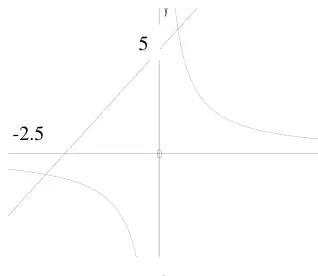
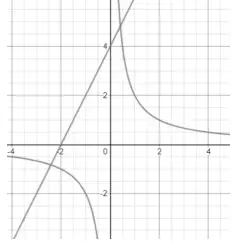
(i) \(y = -3x + c\), where \(c\) is a positive constant,
(ii) \(y = \dfrac{1}{x} + 5\)
On each sketch show the coordinates of any point at which the graph crosses the \(y\)-axis and the equation of any horizontal asymptote.
(4)
Given that \(y = -3x + c\), where \(c\) is a positive constant, meets the curve \(y = \dfrac{1}{x} + 5\) at two distinct points,
(b) show that \((5 - c)^2 > 12\) (3)
(c) Hence find the range of possible values for \(c\). (4)
Mark scheme (a)
(a)(i)
Scheme
Marks
Straight line with negative gradient anywhere even with no axes.
B1
Straight line with an intercept at \((0, c)\) or just \(c\) marked on the positive \(y\)-axis provided the line passes through the positive \(y\)-axis. Allow \((c, 0)\) as long as it is marked in the correct place. Allow \((0, c)\) in the body of the script but in any ambiguity, the sketch has precedence. Ignore any intercepts with the \(x\)-axis.
B1
(a)(ii)
Scheme
Marks
Either: For the shape of a \(y = \dfrac{1}{x}\) curve in any position. It must have two branches and be asymptotic horizontally and vertically with no obvious “overlap” with the asymptotes, but otherwise be generous. The curve may bend away from the asymptote a little at the end. Sufficient curve must be seen to suggest the asymptotic behaviour, both vertically and horizontally and the branches must approach the same asymptote Or the equation \(y = 5\) seen independently i.e. whether the sketch has an asymptote here or not. Do not allow \(y \neq 5\) or \(x = 5\).
B1
Fully correct graph and with a horizontal asymptote on the positive \(y\)-axis. The asymptote does not have to be drawn but the equation \(y = 5\) must be seen. The shape needs to be reasonably accurate with the “ends” not bending away significantly from the asymptotes and the branches must approach the same asymptote. Ignore \(x = 0\) given as an asymptote.
M1: Sets \(\dfrac{1}{x} + 5 = -3x + c\), attempts to multiply by \(x\) and collects terms (to one side). Allow e.g. “>” or “<” for “=”. At least 3 of the terms must be multiplied by \(x\), e.g. allow one slip. The ‘= 0’ may be implied by subsequent work and provided correct work follows, full marks are still possible in (b).
M1: Attempts to use \(b^2 - 4ac\) with their \(a\), \(b\) and \(c\) from their equation where \(a = \pm 3,\ b = \pm 5 \pm c\) and \(c = \pm 1\). This could be as part of the quadratic formula or as \(b^2 < 4ac\) or as \(b^2 > 4ac\) or as \(\sqrt{b^2 - 4ac}\) etc. If it is part of the quadratic formula only look for use of \(b^2 - 4ac\). There must be no \(x\)’s.
A1*: Completes proof with no errors or incorrect statements and with the “>” appearing correctly before the final answer, which could be from \(b^2 - 4ac > 0\). Note that the statement \(3x^2 + 5x - cx + 1 > 0\) or starting with e.g. \(\dfrac{1}{x} + 5 > -3x + c\) would be an error.
Note: A minimum for (b) could be, \(\dfrac{1}{x} + 5 = -3x + c \Rightarrow 3x^2 + 5x - cx + 1\left(= 0\right)\) (M1) \(b^2 > 4ac \Rightarrow (5 - c)^2 > 12\) (M1A1) If \(b^2 > 4ac\) is not seen then \(4\times 3\times 1\) needs to be seen explicitly.
\(c < \text{"}5 - \sqrt{12}\text{"},\ c > \text{"}5 + \sqrt{12}\text{"}\)
M1
\(0 < c < 5 - \sqrt{12},\ c > 5 + \sqrt{12}\)
A1
Allow the use of \(x\) rather than \(c\) in (c) but the final answer must be in terms of \(c\).
(4)
(11 marks)
Notes
M1: Attempts to find at least one critical value using the result in (b) or by expanding and solving a 3TQ (See General Principles) (the “= 0” may be implied)
A1: Correct critical values in any form. Note that \(\sqrt{12}\) may be seen as \(2\sqrt{3}\).
M1: Chooses outside region. The ‘0 <’ can be ignored for this mark. So look for \(c <\) their \(5 - \sqrt{12}\), \(c >\) their \(5 + \sqrt{12}\). This could be scored from \(5 + \sqrt{12} < c < 5 - \sqrt{12}\) or \(5 - \sqrt{12} > c > 5 + \sqrt{12}\). Evidence is to be taken from their answers not from a diagram.
A1: Correct ranges including the ‘0 <’ e.g. answer as shown or each region written separately or e.g. \(\left(0, 5 - \sqrt{12}\right)\), \(\left(5 + \sqrt{12}, \infty\right)\). The critical values may be un-simplified but must be at least \(\dfrac{10 + \sqrt{48}}{2}, \dfrac{10 - \sqrt{48}}{2}\). Note that \(0 < c < 5 - \sqrt{12}\) and \(c > 5 + \sqrt{12}\) would score M1A0.
M1: Uses the addition or power law of indices on \(2^{2x}\) or \(2^{2x+1}\). E.g. \(2^x\times 2^x = 2^{2x}\) or \(\left(2^x\right)^2 = 2^{2x}\) or \(2^{2x+1} = 2\times 2^{2x}\) or \(2^{x+0.5} = 2^x\times\sqrt{2}\) or \(2^{2x+1} = \left(2^{x+0.5}\right)^2\).
A1*: Cso. Complete proof that includes explicit statements for the addition and power law of indices on \(2^{2x+1}\) with no errors. The equation needs to be as printed including the “= 0”. If they work backwards, they do not need to write down the printed answer first but must end with the version in \(2^x\) including ‘= 0’.
\(2^{2x+1} = 2\times 2^{2x} \Rightarrow 2\times 2^{2x} - 17\left(2^x\right) + 8 = 0\) \(\Rightarrow 2y^2 - 17y + 8 = 0\) Scores M1A0 as \(2^{2x} = \left(2^x\right)^2\) has not been shown explicitly
Special Case: \(2^{2x+1} = 2^1\times\left(2^x\right)^2\) or \(2^{2x+1} = \left(2^x\right)^2\times 2^1\) With or without the multiplication signs and with no subsequent explicit evidence of the power law scores M1A0Example of insufficient working: \(2^{2x+1} = 2\left(2^x\right)^2 = 2y^2\) scores no marks as neither rule has been shown explicitly.
\(\left(y =\right)\dfrac{1}{2}, 8\) or \(\left(2^x =\right)\dfrac{1}{2}, 8\)
A1
\(\Rightarrow 2^x = \dfrac{1}{2}, 8 \Rightarrow x = -1, 3\)
M1 A1
(4)
(6 marks)
Notes
M1: Solves the given quadratic either in terms of \(y\) or in terms of \(2^x\) See General Principles for solving a 3 term quadratic Note that completing the square on e.g. \(y^2 - \dfrac{17}{2}y + 4 = 0\) requires \(\left(y \pm \dfrac{17}{4}\right)^2 \pm q \pm 4 = 0 \Rightarrow y = \ldots\)
A1: Correct values
M1: Either finds one correct value of \(x\) for their \(2^x\) or obtains a correct numerical expression in terms of logs e.g. for \(k > 0\) \(2^x = k \Rightarrow x = \log_2 k\) or \(\dfrac{\log k}{\log 2}\)
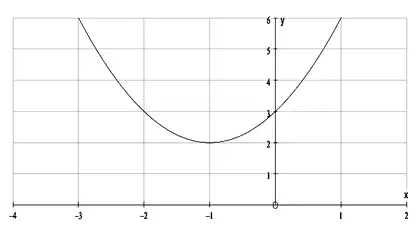
(a) Express \(\mathrm{f}(x)\) in the form \((x + a)^2 + b\), where \(a\) and \(b\) are constants. (2)
The curve \(C\) with equation \(y = \mathrm{f}(x)\) crosses the \(y\)-axis at the point \(P\) and has a minimum point at the point \(Q\).
(b) Sketch the graph of \(C\) showing the coordinates of point \(P\) and the coordinates of point \(Q\). (3)
(c) Find the distance \(PQ\), writing your answer as a simplified surd. (3)
Mark scheme (a)
Scheme
Marks
\(\mathrm{f}(x) = (x - 4)^2 + 3\)
M1A1
Allow \(a = -4\), \(b = 3\) to score both marks
(2)
Notes
M1: \(\mathrm{f}(x) = \left(x \pm 4\right)^2 \pm \alpha,\ \alpha \neq 0\) (where \(\alpha\) is a single number or a numerical expression \(\neq 0\))
A1: Allow \(\left(x + {}^{-}4\right)^2 + 3\) and ignore any spurious “= 0”
Mark scheme (b)
Scheme
Marks
U shape anywhere even with no axes. Do not allow a “V” shape i.e. with an obvious vertex.
B1
\(P(0, 19)\). Allow (0, 19) or just 19 marked in the correct place as long as the curve (or straight line) passes through or touches here and allow (19, 0) as long as it is marked in the correct place. Correct coordinates may be seen in the body of the script as long as the curve (or straight line) passes through or touches here. If there is any ambiguity, the sketch has precedence. (There must be a sketch to score this mark)
B1
\(Q(4, 3)\). Correct coordinates that can be scored without a sketch but if a sketch is drawn then it must have a minimum in the first quadrant and no other turning points. May be seen in the body of the script. If there is any ambiguity, the sketch has precedence. Allow this mark if 4 is clearly marked on the \(x\)-axis below the minimum and 3 is marked clearly on the \(y\)-axis and corresponds to the minimum,
M1:Correct use of Pythagoras’ Theorem on 2 points of the form \((0, p)\) and \((q, r)\) where \(q \neq 0\) and \(p \neq r\) with \(p\), \(q\) and \(r\) numeric.
A1: Correct un-simplified numerical expression for \(PQ\) including the square root. This must come from a correct \(P\) and \(Q\). Allow e.g. \(PQ = \sqrt{\left(0 - 4\right)^2 + \left(19 - 3\right)^2}\). Allow \(\pm\sqrt{\left(0 - 4\right)^2 + \left(19 - 3\right)^2}\)
A1: Cao and cso i.e. This must come from a correct \(P\) and \(Q\).
Note that it is possible to obtain the correct value for PQ from (-4,3) and (0, 19) and e.g. (0, 13) and (4, -3) but the A marks in (c) can only be awarded for the correct P and Q.
M1:Either: Compares the given quadratic expression with the given linear expression using <, >, =, \(\neq\) (May be implied) or Rearranges \(y = 3x - 7\) to make \(x\) the subject and substitutes into the given quadratic
dM1: Moves all the terms to one side allowing sign errors only. Ignore > 0, < 0, = 0 etc. The terms do not need to be collected. Dependent on the first method mark.
ddM1: Attempts to use \(b^2 - 4ac\) with their \(a\), \(b\) and \(c\) where \(a = \pm 2p,\ b = \pm(-6p \pm 3)\) and \(c = \pm(4p \pm 7)\) or for the quadratic in \(y\), \(a = \pm 2p,\ b = \pm(10p \pm 9)\) and \(c = \pm 8p\). This could be as part of the quadratic formula or as \(b^2 < 4ac\) or as \(b^2 > 4ac\) or as \(\sqrt{b^2 - 4ac}\) etc. If it is part of the quadratic formula only look for use of \(b^2 - 4ac\). There must be no \(x\)’s or \(y\)’s. Dependent on both method marks.
A1*: Obtains printed answer with no errors seen (Allow \(0 > 4p^2 - 20p + 9\)) but this < 0 must been seen at some stage before the last line.
Mark scheme (b)
Scheme
Marks
\((2p - 9)(2p - 1) = 0 \Rightarrow p = \ldots\) to obtain \(p =\)
M1
\(p = \dfrac{9}{2},\quad \dfrac{1}{2}\)
A1
\(\tfrac{1}{2} < p < 4\tfrac{1}{2}\) Allow equivalent values e.g. \(\dfrac{36}{8}\) for \(4\tfrac{1}{2}\)
M1A1
(4)
(8 marks)
Notes
M1: Attempt to solve the given quadratic to find 2 values for \(p\). See general guidance.
A1: Both correct. May be implied by e.g. \(p < \dfrac{9}{2},\quad p < \dfrac{1}{2}\). Allow equivalent values e.g. 4.5, \(\dfrac{36}{8}\), 0.5 etc. If they use the quadratic formula allow \(\dfrac{20 \pm 16}{8}\) for this mark but not \(\sqrt{256}\) for 16 and allow e.g. \(\dfrac{5}{2} \pm 2\) if they complete the square.
M1: Chooses ‘inside’ region i.e. Lower Limit < \(p\) < Upper Limit or e.g. Lower Limit \(\leqslant p \leqslant\) Upper Limit
A1: Allow \(p \in \left(\tfrac{1}{2}, 4\tfrac{1}{2}\right)\) or just \(\left(\tfrac{1}{2}, 4\tfrac{1}{2}\right)\) and allow \(p > \tfrac{1}{2}\) and \(p < 4\tfrac{1}{2}\) and \(4\tfrac{1}{2} > p > \tfrac{1}{2}\) but \(p > \tfrac{1}{2},\ \ p < 4\tfrac{1}{2}\) scores M1A0 \(\tfrac{1}{2} > p > 4\tfrac{1}{2}\) scores M0A0
Allow working in terms of \(x\) in (b) but the answer must be in terms of \(p\) for the final A mark.
M1: Attempts to makes \(y\) the subject of the linear equation and substitutes into the other equation. Allow slips e.g. substituting \(y = -4x + 1\) etc.
A1: Correct 3 term quadratic (terms do not need to be all on the same side). The “= 0” may be implied by subsequent work.
dM1: Solves a 3 term quadratic by the usual rules (see general guidance) to give at least one value for \(x\). Dependent on the first method mark.
A1: \((x =) -\tfrac{1}{7},\ -\tfrac{1}{3}\) (two separate correct exact answers). Allow exact equivalents e.g. \((x =) -\tfrac{6}{42},\ -\tfrac{14}{42}\)
M1: Substitutes to find at least one \(y\) value (Allow substitution into their rearranged equation above but not into an equation that has not been seen earlier). You may need to check here if there is no working and \(x\) values are incorrect.
Note that if the linear equation is explicitly rearranged to \(y = 4x + 1\), this gives the correct answers for \(x\) and possibly for \(y\). In these cases, if it is not already lost, deduct the final A1.
M1: Attempts to makes \(x\) the subject of the linear equation and substitutes into the other equation. Allow slips in the rearrangement as above.
A1: Correct 3 term quadratic (terms do not need to be all on the same side). The “= 0” may be implied by subsequent work.
dM1: Solves a 3 term quadratic by the usual rules (see general guidance) to give at least one value for \(y\). Dependent on the first method mark.
A1: \((y =) -\tfrac{3}{7},\ \tfrac{1}{3}\) (two separate correct exact answers). Allow exact equivalents e.g. \((y =) -\tfrac{18}{42},\ \tfrac{14}{42}\)
M1: Substitutes to find at least one \(x\) value (Allow substitution into their rearranged equation above but not into an equation that has not been seen earlier). You may need to check here if there is no working and \(y\) values are incorrect.
Note that if the linear equation is explicitly rearranged to \(x = (y + 1)/4\), this gives the correct answers for \(y\) and possibly for \(x\). In these cases, if it is not already lost, deduct the final A1.
(a) Simplify\[\sqrt{50} - \sqrt{18}\]giving your answer in the form \(a\sqrt{2}\), where \(a\) is an integer. (2)
(b) Hence, or otherwise, simplify\[\frac{12\sqrt{3}}{\sqrt{50} - \sqrt{18}}\]giving your answer in the form \(b\sqrt{c}\), where \(b\) and \(c\) are integers and \(b \neq 1\) (3)
Mark scheme (a)
Scheme
Marks
\(\sqrt{50} - \sqrt{18} = 5\sqrt{2} - 3\sqrt{2}\)
M1
\(= 2\sqrt{2}\)
A1
(2)
Notes
M1: \(\sqrt{50} = 5\sqrt{2}\) or \(\sqrt{18} = 3\sqrt{2}\) and the other term in the form \(k\sqrt{2}\). This mark may be implied by the correct answer \(2\sqrt{2}\)
M1: Uses part (a) by replacing denominator by their \(a\sqrt{2}\) where \(a\) is numeric. This is all that is required for this mark.
dM1: Rationalises the denominator by a correct method e.g. multiplies numerator and denominator by \(k\sqrt{2}\) to obtain a multiple of \(\sqrt{6}\). Note that multiplying numerator and denominator by \(2\sqrt{2}\) or \(-2\sqrt{2}\) is quite common and is acceptable for this mark. May be implied by a correct answer. This is dependent on the first M1.
M1: For rationalising the denominator by a correct method i.e. multiplying numerator and denominator by \(k\left(\sqrt{50} + \sqrt{18}\right)\)
dM1: For replacing numerator by \(\alpha\sqrt{6} + \beta\sqrt{6}\). This is dependent on the first M1 and there is no need to consider the denominator for this mark.
2. Express \(9^{3x+1}\) in the form \(3^y\), giving \(y\) in the form \(ax + b\), where \(a\) and \(b\) are constants. (2)
Mark scheme
Scheme
Marks
\(9^{3x+1} =\) for example \(3^{2(3x+1)}\) or \(\left(3^2\right)^{3x+1}\) or \(\left(3^{(3x+1)}\right)^2\) or \(3^{3x+1}\times 3^{3x+1}\) or \((3\times 3)^{3x+1}\) or \(3^2\times\left(3^2\right)^{3x}\) or \(\left(9^{\frac{1}{2}}\right)^y\) or \(9^{\frac{1}{2}y}\) or \(y = 2(3x + 1)\)
M1
\(= 3^{6x+2}\) or \(y = 6x + 2\) or \(a = 6,\ b = 2\)
A1
(2)
(2 marks)
Notes
M1: Expresses \(9^{3x+1}\) correctly as a power of 3 or expresses \(3^y\) correctly as a power of 9 or expresses \(y\) correctly in terms of \(x\) (This mark is not for just \(3^2 = 9\))
A1: Cao (isw if necessary)
Providing there is no incorrect work, allow sight of \(6x + 2\) to score both marks Correct answer only implies both marks Special case: \(3^{6x+1}\) only scores M1A0
M1: For attempting to solve the given equation as a 3 term quadratic in \(y\) or as a 3 term quadratic in \(2^x\) leading to a value of \(y\) or \(2^x\) (Apply usual rules for solving the quadratic – see general guidance) Allow \(x\) (or any other letter) instead of \(y\) for this mark e.g. an attempt to solve \(8x^2 - 9x + 1 = 0\)
A1: Both correct answers of \(\dfrac{1}{8}\) (oe) and 1 for \(2^x\) or \(y\) or their letter but not \(x\) unless \(2^x\,(\text{or } y)\) is implied later
M1: A correct attempt to find one numerical value of \(x\) from their \(2^x\,(\text{or } y)\) which must have come from a 3 term quadratic equation. If logs are used then they must be evaluated.
A1: Both \(x = -3\) and/or \(x = 0\) May be implied by e.g. \(2^{-3} = \dfrac{1}{8}\) and \(2^0 = 1\) and no extra values.
M1: Attempts to use \(b^2 - 4ac\) with at least two of \(a\), \(b\) or \(c\) correct. May be in the quadratic formula. Could also be, for example, comparing or equating \(b^2\) and \(4ac\). Must be considering the given quadratic equation. Inequality sign not needed for this M1.There must be no \(x\) terms.
A1: For a correct un-simplified inequality that is not the given answer
A1*: Correct solution with no errors that includes an expansion of \((p - 1)(p - 5)\)
Mark scheme (b)
Scheme
Marks
\(p^2 - 6p + 1 = 0 \Rightarrow p = \ldots\)
M1
\(p = 3 \pm \sqrt{8}\)
A1
\(p < 3 - \sqrt{8}\) or \(p > 3 + \sqrt{8}\)
M1A1
(4)
(7 marks)
Notes
M1: For an attempt to solve \(p^2 - 6p + 1 = 0\) (not their quadratic) leading to 2 solutions for \(p\) (do not allow attempts to factorise – must be using the quadratic formula or completing the square)
A1: \(p = 3 \pm 2\sqrt{2}\) or any equivalent correct expressions e.g. \(p = \dfrac{6 \pm \sqrt{32}}{2}\) (May be implied by their inequalities) Discriminant must be a single number not e.g. 36 - 4
Allow the M1A1 to score anywhere for solving the given quadratic
M1: Chooses outside region – not dependent on the previous method mark
A1: \(p < 3 - \sqrt{8},\ p > 3 + \sqrt{8}\) or equivalent e.g. \(p < \dfrac{6 - \sqrt{32}}{2},\ p > \dfrac{6 + \sqrt{32}}{2}\) \(\left(-\infty,\ 3 - \sqrt{8}\right) \cup \left(3 + \sqrt{8},\ \infty\right)\) Allow “,”, “or” or a space between the answers but do not allow \(p < 3 - \sqrt{8}\) and \(p > 3 + \sqrt{8}\) (this scores M1A0) Apply ISW if necessary.
A correct solution to the quadratic followed by \(p > 3 \pm \sqrt{8}\) scores M1A1M0A0
\(3 + \sqrt{8} < p < 3 - \sqrt{8}\) scores M1A0
Allow candidates to use \(x\) rather than \(p\) but must be in terms of \(p\) for the final A1
\((4)(2x + 1)(x + 4) = 0 \Rightarrow x = \ldots\) or \((2)(y + 4)(y - 3) = 0 \Rightarrow y = \ldots\)
M1
\(x = -0.5,\ x = -4\) or \(y = -4,\ y = 3\)
A1 cso
Sub into \(y = 2x + 4\) or Sub into \(x = \dfrac{y - 4}{2}\)
M1
\(y = 3,\ \ y = -4\) and \(x = -4,\ \ x = -0.5\)
A1
(7 marks)
Notes
M1: Attempts to rearrange the linear equation to \(y = \ldots\) or \(x = \ldots\) or \(2x = \ldots\) and attempts to fully substitute into the second equation.
M1: Collects terms together to produce quadratic expression = 0. The ‘= 0’ may be implied by later work.
A1: Correct three term quadratic equation in \(x\) or \(y\). The ‘= 0’ may be implied by later work.
M1: Attempt to factorise and solve or complete the square and solve or uses a correct quadratic formula for a 3 term quadratic.
A1 cso: Correct answers for either both values of \(x\) or both values of \(y\) (possibly un-simplified)
M1: Substitutes at least one of their values of \(x\) into a correct equation as far as \(y = \ldots\) or substitutes at least one of their values of \(y\) into a correct equation as far as \(y = \ldots\)
A1: Fully correct solutions and simplified. Pairing not required. If there are any extra values of \(x\) or \(y\), score A0.
M1: Multiplies top and bottom by a correct expression. This statement is sufficient. NB \(2\sqrt{5} + 3\sqrt{2} \equiv \sqrt{20} + \sqrt{18}\) (Allow to multiply top and bottom by \(k\left(2\sqrt{5} + 3\sqrt{2}\right)\))
A1: Obtains a denominator of 2 or sight of \(\left(2\sqrt{5} - 3\sqrt{2}\right)\left(2\sqrt{5} + 3\sqrt{2}\right) = 2\) with no errors seen in this expansion. May be implied by \(\dfrac{\ldots}{2k}\)
Note that M0A1 is not possible. The 2 must come from a correct method.
Note that if M1 is scored there is no need to consider the numerator. e.g. \(\dfrac{2\,(MR?)}{2\sqrt{5} - 3\sqrt{2}}\times\dfrac{2\sqrt{5} + 3\sqrt{2}}{2\sqrt{5} + 3\sqrt{2}} = \dfrac{\ldots}{2}\) scores M1A1
M1: An attempt to multiply the numerator by \(\pm\left(2\sqrt{5} \pm 3\sqrt{2}\right)\) and obtain an expression of the form \(p + q\sqrt{10}\) where \(p\) and \(q\) are integers. This may be implied by e.g. \(2\sqrt{10} + 3\sqrt{4}\) or by their final answer. (Allow attempt to multiply the numerator by \(k\left(2\sqrt{5} \pm 3\sqrt{2}\right)\))
A1: Cso. For the answer as written or \(\sqrt{10} + 3\) or a statement that \(a = 3\) and \(b = 10\). Score when first seen and ignore any subsequent attempt to ‘simplify’. Allow \(1\sqrt{10}\) for \(\sqrt{10}\)
9. The curve \(C\) has equation \(y = \dfrac{1}{3}x^2 + 8\)
The line \(L\) has equation \(y = 3x + k\), where \(k\) is a positive constant.
(a) Sketch \(C\) and \(L\) on separate diagrams, showing the coordinates of the points at which \(C\) and \(L\) cut the axes. (4)
Given that line \(L\) is a tangent to \(C\),
(b) find the value of \(k\). (5)
Mark scheme (a)
Scheme
Marks
U shaped parabola – symmetric about \(y\) axis
B1
Graph passes through \((0, 8)\)
B1
Shape and position for \(L\)
M1
Both \(\left(-\dfrac{k}{3}, 0\right)\) and \((0, k)\)
A1
Allow marks even if on the same diagram
(4)
Notes
B1: Shape for \(C\). \(\cup\) Approximately Symmetrical about the \(y\) axis
B1: Coordinates of \((0, 8)\) There must be a graph. Accept graph crossing positive \(y\) axis with only 8 marked. Accept \((8,0)\) if given on \(y\) axis.
M1: Shape for \(L\). A straight line with positive gradient and positive intercept
A1: Coordinates of \((0, k)\) and \((-k/3, 0)\) or \(k\) marked on \(y\) axis, and \(-k/3\) marked on \(x\) axis or even Accept \((k, 0)\) on \(y\) axis and \((0, -k/3)\) on \(x\) axis
Mark scheme (b)
Method 1
Scheme
Marks
Equate curves \(\dfrac{1}{3}x^2 + 8 = 3x + k\) and proceed to collect terms on one side
Method 1a: \(9 = 4\times\dfrac{1}{3}\times(8 - k) \Rightarrow k = ..\) Method 1b: Deduce that \(k = 8 - \lambda\)
dM1
\(k = \dfrac{5}{4}\) o.e.
A1
(5)
(9 marks)
Notes
M1: Equate curves \(\dfrac{1}{3}x^2 + 8 = 3x + k\) and proceed to collect \(x\) terms on one side and \((8 - k)\) terms together on the same side or on the other side
A1: Achieves an expression that leads to the point of intersection e.g \(\dfrac{1}{3}x^2 - 3x + (8 - k)\)
Method 1a
dM1: (depends on previous M mark) Uses the fact that \(b^2 = 4ac\) or ‘\(b^2 - 4ac\)’\(= 0\) is true
dM1: (depends on previous M mark) Solves their \(b^2 = 4ac\), leading to \(k = ..\)
A1: cso \(k = \dfrac{5}{4}\) Accept equivalents like 1.25 etc.
Method 1b
dM1: (depends on previous M mark) Uses completion of the square as shown in scheme
dM1: (depends on previous M mark) Uses \(k = 8 - \lambda\)
A1: cso \(k = \dfrac{5}{4}\) Accept equivalents like 1.25 etc.
Method 2
Scheme
Marks
Attempts to set \(\dfrac{\mathrm{d}y}{\mathrm{d}x} = 3\)
M1
\(\dfrac{2}{3}x = 3 \Rightarrow x = 4.5\)
A1
Method 2a: Substitutes \(x = \text{"}4.5\text{"}\) into \(y = \dfrac{1}{3}x^2 + 8 \Rightarrow y = \ldots.(14.75)\) Method 2b: Substitutes \(x = \text{"}4.5\text{"}\) into \(\dfrac{1}{3}x^2 + 8 = 3x + k\)
dM1
Method 2a: Substitutes both their \(x\) and \(y\) into \(y = 3x + k\) to find \(k\) Method 2b: Finds \(k =\)
dM1
\(k = 1.25\) o.e.
A1
(5)
M1: Equate \(\dfrac{\mathrm{d}y}{\mathrm{d}x} = 3\) Not given just for derivative
A1: Solves to get \(x = 4.5\)
Method 2a
dM1: Substitutes their 4.5 into equation for \(C\) to give \(y\) coordinate
dM1: Substitutes both their \(x\) and \(y\) into \(y = 3x + k\) to find \(k\)
A1: cso \(k = \dfrac{5}{4}\) Accept equivalents like 1.25 etc.
Method 2b
dM1: Substitutes their 4.5 into \(\dfrac{1}{3}x^2 + 8 = 3x + k\)
dM1: Finds \(k\)
A1: cso \(k = \dfrac{5}{4}\) Accept equivalents like 1.25 etc.
Figure 1 shows the plan of a garden. The marked angles are right angles.
The six edges are straight lines.
The lengths shown in the diagram are given in metres.
Given that the perimeter of the garden is greater than 40 m,
(a) show that \(x > 1.7\) (3)
Given that the area of the garden is less than 120 m2,
(b) form and solve a quadratic inequality in \(x\). (5)
(c) Hence state the range of the possible values of \(x\). (1)
Mark scheme (a)
Scheme
Marks
\(P = 20x + 6\) o.e
B1
\(20x + 6 > 40 \Rightarrow x >\)
M1
\(x > 1.7\)
A1*
(3)
Notes
B1: Correct expression for perimeter but may not be simplified so accept \(2x + 1 + 2x + 4x + 2 + 2x + 6x + 3 + 4x\) or \(2(10x + 3)\) or any equivalent
M1: Set \(P > 40\) with their linear expression for \(P\) (this may not be correct but should be a sum of sides) and manipulate to get \(x > \ldots\)
A1*: cao \(x > 1.7\). This is a given answer, there must not be any errors, but accept \(1.7 < x\)
Mark scheme (b)
Scheme
Marks
Mark parts (b) and (c) together \(A = 2x(2x + 1) + 2x(6x + 3) = 16x^2 + 8x\)
B1
\(16x^2 + 8x - 120 < 0\)
M1
Try to solve their \(2x^2 + x - 15 = 0\) e.g. \((2x - 5)(x + 3) = 0\) so \(x =\)
M1
Choose inside region
M1
\(-3 < x < \dfrac{5}{2}\) or \(0 < x < \dfrac{5}{2}\) (as \(x\) is a length)
A1
(5)
Notes
Marks parts (b) and (c) together
B1: Writes a correct statement in \(x\) for the area. It need not be simplified. You may isw Amongst numerous possibilities are. \(2x(2x + 1) + 2x(6x + 3),\ 16x^2 + 8x,\ \ 4x(6x + 3) - 2x(4x + 2),\ 4x(2x + 1) + 2x(4x + 2)\)
M1: Sets their quadratic expression < 120 and collects on one side of the inequality
M1: For an attempt to solve a 3 Term quadratic equation producing two solutions by factorising, formula or completion of the square with the usual rules (see notes)
M1: For choosing the ‘inside’ region. Can follow through from their critical values – must be stated – not just a table or a graph. Can also be implied by \(0 < x <\) upper value
A1: \(-3 < x < \dfrac{5}{2}\). Accept \(x > -3\) and \(x < 2.5\) or \((-3, 2.5)\) As \(x\) is a width, accept \(0 < x < \dfrac{5}{2}\) Also accept \(\dfrac{10}{4}\) or 2.5 instead of \(\dfrac{5}{2}\). \(\leqslant\) would be M1A0 Allow this final answer to part (b) to appear as answer to part (c) This would score final M1A1 in (b) then B0 in (c)
Mark scheme (c)
Scheme
Marks
\(1.7 < x < \dfrac{5}{2}\)
B1cao
(1)
(9 marks)
Notes
B1cao: \(1.7 < x < \dfrac{5}{2}\). Must be correct. [ This does not imply final M1 in (b)]
\(4x + 10\sqrt{2} = 6x \Rightarrow 2x = 10\sqrt{2}\) \(x = 5\sqrt{2}\) or \(a = 5\) and \(b = 2\)
M1A1
(4)
Notes
M1: For multiplying both sides by \(\sqrt{2}\) – allow a slip e.g. \(\sqrt{2}x\sqrt{8} + 10 = \dfrac{6x}{\sqrt{2}}\times\sqrt{2}\) or \(\sqrt{2}\times 10 + x\sqrt{8} = \dfrac{6x}{\sqrt{2}}\times\sqrt{2}\), where one term has an error or the correct \(\sqrt{2}\left(10 + x\sqrt{8}\right) = \dfrac{6x}{\sqrt{2}}\times\sqrt{2}\) NB \(x\sqrt{8} + 10 = 6x\sqrt{2}\) is M0
A1: A correct equation in \(x\) with no fractional terms. Eg \(x\sqrt{16} + 10\sqrt{2} = 6x\) oe.
M1: An attempt to solve their linear equation in \(x\) to produce an answer of the form \(a\sqrt{2}\) or \(a\sqrt{50}\)
M1: For writing \(\sqrt{8}\) as \(2\sqrt{2}\) or \(\dfrac{6}{\sqrt{2}}\) as \(3\sqrt{2}\)
A1: A correct equation in \(x\) with no fractional terms. Eg \(2\sqrt{2}x + 10 = 3\sqrt{2}x\) or \(x\sqrt{8} + 10 = 3\sqrt{2}x\) oe.
M1: An attempt to solve their linear equation in \(x\) to produce an answer of the form \(a\sqrt{2}\) or \(a\sqrt{50}\) \(\sqrt{2}x = 10 \Rightarrow x = \dfrac{10}{\sqrt{2}} = \dfrac{10\sqrt{2}}{2},\ = 5\sqrt{2}\) or \(\sqrt{2}x = 10 \Rightarrow 2x^2 = 100 \Rightarrow x^2 = 50 \Rightarrow x = \sqrt{50}\) or \(5\sqrt{2}\)
M1: Dealing with either the ‘cube’ or the ‘square root’ first. A correct answer will imply this mark. Also accept a law of indices approach \(81^{\frac{3}{2}} = 81^1\times 81^{\frac{1}{2}} = 81\times 9\)
A1: Cao 729. Accept \((\pm)729\)
Mark scheme (b)
Scheme
Marks
\(\left(4x^{-\frac{1}{2}}\right)^2 = 16x^{-\frac{2}{2}}\) or \(\dfrac{16}{x}\) or equivalent
M1
\(x^2\left(4x^{-\frac{1}{2}}\right)^2 = 16x\)
A1
(2)
(4 marks)
Notes
M1: For correct use of power 2 on both 4 and the \(x^{-\frac{1}{2}}\) term.
[In many respects these marks are similar to three B marks. \(p = 2\) is B1; \(q = 2\) is B1 and \(p = 2\), \(q = 2\) and \(r = -5\) is final B1 but they must be entered on epen as B1 M1 A1]
Special case: Obtains \(2x^2 + 8x + 3 = 2(x + 2) - 1\) This may have first B1, for \(p = 2\) then M0A0
Mark scheme (c)
Method 1A
Scheme
Marks
Sets derivative \(\text{"}4x + 8\text{"} = 4 \Rightarrow x =,\qquad x = -1\)
M1, A1
Substitute \(x = -1\) in \(y = 2x^2 + 8x + 3\) \((\Rightarrow y = -3)\)
dM1
Substitute \(x = -1\) and \(y = -3\) in \(y = 4x + c\) or into \((y + 3) = 4(x + 1)\) and expand
dM1
\(c = 1\) or writing \(y = 4x + 1\)
A1cso
Also see special case for using a perpendicular gradient (below)
(5)
(10 marks)
Notes
Method 1A (Differentiates and puts gradient equal to 4. Needs both \(x\) and \(y\) to find \(c\))
M1: Attempts to solve their \(\dfrac{\mathrm{d}y}{\mathrm{d}x} = 4\). They must reach \(x = \ldots\) (Just differentiating is M0 A0)
A1: \(x = -1\) (If this follows \(\dfrac{\mathrm{d}y}{\mathrm{d}x} = 4x + 8\), then give M1 A1 by implication)
dM1: (Depends on previous M mark) Substitutes their \(x = -1\) into \(\mathrm{f}(x)\) or into “their \(\mathrm{f}(x)\) from (b)” to find \(y\)
dM1: (Depends on both previous M marks) Substitutes their \(x = -1\) and their \(y = -3\) values into \(y = 4x + c\) to find \(c\) or uses equation of line is (\(y\) + “3”)=4(\(x\) + “1”) and rearranges to \(y = mx + c\)
A1: \(c = 1\) or allow for \(y = 4x + 1\) cso
Method 1B
Scheme
Marks
Sets derivative \(\text{"}4x + 8\text{"} = 4 \Rightarrow x =,\qquad x = -1\)
Method 1B (Differentiates and puts gradient equal to 4. Also equates equations and uses \(x\) to find \(c\))
M1A1: Exactly as in Method 1A above
dM1: (Depends on previous M mark) Substitutes their \(x = -1\) into \(2x^2 + 8x + 3 = 4x + c\)
dM1: Attempts to find value of \(c\) then A1 as before
Method 2
Scheme
Marks
Sets \(2x^2 + 8x + 3 = 4x + \mathrm{c}\) and collects \(x\) terms together
M1
Obtains \(2x^2 + 4x + 3 - c = 0\) or equivalent
A1
States that \(b^2 - 4ac = 0\)
dM1
\(4^2 - 4\times 2\times(3 - c) = 0\) and so \(c =\)
dM1
\(c = 1\)
A1cso
(5)
Method 2 (uses repeated root to find \(c\) by discriminant)
M1: Sets \(2x^2 + 8x + 3 = 4x + c\) and tries to collect \(x\) terms together
A1: Collects terms e.g. \(2x^2 + 4x + 3 - c = 0\) or \(-2x^2 - 4x - 3 + c = 0\) or \(2x^2 + 4x + 3 = c\) or even \(2x^2 + 4x = c - 3\) Allow “=0” to be missing on RHS.
dM1: (If the line is a tangent it meets the curve at just one point so repeated root and \(b^2 - 4ac = 0\)) Stating that \(b^2 - 4ac = 0\) is enough
dM1: Using \(b^2 - 4ac = 0\) to obtain equation in terms of \(c\) (Eg. \(4^2 - 4\times 2\times(3 - c) = 0\)) AND leading to a solution for \(c\)
A1: \(c = 1\) or allow for \(y = 4x + 1\) cso
Method 3
Scheme
Marks
Sets \(2x^2 + 8x + 3 = 4x + \mathrm{c}\) and collects \(x\) terms together
M1
Obtains \(2x^2 + 4x + 3 - c = 0\) or equivalent
A1
Uses \(2(x + 1)^2 - 2 + 3 - c = 0\) or equivalent
dM1
Writes \(-2 + 3 - c = 0\)
dM1
So \(c = 1\)
A1cso
(5)
Method 3 (Similar to method 2 but uses completion of the square on the quadratic to find repeated root)
M1: Sets \(2x^2 + 8x + 3 = 4x + \mathrm{c}\) and tries to collect \(x\) terms together. May be implied by \(2x^2 + 8x + 3 - 4x \pm c\) on one side
A1: Collects terms e.g. \(2x^2 + 4x + 3 - c = 0\) or \(-2x^2 - 4x - 3 + c = 0\) or \(2x^2 + 4x + 3 = c\) or even \(2x^2 + 4x = c - 3\) Allow “=0” to be missing on RHS.
dM1: Then use completion of square \(2(x + 1)^2 - 2 + 3 - c = 0\) (Allow \(2(x + 1)^2 - k + 3 - c = 0\)) where \(k\) is non zero. It is enough to give the correct or almost correct (with \(k\)) completion of the square
dM1: \(-2 + 3 - c = 0\) AND leading to a solution for \(c\) (Allow \(-1 + 3 - c = 0\)) (\(x = -1\) has been used)
A1: \(c = 1\) cso
In Method 1 they may use part (b) and differentiate their \(\mathrm{f}(x)\) and put it equal to 4 They can earn M1, but do not follow through errors.
In Methods 2 and 3 they may use part (b) to write their \(2(x + 2)^2 - 5 = 4x + c\). They need to expand and collect \(x\) terms together for M1 Then expanding gives \(2x^2 + 4x + 3 - c = 0\) for A1 – do not follow through errors Then the scheme is as before
If they just state \(c = 1\) with little or no working – please send to review,
Special case uses perpendicular gradient (maximum of 2/5)
Scheme
Marks
Sets \(4x + 8 = -\dfrac{1}{4} \Rightarrow x =,\qquad x = -\dfrac{33}{16}\)
M1 A0
Substitute \(x = -\dfrac{33}{16}\) in \(y = 2x^2 + 8x + 3\) \(\left(\Rightarrow y = -\dfrac{639}{128}\right)\)
M0
Substitute \(x = -\dfrac{33}{16}\) and \(y = -\dfrac{639}{128}\) into \(y = 4x + c\) or into \(\left(y + \dfrac{639}{128}\right) = 4\left(x + \dfrac{33}{16}\right)\) and expand
\(= \dfrac{20 - 4\sqrt{5}}{4}\) or \(\dfrac{4\sqrt{5} - 20}{-4}\)
A1
\(= 5 - \sqrt{5}\)
A1cao
(4)
(5 marks)
Notes
B1ft: Only ft on \(c\) See \(\dfrac{\sqrt{80}}{\sqrt{5} + 1}\) or \(\dfrac{c\sqrt{5}}{\sqrt{5} + 1}\)
M1: State intention to multiply by \(\sqrt{5} - 1\) or \(1 - \sqrt{5}\) in the numerator and the denominator
A1: Obtain denominator of 4 (for \(\sqrt{5} - 1\)) or \(-4\) (for \(1 - \sqrt{5}\)) or correct simplified numerator of \(20 - 4\sqrt{5}\) or \(4\left(5 - \sqrt{5}\right)\) or \(4\sqrt{5} - 20\) or \(4\left(\sqrt{5} - 5\right)\) So either numerator or denominator must be correct
A1: Correct answer only. Both numerator and denominator must have been correct and division of numerator and denominator by 4 has been performed. Accept \(p = 5,\ q = -1\) or accept \(5 - \sqrt{5}\) or \(-\sqrt{5} + 5\) Also accept \(5 - 1\sqrt{5}\)
B1ft: Only ft on \(c\) \(\left(p + q\sqrt{5}\right)\left(\sqrt{5} + 1\right) = \sqrt{80}\) or \(c\sqrt{5}\)
M1: Multiply out the lhs and replace \(\sqrt{80}\) by \(c\sqrt{5}\)
A1: Compare rational and irrational parts to give \(p + q = 4\), and \(p + 5q = 0\)
A1: Solve equations to give \(p = 5,\ q = -1\)
Common error: \(\dfrac{\sqrt{80}}{1 + \sqrt{5}}\times\dfrac{1 - \sqrt{5}}{1 - \sqrt{5}} = \dfrac{4\sqrt{5} - 20}{4} = \sqrt{5} - 5\) gets B1 M1 A1 (for correct numerator – denominator is wrong for their product) then A0
Correct answer with no working – send to review – have they used a calculator? Correct answer after trial and improvement with evidence that \(\left(5 - \sqrt{5}\right)\left(\sqrt{5} + 1\right) = \sqrt{80}\) could earn all four marks
\(x > 2.5,\ x > \dfrac{5}{2},\ \dfrac{5}{2} < x\) o.e.
A1
(2)
Notes
M1: Reaching \(px > q\) with one or both of \(p\) or \(q\) correct. Also give for \(-4x < -10\)
A1: Cao \(x > 2.5\) o.e. Accept alternatives to 2.5 like \(2\dfrac{1}{2}\) and \(\dfrac{5}{2}\) even allow \(\dfrac{10}{4}\) and allow \(\dfrac{5}{2} < x\) o.e. This answer must occur and be credited as part (a) A correct answer implies M1A1
Mark scheme (b)
Scheme
Marks
Obtain \(x^2 - 9x - 36\) and attempt to solve \(x^2 - 9x - 36 = 0\) e.g. \((x - 12)(x + 3) = 0\) so \(x = \ \), or \(x = \dfrac{9 \pm \sqrt{81 + 144}}{2}\)
M1
\(12,\ -3\)
A1
\(-3 \leqslant x \leqslant 12\)
M1A1
(4)
Notes
Mark parts (b) and (c) together.
M1: Rearrange 3TQ \(\leqslant 0\) or 3TQ = 0 or even 3TQ > 0 Do not worry about the inequality at this stage AND attempt to solve by factorising, formula or completion of the square with the usual rules (see notes)
A1: 12 and \(-3\) seen as critical values
M1: Inside region for their critical values – must be stated – not just a table or a graph
A1: \(-3 \leqslant x \leqslant 12\) Accept \(x \geqslant -3\) and \(x \leqslant 12\) or \([-3, 12]\) For the A mark: Do not accept \(x \geqslant -3\) or \(x \leqslant 12\) nor \(-3 < x < 12\) nor \((-3, 12)\) nor \(x \geqslant -3, x \leqslant 12\) However allow recovery if they follow these statements by a correct statement, either in (b) or as they start part (c) N.B. \(-3 \leqslant 0 \leqslant 12\) and \(x \geqslant -3, x \leqslant 12\) are poor notation and get M1A0 here.
Mark scheme (c)
Scheme
Marks
\(2.5 < x \leqslant 12\)
A1cso
(1)
(7 marks)
Notes
A1 cso: \(2.5 < x \leqslant 12\) Accept \(x > 2.5\) and \(x \leqslant 12\) Allow \(\dfrac{10}{4}\) Do not accept \(x > 2.5\) or \(x \leqslant 12\) Accept \((2.5, 12]\) A graph or table is not sufficient. Must follow correct earlier work – except for special case
Special case (c) \(x > 2.5, x \leqslant 12\); \(2.5 < 0 \leqslant 12\) are poor notation – but if this poor notation has been penalised in (b) then allow A1 here. Any other errors are penalised in both (b) and (c).
For \(2^{-2}\) or \(\dfrac{1}{4}\) or \(\left(\dfrac{1}{2}\right)^2\) or 0.25 as coefficient of \(x^k\), for any value of \(k\) including \(k = 0\)
M1
Correct index for \(x\) so \(Ax^{-2}\) or \(\dfrac{A}{x^2}\) o.e. for any value of \(A\)
B1
\(= \dfrac{1}{4x^2}\) or \(0.25x^{-2}\)
A1 cao
(3)
(4 marks)
Notes
Look at their final answer
M1: For \(2^{-2}\) or \(\dfrac{1}{4}\) or \(\left(\dfrac{1}{2}\right)^2\) or 0.25 in their answer as coefficient of \(x^k\) for numerical value of \(k\) (including \(k = 0\)) so final answer \(\dfrac{1}{4}\) is M1 B0 A0
B1: \(Ax^{-2}\) or \(\dfrac{A}{x^2}\) or equivalent e.g. \(Ax^{-\frac{10}{5}}\) or \(Ax^{-\frac{50}{25}}\) i.e. correct power of \(x\) seen in final answer May have a bracket provided it is \((Ax)^{-2}\) or \(\left(\dfrac{A}{x}\right)^2\)
A1: \(\dfrac{1}{4x^2}\) or \(\dfrac{1}{4}x^{-2}\) or \(0.25x^{-2}\) oe but must be correct power and coefficient combined correctly and must not be followed by a different wrong answer.
Poor bracketing: \(2x^{-2}\) earns M0 B1 A0 as correct power of \(x\) is seen in this solution (They can recover if they follow this with \(\dfrac{1}{4x^2}\) etc)
Special case \((2x)^{-2}\) as a final answer and \(\left(\dfrac{1}{2x}\right)^2\) can have M0 B1 A0 if the correct expanded answer is not seen
The correct answer \(\dfrac{1}{4x^2}\) etc. followed by \(\left(\dfrac{1}{2x}\right)^2\) or \((2x)^{-2}\), treat \(\dfrac{1}{4x^2}\) as final answer so M1 B1 A1 isw
But the correct answer \(\dfrac{1}{4x^2}\) etc clearly followed by the wrong \(2x^{-2}\) or \(4x^{-2}\), gets M1 B1 A0 do not ignore subsequent wrong work here
M1: For attempting to use \(b^2 - 4ac\) with the values of a, b and c from the given equation. Condone invisible brackets. \(2k^2 - 4\times 2\times k + 2\) could be evidence
A1: Fully correct (unsimplified) expression for \(b^2 - 4ac = (2k)^2 - 4\times 2\times(k + 2)\) The bracketing must be correct. You can accept with or without any inequality signs. Accept \(a = 2, b = 2k, c = k + 2 \Rightarrow b^2 - 4ac = (2k)^2 - 4\times 2\times(k + 2)\)
A1*: Full proof, no errors, this is a given answer. It must be stated or implied that \(b^2 - 4ac > 0\) Do not accept recovery from poor or incorrect bracketing or incorrect inequalities. Do not accept the answer written down without seeing an intermediate line such as \(4k^2 - 4\times 2\times(k + 2) > 0 \Rightarrow k^2 - 2k - 4 > 0\) Or \(4k^2 - 8k - 16 > 0 \Rightarrow k^2 - 2k - 4 > 0\) The inequality must have been seen at least once before the final line for this mark to have been awarded. Eg accept \(D = 4k^2 - 8k - 16 \Rightarrow 4k^2 - 8k - 16 > 0 \Rightarrow k^2 - 2k - 4 > 0\) (corrected from the printed mark scheme: these two lines are printed with \(4k^2 - 8k - 8\), and the last one ends \(k^2 - 2k - 2 > 0\); since \(4\times 2\times(k + 2) = 8k + 16\), the discriminant is \(4k^2 - 8k - 16\).)
Mark scheme (b)
Scheme
Marks
\(k^2 - 2k - 4 = 0 \Rightarrow (k - 1)^2 = 5\)
M1
\(k = 1 \pm \sqrt{5}\) oe
A1
\(k > 1 + \sqrt{5},\quad k < 1 - \sqrt{5}\)
dM1A1
(4)
(7 marks)
Notes
M1: Attempt to solve the given 3 term quadratic (=0) by formula or completing the square. Do NOT accept an attempt to factorise in this question. If the formula is given it must be correct. It can be implied by seeing either \(\dfrac{-(-2) \pm \sqrt{(-2)^2 - 4\times 1\times -4}}{2\times 1}\) or \(\dfrac{--2 \pm \sqrt{-2^2 - 4\times 1\times -4}}{2\times 1}\) If completing the square is used it can be implied by \((k - 1)^2 \pm 1 - 4 = 0 \Rightarrow k = \ldots\)
dM1: Outsides of their values chosen. It is dependent upon the previous M mark having been awarded. States \(k >\) their largest value, \(k <\) their smallest value Do not award simply for a diagram or a table- they must have chosen their ‘outside regions’
A1: Correct answer only. Accept \(k > 1 + \sqrt{5}\) or \(k < 1 - \sqrt{5}\), \(k > 1 + \sqrt{5}\ \ k < 1 - \sqrt{5}\), \(\left(-\infty, 1 - \sqrt{5}\right) \cup \left(1 + \sqrt{5}, \infty\right)\) but not \(k > 1 + \sqrt{5}\) and \(k < 1 - \sqrt{5}\), \(1 + \sqrt{5} < k < 1 - \sqrt{5}\) Also accept exact alternatives as a simplified form is not explicitly asked for in the question Accept versions such as \(k > \dfrac{2 + \sqrt{20}}{2}\) or \(k < \dfrac{2 - \sqrt{20}}{2}\)
M1: Rearrange \(x - 2y - 1 = 0\) into \(x = ..\), or \(y = ..\), or \(2y = ..\) and attempt to fully substitute into 2nd equation. It does not need to be correct but a clear attempt must be made. Condone missing brackets \((2y + 1)^2 + 4y^2 - 10\times 2y + 1 + 9 = 0\)
M1: Collect like terms to produce a quadratic equation in \(x\) (or \(y\)) =0
A1: Correct quadratic equation in \(x\) (or \(y\))=0. Either \(A(y^2 - 2y) = 0\) or \(B(x^2 - 6x + 5) = 0\)
M1: Attempt to solve, with usual rules. Check the first and last terms only for factorisation. See appendix for completing the square and use of formula. Condone a solution from cancelling in a case like \(A(y^2 - 2y) = 0\). They must proceed to find at least one solution \(x = ..\) or \(y = ..\)
M1: Substitute at least one value of their \(x\) to find \(y\) or vice versa. This may be implied by their solution- you will need to check!
A1: Both \(x\)’s or both \(y\)’s correct or a correct matching pair. Accept as a coordinate. Do not accept correct answers that are obtained from incorrect equations.
A1: Both ‘pairs’ correct. Accept as coordinates \((1, 0)\ (5, 2)\)
Special Cases where candidates write down answers with little or no working as can be awarded above. One correct solution – B2. Two correct solutions – B2, B2 To score all 7 marks candidates must prove that there are only two solutions. This could be justified by a sketch.
M1: For multiplying numerator and denominator by \(2 - \sqrt{7}\) and attempting to expand the brackets. There is no requirement to get the expanded numerator or denominator correct- seeing the brackets removed is sufficient.
A1: All four terms correct (unsimplified) on the numerator OR the correct denominator of −3
A1: Correct answer \(-1 + \sqrt{7}\). Accept \(\sqrt{7} - 1\), \(-1 + 1\sqrt{7}\) and other fully correct simplified forms
Coordinates are \(\left(-\dfrac{19}{5}, -\dfrac{9}{5}\right)\) and \((1, 3)\)
A1
(6)
Notes
M1: Substitute \(y = \pm x \pm 2\) into \(x^2 + 4y^2 - 2x = 35\) to obtain an equation in \(x\) only.
M1: Multiply out and collects terms producing 3 term quadratic in any form.
dM1: Solves their quadratic, usual rules, as far as \(x\) = ... Dependent on the first M1 i.e. a correct method for eliminating \(y\) (or \(x\) – see below)
A1: Both correct
M1: Substitutes back into either given equation to find a value for \(y\)
A1: Correct matching pairs. Coordinates need not be given explicitly but it must be clear which \(x\) goes with which \(y\)
M1: Multiply out lhs, produce 3TQ = 0 and attempt to solve leading to \(x\) =... according to general guidelines
M1: Attempts the ‘inside’ for their critical values (may be from a 2TQ here)
A1: Accept either \(-7 < x < 3\) or \(0 < x < 3\) or (\(x > -7\) and \(x < 3\)) or (\(x > 0\) and \(x < 3\)) but not e.g. (\(x > -7,\ x < 3\)) or (\(x > -7\) or \(x < 3\)) (There is no specific need for them to realise \(x > 0\))
Mark scheme (c)
Scheme
Marks
\(2.8 < x < 3\)
B1ft
(1)
(8 marks)
Notes
B1ft: Follow through their answers to (a) and (b) Provided “their 3” > 2.8
Examples
\(x(x - 4) < 21 \Rightarrow x^2 - 4x - 21 < 0\) \((x - 7)(x + 3) < 0,\ x = 7, x = -3\) \(-3 < x < 7\ \textit{or}\ 0 < x < 7\) \(2.8 < x < 7\) Scores B0M1M1A0B1ft
\(x\times 4x < 21 \Rightarrow 4x^2 - 21 < 0\) \((2x - \sqrt{21})(2x + \sqrt{21}) < 0,\ x = \pm\dfrac{\sqrt{21}}{2}\) \(-\dfrac{\sqrt{21}}{2} < x < \dfrac{\sqrt{21}}{2}\ \textit{or}\ 0 < x < \dfrac{\sqrt{21}}{2}\) \(2.8 < x < \dfrac{\sqrt{21}}{2}\) Scores B0M0M1A0B0
B1: Terms combined correctly with a common denominator (Need not be simplified)
M1: Attempts to multiply numerator and denominator by \(\sqrt{3}\). This may be implied by a correct answer.
A1: \(\dfrac{6\sqrt{3}}{3}\)
Note that \(\dfrac{15}{\sqrt{3}} - \sqrt{27} = \dfrac{15\sqrt{3}}{3} - 3\sqrt{3} = 15\sqrt{3} - 9\sqrt{3} = 6\sqrt{3}\) is quite common and scores M1A0B1A0 (i.e. \(5\sqrt{3}\) is never seen)
10. Given the simultaneous equations\[\begin{aligned} 2x + y &= 1 \\ x^2 - 4ky + 5k &= 0 \end{aligned}\]where \(k\) is a non zero constant,
(a) show that\[x^2 + 8kx + k = 0\] (2)
Given that \(x^2 + 8kx + k = 0\) has equal roots,
(b) find the value of \(k\). (3)
(c) For this value of \(k\), find the solution of the simultaneous equations. (3)
Mark scheme (a)
Scheme
Marks
\(x^2 - 4k(1 - 2x) + 5k\ (= 0)\)
M1
So \(x^2 + 8kx + k = 0\,*\)
A1cso
(2)
Notes
M1: Makes \(y\) the subject from the first equation and substitutes into the second equation (= 0 not needed here) or eliminates \(y\) by a correct method.
A1cso: Correct completion to printed answer. There must be no incorrect statements.
Mark scheme (b)
Way 1
Scheme
Marks
\((8k)^2 - 4k\)
M1 A1
\(k = \dfrac{1}{16}\) (oe)
A1
(3)
Notes
M1:Use of \(b^2 - 4ac\) (Could be in the quadratic formula or an inequality, = 0 not needed yet). There must be some correct substitution but there must be no \(x\)’s. No formula quoted followed by e.g. \(8k^2 - 4k = 0\) is M0.
A1: Correct expression. Do not condone missing brackets unless they are implied by later work but can be implied by \((8k)^2 > 4k\) etc.
A1: Cso (Ignore any reference to \(k = 0\)) but there must be no contradictory earlier statements. A fully correct solution with no errors.
Completes the Square \(x^2 + 8kx + k = (x + 4k)^2 - 16k^2 + k\) \(\Rightarrow 16k^2 - k = 0\)
M1A1
\(k = \dfrac{1}{16}\) (oe)
A1
M1: \((x \pm 4k)^2 \pm p \pm k,\ p \neq 0\)
A1: Correct equation
A1: Cso (Ignore any reference to \(k = 0\))
Mark scheme (c)
Scheme
Marks
\(x^2 + \tfrac{1}{2}x + \tfrac{1}{16} = 0\) so \((x + \tfrac{1}{4})^2 = 0 \Rightarrow x =\)
M1
\(x = -\tfrac{1}{4},\ y = 1\tfrac{1}{2}\)
A1A1
(3)
(8 marks)
Notes
M1: Substitutes their value of \(k\) into the given quadratic and attempt to solve their 2 or 3 term quadratic as far as \(x =\) (may be implied by substitution into the quadratic formula) or starts again and substitutes their value of \(k\) into the second equation and solves simultaneously to obtain a value for \(x\).
A1A1: First A1 one answer correct, second A1 both answers correct.
Special Case: \(x^2 + \tfrac{1}{2}x + \tfrac{1}{16} = 0 \Rightarrow x = -\dfrac{1}{4},\ \dfrac{1}{4} \Rightarrow y = 1\dfrac{1}{2},\ \dfrac{1}{2}\) allow M1A1A0
M1: Attempts to expand the bracket and collect \(x\) terms on one side and constant terms on the other. Condone sign errors and allow one error in expanding the bracket. Allow \(<,\ \leqslant,\ \geqslant,\ =\) instead of \(>\).
A1: Cao
Note that use of \(\leqslant\) or \(\geqslant\) appearing in an otherwise correct answer in (a) or (b) should only be penalised once, the first time it occurs.
Mark scheme (b)
Scheme
Marks
\((x + 3)(3x - 1)\,[= 0]\) \(\Rightarrow x = -3\) and \(\dfrac{1}{3}\)
M1A1
\(-3 < x < \dfrac{1}{3}\)
M1A1ft
(4)
(6 marks)
Notes
M1: Attempt to solve the quadratic to obtain two critical values
A1: \(x = -3\) and \(\dfrac{1}{3}\) (may be implied by their inequality). Allow all equivalent fractions for −3 and 1/3. (Allow 0.333 for 1/3)
M1: Chooses “inside” region (The letter \(x\) does not need to be used here)
A1ft: Allow \(x < \dfrac{1}{3}\) and \(x > -3\) or \(\left(-3, \dfrac{1}{3}\right)\) or \(x < \dfrac{1}{3} \cap x > -3\). Follow through their critical values. (must be in terms of \(x\) here) Allow all equivalent fractions for −3 and 1/3. Both (\(x < \dfrac{1}{3}\) or \(x > -3\)) and (\(x < \dfrac{1}{3},\ x > -3\)) as a final answer score A0.
Note that use of \(\leqslant\) or \(\geqslant\) appearing in an otherwise correct answer in (a) or (b) should only be penalised once, the first time it occurs.
\(\dfrac{8x^{\frac{3}{2}}}{4x^2} = 2x^{-\frac{1}{2}}\) or \(\dfrac{2}{\sqrt{x}}\)
dM1A1
(3)
(5 marks)
Notes
M1: One correct power either \(2^3\) or \(x^{\frac{3}{2}}\). \(\left(2x^{\frac{1}{2}}\right)\times\left(2x^{\frac{1}{2}}\right)\times\left(2x^{\frac{1}{2}}\right)\) on its own is not sufficient for this mark.
dM1: Divides coefficients of \(x\) and subtracts their powers of \(x\). Dependent on the previous M1
A1: Correct answer
Note that unless the power of \(x\) implies that they have subtracted their powers you would need to see evidence of subtraction. E.g. \(\dfrac{8x^{\frac{3}{2}}}{4x^2} = 2x^{\frac{1}{2}}\) would score dM0 unless you see some evidence that 3/2 – 2 was intended for the power of \(x\).
Note that there is a misconception that \(\dfrac{\left(2x^{\frac{1}{2}}\right)^3}{4x^2} = \left(\dfrac{2x^{\frac{1}{2}}}{4x^2}\right)^3\) - this scores 0/3
M1: Multiplies top and bottom by a correct expression. This statement is sufficient.
A1cso: Obtains a denominator of 4 or sight of \((\sqrt{5} - 1)(\sqrt{5} + 1) = 4\)
M1: An attempt to multiply the numerator by \((\pm\sqrt{5} \pm 1)\) and get 4 terms with at least 2 correct for their \((\pm\sqrt{5} \pm 1)\). (May be implied)
A1cso: Answer as written or \(a = 3\) and \(b = 2\). (Allow \(2\sqrt{5} + 3\))
M1: Multiplies top and bottom by a correct expression. This statement is sufficient.
A1cso: Obtains a denominator of −4
M1: An attempt to multiply the numerator by \((\pm\sqrt{5} \pm 1)\) and get 4 terms with at least 2 correct for their \((\pm\sqrt{5} \pm 1)\). (May be implied)
A1cso: Answer as written or \(a = 3\) and \(b = 2\)
Alternative using Simultaneous Equations:
\(\dfrac{(7 + \sqrt{5})}{\sqrt{5} - 1} = a + b\sqrt{5} \Rightarrow 7 + \sqrt{5} = (a - b)\sqrt{5} + 5b - a\) M1 Multiplies and collects rational and irrational parts \(a - b = 1,\ 5b - a = 7\) A1 Correct equations \(a = 3,\ b = 2\) M1 for attempt to solve simultaneous equations A1 both answers correct
(a) Find the values of the constants \(a\), \(b\) and \(c\). (3)
(b) On the axes below, sketch the curve with equation \(y = 4x^2 + 8x + 3\), showing clearly the coordinates of any points where the curve crosses the coordinate axes. (4)
Mark scheme (a)
Scheme
Marks
This may be done by completion of square or by expansion and comparing coefficients
\(a = 4\)
B1
\(b = 1\)
B1
All three of \(a = 4\), \(b = 1\) and \(c = -1\)
B1
(3)
Notes
B1: States \(a = 4\) or obtains \(4(x + b)^2 + c\),
B1: States \(b = 1\) or obtains \(a(x + 1)^2 + c\),
B1: States \(a = 4\), \(b = 1\) and \(c = -1\) or \(4(x + 1)^2 - 1\) (Needs all 3 correct for final mark)
Special cases: If answer is left as \((2x + 2)^2 - 1\) treat as misread B1B0B0 or as \(2(x + 1)^2 - 1\) then the mark is B0B1B0 from scheme
Mark scheme (b)
Scheme
Marks
U shaped quadratic graph.
M1
The curve is correctly positioned with the minimum in the third quadrant. . It crosses \(x\) axis twice on negative \(x\) axis and \(y\) axis once on positive \(y\) axis.
A1
Curve cuts \(y\)-axis at \((\{0\}, 3)\) only
B1
Curve cuts \(x\)-axis at \(\left(-\tfrac{3}{2}, \{0\}\right)\) and \(\left(-\tfrac{1}{2}, \{0\}\right)\).
B1
(4)
(7 marks)
Notes
M1: Any position provided U shaped (be generous in interpretation of U shape but V shape is M0)
A1: The curve is correctly positioned with the minimum in the third quadrant. It crosses \(x\) axis twice on negative \(x\) axis and \(y\) axis once on positive \(y\) axis.
B1: Allow 3 on \(y\) axis and allow either \(y = 3\) or \((0, 3)\) if given in text Curve does not need to pass through this point and this mark may be given even if there is no curve at all or if it is drawn as a line.
B1: Allow −3/2 and −1/2 if given on \(x\) axis – need co-ordinates if given in text or \(x = -3/2\), \(x = -1/2\) . Accept decimal equivalents. Curve does not need to pass through these points and this mark may be given even if there is no curve. Ignore third point of intersection and allow touching instead of cutting. So even a cubic curve might get M0A0 B1 B1. A V shape with two ruled lines for example might get M0A0B1B1
As \(b^2 - 4ac > 0\), then \(-4k^2 + 8k + 96 > 0\) and so, \(k^2 - 2k - 24 < 0\)
A1 *
(4)
Notes
Method 1: M1: Attempts \(b^2 - 4ac\) for \(a = (k + 3)\), \(b = 6\) and their \(c\). \(c \neq k\) or uses quadratic formula and has this expression under square root. (ignore > 0, < 0 or = 0 for first 3 marks)
A1: Correct expression for \(b^2 - 4ac\) - need not be simplified (may be under root sign)
B1: Uses algebra to manipulate result without error into one of these three term quadratics. Again may be under root sign in quadratic formula. If inequality is used early in “proof” may see \(4k^2 - 8k - 96 < 0\) and B1 would be given for \(4k^2 - 8k - 96\) correctly stated.
A1: Applies \(b^2 - 4ac > 0\) correctly ( or writes \(b^2 - 4ac > 0\) ) to achieve the result given in the question. No errors should be seen. Any incorrect line of argument should be penalised here. There are several ways of reaching the answer; either multiplication of both sides of inequality by −1, or taking every term to other side of inequality. Need conclusion i.e. printed answer.
Method 2
Scheme
Marks
Considers \(b^2 > 4ac\) for \(a = (k + 3)\), \(b = 6\) and their \(c\). \(c \neq k\)
M1
\(6^2 > 4(k + 3)(k - 5)\)
A1
\(4k^2 - 8k - 96 < 0\) or \(-4k^2 + 8k + 96 > 0\) or \(9 > (k + 3)(k - 5)\) (with no prior algebraic errors)
B1
and so, \(k^2 - 2k - 24 < 0\) following correct work
A1 *
Method 2: M1: Allow \(b^2 > 4ac\), \(b^2 < 4ac\) or \(b^2 = 4ac\) for \(a = (k + 3)\), \(b = 6\) and their \(c\). \(c \neq k\)
A1: Correct expressions on either side (ignore >, < or =).
B1: Uses algebra to manipulate result into one of the two three term quadratics or divides both sides by 4 again without error
A1: Produces result with no errors seen from initial consideration of \(b^2 > 4ac\) .
Special case : In part (a) uses \(c = k\) instead of \(k - 5\) - scores 0 . Allow \(k + 5\) for method marks
Mark scheme (b)
Scheme
Marks
Attempts to solve \(k^2 - 2k - 24 = 0\) to give \(k =\) (\(\Rightarrow\) Critical values, \(k = 6,\ -4\).)
M1
\(k^2 - 2k - 24 < 0\) gives \(-4 < k < 6\)
M1 A1
(3)
(7 marks)
Notes
M1: Uses factorisation, formula, completion of square method to find two values for \(k\), or finds two correct answers with no obvious method
M1: Their Lower Limit \(< k <\) Their Upper Limit. Allow the M mark mark for \(\leqslant\) . (Allow \(k <\) upper and \(k >\) lower)
A1: \(-4 < k < 6\) Lose this mark for \(\leqslant\) Allow \((-4, 6)\) [not square brackets] or \(k > -4\) and \(k < 6\) (must be and not or) Can also use intersection symbol \(\cap\) NOT \(k > -4,\ k < 6\) (M1A0)
Special Case: In part (b) Obtaining \(-6 < k < 4\) This is a common wrong answer. Give M1 M1 A0 special case.
Special Case: In part (b) Use of \(x\) instead of \(k\) – M1M1A0
Special Case: \(-4 < k < 6\) and \(k < -4,\ k > 6\) both given is M0A0 for last two marks. Do not treat as isw.
Figure 1 shows a sketch of the curve with equation \(y = \dfrac{2}{x},\ x \neq 0\)
The curve \(C\) has equation \(y = \dfrac{2}{x} - 5,\ x \neq 0\), and the line \(l\) has equation \(y = 4x + 2\)
(a) Sketch and clearly label the graphs of \(C\) and \(l\) on a single diagram.
On your diagram, show clearly the coordinates of the points where \(C\) and \(l\) cross the coordinate axes. (5)
(b) Write down the equations of the asymptotes of the curve \(C\). (2)
(c) Find the coordinates of the points of intersection of \(y = \dfrac{2}{x} - 5\) and \(y = 4x + 2\) (5)
Mark scheme (a)
Scheme
Marks
\(y = \dfrac{2}{x}\) is translated up or down.
M1
\(y = \dfrac{2}{x} - 5\) is in the correct position.
A1
Intersection with \(x\)-axis at \(\left(\tfrac{2}{5}, \{0\}\right)\) only Independent mark.
B1
\(y = 4x + 2\) : attempt at straight line, with positive gradient with positive \(y\) intercept.
B1
Intersection with \(x\)-axis at \(\left(-\tfrac{1}{2}, \{0\}\right)\) and \(y\)-axis at \(\left(\{0\}, 2\right)\).
B1
Check graph in question for possible answers and space below graph for answers to part (b)
(5)
Notes
M1: Curve implies \(y\) axis as asymptote and does not change shape significantly. Changed curve needs horizontal asymptote (roughly) Asymptote(s) need not be shown but shape of curve should be implying asymptote(s) parallel to \(x\) axis. Curve should not remain where it was in the given figure. Both sections move in the same direction. There should be no reflection
A1: Crosses positive \(x\) axis. Hyperbola has moved down. Both sections move by almost same amount. See sheet on page 19 for guidance.
B1:Check diagram and text of answer. Accept 2/5 or 0.4 shown on \(x\)-axis or \(x = 2/5\), or \((2/5, 0)\) stated clearly in text or on graph. This is independent of the graph. Accept \((0, 2/5)\) if clearly on \(x\) axis. Ignore any intersection points with \(y\) axis. Do not credit work in table of values for this mark.
B1: Must be attempt at a straight line, with positive gradient & with positive \(y\) intercept (need not cross \(x\) axis)
B1: Accept \(x = -1/2\), or −0.5 shown on \(x\)-axis or \((-1/2, 0)\) or \((-0.5, 0)\) in text or on graph and similarly accept 2 on y axis or \(y = 2\) or \((0, 2)\) in text or on graph. Need not cross curve and allow on separate axes.
Mark scheme (b)
Scheme
Marks
Asymptotes : \(x = 0\) (or \(y\)-axis) and \(y = -5\). An asymptote stated correctly. Independent of (a)
B1
(Lose second B mark for extra asymptotes) These two lines only. Not ft their graph.
B1
(2)
Notes
B1: For either correct asymptote equation. Second B1: For both correct (lose this if extras e.g. \(x = \pm 1\) are given also). These asymptotes may follow correctly from equation after wrong graph in (a) Just \(y = -5\) is B1 B0 This may be awarded if given on the graph. However for other B mark it must be clear that \(x = 0\) (or the \(y\)-axis) is an asymptote. NB \(x \neq 0,\ y \neq -5\) is B1B0
Mark scheme (c)
Method 1
Scheme
Marks
\(\dfrac{2}{x} - 5 = 4x + 2\)
M1
\(4x^2 + 7x - 2 = 0 \Rightarrow x =\)
dM1
\(x = -2,\ \tfrac{1}{4}\)
A1
When \(x = -2,\ y = -6\), When \(x = \tfrac{1}{4},\ y = 3\)
M1A1
(5)
(12 marks)
Notes
M1: Either of these equations is enough for the method mark (May appear labelled as part (b))
dM1: Attempt to solve a 3 term quadratic by factorising, formula, completion of square or implied by correct answers. (see note 1) This mark depends on previous mark.
A1: Need both correct \(x\) answers (Accept equivalents e.g. 0.25) or both correct \(y\) values (Method 2)
M1: At least one attempt to find second variable (usually \(y\)) using their first variable (usually \(x\)) related to line meeting curve. Should not be substituting \(x\) or \(y\) values from part (a) or (b). This mark is independent of previous marks. Candidate may substitute in equation of line or equation of curve.
A1: Need both correct second variable answers Need not be written as co-ordinates (allow as in the scheme)
Note: Special case: Answer only with no working in part (c) can have 5 marks if completely correct, with both points found. If co-ordinates of just one of the points is correct – with no working – this earns M0 M0 A0 M1 A0 (i.e. 1 / 5)
Method 2
Scheme
Marks
\(\dfrac{y - 2}{4} = \dfrac{2}{y + 5}\)
M1
\(y^2 + 3y - 18 = 0 \to y =\)
dM1
\(y = -6,\ 3\)
A1
When \(y = -6,\ x = -2\) When \(y = 3,\ x = \tfrac{1}{4}\).
\(= 5 + 5\sqrt{2} - 2\sqrt{2} - 4\) \(\sqrt{8} = 2\sqrt{2}\), seen or implied at any point.
B1
\(= 1 + 3\sqrt{2}\) \(1 + 3\sqrt{2}\) or \(a = 1\) and \(b = 3\).
A1
(3)
Notes
M1: Multiplies out brackets correctly giving four correct terms or simplifying to correct expansion. (This may be implied by correct answer) – can appear as table
B1: \(\sqrt{8} = 2\sqrt{2}\), seen or implied at any point
A1: Fully and correctly simplified to \(1 + 3\sqrt{2}\) or \(a = 1\) and \(b = 3\).
Alternative for (i)
Scheme
Marks
\(\left(5 - 2\sqrt{2}\right)\left(1 + \sqrt{2}\right)\) This earns the B1 mark.
\(= 5 + 5\sqrt{2} - 2\sqrt{2} - 2\sqrt{2}\sqrt{2}\) Multiplies out correctly with \(2\sqrt{2}\). This may be seen or implied and may be simplified e.g. \(= 5 + 3\sqrt{2} - 2\sqrt{4}\) o.e.
M1
For earlier use of \(2\sqrt{2}\)
B1
\(= 1 + 3\sqrt{2}\) \(1 + 3\sqrt{2}\) or \(a = 1\) and \(b = 3\).
A1 (3)
Mark scheme (ii)
Method 1
Scheme
Marks
Either \(\sqrt{80} + \dfrac{30}{\sqrt{5}}\left(\dfrac{\sqrt{5}}{\sqrt{5}}\right)\)
M1
\(= 4\sqrt{5} + \ldots\)
B1
\(= 4\sqrt{5} + 6\sqrt{5}\) \(= 10\sqrt{5}\)
A1
(3)
(6 marks)
Notes
M1: Rationalises denominator i.e. Multiplies \(\left(\dfrac{k}{\sqrt{5}}\right)\) by \(\left(\dfrac{\sqrt{5}}{\sqrt{5}}\right)\) or \(\left(\dfrac{-\sqrt{5}}{-\sqrt{5}}\right)\), seen or implied or uses Method 3 or similar e.g. \(\left(\dfrac{30}{\sqrt{5}}\right) = \dfrac{6\times 5}{\sqrt{5}} = 6\sqrt{5}\)
B1: (Independent mark) States \(\sqrt{80} = 4\sqrt{5}\) Or either \(\sqrt{400} = 20\) or \(\sqrt{80}\sqrt{5} = 20\) at any point if they use Method 2.
A1: \(10\sqrt{5}\) or \(c = 10\).
Method 2
Scheme
Marks
Or \(\left(\dfrac{\sqrt{400} + 30}{\sqrt{5}}\right)\dfrac{\sqrt{5}}{\sqrt{5}}\)
N.B There are other methods e.g. \(\sqrt{80} = \dfrac{20}{\sqrt{5}}\) (B1) then add \(\dfrac{20}{\sqrt{5}} + \dfrac{30}{\sqrt{5}} = \dfrac{50}{\sqrt{5}}\) then M1 A1 as before Those who multiply initial expression by \(\sqrt{5}\) to obtain \(\sqrt{400} + 30 = 20 + 30 = 50\) earn M0 B1 A0
8.\[4x - 5 - x^2 = q - (x + p)^2\]where \(p\) and \(q\) are integers.
(a) Find the value of \(p\) and the value of \(q\). (3)
(b) Calculate the discriminant of \(4x - 5 - x^2\) (2)
(c) On the axes on page 17, sketch the curve with equation \(y = 4x - 5 - x^2\) showing clearly the coordinates of any points where the curve crosses the coordinate axes. (3)
(corrected from the printed mark scheme: the first line restates the identity as \(q - (x - p)^2\); the question has \(q - (x + p)^2\), so \(p = -2\))
M1: for an attempt to complete the square eg: \(\pm(\pm x \pm 2)^2 \pm k - 5,\ k \neq 0\) or \(\pm(\pm x \pm 2)^2 \pm \lambda,\ \lambda \neq -5\) seen or implied in working.
1st A1: for \(p = -2\) or for \(\pm\alpha - (x - 2)^2\), \(\alpha\) can be 0.
2nd A1: for \(q = -1\)
Note: Allow M1A1A1 for a correct written down expression of \(-1 - (x - 2)^2\) Ignore \(-1 - (x - 2)^2 = 0\). Note: If a candidate states either \(p = -2\) or \(q = -1\) or writes \(\pm k - (x - 2)^2\) then imply the M1 mark. Note: A candidate who writes down with no working \(p = 2,\ q = \) (a value which is not \(-1\)) gets M0A0A0. Note: Writing \((x - 2)^2 - 1\), followed by \(p = -2,\ q = -1\) is M1A1A0.
M1: for correctly substituting any two of \(a = -1,\ b = 4,\ c = -5\) into \(b^2 - 4ac\) if this is quoted. If \(b^2 - 4ac\) is not quoted then the substitution must be correct. Substitution into \(b^2 < 4ac\) or \(b^2 = 4ac\) or \(b^2 > 4ac\) is M0.
A1: for \(-4\) only. If they write \(-4 < 0\) treat the \(< 0\) as ISW and award A1. If they write \(-4 \geqslant 0\) then score A0. So substituting into \(b^2 - 4ac < 0\) leading to \(-4 < 0\) can score M1A1
Note: Only award marks for use of the discriminant in part (b). Note: Award M0 if the candidate uses the quadratic formula UNLESS they later go on to identify that the discriminant is the result of \(b^2 - 4ac\). Beware: A number of candidates are writing up their solution to part (b) at the bottom of the second page. So please look!
Mark scheme (c)
Scheme
Marks
Correct \(\cap\) shape
M1
Maximum within the 4th quadrant
A1
Curve cuts through -5 or \((0, -5)\) marked on the \(y\)-axis
B1
(3)
(8 marks)
Notes
M1: Correct \(\cap\) shape in any quadrant.
A1: The maximum must be within the fourth quadrant to award this mark.
B1: Curve (and not line!) cuts through -5 or \((0, -5)\) marked on the \(y\)-axis Allow \((-5, 0)\) rather than \((0, -5)\) if marked in the “correct” place on the \(y\)-axis. If the curve cuts through the negative \(y\)-axis and this is not marked, then you can recover \((0, -5)\) from the candidate’s working in part (c). You are not allowed to recover this point, though, from a table of values.
Note: Do not recover work for part (a) in part (c).
1st B1: for \(\sqrt{12} = 2\sqrt{3}\) or \(\sqrt{48} = 4\sqrt{3}\) seen or implied in candidate’s working.
2nd B1: for \(\sqrt{8} = 2\sqrt{2}\) or \(\sqrt{32} = 4\sqrt{2}\) seen or implied in candidate’s working.
2nd A1: for \(\sqrt{3} + \sqrt{2}\). Note: \(\dfrac{\sqrt{3} + \sqrt{2}}{1}\) as a final answer is A0.
Note: The first accuracy mark is dependent on the first method mark being awarded. Note: \(\dfrac{1}{2}\sqrt{12} + \dfrac{1}{2}\sqrt{8} = \sqrt{3} + \sqrt{2}\) with no intermediate working implies the B1B1 marks. Note: \(\sqrt{12} = \sqrt{4}\sqrt{3}\) or \(\sqrt{8} = \sqrt{4}\sqrt{2}\) are not sufficient for the B1 marks. Note: A candidate who writes down (by misread) \(\sqrt{18}\) for \(\sqrt{8}\) can potentially obtain M1A0B1B1A0, where the 2nd B1 will be awarded for \(\sqrt{18} = 3\sqrt{2}\) or \(\sqrt{72} = 6\sqrt{2}\) Note: The final accuracy mark is for a correct solution only.
\(\left\{(32)^{\frac{3}{5}}\right\} = \left(\sqrt[5]{32}\right)^3\) or \(\sqrt[5]{(32)^3}\) or \(2^3\) or \(\sqrt[5]{32768}\)
M1
\(= 8\)
A1
(2)
Notes
M1: for a full correct interpretation of the fractional power. Note: \(5\times(32)^3\) is M0.
A1: for 8 only.
Note: Award M1A1 for writing down 8.
Mark scheme (b)
Scheme
Marks
\(\left\{\left(\dfrac{25x^4}{4}\right)^{-\frac{1}{2}}\right\} = \left(\dfrac{4}{25x^4}\right)^{\frac{1}{2}}\) or \(\left(\dfrac{5x^2}{2}\right)^{-1}\) or \(\dfrac{1}{\left(\frac{25x^4}{4}\right)^{\frac{1}{2}}}\) See notes below
M1
\(= \dfrac{2}{5x^2}\) or \(\dfrac{2}{5}x^{-2}\) See notes for other alternatives
A1
(2)
(4 marks)
Notes
M1: For use of \(\dfrac{1}{2}\) OR use of \(-1\)
Use of \(\dfrac{1}{2}\): Candidate needs to demonstrate the they have rooted all three elements in their bracket.Use of -1: Either Candidate has \(\dfrac{1}{\text{Bracket}}\) or \(\left(\dfrac{Ax^C}{B}\right)\) becomes \(\left(\dfrac{B}{Ax^C}\right)\).
Allow M1 for...
\(\left(\dfrac{4}{25x^4}\right)^{\frac{1}{2}}\) or \(\left(\dfrac{5x^2}{2}\right)^{-1}\) or \(\dfrac{1}{\left(\frac{25x^4}{4}\right)^{\frac{1}{2}}}\) or \(\sqrt{\left(\dfrac{4}{25x^4}\right)}\) or \(\dfrac{1}{\sqrt{\left(\frac{25x^4}{4}\right)}}\) or \(\left(\dfrac{\frac{1}{25x^4}}{\frac{1}{4}}\right)^{\frac{1}{2}}\) or \(\dfrac{\frac{1}{5x^2}}{\frac{1}{2}}\) or \(\dfrac{\frac{1}{5}x^{-2}}{\frac{1}{2}}\) or \(-\left(\dfrac{5x^2}{2}\right)\) or \(\left(\dfrac{-5x^{-2}}{-2}\right)\) or \(-\left(\dfrac{5x^{-2}}{2}\right)\) or \(\dfrac{5x^{-2}}{2}\)
\(\left(\dfrac{4}{25x^4}\right)^K\) or \(\left(\dfrac{5x^2}{2}\right)^C\) where \(K\), \(C\) are any powers including 1.
A1: for either \(\dfrac{2}{5x^2}\) or \(\dfrac{2}{5}x^{-2}\) or \(0.4x^{-2}\) or \(\dfrac{0.4}{x^2}\).
Note: \(\left(\sqrt{\left(\dfrac{25x^4}{4}\right)}\right)^{-1}\) is not enough work by itself for the method mark.Note: A final answer of \(\dfrac{1}{\frac{5}{2}x^2}\) or \(\dfrac{1}{2\frac{1}{2}x^2}\) or \(\dfrac{1}{2.5x^2}\) is A0.Note: Also allow \(\pm\dfrac{2}{5x^2}\) or \(\pm\dfrac{2}{5}x^{-2}\) or \(\pm 0.4x^{-2}\) or \(\pm\dfrac{0.4}{x^2}\) for A1.
5. The curve \(C\) has equation \(y = x(5 - x)\) and the line \(L\) has equation \(2y = 5x + 4\)
(a) Use algebra to show that \(C\) and \(L\) do not intersect. (4)
(b) In the space on page 11, sketch \(C\) and \(L\) on the same diagram, showing the coordinates of the points at which \(C\) and \(L\) meet the axes. (4)
\(= 25 - 32 \quad < 0\), so no roots or no intersections or no solutions
A1
(4)
Notes
1st M1: for forming a suitable equation in one variable
1st A1: for a correct 3TQ equation. Allow missing “\(= 0\)” Accept \(2x^2 + 4 = 5x\) etc
2nd M1: for an attempt to evaluate discriminant for their 3TQ. Allow for \(b^2 > 4ac\) or \(b^2 < 4ac\) Allow if it is part of a solution using the formula e.g. \((x =)\dfrac{5 \pm \sqrt{25 - 32}}{4}\) Correct formula quoted and some correct substitution or a correct expression False factorising is M0
2nd A1: for correct evaluation of discriminant for a correct 3TQ e.g. 25 – 32 (or better) and a comment indicating no roots or equivalent. For contradictory statements score A0
ALT
2nd M1: for attempt at completing the square \(a\left[\left(x \pm \tfrac{b}{2a}\right)^2 - q\right] + c\)
2nd A1: for \(\left(x - \tfrac{5}{4}\right)^2 = -\dfrac{7}{16}\) and a suitable comment
Mark scheme (b)
Scheme
Marks
Curve: \(\cap\) shape and passing through \((0, 0)\)
B1
\(\phantom{\text{Curve: }}\cap\) shape and passing through \((5, 0)\)
B1
Line: \(+\)ve gradient and no intersections with \(C\). If no \(C\) drawn score B0
B1
Line passing through \((0, 2)\) and \((-0.8, 0)\) marked on axes
B1
(4)
(8 marks)
Notes
Coordinates must be seen on the diagram. Do not award if only in the body of the script. “Passing through” means not stopping at and not touching. Allow \((0, x)\) and \((y, 0)\) if marked on the correct places on the correct axis.
1st B1: for correct shape and passing through origin. Can be assumed if it passes through the intersection of axes
2nd B1: for correct shape and 5 marked on \(x\)-axis
SC: for \(\cap\) shape stopping at both \((5, 0)\) and \((0, 0)\) award B0B1
3rd B1: for a line of positive gradient that (if extended) has no intersection with their \(C\) (possibly extended). Must have both graphs on same axes for this mark. If no \(C\) given score B0
4th B1: for straight line passing through \(-0.8\) on \(x\)-axis and 2 on \(y\)-axis Accept exact fraction equivalents to \(-0.8\) or 2(e.g. \(\tfrac{4}{2}\))
M1: for reducing to the form \(px > q\) with one of \(p\) or \(q\) correct Using \(px = q\) is M0 unless \(>\) appears later on
A1: \(x > 4\) only
Mark scheme (b)
Scheme
Marks
\(x^2 - 4x - 12 = 0\)
\((x + 2)(x - 6)\,[= 0]\)
M1
\(x = 6,\ -2\)
A1
\(x < -2,\ x > 6\)
M1, A1ft
(4)
(6 marks)
Notes
1st M1: for multiplying out and attempting to solve a 3TQ with at least \(\pm 4x\) or \(\pm 12\) See General Principles for definitions of “attempt to solve”
1st A1: for 6 and \(-2\) seen. Allow \(x > 6\), \(x > -2\) etc to score this mark. Values may be on a sketch.
2nd M1: for choosing the “outside region” for their critical values. Do not award simply for a diagram or table – they must have chosen their “outside” regions
2nd A1ft: follow through their 2 distinct critical values. Allow “,” “or” or a “blank” between answers. Use of “and” is M1A0 i.e. loses the final A1
\(-2 > x > 6\) scores M1A0 i.e. loses the final A1 but apply ISW if \(x > 6\), \(x < -2\) has been seen
Accept \((-\infty, -2)\cup(6, \infty)\) (o.e)
Use of \(\leqslant\) instead of \(<\) (or \(\geqslant\) instead of \(>\)) loses the final A mark in (b) unless A mark was lost in (a) for \(x \geqslant 4\) in which case allow it here.
1st M1: for an attempt to multiply by \(\dfrac{3 - \sqrt{2}}{3 - \sqrt{2}}\) (o.e.) Allow poor use of brackets
2nd dM1: for using \(a\sqrt{2}\) to correctly obtain a numerator of the form \(p + q\sqrt{2}\) where \(p\) and \(q\) are non-zero integers. Allow arithmetic slips e.g. \(21\sqrt{2} - 28\) or \(3\sqrt{2}\times\sqrt{2} = 3\) Follow through their \(a = 7\) or a new value found in (b). Ignore denominator. Allow use of letter \(a\). Dependent on 1st M1 So \(3\sqrt{32} - \sqrt{64} + 3\sqrt{8} - \sqrt{36}\) is M0 until they reduce \(p + q\sqrt{2}\)
1st A1: for \(3\sqrt{2}\) or accept \(b = 3\) from correct working
2nd A1: for \(-2\) or accept \(c = -2\) from correct working
ALT
Scheme
Marks
\((b\sqrt{2} + c)(3 + \sqrt{2}) = 7\sqrt{2}\) leading to: \(3b + c = 7,\quad 3c + 2b = 0\) e.g. \(3(7 - 3b) + 2b = 0\) (o.e.)
M1 dM1
Simultaneous Equations
1st M1: for \((b\sqrt{2} + c)(3 + \sqrt{2}) = 7\sqrt{2}\) and forming 2 simultaneous equations. Ft their \(a = 7\)
2nd dM1: for solving their simultaneous equations: reducing to a linear equation in one variable
7.\[\mathrm{f}(x) = x^2 + (k + 3)x + k\]where \(k\) is a real constant.
(a) Find the discriminant of \(\mathrm{f}(x)\) in terms of \(k\). (2)
(b) Show that the discriminant of \(\mathrm{f}(x)\) can be expressed in the form \((k + a)^2 + b\), where \(a\) and \(b\) are integers to be found. (2)
(c) Show that, for all values of \(k\), the equation \(\mathrm{f}(x) = 0\) has real roots. (2)
(a) M1: attempt to find discriminant – substitution is required If formula \(b^2 - 4ac\) is seen at least 2 of \(a\), \(b\) and \(c\) must be correct If formula \(b^2 - 4ac\) is not seen all 3 of \(a\), \(b\) and \(c\) must be correct Use of \(b^2 + 4ac\) is M0 A1: correct unsimplified
Mark scheme (b)
Scheme
Marks
\((k + 3)^2 - 4k = k^2 + 2k + 9 = (k + 1)^2 + 8\)
M1 A1
(2)
Notes
(b) M1: Attempt at completion of square (see earlier notes) A1: both correct (no ft for this mark)
Mark scheme (c)
Scheme
Marks
For real roots, \(b^2 - 4ac \geqslant 0\) or \(b^2 - 4ac > 0\) or \((k + 1)^2 + 8 > 0\)
M1
\((k + 1)^2 \geqslant 0\) for all \(k\), so \(b^2 - 4ac > 0\), so roots are real for all \(k\) (or equiv.)
A1 cso
(2)
(6 marks)
Notes
(c) M1: States condition as on scheme or attempts to explain that their \((k + 1)^2 + 8\) is greater than 0
A1: The final mark (A1cso) requires \((k + 1)^2 \geqslant 0\) and conclusion. We will allow \((k + 1)^2 > 0\) ( or word positive) also allow \(b^2 - 4ac \geqslant 0\) and conclusion.
1st M: Squaring to give 3 or 4 terms (need a middle term) 2nd M: Substitute to give quadratic in one variable (may have just two terms) 3rd M: Attempt to solve a 3 term quadratic. 4th M: Attempt to find at least one \(y\) value (or \(x\) value). (The second variable) This will be by substitution or by starting again.
If \(y\) solutions are given as \(x\) values, or vice-versa, penalise accuracy, so that it is possible to score M1 M1A1 M1 A0 M1 A0.
“Non-algebraic” solutions:
No working, and only one correct solution pair found (e.g. \(x = 5,\ y = -3\)): M0 M0 A0 M1 A0 M1 A0 No working, and both correct solution pairs found, but not demonstrated: M0 M0 A0 M1 A1 M1 A1 Both correct solution pairs found, and demonstrated: Full marks are possible (send to review)
So \(\dfrac{5 - 2\sqrt{3}}{\sqrt{3} - 1} = -\dfrac{1}{2} + \dfrac{3}{2}\sqrt{3}\)
A1
(4 marks)
Notes
Alternative
Scheme
Marks
\(\left(p + q\sqrt{3}\right)(\sqrt{3} - 1) = 5 - 2\sqrt{3}\), and form simultaneous equations in \(p\) and \(q\)
M1
\(-p + 3q = 5\) and \(p - q = -2\)
A1
Solve simultaneous equations to give \(p = -\dfrac{1}{2}\) and \(q = \dfrac{3}{2}\).
M1 A1
Notes
1st M1: for multiplying numerator and denominator by same correct expression
1st A1: for a correct denominator as a single number (NB depends on M mark)
2nd M1: for an attempt to multiply the numerator by \(\left(\sqrt{3} \pm 1\right)\) and get 4 terms with at least 2 correct.
2nd A1: for the answer as written or \(p = -\dfrac{1}{2}\) and \(q = \dfrac{3}{2}\). Allow \(-0.5\) and 1.5. (Apply isw if correct answer seen, then slip writing \(p =,\ q =\))
Answer only (very unlikely) is full marks if correct – no part marks
showing clearly the coordinates of the points where the curves cross the coordinate axes.
(5)
(b) Show that the \(x\)-coordinates of the points of intersection of\[y = x(4 - x) \quad \text{and} \quad y = x^2(7 - x)\]are given by the solutions to the equation \(x(x^2 - 8x + 4) = 0\) (3)
The point \(A\) lies on both of the curves and the \(x\) and \(y\) coordinates of \(A\) are both positive.
(c) Find the exact coordinates of \(A\), leaving your answer in the form \((p + q\sqrt{3},\ r + s\sqrt{3})\), where \(p\), \(q\), \(r\) and \(s\) are integers. (7)
Mark scheme (a)
Scheme
Marks
(i) \(\ \cap\ \) shape (anywhere on diagram)
B1
Passing through or stopping at \((0, 0)\) and \((4,0)\) only(Needn’t be \(\ \cap\ \) shape)
B1
(ii) correct shape (-ve cubic) with a max and min drawn anywhere
B1
Minimum or maximum at \((0,0)\)
B1
Passes through or stops at \((7,0)\) but NOT touching. \((7, 0)\) should be to right of \((4,0)\) or B0
B1
Condone \((0,4)\) or \((0, 7)\) marked correctly on \(x\)-axis. Don’t penalise poor overlap near origin. Points must be marked on the sketch...not in the text
B1: for a common factor of \(x\) taken out legitimately. Can treat this as an M mark. Can ft their cubic \(= 0\) found from an attempt at solving their equations e.g. \(x^3 - 8x^2 - 4x = x(\ldots\)
A1cso: no incorrect working seen. The “\(= 0\)” is required but condone missing from some lines of working. Cancelling the \(x\) scores B0A0.
(a) Show that \(x^2 + 6x + 11\) can be written as\[(x + p)^2 + q\]where \(p\) and \(q\) are integers to be found. (2)
(b) In the space at the top of page 7, sketch the curve with equation \(y = x^2 + 6x + 11\), showing clearly any intersections with the coordinate axes. (2)
(c) Find the value of the discriminant of \(x^2 + 6x + 11\) (2)
Mark scheme (a)
Scheme
Marks
\((x + 3)^2 + 2\) or \(\ p = 3\) or \(\dfrac{6}{2}\)
B1
\(q = 2\)
B1
(2)
Notes
Ignore an “\(= 0\)” so \((x + 3)^2 + 2 = 0\) can score both marks
Mark scheme (b)
Scheme
Marks
U shape with min in 2nd quad (Must be above \(x\)-axis and not on \(y\)=axis)
B1
U shape crossing \(y\)-axis at \((0, 11)\) only (Condone \((11,0)\) marked on \(y\)-axis)
B1
(2)
Notes
The U shape can be interpreted fairly generously. Penalise an obvious V on 1st B1 only. The U needn’t have equal “arms” as long as there is a clear min that “holds water”
1st B1: for U shape with minimum in 2nd quad. Curve need not cross the \(y\)-axis but minimum should NOT touch \(x\)-axis and should be left of (not on) \(y\)-axis
2nd B1: for U shaped curve crossing at \((0, 11)\). Just 11 marked on \(y\)-axis is fine. The point must be marked on the sketch (do not allow from a table of values) Condone stopping at \((0, 11)\)
Mark scheme (c)
Scheme
Marks
\(b^2 - 4ac = 6^2 - 4\times 11\)
M1
\(= \underline{-8}\)
A1
(2)
(6 marks)
Notes
M1: for some correct substitution into \(b^2 - 4ac\). This may be as part of the quadratic formula but must be in part (c) and must be only numbers (no \(x\) terms present). Substitution into \(b^2 < 4ac\) or \(b^2 = 4ac\) or \(b^2 > 4ac\) is M0
A1: for \(-8\) only. If they write \(-8 < 0\) treat the \(< 0\) as ISW and award A1 If they write \(-8 \geqslant 0\) then score A0 A substitution in the quadratic formula leading to \(-8\) inside the square root is A0. So substituting into \(b^2 - 4ac < 0\) leading to \(-8 < 0\) can score M1A1. Only award marks for use of the discriminant in part (c)
\(x < 2.8\) or \(\dfrac{14}{5}\) or \(2\frac{4}{5}\) (condone \(\leqslant\))
A1
(2)
Notes
Accept any exact equivalents to -1, 2.8, 3.5
M1: for attempt to rearrange to \(kx < m\) (o.e.) Either \(k = 5\) or \(m = 14\) should be correct Allow \(5x = 14\) or even \(5x > 14\)
Penalise use of \(\leqslant\) only on the A1 in part (b). [i.e. condone in part (a)]
Mark scheme (b)
Scheme
Marks
Critical values are \(x = \dfrac{7}{2}\) and \(-1\)
B1
Choosing “inside” \(-1 < x < \dfrac{7}{2}\)
M1 A1
(3)
Notes
Accept any exact equivalents to -1, 2.8, 3.5
B1: for both correct critical values. (May be implied by a correct inequality)
M1: ft their values and choose the “inside” region
A1: for fully correct inequality (Must be in part (b): do not give marks if only seen in (c)) Condone seeing \(x < -1\) in working provided \(-1 < x\) is in the final answer.
e.g. \(x > -1,\ x < \dfrac{7}{2}\) or \(x > -1\) “or” \(x < \dfrac{7}{2}\) or \(x > -1\) “blank space” \(x < \dfrac{7}{2}\) score M1A0 BUT allow \(x > -1\) and \(x < \dfrac{7}{2}\) to score M1A1 (the “and” must be seen) Also \(\left(-1, \tfrac{7}{2}\right)\) will score M1A1
NB: \(x < -1, x < \tfrac{7}{2}\) is of course M0A0 and a number line even with “open” ends is M0A0 Allow 3.5 instead of \(\dfrac{7}{2}\)
Penalise use of \(\leqslant\) only on the A1 in part (b). [i.e. condone in part (a)]
Mark scheme (c)
Scheme
Marks
\(-1 < x < 2.8\)
B1ft
(1)
(6 marks)
Notes
Accept any exact equivalents to -1, 2.8, 3.5
B1ft: for \(-1 < x < 2.8\) (ignoring their previous answers) or ft their answers to part (a) and part (b) provided both answers were regions and not single values. Allow use of “and” between inequalities as in part (b) If their set is empty allow a suitable description in words or the symbol \(\varnothing\).
Common error: If (a) is correct and in (b) they simply leave their answer as \(x < -1\), \(x < 3.5\) then in (c) \(x < -1\) would get B1ft as this is a correct follow through of these 3 inequalities.
\(-\dfrac{1}{4}\) and 3 (Ignore any inequalities for the first 2 marks in (b)).
A1
Using \(b^2 - 4ac < 0\) for no real roots, i.e. “\(4k^2 - 11k - 3\)” \(< 0\), to establish inequalities involving their two critical values \(m\) and \(n\) (even if the inequalities are wrong, e.g. \(k < m,\ k < n\)).
M1
\(-\dfrac{1}{4} < k < 3\) (See conditions below) Follow through their critical values. The final A1ft is still scored if the answer \(m < k < n\) follows \(k < m,\ k < n\). Using \(x\) instead of \(k\) in the final answer loses only the 2nd A mark, (condone use of \(x\) in earlier working).
A1ft
(4)
Notes
1st M: Forming and solving a 3-term quadratic in \(k\) (usual rules.. see general principles at end of scheme). The quadratic must come from “\(b^2 - 4ac\)”, or from the “\(q\)” in part (a). Using wrong discriminant, e.g. “\(b^2 + 4ac\)” will score no marks in part (b).
2nd M: As defined in main scheme above.
2nd A1ft: \(m < k < n\), where \(m < n\), for their critical values \(m\) and \(n\). Other possible forms of the answer (in each case \(m < n\)): (i) \(n > k > m\) (ii) \(k > m\) and \(k < n\) In this case the word “and” must be seen (implying intersection). (iii) \(k \in (m, n)\) (iv) \(\{k : k > m\} \cap \{k : k < n\}\) Not just a number line. Not just \(k > m,\ k < n\) (without the word “and”).
Mark scheme (c)
Scheme
Marks
Shape (seen in (c))
B1
Minimum in correct quadrant, not touching the \(x\)-axis, not on the \(y\)-axis, and there must be no other minimum or maximum.
B1
\((0, 14)\) or 14 on \(y\)-axis. Allow \((14, 0)\) marked on \(y\)-axis.
B1
n.b. Minimum is at \((-2, 10)\), (but there is no mark for this).
(3)
(10 marks)
Notes
Final B1 is dependent upon a sketch having been attempted in part (c).
\(y = -1 \quad y = 10\) (Solutions need not be “paired”)
M1 A1
(7 marks)
Notes
1st M: Obtaining an equation in \(x\) only (or \(y\) only). Condone missing “\(= 0\)” Condone sign slips, e.g. \((3x + 2)^2 - x - 6x^2 = 0\), but not other algebraic mistakes (such as squaring individual terms... see bottom of page).
2nd M: Multiplying out their \((3x - 2)^2\), which must lead to a 3 term quadratic, i.e. \(ax^2 + bx + c\), where \(a \ne 0,\ b \ne 0,\ c \ne 0\), and collecting terms.
3rd M: Solving a 3-term quadratic (see general principles at end of scheme).
2nd A: Both values.
4th M: Using an \(x\) value, found algebraically, to attempt at least one \(y\) value (or using a \(y\) value, found algebraically, to attempt at least one \(x\) value)… allow b.o.d. for this mark in cases where the value is wrong but working is not shown.
3rd A: Both values.
If \(y\) solutions are given as \(x\) values, or vice-versa, penalise at the end, so that it is possible to score M1 M1A1 M1 A1 M0 A0.
“Non-algebraic” solutions: No working, and only one correct solution pair found (e.g. \(x = 4,\ y = 10\)): M0 M0 A0 M0 A0 M1 A0 No working, and both correct solution pairs found, but not demonstrated: M0 M0 A0 M1 A1 M1 A1 Both correct solution pairs found, and demonstrated: Full marks
\((y + 1)(y - 10) = 0 \qquad y = \ldots \qquad\quad y = -1 \quad y = 10\)
M1 A1
\(x = \dfrac{1}{3} \quad x = 4\)
M1 A1
Squaring each term in the first equation, e.g. \(y^2 - 9x^2 + 4 = 0\), and using this to obtain an equation in \(x\) only could score at most 2 marks: M0 M0 A0 M1 A0 M1 A0.
(a) Expand and simplify \((7 + \sqrt{5})(3 - \sqrt{5})\). (3)
(b) Express \(\dfrac{7 + \sqrt{5}}{3 + \sqrt{5}}\) in the form \(a + b\sqrt{5}\), where \(a\) and \(b\) are integers. (3)
Mark scheme (a)
Scheme
Marks
\(\left(7 + \sqrt{5}\right)\left(3 - \sqrt{5}\right) = 21 - 5 + 3\sqrt{5} - 7\sqrt{5}\) Expand to get 3 or 4 terms
M1
\(= 16,\ -4\sqrt{5}\) (1st A for 16, 2nd A for \(-4\sqrt{5}\)) (i.s.w. if necessary, e.g. \(16 - 4\sqrt{5} \to 4 - \sqrt{5}\))
A1, A1
(3)
Notes
M1: Allowed for an attempt giving 3 or 4 terms, with at least 2 correct (even if unsimplified). e.g. \(21 - \sqrt{5}^2 + \sqrt{15}\) scores M1.
Answer only: \(16 - 4\sqrt{5}\) scores full marks One term correct scores the M mark by implication, e.g. \(26 - 4\sqrt{5}\) scores M1 A0 A1
Mark scheme (b)
Scheme
Marks
\(\dfrac{7 + \sqrt{5}}{3 + \sqrt{5}}\times\dfrac{3 - \sqrt{5}}{3 - \sqrt{5}}\) (This is sufficient for the M mark)
M1
Correct denominator without surds, i.e. \(9 - 5\) or 4
A1
\(4 - \sqrt{5}\) or \(4 - 1\sqrt{5}\)
A1
(3)
(6 marks)
Notes
Answer only: \(4 - \sqrt{5}\) scores full marks One term correct scores the M mark by implication, e.g. \(4 + \sqrt{5}\) scores M1 A0 A0 \(16 - \sqrt{5}\) scores M1 A0 A0
Ignore subsequent working, e.g. \(4 - \sqrt{5}\) so \(a = 4,\ b = 1\)
Note that, as always, A marks are dependent upon the preceding M mark, so that, for example, \(\dfrac{7 + \sqrt{5}}{3 + \sqrt{5}}\times\dfrac{3 + \sqrt{5}}{3 - \sqrt{5}} = \dfrac{\ldots\ldots}{4}\) is M0 A0.
Alternative
Scheme
Marks
\(\left(a + b\sqrt{5}\right)\left(3 + \sqrt{5}\right) = 7 + \sqrt{5}\), then form simultaneous equations in \(a\) and \(b\).
M1
Correct equations: \(\quad 3a + 5b = 7 \quad\) and \(\quad 3b + a = 1\)
6. The equation \(x^2 + 3px + p = 0\), where \(p\) is a non-zero constant, has equal roots.
Find the value of \(p\). (4)
Mark scheme
Scheme
Marks
\(b^2 - 4ac\) attempted, in terms of \(p\).
M1
\((3p)^2 - 4p = 0 \qquad\) o.e.
A1
Attempt to solve for \(p\) e.g. \(p(9p - 4) = 0 \quad\) Must potentially lead to \(p = k,\ k \ne 0\)
M1
\(p = \dfrac{4}{9} \qquad\) (Ignore \(p = 0\), if seen)
A1cso
(4 marks)
Notes
1st M1: for an attempt to substitute into \(b^2 - 4ac\) or \(b^2 = 4ac\) with \(b\) or \(c\) correct Condone \(x\)’s in one term only. This can be inside a square root as part of the quadratic formula for example. Use of inequalities can score the M marks only
1st A1: for any correct equation: \((3p)^2 - 4\times 1\times p = 0\) or better
2nd M1: for an attempt to factorize or solve their quadratic expression in \(p\). Method must be sufficient to lead to their \(p = \dfrac{4}{9}\).
Accept factors or use of quadratic formula or \(\left(p \pm \tfrac{2}{9}\right)^2 = k^2\) (o.e. eg) \(\left(3p \pm \tfrac{2}{3}\right)^2 = k^2\) or equivalent work on their eqn. \(9p^2 = 4p \Rightarrow \dfrac{9p^{\cancel{2}}}{\cancel{p}} = 4\) which would lead to \(9p = 4\) is OK for this 2nd M1
ALTComparing coefficients M1 for \((x + \alpha)^2 = x^2 + \alpha^2 + 2\alpha x\) and A1 for a correct equation eg \(3p = 2\sqrt{p}\) M1 for forming solving leading to \(\sqrt{p} = \tfrac{2}{3}\) or better
Use of quadratic/discriminant formula (or any formula) Rule for awarding M mark If the formula is quoted accept some correct substitution leading to a partially correct expression. If the formula is not quoted only award for a fully correct expression using their values.
\(5x > 10, \quad x > 2\) [Condone \(x > \tfrac{10}{2} = 2\) for M1A1]
M1, A1
(2)
Notes
M1 for attempt to collect like terms on each side leading to \(ax > b\), or \(ax < b\), or \(ax = b\) Must have \(a\) or \(b\) correct so eg \(3x > 4\) scores M0
Use of \(\leqslant\) instead of \(<\) (or \(\geqslant\) instead of \(>\)) loses one accuracy mark only, at first occurrence.
Mark scheme (b)
Scheme
Marks
\((2x + 3)(x - 4) = 0\), ‘Critical values’ are \(-\dfrac{3}{2}\) and 4
M1, A1
\(-\dfrac{3}{2} < x < 4\)
M1 A1ft
(4)
Notes
1st M1: for an attempt to factorize or solve to find critical values. Method must potentially give 2 critical values
1st A1: for \(-\dfrac{3}{2}\) and 4 seen. They may write \(x < -\dfrac{3}{2},\ x < 4\) and still get this A1
2nd M1: for choosing the “inside region” for their critical values
2nd A1ft: follow through their 2 distinct critical values
Allow \(x > -\dfrac{3}{2}\) with “or” “,” “\(\cup\)” “ ” \(x < 4\) to score M1A0 but “and” or “\(\cap\)” score M1A1 \(x \in \left(-\tfrac{3}{2}, 4\right)\) is M1A1 but \(x \in \left[-\tfrac{3}{2}, 4\right]\) is M1A0. Score M0A0 for a number line or graph only
Use of \(\leqslant\) instead of \(<\) (or \(\geqslant\) instead of \(>\)) loses one accuracy mark only, at first occurrence.
Mark scheme (c)
Scheme
Marks
\(2 < x < 4\)
B1ft
(1)
(7 marks)
Notes
B1ft: Allow if a correct answer is seen or follow through their answer to (a) and their answer to (b) but their answers to (a) and (b) must be regions. Do not follow through single values. If their follow through answer is the empty set accept \(\varnothing\) or { } or equivalent in words If (a) or (b) are not given then score this mark for cao
NB: You may see \(x < 4\) (with anything or nothing in-between) \(x < -1.5\) in (b) and empty set in (c) for B1ft Do not award marks for part (b) if only seen in part (c)
Use of \(\leqslant\) instead of \(<\) (or \(\geqslant\) instead of \(>\)) loses one accuracy mark only, at first occurrence.
1st B1: for \(32 = 2^5\) or \(2048 = 2^{11}\) This should be explicitly seen: \(32\sqrt{2} = 2^a\) followed by \(2^5\sqrt{2} = 2^a\) is OK Even writing \(32\times 2 = 2^5\times 2\left(= 2^6\right)\) is OK but simply writing \(32\times 2 = 2^6\) is NOT
2nd B1: for \(2^{\frac{1}{2}}\) or \((2048)^{\frac{1}{2}}\) seen. This mark may be implied
3rd B1: for answer as written. Need \(\boldsymbol{a =}\) … so \(2^{\frac{11}{2}}\) is B0
\(a = \dfrac{11}{2} \left(\text{or } 5\dfrac{1}{2} \text{ or } 5.5\right)\) with no working scores full marks. If \(a = 5.5\) seen then award 3/3 unless it is clear that the value follows from totally incorrect work. Part solutions: e.g. \(2^5\sqrt{2}\) scores the first B1.
Special case: If \(\sqrt{2} = 2^{\frac{1}{2}}\) is not explicitly seen, but the final answer includes \(\dfrac{1}{2}\), e.g. \(a = 2\dfrac{1}{2}\), \(a = 4\dfrac{1}{2}\), the second B1 is given by implication.
M1: for an attempt to expand their brackets with \(\geqslant 3\) terms correct. They may collect the \(\sqrt{5}\) terms to get \(16 - 5 - 6\sqrt{5}\) Allow \(-\sqrt{5}\times\sqrt{5}\) or \(-\left(\sqrt{5}\right)^2\) or \(-\sqrt{25}\) instead of the \(-5\) These 4 values may appear in a list or table but they should have minus signs included
The next two marks should be awarded for the final answer but check that correct values follow from correct working. Do not use ISW rule
1st A1: for 11 from \(16 - 5\) or \(-6\sqrt{5}\) from \(-8\sqrt{5} + 2\sqrt{5}\)
2nd A1: for both 11 and \(-6\sqrt{5}\).
S.C - Double sign error in expansion For \(16 - 5 - 2\sqrt{5} + 8\sqrt{5}\) leading to \(11 + \ldots\) allow one mark
So \(k^2 - 5k + 4 > 0\) (Allow any order of terms, e.g. \(4 - 5k + k^2 > 0\)) (*)
A1cso
(3)
Notes
For this question, ignore (a) and (b) labels and award marks wherever correct work is seen.
M1: for attempting to use the discriminant of the initial equation (\(> 0\) not required, but substitution of \(a\), \(b\) and \(c\) in the correct formula is required). If the formula \(b^2 - 4ac\) is seen, at least 2 of \(a\), \(b\) and \(c\) must be correct. If the formula \(b^2 - 4ac\) is not seen, all 3 (\(a\), \(b\) and \(c\)) must be correct. This mark can still be scored if substitution in \(b^2 - 4ac\) is within the quadratic formula. This mark can also be scored by comparing \(b^2\) and \(4ac\) (with substitution). However, use of \(b^2 + 4ac\) is M0.
1st A1: for fully correct expression, possibly unsimplified, with \(>\) symbol. NB must appear before the last line, even if this is simply in a statement such as \(b^2 - 4ac > 0\) or ‘discriminant positive’. Condone a bracketing slip, e.g. \(16 - 4\times k\times 5 - k\) if subsequent work is correct and convincing.
2nd A1: for a fully correct derivation with no incorrect working seen. Condone a bracketing slip if otherwise correct and convincing.
Using \(\sqrt{b^2 - 4ac} > 0\): Only available mark is the first M1 (unless recovery is seen).
For this question, ignore (a) and (b) labels and award marks wherever correct work is seen.
1st M1: for attempt to solve an appropriate 3TQ
1st A1: for both \(k = 1\) and 4 (only the critical values are required, so accept, e.g. \(k > 1\) and \(k > 4\)). **
2nd M1: for choosing the “outside” region. A diagram or table alone is not sufficient. Follow through their values of \(k\). The set of values must be ‘narrowed down’ to score this M mark… listing everything \(k < 1,\ 1 < k < 4,\ k > 4\) is M0.
2nd A1: for correct answer only, condone “\(k < 1,\ k > 4\)” and even “\(k < 1\) and \(k > 4\)”, but “\(1 > k > 4\)” is A0.
** Often the statement \(k > 1\) and \(k > 4\) is followed by the correct final answer. Allow full marks.
Seeing 1 and 4 used as critical values gives the first M1 A1 by implication.
In part (b), condone working with \(x\)’s except for the final mark, where the set of values must be a set of values of \(k\) (i.e. 3 marks out of 4).
Use of \(\leqslant\) (or \(\geqslant\)) in the final answer loses the final mark.
(a) Write down the value of \(125^{\frac{1}{3}}\). (1)
(b) Find the value of \(125^{-\frac{2}{3}}\). (2)
Mark scheme (a)
Scheme
Marks
5 (\(\pm 5\) is B0)
B1
(1)
Mark scheme (b)
Scheme
Marks
\(\dfrac{1}{\left(\text{their } 5\right)^2}\) or \(\left(\dfrac{1}{\text{their } 5}\right)^2\)
M1
\(= \dfrac{1}{25}\) or 0.04 (\(\pm\dfrac{1}{25}\) is A0)
A1
(2)
(3 marks)
Notes
M1: follow through their value of 5. Must have reciprocal and square.
\(5^{-2}\) is not sufficient to score this mark, unless \(\dfrac{1}{5^2}\) follows this.
A negative introduced at any stage can score the M1 but not the A1, e.g. \(125^{-\frac{2}{3}} = \left(-\dfrac{1}{5}\right)^2 = \dfrac{1}{25}\) scores M1 A0 \(125^{-\frac{2}{3}} = -\left(\dfrac{1}{5}\right)^2 = -\dfrac{1}{25}\) scores M1 A0.
Correct answer with no working scores both marks.
Alternative
Scheme
Marks
\(\dfrac{1}{\sqrt[3]{125^2}}\) or \(\dfrac{1}{\left(125^2\right)^{\frac{1}{3}}}\) (reciprocal and the correct number squared)
So \(q^2 - 4\times 2q\times(-1) < 0\) i.e. \(q^2 + 8q < 0 \qquad (*)\)
A1cso
(2)
Notes
M1: for attempting \(b^2 - 4ac\) with one of \(b\) or \(a\) correct. \(< 0\) not needed for M1 This may be inside a square root.
A1cso: for simplifying to printed result with no incorrect working or statements seen. Need an intermediate step
e.g. \(q^2 - -8q < 0\) or \(q^2 - 4\times 2q\times -1 < 0\) or \(q^2 - 4(2q)(-1) < 0\) or \(q^2 - 8q(-1) < 0\) or \(q^2 - 8q\times -1 < 0\) i.e. must have \(\times\) or brackets on the \(4ac\) term \(< 0\) must be seen at least one line before the final answer.
Mark scheme (b)
Scheme
Marks
\(q(q + 8) = 0\) or \((q \pm 4)^2 \pm 16 = 0\)
M1
\((q) = 0\) or \(-8\) (2 cvs)
A1
\(-8 < q < 0\) or \(q \in (-8, 0)\) or \(q < 0\) and \(q > -8\)
A1ft
(3)
(5 marks)
Notes
M1: for factorizing or completing the square or attempting to solve \(q^2 \pm 8q = 0\). A method that would lead to 2 values for \(q\). The “= 0” may be implied by values appearing later.
1st A1: for \(q = 0\) and \(q = -8\)
2nd A1: for \(-8 < q < 0\). Can follow through their cvs but must choose “inside” region. \(q < 0,\ q > -8\) is A0, \(q < 0\) or \(q > -8\) is A0, \((-8, 0)\) on its own is A0 BUT “\(q < 0\) and \(q > -8\)” is A1
6. The curve \(C\) has equation \(y = \dfrac{3}{x}\) and the line \(l\) has equation \(y = 2x + 5\).
(a) On the axes below, sketch the graphs of \(C\) and \(l\), indicating clearly the coordinates of any intersections with the axes. (3)
(b) Find the coordinates of the points of intersection of \(C\) and \(l\). (6)
Mark scheme (a)
Scheme
Marks
B1M1A1
(3)
Notes
B1: for curve of correct shape i.e 2 branches of curve, in correct quadrants, of roughly the correct shape and no touching or intersections with axes. Condone up to 2 inward bends but there must be some ends that are roughly asymptotic.
M1: for a straight line cutting the positive \(y\)-axis and the negative \(x\)-axis. Ignore any values.
A1: for (0,5) and (-2.5,0) or points correctly marked on axes. Do not give for values in tables. Condone mixing up \((x, y)\) as \((y, x)\) if one value is zero and other value correct.
Mark scheme (b)
Scheme
Marks
\(2x + 5 = \dfrac{3}{x}\)
M1
\(2x^2 + 5x - 3\ [=0]\) or \(2x^2 + 5x = 3\)
A1
\((2x - 1)(x + 3)\ [=0]\)
M1
\(x = -3\) or \(\tfrac{1}{2}\)
A1
\(y = \dfrac{3}{-3}\) or \(2\times(-3) + 5\) or \(y = \dfrac{3}{\frac{1}{2}}\) or \(2\times\left(\tfrac{1}{2}\right) + 5\)
M1
Points are \(\underline{(-3, -1) \text{ and } \left(\tfrac{1}{2}, 6\right)}\) (correct pairings)
A1ft
(9 marks)
Notes
1st M1: for attempt to form a suitable equation and multiply by \(x\) (at least one of \(2x\) or \(+5\)) should be multiplied.
1st A1: for correct 3TQ - condone missing = 0
2nd M1: for an attempt to solve a relevant 3TQ leading to 2 values for \(x = \ldots\)
2nd A1: for both \(x = -3\) and 0.5.
T&I for \(x\) values may score 1st M1A1 otherwise no marks unless both values correct. Answer only of \(x = -3\) and \(x = \tfrac{1}{2}\) scores 4/4, then apply the scheme for the final M1A1ft
3rd M1: for an attempt to find at least one \(y\) value by substituting their \(x\) in either \(\dfrac{3}{x}\) or \(2x + 5\)
3rd A1ft: follow through both their \(x\) values, in either equation but the same for each, correct pairings required but can be \(x = -3\), \(y = -1\) etc
1st M: Using the \(k\) from the right hand side to form 3-term quadratic in \(x\) (‘= 0’ can be implied), or… attempting to complete the square \(\left(x + \dfrac{k}{2}\right)^2 - \dfrac{k^2}{4} + 8 - k \ (= 0)\) or equiv., using the \(k\) from the right hand side. For either approach, condone sign errors. 1st M may be implied when candidate moves straight to the discriminant.
2nd M: Dependent on the 1st M. Forming expressions in \(k\) (with no \(x\)’s) by using \(b^2\) and \(4ac\). (Usually seen as the discriminant \(b^2 - 4ac\), but separate expressions are fine, and also allow the use of \(b^2 + 4ac\). (For ‘completing the square’ approach, the expression must be clearly separated from the equation in \(x\)). If \(b^2\) and \(4ac\) are used in the quadratic formula, they must be clearly separated from the formula to score this mark. For any approach, condone sign errors.
If the wrong statement \(\sqrt{b^2 - 4ac} < 0\) is seen, maximum score is M1 M1 A0.
Mark scheme (b)
Scheme
Marks
\((k + 8)(k - 4) = 0 \qquad k = \ldots\)
M1
\(k = -8 \qquad k = 4\)
A1
Choosing ‘inside’ region (between the two \(k\) values)
M1
\(-8 < k < 4\) or \(4 > k > -8\)
A1
(4)
(7 marks)
Notes
Condone the use of \(x\) (instead of \(k\)) in part (b).
1st M: Attempt to solve a 3-term quadratic equation in \(k\). It might be different from the given quadratic in part (a).
Ignore the use of \(<\) in solving the equation. The 1st M1 A1 can be scored if \(-8\) and 4 are achieved, even if stated as \(k < -8,\ k < 4\). Allow the first M1 A1 to be scored in part (a).
1st M: Multiplying top and bottom by \(\left(2 - \sqrt{3}\right)\). (As shown above is sufficient).
2nd M: Attempt to multiply out numerator \(\left(5 - \sqrt{3}\right)\left(2 - \sqrt{3}\right)\). Must have at least 3 terms correct.
Final answer: Although ‘denominator = 1’ may be implied, the \(13 - 7\sqrt{3}\) must obviously be the final answer (not an intermediate step), to score full marks. (Also M0 M1 A1 A1 is not an option).
The A marks cannot be scored unless the 1st M mark has been scored, but this 1st M mark could be implied by correct expansions of both numerator and denominator.
It is possible to score M1 M0 A1 A0 or M1 M0 A0 A1 (after 2 correct terms in the numerator).
Special case: If numerator is multiplied by \(\left(2 + \sqrt{3}\right)\) instead of \(\left(2 - \sqrt{3}\right)\), the 2nd M can still be scored for at least 3 of these terms correct: \(10 - 2\sqrt{3} + 5\sqrt{3} - \left(\sqrt{3}\right)^2\). The maximum score in the special case is 1 mark: M0 M1 A0 A0.Answer only: Scores no marks.
(a) Allow \(-2\). Allow \(\pm 2\). Allow ‘2 or \(-2\)’.
Mark scheme (b)
Scheme
Marks
\(x^9\) seen, or \(\left(\text{answer to (a)}\right)^3\) seen, or \(\left(2x^3\right)^3\) seen.
M1
\(8x^9\)
A1
(2)
(3 marks)
Notes
M: Look for \(x^9\) first… if seen, this is M1. If not seen, look for \(\left(\text{answer to (a)}\right)^3\), e.g. \(2^3\ldots\) this would score M1 even if it does not subsequently become 8. (Similarly for other answers to (a)). In \(\left(2x^3\right)^3\), the \(2^3\) is implied, so this scores the M mark.
Negative answers:
(b) Allow \(\pm 8x^9\). Allow ‘\(8x^9\) or \(-8x^9\)’.
N.B. If part (a) is wrong, it is possible to ‘restart’ in part (b) and to score full marks in part (b).
M1: for use of \(b^2 - 4ac\), one of \(b\) or \(c\) must be correct. Or full attempt using completing the square that leads to a 3TQ in \(k\) e.g. \(\left(\left[x + \dfrac{k}{2}\right]^2 =\right)\dfrac{k^2}{4} - (k + 3)\)
A1cso: Correct argument to printed result. Need to state (or imply) that \(b^2 - 4ac > 0\) and no incorrect working seen. Must have \(>0\). If \(> 0\) just appears with \(k^2 - 4(k + 3) > 0\) that is OK. If \(>0\) appears on last line only with no explanation give A0. \(b^2 - 4ac\) followed by \(k^2 - 4k - 12 > 0\) only is insufficient so M0A0
e.g. \(k^2 - 4\times 1\times k + 3\) (missing brackets) can get M1A0 but \(k^2 + 4(k + 3)\) is M0A0 (wrong formula) Using \(\sqrt{b^2 - 4ac} > 0\) is M0.
Treat this question as 3 two mark parts. If part (a) is seen in (b) or vice versa marks can be awarded.
Mark scheme (b)
Scheme
Marks
\(k^2 - 4k - 12 = 0 \Rightarrow\)
\((k \pm a)(k \pm b)\), with \(ab = 12\) or \(\left(k =\right)\dfrac{4 \pm \sqrt{4^2 - -4\times 12}}{2}\) or \((k - 2)^2 \pm 2^2 - 12\)
M1
\(k = -2\) and 6 (both)
A1
\(\underline{k < -2,\quad k > 6}\) or \(\underline{(-\infty, -2);(6, \infty)}\) M: choosing “outside”
M1 A1ft
(4)
(6 marks)
Notes
1st M1: for attempting to find critical regions. Factors, formula or completing the square.
1st A1: for \(k = 6\) and \(-2\) only
2nd M1: for choosing the outside regions
2nd A1f.t.: as printed or f.t. their (non identical) critical values
\(6 < k < -2\) is M1A0 but ignore if it follows a correct version \(-2 < k < 6\) is M0A0 whatever their diagram looks like
Condone use of \(x\) instead of \(k\) for critical values and final answers in (b).
Treat this question as 3 two mark parts. If part (a) is seen in (b) or vice versa marks can be awarded.
(a) By eliminating \(y\) from the equations\[\begin{aligned} y &= x - 4, \\ 2x^2 - xy &= 8, \end{aligned}\]show that\[x^2 + 4x - 8 = 0.\] (2)
(b) Hence, or otherwise, solve the simultaneous equations\[\begin{aligned} y &= x - 4, \\ 2x^2 - xy &= 8, \end{aligned}\]giving your answers in the form \(a \pm b\sqrt{3}\), where \(a\) and \(b\) are integers. (5)
Mark scheme (a)
Scheme
Marks
\(2x^2 - x(x - 4) = 8\)
M1
\(x^2 + 4x - 8 = 0 \qquad (*)\)
A1cso
(2)
Notes
M1: for correct attempt to form an equation in \(x\) only. Condone sign errors/slips but attempt at this line must be seen. E.g. \(2x^2 - x^2 \pm 4x = 8\) is OK for M1.
A1cso: for correctly simplifying to printed form. No incorrect working seen. The = 0 is required.
These two marks can be scored in part (b). For multiple attempts pick best.
\(y = \left(-2 \pm 2\sqrt{3}\right) - 4\) M: Attempt at least one \(y\) value
M1
\(\underline{x = -2 + 2\sqrt{3},\quad y = -6 + 2\sqrt{3}}\) \(\underline{x = -2 - 2\sqrt{3},\quad y = -6 - 2\sqrt{3}}\)
A1
(5)
(7 marks)
Notes
1st M1: for use of correct formula. If formula is not quoted then a fully correct substitution is required. Condone missing \(x =\) or just + or − instead of \(\pm\) for M1. For completing the square must have as printed or better. If they have \(x^2 - 4x - 8 = 0\) then M1 can be given for \((x - 2)^2 \pm 4 - 8 = 0\).
1st A1: for \(-2 \pm\) any correct expression. (The \(\pm\) is required but \(x =\) is not)
B1: for simplifying the surd e.g. \(\sqrt{48} = 4\sqrt{3}\). Must reduce to \(b\sqrt{3}\) so \(\sqrt{16}\sqrt{3}\) or \(\sqrt{4}\sqrt{3}\) are OK.
2nd M1: for attempting to find at least one \(y\) value. Substitution into one of the given equations and an attempt to solve for \(y\).
2nd A1: for correct \(y\) answers. Pairings need not be explicit but they must say which is \(x\) and which \(y\). Mis-labelling \(x\) and \(y\) loses final A1 only.
Attempt \(\sqrt[3]{8}\) or \(\sqrt[3]{\left(8^4\right)}\)
M1
\(= \underline{16}\)
A1
(2)
Notes
M1: for: 2 (on its own) or \(\left(2^3\right)^{\frac{4}{3}}\) or \(\sqrt[3]{8}\) or \(\left(\sqrt[3]{8}\right)^4\) or \(2^4\) or \(\sqrt[3]{8^4}\) or \(\sqrt[3]{4096}\)
\(8^3\) or 512 or \(\left(4096\right)^{\frac{1}{3}}\) is M0
(a) On the same axes sketch the graphs of the curves with equations
(i) \(y = x^2(x - 2)\), (3)
(ii) \(y = x(6 - x)\), (3)
and indicate on your sketches the coordinates of all the points where the curves cross the \(x\)-axis.
(b) Use algebra to find the coordinates of the points where the graphs intersect. (7)
Mark scheme (a)
(i)
Scheme
Marks
Shape
B1
Max. at (0, 0).
B1
(2, 0), (or 2 shown on \(x\)-axis).
B1
(3)
(ii)
Scheme
Marks
Shape
B1
(It need not go below \(x\)-axis) Through origin.
B1
(6, 0), (or 6 shown on \(x\)-axis).
B1
(3)
Notes
(i) For the third ‘shape’ shown above, where a section of the graph coincides with the \(x\)-axis, the B1 for (2, 0) can still be awarded if the 2 is shown on the \(x\)-axis.
For the final B1 in (i), and similarly for (6, 0) in (ii): There must be a sketch. If, for example (2, 0) is written separately from the sketch, the sketch must not clearly contradict this. If (0, 2) instead of (2, 0) is shown on the sketch, allow the mark. Ignore extra intersections with the \(x\)-axis.
(ii) 2nd B is dependent on 1st B.
Separate sketches can score all marks.
Mark scheme (b)
Scheme
Marks
\(x^2(x - 2) = x(6 - x)\)
M1
\(x^3 - x^2 - 6x = 0\) Expand to form 3-term cubic (or 3-term quadratic if divided by \(x\)), with all terms on one side. The “= 0” may be implied.
M1
\(x(x - 3)(x + 2) = 0 \qquad x = \ldots\) Factor \(x\) (or divide by \(x\)), and solve quadratic.
M1
\(x = 3\) and \(x = -2\)
A1
\(x = -2: \qquad y = -16\) Attempt \(y\) value for a non-zero \(x\) value by substituting back into \(x^2(x - 2)\) or \(x(6 - x)\).
M1
\(x = 3: \qquad y = 9\) Both \(y\) values are needed for A1. \((-2, -16)\) and \((3, 9)\)
A1
\((0, 0)\) This can just be written down. Ignore any ‘method’ shown. (But must be seen in part (b)).
B1
(7)
(13 marks)
Notes
Note the dependence of the first three M marks.
A common wrong solution is \((-2, 0)\), \((3, 0)\), \((0, 0)\), which scores M0 A0 B1 as the last 3 marks.
A solution using no algebra (e.g. trial and error), can score up to 3 marks: M0 M0 M0 A0 M1 A1 B1. (The final A1 requires both \(y\) values).
Also, if the cubic is found but not solved algebraically, up to 5 marks: M1 M1 M0 A0 M1 A1 B1. (The final A1 requires both \(y\) values).
\(\left(4 + 3\sqrt{x}\right)\left(4 + 3\sqrt{x}\right)\) seen, or a numerical value of \(k\) seen, \((k \neq 0)\). (The \(k\) value need not be explicitly stated… see below).
M1
\(16 + 24\sqrt{x} + 9x\), or \(k = 24\)
A1cso
(2)
Notes
e.g. \(\left(4 + 3\sqrt{x}\right)\left(4 + 3\sqrt{x}\right)\) alone scores M1 A0, (but not \(\left(4 + 3\sqrt{x}\right)^2\) alone).
e.g \(16 + 12\sqrt{x} + 9x\) scores M1 A0.
\(k = 24\) or \(16 + 24\sqrt{x} + 9x\), with no further evidence, scores full marks M1 A1.
Correct solution only (cso): any wrong working seen loses the A mark.
Mark scheme (b)
Scheme
Marks
\(16 \to cx\) or \(kx^{\frac{1}{2}} \to cx^{\frac{3}{2}}\) or \(9x \to cx^2\)
A1: \(16x + \dfrac{9x^2}{2} + C\). Allow 4.5 or \(4\dfrac{1}{2}\) as equivalent to \(\dfrac{9}{2}\).
A1ft: \(\dfrac{2k}{3}x^{\frac{3}{2}}\) (candidate’s value of \(k\), or general \(k\)).
For this final mark, allow for example \(\dfrac{48}{3}\) as equivalent to 16, but do not allow unsimplified “double fractions” such as \(\dfrac{24}{\left(\frac{3}{2}\right)}\), and do not allow unsimplified “products” such as \(\dfrac{2}{3}\times 24\).
A single term is required, e.g. \(8x^{\frac{3}{2}} + 8x^{\frac{3}{2}}\) is not enough.
An otherwise correct solution with, say, \(C\) missing, followed by an incorrect solution including \(+\,C\) can be awarded full marks (isw, but allowing the \(C\) to appear at any stage).
\(8k < -17\) (Manipulate to get \(pk < q\), or \(pk > q\), or \(pk = q\))
M1
\(k < -\dfrac{17}{8}\) \(\left(\text{Or equiv}: k < -2\dfrac{1}{8}\ \text{ or }\ k < -2.125\right)\)
A1cso
(4 marks)
Notes
1st M: Could also be, for example, comparing or equating \(b^2\) and \(4ac\). Must be considering the given quadratic equation. There must not be \(x\) terms in the expression, but there must be a \(k\) term.
1st A: Correct expression (need not be simplified) and correct inequality sign. Allow also \(-3^2 - 4\times 2\times -(k + 1) < 0\).
2nd M: Condone sign or bracketing mistakes in manipulation. Not dependent on 1st M, but should not be given for irrelevant work. M0 M1 could be scored: e.g. where \(b^2 + 4ac\) is used instead of \(b^2 - 4ac\).
Special cases:
1. Where there are \(x\) terms in the discriminant expression, but then division by \(x^2\) gives an inequality/equation in \(k\). (This could score M0 A0 M1 A1).
2. Use of \(\leqslant\) instead of \(<\) loses one A mark only, at first occurrence, so an otherwise correct solution leading to \(k \leqslant -\dfrac{17}{8}\) scores M1 A0 M1 A1.
N.B. Use of \(b = 3\) instead of \(b = -3\) implies no A marks.
\((x - 3)(x + 1) = 0,\quad x = \ldots\) or \((y + 3)(y - 1) = 0,\quad y = \ldots\) (The above factorisations may also appear as \((2x - 6)(x + 1)\) or equivalent).
M1
\(x = 3 \quad x = -1\) or \(y = -3 \quad y = 1\)
A1
\(y = 1 \quad y = -3\) or \(x = -1 \quad x = 3\)
M1 A1
(Allow equivalent fractions such as: \(x = \dfrac{6}{2}\) for \(x = 3\)).
(7 marks)
Notes
1st M: ‘Squaring a bracket’, needs 3 or 4 terms, one of which must be an \(x^2\) or \(y^2\) term.
2nd M: Substituting to get an equation in one variable (awarded generously).
1st M1 For use of \(b^2 - 4ac\) or a full attempt to complete the square leading to a 3TQ in \(p\). May use \(b^2 = 4ac\). One of \(b\) or \(c\) must be correct.
1st A1 For a correct 3TQ in \(p\). Condone missing “=0” but all 3 terms must be on one side.
2nd M1 For attempt to solve their 3TQ leading to \(p = \ldots\)
2nd A1 For \(p = 4\) (ignore \(p = -1\)). \(b^2 = 4ac\) leading to \(p^2 = 4(3p + 4)\) and then “spotting” \(p = 4\) scores 4/4.
Trial and Improvement
M2 For substituting values of \(p\) into the equation and attempting to factorize. (Really need to get to \(p = 4\) or \(-1\))
A2c.s.o. Achieve \(p = 4\). Don’t give without valid method being seen.
Mark scheme (b)
Scheme
Marks
\(x = \dfrac{-b}{2a}\) or \((x + p)(x + p) = 0 \Rightarrow x = \ldots\)
M1
\(x\ (= -p) = \underline{-4}\)
A1f.t.
(2)
(6 marks)
Notes
M1 For a full method leading to a repeated root \(x = \ldots\)
M1 For 4 terms, at least 3 correct e.g. \(8 + 4\sqrt{3} - 4\sqrt{3} - \left(\sqrt{3}\right)^2\) or \(16 \pm 8\sqrt{3} - \left(\sqrt{3}\right)^2\) or \(16 + 3\) \(4^2\) instead of 16 is OK \((4 + \sqrt{3})(4 + \sqrt{3})\) scores M0A0
1st M1 For attempting to find critical values. Factors alone are OK for M1, \(x =\) appearing somewhere for the formula and as written for completing the square
1st A1. Factors alone are OK. Formula or completing the square need \(x =\) as written.
2nd M1 For choosing outside region. Can f.t. their critical values. They must have two different critical values. \(-2 > x > 9\) is M1A0 but ignore if it follows a correct version \(-2 < x < 9\) is M0A0 whatever the diagram looks like.
2nd A1 Use of \(\geqslant\) in final answer gets A0
(a) Find the values of the constants \(a\) and \(b\). (2)
(b) In the space provided below, sketch the graph of \(y = x^2 + 2x + 3\), indicating clearly the coordinates of any intersections with the coordinate axes. (3)
(c) Find the value of the discriminant of \(x^2 + 2x + 3\). Explain how the sign of the discriminant relates to your sketch in part (b). (2)
The equation \(x^2 + kx + 3 = 0\), where \(k\) is a constant, has no real roots.
(d) Find the set of possible values of \(k\), giving your answer in surd form. (4)
5. Solve the simultaneous equations\[\begin{aligned} x - 2y &= 1, \\ x^2 + y^2 &= 29. \end{aligned}\] (6)
Mark scheme
Scheme
Marks
\(x = 1 + 2y\) and sub \(\to (1 + 2y)^2 + y^2 = 29\)
M1
\(\Rightarrow 5y^2 + 4y - 28\ (= 0)\)
A1
i.e. \((5y + 14)(y - 2) = 0\)
M1
\((y =)\,2\) or \(-\dfrac{14}{5}\) (o.e.) (both)
A1
\(y = 2 \Rightarrow x = 1 + 4 = 5\); \(y = -\dfrac{14}{5} \Rightarrow x = -\dfrac{23}{5}\) (o.e)
M1A1 f.t.
(6 marks)
Notes
1st M1 Attempt to sub leading to equation in 1 variable 1st A1 Correct 3TQ (condone = 0 missing) 2nd M1 Attempt to solve 3TQ leading to 2 values for \(y\). 2nd A1 Condone mislabelling \(x =\) for \(y = \ldots\) but then M0A0 in part (c). 3rd M1 Attempt to find at least one \(x\) value 3rd A1 f.t. f.t. only in \(x = 1 + 2y\) (3sf if not exact) Both values
N.B. False squaring (e.g. \(y = x^2 + 4y^2 = 1\)) can only score the last 2 marks.
Compare coefficients \(-8 = 2a\) equation for \(a\)
M1
\(a = -4\) AND \(a^2 + b = -29\)
A1
\(b = -45\)
A1
(a) M1 for \((x \pm 4)^2\) or an equation for \(a\).
Mark scheme (b)
Scheme
Marks
\((x - 4)^2 = 45\) (follow through their \(a\) and \(b\) from (a))
M1
\(\Rightarrow x - 4 = \pm\sqrt{45}\) \(c = 4\)
A1
\(x = 4 \pm 3\sqrt{5}\) \(d = 3\)
A1
(3)
(6 marks)
Notes
(b) M1 for a full method leading to \(x - 4 = \ldots\) or \(x = \ldots\) A1 for \(c\) and A1 for \(d\)
Note Use of formula that ends with \(\dfrac{8 \pm 6\sqrt{5}}{2}\) scores M1 A1 A0 (but must be \(\sqrt{5}\)) i.e. only penalise non-integers by one mark.
(a) Show that\[\frac{1}{\sqrt{k} + \sqrt{k + 1}} \equiv \sqrt{k + 1} - \sqrt{k} \qquad k \gt 0\] [2 marks]
(b) Using the result from part (a) find the exact value of\[\frac{1}{\sqrt{1} + \sqrt{2}} + \frac{1}{\sqrt{2} + \sqrt{3}} + \frac{1}{\sqrt{3} + \sqrt{4}}\]
Fully justify your answer. [2 marks]
Mark scheme (a)
Scheme
Marks
AO
Uses \(\left(\sqrt{k} + \sqrt{k + 1}\right)\left(\sqrt{k} - \sqrt{k + 1}\right)\) Or \(\left(\sqrt{k} + \sqrt{k + 1}\right)\left(\sqrt{k + 1} - \sqrt{k}\right)\) PI by \(\pm\left[k - (k + 1)\right]\) on denominator
M1
1.1a
Completes a reasoned argument to show given result Must see correct simplification of the denominator AG
Substitutes to obtain a quadratic equation, must have = 0, in terms of \(x\) or \(y\) only. PI by two correct values of \(x\) or two correct values of \(y\).
M1
1.1a
Obtains \(x = 3, x = -\dfrac{3}{4}\) Or Obtains \(y = 7, y = \dfrac{41}{8}\) CSO
A1
1.1b
Substitutes at least one of their \(x\) or \(y\) values into either equation to obtain \(y\) or \(x\) values
M1
1.1a
Obtains \(x = 3, x = -\dfrac{3}{4}\) \(y = 7, y = \dfrac{41}{8}\) ACF CSO Do not ISW
Forms inverse proportion equation for \(C\) and substitutes given value PI by sight of 25 with or without inequalities
M1
1.1a
Obtains correct value of constant of proportionality PI by sight of 25 with or without inequalities
A1
1.1b
Forms inequality linking \(P\) and their \(C\). Condone equality at this stage. Or Shows an attempt at trial and error to solve the inequality Condone equality at this stage. Or States \(n \gt 25\) \(n = 25\) or \(n \geqslant 25\) only
M1
1.1a
Obtains \(n \gt 25\) ignore any extra inequality containing 0 CAO
Identifies correctly the number of items that need to be sold to make a profit corresponding to their range of \(\boldsymbol{n}\) from part (b) Providing \(n \gt 0\) OE
E1F
3.5a
(1)
(6 marks)
Typical solution
The artist makes a profit if they sell more than 25 items
Find the set of values of \(p\) for which the line intersects the curve at two distinct points.
Give your answer in exact form. [5 marks]
Mark scheme
Scheme
Marks
AO
Equates the equation of the curve to the equation of the line
M1
1.1a
Obtains the correct quadratic in form \(\mathrm{f}(x) = 0\) ACF
A1
1.1b
Obtains \((p - 5)^2 - 24\) ACF
A1
1.1b
Sets their discriminant to be \(\gt 0\) Condone non-strict inequality here, but discriminant cannot contain terms in \(x\) Or Solves their discriminant = 0 to obtain exact values of \(p\)
M1
1.1a
Obtains correct inequalities ACF but must be exact
7 The expression\[\frac{3 - \sqrt{n}}{2 + \sqrt{n}}\]
can be written in the form \(a + b\sqrt{n}\), where \(a\) and \(b\) and \(n\) are rational but \(\sqrt{n}\) is irrational.
Find expressions for \(a\) and \(b\) in terms of \(n\). [4 marks]
Mark scheme
Scheme
Marks
AO
Recalls that correct step is to multiply top and bottom by \(2 - \sqrt{n}\) PI by subsequent work
M1
1.2
Multiplies numerator and denominator by \((2 - \sqrt{n})\) to get correct terms (condone sign errors) Does not need to be simplified PI by correct simplification
M1
1.1a
Obtains correct simplified numerator and denominator not necessarily in a fraction
A1
1.1b
States correct expressions for \(a\) and \(b\)
Or gives expression with \(a\) and \(b\) correctly identified
Substitutes \(11 + a\) into equation to find \(y\).
M1
3.1b
Explains a limitation of the model eg that the model assumes that jet has no size or a size less than 3.75cm or Wall has no width or has some width or No air resistance
E1
3.5b
Compares correct value with 2.3 to infer that jet passes over wall / fails to pass over the wall. Inference must be consistent with stated assumption. Condone a valid comparison if no assumption given
(a) Using \(y = 2^{2x}\) as a substitution, show that\[16^x - 2^{(2x + 3)} - 9 = 0\]
can be written as
\[y^2 - 8y - 9 = 0\]
[2 marks]
(b) Hence, show that the equation\[16^x - 2^{(2x + 3)} - 9 = 0\]
has \(x = \log_2 3\) as its only solution.
Fully justify your answer. [4 marks]
Mark scheme (a)
Scheme
Marks
AO
Uses rules of indices to express \(2^{(2x + 3)}\) in terms of \(y\) or \(16^x\) in terms of \(y\), must see an intermediary step, either \((2^4)^x\) or \((4^2)^x\), not just \(16^x = (2^{2x})^2\)
M1
1.1a
Completes rigorous solution expressing both terms in terms of \(y\)
Condone working backwards from quadratic in \(y\) to both terms in \(x\). Be convinced
(a) Express \(2x^2 - 5x + k\) in the form \(a(x - b)^2 + c\) [3 marks]
(b) Find the values of \(k\) for which the curve \(y = 2x^2 - 5x + k\) does not intersect the line \(y = 3\) [3 marks]
Mark scheme (a)
Scheme
Marks
AO
Takes out a factor of 2, or obtains \(a = 2\) by equating coefficients. Note \(2(x^2 - \text{‘anything’})\) or \(2(x - \text{‘anything’})^2\) scores M1
M1
1.1a
Expresses as \(\left(x - \frac{5}{4}\right)^2\) or obtains \(b = \frac{5}{4}\) by equating coefficients
M1
1.1a
Obtains correct expression, If using equating coefficients must be put back in given form required
Selects a method using completed square form (recognition that vertex occurs when \(x\) = ‘their’ \(b\)), discriminant (any use of \(b^2 - 4ac\) seen) or calculus (finds \(y\) coordinate of stationary point).
M1
3.1a
Forms an appropriate correct inequality for their chosen method. (first time inequality sign seen in each typical solution scores A1)
A1
1.1b
Obtains \(k \gt \frac{49}{8}\) (ACF)(OE)
A1
1.1b
(3)
(6 marks)
Typical solution
Typical solution 1
When \(x = \frac{5}{4}\), \(\left(x - \frac{5}{4}\right)^2 = 0\)
The diagram shows the curve with equation \(y = \mathrm{f}(x)\) where \(\mathrm{f}(x)\) is a quadratic function. The curve intersects the \(x\)-axis at the point \((1, 0)\) and has its minimum at the point \((3, -16)\).
(a) Show that \(\mathrm{f}(x) = 4x^2 - 24x + 20\). [3]
The shaded region is enclosed by the curve, the \(x\)-axis, and the line \(x = a\). The area of the shaded region is \(\tfrac{100}{3}\) units\(^2\).
(b) Determine the exact value of the constant \(a\). [6]
M1*: Attempt to integrate – at least one term with power increased by 1 and a change in coefficient of that term. Ignore limits for the first M1 A1 SC \(\int x^2 - 6x + 5\,\mathrm{d}x\) scores B1M1*M1dep*M1 max 4 out of 6
A1: Correct integration (allow unsimplified)
M1dep*: Set up a cubic equation in \(a\) using correct limits and the given \(\tfrac{100}{3}\) Must be applying limits correctly (but allow one slip)
M1: BC solves their 3 (or 4) term cubic – if correct equation then allow the stating of only the correct value for this mark. If incorrect cubic then must state all possible real roots for this mark. Can be awarded for inexact solutions Dependent on both previous M marks If correct \(a = 0\), 6.7912…, 2.20871…
A1: Correct exact root together with justification.
Either \(\lambda \leqslant x \leqslant \tfrac{5}{2}\) or \(\lambda \leqslant x,\ x \leqslant \tfrac{5}{2}\)
A1
2.2a
\(\left(2, \tfrac{5}{2}\right]\)
A1
2.5
[5]
Notes
M1*: Setting up an inequality or equation with the correct three lengths and 9 Allow any inequality sign or equals
M1dep*: Forming a three-term quadratic expression with all terms on the same side Allow a single sign slip when simplifying
B1: Solving their three-term quadratic correctly by factorisation (oe) If using factorisation then when expanded \(x^2\) term and at least one other term correct for this mark Dependent on both M marks
A1: Dependent on the first two M marks – allow strict inequalities for this mark or a mixture of strict and non-strict – can be implied by correct answer Where \(\lambda = -1, 0\) or \(2\)
B1: Correct expression for \(BC\) Can be implied by \(6 + 2\sqrt{3}\)
M1: Multiply numerator and denominator by \(\pm(3 + \sqrt{3})\) to obtain a numerator with at least two terms and a denominator (not 0 or 1) If correct, then \(\dfrac{36 + 12\sqrt{3}}{6}\) or \(6 + 2\sqrt{3}\)
M1: Correct method seen for finding perimeter with their \(AD/BC\) Do not award if \(BC\) is never rationalised.
1In this question you must show detailed reasoning.
Solve the following equations.
(a) \(\sqrt{x^2 - 11} = 5\) [2]
(b) \(y^6 + 7y^3 - 8 = 0\) [4]
(c) \(2^{3z - 10} = 16\) [2]
Mark scheme (a)
Scheme
Marks
AO
DR \(x^2 - 11 = 25\)
M1
1.1
\([x^2 = 36] \Rightarrow x = \pm 6\)
A1
1.1
[2]
Notes
M1: Square both sides
Mark scheme (b)
Scheme
Marks
AO
DR \((y^3)^2 + 7y^3 - 8 = 0\quad\) or \(\quad u = y^3\)
M1
1.1
\((y^3 + 8)(y^3 - 1) = 0\quad\) or \(\quad (u + 8)(u - 1) = 0\)
B1
1.1
\(y^3 = -8\) or \(1\quad\) or \(\quad u = -8\) or \(1\)
A1
1.1
\(y = -2\) or \(1\)
A1
1.1
[4]
Notes
M1: soi (implied by B1) Allow other letters but not \(y = y^3\)
B1: Correct working or use of formula to solve a quadratic in \(u\), \(y^3\) oe. Condone omission of \(= 0\) and sign errors for this mark
(NB answers only without working scores 0/4)
Mark scheme (c)
Scheme
Marks
AO
DR \(3z - 10 = 4\)
M1
1.1
\(z = \tfrac{14}{3}\) or 4.67 (3sf)
A1
1.1
[2]
Notes
M1: May see additional earlier working including logs or \(2^{10}\) etc. but award M1 for a correct linear equation in \(z\) only. Allow alternative forms e.g. \(3z - 10 = \log_2 16\) but must be a linear equation in \(z\)
9 Express \(\dfrac{a^{\frac{7}{2}} - a^{\frac{5}{2}}}{a^{\frac{3}{2}} - a}\) in the form \(a^m + \sqrt{a^n}\), where \(m\) and \(n\) are integers and \(a \neq 0\) or 1. [5]
\(= a^{\frac{3}{2}}\left(a^{\frac{1}{2}} + 1\right)\) or \(a^2 + a^{\frac{3}{2}}\)
A1
1.1
\(= a^2 + \sqrt{a^3}\)
A1
2.2a
[5]
Notes
M1 for correct factorisation of numerator and denominator
M1 for multiplying numerator and denominator by \(\left(a^{\frac{1}{2}} + 1\right)\) or \(a\left(a^{\frac{1}{2}} + 1\right)\) or another multiple of this.
A1 for correct, simplified, denominator (dependent only on second M1 above)
(corrected from the printed mark scheme: a stray extra bracket after \(a^{\frac{5}{2}}(a - 1)\) has been removed in both methods)
B1: Correctly moves all terms to one side of the equation
M1*: Use of \(b^2 - 4ac\) with \(a = \pm k\), \(b = \pm 2k \pm 3\), \(c = \pm 2k \pm 1\). Therefore, allow sign errors only Allow with any inequality or equals M0 if \(b^2 - 4ac\) appears only in the quadratic formula
M1dep*: Setting discriminant \(\lt 0\)
A1:AG - sufficient working must be shown (e.g. at least one line of working from \((2k - 3)^2 - 4(k)(2k + 1) \lt 0\) to given answer) All inequality work must be correct throughout for this mark
Mark scheme (b)
Scheme
Marks
AO
c.v. are 0.5 and \(-4.5\)
B1
1.1
\(\{k : k \gt 0.5\} \cup \{k : k \lt -4.5\}\)
B1FT
2.5
[2]
Notes
B1:BC – correct critical values of \(k\)
B1FT: FT their critical values \(k_1, k_2\) from the given correct inequality e.g. \(\{k : k \gt k_1\} \cup \{k : k \lt k_2\}\) where \(k_1 \gt k_2\) Answer must be in set notation for this mark
(a) Determine the two real roots of the equation \(8x^6 + 7x^3 - 1 = 0\). [3]
(b) Determine the coordinates of the stationary points on the curve \(y = 8x^7 + \tfrac{49}{4}x^4 - 7x\). [4]
(c) For each of the stationary points, use the value of \(\dfrac{\mathrm{d}^2 y}{\mathrm{d}x^2}\) to determine whether it is a maximum or a minimum. [4]
Mark scheme (a)
Scheme
Marks
AO
\(x^3 = -1\) or \(\tfrac{1}{8}\)
M1
1.1
\(x = -1\)
A1
1.1
or \(x = \tfrac{1}{2}\)
A1
1.1
[3]
Notes
M1: For attempting to solve as a quadratic in \(x^3\) (May be implied by these correct answers for \(x^3\))
A1: (Must be explicitly, separately, stated following \(x^3 = -1\)) Some working must be seen
Answers only (no working or inadequate working) SCB1 for each (max 2/3)
\(56x^6 + 49x^3 - 7 = 0\) \(\left(8x^6 + 7x^3 - 1 = 0,\ x = -1 \text{ or } x = \tfrac{1}{2}\right)\)
M1
1.1
SPs are \((-1,\ 11.25)\) and \(\left(0.5,\ -\tfrac{171}{64}\right)\) or \((0.5,\ -2.67)\) (3sf)
A1
1.1
[4]
Notes
M1: Attempt differentiate, at least two terms correct
A1: All correct
M1: Setting their \(\dfrac{\mathrm{d}y}{\mathrm{d}x} = 0\) and attempting to solve (must show attempt at solving the quadratic in \(x^3\) or reach \(x = \ldots\) from part (a)) Must see =0 here (may be implied by fully correct solutions only)
A1: (Accept 11.3 or \(\tfrac{45}{4}\)) Coordinates must be correctly paired
M1*: Attempt differentiate their \(\dfrac{\mathrm{d}y}{\mathrm{d}x}\), allow one error only
A1ft: \(\dfrac{\mathrm{d}^2 y}{\mathrm{d}x^2} = \dfrac{189}{4} = 47.25\) (not required but if given then must be correct for their value of \(x\)) Must see both statements; no need to see calculation ft their 2nd derivative and their positive \(x\)
dM1: Substitute their −ve \(x\) into their \(\dfrac{\mathrm{d}^2 y}{\mathrm{d}x^2}\); may be implied by −189
A1ft: www in this part, ft their −ve \(x\) value (−189 not required but if given then must be correct for their value of \(x\))
NB differentiating \(8x^6 + 7x^3 - 1\) can achieve M1A0dM1A0 (max 2/4)
2In this question you must show detailed reasoning.
Solve the equation \(x\sqrt{5} + 32 = x\sqrt{45} + 2x\). Give your answer in the form \(a\sqrt{5} + b\), where \(a\) and \(b\) are integers to be determined. [4]
(a)In this question you must show detailed reasoning.
Find the range of values of the constant \(m\) for which the simultaneous equations \(y = mx\) and \(x^2 + y^2 - 6x - 2y + 5 = 0\) have real solutions. [5]
(b) Give a geometrical interpretation of the solution in the case where \(m = 2\). [3]
3 The diagram below shows part of the graph of \(y = x^2 - 4x + 3\).
(a) It is required to solve the equation \(x^2 - 3x + 1 = 0\) graphically by drawing a straight line with equation \(y = mx + c\) on the diagram, where \(m\) and \(c\) are constants.
Find the values of \(m\) and \(c\). [2]
(b) Use the graph to find approximate values of the roots of the equation \(x^2 - 3x + 1 = 0\). [2]
(c) By shading, or otherwise, indicate clearly the regions where all of the following inequalities are satisfied. You should use the values of \(m\) and \(c\) found in part (a).
M1: Attempt form equation of form \(x^2 - 4x + 3 = mx + c\) NB \(x^2 - 3x + 1 = x^2 - 4x + 3\): M0 unless this leads to \(y = mx + c\) seen
Mark scheme (b)
Scheme
Marks
AO
Line \(y = -x + 2\) drawn
M1
1.1
\(x = 0.4\ (\pm 0.1)\), \(x = 2.6\ (\pm 0.1)\)
A1
2.2a
[2]
Notes
M1: Good attempt at draw their line from (a) Ignore \(y\)-coords
A1: cao NB, correct answers do NOT score marks unless they clearly come from the correct line seen, except: SC: correct answers from graph of \(y = x^2 - 3x + 1\) B0B1
Mark scheme (c)
Scheme
Marks
AO
At least one region indicated that is: wholly above the line \(y = -x + 2\), ft their line, no omission
B1ft
1.1
wholly below the curve \(y = x^2 - 4x + 3\), no omissions
B1ft
1.1
All correct
B1
1.1
[3]
Notes
B1ft: Follow only correct line or their line from (a)
B1ft: Follow their line as drawn with its shading
B1: cao
Accept any correct indication, eg shading in, shading out, arrows, letters etc
(c) Find the exact solution of the equation \((3^x)^2 = 3 \times 2^x\). [5]
Mark scheme (a)
Scheme
Marks
AO
DR \((x - 2)(x + 3) \gt 0\)
M1 A1
3.1a 1.1
\(x \lt -3\), \(x \gt 2\)
A1
1.1
\(\{x : x \lt -3\} \cup \{x : x \gt 2\}\)
B1ft
2.5
[4]
Notes
M1: Attempt factorise
A1: Correct factors and \(\gt 0\) or \(y \gt 0\)
A1: Any notation. Allow "and", "or", comma etc But NOT \(-3 \lt x \gt 2\) \(x \lt -3\), \(x \gt 2\) seen, with no working or muddled working; SC B1
B1ft: Allow ( ) instead of { } Allow \(x \in (-\infty, -3) \cup (2, \infty)\) ft their factors, dep two separate ranges.
Mark scheme (b)
Scheme
Marks
AO
DR \(\left(x^{\frac{3}{2}} + 1\right)\left(x^{\frac{3}{2}} - 8\right) = 0\)
M1
1.1
\(x^{\frac{3}{2}} = -1\) gives no solution
B1
3.2b
\(x^{\frac{3}{2}} = 8\) or \(x^3 = 64\)
A1
1.1
\(x = 4\)
A1
1.1
[4]
Notes
M1: Attempt factors of form \(\left(x^{\frac{3}{2}} \pm k\right)\) or \((y \pm k)\) or \((y + 1)(y - 8)\) or \(y = -1\) or \(y = 8\) AND \(y = x^{\frac{3}{2}}\) soi Allow \((x + 1)(x - 8)\) AND \(x = x^{\frac{3}{2}}\) seen
B1: Condone inadequate reason
A1: \(y = 8\) not enough for this mark
A1: Indep of previous A1
Mark scheme (c)
Scheme
Marks
AO
DR \(\ln[(3^x)^2] = \ln[3 \times 2^x]\)
M1
3.1a
\(2\ln(3^x)\) or \(\ln(3^{2x})\) or \(x\ln(3^2)\) or \(\ln(9^x)\) or \(2x\ln 3\)
M1: Multiplying numerator and denominator by \(3 + \sqrt{5}\) or \(-3 - \sqrt{5}\)
A1: Correct simplified denominator
A1: Final answer cao, therefore final answer of only \(6(3 + \sqrt{5})\) is A0
Alternative
M1 Correct method to solve simultaneous equations formed from equating expressions to \(a + b\sqrt{5}\) A1 Either \(a\) or \(b\) correct A1 Both correct
(i) Express \(4x^2 - 12x + 11\) in the form \(a(x + b)^2 + c\). [3]
(ii) State the number of real roots of the equation \(4x^2 - 12x + 11 = 0\). [1]
(iii) Explain fully how the value of \(r\) is related to the number of real roots of the equation \(p(x + q)^2 + r = 0\) where \(p\), \(q\) and \(r\) are real constants and \(p \gt 0\). [2]
(a) Show that the equation \(x^2 + kx - k^2 = 0\) has real roots for all real values of \(k\). [2]
(b) Show that the roots of the equation \(x^2 + kx - k^2 = 0\) are \(\left(\dfrac{-1 \pm \sqrt{5}}{2}\right)k\). [2]
Mark scheme (a)
Scheme
Marks
AO
Discriminant \(k^2 - 4(-k^2) = 5k^2\)
M1
2.1
This is never negative so has real roots for all (real) values of \(k\)
A1
2.2a
[2]
Notes
M1: Attempt to evaluate the discriminant in terms of \(k\). Also allow for an attempt to use the roots of the equation
A1: Clear argument from correct discriminant Condone “This is always positive” or \(\gt 0\) used in the argument for real roots Also allow for solving the equation and arguing that the roots are real for all \(k\).
Mark scheme (b)
Scheme
Marks
AO
Roots \(x = \frac{-k \pm \sqrt{5k^2}}{2}\) oe
M1
2.1
\(= \left(\frac{-1 \pm \sqrt{5}}{2}\right)k\)
A1
2.1
[2]
Notes
M1: using the quadratic formula FT with their discriminant Also allow for completing the square. Also allow for substituting both roots into the equation and clearly demonstrating the zero
M1: Expansion of the quadratic to obtain a correct equation, allow one sign error or one coefficient error, this can be implied by a correct linear equation.
A1: Progress to solve and obtain correct value
Alternative
Scheme
Marks
AO
\(y^2 - 4\left(\dfrac{y - 3}{2}\right)^2 = 33\)
B1
3.1a
\(y^2 - (y^2 - 6y + 9) = 33\) Or \(6y - 9 = 33\)
M1
2.1
\(y = 7\)
A1
1.1
\((2, 7)\) cao
A1
1.1
B1: substitution to eliminate \(x\)
M1: Expansion of the quadratic to obtain a correct equation, allow one sign error or one coefficient error this can be implied by a correct linear equation.
4In this question you must show detailed reasoning.
Express \(\dfrac{1 + 4\sqrt{3}}{2 + \sqrt{3}}\) in the form \(a + b\sqrt{3}\), where \(a\) and \(b\) are integers to be determined. [3]
Mark scheme
Scheme
Marks
AO
attempt to multiply out \(\dfrac{1 + 4\sqrt{3}}{2 + \sqrt{3}} \times \dfrac{2 - \sqrt{3}}{2 - \sqrt{3}} = \cdots\)
M1
1.1a
\(\dfrac{2 - \sqrt{3} + 8\sqrt{3} - 12}{2^2 - \sqrt{3}^2}\) or better with attempt at numerator
A1
1.1
\(-10 + 7\sqrt{3}\)
A1
1.1
[3]
Notes
M1: Multiplying by the correct conjugate, and making a valid attempt at the resulting multiplication on either numerator or denominator – condoning sign/bracket errors only
A1: A valid attempt at multiplication on the numerator must be made to score this mark (condoning one sign or coeff. error only)
If they write down \((1 + 4\sqrt{3})(2 - \sqrt{3}) = -10 + 7\sqrt{3}\) and \((2 + \sqrt{3})(2 - \sqrt{3}) = 1\) then M0A0A0 as detailed reasoning required.
A1: Correct result from correct work. At least one correct intermediate line of working required before the final answer.
15 A family is planning a holiday in Europe. They need to buy some euros before they go. The exchange rate, \(y\), is the number of euros they can buy per pound. They believe that the exchange rate may be modelled by the formula
\(y = at^2 + bt + c\),
where \(t\) is the time in days from when they first check the exchange rate.
Initially, when \(t = 0\), the exchange rate is 1.14.
(a) Write down the value of \(c\). [1]
When \(t = 2\), \(y = 1.20\) and when \(t = 4\), \(y = 1.25\).
(b) Calculate the values of \(a\) and \(b\). [2]
The family will only buy their euros when their model predicts an exchange rate of at least 1.29.
(c) Determine the range of values of \(t\) for which, according to their model, they will buy their euros. [3]
(d) Explain why the family’s model is not viable in the long run. [1]
A1: Fractional equivalents are \(a = -\frac{1}{800}\) and \(b = \frac{13}{400}\). Equivalents in standard form is acceptable
Mark scheme (c)
Scheme
Marks
AO
\(1.29 = 1.14 + 0.0325t - 0.00125t^2\)
M1
3.1b
\(t = 6\) and 20
A1
3.4
\(6 \leqslant t \leqslant 20\)
A1
3.5a
[3]
Notes
M1: FT their \(a, b, c\) (Can be \(\gt\) etc)
A1: (\(6 \leqslant t \leqslant 20\)) Set notation such as \(t \in [6, 20]\) is fine but must not be soft brackets. \(t \geqslant 6\) and \(t \leqslant 20\) or \(t \geqslant 6 \cap t \leqslant 20\) but NOT \(t \geqslant 6,\ t \leqslant 20\)
Mark scheme (d)
Scheme
Marks
AO
It will eventually predict a negative exchange rateoe (will fall below zero etc)
B1
3.5a
[1]
Notes
‘Exchange rate tends to zero’ is B0
Must mention the variable ‘exchange rate’. Underlined words needed
8 A team of volunteers donates cakes for sale at a charity stall. The number of cakes that can be sold depends on the price. A model for this is \(y = 190 - 70x\), where \(y\) cakes can be sold when the price of a cake is £\(x\).
(a) Find how many cakes could be given away for free according to this model. [1]
The number of volunteers who are willing to donate cakes goes up as the price goes up. If the cakes sell for £1.20 they will donate 50 cakes, but if they sell for £2.40 they will donate 140 cakes. They use the linear model \(y = mx + c\) to relate the number of cakes donated, \(y\), to the price of a cake, £\(x\).
(b) Find the values of the constants \(m\) and \(c\) for which this linear model fits the two data points. [2]
(c) Explain why the model is not suitable for very low prices. [1]
(d) The team would like to sell all the cakes that they donate.
Find the set of possible prices that the cakes could have to achieve this. [3]
M1: Attempt to find one of the bounds for \(x\) using their \(y = 75x - 40\)
A1: (upper bound) Accept \(x < 1.586\) or \(x < 1.59\) or \(x < 1.58\) or \(x \leqslant 1.56\). Allow use of \(<\) or \(\leqslant\). Allow for a separate inequality or as part of a combined inequality with lower bound
Note the prices £1.58 and £1.57 do not lead to integer values for the number of cakes, so the fully correct answer is \(x \leqslant 1.56\)
A1: (lower bound) Accept \(0.533 < x\) or \(0.53 < x\) or \(0.54 < x\) or \(0.56 \leqslant x\). Allow use of \(<\) or \(\leqslant\). Allow for a separate inequality or as part of a combined inequality with upper bound
Note the prices £0.54 and £0.55 do not lead to integer values for the number of cakes, so the fully correct answer is \(0.56 \leqslant x\)
(a) On the pair of axes below, sketch the graphs of
\(y = 2x + 4\)
\(y = \dfrac{2}{x}\) [2]
(b) Determine the \(x\)-coordinates of the points of intersection of the line \(y = 2x + 4\) and the curve \(y = \dfrac{2}{x}\), giving your answers in an exact form. [5]
Mark scheme (a)
Scheme
Marks
AO
B1
B1
1.1
1.2
[2]
Notes
B1: correct line beyond the axes
B1: correct shaped curve- approaching axes, not touching, in quadrant 1 and 3, beyond points of intersections
8In this question you must show detailed reasoning.
(a) Use differentiation to find the coordinates of the stationary point on the curve with equation \({y = 2x^2 - 3x - 2}\). [3]
(b) Use the second derivative to determine the nature of the stationary point. [2]
(c) Show by shading on a sketch the region defined by the inequality \(y \geqslant 2x^2 - 3x - 2\), indicating clearly whether the boundary is included or not. [3]
(d) Solve the inequality \(2x^2 - 3x - 2 > 0\) using set notation for your answer. [4]
Mark scheme (a)
Scheme
Marks
AO
DR
\(\dfrac{\mathrm{d}y}{\mathrm{d}x} = 4x - 3 = 0\) at a stationary point
M1
1.1
\(x = 0.75\)
A1
1.1
When \(x = 0.75,\ y = 2 \times 0.75^2 - 3 \times 0.75 - 2 = -3.125\) So stationary point at (0.75, −3.125)
A1
1.1
[3]
Notes
M1: Attempt to differentiate and equate to zero
Differentiation must be used
A1: cao any form
A1: cao \(\left(\frac{3}{4}, -\frac{25}{8}\right)\)
Mark scheme (b)
Scheme
Marks
AO
DR
\(\dfrac{\mathrm{d}^2y}{\mathrm{d}x^2} = 4 > 0\) so minimum point
M1 E1
1.1 2.2a
[2]
Notes
M1: Finding the second derivative FT their derivative
E1: Clear conclusion from consideration of the sign of the second derivative
Do not allow from an argument based on the coefficient of \(x^2\)
Mark scheme (c)
Scheme
Marks
AO
DR
Min point at (0.75, −3.125) (0, −2) is on the curve \(y \geqslant 2x^2 - 3x - 2\) is the shaded region above the curve including the boundary
M1
A1
A1
1.1a
1.1a
1.1b
[3]
Notes
M1: Attempt to sketch a parabola using their labelled minimum point
Also allow M1 for attempt to sketch parabola using the intersection with at least one axis
A1: Parabola with their minimum point and one other correct point clearly shown
A1 parabola through 3 correct points eg (−0.5, 0), (2, 0) and (0, −2). Other points include (−2, 12), (−1, 3) (1, −3) (3, 7) (corrected from the printed mark scheme: “(2. 0)”)
A1: Area above their curve indicated and the boundary clearly included
Mark scheme (d)
Scheme
Marks
AO
DR
\((2x + 1)(x - 2) > 0\)
M1
1.1a
boundary values \(x = -\frac{1}{2}\) and 2
A1
1.1a
\(\left\{x : x < -\frac{1}{2}\right\} \cup \left\{x : x > 2\right\}\)
A1
A1
1.1a
2.5
[4]
Notes
M1: Factorising the quadratic expression or attempting to solve \(2x^2 - 3x - 2 = 0\)
Allow M1A1 for roots of quadratic equation BC
A1: Correct roots of the quadratic equation soi
A1: Indicates that the required sets are less than their lower root and more than their upper root
A1: Correct set notation must be used. FT their roots
Allow M1A1A1A0 if solved BC without set notation seen
M1: Rearrange to get \(x\) terms on one side; number terms on other. Allow one sign error; allow one arithmetic error, allow wrong inequality (or equality) sign for M1
3 Given that \(k\) is an integer, express \(\dfrac{3\sqrt{2} - k}{\sqrt{8} + 1}\) in the form \(a + b\sqrt{2}\) where \(a\) and \(b\) are rational expressions in terms of \(k\). [4]
5. The curve \(C_1\) has equation \(y=-x^2+2x+3\) and the curve \(C_2\) has equation \(y=x^2-x-6\). The two curves intersect at the points \(A\) and \(B\).
(a) Determine the coordinates of \(A\) and \(B\). [4]
(b) On the same set of axes, sketch the graphs of \(C_1\) and \(C_2\). Clearly label the points where the two curves intersect. [3]
(c) In the diagram drawn in part (b), shade the region satisfying the following inequalities: [2]\[\begin{aligned}&x>0,\\ &y<-x^2+2x+3,\\ &y>x^2-x-6.\end{aligned}\]
We'd like to use Google Analytics cookies to count visits and see which pages help most. They're optional, and the site works exactly the same either way. Privacy policy

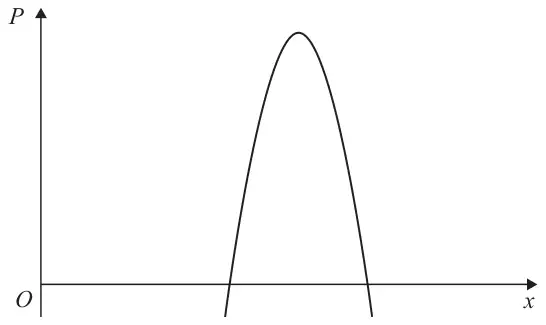
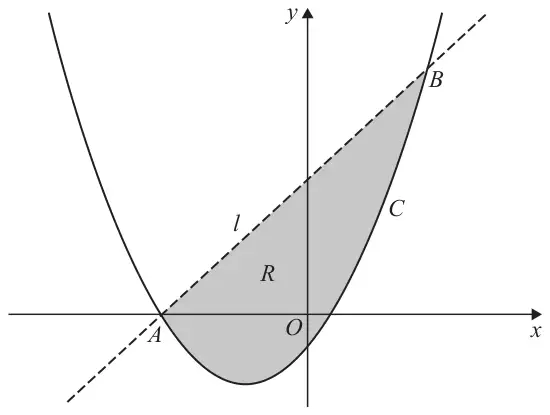
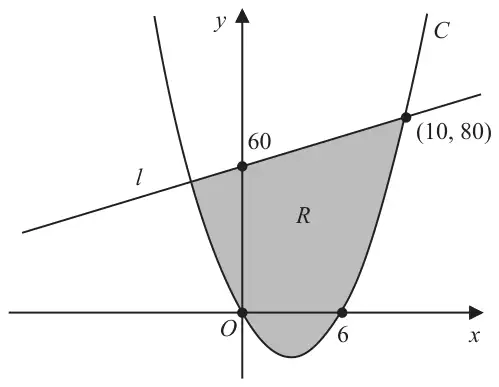
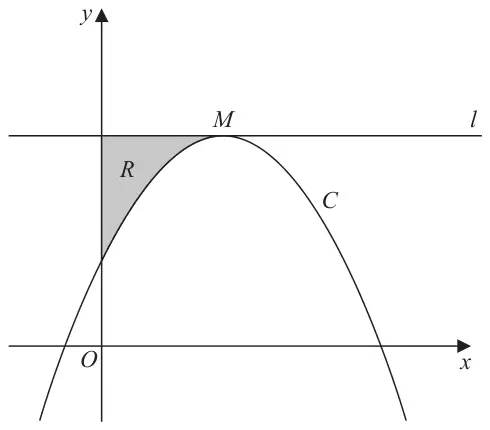
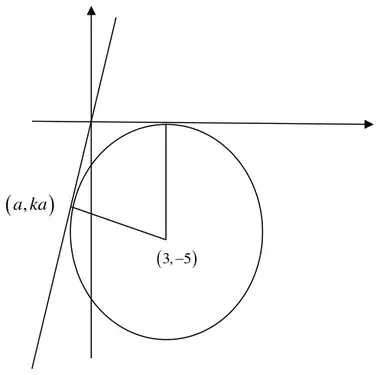
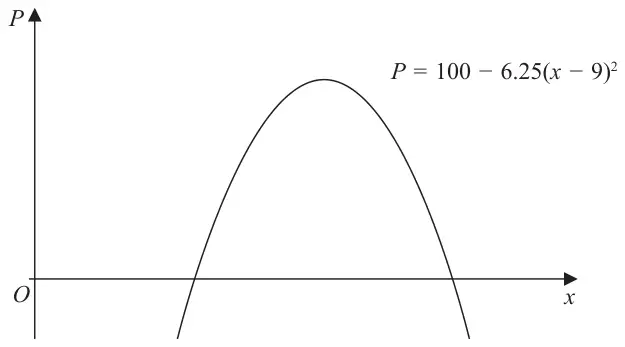
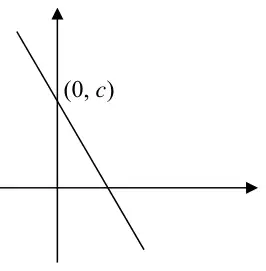
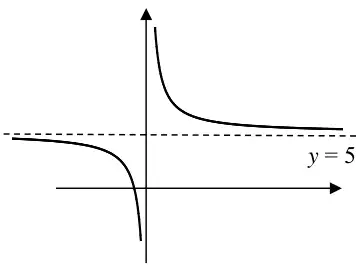
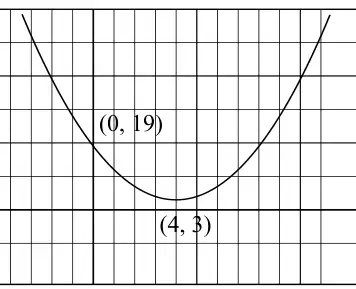
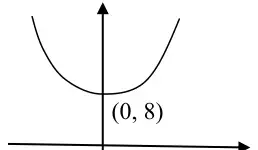
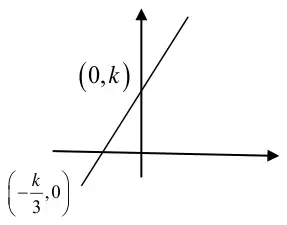
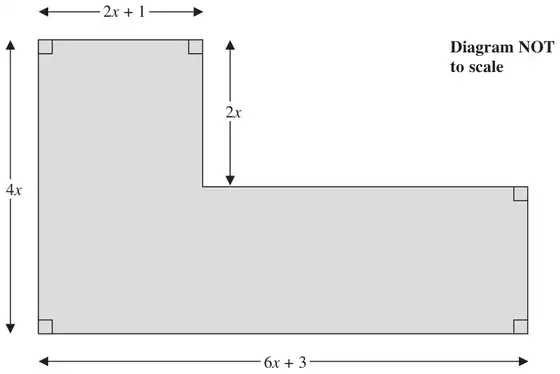
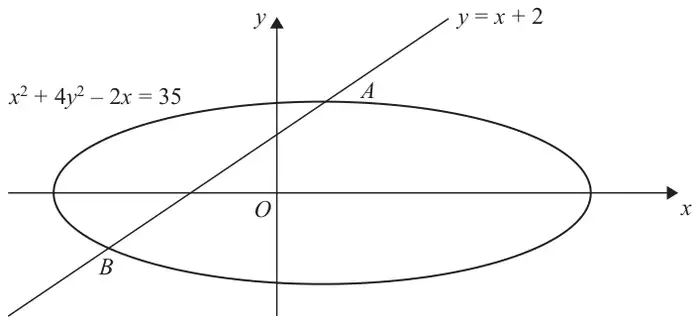
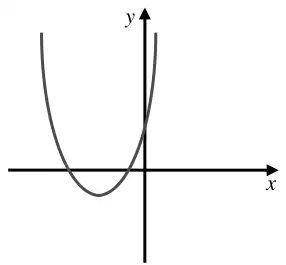
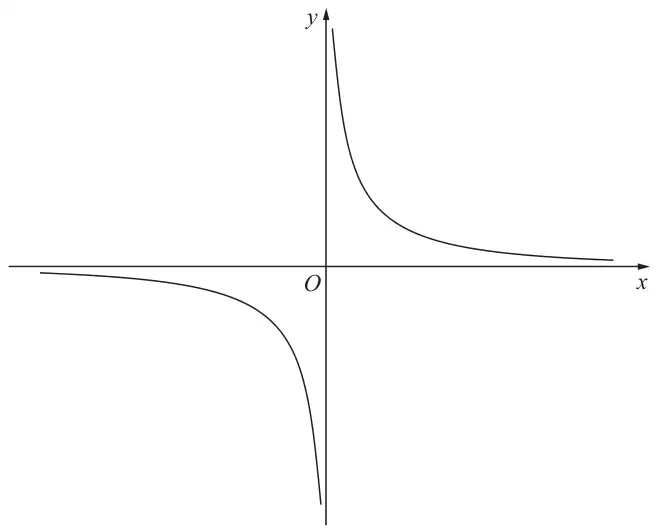
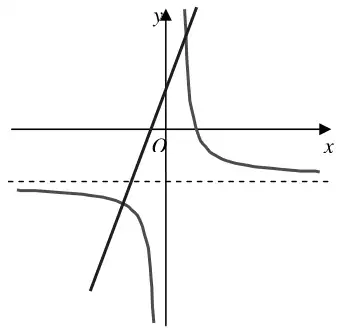
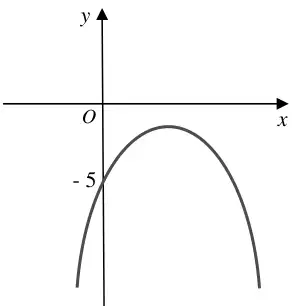
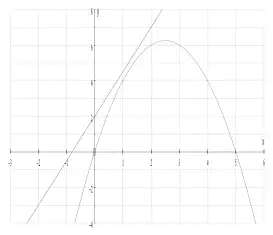
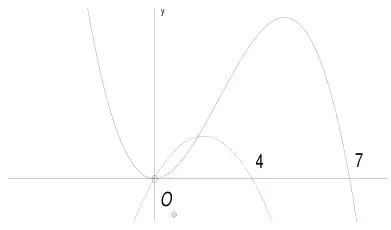
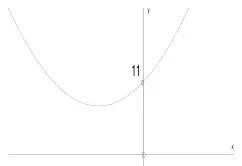
 (seen in (c))